Your ShelfYour Projects

Signs of the Times, Vol. 23, No. 38.

Editorial

Signs of the Times

Sep 30, 1897

Pacific Press Publishing Company · Oakland, California · Sep 30, 1897

Editorial

The Great Sacrifice.—The great Sacrifice of divine love was not an after thought, coming in after man sinned. It was not a new device to meet an exigency. There are no surprises to Him who is infinite in knowledge and wisdom. Jesus Christ was "the Lamb slain from the foundation of the world." Rev. 13:8.

Character a Matter of Choice.—In the very plan of God the possibility (not the necessity) of sin was involved. That creature enjoying the greatest bliss must obtain it by choice; he must be free because he chooses freedom. That which man is compelled to do brings him little joy. The chafing chain of compulsion destroys all the pleasures of what if of choice would be a delightful occupation. The only pleasure sin ever brings, evanescent as it is, comes because men choose it; and the pleasure which comes from choosing good and doing good is as much greater and higher as eternity is more than time. God therefore gave to man free choice, with the possibility of sin. But God set before man the end of the evil way, and the eternal fruitage of good, desiring him to choose the good way and making it possible for every one so to do.
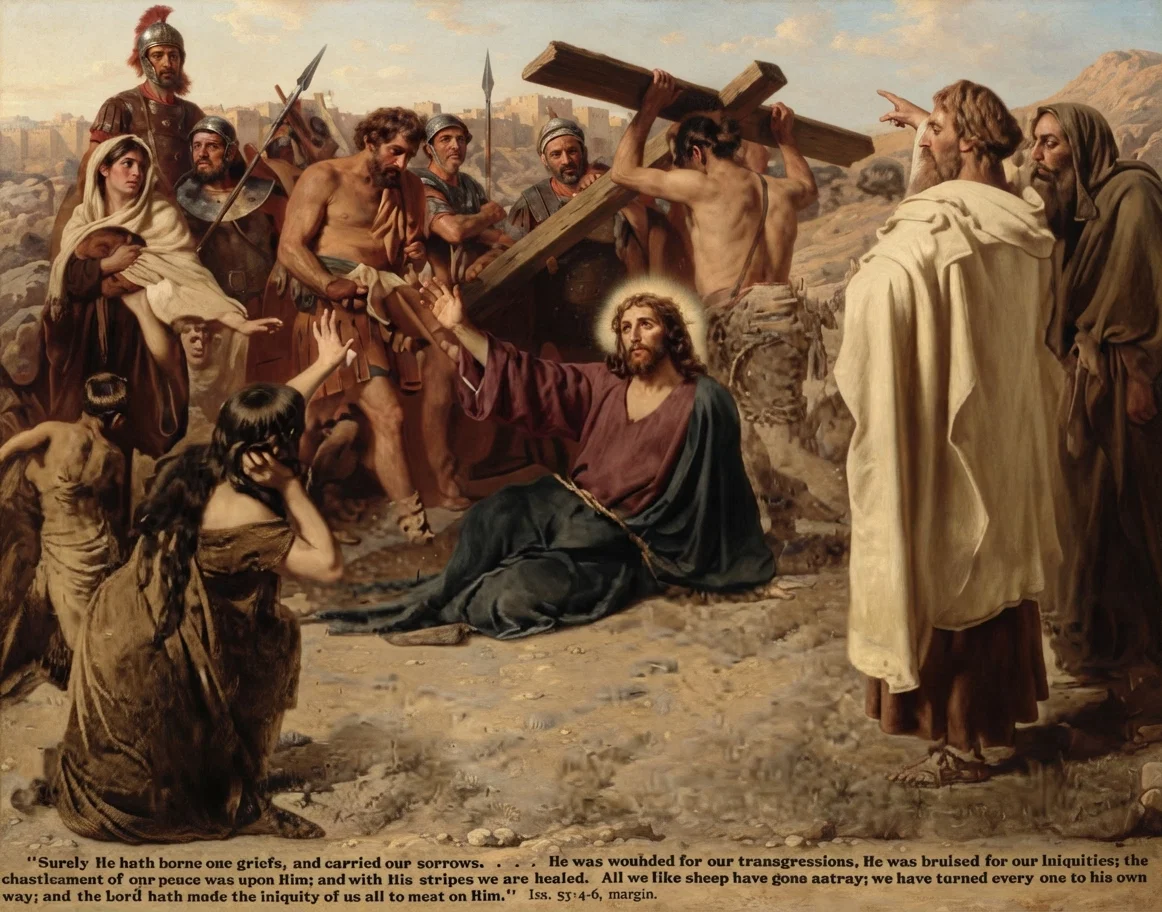
Surely He hath borne our griefs, and carried our sorrows. . . . He was wounded for our transgressions, He was bruised for our iniquities; the chastisement of our peace was upon Him; and with His stripes we are healed. All we like sheep have gone astray; we have turned every one to his own way; and the Lord hath made the iniquity of us all to meet on Him." Isa. 53:4-6, margin.

Man's Choice.—Man's choice was evil. He walked by sight not by faith. God's way was in his Word. He warned man, "In the day that thou eatest thereof thou shalt surely die." Gen. 2:17. Faith is based on God's Word. Rom. 10:17. But man "saw that the tree was good for food, and that it was pleasant to the eyes," he chose the way of sight, and sinned, and died. Gen. 3:6. Choosing by sight was the way of temporary pleasure and selfishness, the very way in which millions barter eternal life and bliss. Choosing by faith in God's Word, it would have forever led man out toward God, like whom he would have continued to grow. Infinite Love gave to man the way of faith, that it might be the way of infinite blessing.

Love's Infinite Gift.—Yet, knowing that man would sin, God provided (not for the sin) but salvation from the sin. He gave his only-begotten Son. Not eighteen centuries ago did he give him, but he "verily was foreordained before the foundation of the world, but was manifest in these last times for you." 1 Peter 1:20. The gift was made—God gave his Son (John 3:16), that Son "gave himself" (Titus 2:14)—in the beginning, the gift of God's infinite love. As that gift involved the very Godhead, the person of him who with the Fathermade the worlds, all the purposes of God are found in him. With respect to that great center of love and power has all the plan of God through all the ages been wrought out. Every sacrifice ordained of God was efficacious only as it expressed faith in God's great sacrifice of his Son. Every kid, every lamb, every offering of first-fruits, every one of the first-born, pointed to the Lamb of God that taketh away the sin of the world. John 1:29.

'Manifest in These Last Times.'—The Sacrifice was eternal; its greatest manifestation was when Jesus Christ was given into the hands of the powers of darkness, condemned without a trial, mocked and scourged, and crowned with thorns, made to bear the instrument of his own suffering till bodily strength failed from sheer exhaustion, and then nailed to the cruel tree. During all this time mindful only of others, admonishing the women of Jerusalem that were weeping for him, gently reproving Peter with a look, placing his mother in the care of a loved disciple, praying for those who tortured him, and comforting the repentant criminal at his side—was there ever sacrifice and love like this? The cross was the climax of the manifestation of his suffering; but he suffers still. He was a present Saviour to Abel, to John who stood beside the cross, to us who live in the nineteenth century. For as truly as to the Gauls of old, so to us, before our eyes, "Jesus Christ hath been evidently set forth, crucified among you." Gal. 3:1. His death is for us to-day. Our sins are to-day laid upon him that we may sin no more.

An Eternal Sacrifice.—His is not a sacrifice of a day, or for three and one-half years, or for thirty-four years; it is an eternal sacrifice. When he left heaven's glory, and took upon himself the form of a servant, and was made in the likeness of men, he became one of us, a "brother in adversity;" and when he ascended, we triumphed with him; but he is one with us still; and forever is he one with us—God, yet man—a brother to all men, for all eternity. And the pain is not over yet. He is touched with the feeling of all our infirmities, suffers with his body, the church, a crucified yet risen Saviour. What love is this? As he has made the eternal sacrifice for you, O soul, will you not yield yourself, your all, to him, "a living sacrifice, holy, acceptable unto God, which is your reasonable service." Rom. 12:1. There is cleansing, there is blessing, there is power and life and salvation in Jesus Christ, even "to the uttermost."

Taste and See.—One of my friends offers me some food which he says is very good and nourishing, and asks me to adopt it as an article of diet. But I am skeptical, and do not believe that it is good, and so I say, "Prove to me that it is good, and I will take it." "That I can not do," he replies; "I know it is good, and can assure you of the fact; but you must prove it for yourself; taste it, and you will know it too." Well, that is certainly reasonable; for I can't expect to know that a thing is good, unless I taste for myself. Even so, when my friend does not believe me when I tell him that the Lord is good, and asks me to prove it to him. I can not; I know that he is good, for I have tried him; I can assure others of his goodness, but I can not prove it to them. I can only say, "O taste and see that the Lord is good." Why will not people be as reasonable in regard to spiritual food as with the mere physical? Taste, and you have the proof.

E. J. W.

PATRIOTISM AND CHRISTIANITY.

HERE is a clipping, similar to many others in these days of "Christian Citizenship" and "applied Christianity," which we take from the Christian Work of July 1:—
The better Christian a man is, the better patriot will he be. Indeed, he is the highest and best type of a patriot, for whom the truth makes free is free indeed. He is free from all narrowness and the bitterness of selfish prejudices. He is broader minded and more liberal and just in his views and his dealings with others, less hard and exacting, and more ready to yield where to do so is right and proper. At the same time, the honor and the welfare of his country is as precious to him as his own personal honor, and he will as rigidly and firmly uphold the one as the other.
A true Christian is a follower, a learner, a disciple of Christ, one who lives the life of Christ, who is actuated by the same spirit of large-hearted unselfishness. Christ died to save not a country or nation but the world; he died to save all men, of whatever race or nation. The Christian is a debtor, and should acknowledge himself as such, "both to the Greeks, and to the Barbarians; both to the wise, and to the unwise." Rom. 1:14. "If any man will come after me," says Jesus, "let him deny himself, and take up his cross, and follow me." Matt. 16:24. "Whosoever he be of you that forsaketh not all that he hath, he can not be my disciple." Luke 14:33. "He that loveth father or mother more than me is not worthy of me and he that loveth son or daughter more than me is not worthy of me. And he that taketh not his cross, and followeth after me, is not worthy of me. He that findeth his life shall lose it; and he that loseth his life for my sake shall find it." Matt. 10:37-39. This is what it is to be a Christian.
A true patriot is "one who loves his country and zealously supports and upholds its institutions and interests."—Standard Dictionary.
Patriotism is "love and devotion to one's country; the spirit that, originating in love of country, prompts to obedience to its laws, to the support and defense of its existence, rights, and institutions, and to the promotion of its welfare."—Id.

A Vital Difference.

It will be seen from the above that there is a vital difference between patriotism and Christianity, and hence between a patriot and a Christian. It will also be conceded that Christ died for all, that he is "no respecter of persons," that "in every nation he that feareth him, and worketh righteousness, is accepted with him." Acts 10:34, 35.
When Jesus walked the earth, the Jewish idea of religion was patriotism, or fealty to that one nation, and in that nation the Pharisees believed themselves to be the only ones worthy of consideration. So when Christ's love reached out to the publicans and the hated Samaritans, and even intimated that God would find in other nations those for whom he could better work, the Jews hated him and were ready to kill him. Luke 4:24-29. The reason was that he did not regard their institutions, their burdensome Sabbath, so unlike God's, except in the matter of the day; he did not regard above others the scribes and Pharisees, who arrogated to themselves the chief seats of wisdom. Loving them as they did not love each other, loving Jerusalem and Judea as they could not love it, loving all the world as they did not love even their own, they sought to kill him because he was not "patriot" enough to observe their man-perverted institutions. John 5:10, 16, 18.

History Repeats Itself.

The religious world, strong in number, weak in spiritual power, have departed from the Word of God. They hold traditional institutions which find no support in the Word of God. Among these is the Sunday-sabbath. They not only count it a test of their religion, but are endeavoring to identify it with the nation. It is called the American Sunday and the American sabbath. It is demanded by thousands of so-called Christian citizens that it shall be made a test of patriotism; that he who "desecrates" Sunday is not a patriot, but a foe to his country. In the words of Archbishop Ireland, "The violator of a Sunday law is the worst of criminals."
Now to many Bible Christians Sunday has no sacredness. It is an interloper, a counterfeit sabbath, a usurper of the Sabbath of the Lord. To observe it as a sacred day is to them dishonoring to God, and a tax upon their time, which is not required of others. Conscientiously they can not yield to such an institution. But while in the eyes of so-called "patriots" they are the greatest foes to their country, in very fact they are the truest friends, because they are the friends of all, laboring for the eternal good and highest happiness of all.
The Christian view is the broader, higher, better, purer view. In whatever country God places him, that is his field of labor. He is there to give to men God's message till the Lord sends him elsewhere. His country lies beyond. His citizenship is in heaven, and he seeks there the better country. In this world, like Abraham, he has forsaken country and kindred and father's house to go to the land he should afterward receive for an inheritance. Gen. 12:1. He received no inheritance in this world, no, not so much as to set his foot on (Acts 7:5), but he died strong in faith, looking for "a better country, that is, an heavenly; wherefore God is not ashamed to be called their God; for he hath prepared for them a city" (see Heb. 11:13-16). Christianity, in object, in purpose, in spirit, in noble, unselfish impulses, labors, and sympathies, as far transcends patriotism as heaven does earth, as the eternal does the temporal.

IMAGINING DIFFICULTIES.

"O, I CAN'T sleep at night, I can't sleep!"
"Poor fellow, you must cease your overwork, and at once make use of soothing remedies!"
"O, that will do no good; the trouble is not with me; I could sleep very well if I had an opportunity, but there is no time in which to sleep; I can never sleep any more!"
"Why not? How can that be?"
"I have just learned that the earth is round, and that it isn't night at all places on the earth at the same time, and that therefore it is impossible for people to sleep."
"Foolish fellow! Who has been telling you that?"
"Nobody; but my pastor, who is a learned man, has told me that it is impossible to keep the seventh-day Sabbath, because it is not the seventh day all over the world at one time; and I have sense enough to see that if we can't rest on the seventh day, then we can't sleep on the seventh night; and if we can't sleep on the seventh night, we can't sleep on any other night. What shall I do?"
"Do! why, go to bed to-night, when the night comes to you, and sleep where you are, instead of thinking you must sleep where you are not. Didn't you sleep well last night?"
"First-rate; never slept better in my life; but then you see I had not heard the parson's theory."
"Well, don't let a theory run away with the fact. The fact is, you can and do sleep every night when it comes to you; when the night is on the other side of the earth, you do not need to sleep. So with the Sabbath—the seventh day—which God made for man—for all men—to keep. Keep it when it comes to you; when it is not present with you, then you are not required to rest on it. Let your soul rest in the assurance that God has never given a commandment that it is not possible for all men everywhere to obey." E. J. W.

A WRONG CONCEPTION.

Is the Nation Christian?

THE Presbyterian Banner, quoted by the Christian Citizen, prints an extract from a recently published speech of David Agnew, a jurist of Pennsylvania, now in his eighty-ninth year. The purpose of the address was to show that the Constitution of the United States was Christian. He thus concludes:—
In conclusion, I have shown (conclusively, I think) that this is a Christian nation—that this continent and the provinces were settled by a Christian people—that the States formed from them continued Christian, and set the legal evidence of their belief in their early constitutions—that other religions are exceptional, and were tolerated for individual conscience’ sake only—that the Constitution of the United States formed by the same people, contemporary with their state constitutions, and with identical provisions for the toleration of individual freedom of conscience, expressly reserved to them all their ungranted rights, among which are their Christian institutions—that the Constitution itself carries internal evidence of its Christian character; that its continued existence rests on the fabric of the States; and that infidels, pagans, cavilers, and Mormons derive from it no support in their warfare against Christianity. I have shown, also, that the safety of this Christian character, peace, order, and prosperity, demand its citizenship to be protected against promiscuous and loose naturalization.
Upon this the Presbyterian Banner remarks:—
This address is both timely and conclusive. There is no escape from the facts which Judge Agnew presents to show that this is a Christian nation.
Now all of this would doubtless be true if Christianity were a mere form or creed or system; but right in this very thing lies the fallacy of the reasoning. The aged judge does not know Christianity. He judges it as he does Mohammedanism, by the Koran; or Presbyterianism, by the Westminster Confession of Faith; or Episcopalianism, by the Thirty-nine Articles. Christianity is the life, the power, of God; and it is nothing but a mockery if it is not this.
Men might pile up constitutions, the sentences of which were taken bodily from the creed of the Presbyterian or Congregational or Seventh-day Adventist Church, but that would not make a constitution Christian, nor the nation which accepted it Christian. Is the nation Christian? Here is the test of Jesus Christ: "Every good tree bringeth forth good fruit; but a corrupt tree bringeth forth evil fruit. . . . Wherefore by their fruits ye shall know them." Matt. 7:17-20. Is the nation Christian? What say the myriad of murders of last year? What say the corrupt congresses and legislatures? What say the oppression of the poor? the building up of great corporations? the ten thousand other evils with which the nation abounds? Is the nation Christian? There are a billion dollars spent for drunkenness and a paltry five millions to convert the heathen. A tree is known by its fruit. Is the nation Christian?—No; Christianity is more than a creed; it is life and power from God given through faith in Jesus Christ, and how can a nation be said to have faith when the greater mass of those who compose it do not know faith, have no living connection with or personal faith in Jesus Christ?

EXERCISE AND DIET.

THERE are many suffering from ill health to-day because they do not pay attention to the laws of health. They do not exercise their reason in caring for the human machinery that God has intrusted to them and thus they present to God a crippled offering. Many persons confine themselves in ill-ventilated rooms, where the air is not charged with its appropriate supply of oxygen. In expiration we are constantly throwing off from the lungs impurities that defile the air, and there is positive necessity of having a constant supply of pure air. Many breathe air that is poisoned, and the blood is not purified in the lungs, and passes into the body without being vitalized by a fresh current of air. The result is that such persons are troubled with giddiness, restlessness, with confused thoughts, and gloomy spirits. The process of digestion is not properly carried forward, the brain is clouded, and the heart depressed. Such persons are suffering for want of exercise in the pure air. If they would have their organs perform their work properly, and be saved from the inroads of disease, they must change their course of action.
Schoolrooms are often death traps, as also are ill-ventilated bedchambers. If buildings are constructed in such a way that they can not have a constant supply of fresh air, the health of their inmates will surely be impaired.
Ministers are often forced to pay a severe penalty for speaking in close, ill-ventilated buildings. The preacher marvels that he has not power to impress the people, when they, as well as himself, are suffering from lack of vitalizing air, and are thus rendered incapable of appreciating the subject upon which he is speaking. The want of the circulation of pure air in a church makes many a meeting of no effect; for labor is expended for naught, because the people can not keep awake.
There are many who imagine that they are health reformers, and that they are practising right habits in matters of diet. Many have wretched feelings, which they attribute to an insufficient amount of food, when these wretched feelings are due to a different cause altogether. Sometimes it is because the food is not of the right quality, or has not been properly prepared. Others who have indulged their appetite from childhood, think that it is essential for them to have food that tastes good, no matter how unhealthful may be its character. Thus they cultivate a perverted taste, and as a result have a diseased stomach. They abuse and overtax their digestive organs by eating that which they like rather than that which is good for them. On the other hand, many who think themselves patterns of strict propriety in matters of diet are in reality not intelligent health reformers, and their example is not worthy of imitation. They have educated their tastes in the wrong direction, and will have to learn anew what constitutes health reform. Some who have professed to be health reformers have said that they were furnished with rich food from their youth, and that their tastes were cultivated to enjoy this kind of a diet. But such should understand that they should take a different course, and educate themselves to enjoy simple, nutritious food. They should study to prepare inexpensive dishes for the table. Those who profess to be health reformers should not mislead others by their own habits of eating. Neither by precept nor example should they give a false example in these matters. If we do not begin to practise economy now, we shall be compelled to practise economy in the near future. Time is money; it belongs to God. To use precious time in preparing a variety of dishes that will only result in dyspepsia, is certainly putting time to a wrong use. The cook should not be made a slave, or be required to cater to appetite. Let the diet be of such a character that she may prepare it, and yet have time for the reading of her Bible, for prayer, and for relaxation from labor. We should not cherish self-indulgence, or teach others by our example to follow in a selfish course. We should understand what we are about, and consider what kind of impressions we are making upon the minds of those who look to us for guidance.
As applied to diet, true hygiene demands the intelligent selection of the most healthful articles of food, prepared in the simplest and most healthful manner. It is customary to provide a variety of vegetables and other articles of diet for the first course at dinner. Then fashion requires that dessert shall come on the table in puddings, custards, or other kinds of sweets. To introduce such combinations into the stomach after partaking of vegetables and fruit is anything but wise. A large share of the endless mixtures called health reform dishes is in reality anything but healthful. Grains and fruits, or vegetables with bread and accompaniments, are all that the system needs. It would be better not to tax the stomach with unhealthful desserts, and not to demand that the cook expend time and strength and ingenuity in preparing them. It would be much better to discard the sweet puddings, jams, and marmalade, which cause fermentation in the stomach. When these are banished from our tables, when we have sweeter stomachs, we shall have sweeter tempers, and be better enabled to live a Christian life.
There is real common sense in health reform. We can not all eat the same things. Some articles of food that are wholesome and palatable to one person may be hurtful and unpalatable to another. Some can not use milk, while others can subsist upon it. Some can use dried beans and peas, while others find them indigestible. Some, whose stomachs are sensitive, can not use the coarser kinds of graham flour. It is impossible to make an unvarying rule by which to regulate every one's dietetic habits. Do not indulge the idea that we are health reformers only as we use mush for breakfast. There are some who can not eat mush and have a healthy stomach.
But while we would recommend simplicity in diet, let it be understood that we do not recommend a meager diet. Let there be a plentiful supply of fruits and vegetables that are in a good condition. Overripe fruit or wilted vegetables ought not to be used. Vegetables and fruit should not be eaten at the same meal. At one meal use bread and fruit, at the next bread and vegetables. Thus we may have all the variety that we need to desire, and if we must have puddings and custards, let bread and these articles form the meal.
In order to preserve health, we must practise temperance in all things,—temperance in labor, temperance in study, temperance in eating and drinking. Our heavenly Father sent light on health reform to guard against the evil that results from a debased appetite. He would have us know how to use with discretion the good things he has provided for us. By exercising temperance in our daily life, by loving purity and holiness, we may become sanctified through the truth.
Intemperance in eating and drinking, intemperance in labor, intemperance in almost everything, exists on every hand. Those who make great exertions to accomplish just so much work in a given time, and continue to labor when their judgment tells them that they ought to rest, are never gainers. They are living on borrowed capital. They are expending vital force which they will need at a future time. When the energy they have so recklessly used, is demanded, they fail for want of it. Physical strength is gone, and mental power unavailable. They realize that they have met with loss. Their time of need has come, and their physical resources are exhausted. Those who violate the laws of health will sometime have to pay the penalty. God has provided us with constitutional force, and if we recklessly exhaust this force by continual overtaxation, our usefulness will be lessened, and our lives end prematurely.
MRS. E. G. WHITE.

Is It Spurious?

A RELIGIOUS publishing house and tract society continue to circulate the following:—
In Rev. 20: 5 the words, "But the rest of the dead lived not again until the thousand years were finished," are spurious. They are not found in the oldest and most reliable Greek MSS., the Sinaitic, Vatican Nos. 1209 and 1160, nor in the Syriac MS. We must remember that a few passages found in the modern copies are additions which do not properly belong to the Bible. Since [it is] commanded not to add to the Word of God, it is our duty to repudiate such additions as soon as their spurious character is established. The words indicated probably crept into the text by accident, in the fifth century; for no MS. of earlier date (either Greek or Syriac) contains this clause. It was probably at first merely a marginal comment made by a reader, expressive of his thought upon the text, and copied into the body of the text by some subsequent transcriber who failed to distinguish between the text and the comment.
What are the facts?—Simply these: (1) The Revelation itself is not found in Vatican MS. 1209; of course Rev. 20: 5 would not be there. (2) In Vatican MS. No. 1160, the words in question were probably omitted by copyist; for (3) they are found in A Codex Alexandrinus, of the fifth century; (4) in B Codex Vaticanus, of the seventh century; (5) in C Codex Ephrami Rescriptus, No 9, probably of the fifth century. (6) The words are printed by Dr. Robert Young in his "Bible Translation" with no marks of doubt; (7) the same with Hind's Interlinear Translation, the text of which is the combined results of Greek scholarship; (8) Rotherham's Emphatic Translation, based on Tregelles' Greek text, does not even question the words. (9) Alford, a noted Greek scholar and translator, raises not even a question concerning them; and (10) the Revised Version, and we know not how many other authorities, are likewise in harmony. The genuineness of the text is not questioned by good authority. The above note is published for a purpose foreign from truth, not perhaps by the human agent, but by Satan.

Christ and Self

"THERE is something in Christ for self, and nothing for selfishness."

THE COMFORTER.

WHEN guilt and wo and sin Press on the heart within, When bowed in bitter grief, Despairing of relief, What voice speaks low within, "Jesus can cleanse from sin"? What voice but thine, O dove, Comforter from above?
When failure marks the strife, And ruin seems the life, When every flower is marred, And every promise scarred, When disappointments break Into the dreams we make, The voice speaks as before, "Jesus can all restore."
When cares press hard and long, And toil subdues our song, When heavy burdens weigh The gladness from the day, When weary, worn, afraid To ask for heavenly aid, Then comes the Spirit's call, "Let Jesus bear it all."
When in the gloomy vale Death plucks our treasures frail, And lays low in the dust Earth's dearest joy, we thrust Our hands into the clay, And cry to Heaven, and say, "Is there a path from this Desolate loneliness?" The voice consoles the gloom, "Jesus hath burst the tomb."
O Comforter, through the night And in the morning light Thou showest us things divine, Makest Christ's glory shine, Speaking of heaven's day, Of beauty now and aye, Linking our souls above, Bide with us, heavenly Dove. HOPE ONSLOW.

FOGGY MORNINGS.

Fog in one's spiritual life need be no more lasting than that in nature. "It will burn off before long." How often weather-wise people say this, when the gray mists of the seashore depress the hearts that were longing for a bright day. And so it proves. A glow of silver in the sky near the sun; a thinning out here and there of the vapory shroud; glimpses of blue, clean outlining and swift sailing away of the clouds,—and the fine, clear day is here long before noon.
We might oftener save ourselves from heavy hearts and gloomy faces when early morning shows gray in our lives or other lives about us. Mists are left over from a storm yesterday. The day closed on a misunderstanding. The morning is foggy and depressing. Why talk about it? Let the weather alone. Fog is shallow. "It will burn off before long." There is a good, warm sun of love at work, and the blue sky will soon be over us.—S. S. Times.

THE SABBATH "SAYING OF JESUS."

INTEREST increases in the "Sayings of Jesus," lately found in Egypt, and not least in the second Logion, which makes the bold declaration, "Except ye keep ["Sabbatize"] the Sabbath ye shall not see the Father." Prof. Adolph Harnack has written concerning it, and naturally his words are eagerly sought. Speaking of what he says, The Independent, September 2, writes:—
With regard to the general treatment of the subject, Harnack agrees closely with the Oxford editors, whose judgment he confirms in a number of points. In particular he shows conclusively that the Fast and Sabbath of the second Logion are the true Fast and the new Sabbath of the early Christian preaching.
With this view we heartily accord. The New Sabbath which Christ kept, and about which he taught so much by precept and example, was what men are now pleased to call the "Jewish Sabbath," clarified from national and formalistic errors, until, as God's representative in time, it was literally the means of bringing men to "see the Father." The corresponding thought is in the "Beatitude," "The pure in heart shall see God." It was not an abrogated nor a changed Sabbath, but a fulfilled and uplifted Sabbath, which thus became as a mirror in which men saw God. The "New Sabbath" which the Independent seems tohave in mind, i. e., Sunday, found its place in the church from the last half of the second century forward. It was the creation of paganizing influences, and the primal germ of the non-spiritual and non-religious "Continental Sunday." The New Christian Sabbath of Christ and the New Testament period is the Sabbath for which we plead.
—Sabbath Recorder.

FAITH AS A SEED.

WHEN certain of Jesus' disciples had failed to cure a child that was a lunatic, they came to him and asked him:—
"Why could not we cast him out? And Jesus said unto them, Because of your unbelief; for verily I say unto you, If ye have faith as a grain of mustard seed, ye shall say unto this mountain, Remove hence to yonder place; and it shall remove." Matt. 17 : 19, 20.
Few persons in reading this language ever think of the deep meaning that lies in the ten words, "If ye have faith as a grain of mustard seed." They read it and pass it by with the single thought, Well, if one can not have as little faith as that, measuring their faith by so small a seed, how can we ever hope to have enough to meet the Saviour when he comes, and we no longer wonder at his question, "Shall he find faith on the earth?" Luke 18 : 8.
Paul says in Heb. 11 : 1 that faith is the "evidence of things not seen." And so it was this unseen faith that Jesus alluded to in the seed, hid within the seed itself, a power from his hand that made it grow into a tree in which the fowls of the air could lodge, a power effectually working within it, as the Word of God effectually works within those that believe. 1 Thess. 2 : 13.
And as the Christian does not believe the Word as coming from man, but goes far beyond and sees the truth as the Word of God, so, under the same power, the little seed finds its way through the dark ground into the light of day, even as a Christian's faith carries him through the dark paths of life, and leads him into the marvelous light of God's liberty and love.
MARSHALL M. SMITH
Continue reading: THE LAMB OF GOD