Your ShelfYour Projects

Signs of the Times, Vol. 34, No. 29.

TAUGHT IN MANY SERMONS TO-DAY

Signs of the Times

Jul 15, 1908

Pacific Press Publishing Company · Mountain View, California · Jul 15, 1908

TAUGHT IN MANY SERMONS TO-DAY.

*"ALL RELIGIONS ARE GOOD."
*"IT MAKES NO DIFFERENCE WHAT CHURCH YOU BELONG TO, OR WHAT YOU BELIEVE AS LONG AS YOU LIVE UP TO ITS TEACHINGS."
*"THE THEATRE IS AN UPLIFTING INSTITUTION. (EXCEPT ON SUNDAYS)"
*"THEATRE GOING, CARD PLAYING NOVEL READING, DANCING ETC. ARE NOT INCONSISTENT WITH THE CHRISTIAN LIFE."
*"DARWIN, SPENCER AND HUXLEY WERE PROPHETS NO LESS THAN MOSES."
*"IF THE BIBLE DISAGREES WITH "SCIENCE" DISCARD THE BIBLE."
"Ye have wearied the Lord with your words. Yet ye say, Wherein have we wearied Him? When ye say, Every one that doeth evil is good in the sight of the Lord, and He delighteth in them; or, Where is the God of Judgment?" Mal. 2:17. See Page 8, "Which Shall It Be?"

With Our Inquirers

"If ye will inquire, inquire ye."
This Inquirers' Department is conducted for the purpose of helping those who are studying the Bible. The answers are oftentimes only suggestive. They are never to be considered infallible, only as they agree with the infallible word. The writer who may answer them does not consider that his opinion is infallible. He will simply give the best that he has, and plead with the inquirer to search the word. Such questions only will be answered which, to the editors, seem to minister to the good of the readers and to the mission of the paper. We can not answer repeatedly in the same volume questions upon the same scripture. The name and address must accompany question, not for publication, but as an evidence of good faith, and that answer may be made by letter if deemed advisable. No letters are answered which do not contain the name of the writer. It is well always to enclose stamp for reply.

2557.—Christ Died for Us.

How, by dying on the cross, did Jesus save the people from their sins?
It is impossible to tell the how of the great mystery of the Gospel of God. The Lord gives us poor humans the facts of the matter, and faith makes those facts genuine experiences. If our correspondent will read Isaiah 53; 2 Cor. 5:21; John 3:16; Rom. 5:1-10; 1 Cor. 15:1-3, she will learn the great facts of the matter, that God in His great love for His suffering children, gave His Son to die for them. According to Titus 2:15 that Son "gave Himself," became sin for us, and suffered in our stead, the innocent becoming guilty in our behalf that we who are guilty might be made innocent thru Him. He who by faith renounces sin and accepts Jesus Christ receives the benefit of the offering which has been made for him.

2558.—Greater than John.

What is meant by the expression, "He that is least in the kingdom of heaven is greater than he," referring to John the Baptist in Matt. 11:11? Do we understand by this that there are degrees of reward in heaven?
Not at all. John came as the messenger of the King. Jesus Christ came to inaugurate the principles of the kingdom of God in the hearts of His people. And when He came He proclaimed, "The kingdom of heaven is at hand." John was to die before that kingdom was fully inaugurated. He was to see very little of the fruits of Christ's labor or work; was to know very little of the teaching which fell from the lips of Him who "spake as never man spake." And the expression, if we understand it aright, means that those who accepted of Christ and came into full fellowship with Him, had far greater privileges and opportunities than did John the Baptist; greater simply in point of privilege and blessing. This question has no bearing at all on degrees in the kingdom of heaven, or degrees of reward; but there evidently are degrees of reward, for we are told again and again in Scripture that one will be rewarded according to the deeds done in His body. We are also told that there will be differences in the resurrection of the dead. "There is one glory of the sun, and another glory of the moon, and another glory of the stars; for one star differeth from another star in glory, so also is the resurrection of the dead." But when one has greater glory or greater reward than another, there will be a perfect fitness in it all, and all will recognize the perfect fitness.

2559.—Change of the Sabbath.

Does not Heb. 4:8 prove that Christ did not change the day?
There is nothing in Hebrews 4 which relates in any way to the change of the Sabbath. What the Lord is there talking about is the opportunities which He has offered to His people. He wants to give them rest. When He created the world, He rested on the seventh day. That was a pledge of eternal rest to all His people, if they would but believe Him and do His will. God entered there into His rest, that is, He was delighted with His work. If we will only yield ourselves to God and let Him work His works in us, we shall also enter His rest, even as we have His works wrought in us. When Israel came up out of Egypt, God wanted to give them that rest of which the Sabbath was a pledge, but thru their unbelief they did not enter it. So we read in the eighth verse, "For if Jesus had given them rest, then would He not afterward have spoken of another day." The word "Jesus" ought to be "Joshua" as in the Revised Version. The word "Joshua" in the Hebrew means the same as "Jesus" in the Greek. Joshua did not give them rest, altho he took them into the land of Canaan. Many were still in unbelief, and they went into sin soon after entering the land. Therefore, the rest of God's people lay beyond that, and that other "day" to which the Lord has called them, beyond the time of Joshua, is "To-day." "To-day if ye will hear His voice, harden not your hearts." "Behold, now is the acceptable time; behold, now is the day of salvation;" and any one who will come to God thru Christ, giving up his own works and accepting of the Lord's works, giving up his own way of salvation and choosing God's way, will in God's way enter into the Lord's rest spiritually. That spiritual rest is a type of the eternal rest of which the Sabbath day still stands for a pledge, as in the beginning.

2560.—Bible Weights and Measures.

I would like to ask thru the SIGNS OF THE TIMES what was the weight of a shekel in the Hebrew standard.
The weight of a shekel, as near as can be calculated, was three fifths of an ounce avoirdupois. This was still further divided into twenty gerahs, each about one thirtieth of an ounce; ten of which made one-half shekel, or bekah. According to this calculation, Absalom's hair of two hundred shekels weight, weighed one hundred and twenty ounces, or about seven and one-half pounds. Other weights given in shekels can be easily reckoned from the above. Take three fifths of the number of shekels named, and you have the avoirdupois ounces; divide the number of ounces by sixteen, and you have the pounds. Sixty shekels made a maneh, and sixty manehs made a talent. The cubit is variously reckoned. Some give it at about twenty-one and eight-tenth inches, others, at eighteen inches. We can easily determine the length or height of objects where the term is given in cubits. The American Revised Bible Dictionary gives for the ordinary cubit 24 and 24-100 inches, or about 24 1/4 inches. The cubit was derived from the human arm, the length from the elbow to the fingers extended. The finger measure, the width, was used, about seven tenths of an inch. This was the smaller measure; the palm, or hand-breadth, was four inches; the span was the space between the extended extremities of the thumb and the little finger, about seven and one-half inches. The height of Goliath and other dimensions given in the Scriptures can be easily reckoned from this.

2561.—Eating Meat.

It would seem by the reading of 1 Cor. 10:27, 28, and Luke 10:8 that we should eat meat and everything that is set before us when we have to eat away from home. Please explain these texts.
The first scripture named does not have to do with the particular food. The question is, as to whether the food has been offered to idols or not. It was a general thing for the heathen to dedicate every animal they slaughtered; and a part of the foodstuffs were sold in the market, or shambles. Some who had been converted from heathenism could not eat these; their conscience condemned them. The memory of the old idolatry came up and they could not think of doing anything that would seem to them to be paying devotion to the gods. Others who had not been worshipers of idols had no conscience over this thing at all. The instruction of the apostle is, "Whatsoever is sold in the shambles," that is, presumably of food that is proper to eat, "eat, asking no questions for conscience' sake;" but if there is a weak brother at the feast and he says, "That has been offered to idols," for his sake do not eat it. The Lord permitted His people to eat flesh. The only prohibitions that He made are found in Leviticus 11 and in Deuteronomy 14. Thru all Biblical times, from the Deluge to the close of the Scripture canon, the Lord's people ate flesh in harmony with the prohibitions laid down in the scriptures above named, with the exception of a part of the time in the wilderness when manna was their food. At least we have no scripture record to the contrary. The disciples who went out to preach the Gospel of the kingdom were among Jews; those who were eating the food permitted of God, and whatsoever was set before them, that they were to eat, asking no question. The matter of a vegetarian diet is not a matter of Scripture command; let that be understood once and forever. Yet God taught us that there is a better food than a flesh diet. He has shown this in the primitive diet which He gave to man, containing no flesh; and in the manna which He gave to the children of Israel in the wilderness. Science tells us, and common, clear observation also, that the animal kingdom is becoming more and more diseased; that flesh foods are more expensive; that flesh-eaters are more liable to certain diseases than are vegetarians; and these reasons ought to be sufficient for the adoption, as a general rule, of a vegetarian dietary. The rule which should govern Christians is set forth in 1 Cor. 10:31: "Whether therefore ye eat, or drink, or whatsoever ye do, do all to the glory of God." The reason why the writer is a vegetarian is that he has found that the better, the cleaner, the purer, diet. Why not choose the best? At the same time do not condemn others who may think differently, but try to teach them the better way.

2562.—Everything That Liveth Shall Be Meat for You. Gen. 9:2, 3.

Does not God say that "every moving thing that liveth shall be food for you; as the green herb have I given you all"? I can not make this harmonize with Leviticus 11.
The passage in Genesis was given at a time when there was no vegetable food on the face of the earth. The Flood had destroyed everything; there were no unclean animals to eat because they entered the ark by pairs simply. There were clean animals enough in the ark so that when Noah and his family came out there would be not only enough for sacrifice, but some for food as well. The unclean animals went into the ark two by two, a pair of each only; the clean animals, seven pairs of each. The same distinction existed then as existed in the days of Moses when Leviticus was written. It is not an arbitrary law which makes one kind clean and the other unclean. This is true in the very nature of the animals themselves. If God's people were so situated that they could get absolutely nothing but unclean animals they would better eat them than starve. That has ever been true; and is just as true to-day. There are certain things that men use for food that are utterly unfit for food. Among these may be the animals designated as unclean in Leviticus and Deuteronomy. Clean animals are permitted among the kinds of food which God gave to His people; some are much better than others. He has permitted a flesh diet; but He has shown us in different ways that there was a better than this.

2563.—Voting for President.

Which of the nine candidates for President of the United States should one vote for, if any? and if not for any, why?
Just now there are not so many candidates as that before the people of the United States. There may be more by the time we come to the next election, but this journal is not a political paper, nor is it advising any one as to his duty in politics. To look at it from the high spiritual standpoint, in the words of the apostle, "Our citizenship is in heaven," from whence we look for the Saviour, the Lord Jesus Christ. See Phil. 3:20, 21. Revised Version.

Christ's Example in Prayer.

PRAYER is communion with God. It is the opening of the heart to God as to a friend. Not that it is necessary in order to make known to God what we are, but in order to enable us to receive Him. Prayer does not bring God down to us, but brings us up to Him.
Jesus Himself, while He dwelt among men, was often in prayer. Prayer went before and sanctified every act of His ministry. It was by prayer that He was braced for duty and for trial. He is a brother in our infirmities, and was "in all points tempted like as we are;" but as the Sinless One, His nature recoiled from evil; He endured struggles and torture of soul in a world of sin. His humanity made prayer a necessity and a privilege.
To the believing Jews in Jerusalem in the time of Christ, Olivet was a frequent resort for devotion. The hills and valleys about Jerusalem, now so bleak and bare, were then studded with olive-groves and orchards, and here the faithful in Israel would often go to search the Scriptures and to pray. The Garden of Gethsemane was among the places thus frequented. It was to this place, when the city of Jerusalem was hushed in the silence of midnight, that Jesus often repaired for communion with His Father. When those to whom He had ministered all the day went every man to his house, Jesus, we read, "went unto the Mount of Olives." He would sometimes take His disciples with Him to this place of retirement, that they might join their prayers with His.
In prayer Christ had power with God, and prevailed. Morning by morning, and evening by evening, He received grace that He might impart to others. Then, His soul replenished with grace and fervor, He would set forth to minister to the souls of men.
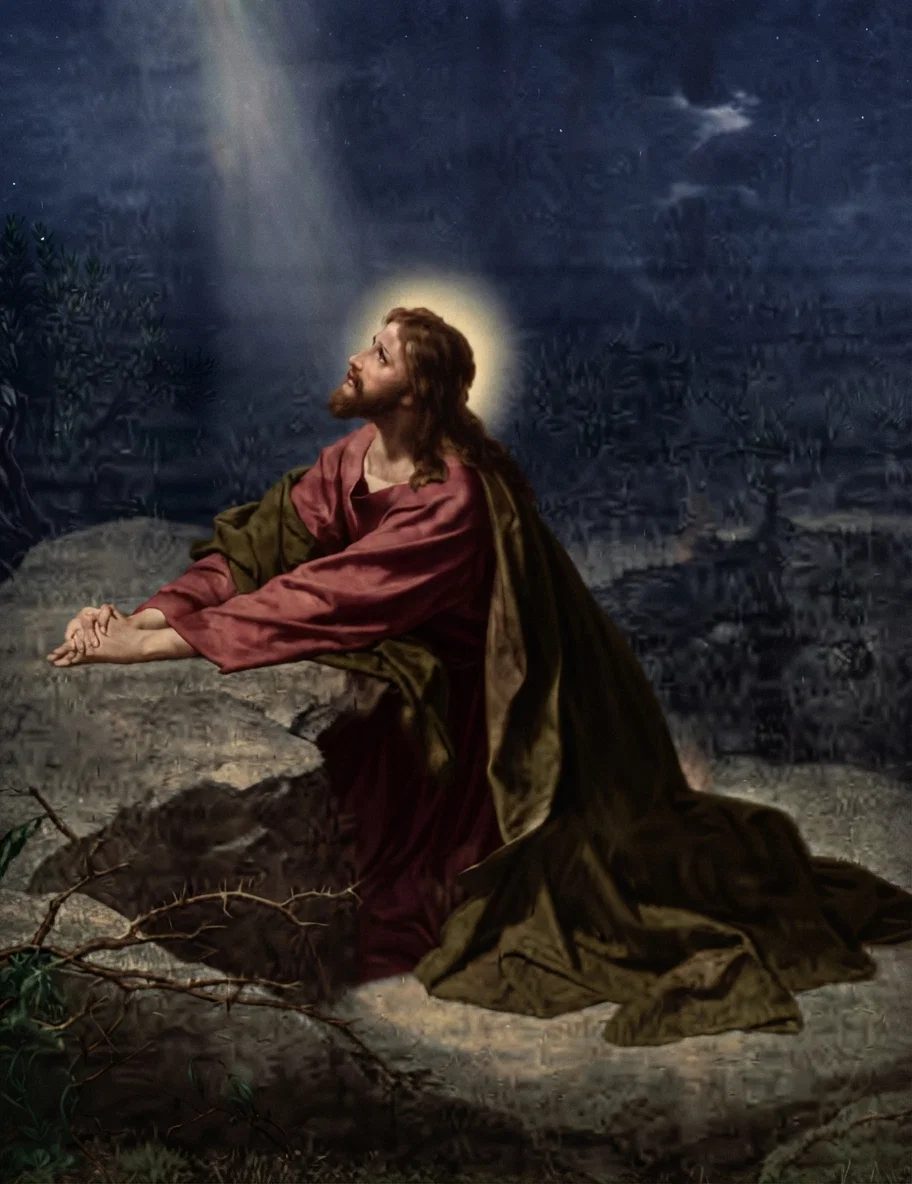
JESUS IN GETHSEMANE. Hofmann.
We should not think that Christ's need of prayer in His human life lessens His dignity as our Redeemer. He came to be our Example in all things. He identified Himself with our weakness that we might identify ourselves with His strength. He was tempted in all points like as we are, yet He did not yield in a single instance to the sins that were proving the ruin of the sons of men. Thru prayer and communion with God, we, like Him, are to come forth refreshed and strengthened for the battles of life.

JESUS IN GETHSEMANE.

"And being in an agony He prayed more earnestly."
In the Saviour's last recorded prayer for His disciples, we are given an inspiring view of the divine and human that combined in the nature of Christ. Behold the kneeling form in the shadow of Olivet! As a humble suppliant the Saviour pleads for strength for Himself and for His disciples in the coming struggle. With strong crying and tears He pleads in behalf of those whom He has called out from the world to give the message of salvation to men. "I have given them Thy word; and the world hath hated them," He pleads. "I pray not that Thou shouldst take them out of the world, but that Thou shouldst keep them from the evil. They are not of the world, even as I am not of the world. Sanctify them thru Thy truth; Thy word is truth." "Neither pray I for these alone, but for them also which shall believe on Me thru their word."
"O righteous Father, the world hath not known Thee; but I have known Thee, and these have known that Thou hast sent Me. And I have declared unto them Thy name, and will declare it; that the love wherewith Thou hast loved Me may be in them, and I in them."
The Son of God, now at the Father's right hand, still pleads as man's intercessor. He still retains His human nature, is still the Saviour of mankind. We need to appreciate more than we do the precious privilege we have of presenting our petitions to Him as He presented His prayers to the Father. "I say unto you, Ask, and it shall be given you; seek, and ye shall find; knock, and it shall be opened unto you. . . . If a sonshall ask bread of any of you that is a father, will he give him a stone? Or if he ask a fish, will he for a fish give him a serpent? Or if he shall ask an egg, will he offer him a scorpion? If ye then, being evil, know how to give good gifts unto your children; how much more shall your heavenly Father give the Holy Spirit to them that ask Him?"
It is only at the altar of God that we kindle the taper with holy fire. It is only the divine light that will reveal the littleness, the incompetence, of human ability, and give clear, distinct views of the perfection and purity of Jesus Christ. It is only as we behold Jesus that we desire to become like Him. Only as we view His righteousness do we hunger and thirst to possess it. Only as we ask in earnest prayer and with the humility and simplicity of a little child, can God grant us our heart's desire. Such prayer is heard and answered. The Lord is more willing to give His Holy Spirit to those who earnestly desire it than earthly parents are to give good gifts to their children. Christ has promised the Holy Spirit to guide us into all truth and righteousness and holiness. The Spirit of God is not given by measure to those who earnestly seek for it, who by faith stand upon the promises of God. They plead the pledged word of God, saying, 'Thou hast said it. I will take Thee at Thy word.'
The Comforter is given that He may take of the things of Christ and show them unto us, that He may present in their rich assurance the words that fell from His lips, and convey them with living power to the soul who is obedient, who is emptied of self. It is then that the soul receives the image and superscription of the Divine. Then Christ is formed within, the hope of glory.

Christ the Rest-Giver

By Charles Lindsay Taylor
"The Sabbath was made for man and not man for the Sabbath; therefore the Son of Man is Lord also of the Sabbath." Mark 2:27, 28.
THE word "Sabbath" signifies rest. The Sabbath day is simply the rest day. The command, "Remember the Sabbath day to keep it holy," is the command to remember the rest day.
It requires no interpretation, therefore, and really no explanation, to make it plain that the Lord Jesus in declaring Himself "Lord also of the Sabbath" was simply expressing this great truth, that He is the Lord of the rest day.
Now right here the reader should not forget that ofttimes remarkable word "therefore." Jesus says, "Therefore the Son of Man is Lord also of the Sabbath." By the use of that word He points the mind back to a reason why He is Lord of the Sabbath.
The only reason given is, "The Sabbath was made for man." The making of the Sabbath for man is therefore the reason why Jesus is its Lord.
The Sabbath day, the rest day, was made and given to man at the very foundation of the world. Thus we read, "The heavens and the earth were finished, and all the host of them. And on the seventh day God ended His work which He had made; and He rested on the seventh day from all His work which He had made. And God blessed the seventh day and sanctified it: because that in it He had rested from all His work which God had made." Gen. 2:1-3.
Without question this account is Jehovah's record of the making of the Sabbath—the Sabbath that was made for man; and undoubtedly it was to this very record that Jesus referred when He said, "The Sabbath was made for man," and declared, "Therefore the Son of Man is Lord also of the Sabbath."
Remembering once more that Jesus Christ was the Creator (John 1:1-3, 14; Col. 1:16); that it was Christ who "rested on the seventh day;" that it was Christ who "blessed the seventh day and sanctified it, because that in it He had rested from all His work;"—remembering this we can at once understand why He called Himself "Lord also of the Sabbath." Christ Jesus was the Author of the Sabbath and therefore is Lord of the Sabbath.
Very few, indeed, are the people who enter into the real truth of the Sabbath of Christ, the Sabbath of the seventh day. To most professed Christians the making of the Sabbath was nothing more than the arbitrary setting apart, by decree, of a twenty-four-hour day, a thought which, at the best, contains no help and comfort for sin-weary souls. And yet Jesus said, "The Sabbath was made for man,"—for his salvation and strength.
Jesus Christ "blessed the seventh day." Are these words meaningless? Are they empty rhetoric? or, do they bring home to us the very fulness of Gospel truth? What is the "blessing" of God?
The blessed word says, "The blessing of the Lord, it maketh rich." Prov. 10:22. Christ, the Angel of Jehovah, bestowed upon the patriarch Jacob "the blessing of the Lord." Jacob in his life had been far from God. But when, in the agony of his soul, and because he realized that he must be a different man, even a man of God, he said, "I will not let Thee go, except Thou bless me," the blessing came. And what did it mean to Jacob?—It brought him another nature and another name. He had been Jacob, "the supplanter;" now he was Israel, the overcomer. See Gen. 32:24-29. The blessing of God was God's presence in his soul. It was, in fact, Christ in him the hope of glory. He who had been unholy was now holy; he who had been unsanctified was now sanctified.
The blessing of God can never be, and therefore never is, separated from the presence of God. To say that God blesses men is but to say that He puts Himself, His own living presence, within them. It is thus that men are made holy. God's presence in Jesus Christ at the burning bush made the place holy or sanctified (Ex. 3:2-5); and likewise His presence in the tabernacle sanctified the entire building.
With these thoughts in mind turn back, dear reader, to the making of the Sabbath, Christ, the Creator, blessed and sanctified the seventh day. In other words, He put His presence, His own divine Self, into the day. His holy presence in the day makes it a holy day. No place, no man, and no day, are holy in any other sense; but in this sense each and all are specifically "holy."
And just as the presence of the Lord Jesus makes holy, so it gives rest. To Israel Jehovah said, "My presence shall go with thee, and I will give thee rest." Ex. 33:14. The Presence of God—the Lord Christ—would give "rest." Christ is the Author of rest. He who went with Israel is He who said, "Come unto Me, all ye that labor and are heavy-laden, and I will give you rest. . . . Ye shall find rest unto your souls." Matt. 11:28, 29.
The rest found in the Son of God is rest from self and sin, rest from all that annoys and distracts, rest from that which tears down and destroys. His presence keeps man from sin and thus gives rest and makes him whole. Wholeness is holiness. Perfect rest from sin means perfect wholeness of soul—perfect holiness of life. Rest and holiness are truly coordinate in meaning, and both came from the abiding presence of the holy Son of God.
To say that our Lord Christ was the Maker and Lord of the Sabbath day is only another way of saying that He is the great Rest-giver to mankind. The Sabbath—the rest day—is His "rest," and thus to be the Lord of the Sabbath is to be the Lord of rest. And to know Him as the Lord of rest is to find in Him salvation from self and sin. True Sabbath-keeping is the sunshine and sweetness of salvation, the restfulness and helpfulness of everlasting life springing from the immediate presence of God's only Son.
The Sabbath brings rest because it brings Christ; and it brings Christ because for the eternal good of His people Christ put Himself into the day. Blessed Sabbath, blessed Rest-giver!
Long has God waited for men who would enter into His rest. Read Heb. 4:3-11 and take note that from the time that Jesus Christ rested from all His works (Verse 4), and the "rest" of the Sabbath was given, men have been invited in a special way to choose that rest. All thru the ages, Christ, the Rest-giver, has been seeking to lead men into His rest by revealing Himself to them thru His rest day.
The Rest-giver gave His rest day before sin entered the world. He has continued to give it thru all the ages; He will continue to give it after sin has been overthrown. Eden, fresh from the hand of theCreator, knew both the Author of rest and the day of rest; Eden restored will have the same privilege. Isa. 66:23.
Let us all "remember the Sabbath day to keep it holy," that in so doing we may continually invite into our lives the Author of its rest and holiness, the Lord of the Sabbath, the Rest-giver of mankind.

Rising Up Early.

It is the privilege of the children of God to see some lovely trait of character of their heavenly Father in each act of His dealing with His created intelligences, for "The Lord is righteous in all His ways, and holy in all His works." Ps. 145:17.
His attitude toward His fallen creatures has ever been that of loving-kindness, and tender mercy. He says, "I am the Lord which exercise loving-kindness." See Jer. 9:24 and Ps. 145:9.
In His dealings with ancient Israel, we see ever manifested Jehovah's long-suffering and loving pity toward His wayward people; and, in consequence of their backslidings and their spurning away His loving-kindness, we hear Him giving expression to His wounded heart of love in strains like these: "Forty years long was I grieved with this generation." Ps. 95:10. Forty years seemed long even to the Eternal One to suffer the ingratitude of His people so dear to Him. Harken again to the pitying and pitiful lamentation in Ps. 81:13: "O that My people had harkened unto Me, and Israel had walked in My ways!" Cold and careless one, listen to the deep yearnings of God for the impenitent in these expressions.
Another principle manifested in God's dealings with His creatures akin to that of long-suffering is that He always gave them timely warning of the results of their departure from His instruction. For "the curse causeless shall not come." Prov. 26:2. Or, if they had already started in a wrong course, He faithfully admonished them of the unwelcome harvest for their seed-sowing, "for whatsoever a man soweth, that shall he also reap." Gal. 6:7.
In 2 Chron. 36:15 Israel is reminded of this principle of God's dealings with them in these words, "And the Lord God of their fathers sent to them by His messengers, rising up betimes ["early," A.R.V. or "in good season or time," "before it is late," Webster], and sending, because He had compassion on His people." Also in the book of Jeremiah seven different times at least the Lord reminds Israel of His faithfulness in this respect. Jer. 7:12, 13, 25; 11:17; 25:3, 4; 26:5; 29:19; 44:4.
Ever awake to the interests of the objects of His love and care (for "He that keepeth Israel shall neither slumber nor sleep." Ps. 121:4), our compassionate God represents Himself as "rising up early" in the event and sounding the note of alarm thru His chosen messengers, upon whom He lays the burden of the message with the intensity given to Jeremiah, who was so derided and reproached for bearing such straight testimony that he decides to "not make mention of Him, nor speak any more in His name." Yet he says, "But His word was in my heart as a burning fire shut up in my bones, and I was weary with forbearing, and I could not stay." Please read Jer. 20:8, 9.
The sad sequel of all this effort of love is thus recorded in 2 Chron. 36:16: "But they mocked the messengers of God, and despised His words, and misused His prophets, until the wrath of the Lord arose against His people, till there was no remedy."

A Parallel.

"Now all these things happened unto them for ensamples [margin, "types"] : and they are written for our admonition upon whom the ends of the world are come." 1 Cor. 10:11. Since those "things happened unto them for types," and "are written for our admonition," then truly "the prophets wrote less for their own time than for the ages which have followed, and for our own day."
Wonderful condescension to the last of earth's inhabitants! Away back in times past experiences took place which have stood out as beacon lights of warning to all succeeding generations, and as timely admonitions they come sounding down the line to our own time.
Now to what intent are we especially admonished in this connection? Verses 6 and 7 of the last chapter quoted tell us, "To the intent we should not lust after evil things, as they also lusted. Neither be ye idolaters as were some of them." And to what idolatrous worship will well-nigh all of the last generation be devoted? Of this also the prophetic word plainly informs us in Rev. 13:3: "And all the world wondered after the beast," "and they worshiped the beast" (verse 4); "and all that dwell upon the earth shall worship him, whose names are not written in the Book of Life" (verse 8).
In Rev. 14:9, 10 there is foretold also a solemn admonition against the worship of this symbolic beast, given with a force and fervency represented by an angel "saying with a loud voice, If any man worship the beast, . . . the same shall drink of the wine of the wrath of God." Dear reader, are you aware that, in fulfilment of this prophetic warning, and as the counterpart of those warnings given to ancient Israel back there in the types, God has been raising up messengers and sending them to warn against the worship of the symbolic beast of the books of Daniel and Revelation? If not, be appraised of the fact that the conflict is on, the testing time is here, the actors in the last great scene in the drama are on the stage of action; it remains for you to decide the part you are to take. Are you ready for the issue? Get ready! Get ready!! Get ready!!!

The Believer's Strength.

BLESSED be the God of heaven, Father of our Lord, our King! Father is He of all mercies; Every comfort He doth bring.
Who but He in tribulation Giveth grace to bear it all? He alone can give salvation; Trusting Him we can not fall.
Let us then give cheer to others Who in trial may be found; Comfort all our weary brothers By God's grace which doth abound.
For Christ's sufferings abounding In our hearts from day to day Are assurance that surrounding All our lives is Christ, our Stay. Max Hill.

Living Wealth.

LIFE that lasts is the only wealth worth while. It has been well said that "'a man's life consisteth not in the abundance of the things which he possesseth,' but the abundance of the things which he possesseth consisteth in the life that he has." A full, rich, abounding life, which glows and fairly sparkles with the never-ceasing, out-going richness of its supply, is utterly independent of earthly wealth. What a blessing that its possessors can look with pity at death-bound holders of millions, yet that it is within the reach of rich and poor alike! The more it is used, the richer such life grows; the longer one lives, the stronger it becomes. And it is ours for the asking,—when once we give it its true value, and for it lose all that we have.—S. S. Times.

Jefferson's Prophecy.

BESIDES the spirit of the times may alter, will alter. Our rulers will become corrupt; our people careless. A single zealot may commence persecution, and better men be his victims. It can not too often be repeated that the time for fixing every essential right on a legal basis is while our rulers are honest, and ourselves united. From the conclusion of this war we shall be going down-hill. It will not then be necessary to resort every moment to the people for support. They will be forgotten, therefore, and their rights disregarded. They will forget themselves, but in the sole faculty of making money, and will never think of uniting to effect a due respect for their rights. The shackles, therefore, which shall not be knocked off at the conclusion of this war, will remain on us long; will be made heavier and heavier, till our rights shall revive, or expire in a convulsion.—Notes on Virginia, Query XVII.

The Promise of Jesus

Look not to the sins of the past, nor fear, For list to the promise of Jesus to thee, Be thou not afraid, I am ever near, Thy sins have I cast in the depths of the sea. M. H.

What Must I Do to Be Lost?

A CERTAIN evangelist is using a card on one side of which is the question, "What must I do to be saved?" and following it are the scriptures which point out the way of salvation. On the other side of the card is the question, "What must I do to be lost?" and the answer follows, "Nothing."
The reply is simple, but wonderfully impressive. Many think that in order to be lost they must run the long gamut of vices and be aggressively bad. Not so. We are all bad enough to miss the kingdom in spite of the good points we may have.—Selected.
Continue reading: The Beginning of the Inquisition in Portugal, No. 4