Your ShelfYour Projects

Signs of the Times, Vol. 28, No. 7.

LIVING FOR CHRIST

Signs of the Times

Feb 12, 1902

Pacific Press Publishing Company · Oakland, California · Feb 12, 1902

LIVING FOR CHRIST.

Ye are the light of the world. . . . Let your light so shine before men that they may see your good works, and glorify your Father which is in heaven. . . . Ye are the salt of the earth; but if the salt have lost his savor, wherewith shall it be salted? Is it thenceforth good for nothing, but to be cast out, and to be trodden under foot of men.”
God has given His subjects a work to perform. By helpful words and kindly actions they are to reveal Christ to the world. By self-denial, by sacrificing that which would be obtained at the loss of another, they are to show the power of the truth to restrain evil inclinations. Those who do this are “the salt of the earth,” preserving it from decay.
God requires His followers to exercise toward others the compassion they desire others to exercise toward them. Christians are to bring Christlikeness into their service, that in their hands the truth may not lose its preserving influence. In all their associations in the church and in the world they are to be unselfish and sincere.
If a professing Christian is unchristlike; if he cherishes unholy traits of character, studying how he may get the best of a bargain to the disadvantage of some one else, if, forgetting that it is his duty to help others, he cares little whether he destroys his neighbor’s prospects, he is as salt that has lost its savor—fit only to be cast out. He may gain some advantage himself, but what help is he to the world? If the character is not under the moulding influence of the Spirit of God, if the life is not free from selfishness, what does the profession avail?
How may we retain in our lives the preservative qualities of the truth? How may we exert a saving influence on the world?—By obeying the plain command of God; by being kind and generous; by relieving the necessities of the needy; by working as Christ worked.
“Lord, who shall abide in thy tabernacle? who shall dwell in Thy holy hill? He that walketh uprightly, and worketh righteousness, and speaketh the truth in his heart. He that backbiteth not with his tongue, nor doeth evil to his neighbor, nor taketh up a reproach against his neighbor. In whose eyes a vile person is contemned; but he honoreth them that fear the Lord. He that sweareth to his own hurt, and changeth not. He that putteth not out his money to usury, nor taketh reward against the innocent. He that doeth these things shall never be moved.”
Let these lessons be practised. Not a tithe of what we should be are we in purity, in Christlikeness. This is why we have not more power with God. We profess to believe truth that God declares will refine and sanctify the life. But if our religion is merely nominal, we are as salt without savor.
Every true Christian will say from the heart, When I was baptized in the name of the Father, the Son, and the Holy Spirit, I was buried in the likeness of Christ’s death, and raised in the likeness of His resurrection. I have taken a sacred vow to live in close communion with Christ. I am pledged to devote my life to His service.
“Buried with Him in baptism, wherein also ye are risen with Him through the faith of the operation of God, who hath raised Him from the dead. And you, being dead in your sins and the uncircumcision of your flesh, hath He quickened together with Him, having forgiven you all trespasses.” As you openly renounced sin and Satan, the three great powers of heaven pledged themselves to help you to overcome. You were raised in newness of life by the power that raised Christ from the dead. You came forth from the watery grave pledged to devote your life to the Master’s service. You are henceforth to live a new life, as if reason, knowledge, affection, speech, property, and all else you have, had been anew entrusted to you, with a distinct intimation from heaven that they are to be used for God. You are to live a life of cross-bearing and self-denial, a life bound up with the life of Christ.
The character of the Christian is to be a reproduction of the character of Christ. The same love, the same grace, the same unselfish benevolence, that characterized the life of the Redeemer, are to characterize the lives of His followers. “If ye then be risen with Christ, seek those things which are above, where Christ sitteth on the right hand of God. Set your affection on things above, not on things on the earth. For ye are dead, and your life is hid with Christ in God. When Christ, who is our life, shall appear, then shall ye also appear with Him in glory.”
In His great mercy, God gives men and women power for service, strengthening them as He strengthened Joseph, Samuel, Daniel, Timothy; and many others who availed themselves of His promises. They believed in Him and relied on Him, and this was their righteousness. Without the help that comes only from God we are in constant danger of falling into the snares that Satan has prepared for our feet. It is the one who obeys God, the one who is not satisfied unless he has the divine presence with him, that is a power for good in the world.
“Unto the angel of the church of Ephesus write: These things saith He that holdeth the seven stars in His right hand, who walketh in the midst of the seven golden candlesticks, I know thy works.” This figure illustrates the eternal vigilance of our Saviour. Christ is in the midst of the seven golden candlesticks, walking from church to church, from congregation to congregation, from heart to heart. He who keeps Israel neither slumbers nor sleeps. If the candlesticks were left to the care of human beings, how often they would flicker and go out. But God has not given His church into the hands of men. Christ, One who gave His life for the life of the world, is the Watchman of the house. He is the Warder, faithful and true, of the temple courts of the Lord. We are not dependent on the presence of priest or minister. We are kept by the power of God. The presence of Christ is the secret of our life and light.
MRS. E. G. WHITE.

LIFTING THE LOAD.

While hearts are sick with sorrow, And cheeks are wet with tears For cares that haunt to-morrow Or lade the passing years, There somewhere is a kindness, A word from tongue or pen, Which heaven, but for our blindness, Could use to comfort men.
Why let the world be bitter And sorrow camp around, Where stars of hope should glitter And flowers strew the ground? The clouds be thick above us, And thorns our feet beset, Still does our Father love us— And God can not forget.
There is no heart so weary But Christ can lift the load; No prospect is so dreary If He but point the road. O, let the heart be lightened, And hope the way illume; The threatening skies be brightened, And joy dispel the gloom.
There is a brighter morning, A happier, sweeter day, Our every hope adorning With its unfettered ray; And toward that morn we're speeding With glad hands lifted high, Our trials all unheeding, Our sorrows all passed by.
Oakland, Cal. C. M. Snow.

GOD WANTS US.

Not long since we heard a preacher say, “God does not need the company of man, and can easily dispense with it.” Don’t believe it. “God so loved the world that He gave His only-begotten Son, that whosoever believeth in Him should not perish, but have everlasting life.” He gave Himself for us, because He wanted us. His soul yearns for human companionship so much that He can not live without it. He saves us, not for our sakes, but for His own sake, He tells us more than once. What confidence this gives us in approaching Him. We do not come cowering, as culprits who hardly dare believe the words of pardon spoken by the Judge, but with boldness, as friends to a Friend who has been at infinite pains to secure our company.
E. J. Waggoner.

A LAY DISCURSUS ON THE SOUL

BY PROF. J.A.L. DERBY

WHAT IS THE SOUL?

Aiming to confine ourself to our range of known facts and to considerations within the reach of the lay brother, let us inquire,

What Is the Soul?

Can we know its essential nature? Can we ascertain its attributes or properties? Can we define it as something capable of existing in a conscious condition separated from the body? Can we scientifically determine its quality? Has any one seen a soul apart from a body? There are chiefly two things which we purpose to use in answering these questions, (a) common sense, (b) the Scriptures; and we shall proceed on the belief that these are within reach of every one who may follow this thesis. Without taking up these questions categorically, there are also two phases under which we shall treat the subject: (1) Scientifically; (2) Scripturally.

I. Scientifically.

1. On Necessary Consciousness.

A glory of mellow sunlight is poured from the blue sky upon our portion of creation, this beautiful spring day, and the earth responds to the genial rays of the fervent sun. The early flowers are rushing into blossom; the bluebird’s back reflects the azure overhead; on yonder twig a warbler, whose song is sweeter than his vesture is bright, makes music for my pleasure as sweetly as if he were doing it for himself instead.
But not a sight in all this joyous scene is half so fair as your own sweet babe, as she lies in dimpled sleep on yonder couch. Asleep; aye, with never a dream perhaps—no thought, no dream, the mind a perfect blank. But for that reason has she no soul? Because she is unconscious, because she neither thinks, feels, nor wills, has her soul left her body? Or tho she be not yet advanced to that age when consciousness dawns, shall you say she is a soulless thing? Her fond and happy mother, just at hand, would excommunicate you for a heretic, apostate, and brute at the mere suggestion.
The sum of all this is, that the soul (whatever it is) is not necessarily conscious at all times. When you are sleeping soundly, have you no soul, tho no single dream flits through your passive fancy? I shall do you the honor to believe your soul remains. Your soul, then, is not necessarily conscious at all times.
We cut the following from a newspaper, in the month of March, 1894:—
Horace Tetlow of Philadelphia has been restored, by a surgical operation, to reason. He uttered the other day his first intelligent words since the Conemaugh flood, Friday, May 31, 1889, when his skull was crushed by a piece of falling timber. Since that time he has been an imbecile. Last week he was examined by physicians, when trephining was decided upon. The operation was performed, a bone button the size of a dollar being removed. The patient upon opening his eyes said, “It comes from the dam.” His mind is a blank as to the occurrences of the last five years; but he recalls the events of his life preceding the accident that rendered him speechless.
Query: Where was Horace Tetlow’s conscious (thinking, feeling, willing) soul during these five years?
No argument that we have ever yet encountered has been able to remove from our mind the common-sense conclusion that, if an infant has a soul before it reaches the age of thought; if after reaching that age she may fall into a perfectly unconscious condition in sleep and still retain her soul; if she can by the force of a blow or by chloroform be made unconscious for hours, and yet no one think of denying that she has a soul; if by some sad accident she may be bereft of reason and become an idiot, and every one admit that she retains her soul; it is altogether too much of an assumption, a conclusion entirely gratuitous in its nature, to say, had she died before reaching years of accountability, or while in a dreamless sleep, or while accidentally unconscious, or while an imbecile, that somehow “in the dissolving chemistry” of death her “immortal” soul would have become eternally conscious. Too much; too much for common sense!
The obvious bearing of this on the condition of the soul in death is that, whatever or wherever it is, it is not necessarily conscious.
Necessary consciousness must therefore be excluded from a scientific definition of soul.

2. Do We Know What the Soul Is?

Two other corollaries follow from the preceding conclusion: (a) the soul is not one’s thoughts. Neither will any one claim for a moment that it is feeling, either mental or physical, as the mental experience of grief, or the physical sensation of a burn. No one will attempt to support such an idea; for tho a person under the influence of chloroform feels no pain of any kind, yet it is not because his soul is dead or absent. The same is true of the mental fact called willing. A sleeping or unconscious man wills nothing; none the less his soul is in him.
(b) But that the soul is capable of, and at times does actually think, feel, and will, is universally admitted; else the blessedness of heaven, the terror of Gehenna, and all theories and doctrines built on the idea of the soul’s conscious existence at some time and in some place, are chaff, myths, folly.
But to be capable of doing a thing is not to be the thing done. A bee makes honey; but a bee is not honey. The soul thinks, feels, wills; but thinking, feeling, willing, are not the soul.
The thoughtful person will here say that, since it is the mind which thinks, feels, and wills, we are trying to identify soul with mind. We disclaim the intention, but remark that from the standpoint of science the two are indistinguishable. Practically the science of psychology deals only with human soul (refusing that element to animals), and identifies it with mind; so that every casualty to the mind in life, insanity, sleep, accidental unconsciousness, hypnotic trance, and the event of death, must be affirmed likewise of the soul.
That this is not the full idea of the soul to be gathered from revelation, perhaps needs to be here stated; but the supernatural has not yet been included within the sphere of science. This phase we shall consider later.
Again, science knows nothing of what the mind is in its essence or substance, if it be such. Psychology deals only with the phenomena of mind—mental facts. Whether its quality be material or immaterial, science professes only to be ignorant. Scientifically, therefore, we know nothing of what the soul is. Much less does either nature or science know anything of natural immortality. Science does not define soul any more than it does mind. The word soul is simply a convenient symbol of an unknown something with whose functions or faculties we are to some extent familiar. We may indeed from this point of view go further in regard to the perishable or imperishable nature of the human soul. The more skilful and profound the investigations of physiologists and biologists, the more notorious becomes the fact that conscious mind is inseparable from matter. No microscope, no telescope, ever yet revealed in earth or sky a mind disassociated from matter. There is no evidence that naked thoughts flit about like angels in the atmosphere or ether. So far as the survival of mind is concerned as a separate entity after the body has suffered the mortal stroke, science stands mute as the sphinx in the desert sands. Even tho mind were indubitably demonstrated to be a function of matter, this would give no encouragement to the development hypothesis of Darwin; because it is manifestly not true that mind pertains to all matter, since inorganic matter—stones, water, air—must be excluded, as also the whole organic kingdom of plants and animals, save only man, and man alone as regards his brain. The fact is, that it was only to that very small part of matter organized as human brain, that God in the beginning gave the touch of inspiration that awakens consciousness. Thus Job 32:8,
“There is a spirit in man; and the inspiration of the Almighty giveth them understanding.”

Not far removed from this is the conclusion of an eminent, scientific thinker of the day, who, tho so pronounced an evolutionist as to say that “there is no more reason for supposing that Darwin’s theory will ever be gainsaid, than for supposing that the Copernican astronomy will sometime be overthrown,” still confesses that the view that mind, or soul, is “an effluence from Godhead, which under certain conditions becomes incarnated in perishable forms of matter, is doubtless the view most consonant with the present state of our knowledge.” To be sure this is only his guess, and is not to be regarded as scientific; but it shows that evolution can not account for mind, or soul, as a natural attribute or product of matter, for he himself acknowledges in so many words, “That it can not possibly be the product of any cunning arrangement of material particles is demonstrated beyond peradventure by what we now know of the correlation of physical forces.”
Hence our common-sense conclusion is that the soul is a gift of God. But, be it remarked, this is not to say that it was necessarily a conscious entity before it became joined to matter; that is, that it pre-existed in a rational state; nor is it to say that it must remain conscious when, in the event of death, it goes back to God as life that He gave.
Tho we have here stepped outside of the realm of pure science, we trust we are still within that of common sense; and this view of the soul is confirmed by the case of Adam, who was first formed from the dust—his brain organized—then God breathed into his nostrils the breath of life. Not natural, but supernatural. The reason that mental science denies soul to animals is simply because they lack mind—the rational faculty.
Strictly speaking, science finds only the fact of mind; revelation tells its source.
[The above is the second article in the series; the next paper will consider some “Testimony on Soul Survival.”]

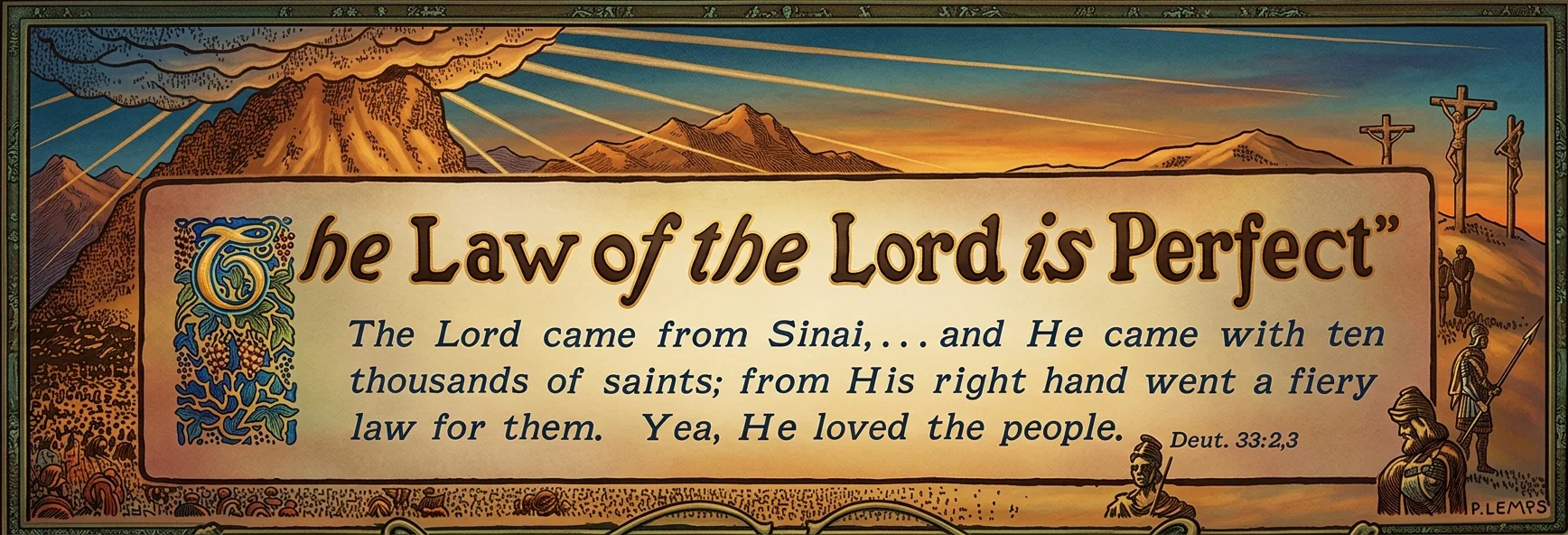
“The Law of the Lord is Perfect”

The Lord came from Sinai,... and He came with ten thousands of saints; from His right hand went a fiery law for them. Yea, He loved the people. Deut. 33:2, 3.
I am the Lord thy God, which have brought thee out of the land of Egypt, out of the house of bondage.
I. Thou shalt have no other gods before Me.
II. Thou shalt not make unto thee any graven image, or any likeness of any thing that is in heaven above, or that is in the earth beneath, or that is in the water under the earth; thou shalt not bow down thyself to them, nor serve them; for I, the Lord thy God, am a jealous God, visiting the iniquity of the fathers upon the children unto the third and fourth generation of them that hate Me; and showing mercy unto thousands of them that love Me, and keep My commandments.
III. Thou shalt not take the name of the Lord thy God in vain; for the Lord will not hold him guiltless that taketh His name in vain.
IV. Remember the Sabbath day to keep it holy. Six days shalt thou labor, and do all thy work; but the seventh day is the Sabbath of the Lord thy God: in it thou shalt not do any work, thou, nor thy son, nor thy daughter, thy man-servant, nor thy maid-servant, nor thy cattle, nor thy stranger that is within thy gates. For in six days the Lord made heaven and earth, the sea and all that in them is, and rested the seventh day; wherefore the Lord blessed the Sabbath day and hallowed it.
V. Honor thy father and thy mother; that thy days may be long upon the land which the Lord thy God giveth thee.
VI. Thou shalt not kill.
VII. Thou shalt not commit adultery.
VIII. Thou shalt not steal.
IX. Thou shalt not bear false witness against thy neighbor.
X. Thou shalt not covet thy neighbor’s house, thou shalt not covet thy neighbor’s wife, nor his man-servant, nor his maid-servant, nor his ox, nor his ass, nor any thing that is thy neighbor’s.
Hear, O Israel: The LORD our God is one LORD: and thou shalt love the LORD thy God with all thine heart, and with all thy soul, and with all thy might. DEUT. 6:4, 5.
And now, Israel, what doth the LORD thy God require of thee, but to fear the LORD thy God, to walk in all His ways, and to love Him, and to serve the LORD thy God with all thy heart and with all thy soul, to keep the commandments of the LORD, and His statutes, which I command thee this day for thy good? DEUT. 10:12, 13.
Thou shalt love thy neighbor as thyself: I am the LORD. LEV. 19:18.
Lift up your eyes to the heavens, and look upon the earth beneath; for the heavens shall vanish away like smoke, and the earth shall wax old like a garment, and they that dwell therein shall die in like manner: but My salvation shall be forever, and My righteousness shall not be abolished. Hearken unto Me, ye that know righteousness, the people in whose heart is My law; fear ye not the reproach of men, neither be ye afraid of their revilings. ISA. 51:6, 7.
All Thy commandments are righteousness. Ps. 119:172.
I delight to do Thy will, O My God, yea, Thy law is within My heart.—CHRIST, in Ps. 40:8.
My covenant will I not break, nor alter the thing that is gone out of My lips. Ps. 89:34.
The righteousness of thy testimonies is everlasting; give me understanding, and I shall live. Ps. 119:144.
Concerning Thy testimonies, I have known of old that Thou hast founded them forever. Ps. 119:152.
The works of His hands are verity and judgment; all His commandments are sure. They stand fast forever and ever, and are done in truth and uprightness. Ps. 111:7, 8.
For in Christ Jesus neither circumcision availeth anything, nor uncircumcision, but a new creature. GAL. 6:15.
Circumcision is nothing, and uncircumcision is nothing, but the keeping of the commandments of God. 1 COR. 7:19.
For in Jesus Christ neither circumcision availeth anything, nor uncircumcision; but faith which worketh by love. GAL. 5:6.
Jesus said unto him, Thou shalt love the LORD thy God with all thy heart, and with all thy soul, and with all thy mind. This is the first and great commandment. And the second is like unto it, Thou shalt love thy neighbor as thyself. On these two commandments hang all the law and the prophets. MATT. 22:37–40.
Think not that I am come to destroy the law, or the prophets; I am not come to destroy, but to fulfil. For verily I say unto you, Till heaven and earth pass, one jot or one tittle shall in no wise pass from the law, till all be fulfilled.
Whosoever therefore shall break one of these least commandments, and shall teach men so, he shall be called the least in the kingdom of heaven; but whosoever shall do and teach them, the same shall be called great in the kingdom of heaven. For I say unto you, That except your righteousness shall exceed the righteousness of the scribes and Pharisees, ye shall in no case enter into the kingdom of heaven. MATT. 5:17–20.
Jesus saith unto them, My meat is to do the will of Him that sent Me. JOHN 4:34.
I have kept My Father’s commandments, and abide in His love. JOHN 15:10.
It is easier for heaven and earth to pass, than one tittle of the law to fail. LUKE 16:17.
Do we then make void the law through faith? God forbid; yea, we establish the law. ROM. 3:31.
And this is love, that we walk after His commandments. 2 JOHN 6.
He that saith he abideth in Him [Christ] ought himself also so to walk, even as He walked. 1 JOHN 2:6.
Blessed are they that do His commandments, that they may have right to the tree of life, and may enter in through the gates into the city. REV. 22:14.
For this is the love of God, that ye keep His commandments; and His commandments are not grievous. 1 JOHN 5:3.
And the dragon was wroth with the woman, and went to make war with the remnant of her seed, which keep the commandments of God, and have the testimony of Jesus Christ. REV. 12:17.
Here is the patience of the saints; here are they that keep the commandments of God, and the faith of Jesus. REV. 14:12.

THE SECOND PERSECUTION.

The power of God always works outside of ordinary methods. The unaccountable way it has of doing marvelous things through human agencies, is that which stirs the ire of Satan in his efforts to stop the progress of the Gospel. He well knows the source of the power manifested, that it is above and beyond his direct control. So he attempts to break its force by obstructing the human channel through which God has chosen to make His power known. If through persecution Satan can but intimidate the agency of that power, and so prevent its reception, his design is nearly met. He would rather direct the administration of infinite power; but as that can not be done, his next best effort is in the direction of suppressing it.
This was the case in the days of the apostles. The death of Ananias and his wife through the direct intervention of the Spirit’s power, caused a mighty stir, not only in Jerusalem, but in all the region about. Some, through fear, dared not go near the apostles, but extolled them from a distance. A multitude of others believed, and were “added to the Lord.” In every street through which it was thought Peter might pass, the sick were placed in positions where the supposed healing shadow of that apostle might fall on them. The work being done in the metropolis was soon heralded afar, and from outside cities multitudes of sick and infirm were brought in, where all were healed. Acts 5:12–16.
This was more than the church fathers could calmly endure. It mattered not that the work done was a great benefit to so many people; it was irregular, and done without the consent of the priesthood, and so must not be tolerated. With the power of the civil law behind him, the high priest, and his followers arrested the apostles and put them in the common prison. But this could not stop the work of the holy power. In the night which soon followed, the angel of the Lord opened the prison doors, and brought out the disciples. Upon releasing them He said, “Go, stand and speak in the temple to the people all the words of this life.” Verse 20.
In the morning the high priest gathered about him the council of seventy elders, and the members of the civil senate, intending to put the apostles on trial for their temerity of the preceding day. The proper officers were sent to conduct the culprits into the presence of the august assembly convened in the council-chamber of the nation. But in due time the officers returned with the information that, while they found the doors securely locked, and the doorkeepers in place, the prisoners were gone. This report threw the council into consternation, and while they were questioning as to what the end of the matter would be, a messenger from the temple reported that the men wanted by the council were in the temple teaching the people.
The officers then betook themselves to the holy edifice; but knowing the tender regard of the people for their newly found teachers, these limbs of the law feared to use violence in re-arresting the apostles. So with great mildness they drew them away from the temple, and to the hall of council. Once in there the opportunity came for exercising authority with less tenderness. Looking upon them with a frown, the high priest, who acted as judge, said, “Did not we straitly command you that ye should not teach in this name? and, behold, ye have filled Jerusalem with your doctrine, and intend to bring this man’s blood upon us.” Verse 28. These words failed, however, to have their designed effect upon the apostles. Under the impulse of the Spirit of God, they quickly replied that his command carried no weight with them when God required them to do otherwise. Then came the repetition of the story of the cross, and the power sent of God by which Israel was granted repentance and forgiveness of sins. The only word they had to say of themselves was: “We are His witnesses of these things; and so is also the Holy Ghost, whom God has given to them that obey Him.” Verse 32.
But this was quite enough to enrage the priests, and, notwithstanding their high pretensions to goodness, they began to counsel together about putting the apostles to death. Then a learned doctor of the law, named Gamaliel, one of the most influential men of the nation, stood forth, and after asking that the apostles be temporarily removed from the council, advised moderation in deciding their fate. Reviewing the history of religious movements, he cited the cases of two men, who, in different periods, under the proclamation of their own greatness, gathered about them large numbers of followers, all of whom were soon scattered. He decided that these calamities were evidence of the falsity of their missions, and that the results following them would surely attend every other work of like nature. Applying his logic, the speaker said: “Refrain from these men, and let them alone; for if this counsel or if this work be of men, it will come to naught; but if it be of God, ye can not overthrow it, lest haply ye be found even to fight against God.” Verses 38, 39.
This argument was so conclusive, and so evidently correct in the minds of all, that the priests agreed to it; but they still desired to have some vindictive satisfaction, and so recalled the apostles, whom they beat with rods. They then gave them positive command not to preach more in the name of Jesus, and so let them go.
But neither the beating nor the threatening command had power to deter those brave witnesses for Christ. Leaving the council, they rejoiced that their testimony had mightily stirred the people, and that they were counted worthy to suffer the oppression of the authorities for the name of Jesus. Going directly to the temple, and from house to house in the city, they constantly taught the people in the ways of righteousness.
In the foregoing narrative is clearly illustrated the method by which Satan has ever sought to hinder the working of God’s power among men. Uniting with civil power, the established church has ever striven to restrain every movement advocating religious reform. There was no other way for them to maintain their own ascendency. To let the truth of God have free course was to let their own adherents come under the fascinating influence of the Spirit, which would mean the disintegration of their own source of authority. From the standpoint of goodness, they had no right forcibly to interfere with reformers, because they themselves were supposed to draw recruits from all ranks of society. But having become “established,” they thought the field exclusively their own; and so in order to keep out all forms of rivalry, they appealed to the civil power for laws by which certain prescribed differences would not be tolerated.
It was under this system of civil and ecclesiastical power that the persecution of the apostles, as narrated in this lesson, was possible. It will be noticed that the court, before whom the offenders were brought, was composed of the council and the senate of the Jews, which represented both the religious and the civil power. In the trial of the apostles, the high priest sat as judge, and dictated all the forms of procedure. With such an arrangement, the civil power is subject to the decrees of the church. It was thus under the administrations of the Dark Ages, and must be the same now whenever any civil power consents to an alliance with the church. Religion being a matter of personal preference, it has to do with individuals singly, each for himself. Laws of civil government are uniformly rigid, and bind all alike, regardless of individual conscience or preference. They are not, therefore, adapted to establish religion in men’s hearts, which must be left, with all its forms, to the power of the Holy Ghost. Bring the operation of this heavenly power into conflict with human laws, and persecution is the sure result; not to the civil, but to the religious side, because the civil, and not the religious element, carries in its hand the law of force. But when the religious unites with the civil in order to have the benefit of human force, it soon dominates the civil, to make its laws the servant of the church in its backslidden condition. Under these circumstances, bigotry is framed into law, and quickly ripens into persecution.
J. O. CORLISS.
Continue reading: LOVE IN GOD'S LAW