Your ShelfYour Projects

Signs of the Times, Vol. 36, No. 39.

Our Bible Band
Earlier text: The Age of Apostasy

Gospel Facilities in China

It is said that there is no other civilized country of the world where the means of communication are so difficult as in China.
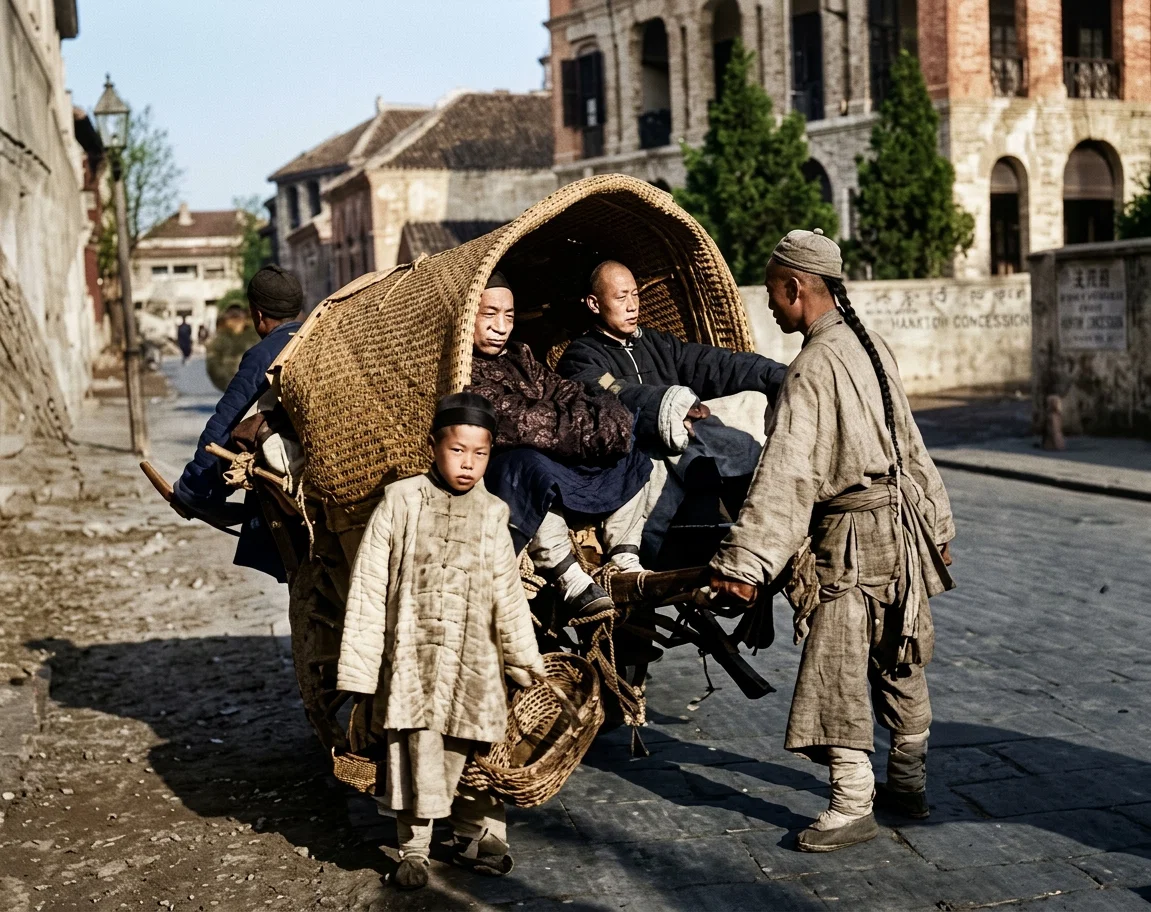
In Central and Southern China, where the country is largely mountainous, the only highways are foot-paths that seldom exceed five feet in width. These hardly admit of any conveyance other than the wheelbarrow and sedan-chair. In the plains of the North the roads widen out enough to allow rough carts to travel on them, tho frequently they appear merely as beaten paths through the fields. In other places, through long years of travel, they are found to be sunk so deep between high walls of yellow earth that the travelers are unobserved by any one more than a few rods distant.
Aside from these ordinary roads, the Chinese Government has constructed a system of courier roads, called in the Chinese “Great Public Horse Roads,” which connect Pekin with the most remote regions of the empire. These take an approximately straight course, often being cut into the steep sides of mountains or run through them by means of tunnels. In the plains these roads have a width of from twenty to thirty yards and are paved. At intervals of every three miles a signal tower is erected, and along the entire route are to be found inns, relay-posts, and companies of soldiers. The repair of these roads is entirely neglected and the government is now considering the idea of abolishing this courier service altogether, and having the official despatches transmitted through the post-office.
In her four river systems, China has ten thousand miles of navigable waterways. These are well utilized by the Chinese, many thousands of whom have no other home than the house-boat. The Grand Canal, which is about one thousand miles in length, is also of much value. Considerable portions of it are now in such condition that it is barely navigable, but the government is now planning to make extensive repairs and reopen it for commerce. In recent years many steam-launch and steamship lines have been established, and have been a most valuable factor in the development of China.
Chinese Wheelbarrow. Country Travelers Entering Foreign Concession at Hankow
The first telegraph line was established in 1884 and connected Pekin with Shanghai. Since then many other lines have been put in operation, by which Pekin is connected with all provincial capitals and important commercial centers, making in all nearly forty thousand miles of wire. China is in communication with the outside world by the overland Siberian telegraph line, and by two submarine cables,—one running to Japan and the United States, the other to Europe by way of the Indian Ocean and the Mediterranean.
As the Chinese characters can not be transmitted by wire, the following ingenious device is used. Each character has its number. The operators have type with the character on one end and the corresponding number on the other. When the message is to be sent the operator arranges the type according to the characters to be used, then turns it over and sends the numbers. At the other end of the line the numbers are received and the type arranged accordingly; then the type is turned and the message is read in Chinese characters.
In 1876 China’s pioneer railway was constructed by an English corporation and connected Shanghai with Woosung, a distance of twelve miles. As the government had given no regular permission, and as there was much opposition by the Chinese, the line was compelled to suspend operations. The next year the property was purchased by the Chinese Government, the rails and sleepers were torn up, and the whole thing, together with the engines and cars, was shipped to the Island of Formosa. This procedure quieted all railway enterprise in this section of China for about twenty years.
In North China a railway connecting the Kaiping coal mines with Tientsin was opened in 1888, and nine years later it was completed as far as Pekin. This railway has now been extended in Manchuria, and with other lines connects with the Siberian Railway. By the investment of Russian, Japanese, and Chinese capital, the Dependency of Manchuria has been provided with more and better railway facilities than any section of China proper.
In Shantung, a province of Eastern China, two hundred and seventy-four miles of railway has been constructed by a German corporation, and it is expected that other lines will soon be added to this system.
The Pekin-Hankow Railway, built by the Belgians and French, was opened to traffic in the autumn of 1905. It is seven hundred sixty miles in length, and spans the Yellow River by a bridge that has for its foundation nothing but the sand bottom of the river. Notwithstanding the many doubts that have been entertained regarding this structure, it has thus far stood the test.
The Hankow-Canton line, which with the Pekin-Hankow Railway would form a trunk line through the heart of China proper from north to south, was undertaken several years ago. The control of this proposed railroad has passed through various hands, but it is now hoped that the present Chinese company, with German capital, will succeed in completing the work.
Along the lower Yangtze a well-built road, two hundred miles in length, connecting Shanghai and Nanking, has recently been put in operation. It is now proposed to push on with this railway nine hundred miles further into western China.
Without question, the most important railway now under construction in China isone which is to connect the cities of North China with those of the lower Yangtze. It will make the distance between Pekin and Shanghai eight hundred seventy-five miles to be traveled in forty-eight hours. German and British enterprise combine in the construction, and it is hoped that this line will be open to traffic by the autumn of 1911.
These are but a few of the more important railways that have been built, or that it is hoped will soon be built in China. Including Manchuria, there is now nearly four thousand miles of road in operation, and almost as much more under construction. The French are making substantial progress in the Southwest, and it is hoped that ere long there will be railway connection between China, Burma, and India. Altho very difficult because of the canyon-cleft country, still the project is feasible, and various routes have already been suggested.
Nearly two thousand years ago, the Saviour made the explicit promise, “And this Gospel of the kingdom shall be preached in all the world for a witness unto all nations, and then shall the end come.” In all ages when the Lord has had a great work to be accomplished, He has likewise had His agencies at work to prepare the way. To-day the tokens of the soon coming of Christ to this world are unmistakable; but before the dawn of that glad morn there is a message to be carried to “every nation, kindred, tongue, and people.” Therefore we confidently believe that this great movement in the development of communications and facilities for travel in this ancient yet densely populated empire is a part of God’s program in the opening of China to the Gospel of salvation.
Shall we not make greater efforts in the future than we have in the past to keep pace with the unfolding providences of God? Who will consecrate himself this day for service in this mighty mission field? Who will give freely and willingly of his means to assist in supporting workers, to establish mission stations, and to publish and circulate Gospel-filled literature in the land of ancient Sinim? And finally, pray, and pray earnestly for this work, for the workers, and for China’s millions.
R. F. COTTRELL.

Evangelical Preacher

SAY, what is Gospel-preaching? ’Tis to show How from his Father’s love by wilful deed Man fell; and how, for ransomed man to bleed, The Son of God took in this world of wo Our flesh, and quelled by death our natural foe; And what His Spirit’s aid; and whither lead His laws; His means of grace; and what the need Of faith, matured by love; and what we owe The Three in One! This knowledge, passing reach Of man’s device or angel’s, broad and deep, God by His Son delivered; this to teach Mankind, He charged the shepherds of His sheep: If man or angel other Gospel preach, He “sows the wind, and shall the whirlwind reap.” — Bishop Mant.

Our Work and Workers

(Items from the Local Papers)
THREE were baptized at Alma, East Michigan, August 7.
THIRTEEN were baptized at Mount Pleasant, North Michigan, on July 31.
FOUR precious souls were added to the 58th Street Church, South Brooklyn, N. Y., August 21.
N. W. LEWIS and J. W. McComas state that five persons were baptized at Burlington, Iowa, August 22.
At the East Michigan camp-meeting recently held, twenty-six were baptized on the camp-ground, and others who presented themselves for baptism were referred to their home churches.
J. H. SEBAL reports the baptism of four on the Fourth of July at Kulm, N. Dak., and a new church of twenty members organized July 17. During the last eighteen months two churches and one company of thirteen members have been added to the North Dakota Conference from among the German people in the southern part of the state.
At the recent Iowa camp-meeting held in August, 65 presented themselves for baptism; but as no suitable place could be found, they were recommended to their home churches. Sister E. G. White and Brother W. C. White were in attendance.
The Chillicothe (Mo.) Tribune reports one of our workers, Mrs. Lulu W. Wightman, as addressing the citizens of that town from a dray at the Citizens’ National Bank corner. She is reported to have said: “I go to the people directly upon the street because I can get ten times the number of persons to hear my subjects. The subject of religious liberty is becoming a live issue in the United States. God raised up this free country, in my opinion, to teach the governments of the world that the ideal system of government was that wherein the church and state were entirely separated. The marvelous growth of religion in this country has been largely due to this fact.”
Our local conference papers report a great many baptisms and accessions of one and two to different churches in different places, but these we have no space to record.

LIBERTY

THE OFFICIAL ORGAN OF
THE RELIGIOUS LIBERTY BUREAU
An illustrated, 48-page, quarterly magazine, published as an exponent and advocate of true religious liberty; defending Christianity and the rights of conscience; upholding the Bible as the infallible word of God; recognizing the church and state as ordained of Heaven for specific and distinct purposes, but vigorously protesting against the alliance of the church with the state in the attempt to advance religion and to promote the state.
Price 25 cents per year. Liberal terms to agents.
Address, LIBERTY, Takoma Park, D. C.

Life and Health

A PRACTICAL health journal, published with a view of meeting hygienic needs in every home; teaching how to care for the health and how to preserve life; prescribing simple home treatments to assist nature in throwing off diseases rather than adding more poison by using drugs or unnatural stimulants as remedies; teaching how to avoid disease as far as possible, how to manage in the home when sickness does come, and how to combat the disease by simple remedies which nature provides.
Send for sample copy and special rates to agents. Price 10 cents per copy or $1.00 per year.
Address, LIFE & HEALTH, Takoma Park, D. C.

Home for Sale

Any one desiring a pleasant home in Adventist neighborhood, one block from church and church school, will find it to their advantage to communicate with F. E. Stafford, Mountain View, Cal. Easy terms and special low price if taken at once.

Wanted: Restaurant Department Manager

Wanted

A live, wide-awake man to act as manager for our Restaurant Department, the Vegetarian Cafe in Portland, Oregon. A good opportunity for the right man. Could purchase a small interest if satisfactory. Must be Seventh-day Adventist. References required. Address, H. H. Haynes, president, Vegetarian Food Company, Inc., 105 Sixth St., Portland, Ore.

Colds

Colds.—By G. H. Heald, M.D. A treatise on the causes, prevention, and cure of colds. White leatherette binding. 58 pages, 25c. Address this office.

THE PROBLEM OF CAPITAL AND LABOR

From Every Standpoint
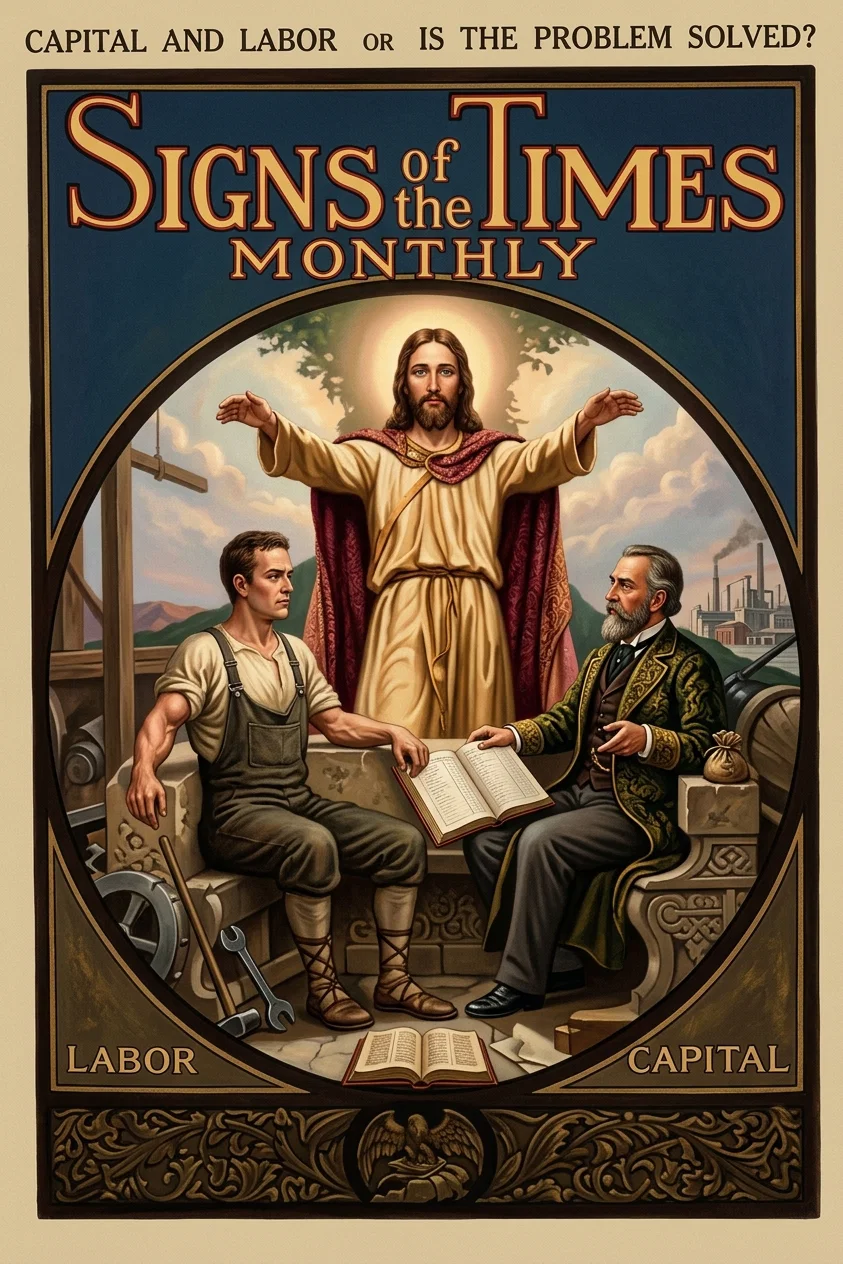
By glancing at list of contents of the October Signs Monthly you will be impressed with the thought that
The thinking person will be interested The curious will wish to investigate Attention of most careless will be arrested
The index is so arranged that a glance gives the scope of the paper.

Contents

Frontispiece.—The Conflict Between Capital and Labor.
Current Topics.—The Jubilee of Calvin; Aeroplane and Automobile; Income Tax; Misuse of Wealth; The Strike Near Pittsburg; Discovery of the North Pole; Two-Million-Dollar Home.

THE PROBLEM OF CAPITAL AND LABOR

The Manufacturer and the Labor Movement, J. Kirby, Jr.; Hostility of the Manufacturers' Association, John Mitchell; Methods of the Manufacturers' Association, Samuel Gompers; Capitalism and Socialism, Eugene V. Debs.
Christian and Prophetic
Two Pictures, M. C. Wilcox; The Federation Age, George A. Snyder; The Struggle of the Ages, A. O. Tait; The Harvest of Greed (Bible Reading); The Reaping of Arthur Glendon (Story), Emma H. Adams; The Great Commission, Mrs. E. G. White; Divine Healing, D. H. Kress, M. D.; The Blessed Assurance (Poetry), Mrs. L. D. Avery-Stuttle; The Sabbath Institution, H. W. Cottrell; Nations and Prophecy, Clarence Santee; Editor and Reader.

Orders Are Coming

Tract Society, Los Angeles 1000
One Agent, Spokane 550
One Agent, Iowa Points 350
One Agent, Portland, Ore. 100
One Agent, Pennsylvania 500
One Agent, Iowa 500
One Agent, San Francisco 1000
Send yours for whatever number you feel you can use.
Twenty-five copies cost $1.00; they sell for $2.50. 100 cost $4.00. You sell them for $10.00. Order of your Tract Society. Ask for the SIGNS WORKER which contains selling points and suggestive canvasses.

Signs of the Times

MOUNTAIN VIEW, CALIFORNIA

Bee to Aid Japan

A TINY American bee is about to be charged with a task beyond the power of man to accomplish — a task which means nothing less than changing the agricultural status of a nation. If successful — and results already indicate favorable progress of the experiment — it will mean wealth and prosperity for hundreds of farmers in Japan. Instead of trying unsuccessfully to raise fruits, such as apples and pears, the soil of the “Land of the Cherry Blossom” will yield in abundance, and the natives will rejoice in luscious fruits and delicious vegetables which, because of the lethargy of their native bee and its failure to carry pollen, it has been impossible for them to raise.
The bee to which this task is assigned is the golden bee. It is raised in America andwas produced by an American, and already many little queen golden bees have been sent to Japan to begin their task.
The native Japanese bee is an indolent thing, and does little more than crawl about to meet the needs of its day. Because of its apathy, it has been impossible to cultivate such fruits as apples and pears, and such vegetables as cucumbers, tomatoes, and melons. The male and the female blossoms of the bell-flower varieties of fruits and vegetables are usually so far apart that it is necessary for some agent of nature to carry the pollen. In many other countries the busy little bee, in its search for honey, is the means of fructification. In Japan the bees simply refuse to work.— Harper’s Weekly.

Establishing the Health of the Child

By Maria L. Edwards, M.D.

Heredity

NO ONE has ever yet been born with an overstock of vitality with which to run his human machine during life’s period; but many and many a one, by no fault of his own, has started out in life with deficient physical strength, that has handicapped his usefulness and pleasure, and given him an unequal struggle all through life.
Since health is the greatest temporal blessing that can attend us here below, what more important obligation could parents have resting upon them, than to make sure that their children have strong constitutions, well-developed bodies and minds, and, with all, moral power to resist temptation. The world is in crying need of children of this type to join the forces for good and to assist in the overthrow of vice and injustice.
When shall the work of establishing the health of the child be begun? Oliver Wendell Holmes said that the child is born in the lives of its ancestors two hundred years before it enters the world. If that is true, the law of heredity plays no uncertain part in the life of every human being, and is well worth taking into consideration.
Galton has estimated that one fourth of our inheritance is from each of our parents, one fourth from our four grandparents, and one fourth from our more remote ancestors. The Scriptures bear us out in attaching importance to the law of heredity, when they say that the iniquities of the fathers are visited upon the children to the third and fourth generation; and every physician knows that in order to get a clear understanding of his patient and be able rightly to judge of the probable outcome of the case, he must know the history of the parents, and, many times, of the grandparents as well.
The careful instruction given to the parents of men who were chosen of God to do a great work, as Moses, Samuel, Samson, John the Baptist, etc., also adds weight to the thought.

Good Common Sense Needed

If, in the matter of ancestry, men and women would manifest the good sense that is used by stock-growers, and remember that strong, well-developed children do not come from sickly, puny, exhausted parents, and learn to plan as generously for the human offspring as they do for the colts, calves, and pigs, there would at once be seen an improvement in the human stock.
The year that the mother horse bears a colt, she is not expected to carry on the regular heavy work of other years. I wonder what would happen if the human mother should be given as much rest from regular household duties and taxing cares, and have time to live out-of-doors, and to build herself up physically and mentally. Instead of this, many a mother has only the imperative three weeks, or possibly less, from work, and thereafter is expected to take not only her previous duties, but the added work of caring for the little newcomer.
Strange economy, isn’t it, when a few dollars, expended in hiring help during this year, would reap so abundant a harvest in the vitality and subsequent health of the little treasure that has come into the home? Not only is rest from hard labor and from taxing care beneficial, but it is also highly essential that the laws of hygiene be rigidly observed by the parents.
Out-of-doors as much as possible — day and night is none too much; undisturbed rest from 9:30 P.M. to 6:00 A.M.; exercise that is variable and mild, but not taxing; food that is nutritious, simply prepared, small variety at each meal, and taken regularly; six to eight glasses of water daily; clothing that is evenly distributed, supported from the shoulders, and which does not restrict the body — all are simple rules of hygiene that have long been advocated, and should be observed, especially at such times.
While it is impossible for any of us to improve our own ancestry, it does lie within the power of parents to make every possible provision for the strength and vigor of their posterity.

While We May

THE hands are such dear hands; They are so full; they turn at our demands So often; they reach out, With trifles scarcely thought about, So many times; they do So many things for me, for you. If their fond wills mistake, We well may bend, not break.
They are such fond, frail lips That speak to us. Pray, if love strips Them of discretion many times, Or if they speak too slow or quick, such crimes We may pass by; for we may see Days not far off when those small words may be Held not as slow, or quick, or out of place, but dear, Because the lips are no more here.
They are such dear familiar feet that go Along the path with ours—feet fast or slow, And trying to keep pace. If they mistake, Or tread upon some flower that we would take Upon our breast, or bruise some reed, Or crush poor Hope until it bleed, We may be mute, Not turning quickly to impute Grave fault; for they and we Have such a little way to go—can be Together such a little while along the way— We will be patient while we may.
So many little faults we find; We see them; for love is not blind. We see them; but if you and I Perhaps remember them some by and by, They will not be Faults then—grave faults—to you and me, But just odd ways—mistakes, or even less— Remembrances to bless.
Days change so many things—yes, hours; We see so differently in suns and showers; Mistaken words to-night May be so cherished by to-morrow’s light. We may be patient; for we know There’s such a little way to go.
— Anonymous.

It Takes Courage

To LIVE according to your convictions.
Not to bend the knee to popular prejudice.
To say “No” squarely when those around you say “Yes.”
To be what you are, and not pretend to be what you are not.
To refuse, even tho poor, to knuckle and bend the knee to the wealthy.
To remain in honest poverty while others grow rich by questionable methods.
To speak the truth when, by a little prevarication, you can get some good advantage.
To live honestly within your means, and not dishonestly upon the means of others.
To stand firmly erect while others are bowing and fawning for praise and power.
To refuse to do a thing which you think is wrong, because it is customary and done in trade.
To face slander and lies, and to carry yourself with cheerfulness, grace, and dignity for years before the lie can be corrected.
To do your duty in silence, obscurity, and poverty, while others about you prosper through neglecting or violating sacred obligations.
To be talked about, and yet remain silent when a word would justify you in the eyes of others, but which you can not speak without injury to another.
To throw up a position with a good salary when it is the only business you know, and you have a family depending upon you, because it does not have your unqualified approval.—Success Magazine.

Uncle Ben’s Cobblestones

Familiar Talks with Boys and Girls About Common Things
UNCLE BEN has such a pleasing way of telling about the origin and use of common, every-day articles, that he holds the interest of the reader from the start in his talks about air, water, sunshine, fire, smoke, glass, coal, salt, paper, matches, etc.
He tells about more than one hundred different things in all, and intersperses with many happy thoughts that bring good cheer to young and old.
Two hundred and twenty-one pages, nicely bound. Price, post-paid, $1.00.
Pacific Press Publishing Assn.
Mountain View, California
Portland, Ore. Regina, Sask., Can. Kansas City, Mo.

Bloodthirsty Dingo

THERE are some who believe that certain of the wild dogs, like the Australian dingo—“yellow dog dingo, always hungry, dusty in the sun”—are reversions to the wild state of a race once tame, just as the pariah dogs of various countries have traveled half the road toward becoming wild animals again.
As one sees the dingo here in the gardens it looks not merely like a domesticated dog, but like a dog of a distinctly engaging and amicable kind. The dingo’s character belies its gentle looks. “Quarrelsome, sly, and treacherous,” an Australian naturalist has called it. So sly it is that according to Mr. Beddard (in “The Cambridge Natural History”) it feigns death “with such persistence that an individual has been known to be partly flayed before moving;” and so treacherous that in the days when dingoes were more commonly kept as pets by the colonists than, as a result of bitter experience, is the case to-day, it was no unusual thing for the dog which had been brought up with every tenderness from puppyhood, to turn suddenly on its master or mistress, or what was more frequent, when left in temporary charge of an empty house, to seize the opportunity to raid the sheepfold or the poultry-runs.
On such occasions it “ravens” even as the wolf, killing not to satisfy its hunger, but in the unrestrainable fury of a brute instinct, so that given time enough it will not leave one fowl or one sheep alive. That it does not need much time, moreover, is shown by the statement of Thomas Ward that “one dingo in the course of a few hours has been known to destroy several scores of sheep.” For its fighting ability the same authority declares it to be a match for most domestic dogs of double its size.
When wild it hunts in packs which are said sometimes to include as many as a hundred individuals, tho from six to a dozen is the common number; and the only Australian animal which it is uncertain if the pack can ever pull down is (in spite of Mr. Kipling) the “old man” kangaroo.—London Times.

Reading Providence Through Tears

God sometimes washes the eyes of His children with tears, in order that they may read aright His providence and His commandments.—T. L. Cuyler.

IN THREE DAYS

Overland Limited

TAKES YOU
To Chicago
ACROSS GREAT SALT LAKE
AND
HIGH SIERRA BY DAYLIGHT
Luxurious High-class Equipment
Electric Lighted Throughout
Pullman Drawing-room
Stateroom
Vestibuled Sleeping Cars
Careful and Attentive Dining Service
Parlor Observation Car with Library and Cafe
Ladies’ Reading Room
Gentlemen’s Smoking Room
Daily News Bulletins
Latest Papers and Magazines
SOUTHERN PACIFIC

Our Little Friend

An Illustrated Paper for the Smaller Men and Women, for the Children and Little Ones
Instructive and entertaining, clean, wholesome, sensible. It is a character builder, a helper to father and mother. Our Little Friend would plant seed in the joyous life of the children in the Present, that it may bear blessed fruitage in the Harvest of the Future. Respect your child's individuality. Take the paper for him or her. Only 50 cents a year.
Address, OUR LITTLE FRIEND, Mountain View, Cal.

Bibles

Bibles.— Remember that we are headquarters for anything in the Bible line. We shall be pleased to send you our catalog of Bible selections on application. Pacific Press, Mountain View, Cal.

Education.

The object of true education and how it may be realized by the youth, the parent, the teacher, the writer, the tiller of the soil, and the business man, is the great theme of this book. Its first chapter is devoted to First Principles; following that are illustrations taken from the history of Israel. Master Teacher, Nature Teaching, the Bible as an Educator, Physical Culture, Character Building, the Under Teacher, and the Higher Course, are titles of other chapters. 321 pages. Cloth, $1.25. Address this office.

Increase the Circulation of Signs of the Times

Reader, does not the “Signs of the Times” give you a vast amount of valuable and interesting instruction during the course of the year for one dollar and fifty cents? Every issue contains enough of God’s precious truth to save a soul. Help us to pass it along. The times, the message it bears, the needs of millions of souls, call loudly that its circulation should be not 20,000 nor 40,000, but 400,000. And why not?

Bible Study Series Included in Subscription

Some of our subscribers are inquiring as to whether the Bible Study Series will be included in their regular subscription. We wish to tell them emphatically it will. It will be a part of the regular issues of the Signs for the next six months, beginning with this number, and all regular subscribers to the paper will receive this excellent series; and those who have subscribed for the year will get more than that, of course, for beyond this series we will have something better still. We hope to make the SIGNS constantly better, so that those who read it and are in sympathy with the great lessons it is endeavoring to give, will stay with it to the very end.

Registry Fee and Indemnity Increase

The registry fee of letters in the United States has been raised from 8 cents to 10 cents, taking effect November 1, 1909. This order from the Postmaster-General also increases the maximum indemnity paid to the owner of a lost or rifled registered letter, from $25.00 to $50.00, thus doubling the Department's liability for valuable articles entrusted to its registry branch. Two cents for the additional insurance of $25.00 is certainly reasonable.

Missouri Requires Licenses for Christian Scientists

Missouri has passed a law demanding that Christian Scientists procure a license in order to practise in that state.
Continue reading: The Cost of Automobile Racing