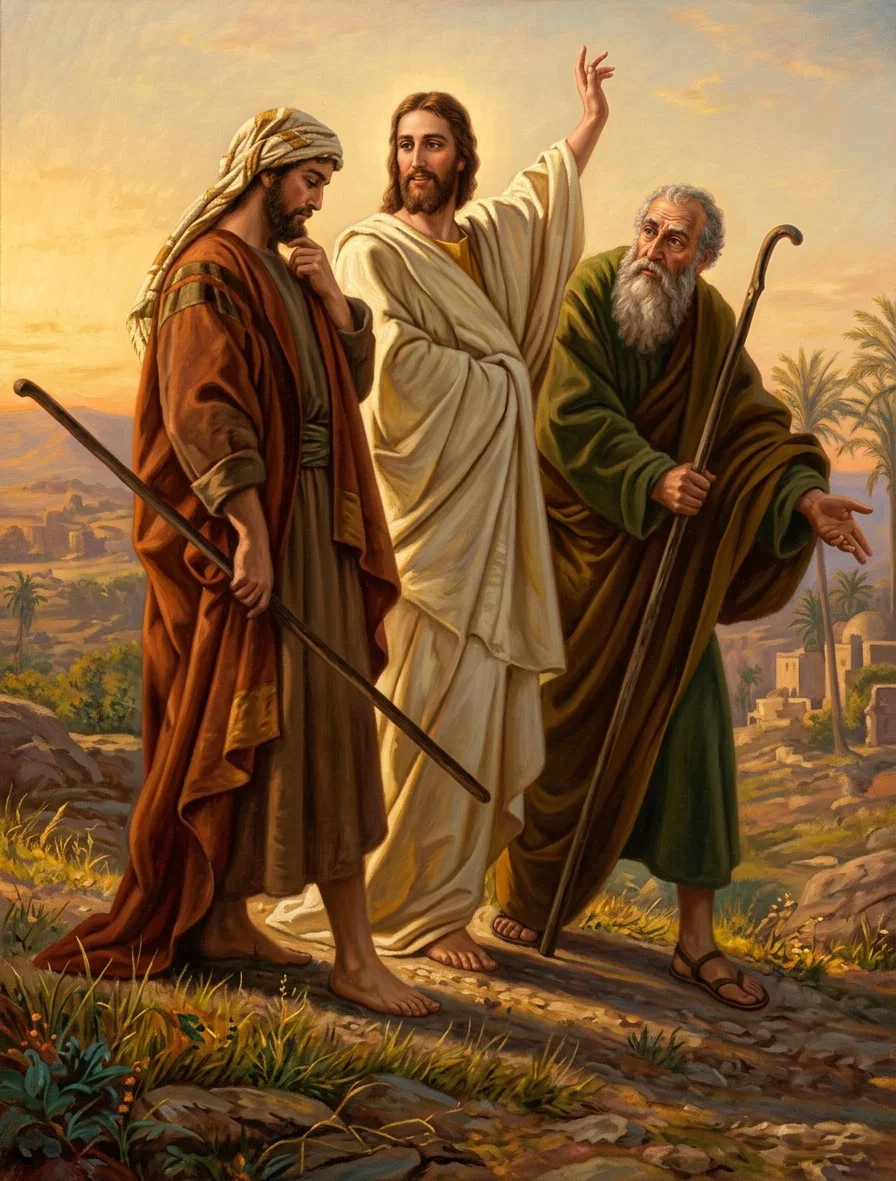
“Did not our heart burn within us, while He talked with us by the way, and while He opened to us the Scriptures?”
The history of the life, death, and resurrection of Jesus, as that of the Son of God, can not be fully demonstrated without the evidence contained in the Old Testament. Christ is revealed in the Old Testament as clearly as in the New. The one testifies of a Saviour to come, while the other testifies of a Saviour that has come in the manner predicted by the prophets. In order to appreciate the plan of redemption, the Scriptures of the Old Testament must be thoroly understood. It is the glorified light from the prophetic past that brings out the life of Christ and the teachings of the New Testament with clearness and beauty. The miracles of Jesus are a proof of His divinity; but the strongest proofs that He is the world's Redeemer are found in the prophecies of the Old Testament compared with the history of the New. Jesus said to the Jews, “Search the Scriptures; for in them ye think ye have eternal life; and they are they which testify of Me.” At that time there was no other Scripture in existence save that of the Old Testament; so the injunction of the Saviour is plain.
This mighty Conqueror of death, who had reached to the very depths of human misery to rescue a lost world, assumed the humble task of walking with the two disciples to Emmaus, to teach and comfort them. Thus He ever identifies Himself with His suffering and perplexed people. In our hardest and most trying paths, lo, Jesus is with us to smooth the way. He is the same Son of Man, with the same sympathies and love which He had before He passed through the tomb and ascended to His Father.
At length, as the sun was going down, the disciples with their companion arrived at their home. The way had never before seemed so short to them, nor had time ever passed so quickly. The stranger made no sign of halting; but the disciples could not endure the thought of parting so soon from one who had inspired their hearts with new hope and joy, and they urged Him to remain with them overnight. Jesus did not at once yield to their invitation, but seemed disposed to pursue His journey. Thereupon the disciples, in their affection for the Stranger, importuned Him earnestly to tarry with them, urging as a reason that the day was far spent. Jesus yielded to their entreaties and entered their humble abode.
The Saviour never forces His presence upon us. He seeks the company of those who He knows need His care, and gives them an opportunity to urge His continuance with them. If they, with longing desire , entreat Him to abide with them, He will enter the humblest homes, and brighten the lowliest hearts. While waiting for the evening meal, Jesus continued to open the Scriptures to His hosts, bringing forward the evidence of His divinity, and unfolding to them the plan of salvation. The simple fare was soon ready, and the three took their position at the table, Jesus taking His place at the head as was His custom.
The duty of asking a blessing upon the food usually devolved upon the head of the family; but Jesus placed His hands upon the bread and blessed it. At the first word of His petition the disciples looked up in amazement.
Surely none other than their Lord had ever done in this manner. His voice strikes upon their ear as the voice of their Master, and, behold, there are the wounds in His hands! It is indeed the well-known form of their beloved Master! For a moment they are spellbound; then they arise to fall at His feet and worship Him; but He suddenly disappears from their midst.
Now they know that they have been walking and talking with the risen Redeemer. Their eyes had been clouded so that they had not before discerned Him, altho the truths He uttered had sunk deep in their discouraged hearts. He who had endured the conflict of the Garden, the shame of the Cross, and who had gained the victory over death and the tomb — He before whom angels had fallen prostrate, worshiping with thanksgiving and praise, had sought the two lonely and desponding disciples, and been in their presence for hours, teaching and comforting them, yet they had not known Him.
Jesus did not first reveal Himself in His true character to them, and then open the Scriptures to their minds; for He knew that they would be so overjoyed to see Him again, risen from the dead, that their souls would be satisfied. They would not hunger for the sacred truths which He wished to impress indelibly upon their minds, that they might impart them to others, who should in their turn spread the precious knowledge, until thousands of people should receive the light given that day to the despairing disciples as they journeyed to Emmaus.
He maintained His disguise till He had interpreted the Scriptures, and had led them to an intelligent faith in His life, His character , His mission to earth, and His death and resurrection. He wished the truth to take firm root in their minds, not because it was supported by His personal testimony, but because the typical law, and the prophets of the Old Testament, agreeing with the facts of His life and death, presented unquestionable evidence of that truth. When the object of His labors with the two disciples was gained, He revealed Himself to them, that their joy might be full, and then vanished from their sight.
When these disciples left Jerusalem, to return to their homes, they intended to take up their old employment again, and conceal their blighted hopes as best they could. But now their joy exceeded their former despair. “And they said one to another, Did not our heart burn within us, while He talked with us by the way, and while He opened to us the Scriptures?”
They forgot their hunger and fatigue, and left the prepared repast, for they could not tarry in their homes and hold their newly found knowledge from the other disciples. They longed to impart their own joy to their companions, that they might rejoice together in a living Saviour risen from the dead. Late as it was, they set about retracing their way to Jerusalem; but how different were their feelings now from those which depressed them when they set out upon their way to Emmaus. Jesus was by their side, but they knew it not. He heard with gladness their expressions of joy and gratitude as they talked with each other by the way.
They were too happy to notice the difficulties of the rough, uncertain road. There was no moon to light them, but their hearts were light with the joy of a new revelation. They picked their way over the rough stones and the dangerous ledges, sometimes stumbling and falling in their haste. But not at all disconcerted by this, they pressed resolutely on. Occasionally they lost their path in the darkness, and were obliged to retrace their steps until they found the track, when they renewed their journey with fresh speed. They longed to deliver their precious message to their friends. Never before6had human lips such tidings to proclaim; for the fact of Christ’s resurrection was to be the great truth around which all the faith and hope of the church would center.
The Word Centering in Christ
By John Orr Corliss
By John Orr Corliss
CENTURIES before Christ appeared in flesh as the Son of Man, the Gospel prophet proclaimed the endless duration of God’s Word. Isa. 40:8. More than half a century following the advent of the Messiah, the same sentiment was uttered, with the added statement: “And this is the Word which by the Gospel is preached unto you.” 1 Peter 1:25. This eternal Word is therefore that which, through the Gospel, is given for our redemption.
But the Gospel itself “is the power of God unto salvation to every one that believeth.” Rom. 1:16. Putting this and that together, we have the blessed assurance that the Word of God, which is the Gospel basis, is the vital power by which God reaches man in his degradation, and rescues him from eternal ruin. A Word which can do so much, must possess more vitality than appears upon the surface. It must have some secret provision of influence more potent than any earthly allurement, by which to draw men away from every natural environment of sin, and turn their faces toward a country and a service foreign to every eye but that of faith.
Its High Origin
One must look beyond the limits of earthly sovereignty to find this mysterious entity. Since no law of humanity, however gentle and persuasive, can reach its measurement, we must look for its rise in some infinite benevolence, above and remote from anything our world produces. Its seat must therefore be located in the untainted atmosphere of heaven’s fair domain.
But how could so pure and powerful an instrument find its way to so debased and forlorn a region as earth became through sin?—In one way alone, and that through its Author’s creative genius. The very beginning of this world was the fiat of God: “He spake, and it was; He commanded, and it stood fast.” Ps. 33:9. As stated by the apostle, “The worlds were framed [took form] by the Word of God.” Heb. 11:3. This is to say that God’s Word operated to give distinct shape to the worlds, and that, too, simply by its utterance.
The creative Word must therefore have been a living, perceptive force, which, when spoken, left its eternal impress in space. Indeed, we are positively assured that “the Word of God is quick [living], and powerful [energetic], . . . and is a discerner of the thoughts and intents of the heart.” Heb. 4:12.
The enabling by which to discern the thoughts and intentions of the heart, requires more than human penetration, hence must be omniscient power. This is just what is required to regulate the movements of the planets. Who, indeed, can so well possess this faculty as He who projected the worlds into space? Yet the placing of the worlds was accomplished by the Word of God. We read that “in the beginning God created the heaven and the earth.” Gen. 1:1. But we are also told that “in the beginning was the Word, and the Word was with God, and the Word was God.” John 1:1. These combined texts warrant one in saying that the Word was creative power. But as tho these were not enough, the sacred narrative continues its discourse on the origin of creation: “All things were made by Him; and without Him was not anything made that was made.” To show that this Word was not an inert generalization, an advance statement follows in this form: “In Him was life; and the life was the light of men.”
The Word Made Flesh
However one may, from this text, consider the personnel of the Word introduced, one thing is fixed: it is an object with life, by which man lives in the light. It is therefore an animate Being. It must be what the text says it is: “The Word was God.” In some way unknown to the earth-born mind, the attributes of Jehovah were personified—yea, more, were actually manifested—in His Word, so that the Word was recognized as God. This conclusion ought not to stagger the faith of one who can accept the further statement of Holy Writ: “The Word was made flesh, and dwelt among us.” John 1:14. Yes, this actual Word was made flesh—not put into flesh, but made flesh. The Word actually became flesh, carrying “the glory as of the only begotten of the Father;” and so the Word of God really did and still does center in Him who became flesh and died for our sins.
This thought is emphasized still further in the following: “That which was from the beginning, which we have heard, which we have seen with our eyes, which we have looked upon, and our hands have handled, of the Word of life.” 1 John 1:1. In explaining this statement in the following texts, the apostle makes it plain that this “Word of life” was none other than He who was with the Father, but had been manifested unto us. Christ is the Word of God, because He uttered the audible mind of God, not as a perfunctory duty, but because, being God’s only begotten Son, that Word was also the expression of His own mind, He and His Father being one. John 10:30. He being in the express image of the “invisible God,” He could but declare the mind of God, and so the Word of God was centered in Him.
Inasmuch as God’s Word can not change, any more than can the character and mind of its Author, that Word must therefore still center in Christ. As He was the Word of God by which the heavens and the earth were formed, and by which man was created in the divine image (John 1:1; Col. 1:15-17); so He it is who must create anew the man “dead in trespasses and sins” (2 Cor. 5:17). But in this new birth unto everlasting life, the seed of an everlasting Father must endow the “new creature” with his heritage. This honor has been conferred upon One only, and He is introduced by the prophet as a Child born among men, who is called “Wonderful, Counselor, the mighty God, the everlasting Father, the Prince of Peace.” Isa. 9:6.
Here is the only hope of everlasting life. We must be “born again,” and that from above. John 3:7. But this requires a seed deposit, as surely as is required for the natural birth. How then is this performed from the heavens, in behalf of men on the earth? An apostle states the matter thus: “Being born again, not of corruptible seed, but of incorruptible, by the Word of God, which liveth and abideth forever.” 1 Peter 1:23. This is the only solution of the problem. Altho being bodily in the heavens, the Lord Jesus “sends the Word” from Himself, freighted with fructifying power to bring a new creature out of an old and hardened sinner. “There is no power but of God,” and so the Word-seed is still the God-Word, and centers in Him who is the Way, the Truth, and the Life of God.
The Destroyer Preeminent
By Emma Hildreth Adams
“By the Word of Thy Lips”
By Emma Hildreth Adams
READER, turn to Ps. 17:4, and read the complete statement of the Shepherd-King of Israel. “By the Word of Thy lips I have kept me from the paths of the DESTROYER.”
Efficient and potent beyond all ability to be reasoned, to be estimated, must have been this Word (law) to which David refers with assertion so unlimited, so positive!
Think of the gainful, priceless service it rendered him — the keeping him from the paths of the destroyer, and hence from eternal death!
When a creature or a thing is destroyed, it ceases to exist. A noble tree of the forest, burned to ashes, is as tho it had not been. Its power to bloom, to bear fruit, to adorn, the landscape, is ended.
When a ruthless hunter brings to earth a beautiful bird, with no higher intent than to display his unpraiseworthy skill, or to gratify his blood-red propensity for the chase, he becomes a cruel destroyer, a heartless taker of life. He takes away that which he did not give, that which he can not restore.
The Destroyer Preeminent
But it is not to these small, second-class destroyers that the great psalmist refers, and from whom he rejoices to have escaped.7
Rather he sings of release from the destroyer preeminent of the universe, from that life-taker who aims only at high-class game, game whose death affects all the earth, and heaven, and worlds reigned over by many princely sons of God; whose death is eternal.
With distinguished skill this arch-destroyer has laid out, opened, countless attractive and fascinating paths, among the charms and beauties of which himself and his myriad fellow hunters lurk for victims unwary, unafraid, easily entrapped.
So invitingly, so temptingly do these paths lead on and on, so concealed, oftentimes, are their dangers, so intricately laid are the meshes for the hasting feet, that few, comparatively, of the heedless, incautious beings who throng them, ever effect their escape therefrom.
Sadly enough, many do not know, hosts of them do not reflect that nearby, in sight, up on the mountainside, extends, stretches away, a narrow, rugged, steep, but mightily defended way in which all feet are safe if they but keep within its distinct, truth-guarded lines.
The Two Ways
Of these two opposed roadways for eternity-bound travelers, Christ once spoke in terms startling, full of warning. Reader, hear Him, heed Him!
“Enter ye in at the STRAIT gate; for WIDE is the gate, and broad is the way, that leadeth to destruction, and MANY there be which go in thereat.
“BECAUSE strait is the gate, and narrow is the way, which leadeth unto LIFE, and FEW there be that find it.”
But by what powerful agency did the king of Israel keep himself, through most of his life, from those “paths of the destroyer”?
David, certainly, was a man whom the destroyer made extraordinary effort to entrap and to ruin in some of his alluring but fatal paths.
And truly there were periods in the great king’s life, when, with amazing heedlessness, with astounding lack of righteous principle, with marvelous yielding to an evil nature, he strode into those dreadful paths with a speed, an unconcern, most startling, and to this day surprising.
To this day also, it is cause for mourning, for deepest regret, that one chosen to position so lofty, appointed to service so beneficent, set for purpose so far-reaching, made a type of the Christ, should ever have dimmed the luster of his reputation with glaring sin, with rushing infringement of the commandments.
The Plenitude of the Word
But how, finally, could the famous ruler claim that he had held himself from the paths of the great destroyer?
Ah, the instrumentality is as helpful to you and to me to-day, is as full of power to rescue, is as immune to failure, as when he resolutely made choice of the narrow way and the strait (close) gate. Listen!
“By the WORD OF THY LIPS I have kept me from the paths of the destroyer.” Ps. 17:4.
Here, undoubtedly, as in a hundred other places in his inspiring psalms, David refers to the Ten Commandments, since these preeminently are THE Word from the Creator’s lips.
Notice that it was the using of the means provided for him that finally saved David from paths made enticing, made destructive, by man’s mighty enemy.
What a testimony to the protecting, preserving, character-building power of the words of the Decalogue is this frank, grateful admission of Israel’s king! What encouragement it should beget, what strength impart to hearts and minds faint, faltering, fearful!
Christ, who gave the law on Sinai, declared to the Jews on one occasion, “The words that I speak unto you, they are spirit, and they are life.”
The Living Word
Heb. 4:12 tells us: “The word of God is living, and powerful; . . . a discerner of the thoughts and intents of the heart.” And Peter asserts that the new birth is accomplished by the Word of God, which liveth and abideth forever.
It was not David’s own wisdom, foresight, ability to resist keen temptation, which held him to paths of safety through most of his conspicuous career.
When moral defeat threatened, when giant error stood at his doorway, when eclipse of earthly hopes and prospects shadowed his sky, it was faith in the living Word of God, confidence in the love, mercy, willingness to forgive, of Him who, the very hour His promise to Abraham was due, led Israel out of Egypt.
No one with keen mind, with devout spirit, can think, think down into the broad, deep intent of the ten precepts of the Decalogue, without realizing that a strange, impelling principle of life surges through every statement, sets ablaze every sentence, animates every word, fills every letter.
In short, it is a living Decalogue, holding no possibility of death, as lasting in structure as earth’s history. Life from God pulsates in every prohibition, every command. Who, then, can “think” to change it?
Little wonder therefore that great King David found therein force to keep him from the path of the destroyer.
The same identical life is therein to-day, and will act for you and me, will impart the same blessing, lead to the same rejoicing.
Our Bible Reading
The Holy Scriptures
How Much Do They Comprise?
1. By what terms does Jesus designate the Old Testament Scriptures?
“The law of Moses, and the prophets, and the Psalms.” Luke 24: 44.
“And beginning from Moses and from all the prophets, He interpreted to them in all the Scriptures the things concerning Himself.” Verse 27.
2. What did He say to the Jews about the Scriptures?
“Ye search the Scriptures, because ye think that in them ye have eternal life; and these are they which bear witness of Me.” John 5: 39.
3. How does Paul, when writing to Timothy, refer to them?
“From a child thou hast known the Holy Scriptures, which are able to make thee wise unto salvation through faith which is in Christ Jesus.” 2 Tim. 3:15.
NOTE.— The Holy Scriptures, or Holy Writings, of the Jews consisted of the Old Testament books which we have to-day. They divided them into the Law, the Prophets, and the Hagiographa (Holy Writings), sometimes called the Psalms, because the Psalms is the first book in the latter division. The Law includes the first five books of the Bible; the Prophets, Joshua, Judges, 1 and 2 Samuel, 1 and 2 Kings, Isaiah, Jeremiah, Ezekiel, and Hosea to Malachi inclusive; the Holy Writings Psalms, Proverbs, Job, Song of Solomon, Ruth, Lamentations, Ecclesiastes, Esther, Daniel, Ezra, Nehemiah, 1 and 2 Chronicles. These, as the above scriptures and many others clearly show, were approved and indorsed by our Lord and His apostles.
4. What promise did Jesus give His apostles as to their teaching?
“But the Comforter, even the Holy Spirit, whom the Father will send in My name, He shall teach you all things, and bring to your remembrance all that I said unto you.” John 14: 26. Also 16:13-15.
5. What does Paul say of the apostolic writings?
“Which things also we speak, not in words which man’s wisdom teacheth, but which the Spirit teacheth.” 1 Cor. 2:13.
6. How does the apostle Peter class the writings of Paul?
“Even as our beloved brother Paul . . . wrote unto you; as also in ALL HIS EPISTLES, speaking in them of these things; wherein are some things hard to be understood, which the ignorant and unsteadfast wrest, as they do also THE OTHER SCRIPTURES, unto their own destruction.” 2 Peter 3:15, 16.
NOTE.— In this text the apostle Peter classes the writings of the apostle Paul among the “other Scriptures,” the Old Testament Scriptures. And the words of the apostle Paul place the New Testament writings with the Holy Scriptures.
The Preacher
By William Cowper
He that negotiates between God and man,
As God's ambassador, the grand concerns
Of judgment and of mercy, should beware
Of lightness in his speech. 'Tis pitiful
To court a grin, when you should woo a soul;
To break a jest, when pity would inspire
Pathetic exhortation; and to address
The skittish fancy with facetious tales
When sent with God's commission to the heart.
So did not Paul. Direct me to a quip
Or merry turn in all he ever wrote,
And I consent you take it for your text,
Your only one, till sides and benches fail.
No: he was serious in a serious cause,
And understood too well the weighty terms
That he had taken in charge. He would not stoop
To conquer those by jocular exploits
Whom truth and soberness assailed in vain.
— William Cowper.
God Kills Thy Comforts
God kills thy comforts from no other design but to kill thy corruptions; wants are ordained to kill wantonness; poverty is appointed to kill pride; reproaches are permitted to destroy ambition.—John Flavel.
Evidences of a Material World
By R.
ALL is Mind, says Mrs. Eddy. “On this statement rests the Science of Being.”—“Science and Health,” page 492.
Let us, then, probe a little for the authority of this statement. Suppose we make a tour of investigation, and inquire if there is any other authority for this statement beside her simple word alone.
Do the great scientists say that all is mind? No, indeed; many of them are more inclined to say that all is matter, so impressed are they with the reality of material things.
Ask the unprejudiced men you meet upon the street if all is mind; do you think they will answer the question in the affirmative?—Not by any means.
Ask the Guide-book, the Bible, if all is mind. There is no such statement within its covers, neither any statement that in any way infers it.
Ask Moses, Is mind all? He speedily answers you: “And the Lord God formed man of the dust of the ground, and breathed into his nostrils the breath of life; and man became a living soul.” Gen. 2:7.
Ask Paul, Is mind all? and his answer is ready: “There is a natural body, and there is a spiritual body. . . . The first man is of the earth, earthy. . . . We have borne the image of the earthy.” “There is one kind of flesh of men, another flesh of beasts, another of fishes, and another of birds. There are also celestial bodies, and bodies terrestrial.” 1 Cor. 15:44, 47, 49, 39, 40. “The invisible things of Him from the creation of the world are clearly seen, being understood by the things that are made; . . . so that they are without excuse.” Rom. 1:20.
Ask Job, Is mind all? His answer rings with a strain of triumph in it: “For I know that my Redeemer liveth, and that He shall stand at the latter day upon the earth: and tho after my skin worms destroy this body, yet in my flesh shall I see God.” Job 19:25, 26.
Ask Isaiah if all is mind, and he tells us of the time when this world will have passed away, and there shall be a new heaven and a new earth, and then “it shall come to pass, that from one new moon to another, and from one Sabbath to another, shall all flesh come to worship before” the Lord. Isa. 66:22, 23.
Ask the prophet Malachi if all is mind, and he will say: “Behold, the day cometh, that shall burn as an oven; and all the proud, yea, and all that do wickedly, shall be stubble: and the day that cometh shall burn them up, saith the Lord of hosts, that it shall leave them neither root nor branch. . . . And ye shall tread down the wicked; for they shall be ashes under the soles of your feet in the day that I shall do this, saith the Lord of hosts.” Mal. 4:1, 3.
Ask Christ, Is mind all? Read His answer in His parables. He likened the things of the kingdom of heaven to grain, to leaven, to life, to the wind, to a grain of mustard seed, to a candle, to treasure. Every object in nature, He teaches, is a picture of spiritual things. He shows us that the same principles run through the natural and the spiritual kingdom. He said to Nicodemus, “We speak that we do know, and testify that we have seen; and ye receive not our witness. If I have told you earthly things, and ye believe not, how shall ye believe, if I tell you of heavenly things?” John 3:11, 12. Is there anything in these words that throws discredit on matter, or earthly things? Christ evidently never saw anything in the material creation to belie or discredit. He used nature, however, to explain and illustrate the things of heaven.
Mrs. Eddy tells us that matter is “merely the objective representative of Spirit’s opposite.” But Christ used the things of the material world with the express statement that the kingdom of heaven was like them. Which shall we believe, Christ, or Mrs. Eddy?
He always spoke of this earthly abode as tho it were God’s world. He used the beauty of the lily as evidence that God would care for man’s earthly wants. The way in which God provides food for the birds, was proof that He would give us material food. Christ told His followers not to worry about food or drink or clothing; that is, material food and material drink and material clothing, such as the Gentiles sought. Instead, they were to seek first the kingdom of God and His righteousness (spiritual things), and all these material comforts (the things the Gentiles sought) would be added to them. Matt. 6:31-33.
But the Christian Scientist is bound to ignore these teachings of Christ if he accepts the doctrines of Mrs. Eddy. Her doctrines are to be counted more worthy of acceptance than is the verdict of his senses, of his consciousness, of his reason; than are even the statements of the Word of God, or the teachings of Christ Himself.
The new disciple of Christian Science is told to assume as the fundamental principle of the new faith, that “all is Mind.” This is to be the dominating thought from one day’s end to another; it is to be the first thought in the morning and the last thought at night. Over and over again must this formula be whispered, until it is fairly made to sink into the soul.
The new student goes out into the world where suggestions of other things haunt him. He can not read a paper but he finds in it tales almost too horrifying to be told. He hears of deeds of diabolical cruelty. He knows of those who suffer, are beggared, and even ruined by the sin and crime of others. There seems to be something in these things beside myth and illusions and misconceptions. But in the face of all, he must continue to believe, All is Mind, all is Mind, all is Mind. He hopes that it is so.
But he beholds a battle-field with its heaps of dead and dying, arms torn out of sockets, bodies rent asunder, heads split open; some alive and gasping, some dead and silent. It makes the heart sink. Pain and suffering seem as real as anything we have to do with in this world.
But “all is Mind,” says the teacher. “Sense is a false witness, the nerves are guilty of perjury, treason, and conspiracy9against man’s rights and even his existence, and deserve to be arrested for these crimes by Almighty God.”—“Science and Health,” page 438.
Such is Christian Science. R.
Twice Written
GOD writes all His Word twice. He not only does not leave “Himself without witness” in the beneficent course of nature, but He leaves not His Word without witness. That Word is in general composed of historical, ethical, or moral, and prophetic writings.
The history records actual events which took place in connection with men and nations in their relations with God and with each other. They show the working out of principles of truth, and the result of the rejection of those principles. They are prophecies of principles and of similar circumstances yet to rise. They show, and are designed to show, to those who follow, that “whatsoever a man soweth, that shall he also reap;” that certain causes produce certain results; that he who transgresses God’s law, the law of life and being, must certainly reap the sure result, deterioration, utter ruin, and death; and that “the Most High ruleth in the kingdom of men, and giveth it to whomsoever He will.”
The moral portion of God’s Word, interwoven with every other part, is in words the expressed character of God. It is a declaration of what God requires of men, a promise and prophecy of what God will make all who will yield to Him. All His holy precepts and requirements were gloriously fulfilled in the life of Jesus Christ, the true witness to God’s character; and the beauty of all will be manifest in the true people of God through Christ. Every true Christian is a witness to the truth of God’s Word. He, his life, is a visible manifestation to the world of the power of Christ over sin and sinful flesh. The true Christian is a “living epistle,” portraying in human conduct the eternal truths of the Decalogue. This is a confirmation to him of his hope in God; it is a witness to the world of the living truths of God’s law.
The prophetic portion of God’s Word is the history of the world, of nations, of peoples, of cities, of individuals, in advance. It is God telling beforehand just what will be. When the time comes for its fulfilment, God, in His overruling providence, writes it again, in nations, in events, in men, that all who know His prophecy may read again His Word, may shun the dangers, and may find in Him salvation.
Do you wish to read God’s word in the strange providences around you, in the characters on every hand, in the history of the world at the present time?—Study first of all God’s Word. Be filled with it, saturated through and through. And in the trying times before us we shall be able to read God’s word in the events of every-day life, in individuals, in nations. Laid up in the heart, it will keep us from falling, make us wise unto salvation, and preserve us unto His heavenly kingdom.