Your ShelfYour Projects

Signs of the Times, Vol. 37, No. 4.

The Greatest of All

Signs of the Times

Jan 25, 1910

Pacific Press Publishing Association · Mountain View, California · Jan 25, 1910

The Greatest of All

(I Corinthians 13, American Standard Revised Version)
If I speak with the tongues of men and of angels, BUT HAVE NOT LOVE, I am become sounding brass, or a clanging cymbal. And if I have the gift of Prophecy, And know all Mysteries and all Knowledge; And if I have all Faith, so as to remove Mountains, BUT HAVE NOT LOVE, I am nothing. And if I bestow all my Goods to feed the poor, And if I give my Body to be Burned, BUT HAVE NOT LOVE, It profiteth me nothing. LOVE suffereth long, and is kind; LOVE envieth not; LOVE vaunteth not itself, Is not puffed up, Doth not behave itself unseemly, Seeketh not its own, Is not provoked, Taketh not account of evil; Rejoiceth not in unrighteousness, But rejoiceth with the Truth; Beareth all things, believeth all things, Hopeth all things, endureth all things. LOVE NEVER FAILETH: But whether there be Prophecies, they shall be done away; Whether there be Tongues, they shall cease; Whether there be Knowledge, it shall be done away. For we know in part, And we prophesy in part; But when that which is Perfect is come, That which is in Part shall be done away. When I was a child, I spake as a child, I felt as a child, I thought as a child: Now that I am become a man, I have put away childish things. For now we see in a mirror darkly; But then face to face: Now I know in part; But then shall I know fully even as also I was fully known. But now abideth FAITH, HOPE, LOVE, These three; And the greatest of these is LOVE

3012.— Speaking with Tongues

  1. Is the speaking with tongues now practised by what is called the Apostolic Faith people, a sign of being baptized by the Holy Spirit?
  2. Is it genuine or the work of the devil?
  3. Do you know a case of healing that they claim to have made that was real?
W. E. C.
Personally, none of these manifestations have come under our observation. From their publication and from the testimony of others, there is a great amount of nonsense connected with them. Some of the speaking in tongues, so called, has been nothing but gibberish in which no one on earth could tell the language used, and in which experts have declared that it was the simple repetition of certain sounds, meaning nothing.
Some of these persons believing that they were talking in the Chinese or some of the languages of India have gone to these various fields, but have found when they reached China or India that the natives could understand nothing of what was said. Some have been greatly deceived by these manifestations, believing them of the Spirit of God, and have been thrown into utter discouragement. No doubt there have been honest and sincere people connected with the movement.
No outward manifestation is of itself proof that the source is the Spirit of God. Our Lord assures us that in the last great day there will be those who will say, “Lord, Lord, have we not prophesied in Thy name? and in Thy name have cast out demons? and in Thy name done many wonderful works?”
To that very class He will say: “I never knew you: depart from Me, ye that work iniquity.” “Iniquity” is “lawlessness,” breaking God’s law, disobedience to His law. The great test always of true Christianity is its fruit, and its fruit must be in harmony with God’s government.
The mightiest miracle that can be wrought is the changing of poor, wretched, sinful man into one who is loyal to God; changing the heart that loves sin and self to a heart that is willing to deny sin and self for the Lord’s sake, and that delights in doing the will of God. All other things ought to be measured by that law, that will. “To the law and to the testimony: if they speak not according to this word, it is because there is no light in them.”
We do not know of any cases of healing or of pretended healing which have come from the people you name. But it is with healing as it is with speaking with tongues. Healing in and of itself is no proof of the divine blessing or the presence of the divine Spirit. We are told that satanic agencies will work miracles and deceive, as recorded in Revelation 13; that Satan will work with all power and signs and lying wonders as the coming of Christ draws nigh, as recorded in 2 Thessalonians 2.
Again we wish to repeat that the one voice by which to measure all other voices is the voice of God in His holy law. There the great Shepherd has spoken. Those who know Him, have His law written in their hearts, and therefore can discern the voice of the Shepherd, because that law in their hearts is in harmony with His law in His Word. In the days of the apostle Paul, the Jews sought after a sign; the worldlings after wisdom, philosophy, hypotheses, men’s theories. We have the same classes to-day—those who are looking after signs; those who are seeking relief in human wisdom. But there ought also to be in these days, as in the days of the apostle, those who “preach Christ crucified,” unto one class a stumbling-block, and unto the other class foolishness; but “the foolishness of God is wiser than men; and the weakness of God is stronger than men.” See 1 Corinthians 1.

3014.— Numerical Value of Roman Letters

Will you kindly inform me what must be taken as a standard for computing the numerical value of “Vicarius Filii Dei”? My Webster’s Unabridged apportions the numerical value to many of the letters found in those three Latin words besides those taken to represent 666. L. W. B.
The usual letters used to represent values in the Roman notation are I, V, X, L, C, D, M. We do not know of any others that are used in that notation. Every number can be expressed by those letters singly or in combination. M is thought to be simply a double D, so that some authorities do not give M as one of the regular letters of numerical value. All Roman numbers so far as we know use simply these letters and no others; and by the use of these letters which occur in “Vicarius Filii Dei,” U and V used interchangeably, which is proper, 666 is the result. If our correspondent would tell us in what way and where and under what heading Webster’s Unabridged gives such information as he suggests, we perhaps could better help him.

Please Be Definite.

For instance, a question comes to us asking us to be so kind as to explain the meaning of the latter part of “the 28th verse of Hebrews.” But the question is not definite enough so that we may know what chapter is referred to. There are five chapters in Hebrews which have 28 verses or more: chapter 7, chapter 9, chapter 10, chapter 11, chapter 12. If our correspondent will tell us what chapter is referred to we will be glad to answer the question if we can.

3011.— Confessing that Jesus Christ Is Come in the Flesh

Please give me your opinion on “Every spirit that confesseth that Jesus Christ is come in the flesh is of God.” 1 John 4:2.
The thought of that text is not that sometime Christ lived here upon this earth; that He walked here as a man; that He was invested in human flesh, and tabernacled among us sometime. There are those who believe that, many of them, who are not children of God. The real thought is that Christ is come by faith in our flesh now. That is, if you are a true believer in Christ, you believe that Christ lives in you by faith. As expressed by the apostle Paul, “I am crucified with Christ: nevertheless I live; yet not I, but Christ liveth in me: and the life which I now live in the flesh I live by the faith of the Son of God, who loved me, and gave Himself for me.” Gal. 2:20. That faith in Christ takes hold upon Him as a complete Saviour. It does away with all the mediatorial work of priest or saint, and brings the soul into living connection with the Lord Jesus Christ. Some claim that Christ is in them; has always been in them; that He dwells in every one, and that faith is but the recognition of that thing; but this is not the teaching of God’s Word. He who is not a Christian is said to be “separate from Christ and without God.” Eph. 2:12. They are “alienated from the life of God.” Eph. 4:18. Faith makes the connecting link between the soul and its Saviour, and brings the life and power of Christ into the heart and life of the believer. If our querist will study the subject in this light, she will see that only truly converted Christians are those who believe that Christ is come in the flesh, in His own way, responsive to faith. This also is shown in the context, “Greater is He that is in you than he that is in the world.”

3013.— Length of Christ’s Ministry

What proof is there that Christ’s ministry lasted three and one half years?
There is this: First, the prophecy in Dan. 9:27 predicting that in the midst of the last week of years, of the seventy weeks, our Lord should be cut off, or offered as a sacrifice, therein meeting the types. Secondly, the number of Passovers that Christ attended as given in the book of John. The first of these is noted in John 2:13, before which Christ had had several months’ ministry since His baptism. The second Passover in John 5:1, “a feast of the Jews.” The great feast was the Passover. The third Passover, noted in John 6:4; and the fourth (John 12:1) and last Passover, at which Jesus was crucified. This would make three and one half years for His ministry, beginning in the autumn of A.D. 27 and closing in the spring of A.D. 31.

3015.— Pleasure in Punishment

A friend takes exception to Rev. 14:10 as being foreign in its sentiment to the character of a God of love as shown in 1 John 4:10; John 3:16, etc. She asks, How can a loving Father take pleasure in witnessing the punishment of His children?
A. T. S.
We refer our inquirer to tract No. 111, “Bible Student’s Library,” entitled “Tormented Forever and Ever.” If the friend will read this she will look upon the text in a different light. We have only space to say here that the text does not teach eternal torment. The word “torment” from the Greek word basanos simply means a testing, and that testing is forever. Those who have utterly rejected God will have to endure His burning glory when He comes. They have claimed themselves divine, have said by rejecting God that they themselves are sufficient; they must witness the presence of the Master at His coming. That coming is to His own possession, the earth, and to His own children who have received Him. He comes to take them home. The glory of that coming will immortalize all those who love Him. Those who do not, will under that final testing perish in His presence. In that perishing He gets no pleasure; for “As I live, saith the Lord God, I have no pleasure in the death of the wicked; but that the wicked turn from his way and live: turn ye, turn ye from your evil ways; for why will ye die?” Eze. 33:11. That is God’s feeling concerning those who will not have life.

3016.— Tithing Question

A person's regular income is $10.00 a week. One dollar of that belongs to the Lord. In the meantime he or she has presents of clothing or substance to live on. Is it their duty to make a valuation of those things and tithe them?
Yes, if those things which they receive are of value to them in living. That is, if they are really supplemental to the income. We can not believe that the Lord requires us to estimate presents which are given us. Many times those are of no worth whatever in helping to maintain families. They are pleasing to us because they show the bond of friendship existing between us and the giver, but are of no worth otherwise; but what comes to us as a real benefit and can be used in that way should be estimated at its true worth as a part of our income.

3017.— Christ’s Brothers and Sisters

Did the mother of Christ have other children, or were those who were called His brethren only His half-brothers?
Presumably the latter. They were probably children of Joseph by a former wife, and in law were His half-brothers.
The second question, asking the meaning of Romans 14 and Ecclesiastes 12, are altogether too large questions for this department or to be answered by letter. There must be some points in these chapters concerning which information is desired. We wish that our correspondents would be definite regarding this. What points in Romans 14, what particular thing or things in Ecclesiastes 12? Romans 14 has been considered twice at least during the last year.

Explanation of 1 Corinthians 2:21

3018.— W. F. asks for the explanation of 1 Cor. 2:21. There are but 16 verses in the 2nd chapter of 1 Corinthians, and we have no means of knowing what is referred to.

Our Message

By Mrs. E. G. White
THE fourteenth chapter of Revelation outlines the work that is to be done by the people of God just before the second advent of our Saviour. Three messages are there represented, which must go to all the inhabitants of the world.
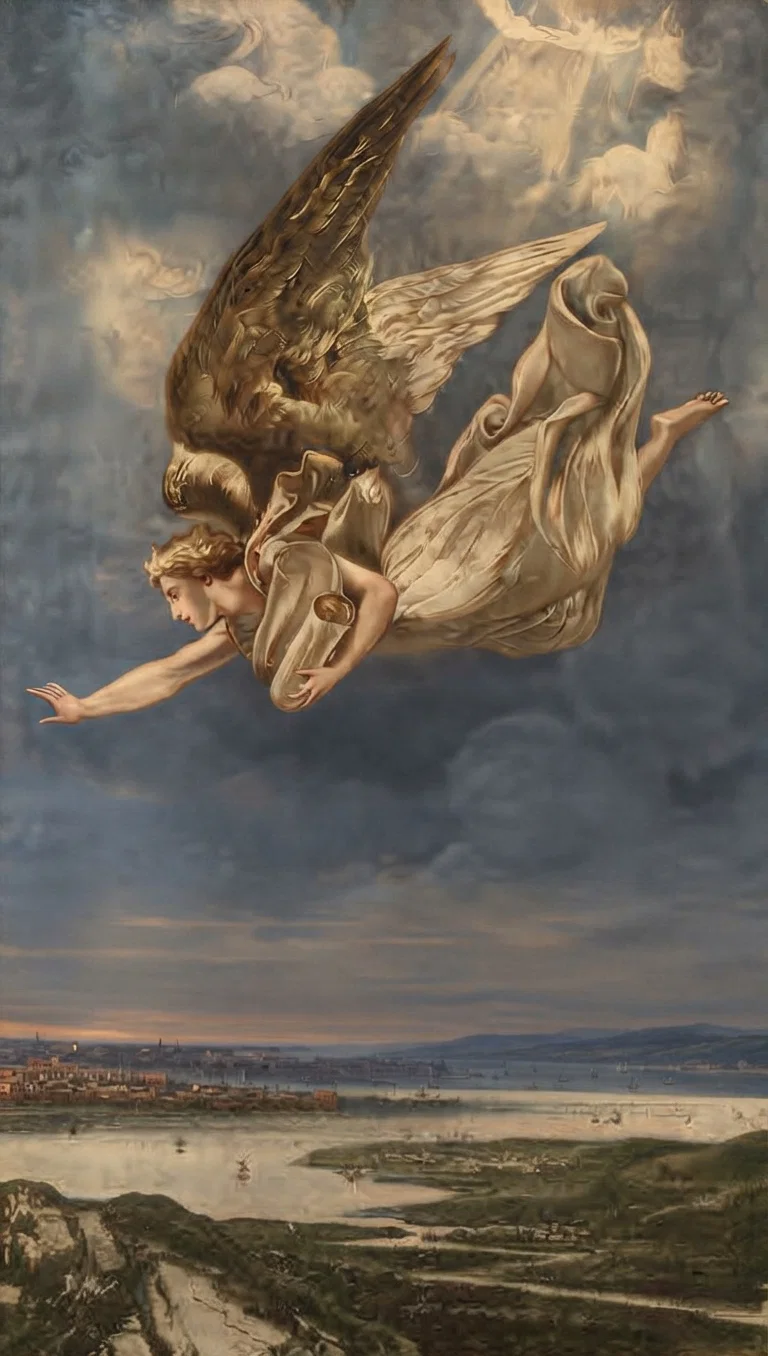
John writes of an angel which he saw flying "in the midst of heaven, having the everlasting Gospel to preach unto them that dwell on the earth, and to every nation, and kindred, and tongue, and people, saying with a loud voice, Fear God, and give glory to Him; for the hour of His judgment is come: and worship Him that made heaven, and earth, and the sea, and the fountains of waters.
"And there followed another angel, saying, Babylon is fallen, is fallen, that great city, because she made all nations drink of the wine of the wrath of her fornication.
"And the third angel followed them, saying with a loud voice, If any man worship the beast and his image, and receive his mark in his forehead, or in his hand, the same shall drink of the wine of the wrath of God, which is poured out without mixture into the cup of His indignation; and he shall be tormented with fire and brimstone in the presence of the holy angels, and in the presence of the Lamb."
These three angels represent the people who accept the light of God's messages, and go forth as His agents to sound the warning throughout the length and breadth of the earth. Christ declared to His followers, "Ye are the light of the world." To every soul that accepts Jesus, the cross of Calvary speaks: "Behold the worth of the soul. 'Go ye into all the world, and preach the Gospel to every creature.'" Nothing is to be permitted to hinder this work. It is the all-important work for this time, and it is to be far-reaching as eternity.
From the beginning of this world's history, there has been opposition between the forces of good and of evil. God declared, "I will put enmity between thee and the woman, and between thy seed and her Seed; it shall bruise thy head, and thou shalt bruise His heel." Man vainly attempted to exalt himself by following his own way, in harmony with Satan's temptation and in opposition to the will of God. He thus gained a knowledge of evil, but he gained it at the cost of his loyalty; and his disobedience opened the flood-gates of wo upon our world.
Ever since the fall of Adam, men have been trying to exalt themselves by the same means. When will they learn that the only way to true exaltation is the path of obedience? Men's plans may seem to them to be exceedingly wise, but there is no safety in following them unless they are in accordance with a "Thus saith the Lord."
THE EVERLASTING GOSPEL

Separate from the World

The Lord called out His people Israel, and separated them from the world, that He might commit to them a sacred trust. He made them the depositaries of His law; and He designed through them to preserve among men the knowledge of Himself. Through them the light of heaven was to shine out to the dark places of the earth, and a voice was to be heard appealing to all peoples to turn from their idolatry to serve the living and true God.
Had the Hebrews been true to their trust, they would have been a power in the world. God would have been their defense, and He would have exalted them above all other nations. His might and truth would have been revealed through them, and they would have stood forth under His wise and holy rule as an example of the superiority of His government over every form of idolatry. But they did not keep their covenant with God. They followed after the idolatrous practises of other nations; and instead of making their Creator's name a praise in the earth, they brought it into contempt.
Yet the purpose of God must be accomplished. The knowledge of His will must be given to the world. God brought the hand of oppression upon His people, and scattered them as captives among the nations. In affliction many of them repented of their transgressions, and sought the Lord. Thus scattered throughout the countries of the heathen, they spread abroad the knowledge of the true God.
In this day, God has called His church, as He called ancient Israel, to stand as a light in the earth. By the mighty cleaver of truth,—the messages of the first, second, and third angels,—He has separated a people from the churches and from the world, to bring them into a sacred nearness to Himself. He has made them the depositaries of His law, and has committed to them the great truths of prophecy for this time. Like the holy oracles committed to ancient Israel, these are a sacred trust to be communicated to the world.
Prophecy declares that the first angel would make his announcement to "every nation, and kindred, and tongue, and people." The warning of the third angel, which forms a part of the same threefold message, and is the message for this time, will be no less widespread. The banner on which is inscribed, "The commandments of God and the faith of Jesus," is to be raised aloft. The power of the first and second messages is to be intensified in the third. It is represented in the prophecy as being proclaimed with a loud voice by an angel flying in the midst of heaven, and it will command the attention of the world.
The most fearful threatening ever addressed to mortals is contained in the thirdangel's message. That must be a terrible sin which calls down the wrath of God unmingled with mercy. But men are not left in darkness concerning this important matter; the warning against the worship of the beast and his image is to be given to the world before the visitation of God's judgments, that all may know why the judgments are inflicted, and may have opportunity to escape.

A Dividing Message

In the issue of the contest, all Christendom will be divided into two great classes, — those who keep the commandments of God and the faith of Jesus, and those who worship the beast and his image, and receive his mark. Altho church and state will unite their power to compel "all, both small and great, rich and poor, free and bond," to receive "the mark of the beast," yet the true people of God will not receive it. The prophet of Patmos beholds "them that had gotten the victory over the beast, and over his image, and over his mark, and over the number of his name, stand on the sea of glass, having the harps of God," and singing the "song of Moses the servant of God, and the song of the Lamb."
The third angel's message increases in importance as we near the close of this earth's history. It is the last offer of mercy to the world, the most solemn message ever given to mortals. In heaven there is a record kept of the impieties of nations, of families, of individuals. God may bear long while the account goes on; calls to repentance and offers of pardon may be given; yet a time will come when the account will be full, when the soul's decision will have been made, when by his own choice man's destiny will have been fixed. Then the signal will be given for judgment to be executed.
The forbearance that God has exercised toward the wicked has emboldened men in transgression; but their punishment will be none the less certain and terrible for being long delayed. "The Lord shall rise up as in Mount Perazim, He shall be wroth as in the valley of Gibeon, that He may do His work, His strange work; and bring to pass His act, His strange act." To our merciful God the act of punishment is a strange act. Yet He will "by no means clear the guilty." By terrible things in righteousness He will vindicate the authority of His downtrodden law. The very fact of His reluctance to execute justice, testifies to the enormity of the sins that call forth His judgments, and to the severity of the retribution awaiting the transgressor.
All the inhabitants of earth are soon to meet the great Lawgiver over His broken law. There are many, many in the popular churches who know little of the real meaning of the message for this time. I appeal to them not to disregard the fulfilling of the signs of the times, which say so plainly that the end is near. O how many who have not sought their soul's salvation, will soon make the bitter lamentation, "The harvest is past, the summer is ended, and my soul is not saved!"
When will men learn that God is God, not man, and that He does not change? Every calamity, every death, is a witness to the power of evil and to the truth of the living God. The Word of God is life, and it will abide forever. Through all eternity it will stand fast. How can man, knowing what God is and what He has done, choose Satan's way instead of God's way? There is only one path to Paradise restored,—the path of obedience.

The Perpetuity of the Sabbath

By Prof. L. A. Reed

The Origin of the Sabbath

"The Sabbath was made for man." Mark 2:27. For man! The word is used in the general sense; for man; that is, mankind! It is not merely for the Jew, or the Babylonian, or the Egyptian, or the Greek; it is for man. The words are those of Christ; they are authoritative. The Sabbath was instituted for man when there was no division of mankind into races or languages; it is therefore the heritage of all mankind—the whole human race, with all that the words comprehend.
Consequently the Sabbath is not limited to place or time. It is limited only to man; so long as there is a man on the earth, for him the Sabbath institution exists. The only way to escape from the Sabbath is to cease to be a man.
Do you belong to the race of beings called man? If a human, then the Sabbath is for you, was made for you; and nothing in time or place can alter the fact.
But it is for you and not against you. In it there resides an eternal benefit for you.
Is this the way it seems to you? One can be in wrong relation to a thing, so that it appears an injury. For example, gravity can smash your head, if you get into wrong relationship with it; and yet every day of your life it works unceasingly for your personal benefit. It is so with all other ordinances of God,—transgress them, they punish; obey them, they bless.
The Sabbath was instituted in Eden before sin existed. It is one of the sacred ordinances left by an all-wise Creator for the blessing of His children ere sin was known. It is thus forever taken out of the category of things ceremonial or typical; it is not contingent upon sin or sin's conditions. It is a part of the original perfect creation, and consequently suggests nothing imperfect, temporal, or expedient.
The Sabbath is a memorial of creation, a weekly sign that God performed a miracle of work in a minimum of time, a symbol of His creative power. Nothing in all the after history of the world can ever alter that fundamental fact. The reason for the Sabbath lies in the nature of creation, and that can now never be removed. It stands as an eternal reality.
The institution of the Sabbath is the manifest origin of the week. In no other way can the existence of the week be accounted for. The week unimpaired has stood in all nations, through all past time, unchanged in all, synchronous in all, harmonious in all. Every seventh-day, as it comes round in the calendar of time, bears to all mankind its mute testimony of that first week in the history of the world, that short period in which God made all things by His unmeasured power. "For in six days Jehovah made heaven and earth, the sea, and all that in them is, and rested the seventh day: wherefore Jehovah blessed the Sabbath day, and hallowed it." Ex. 20:11. So long as the week lasts, so long necessarily the Sabbath as a part of it lasts also.

The Law of the Sabbath

The Sabbath is an integral portion of that great law which God Himself spoke from Sinai and wrote with His own finger miraculously upon the enduring stone. It is guarded by three commandments on the one side and six upon the other. It rests securely in the very bosom of that eternal law. "His ways are everlasting." Hab. 3:6.
Moreover, that law, written upon stone to endure through the ages, was not based upon local conditions or an expediency for a certain age alone. This is made clear in the assertion of Christ that it depends upon the two imperishable principles of love to God and love to man. "On these two commandments the whole law hangeth." The first four commandments of the law, which include the Sabbath, hang upon the one great principle of love to God; the other six depend upon the great principle of love to man. The Sabbath, being thus a part of the great moral and social code which the Creator framed for all mankind, belongs to every age and every clime.

In the Ages to Come

The Sabbath was given to man when there was no sin, and it will still be with man when sin has been removed. In Eden the Sabbath was given as the memorial of God's creative, upholding power. And in Eden restored it will again be found, still bearing its never-ending testimony to man of the power and care of the Creator. "And it shall come to pass, that . . . from one Sabbath to another, shall all flesh come to worship before Me, saith Jehovah." Isa. 66:23.
"The Sabbath was made for man."

Mountain Heights

FULFILLED and unfulfilled, the prophecies are mountains and valleys,—mountains from whose gilded summits you may look on vistas through the fog; straths of sunshine in the vapor-flood, where glorious things and gladsome stand revealed, whilst from the echoing sides of ravines still dark and misty comes up the heavy footfall or terrific cry of sorrows not seen as yet.—Dr. J. Hamilton.

The Seventh-Day Sabbath—Is It Still Binding?

By a careful reading of the scriptures which mention the first day of the week, we find that there is not a word of proof found in them for a change in the Sabbath from the seventh day of the week to the first day of the week.
They read as follows:
"In the end of the Sabbath, as it began to dawn toward the first day of the week, came Mary Magdalene and the other Mary to see the sepulcher." Matt. 28: 1.
"And when the Sabbath was past, Mary Magdalene, and Mary the mother of James, and Salome, had bought sweet spices, that they might come and anoint Him. And very early in the morning, the first day of the week, they came unto the sepulcher at the rising of the sun." Mark 16:1, 2.
"Now when Jesus was risen early the first day of the week, He appeared first to Mary Magdalene, out of whom He had cast seven devils." Mark 16: 9.
"Now upon the first day of the week, very early in the morning, they came unto the sepulcher, bringing the spices which they had prepared, and certain others with them." Luke 24:1.
"The first day of the week cometh Mary Magdalene early, when it was yet dark, unto the sepulcher, and seeth the stone taken away from the sepulcher." John 20:1.
"Then the same day at evening, being the first day of the week, when the doors were shut where the disciples were assembled for fear of the Jews, came Jesus and stood in the midst, and saith unto them, Peace be unto you." John 20:19.
The above are all the texts that mention the first day in the four Gospels. All refer to the same day, the resurrection day. They speak of the women's going early to the sepulcher, and of Jesus' appearing to His disciples in the evening at their place of abode (See Acts 1: 13), convincing them of His resurrection; but they contain not the slightest proof for a change of the Sabbath.
"And upon the first day of the week, when the disciples came together to break bread, Paul preached unto them, ready to depart on the morrow; and continued his speech until midnight." Acts 20: 7.
This scripture is entirely silent in reference to any change in the Sabbath. The breaking of bread upon a certain day does not prove it to be a Sabbath. We read that Christ instituted the Lord's Supper on the night of His betrayal, which was Thursday night. In reading verses 6 to 14, we find that the breaking of bread took place early in the day. Paul preached till midnight; and sometime between that and daybreak, he broke bread. When it came day (Sunday morning), he proceeded on his journey toward Jerusalem, going afoot to Assos, a distance of about twenty miles; which proves clearly that Paul and his companions did not regard the first day of the week as sacred time.
"Upon the first day of the week let every one of you lay by him in store, as God hath prospered him, that there be no gatherings when I come." 1 Cor. 16: 2.
This text says nothing about a change of the Sabbath. Setting apart, each week, a part of that which they had received of the Lord, for those who were in need at Jerusalem, was an individual work, and was the first matter to be attended to each week. The text reads, "Let every one of you lay by him in store." This shows the first day to be common time.
The foregoing are all the scriptures in the New Testament that mention the first day of the week; and they are silent concerning a change in the Sabbath, either in precept or example. Neither do they give to the first day of the week any sacred title whatsoever.
But how does the New Testament deal with the seventh-day Sabbath on this side of the crucifixion of Christ? We read of Christ's followers next day after the crucifixion that they rested, "and rested the Sabbath day according to the commandment." Luke 23: 56.
In foretelling the destruction of Jerusalem, Jesus said, "But pray ye that your flight be not in the winter, neither on the Sabbath day." Matt. 24: 20. So according to Christ's own words the Sabbath would continue down to the destruction of Jerusalem, which took place in A.D. 70, about forty years this side of the crucifixion.
And the writer of the Acts, in recording events which took place about thirty years this side of the crucifixion, speaks of the seventh-day Sabbath as a continuing institution. Notice the following:
"But when they departed from Perga, they came to Antioch in Pisidia, and went into the synagog on the Sabbath day, and sat down." Acts 13: 14.
"And when the Jews were gone out of the synagog, the Gentiles besought that these words might be preached to them the next Sabbath." Verse 42.
"And the next Sabbath day came almost the whole city together to hear the Word of God." Verse 44.
"And on the Sabbath we went out of the city by a riverside, where prayer was wont to be made; and we sat down, and spake unto the women which resorted thither." Acts 16: 13.
"And Paul, as his manner was, went in unto them, and three Sabbath days reasoned with them out of the Scriptures." Acts 17: 2.
"And he reasoned in the synagog every Sabbath, and persuaded the Jews and the Greeks." Acts 18: 4.
The weekly Sabbath is mentioned fifty-nine times in the New Testament, and everywhere it is spoken of as a continuing institution, precisely the same since the crucifixion as before the crucifixion. There is no difference.
The Lord calls the Sabbath "My holy day" (Isa. 58: 13); and the revelator says, "I was in the Spirit on the Lord's day." Rev. 1: 10. This was about A.D. 96, sixty-three years this side of the crucifixion.
The seventh-day Sabbath continues the same as when it was made, nearly six thousand years ago. And the very fact that it continues to exist, is in itself a positive proof that it is still binding. The fact that the Sabbath still exists, is a proof that the seventh day is still holy; and the seventh day's being holy, makes it binding. And in those who profess better things, yet knowingly desecrate the Sabbath, making no difference between the holy and the common, God is dishonored. Of some it is written, "They have put no difference between the holy and profane, . . . and have hid their eyes from My Sabbaths, and I am profaned among them." Eze. 22: 26.
Again the Lord says, "If thou turn away thy foot from the Sabbath, from doing thy pleasure on My holy day; and call the Sabbath a delight, the holy of the Lord, honorable; and shalt honor Him, not doing thine own ways, nor finding thine own pleasure, nor speaking thine own words: then shalt thou delight thyself in the Lord." Isa. 58: 13, 14. O. E. JONES. Hastings, Nebr.

The Crowning Day of Creation

At close of day on Friday eve, I paused to watch the setting sun. A hallowed bliss its rays did leave — Another week of toil was done. The lurid sky, enwrapped with awe, Bore witness to the Author's name When thunder-voice proclaimed His law On Sinai 'mid smoke and flame.
The holy glow immersed the sky, And lent the clouds a sacred hue; And there before my wond'ring eye Vast nature voiced praise justly due To Him who sanctified the day, Whose laws as He Himself endure Without a change to shade the way, Or mar His Word, steadfast and sure.
His rapt'rous praise echoes anew With each succeeding Sabbath day; The perfumed flow'rs and sparkling dew Reflect His smile in silent lay; And sweet their incense to the skies Ascend, to make His glory known; While birds on joyful wings arise, To laud their Maker on His throne.
Should man, creation's masterpiece, Not doubly hail the day with joy, And from his cares and labors cease, To find that rest his blest employ? Jehovah spake, "A sign 'twill be 'Twixt right and wrong; that men for aye May know His just sovereignty, I sanctify this seventh day."
The blessed hours to mortals giv'n, To hold communion with their God, Are mercy-sent to us from heav'n, To cheer our path while here we plod This mundane sphere of sin and wo; But when we tread the heav'nly shore,— Eden restored,—His day shall know Transgression's blot, no, nevermore. AMOS E. FLINT. Granger, Wash.

Declining "Opportunities"

WHEN the devil can not injure a man in any other way, he sometimes does so by persuading him to accept an opportunity for doing good. It is a great mistake to accept a call to do good when we could do better by leaving it alone. This truth is well brought out by a sentence in a letter from one of the most active and efficient Christian laymen in this country. In replying to one who had urged him to render a certain large and needed service to others, he replied, in declining, "I realize what an opportunity I am missing; and yet it seems right to miss even great opportunities for the sake of doing a little more thoroly a lot of things that I am already committed to and am in danger of doing inadequately." In such a decision lies the secret of many a man's greatest usefulness to God and men.— Sunday School Times.

Sin Is Selfishness

SIN is selfishness; it is self destruction; to continue in sin is to eventually commit soul suicide.
Continue reading: Our Bible Reading