Signs of the Times, Vol. 31, No. 36.

The City of God

Signs of the Times

Sep 15, 1914

Pacific Press Publishing Association · Mountain View, California · Sep 15, 1914

The City of God
By L. D. SANTEE
“Glorious things are spoken of thee, O city of God.” Ps. 87:3.
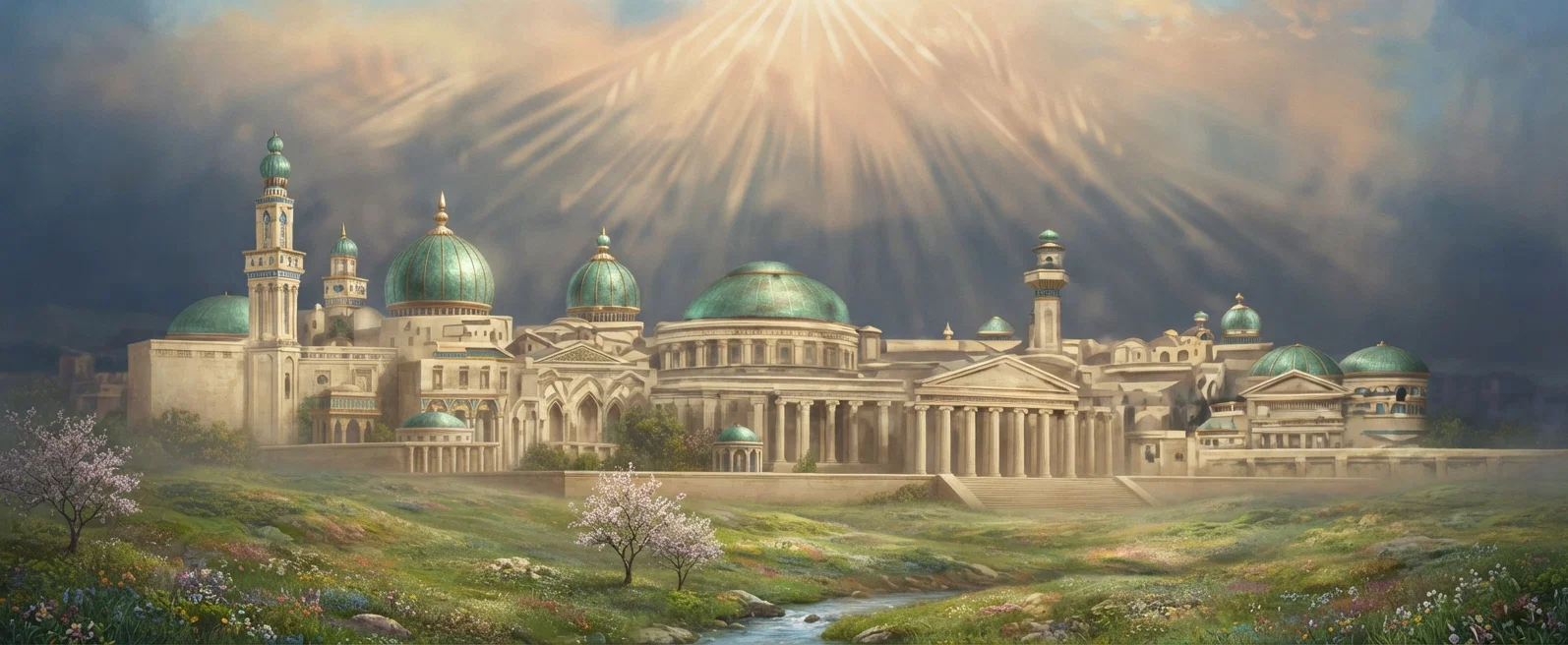
I THINK with delight of the city of God, Where sorrow ne'er enters, and sin never trod. Its wondrous foundations are rainbows unrolled, Its walls are of jasper, its streets of pure gold. Its pavements shall echo with cadence so sweet, To the rapturous march of the glorified feet. 'Tis the rest for the weary, where troubles all cease, Where the angels draw near on the white wings of peace.
There are moments, I think, when the spirit receives Pure thoughts from above on its unwritten leaves, When the depths of the soul for a moment unclose, Like leaves from the innermost heart of the rose. And such is the spirit that woos me to-day From the grossness of earth to the home far away; And fancy soars up on her beautiful wings, Where the tree of life bends, and where sweet blossoms spring.
I am weary of toil. I am weary of pain. But not long will the days of my waiting remain; For I know that the moments and hours, as they go, But shorten the time I shall linger below. And the thought of all others, to me the most dear, Is the blessed assurance, “The city is near.” And ever this thought all my being enfolds, I shall walk with the ransomed on pavements of gold.
I shall share in a gladness that tongue never told, When the Shepherd shall gather the lambs to His fold, And voices familiar, sweet voices I've loved, Shall join in the anthems of praises above. I shall clasp their dear forms, I shall look into eyes That shall smile into mine with a wondrous surprise, In the city of light, that fair city above. I shall meet, I shall greet the dear friends that I love.

Is the Catholic Church the Successor?

"The True Church in Both Testaments"—The Catholic and the Protestant Bible Teach the Same Thing By T. E. BOWEN
In Our Sunday Visitor (Roman Catholic), published at Huntington, Indiana, in its issue of July 26, 1914, under the title "The True Church in Both Testaments," the Rev. Joseph A. Berne makes an effort to show that the Catholic Church is the rightful offspring of the true church of the Old Testament, and he purports to do so "according to the Protestant Bible." The attempt is to show how the priestly service of the Catholic Church is the rightful successor on earth of priestly services of old, and hence is of divine origin.

THE SCRIPTURES QUOTED BY THE PRIEST

The reader may be interested to know what scriptures are set forth from the Protestant Bible to prove this claim. So we quote: "'The first covenant had also ordinances of divine service, and a worldly sanctuary.' Heb. 9:1. "'Then: The new covenant has also ordinances of divine service and a worldly sanctuary.'"

"WORLDLY SANCTUARY COPIED AFTER THE HEAVENLY PATTERN"

"Old Testament

"'See . . . that thou make all things according to the pattern showed to thee in the mount.' Heb. 8:5. "'All this, said David, the Lord made me understand in writing by His hand upon me, even all the works of this pattern.' 1 Chron. 28:19. "'Behold with thine eyes, and hear with thine ears, and set thine heart upon all that I shall show thee; for to the intent that I might show them unto thee art thou brought hither; declare all that thou seest to the house of Israel.' Eze. 40:4.

"New Testament

"'We serve [in the Protestant Bible, also in the Catholic Bible, it reads "Who serve" instead of "We serve"] unto the example and shadow of heavenly things, as Moses was admonished of God.' Heb. 8:5. "'Holy places made with hands are the figures of the true.' Heb. 9:24. "'Ye are come unto Mount Sion, and unto the city of the living God, the heavenly Jerusalem, and to an innumerable company of angels, to the general assembly and church of the first-born.'" Heb. 12:22, 23.
Following these scriptures, other scriptures are quoted from the Old Testament, showing heavenly manifestations of the acceptance of the tabernacle set up by Moses. But when it comes to the New Testament, only the scriptures can be cited which show the divine manifestations at Jesus' birth, the angels appearing to the shepherds, the star in the east, the transfiguration on the mount, and the descent of the Holy Spirit on Pentecost; all of which, as any one can see at a glance, wholly comes short of proving the assertions made in the opening premise regarding a worldly sanctuary on earth after Christ's death and resurrection.

THE CENTER AND PITH OF THE GOSPEL

This question raised by the Catholic priest is the very center and pith of the gospel; and instead of these scriptures proving what this man is attempting to prove by them, they prove the exact opposite, and forever sound the death knell of this whole system of a worldly sanctuary, its priesthood, etc., with all its rituals of service, this side the cross.
The apostle Paul, in his masterly argument to his Hebrew brethren, proves that God established their sanctuary service when He commanded Moses to build the tabernacle in the wilderness. He goes over it minutely, knowing that in doing so he raises no prejudice in their minds; for every true Israelite believed all this within his soul. But what was all this argument leading up to? What is the scheme of the whole book or letter? Was it that this tabernacle back there, with its offerings, its priesthood, its daily and yearly round of service, was typical of another such order to be established by Christ on earth?—Ah, no! The grand climax of it all is to prove that this earthly service simply served to the example and shadow of the heavenly service, which Jesus, our High Priest, entered upon when He ascended up on high.
The statement that "the first covenant had also ordinances of divine service, and a worldly sanctuary," is a correct quotation from the Protestant Bible; while the assertion and deduction of this priest, that "the new covenant has also ordinances of divine service and a worldly sanctuary," is not found in the Protestant Bible at all, nor in any other version. We do not suppose for a moment that he thought so, as no quotation marks are given, and no reference; but his readers, not having such a book as the Protestant Bible, and not being always keen on quotation marks, might innocently infer it to be a text. Christ is the center of the Bible. Salvation came to sinners in olden time, as now, through faith in the Son of God. Christ is in the Old Testament as truly as in the New. Luke 24:17-26. The Old Testament exalts the Christ to come, while the New Testament exalts the Christ that has come, and who is coming again the second time. The salvation of men depends upon knowing and following Him, in His work, His ministry, whether that be on earth or in heaven. As Moses lifted up the serpent in the wilderness, and persons were healed of the serpents' poison by looking to that, so Christ is now lifted up, that sin's sting may be healed by looking to Him.

WHERE DOES CHRIST MINISTER?

Now the vital question is, since Christ is through with the earthly sanctuary, where does He now minister,—on earth, or in heaven? If on earth, the papal arrangement might be right. If in heaven, it is all wrong, and consequently not of divine origin. To prove this, let us go to this same chapter in Hebrews from which this quotation is taken from the Protestant Bible, and read from the Catholic version itself, upon this very important subject. Verses 2-7 go on outlining the regular service of the priests in the earthly sanctuary, concerning which every Hebrew was conversant. There we read: "'The Holy Ghost signifying this, that the way into the holies was not yet made manifest, whilst the former tabernacle was yet standing. Which is a parable of the time present: according to which gifts and sacrifices are offered, which can not, as to the conscience, make him perfect that serveth, only in meats and drinks, and divers washings, and justices of the flesh laid on them until the time of correction.' Heb. 9:8-10. All this service was typical simply of the true that was to come. All this was leading up to the coming of the Messiah, getting the church ready for the true divine service Christ was to enter upon Himself in heaven, after His passion, to be based upon the merits of His own precious blood. But to go on, still reading from the Douay (Catholic) version: "'But Christ, being come an High Priest of the good things to come, by a greater and more perfect tabernacle not made with hand, that is, not of this creation: neither by the blood of goats, or of calves, but by His own blood, entered once into the holies, having obtained eternal redemption.' Verses 11, 12. And where is this holy place not made with human hands, of which the apostle is speaking? This quotation says it is not here, where hands of this earth, this creation, can build tabernacles. It is a greater than any of these, even than that made by Solomon, into which Christ Jesus, glorified, now enters.
But to settle this still more surely, let us turn back to chapter 8, still reading from the Catholic Bible: "'Now of the things which we have spoken this is the sum: We have such an High Priest, who is set on the right hand of the throne of majesty IN THE HEAVENS [capitals ours], a minister of the holies, and of the true tabernacle, which the Lord hath pitched, and not man [italics ours].'"

NOT ON EARTH

Forever, then, this settles it, as to where the services are carried on under the new covenant. The Catholic Bible, as well as the other translations, says they are carried on in heaven, by Christ Himself, and not on earth by man.
Roman Catholic priests are men. They are also on earth. Hence, according to this word of God, it is impossible for them to act as the priests for Christ, in any sense whatever, as did the priests in Aaron's time and on down to the cross. Jesus' work was then connected with this earthly tabernacle. He Himself dwelt in the holy of holies in the visible Shekinah of glory. But not so now. He ministers in heaven.
It is very evident, therefore, that this priest who opens the Protestant Bible to Hebrews 9 to try to prove that the Catholic Church is a divine successor of the Israelitish church established by God in the wilderness at Sinai, with its divine services, has opened at the wrong place, neither has he read very carefully his own Bible. The writer of Hebrews proves conclusively that the divine services of the earthly tabernacle closed forever on earth the very day Jesus, the true Sacrifice, expired on the cross; and that thereafter, so long as the gospel continues, and men receive the forgiveness of sins, services are transferred to heaven, where Jesus ministers in the tabernacle not pitched by man, of which the former, earthly tabernacle was an exact pattern.

IT WAS FORETOLD

It is very interesting to note that this very thing, this putting the earthly in place of the heavenly, has been foretold by the prophet. Suppose we read this also out of the Catholic Bible. It is found in Dan. 8:9-12: "'Out of one of them came forth a little horn: and it became great against the south, and against the east, and against the strength. And it was magnified even unto the strength of heaven: and it threw down of the strength, and of the stars, and trod upon them. And it was magnified even to the Prince of the strength: and it took away from Him [the Prince, Jesus] the continual sacrifice [which He was carrying on in heaven], and cast down the place of His sanctuary. And strength was given Him against the continual sacrifice because of sins: and truth shall be cast down on the ground, and he shall do and shall prosper.'"
Here is foretold exactly all this,—the turning aside of the attention of the people from Christ—the "strength of heaven," or the "Prince of the host," as rendered in the King James Version—who is ministering as man's High Priest in heaven, to an earthly service, to earthly priests, and to an earthly sacrifice in the hands of these priests—the mass.
That which interested Daniel was to know how long this perversion of the truth would be permitted to go on. In his hearing, two angels talked it over. Here is what they said. We still read from the Catholic Bible: "'And I heard one of the saints speaking, and one saint said to another, I know not to whom that was speaking: How long shall be the vision, concerning the continual sacrifice, and the sin of the desolation that is made: and the sanctuary [the true tabernacle, not pitched by man, in heaven], and the strength [Christ Jesus, its Priest] be trodden under foot? And he said to him: Unto evening and morning two thousand three hundred days: and the sanctuary shall be cleansed.' Dan. 8:9-14.
This longest prophetic period mentioned in the Bible ended in 1844. It is a very remarkable truth that at just this time exactly, light upon this whole perversion of the sanctuary service burst in upon the minds of many devout Christians. A door, so to speak, was opened, and some by faith entered with Jesus into it. This beautiful truth that is given us in Hebrews they saw,—that Jesus was their High Priest, ministering for them in heaven. This light has been flooding the world ever since, in increasingly steady rays. Men have tried to shut this door which Jesus Himself opened, but have been unable to do so. And to-day it is salvation to look to Him there, rather than to look for cleansing from sin to any man here on earth.

YOUR HOUSE LEFT DESOLATE

As Jesus left the temple the last time, He said, "Behold, your house is left unto you desolate." Matt. 23:38. The hour He perished upon the cross, the veil of this same earthly temple, separating the holy from the most holy, was by unseen hands rent asunder. "Jesus, when He had cried again with a loud voice, yielded up the ghost. And, behold, the veil of the temple was rent in twain from the top to the bottom." Matt. 27:50, 51. Forty days after His resurrection, Jesus ascended to heaven, and the disciples saw Him go. Acts 1:1-8. Ten days after this, He began His ministry in the true tabernacle in heaven, of which the earthly was an exact pattern; and on that very day He sent down the Holy Ghost upon the disciples, "this signifying, that the way into the holiest of all" was now made manifest, superseding all Jewish earthly sacrifices, as well as all priestly services on earth by any one else.
The invitation to all sinners now is, to come to Him. "Seeing then that we have a great High Priest, that is passed into the heavens, Jesus the Son of God, let us hold fast our profession. For we have not an High Priest which can not be touched with the feeling of our infirmities; but was in all points tempted like as we are, yet without sin. Let us therefore come boldly unto the throne of grace [by faith], that we may obtain mercy, and find grace to help in time of need." Heb. 4:14-16.
Let us do it. Jesus ever lives, and so needs no successor as priest. According to His own word, we down here are brethren of His, servants, meekly to follow in His footsteps and do His will.

At the Name of Jesus

Showing Mercy and Kindness — He Forgives Sins, and Fits Us for the Joys of Eternity — The Songs of Triumph

By FRANCIS MONROE BURG
"The law and the prophets were until John: since that time the kingdom of God is preached, and every man presseth into it." Luke 16: 16.
The name announced before the birth of Bethlehem's Babe was Jesus: "And thou shalt call His name Jesus: for He shall save His people from their sins." Matt. 1: 21.

The Only Name

"Neither is there salvation in any other: for there is none other name under heaven given among men, whereby we must be saved." Acts 4: 12.
"Sweetest note in seraph song, Sweetest name on mortal tongue, Sweetest carol ever sung,— Jesus, blessed Jesus."
The disposition to forgive an offender and to extend mercy toward an enemy, to love those who have done us a wrong, and to do them good, is the highest and most charming grace that can be exhibited. He was called Jesus because "He shall save His people from their sins,"—because of His disposition to forgive sins, and to do good toward His enemies. In this is His claim to recognition as the One whom God sent, and who came to reconcile the world to God again. "To wit, that God was in Christ, reconciling the world unto Himself, not imputing their trespasses unto them." 2 Cor. 5: 19.

Showing Mercy and Kindness

The disposition to show mercy toward the sinful and erring is the characteristic of Jehovah which distinguishes Him from all the gods that claim the recognition and the devotion of men. Says the psalmist: "For Thou, Lord, art good, and ready to forgive; and plenteous in mercy unto all them that call upon Thee. Give ear, O Lord, unto my prayer; and attend to the voice of my supplications. In the day of my trouble I will call upon Thee: for Thou wilt answer me. Among the gods there is none like unto Thee, O Lord; neither are there any works like unto Thy works. All nations whom Thou hast made shall come and worship before Thee, O Lord; and shall glorify Thy name. For Thou art great, and doest wondrous things: Thou art God alone." Ps. 86: 5-10.

Pardoning Iniquity

Micah exclaimed: "Who is a God like unto Thee, that pardoneth iniquity, and passeth by the transgression of the remnant of His heritage? He retaineth not His anger forever, because He delighteth in mercy." Chapter 7: 18.
Moses declared the name of Jehovah when he said, "The Lord, the Lord God, merciful and gracious, long-suffering, and abundant in goodness and truth, keeping mercy for thousands, forgiving iniquity and transgression and sin, and that will by no means clear the guilty." Ex. 34: 6, 7.

Peace and Good Will

So when the Child was born who was called Jesus, an angel choir came down fromheaven and sang over the plains of Judea, "Glory to God in the highest, and on earth peace, good will toward men." Luke 2: 13, 14. That wonderful song, which broke the stillness of the freighted night, has reverberated throughout the vast creation of God, showing that One alone among all the gods can claim the reverence and devotion of men,—the One whose attitude toward His creatures is one of devotion, of love and good will.
The story of His goodness in the everlasting gospel has led many to repentance, and will continue to win the love and devotion of men till a host as numberless as the sands of the sea shall join with David, one of the chief of sinners, who was saved by His grace, to tell the story of His goodness and His mercy "throughout all generations." "I will sing of the mercies of the Lord forever: with my mouth will I make known Thy faithfulness to all generations." Ps. 89: 1.

Endless Songs of Gratitude

In all the eternal years, those who have been forgiven by His grace, and who have tasted of His mercy and goodness in the forgiveness of sins, will give vent in endless song to their gratitude to Him who purchased their redemption at infinite cost. "God, who is rich in mercy, for His great love wherewith He loved us, even when we were dead in sins, hath quickened us together with Christ, (by grace ye are saved;) and hath raised us up together, and made us sit together in heavenly places in Christ Jesus: that in the ages to come He might show the exceeding riches of His grace in His kindness toward us through Christ Jesus." Eph. 2: 4-7.

A Vision of the Great Host

A vision of that great host of the redeemed, singing their song of praise, was given to the seer of Patmos: "And I beheld, and I heard the voice of many angels round about the throne and the beasts and the elders: and the number of them was ten thousand times ten thousand, and thousands of thousands; saying with a loud voice, Worthy is the Lamb that was slain to receive power, and riches, and wisdom, and strength, and honor, and glory, and blessing. And every creature which is in heaven, and on the earth, and under the earth, and such as are in the sea, and all that are in them, heard I saying, Blessing, and honor, and glory, and power, be unto Him that sitteth upon the throne, and unto the Lamb forever and ever." Rev. 5: 11-13.
May the readers of this paper become acquainted with Him who is called Jesus, who "is faithful and just to forgive us our sins, and to cleanse us from all unrighteousness." We should seek for the "spirit of wisdom and revelation in the knowledge of Him." Eph. 1: 17. It is not enough to know of Him historically, nor will it avail for us to have a mere theological belief in Him. No one is acquainted with Jesus who does not know Him in an experimental way as a Saviour from sin and its power. To such a person, He is the chiefest among ten thousand, and the One altogether lovely.

The Sin Against the Holy Spirit

"The most common manifestation of the sin against the Holy Spirit, is in persistently slighting Heaven's invitation to repent. Every step in the rejection of Christ is a step toward the rejection of salvation, and toward the sin against the Holy Spirit."

May Sell Ice-Cream—Crime to Sell Bread

Liberty-Demolishing Law Proposed by the Initiative in California—Would Make Us Criminals for Doing Useful Works on Sunday
By WILLIAM MAYHEW HEALEY
LIBERTY and equal rights, so long enjoyed in California, are threatened with destruction by two initiative measures to be voted on at the general election November 3, 1914. One of these measures is entitled "An act to provide for one day in seven as a day of rest." Subsections 3 and 4 of section 2 of this measure declare that it shall be unlawful on Sunday to keep open any store or place of business where goods or any property is offered for sale, or to sell or offer for sale any property on Sunday; and forbid labor for profit on Sunday in any mine, mill, factory, bakeshop, workshop, studio, or other similar place of business or work.
Section 3 imposes a penalty, for violation of the act, of "not less than ten dollars nor more than two hundred dollars," or imprisonment "in the county jail not to exceed thirty days, and upon each subsequent conviction, both said fine and imprisonment."

A LIST OF EXEMPTIONS

There is given in section 2 a long list of exemptions from the penalties of the proposed law, because they are "works of necessity." Among these exemptions are "hotels, boarding-houses, restaurants, lunch stands, cafes, and work incidental thereto; ice-cream parlors"; "sports, theaters, and amusements"; the preparation and sale of Sunday newspapers; "the sale and delivery of milk or cream, and unavoidable work in making cheese or butter." It exempts all railways, and every public utility, with every kind of transportation, and the use of water in mining or irrigating where the flow is not continuous.
The following exemption is made under k: "And provided, further, that the above subsections numbered 3 and 4 do not apply to any person who is a member of a religious society which observes some other day than Sunday as its day of worship, and who actually keeps his place of business or occupation closed and does not work for gain or wages upon said day of worship."
This measure proposes to establish Sunday by law as the day of rest and worship, and to enforce it upon the people by fines and imprisonment.

UNDER STRICT RULES AND REGULATIONS

Any person desiring to keep any other day is only permitted to do so under strict rules and regulations that are not imposed upon Sunday keepers. His day having no legal standing, like Sunday, he has no protection from the annoyance and encroachment of others upon his rest. He is denied the right of individual choice of a rest day, but is compelled to accept some day that others have accepted in sufficient numbers to form a society, of which he must be a member. He is positively forbidden to do any work for "gain or wages" on the day which he observes, while the Sunday keeper is allowed to labor on his chosen day of rest in a large number of industries as "works of necessity." If the Sunday keeper may sell ice-cream or conduct a theater on Sunday as "works of necessity," why should not the person who observes some other day have the same legal right to perform any of the "works of necessity" named above for gain or wages on the day of his choosing, provided he shall desire so to do?
All these discriminations in favor of Sunday keepers are violations of the constitution of the state of California, which declares that "the free exercise and enjoyment of religious profession and worship, without discrimination or preference, shall forever be guaranteed in this state." (Article 1, section 4, constitution of California.)

WOULD DESTROY OUR RIGHTS

To change this article of our constitution, or to override its plain declaration of liberty, would be to destroy the rights of the citizen guaranteed by the fundamental principles upon which our government is founded.
The supreme court of California has decided that "the enforced observance of a day held sacred by one of the sects is a discrimination in favor of that sect, and a violation of the freedom of the others." (Volume 9, page 502, California Reports.)
The injustice of this proposed law is proved by the large number of exemptions which its advocates are compelled to make. The law, being of itself a violation of the principles of justice, can have no just application to any person or thing, because an unjust law can have no just application. If a daily paper has a right to be published and sold on Sunday, a weekly or triweekly is entitled to the same right. This measure gives special privilege to the daily publication.
This proposed law allows theatrical managers and performers to work for gain on Sunday, and sends a man to jail for doing useful work.

MAY SELL ICE-CREAM, BUT NOT BREAD

The sale of ice-cream on Sunday is made legal; and by the same law, a person is declared a criminal if he opens his bakeshop on the same day to sell a loaf of bread.
The lunch stand is allowed to sell food all day Sunday, while the grocer may be fined $200 for opening his store to sell a nickel’s worth of crackers.

ALSO AN EIGHT HOUR LAW

Section 2, subsections 1 and 2, of this proposed law, forbid hiring or being hired to labor "more than six days in any calendar week of seven days." Subsection 4 contains an exemption to this as follows: "And provided that the above subsections numbered 1 and 2 do not apply to any person whose total hours of labor during seven consecutive days do not exceed forty-eight hours."
This exemption allows labor on every day of the week, provided the total hours do not exceed forty-eight in seven consecutive days. This would conflict with another proposed measure, on the ballot, which allows but eight hours of labor in any one day. It also utterly destroys the provision demanding Sunday rest.

INTERFERES WITH NATURAL RIGHTS

This proposed law regulating the free citizen’s private affairs of labor and rest, is an unwarranted interference with natural human rights and personal liberty, depriving him of his God-given freedom to the use of his own time and the choice of his own religion.
It deals with free men and women as though they were convicts, slaves, or wards of the state. With equal propriety the law could determine when and what a person should eat, and fix the time to retire at night and rise in the morning.
Both the "eight hour" and the "rest day" measure would subject employers to constant loss, vexation, and annoyance. Especially would this be true in agricultural industries, which totaled $371,000,000 last year in California.
It is practically impossible for the farmer, the dairyman, and the fruit grower to bring their work into any exact number of hours each day or week. The provisions of "necessity" and"emergency" are subject to a wide range of interpretation and opinions.
The farmer or fruit grower, fearing rain, may work his help over legal time as an "emergency," while the complainant or prosecutor swears there was no rain and no "emergency."

INCONSISTENT WITH ITSELF

Like all Sunday and religio-civil laws, this measure is inimical to justice, inconsistent with itself, and contrary to every true American and Christian principle of equality and liberty.
This proposed law, in section 4, makes it the "special duty" of officers of the law to prosecute without actual proof of the violation of the law, but on "credible information," or — still worse — on "reasonable cause to believe that there has been any such violation." Of course it is for the informer to decide what is a "reasonable cause to believe."
The discriminations of this proposed law open the way for "busybodies in other men's matters" to establish a system of espionage upon those who observe some other day than Sunday. Besides this, every vote for this proposed Sunday measure is a vote for an eight hour law in disguised form. Then vote against all these unjust, meddlesome, mischief-making propositions, and leave all free to contract their own time of work, to determine their own days and hours of rest, and to choose their own religion.
Continue reading: The Making of the Sabbath