Notwithstanding Peace Congresses, notwithstanding all the mighty efforts that able men are putting forth for peace, notwithstanding earnest prayers which are offered for the same purpose, the preparation for war still goes on, and must go on until the great battle of Armageddon is fought.
It was not a demand for war which the Lord made by His prophet eight hundred years before Christ. He is not stirring up the spirit of war. The prophet simply uttered what would be manifest throughout the world:
“Proclaim ye this among the nations; Prepare war; stir up the mighty men; let all the men of war draw near, let them come up. Beat your plowshares into swords, and your pruning-hooks into spears: let the weak say, I am strong. Haste ye, and come, all ye nations round about, and gather yourselves together: thither cause Thy mighty ones to come down, O Jehovah. Let the nations bestir themselves, and come up to the Valley of Jehoshaphat: for there will I sit to judge all the nations round about.” Joel 3:9-12.
Note also that this is in the harvest-time of the earth; and Jesus says, “The harvest is the end of the world.” Matt. 13:39. Note, too, that the culmination of this great strife is at the very beginning of the day of the Lord, when all the nations of the earth are in “the valley of decision” over the mighty moral questions which are facing humanity at the present time.
There is a tendency, in a great nation, to rest quiet and at ease. That is especially true in the United States; and yet just as soon as the United States went outside of its own boundary, purchased Alaska, not geographically connected with its own home domain, took possession of Hawaii, conquered and possessed the Philippines, it launched itself as a great world power, and these possessions demanded that it too should become a great warlike power among the nations.
A mighty display the United States made in her cruise of sixteen battle-ships around the world; and most Americans thought that with such a fleet as that, we could conquer the nations. And yet America’s condition at the present time is what General Homer Lea calls “the valor of ignorance.”
Three very strong, convincing articles have already appeared in “Harper’s Weekly” by the gentleman named. These articles go to show the “vulnerability of the United States to armed invasion.” He considers the Pacific Ocean, and declares that the United States, having the possessions that it does in that body of water, must maintain them or lose all that it possesses outside of the United States itself. This Government holds in its nominal possession the great strategic points of the Pacific—Alaska, Hawaii, Tutuila, and the Philippines.
General Lea declares that Japan, an insular kingdom, covets all these possessions and feels that she must be the ruling power in the Pacific; that her labor for some years has been with that purpose in mind. Eight years ago she conquered China as a Pacific power. Four years ago she forever shut Russia from the Pacific. When the United States seized the Hawaiian Islands there was no protest raised on the part of any of the nations except Japan. But Japan entered her protest, “and notified the American Government that she would not then or at any time in the future acquiesce in the control of the Hawaiian Islands by this nation.” “Years have now passed, but the protest of Japan has never been withdrawn, nor have preparations to bring about in due time its enforcement ever ceased. This Republic may forget, or after its conquests sleep; but in that Silent Pentagon (the Genro, or Five Elder Statesmen) where rest together the scepter of the Mikado and the sword of the samurai, there is no forgetfulness, and in their slumbers—dreams.”
General Lea connects with his articles a map of the Pacific, and shows how exceedingly important are all these strategic points to Japan, how that without them she must inevitably fall. Once in her possession, it is almost an impossible thing to wrest them from her; and yet the United States Government seems to feel, we are told, that the mere fact of having possession of these strategic points is sufficient, though they are unfortified, unmanned, an easy prey to a power like the Japanese.
He also tells us that the increase of population in Japan demands some other outlet. Her little islands are overcrowded. On the other hand Europe is becoming overcrowded. Europe has within its borders the greatest nations of the world, nearly a quarter of its population, and yet less than one twelfth of the world’s land. Japan is greater in population than the United Kingdom, and pos- sesses only one two hundred fiftieth part of the earth’s surface, while the suzerainty of the United States extends over one fourth of the earth’s surface. Within that suzerainty are included not simply its own dominions, but the South American continent as well. For it is contended that America is as determined that the Monroe Doctrine shall be upheld, as it is that the Constitution shall be maintained. Yet these possessions which are to a greater or less extent under the protection of the United States, are marvelously rich and of sparse population as compared with the Old World. And General Lea truly remarks:
“How unreasonable it is to contend that the combined nations of Europe, with all their military strength, shall remain restricted to one twelfth of this world’s land, burrowed into and hewn over for the last thousand years, while this Republic, without armies, shall maintain dominion over one half the inexploited lands of the world; or that Japan, possessed of two thirds the population of this nation, the military organization fiftyfold greater, shall continue to exist on her rocky isles, that are, inclusive of Korea, but one two hundred fiftieth of the earth’s lands; while an undefended one half lies under the guns of her battle-ships.”
He declares that while the probabilities of an international war at the present time tend more to a struggle with Japan than with any other country, the chances of war are equally possible with other powers, and are existent in a modified form with still other nations.
Then are pointed out the disadvantages of the United States with all the strength of her navy on the Atlantic seaboard. It is also shown that Japan is now supreme in a military and naval sense on the Asiatic Coast north of Hongkong. By her alliance with Great Britain, the elimination of the British power in the Pacific has been accomplished, subtly. There remains only one power for Japan to deal with, and that power is the United States.
In order that Japan may control the Pacific, it is necessary that she should possess the Philippines and the other points of strategic values which have been named.
“With the Philippines in the possession of Japan, the dominion of European powers in Asia and the Pacific seas ends, and ends forever. By the time England’s alliance with Japan ceases, her fortresses in the far East will possess for her no value other than what affection may still hold for ruins, and ambitions that are no more.”
It is argued further, and clearly, that if Japan is going to maintain her supremacy, the Philippines must be in her possession. Comparison is made between the navy of the United States and the navy of Japan, in statistical tables. In vessels and tonnage the navy of the United States ranks third, and Japan fifth; but measured by real effective service, Japan’s navy is superior. While the United States has more battle-ships than Japan, she is greatly inferior in armed cruisers and torpedo craft. Then, too, since Japan conquered Russia she has built a new type of battle-ship equal to any three battle-ships now in the American navy; so that while the American battle-ships exceed in11number those of the Japanese, the latter possesses nearly forty per cent more big guns.
In men Japan is greatly superior. Captains are not commissioned in this country until they are 56 years of age. In Japan the average is 38—a difference of nearly 20 years in which to give good service for the country. Captains in the American navy have only four and one half years in this grade, and in Japan they have eight,—twice as much experience. In the American navy Rear-admirals are not commissioned until they reach the advanced age of 60; in Japan they receive this rank at 44. American sea-going flag-officers only pass 1½ years in this grade; in Japan such officers are on duty for 11 years. Japan constructs a 20,000-ton battle-ship of the new type in two years, and an armored cruiser in less time. In the United States, over 5 years is required to build a 16,000-ton battle-ship, and 5 years and 2 months to build an armored cruiser.
We are also told that in Japan the army and navy are beyond the reach of politics. Changes in the Japanese cabinet do not affect the ministers of war and navy. They are free to take action and immediate action, change types of ships whenever such change is necessary, and the Japanese army and navy have immediately responded to all changes demanded. This all know is not so in America.
The Struggle on Land
The conclusion this critic comes to after a due comparison of the forces which might be called into action at the present time on each side, is that the United States would have no hope whatever of holding what she has already nominally in her possession in the Pacific, or of recovering them if they were once in the power of Japan; but he contends that while the navy will be a strong incident in the war of the future, the struggle will be fought out by land armies after all. All wars have been, and so in the future will be, determined by land warfare. So he contends that war between the United States and Japan will be upon land. A comparison is made between the forces of the two powers. Japan could almost immediately, we are told, place in the field a million and a quarter of men, all of whom have had three years’ training in the regular army, and over eight hundred thousand of whom had the experience of from one year to a year and a half on the battle-fields of Manchuria.
The officers of these forces are technically trained in military science. The American army in time of peace is limited to 100,000 men, but that force is reduced to less than 50,000. In case of an attack on the Pacific Coast, the United States could not mobilize an army or a field force of 20,000 men, while 600,000 would be necessary.
It took the United States two months to find transports for the few troops that were sent to the Philippines. If now it should utilize the eight American transpacific steamers that constitute the entire American merchant marine in the Pacific, it would require two years to transport 100,000 troops to the Philippines. To oppose their landing, a force no larger than the capacity of the transports per voyage would be necessary.
The utter lack of auxiliary vessels was manifest when in 1907 the 16 American battle-ships were convoyed by 28 vessels flying foreign flags, and yet without them the American battle-ships could not have steamed beyond the sphere of their Atlantic bases. On the other hand, the Japanese transport fleet consists of a hundred steamers, which can transport at one time 200,000 men with their entire equipment. These men would be able to reach the Philippines in 5 days; Hawaii in 14; the coast of California in 22; the coast of Alaska, Washington, and Oregon, in less than 20.
The coast defenses of the United States, we are told, consist of 67 forts, defending 28 harbors; but according to the report to Congress in 1906, 268 batteries were out of commission, and only 124 in commission; of 1,100 guns employed, only 390 could be brought into action. To fully man these 67 forts, requires 1,634 officers and 40,675 men; but for these there are now available only 357 officers and 10,700 men. The regular army is 30 per cent below the minimum required by law, and the percentage of deficiency in officers is very much greater.
Then regarding the “moral” quality of the armies: It is rightly pointed out that desertions show something of the loyalty of an army. In Japan desertions are unknown. In the United States during 1906 there occurred in the national army of only 60,000 men, 6,280 desertions.
Regarding the physical standing of the armies: In the American Civil War more than 4 men died from preventable sickness to every 1 killed. In the Spanish-American War, 14 died of disease to 1 on the battlefield. In the Japanese army during the Russian War, 4 deaths resulted from bullets to 1 from sickness. If the ratio of the Civil War should be maintained in a war between Japan and the United States, for every ten thousand American soldiers killed on the field, more than 40,000 would die from preventable sickness; while for every 10,000 Japanese killed, only 2,500 would die from disease. Should the total deaths on the battle-field during the war amount to 50,000 for each nation, the American casualties from disease alone would be more than 200,000; while the Japanese losses would amount to only 12,500.
But should America’s later war—the Spanish-American—form the basis for comparison, the total American losses from disease would amount to 700,000 as against 12,500 Japanese.
Under the present military system of the United States, there could not be mobilized in any one place a field army of 19,000 regular soldiers, in the same period of time that Japan would employ in getting ready an army of half a million veteran troops. For the United States to enlist, equip, and train to the same degree of efficiency a similar force, would require not less than three years.
We have not presented all of the striking comparisons which General Lea has made, by a long way. Nor have we pointed out many other things which are perfectly obvious to the careful and thoughtful reader. He certainly shows that the United States must relinquish her position as a world power, confining herself wholly to the boundaries of the United States proper, or she must place her army and navy in that position where she is able to control the Pacific on the one side, and to meet any power which might come against her from the European side of the Atlantic.
But this means preparation for war, and that will mean greater preparation for war on the part of other powers in the world. It is strange that thoughtful Christians can not see in the prophecies which God has given in His Word concerning this very time, evidences that we are nearing the end. It is not alone in Joel that we are told this, but Jeremiah teems with warnings of the very times in which we live; and in the 16th chapter of Revelation we are told that the spirits of demons are going throughout all the world to prepare the world for the battle of the great day.
We are faced by the great fact that the nations have entered the contest; and from a purely political point of view, a world point of view, the point of view of the natural heart of man, there is no drawing back. Men may talk peace, but there is no peace, and this is just what the Word of God tells us; and it also warns us that the cry of peace which will be raised even throughout the world, by “many people” and “many nations,” is a false cry which will issue in the great battle of Armageddon. Yet God calls His children to peace, and reveals to them the only true, encouraging outcome of it all, and that is the second coming of our Lord Jesus Christ, the Prince of Peace, and the eternal inheritance of peace which lies beyond.
The Government Beaten.
The Panama libel suit which Mr. Roosevelt's administration brought against Delavan Smith and Charles R. Williams, proprietors of the Indianapolis News, summoning them to appear in the District of Columbia and answer to a charge of criminal libel, was decided October 12 by Judge A. B. Anderson of the United States Court. The indictment was that these men had committed a criminal libel in publishing articles alleging there was a corrupt profit of $28,000,000 in the sale of the Panama Canal to the United States. Judge Anderson closed his argument by saying that “men have read the history of our institutions to little purpose who do not view with apprehension the success of such a proceeding as this; to the end that citizens could be dragged from their homes to the District of Columbia, the seat of Government, for trial under the circumstances of this case. The defendants are discharged.”
He regretted that his time was so filled that he could not spend more time and write at greater length upon such an important decision. The judge held that if a newspaper were guilty, a thing that he questioned in the case under consideration, there was but one crime, not many crimes. That crime was not where each individual paper circulated, but it was where the entire edition was published; consequently, the District of Columbia, the city of Washington, or any other locality where the newspaper circulated, had no jurisdiction over the defendants. They must be tried where their office of publication is located. What will be done by the Government now, we do not know. If wisdom prevails, the case will be dropped forever. At least, so it seems to many.
President Taft’s Toast
President Taft sent the following toast for the San Francisco Portola Festival: “Since Portola looked through the Golden Gate on the descending sun, San Francisco has twice become the imperial city of the Pacific; first, by the energy of a pioneer race and steady growth into the Western metropolis; second, after complete destruction by the greedy flames and in the face of insurmountable obstacles, by regeneration as rapid and complete as to be the wonder of the world. May her future growth be as remarkable as her past, and may her civic righteousness and the individual happiness of her citizens keep pace with it.” San Francisco ought to drink it in the purest of water. She will drink it in blood-red wine and stronger drink.
Harriman's Successor.
The successor to E. H. Harriman as railway king is Edwin Hawley. He already, we are told, has great interests in California. It is thought, with the backing behind him, he will build up a vast railroad system that will probably overshadow even the Harriman system.
The Trend
By Editor
The Trend.—A late Bible dictionary, plentifully interspersed with the infidelity of Higher Criticism, receives, according to its publishers’ circulars, the highest praise from Sunday-school workers. We are sorry.
It's All Right.
The Post-office Department decides that a carrier is not obliged to deliver mail at a house where a vicious dog is kept.
Spiritualism in China
By Percival J. Laird
Boys in the China mission field, as elsewhere, are sometimes marred by deep sorrows. And yet the latter are but channels to lead the soul to a deeper faith in God, less reliance on self; and moreover, to give the worker with God new insights into Chinese life hitherto unknown. Thus are opened up new fields for sympathy and prayer. Such is the case of a petty official at Changsha, of whom at one time much was expected.
His mother, a widow, is notorious for her frequent paroxysms of anger. This led her two sons cowardly to put away their wives for the sake of peace. Confucius never inculcated the Edenic teaching, “Therefore shall a man leave . . . his mother, and shall cleave unto his wife.” Hence it is not surprising to find his followers think these two sons able exponents of “filial piety.” But later the elder son’s wife fell very sick. The ordinary Chinese treatment proved unavailing, and as she grew much worse, her husband was induced, as a last resort, to seek one who had “a familiar spirit,” and obtained a satanic written prescription. This was also ineffective, and the poor woman’s unhappy married life ended. In spite of many exhortations to abstain from such a course of action, this man began to study the spirit writings for himself. As a result he has now become a most popular spirit medium. At times, what purports to be his deceased father’s spirit attends the seances, and writes most uncomplimentary and condemnatory messages for the widow mother. Nevertheless, the son still walks in fear and dread of her violent temper.
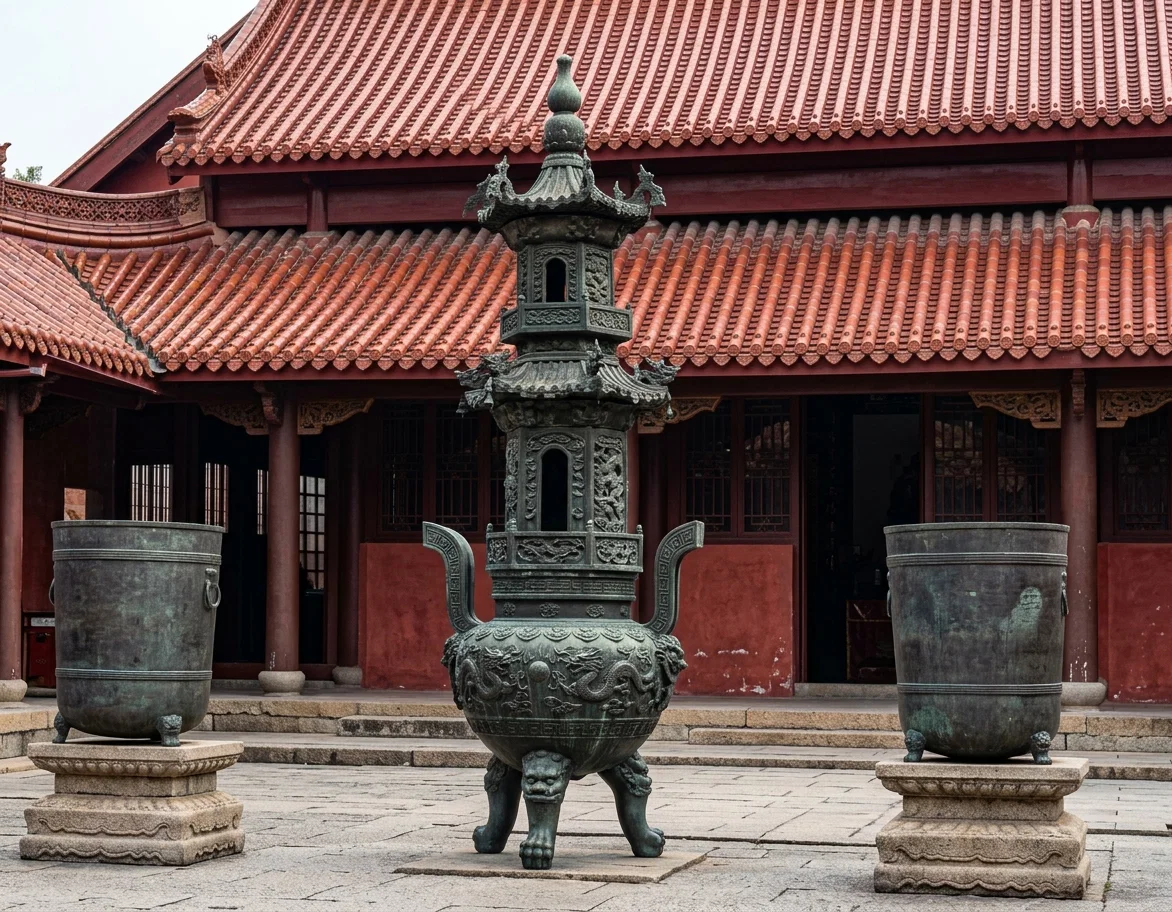
Incense Urn in Temple Court
Yochow, from Tung Ting Lake, Province of Hunan. The Temple is the high building above the white cross.
In China, where ancestral worship “makes dead men into gods, and its gods are only dead men,” these spiritualistic seances have been held for centuries. But in these latter days they have become more prominent at this center, as have those on the other shores of the Pacific Ocean. The seances are held about midnight, and at intervals of a few days. The medium presents his questions orally, but the replies are always made in writing. For this purpose a good supply of ink is prepared beforehand, and a Chinese pen-brush is tied to the single end of a forked peach-branch. Inasmuch as the satanic messages are in the high classical language, the mediums, of necessity, are confined to the literati, whose sage, Confucius, advised that “to respect spiritual beings, but to keep aloof from them, may be called wisdom.”
To summon the spirit, the medium prostrates himself before a shrine, before which have been burned incense, candles, crackers, and the other paraphernalia used in idolatry; certain formularies are recited in a loud voice. The two forked ends of the peach-branch are then held by the medium and another person. After some time has elapsed, a violent agitation of the peach-branch, thus held in readiness, signifies that a spirit has arrived. At times the medium is levitated. On being questioned as to his identity, the satanic messenger uses the peach-branch pen and writes his supposed name in beautiful Chinese characters. If, however, he is not the one whose services are required, he is requested to go and call up this special visitant.
A famous spirit writer in this district purports to be one Lay Tongpin, a scholar who died centuries ago. As the tutelary deity (?) of the Tung Ting Lake, in North Hunan, he has a large temple at Yochow, on the north side of the lake. There are probably few boatmen who would venture the passage of the lake without some pretense to sacrifice toward this temple. A picture is given of an urn in this temple courtyard.
Other strange phenomena are witnessed in this city. In a certain house of three rooms, the middle one being empty, a mosquito curtain was completely burned up as it was hanging over a bed in one of the occupied rooms. Almost immediately after the first one was burned, a like thing happened in the other occupied room. In each case nothing else was damaged at all, even though the mattresses on both beds were composed of loose straw. The poor inmates, who aver they saw a red something go out of the window after the fire, were terrified and have moved out of the house.
In another case, one man was killed outright, and others severely injured, by a house falling in. It was discovered that one of the central wooden pillars, measuring more than a foot in circumference, had snapped asunder like a dry twig. “Surely a spirit visited that house,” was the general opinion.
Since writing the above, I have just returned from a visit to a small temple with a single idol. This idol has suddenly become renowned for its healing virtues. Its origin is unknown, beyond the fact that it was washed down to Changsha during the great flood about four years ago. Some months ago it was stolen, but after a little disturbance was recovered and reinstated in its present position. Altho the river is in flood, causing the shrine to be an island, it does not deter the long stream of worshipers of all ranks and stations in life who are seeking healing for themselves or friends. Each person carries a little bunch of crackers, candles, paper money, incense sticks, etc., to offer at the shrine. The edifice being so small, firecrackers are covered up to prevent injury to the prostrate worshipers. Those arriving late seemed almost to begrudge the time taken by those first at the shrine. The sulphur fumes, smoke, and heat of a sultry morning, added to the sadness of the whole scene, caused me to seek the open air and cry to God for the light of truth to penetrate into these dark hearts.
Well spoke Jeremiah of death’s being “the land of the enemy.” From the cradle to grave, this whole nation of a fourth of the world’s population, “through fear of death” are “all their lifetime subject to bondage.” They are afraid to die themselves, and more afraid of those dead already.
“Christ was unwilling that Chinese should suffer;
And thus of flesh and blood took part the same,
That through death He might destroy Satan’s death power,
Liberate Chinese who feared demon names.
Perishing, perishing! Hark how they call us:
Bring us your Saviour, O tell us of Him!
We are so weary, so heavily laden,
And with long weeping our eyes have grown dim.”
PERCIVAL J. LAIRD.
Note.—Just as these few facts were ready for the post, the spirit medium above mentioned happened along. He handed me one of the seance bulletins which are widely circulated at Changsha. He was completely taken aback to find that, without the slightest attempt at compromise, we could agree as to the genuineness of these seances. But I emphatically denied that the spirits of dead men can be present; for “the dead know not anything.” Eccl. 9:5. This opened up the way for a Bible reading on life only in Christ. Pray for us in this dark field, and also that the time will soon come when we may have13truth-filled literature to educate these poor people away from these soul-destroying delusions of Satan.
P. J. L.
Changsha, Hunan, China.
While It Is Yet To-day
By Edith M. Ericson
By Edith M. Ericson
THE kindly word, the friendly greeting given,
Is like a balm unto the weary soul;
The pleasant smile, like the sweet breath of heaven,
Will heal the wounded heart and make it whole.
Awake, my soul, while it is yet to-day,
And bless thy fellows all along thy way.
In every heart some grief, some pain, is beating;
In every eye hath been the bitter tear;
Live not in idle dreams—the time is fleeting—
Awake, and strive with purpose deep to cheer
The hearts discouraged, wearied, in the fray;
Pass not unheeding one such heart to-day.
Thou dost not know the burdens they are bearing;
Their sorrows and their griefs may be untold;
But if thine act can show them one is caring,
Do not that gracious, kindly act withhold.
Thou mayest never pass again their way;
Awake, my soul, and bless them now, to-day.
The little things, the simple acts of kindness—
Do these, my soul — wait not for something great;
Close not thine eyes in voluntary blindness,
Else when thou seest it shall be too late.
The time is short; thou hast not long to stay;
Awake, my soul, while it is yet to-day.
Welcome News
to-day. — Welcome News.
A Saviour Close By
By H. E. Warner
By Mrs. H. E. Warner
“Casting all your care upon Him; for He careth for you.” 1 Peter 5:7.
“Rejoice in the Lord alway; and again I say, Rejoice.” Phil. 4:4.
THE Lord is close by, at hand, within touch; don’t be anxious; “in nothing be anxious.” How can we be anxious within sight of Jesus?
“Yes, but where is He? How can I get at Him?” The Lord is at hand, close by. Not only at hand as to His second coming, but at hand to deliver, at hand to undertake, at hand to conquer, at hand always. “And again I say, Rejoice.”
“Rejoice?” says a poor, perplexed child of God, who has heard much of sanctification, and has sounded again and again the depths of his own heart to see if he can recognize it there; “rejoice when I can not be quite sure that I have surrendered myself to God? Rejoice while my burden seems always to be on the increase? Again and again I have given myself over to God, and I have thought I was in earnest, and yet I have found no difference in myself, and at last I have given it up.”
Dear brother or sister, where was Jesus all the time? When you surrendered yourself to Him, what did He do? Were you so occupied with the giving up of yourself that you never gave Him the credit of taking the gift you gave? In the giving of the gift, there must be two parties concerned; the one who gives, and the one who receives. Jesus’ own testimony of Himself is, “Him that cometh to Me I will in no wise cast out.” Did He break His word with you, or were you too busy to notice Him? He was at hand, close by. Tell Him that you take Him at His word, you believe He receives the offering; and then, “casting all your care upon Him,” the anxiety about your state will pass away. You will rejoice to be out of your own hands and into His; for He takes the care, the responsibility, and the keeping of all that we drop, into His hands.
Clintonville, Conn.
Wanted
A live, wide-awake man to act as manager for our Restaurant Department, the Vegetarian Cafe in Portland, Oregon. A good opportunity for the right man. Could purchase a small interest if satisfactory. Must be Seventh-day Adventist. References required. Address, H. H. Haynes, president, Vegetarian Food Company, Inc., 105 Sixth St., Portland, Ore.
Every Day Dishes
“What Shall We Eat?” is still a vexing question for the housewife. “Every Day Dishes,” by Mrs. E. E. Kellogg, will help settle the question. It contains a large number of recipes beside a fund of information concerning the value of different foods. 206 pages. Price, post-paid, 75 cents. Address this office.
Thoughts from the Mount of Blessing
Thoughts from the Mount of Blessing.—An exposition of Christ's Sermon on the Mount. It has 218 pages and six chapters: On the Mountain-side, The Beatitudes, The Spirituality of the Law, The True Motive in Service, The Lord's Prayer, Not Judging but Doing. A new edition just printed on fine enameled paper, new type, and reillustrated with 27 beautiful half-tone engravings specially prepared for the book by eminent New York artists. It will be found full of comfort and blessing by all fortunate enough to obtain and read it. A beautiful gift book. In paper covers, 35 cents. Address this office.
Bible-Readings for the Home Circle
Bible-Readings for the Home Circle. This book comprises 162 readings for public and private study, and answers nearly 3,000 questions on religious topics—practical, historical, and prophetical. It contains 600 octavo pages, printed on a superior quality of tinted paper, embellished with 57 full-page engravings and 170 ornamental headings, together with 10 full-page Scriptural and prophetic diagrams, 3 colored plates, and other attractive features. The bindings are elegant and substantial, the styles and prices being as follows: Cloth, gilt side title, marbled edges, $3.00; library, marbled edges, $4.00; full leather, marbled edges, $5.00. Cheap edition, 400 pages, solid type, no illustrations or colored plates, no poetry, thin paper, brown cloth, plain edges, $1.25. Address this office.
Seventh-day Adventist Hymn and Tune Book.
The best selected and arranged hymn and tune book ever issued. Contains 1,413 hymns and 568 of the choicest tunes and sacred songs ever written. 640 large pages. Cloth, plain edges, 75 cents; half leather, marbled edges, $1.50; Russia, marbled edges, $2.00; Turkey morocco, gilt edges, $2.25; Levant, round corners, gilt edges, leather lined, $3.25. Address this office.
The Missionary Idea
By Mrs. A. E. Ellis
BY MRS. A. E. ELLIS
THIS little volume aims to be a suggestive help to every missionary worker whose heart has been touched with a sense of the world's need.
Part One is designed to stimulate a healthy interest in missionary work, both “Home” and “Foreign.” Each of the 16 subjects is arranged in the form of a “Lesson” with carefully prepared questions.
Part Two consists of contributed, selected, and arranged matter which, besides its inspiring character, will suggest to the thoughtful reader ways in which missionary information may constantly be gathered and missionary sentiment encouraged.
Part Three gives an outline of the work done in mission fields since 1874, with a brief history of each mission and outline map of the more important.
317 pages in two handsome bindings. Paper covers 50c. Cloth bound $1.00, post-paid
Pacific Press Publishing Association
Mountain View, Cal.
Portland, Ore. Regina, Sask., Can. Kansas City, Mo.
CHRIST OUR ADVOCATE
A clear, tho brief, setting forth of the Bible types and symbols, the services in connection with the earthly sanctuary, the effectual sacrifice and priesthood of our Lord, to which all these types pointed, and the great prophetic period of Dan. 8:14. Contains 112 pages and is illustrated. Price ten cents.
PACIFIC PRESS Mountain View, Cal.
Science in the Bible
“Science in the Bible,” the A B C of teaching the Bible in Nature and Nature in the Bible. In this little book the Scripture references are alphabetically arranged so that the student of nature may readily find any text bearing on true science as founded in the Word of God. 113 pages. Cloth bound. Price, post-paid, 30 cents. Address this office.
Matthew Twenty-four Second Coming of Christ
An exposition, verse by verse, of one of the most striking chapters in the New Testament; covering
Matthew Twenty-four Second Coming of Christ
our Lord's great discourse on the destruction of Jerusalem, the end of the world, and the special signs of His second coming to reward His children. The facts of fulfilment given make this pamphlet worth many times its price. 94 pages, price 10c.