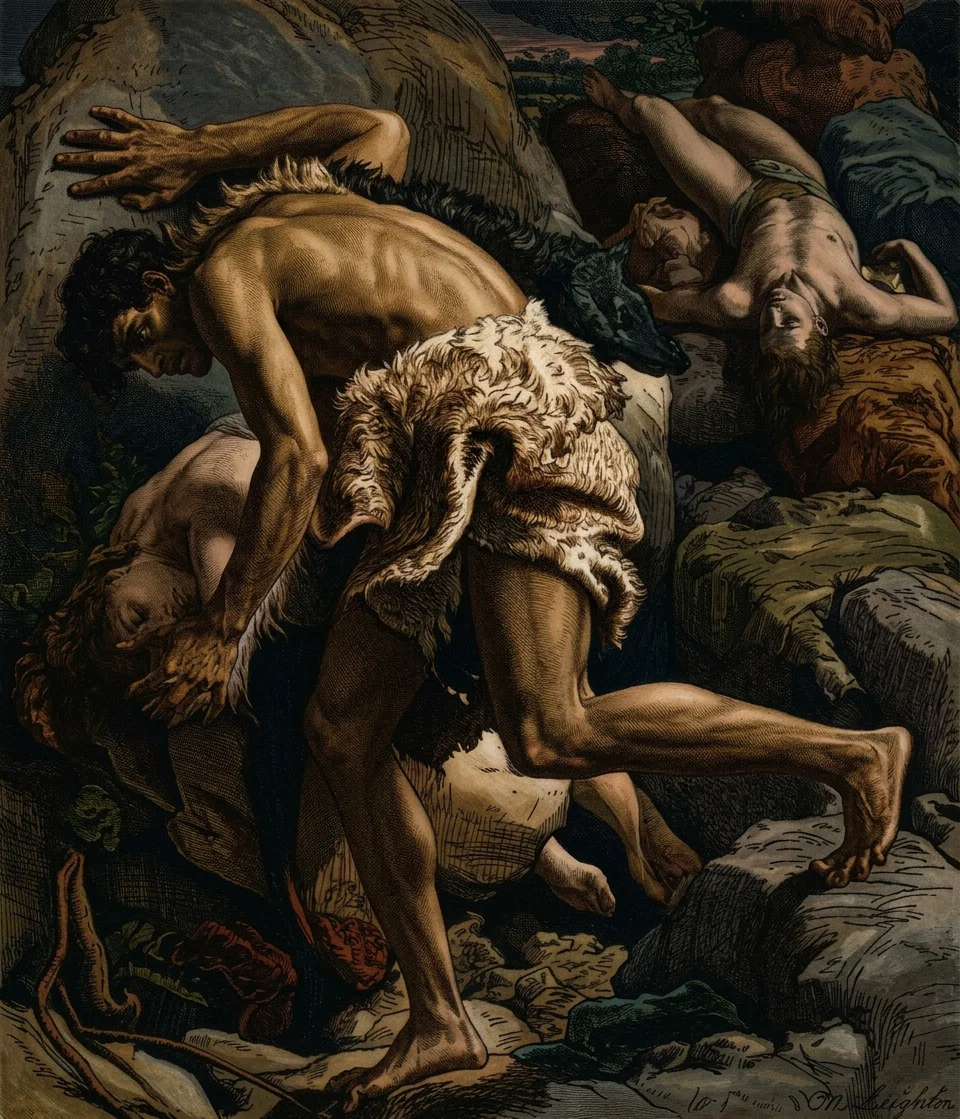
The greatest of all problems with which the human race has struggled for a satisfactory solution, is that of the hereafter. In sheer hopelessness some have given up the contest, with the assertion that man has no future beyond the present life. Others have adopted weird notions regarding the object of man's creation, that have landed them on the platform of Eastern occultism. These results are to be deplored, more so because there is a Fountain of knowledge at which all may be “watered, satisfied” in all things relating to man's creation and future prospects.
This Fountain being the only infallible source of true knowledge, may we not for the time being let all tradition rest in the shadow of forgetfulness, and so be able to give ourselves wholly to an unbiased study of the subject from an original source? In the first place, it is safe to affirm that man, being the highest order of earthly intelligence, must have been designed for some preeminent position, which could not be properly met in a mere temporal existence.
In the Image of God
So when man was to be created, Jehovah (the Self-existent, and who is infinite in all His attributes) said, “Let Us make man in Our image, after Our likeness.” Gen. 1:26. After the model of clay was duly formed, Jehovah God “breathed into his nostrils the breath of life; and man became a living soul.” Gen. 2:7. As this breathing of life from God into the inanimate “earthy” form was essential to its prospective design, so its withdrawal must prove fatal to that purpose.
We can not for a moment suppose that God bestowed in that first “breathing” a gift which was beyond His power to withdraw, especially in view of His foreknowledge of man's temptation to become disloyal to the divine plan. Man himself was made to understand the condition upon which he might retain this breathing of life in his being. Upon being placed in Eden, he was permitted to eat from every tree in the garden, except one. Concerning that tree Jehovah said, “In the day thou eatest thereof thou shalt surely die.” Gen. 2:17.
The Result of Disobedience
Nothing could be plainer than this instruction. To disobey God meant to Adam utter dissolution. That is to say, should man antagonize his Creator and Benefactor, and thus withdraw himself from the divine presence, God would withdraw from the man His divine inbreathing, which otherwise would have retained him in the image and likeness of Jehovah. This would permit the part which had been divinely animated to return to its native element. This condition is clearly stated thus by the wise man: “Then shall the dust return to the earth as it was: and the spirit shall return unto God who gave it.” Eccl. 12:7.
This was indeed just what did transpire in the case of the first pair. Being found guilty of opposing God's will, the Lord pronounced this sentence upon them: “In the sweat of thy face shalt thou eat bread, till thou return unto dust shalt thou return.” Gen. 3:19. Inasmuch as the inbreathing of God's Spirit was that which changed the lifeless clay to a living soul, or being, it goes without saying that the withdrawal of that living essence of the Divine put the man back to his original condition—a lifeless form of earthy matter.
To live, then, is to be animated with the life of Jehovah. As He loaned to the first pair His own life, that they might do and be like Him, so every human being has probation for the same purpose. Should any use that life to further selfish and wicked designs, Heaven's decree is, “The soul that sinneth, it shall die.” Eze. 18:4. This statement is renewed by the great apostle as follows: “The wages of sin is death; but the gift of God is eternal life through Jesus Christ our Lord.” Rom. 6:23.
What Is Death?
Death is, in plain words, the simple cessation of life. This was brought to all men by the death of our first parents (Rom. 5:12), and so means to all men the same that it did to those who introduced death by sin. The penalty for disloyalty to Heaven having been visited upon Adam and Eve, there would have been no remedy, but for the gift of Jesus Christ. Thus we read, “For God so loved the world, that He gave His only-begotten Son, that whosoever believeth in Him should not perish, but have everlasting life.” John 3:16. The gift of Christ, then, was to prevent men from PERISHING, which comes by sin. So, to receive death as “wages” for sin, is to perish.
But redemption from this penalty is promised only to those who believe in Christ. This leaves all of the incorrigibly wicked to remain under the sentence of death.
Thus man returns to the state from whence he was taken in the beginning, without any injustice being done him. He might have retained the life of God with which he had been imbued, and which had been loaned for strength to glorify its Author. But he chose to use that life for his own gratification, without regard to the wishes of its real Owner, and by so doing virtually said: I care nothing for this life but to gratify my senses temporarily. As I can not be permitted to do this forever, without accepting Christ, I am now done with it, so return it to its Author. In depriving such of life altogether, and letting them utterly perish, God does for them just what, by their actions, they have really declared that they desired done. In this He is just, as in all His dealings with the race, and even those who are thus dealt with will be obliged to acknowledge at last that “Jesus Christ is Lord, to the glory of God the Father.” Phil. 2:11.
A Saviour from Sin
By L. A. Reed
By L. A. Reed
“None other is there salvation: for neither is there any other name under heaven, that is given among men, wherein we must be saved.” Acts 4:12. In none other name than Christ is there salvation. Only through Him may we be saved. The truth is well-nigh self-evident.
Man with his whole environment was plunged by his own act into a whelming tide of evil that hourly carries him farther from God. It takes therefore nothing short of omnipotent power to stem that tide and save man. Christ is the omnipotence of God for man. “All power” is given Him, “all power . . . in heaven and in earth.” Matt. 28:18. And this “is the power of God unto salvation to every one that believeth.” Rom. 1:16.
Man was bewitched, his notions all wrong. It needed nothing short of infinite wisdom to undeceive him and set him free. And this, all of this, Christ is for man. In Him “are all the treasures of wisdom and knowledge hidden.” Col. 2:3. And so the man’s ideas are incorrect, and tho he is mystified and mentally bewitched, a pure wisdom, an all-embracing knowledge, is his through “Christ Jesus, who was made unto us wisdom from God.” 1 Cor. 1:30.
Man was contaminated by sin; the very fountain of his nature was defiled; all the outflowing of his life became corrupt and hence corrupting. He could heal nothing, not even himself; like a leper, he could only defile whatsoever his life might touch. But Christ is holy; the very fountain of His nature is divine; all the outflowings of His life are only wholesome and healing. Into man’s life of sin, through Christ, comes the healing tide that cleanses away the sin and removes all the taint of corruption. Christ for us is God, and pours into man the very nature of God; this is for the child of faith, “even the righteousness of God through faith in Jesus Christ unto all them that believe: . . . being justified freely by His grace through the redemption that is in Christ Jesus.” Rom. 3:22, 24.
Outside of Christ man has no where to put his sins; he must bear them himself. But to bear one’s own sins is to be crushed by these sins; for “the wages of sin is death.” Sin crushed to death the Sin-Bearer, tho in Him was the eternal life of God, and tho sin rested on Him only by imputation as our Substitute. Much more, then, shall sin slay the sinner, if he attempt to carry his own sin, and bear its responsibility.
Only in Christ has man refuge from delusion and folly. All man’s reasonings of themselves are illogical and fallacious. Only in7Christ is there clear-sightedness, and reasonable views of duty and life.
Only in Christ is there power to refrain from the habits of sin. Only in Christ, who links the believer with God, is there power to cease from evil and learn to do well. Jer. 13:23. Without Christ we can do nothing. John 15:5.
Man can no more save himself than he can raise himself by pulling upward on his own person. He has no fulcrum to apply his power; and if he had that fulcrum, there is not leverage enough in all mankind to morally save one man. “None of them can by any means redeem his brother, nor give to God a ransom for him.” Ps. 49:7. Man can no more find refuge from sin by his own acts than he could get out of the sun by hiding in his own shadow. We can not get away from our sins of ourselves, for to do so would be to get away from ourselves, our very natures.
And so let us take heed that we do not frustrate the grace of God. Gal. 2:21. Salvation can not come through our efforts, purely human; let us cease to try to save ourselves. He that seeks to save his life shall lose it. But God help us here and now to lose self and gain Christ, our true and better self; and then we shall have proved His word true, that he that loses his life for the kingdom of heaven’s sake, shall find it. Let our efforts be purely those of faith that works by love and purifies the soul; for such efforts will be energized by all the might of God in Jesus Christ to our salvation.
God give us grace to say in the words of the old hymn:
“Could my tears forever
flow,
Could my zeal no languor
know,
These for sin could not
atone;
Thou must save, and Thou
alone.
In my hand no price I
bring;
Simply to Thy cross I
cling.”
The Lord’s Personal Presence
By Francis M. Wilcox
By Francis M. Wilcox
We love our friends, and in the love we bear for them we love their personal presence. It is impossible to conceive how this could be otherwise.
To the one who loves father, mother, wife, or children, there is no place in all the earth so dear as the hearthstone and the family circle. Here is sweetness of communion of which the world knows nothing. Heart beats in sympathy with heart; love flows free and untrammeled. The cold formality of the world is shut out. Position loses its distinction. All meet on common ground, and love makes all hearts one. Such a home is the nearest approach to heaven that this earth affords. The love of such a home is a type of the love which will exist in the heavenly family. And as love of home and friends embraces love of personal communion, so will it be between God and His children.
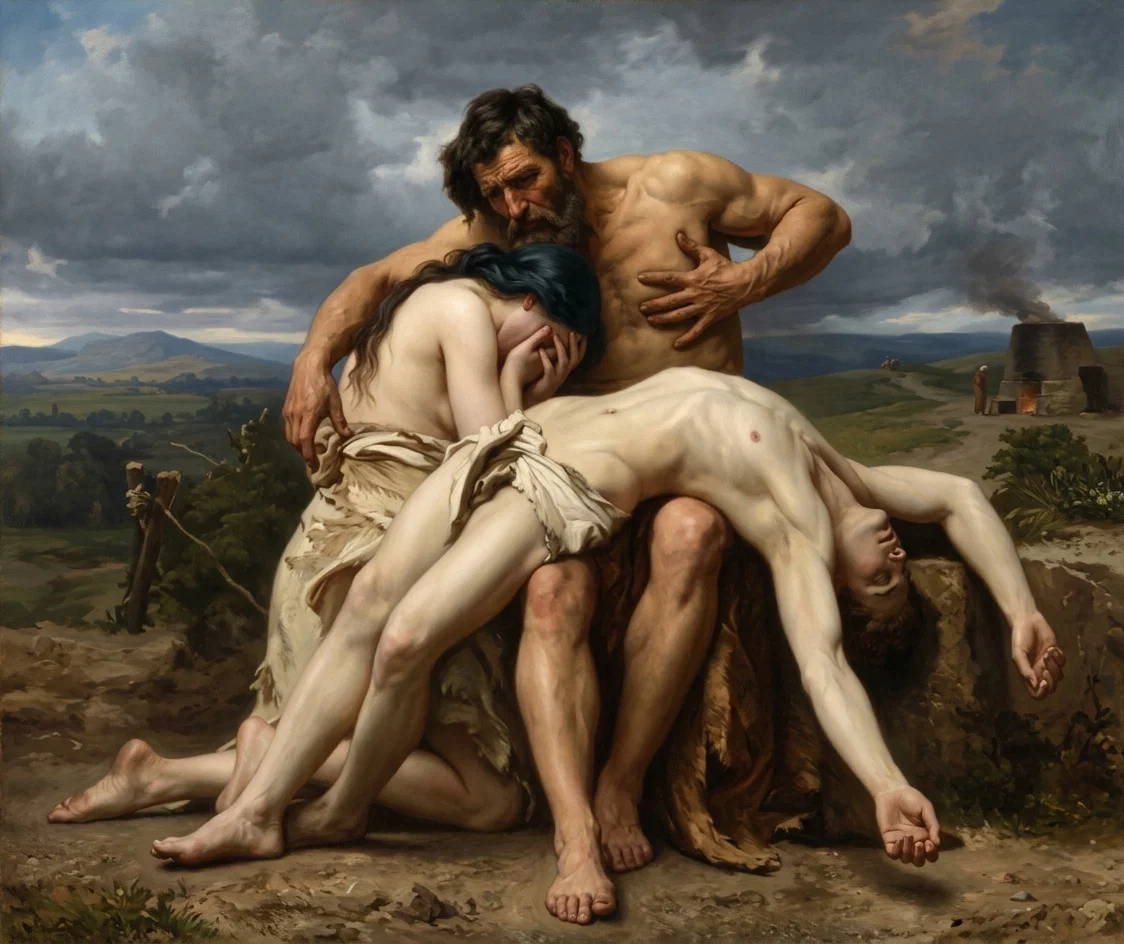
THE FIRST DEATH — W. A. Bouguereau
As one truly comes to love the Lord Jesus Christ, and finds in Him a Saviour, a Friend, a Brother, a Father, will he not love personal communion with such a being? Will he not love to look up into the glorious face of Him who has appeared so many times to his aid and encouragement, and hear that melodious voice which has so often sustained his courage and quieted his fears and nerved him for all of life’s conflicts? Strange, indeed, would be a Christian experience foreign to such desires!
In all the history of the world no class of men ever suffered keener disappointment than did the disciples at the departure of their Lord. With their hopes crushed to the earth, with every ambition disappointed, the death and burial of the Lord left an aching void in every heart, which no human agent could supply. Their feelings were voiced in the sorrowful lament of the two disciples who went down to Emmaus, when they said, “We trusted that it had been He which should have redeemed Israel.” It had been their fondly cherished desire that Christ should take the throne of David, and they looked with eager anticipation to every succeeding event in Christ’s experience to bring about this fruition of their dreams. But now all was lost, and their hopes and ambitions were as dead as the lifeless body of their Lord, sealed in its rock-bound tomb.
The resurrection of the Lord revived their hopes. At the meeting in Galilee which He had appointed, and to which hundreds assembled they believed that the time had come when Christ was to take the throne. They ask, “Lord, wilt Thou at this time restore again the kingdom to Israel?” Again are they doomed to disappointment. “It is not for you to know the times or the seasons, which the Father hath put in His own power.” That event is still future. Before the hour of triumph is the time of labor. They are to be His witnesses, the heralds of His work to earth’s remotest bounds.
He is parted from them, and again unutterable sorrow fills their hearts. But the Lord leaves them not without comfort and assurance. Two angels appear to comfort them. “This same Jesus, which is taken up from you into heaven, shall so come in like manner as ye have seen Him go into heaven.” This is their message of cheer. And again there echo in their ears the blessed words of their Lord, spoken the night of His apprehension: “Let not your heart be troubled; ye believe in God, believe also in Me. . . . I go to prepare a place for you. And if I go and prepare a place for you, I will come again, and receive you unto Myself; that where I am, there ye may be also. . . . I will not leave you comfortless [orphans]; I will come to you.”
This was their support in the hour of darkness and disappointment; and blessed assurance it was indeed. This same Jesus was to come again. The One with whom they had associated for three years; who had acted the part of a friend and a counselor, the part of a brother in every trial; with whom they had walked and talked and communed in every phase of life’s experience among the hills and valleys of Judea; whose blessed hands had supplied their temporal needs; whose sympathetic tones had quieted their fears—He was to come again.
Truly this was comforting assurance, but no less comforting to them than it may be to us. This, today, is the sweet assurance which Heaven gives to every child of God.
Sometime, and now not very long hence, we shall see Him as He is. We shall bask in the presence of the One we have learned to love. We shall see the King in His beauty. Our faces will lighten under the glance of His kindling eye, and the sweetness of communion with Him shall be the inspiration of eternity.
The False and the True
Any work which leads men to laud and glorify man is false either in spirit or doctrine, or both. Sometimes, sad to say, men preach the truth of the Gospel in theory, but with man in the foreground, and Christ secondary. Those affected by the preaching, often praise the man, honor the man, glorify the man. It is wrong. Sometimes men preach error; preach it in such a way that men receive it as truth, glorifying the one who brought it; and so we have the followers of this woman, and that man, who glorify the creature, make of no effect the Word of God, and oftentimes relegate the Creator to an impersonal nothingness. The true spirit of Christian work is not expressed by what great “I” has done, or will do, but by such words as these: “Not unto us, O Lord, not unto us, but unto Thy name give glory, for Thy mercy and for Thy truth’s sake.” There is soon coming a time when the lofty looks of man shall be brought low, and the haughtiness of man shall be lowered down, and the Lord alone shall be exalted in that day. A good time to begin to exalt God is now. He that humbleth himself shall be exalted, and he that exalteth himself shall be brought low.
The Coming Judge
By Jonathan Edwards
The person by whom God will judge the world, is Jesus Christ, God-man. The second person in the Trinity, that same person of whom we read in our Bibles, who was born of the virgin Mary, lived in Galilee and Judea, and was at last crucified without the gates of Jerusalem, will come to judge the world both in His divine and human nature, in the same human body that was crucified, and rose again, and ascended up into heaven. Acts 1:11. “This same Jesus, which is taken up from you into heaven, shall so come in like manner as ye have seen Him go into heaven.”—Jonathan Edwards.
Abiding in Christ, Not America
“If there were more abiding in Christ there would be less abiding in America.”
Sin and Its Fruit—The One Hope
THE “Scriptures of truth” are very clear as to what sin is. When man attempts to define it apart from the Bible, the explanation befogs and confuses rather than enlightens. For instance, a recent book, “The New Theology—An Exposition,” thus defines sin: “A gratifying of the momentary self without considering others, and without considering that higher self whose enrichment always coincides with ministry to the social good.”
Read the Bible definition, and note the differences:
“Whosoever committeth sin transgresseth also the law, for sin is the transgression of the law.” 1 John 3:4.
Moreover this definition is all inclusive, comprehending all sin. Note the following:
“For by the law is the knowledge of sin.” Rom. 3:20.
“For where no law is, there is no transgression.” Rom. 4:15.
“Nay, I had not known sin, but by the law: for I had not known lust, except the law had said, Thou shalt not covet.” Rom. 7:7.
“If ye fulfil the royal law according to the scripture; . . . but if ye have respect to persons, ye commit sin, and are convinced of the law as transgressors. . . . For He that said, Do not commit adultery, said also, Do not kill. Now if thou commit no adultery, yet if thou kill, thou art become a transgressor of the law. So speak ye, and so do, as they that shall be judged by the law of liberty.” James 2:8-12.
What law is it which defines sin?—That law which says, “Thou shalt not kill,” “Thou shalt not commit adultery,” “Thou shalt not covet.” What law contains these precepts?—The Decalogue, spoken by the voice of God from heaven, engraved with His own finger on tables of enduring stone. Ex. 20:1-17; 31:18; 32:15, 16.
“Righteousness” is the quality of being righteous. And “righteous” is conformed to a right standard. Mathematically, a right line is a STRAIGHT line, the shortest distance between two points. Any deviation from that makes crookedness, perversion, or mathematically, sin. The righteousness which God requires is inherent, exhibited in straightforward, up and down conduct, rectitude, righteousness, with no crookedness in it.
Through that channel of righteousness from the great “Fountain,” which is with God, flows the life, the vitality, the power of existence which we have. “In the way of righteousness is life; and in the pathway thereof there is no death.” Prov. 12:28. Outside of that channel is the land of death.
“Sin,” in its original sense, means to “miss the mark.” It is the swerving of the line from the right course. It is falling “short of the glory of God;” it is turning from “the mark for the prize of the high calling of God in Christ Jesus.” Rom. 3:23; Phil. 3:14.
Righteousness perverted is sin; straightness perverted is crookedness; life perverted is death. “Sin, when it is full-grown, bringeth forth death.” James 1:15.
God created man “upright,” and pronounced him “very good.” He received life from God normally. For his physical nature it came through the air he breathed, through the water he drank, through the food he ate. For his spiritual nature it came through God’s Word and by His Spirit. Just so long as man was faithful to God, spiritual life dominated the physical. Death had no place in him. Had he continued faithfully obedient, he never would have died; for “in the way of righteousness is life; and in the pathway thereof there IS NO DEATH.”
But man sinned; he perverted the right ways of God within himself. He refused to be guided by Infinite Wisdom; refused to learn by God’s appointed way—faith—the lessons of infinite worth, and to acquire by simple trust in his Maker the character worthy of eternal existence. He took the tempter’s short, selfish way, in the hope that he would gain knowledge of good and evil, and become like God; but he found evil only, and the end of it all, death. Compare Gen. 2:17; 3:4, 5.
It is true that the serpent’s old lie has been perpetuated, and the millions of deluded mortals have believed it: “Ye shall not surely die.” Strange, isn’t it, that altho God said, just twelve verses previous in the Sacred Record, “In the day that thou eatest thereof THOU SHALT SURELY DIE,” and elsewhere, “The soul that sinneth, it shall die” (Eze. 18:4), men should believe the tempter, “Ye shall NOT surely die”? It is the only promise of immortality to the sinner in himself in all God’s Book. Do you believe its author?
Man died. Adam died. Said God, “Dust thou art, and unto dust shalt thou return.” Gen. 3:19. “And he died!” “and he died!” “and he died!” has been the long, interminable chorus of history and biography ever since. Man has been born, has flourished a few days, has died, has moldered back to dust. “But,” says one, “it was his body that died; his soul lives on.” Who said so? It is playing fast and loose with the words of the Almighty to say that His “thou” in one case means the BODY, in another passage the “thou” means the SOUL. It was the responsible Adam who sinned; it was the responsible Adam who died. “The soul that sinneth, it shall die.” Eze. 18:4, 20. The erroneous immortal-soul theory, the unscriptural conscious-state-of-the-dead doctrine, are the great road-bed and tracks over which Satan has run his train of heathen gods and demigods, saint worship, purgatory, ever-burning hell, universal salvation, Universalism, Swedenborgianism, Christian Science, Modern Spiritism, and other false, delusive doctrines. Righteousness is life, sin is death.
Sin is a disease. Man was originally healthy, normal. But when he departed from God, he perverted the very laws of his being, and all the horrible monstrosities and degeneracies of sin have resulted. The virus is in the bud, and every fruit of man bears the marks of the leprosy of sin. “The heart is deceitful above all things, and it is desperately sick; who can know it?” Jer. 17:9; R.V.
Man has no healing in himself. Standing alone, he has “no hope” and is “without God,” “alienated from the life of God.” Eph. 2:12; 4:18. He may plan and devise ten thousand ways of life; the end thereof will be death. Prov. 16:25. He may imagine ten thousand human saviours; but “none of them can by any means redeem his brother, nor give to God a ransom for him.” Ps. 49:7. He may plan, as he has, a thousand ways to save society and preserve the world, but in the midst of the blazing illumination of righteousness and with myriads of voices calling ever upward, the great tide of human corruption rolls on toward the night of endless perdition.
There is but one hope, only one, for poor, dying humanity, and that is the righteousness and life of Jesus Christ, an all-sufficient Saviour and Redeemer. He gives life by giving righteousness, and He gives it freely to all who will take it in His way—the only way.
Christian Science and Christian Ordinances
By R.
Baptism
CHRISTIAN SCIENCE seems to be a revolt against all formalities and every kind of form. It denies that God has form, and thus reveals its kinship with pantheism.
Christian Science does not conform to the rite of baptism. It can use as a chapter heading the words of Paul that he baptized no one, and then can pass over in silence many other words of Paul which show the binding obligation of this Christian ordinance. Paul forebore to baptize, that none might have occasion to say that they were of Paul; but all who were converted under Paul were baptized by some of Paul's assistants. If you doubt this, read the account of his work as recorded in the book of Acts.
Is it Christian to use the words of Paul so as to imply what he never meant, and thus seek to make his words authorize the Scientists in their nonconformity? And is it Christian to disobey the plain teachings of the Word, notably that of the sixth chapter of the Epistle of Paul to the Romans?
The Lord’s Supper
Christian Science does not conform to the observance of the Lord’s Supper. It finds its excuse for this in the fact that a mere outward conformity to the rite is nothing. This is true of the performance of any act. The mere outward observance of any Christian duty, even that of ministering to the sick, is of no religious value; but this is not to argue, therefore, that we should not minister to the sick. In other words, the abuse of an act does not release us from what we really ought to do.
Christian Science must admit that Christ partook of the bread and wine on that first occasion, and thus set us an example. But Christian Science ignores this fact, and puts all attention and stress upon the fact that Christ said that He would drink it no more until He drank it anew with them in the kingdom.
It is true that He said this. He was about to leave them, and they were to be without His bodily presence. But He gave them command which has perpetuated the ordinance and will give it life as a religious duty until He comes again. “This do,” said He; “in remembrance of Me. For as often as ye eat this bread, and drink this cup, ye do show the Lord’s death till He come.” Those who truly love Him ought to do what He says. Is it Christian to do otherwise?
Christian Science seeks to do away with oral prayer, making all prayer so far as possible secret or mental.
Christian Scientists do not seem to recognize form of any kind; and yet, by force of circumstances they are compelled to acknowledge marriage. They are too practical to do otherwise, altho it is plainly inconsistent with their foundation principles.
Forms are all right, if they are living forms. Forms alone are mere carcasses, not only dead, but vilely odorous.
Even truth has form as expressed in the law. Rom. 2:20. Doctrine has form. Rom. 6:17. There is a form of sound words. 2 Tim. 1:13. And godliness has a form to which should be joined its power. 2 Tim. 3:5.
A man certainly ought to show his faith by his works; he ought to show his love by his obedience. He ought to observe all Christian ordinances, not merely outwardly and thus be a hypocrite, but he should observe9them spiritually and thus be a Christian. And no man has yet found a way of doing a thing inwardly which he kicks at doing outwardly.
And let us not forget that God has promised to reward every man, not according to his thoughts or his spiritual communings, but according to his works. It is not “the hearers,” but “the doers,” whom God commends. The man who hears and does not, Christ likened to a man who built upon the sand, and we know with what result.
If we can not be scientific, let us at least be Christian.
R.
He Is Coming Again
THE Son of God came to this earth once. He took upon Himself humanity. He lived here, died here, rose here; and from earth He ascended to His Father, leaving behind the message, “I will come again, and receive you unto Myself.” John 14:1-3. The heavenly messengers declared, “THIS SAME JESUS, which is taken up from you into heaven, shall so come in like manner as ye have seen Him go into heaven.” Acts 1:9-11. He ascended bodily, visibly, and a cloud received Him out of their sight. Thus is He coming again. “Behold, He cometh with clouds; and every eye shall see Him.” Rev. 1:7.
Men did not believe in His first coming; and when He came, they were unprepared and rejected Him. They preferred Cæsar to Christ. If men do not believe in His second coming, they will be unprepared for Him, and will reject Him for some king of their own choosing, and be left to perish with their king.
There is much said in the Scriptures concerning His first coming; there is much more said concerning His second coming. The first coming has confirmed the second. The strength of confirmation in every succeeding event of prominence in a prophetic series as compared with others in the series, is in the ratio of the square of its number in the series. The second coming of Christ is foretold by the same evidence that predicted the first coming. We have not only the fulfilled predictions concerning the first advent, but we have the multiplied evidences concerning the second. If men were without excuse who rejected Him at His first coming, what shall be said of those who refuse to believe or who ignore His second coming?
“There is a King of Glory,
Ere long on earth to rise,
Sung in prophetic story,
Descending from the skies;
The Babe of Bethlehem, ’tis He;
It is the Man of Calvary.
Not crowned with thorns and gory,
But crowned with glory now!
Not crowned with thorns to-day,
Not mocked and led away,
But crowned with everlasting glory now.”
He Is Coming Again
By LITMON CLESHAR
COMING again is the Prince of Salvation;
Coming again all His own to receive;
Coming again, not in earth's degradation;
Coming — glad tidings to all who believe!
Nevermore tempted in desert wilds dreary;
Nevermore weakened by fasting and fear;
Nevermore burdened, and nevermore weary;
Nevermore anguish, and nevermore tear.
Gone the Gethsemanes, known again never;
Gone the mock trial, with no hand to save;
Gone are the cross and the Calvary, ever;
Gone, and forever, the power of the grave.
Saving e'en now from the power of the devil;
Saving the trusting forever and aye;
Saving from sin and the powers of all evil;
Saving for life in eternity's day.
Coming again in transcendent glory;
Coming again forever to reign;
Coming again — repeat the glad story,
Jesus, our Saviour, is coming again.
Saving His people from every temptation;
Saving to life He has given so free;
Saving forever from earth's degradation;
Saving to home-land forever to be.
Coming, soon coming — the heavens declare it;
Coming, soon coming, declareth the Word;
Coming the kingdom to give; will you share it?
Coming — all earth with its import is stirred.
Reigning forever in glory supernal;
Reigning in righteousness ever to be;
Reigning in kingdom of peace that's eternal;
Love fills it full as the waters the sea.
LITMON CLESHAR.
Man in Life and Death
1. In whose image was man created?
“God created man in His own image, IN THE IMAGE OF GOD created He him; male and female created He them.” Gen. 1: 27.
2. Of what was man formed?
“And the Lord God formed MAN of the DUST OF THE GROUND.” Gen. 2: 7; 3:19. “The first man is of the earth, earthy.” 1 Cor. 15: 47.
3. What caused man to live?
“And the Lord God . . . breathed into his nostrils the BREATH OF LIFE.” Gen. 2: 7.
4. What did this organism then become?
“And man [formed of the dust of the ground] became a LIVING SOUL.” Gen. 2: 7.
NOTE.—This is the simple, clear account of the creation of man, bringing into existence that which had not before existed. He was formed of the dust, a perfect being in all his organs and functions, but still lifeless. God breathed into that form the breath of life, and that which He had formed from the dust became a living soul. Before that it was a soul, a person, but a lifeless soul. There is nothing said in either of these scriptures about a dual man, or of man’s possessing a separate entity, an immortal soul or spirit. Yet it is argued that God is immortal; man is made in God’s image; therefore man is immortal. But this reasoning is a non sequitur. It proves too much; for if to be made in the image of God invests man with one attribute of Deity, immortality, it logically would clothe him with all His attributes, such as omnipotence and omnipresence. An argument which proves too much proves nothing. “Breath of life” does not mean an entity, a spirit capable of existing consciously and intelligently without the body; for if such were the case, the beasts possess the same “breath of life.” Gen. 7: 15, 22. The “breath of life” is simply the vital energy by which the man is caused to live, given to man in harmony with the law of his being. Neither does “living soul” convey any idea of immortality in man. Its meaning is simply “living creature.” See Gen. 1:30, margin, and Rev. 16:3.
5. What test was placed upon man?
“Of the tree of the knowledge of good and evil, thou shalt not eat of it; for in the day that thou eatest thereof THOU SHALT SURELY DIE.” Gen. 2:17.
NOTE.—The responsible man was the “thou,” the one that reasoned, chose, decided, moved the hand to take, the mouth to taste. It was the whole man, the responsible whole, that was addressed and that, if disobedient, would die.
6. What contradiction was made to God’s word?
“And the serpent said, . . . Ye shall NOT surely die.” Gen. 3:4.
Dissolution of Man
7. What did God do that man might not live a sinner forever?
“Now lest he put forth his hand, and take also of the Tree of Life, and EAT, and LIVE FOREVER; therefore the Lord God . . . DROVE OUT THE MAN; and He placed at the east of the Garden of Eden cherubims, and a flaming sword which turned every way, to KEEP THE WAY OF THE TREE OF LIFE.” Gen. 3:22-24.
8. What sentence did He visit upon man?
“In the sweat of thy face shalt thou eat bread, till thou return unto the ground; for out of it wast thou taken: for DUST THOU ART, AND UNTO DUST SHALT THOU RETURN.” Gen. 3:19.
9. What takes place at death?
“Then shall the DUST RETURN TO THE EARTH as it was; and the SPIRIT shall RETURN UNTO GOD who gave it.” Eccl. 12:7. “His BREATH GOETH FORTH, he returneth to his earth; in that very day HIS THOUGHTS PERISH.” Ps. 146:4.
NOTE.—Strange, isn’t it, that men should still take the word of the serpent in preference to the word of God? God said that when man sinned, he should “surely die;” the old serpent declared, “Ye shall not surely die; . . . ye shall be as God.” Gen. 3:4, 5, A.R.V. To every human sense God’s words have been true; but to deceive men, the theory of an immortal soul, a conscious spirit surviving the death of the body, has been invented. Men love to believe the invention because it exalts sinful man. Yet how simple is the truth of God. The spirit was given to man as “the breath of life,” and it made the man, formed out of dust, a living soul. Man dies; the spirit goes back to God as the breath of life, even as God gave it. The dissolution of man is the opposite of his formation. When he dies, the thinking man, the thoughts, perish.
10. What is always the result of sin?
“Sin, when it is finished, BRINGETH FORTH DEATH.” James 1:15. “Wherefore, as by ONE MAN SIN entered into the world, and DEATH BY SIN; and so DEATH PASSED UPON ALL MEN, for that all have sinned.” Rom. 5:12.
NOTE.—The stream can rise no higher than its fountainhead. The children of men can not in themselves rise higher than their first father. They die. All men are subject to death; and death is extinction of life, cessation of being. The whole man dies. How reasonable it is that sin should at last, sooner or later, destroy itself; that the universe should not, could not, know immortal sinners; that God’s law and plan for man should indicate His wisdom and love; and that man should have his own choice, to live or to die. How the simple plan wipes from the pages of the past every charge against God of cruelty and injustice, and reveals beauty instead of ugliness.
The Wall of Separation.
—A “New Philosophy” book before us, written by an “evangelical” pastor, declares that “history is largely made up of attempts of humanity to build walls of separation. Men have been continually putting up bars around themselves, shutting out God and nature and their fellow men.” And this is true. The one mighty, effective wall of separation is sin. Sin separates men from God. Isa. 59:2. The apostle Paul, referring to the past unregenerate condition of Christians, declares, “That ye were at that time separate from Christ, alienated from the commonwealth of Israel, and strangers from the covenants of the promise, having no hope and without God in the world.” Eph. 2:12. Such are “alienated from the life of God.” Eph. 4:18. But this writer, and others of the new philosophy cult, would have us believe that sinful man is not without God, but that God is within him, tho he believes not, while faith simply recognizes man’s divinity. Such philosophy makes of none effect the vicarious offering of Christ and leaves the sinner without hope. The wall of separation remains.