Your ShelfYour Projects

Signs of the Times, Vol. 36, No. 43.

Necessity of the Resurrection

Signs of the Times

Nov 3, 1909

Pacific Press Publishing Association · Mountain View, California · Nov 3, 1909

Necessity of the Resurrection

Now if Christ be preached That He rose from the dead, How say some among you That there is no resurrection of the dead? But if there be no resurrection of the dead, Then is Christ not risen: And if Christ be not risen, Then is our preaching vain, And your faith is also vain, Yea, and we are found false witnesses of God; Because we have testified of God that He raised up Christ: Whom He raised not up, If so be that the dead rise not. For if the dead rise not, Then is not Christ raised: And if Christ be not raised, Your faith is vain; Ye are yet in your sins. Then they also which are fallen asleep in Christ are perished. If in this life only we have hope in Christ, We are of all men most miserable. But now Is Christ risen from the dead, And become the first-fruits of them that slept. For since by man came death, By man came also the resurrection of the dead. For as in Adam all die, Even so in Christ shall all be made alive.

OUR BIBLE BAND

Schedule for Week Ending November 13, 1909

Day Date Morning Evening
Su. Nov. 7 Jer. 40, 41, 42 Heb. 4
Mo. " 8 " 43, 44, 45 " 5
Tu. " 9 " 46, 47 " 6
We. " 10 " 48, 49 " 7
Th. " 11 " 50 " 8
Fr. " 12 " 51, 52 " 9
Sa. " 13 Lam. 1, 2. " 10:1-18

Suggestive Notes

Our lessons in the Old Testament begin with Jeremiah 40 and close with the second chapter of Lamentations. Very instructive are these closing chapters of the weeping prophet, covering as they do some exceedingly interesting personal experiences of Jeremiah himself and of his going into Egypt. He prophesies concerning Egypt, Moab, Ammon, Edom, Damascus, Elam, all of which powers were to fall before the mighty conqueror Nebuchadnezzar. But there are also prophecies concerning Babylon and the doom of Babylon.
The book of Lamentations is supposed to have been written by Jeremiah, altho others think it was written later. It commemorates in sad song the awful sufferings which came to the apostate people of God, the inhabitants of Jerusalem.
Our New Testament readings include Hebrews 4 to the 18th verse of the 10th chapter. They are filled with splendid instruction concerning our High Priest, His Melchizedek priesthood, the wonderful encouragement that God gives to His children, and the certain fate of those who reject the means by which He saves men.

Question Corner

A Word to Our Inquirers.—We wish to help you; help us to do it. (1) Write your question clear, plain, definite. (2) Do not ask for the explanation of a chapter or a book. State the point clearly upon which information is desired. (3) Avoid foolish questions. (4) We can not always answer questions at once. (5) We can not reply to the same question frequently. (6) If answer is desired by letter, members of the Bible Band will please enclose stamp; others will kindly enclose ten cents. Oftentimes this does not begin to meet expenses. (7) We answer no anonymous or unsigned correspondence. We will not publish the name, nor even the initials if we are requested not to do so.

2967.— Gifts of the Spirit

Is not the speaking with tongues a sign of the outpouring of the Spirit? And may not all have this gift?
INQUIRER.
One of the most unimportant of the gifts of the Spirit is the gift of speaking in tongues. This the apostle declares in 1 Cor. 14:19: “Howbeit in the church I had rather speak five words with my understanding, that I might instruct others also, than ten thousand words in a tongue.” The speaking with tongues, as it is called, as manifested at various times the last few years in the United States, has led to wretched fanaticism. People have agonized and prayed for days and weeks that they might speak with a tongue. The result has been that they have uttered some outlandish gibberish which no one could understand, not even they themselves. Some have been deceived in believing that they spoke in certain Indian dialects or Chinese dialects; but when they have found themselves in other lands, among those peoples whose tongue they were supposed to be speaking, they were as unintelligible there as they were at home. There is but one thing for the Christian to do, and that is to submit himself to God to be used as God desires. There are many gifts which He has to bestow. He expressly tells us that these gifts are not of our choosing. They are of His. After mentioning wisdom, knowledge, faith, healing, working of miracles, prophecy, discerning of spirits, tongues, and interpretations of tongues, He declares, “But all these worketh that one and the selfsame Spirit, dividing to every man severally as He [God] will.” 1 Cor. 12:11.
He tells us that we may desire to prophesy, in other words, to speak for God; but the gift, the prophetic gift, lies with God Himself to bestow. If He sends us to a foreign land where we meet with those who can not understand us, and it is His will and His wisdom that we should speak in that tongue, He is able to give it us; but it is the height of folly for Christians to labor and pray and agonize to obtain this or that gift which is not in any wise needed, and which in the very nature of the case leads to fanaticism. When we ourselves are determined that God shall give us a certain thing which may be contrary to His will, and we still persist in our determination; we may be sure that the devil will furnish us substitutes, and the sad history of such movements very clearly shows that his substitutes have been ever ready.
It is exceedingly important that Christians in these days should understand the Bible teaching concerning spiritual gifts. This the Lord has set forth very clearly and fully in such passages as 1 Corinthians, chapters 12 to 14; Romans 12; Ephesians 4; the parables of the talents and pounds, and other scriptures. If they would study the Scriptures, study God’s plan in the bestowing of these gifts, there would be no fanaticism in connection with them. The reception of the gifts themselves would lead away from fanaticism, and the church of Christ would be built up.

2968.— The Scripture Canon

When was the Bible compiled?
C. J. C.
The Old Testament was compiled by Ezra and Nehemiah up to their time. Of the New Testament it may be said that from the days of the apostles, the Gospels and epistles were read in the churches and generally received. “We possess in the Latin fragment by Muratori in 1740, something like a full list of the New Testament Scriptures from a writer who describes himself as contemporaneous with Pius, bishop of Rome, about A.D. 150; and a similar list may be made out from the Syriac Version, which can hardly be later than the second century. . . . The great Athanasius [A.D. 296-373] enumerates unhesitatingly all the Scriptures of the New Testament as we have them now; and so do the Latin fathers Augustin and Jerome.” So reads the “Sabbath School Teachers’ Combination Bible Helps,” Section 14, page 34. In the Sinaitic manuscript of the fourth century, the New Testament is entire.

2969.— Is It Genuine? Mark 16: 9-20

Is it not true that no part of the 16th chapter of Mark after verse 8 is genuine?
F.
No, it is not true. The only thing that can be said is that it is not found in some early manuscripts. But this does not prove that it is not genuine. Alford, in his Greek New Testament, discussing at length the reasons for and against it, says that it is quoted as early as Irenæus, in the second century. He thinks that it was placed there as a completion of the Gospel, immediately after the apostolic period. There is nothing in the passage which is in any wise contrary to the rest of the Scriptures. He concludes that it is an authentic fragment placed as a completion of the Gospel in very early times, coming to us with very weighty sanction, and having strong claims on our reception and reverence. The “Biblical Encyclopædia” says of the verses in question, that while the Sinaitic and Vatican manuscripts omit them, the Alexandrian, Beza, and Paris manuscripts and the Vulgate support them.

2970.— The Earth Abideth Forever

Will you please explain the last clause of Ps. 78:69, and Eccl. 1:4? In the former text we read, “The earth which He hath established forever;” and in Eccl. 1:4, “The earth abideth forever.” But is it not true that the earth will burn up with its wicked inhabitants?
H. T. H.
No. When God created the earth, He did not create it to be destroyed. He bases His very existence upon His power to preserve His work. See Isa. 45:18: “For thus saith Jehovah that created the heavens, the God that formed the earth and made it, that established it and created it not a waste, that formed it to be inhabited: I am Jehovah; and there is none else.” Again in Ps. 115:16: “The heavens are the heavens of Jehovah; but the earth hath He given to the children of men.” In Psalm 37 we have the promise repeated over and over, that the righteous shall receive their reward in the earth; not only the righteous, but the wicked. “The meek shall inherit the land, and shall delight themselves in the abundance of peace.” “The seed of the wicked shall be cut off.” “The righteous shall inherit the land, and dwell therein forever.” Our Lord echoes the same thought when He declares in the Beatitudes, “Blessed are the meek: for they shall inherit the earth.”
In referring to the glorious triumph over sin, the prophet Daniel declares, “And the kingdom and the dominion, and the greatness of the kingdoms under the whole heaven, shall be given to the people of the saints of the Most High: His kingdom is an everlasting kingdom, and all dominions shall serve and obey Him.” Read also Revelation 21, 22, where the new heavens and earth are portrayed before us; in other words, the heaven and the earth renewed by the power of God.
“World” in our Common Version in the New Testament often comes from a Greek word meaning “age.” The world, or age, will end, but the earth, the material earth, purified by the fires of the last day and the power of God, will abide forever. Sometimes “world” comes from a word meaning “the inhabited earth.” Of course there will come a time when it will be without an inhabitant, but sin shall not work its will in the domain of God, “World” comes also from a word meaning “order, beauty, arrangement.” This, too, comes to an end. The earth will be purified from sin and will continue forever.

2971.— The Paying of Tithes

If I buy a wagon or a horse, should I pay tithe on it? and if I sell my crop and pay the tithe on the money and then pay for wagon or horse with some of this money, have I paid tithe on these things?
D.
We pay tithes on income and not on purchases. The tithing system does not ask us to pay tithe on anything that we buy. It is on our income, on that which we receive. If we pay tithe on that, then all our purchases are made from money which is tithed, and it meets all the requirements of the tithing law. And one who carries it out in the true spirit of it, finds much more satisfaction in using the nine tenths which belongs to him after he has rendered to God that which is required. The tithe and the Sabbath are two tests of man’s loyalty: the Sabbath of his time, the tithe of his means. He who is loyal to God will find real joy in rendering both to the Master, and in the gratitude of his heart these will lead him to give himself wholly to God.

2972.— War and Christianity

Is not war contrary to the teachings of the New Testament?
F.
Indeed it is. It is contrary to the whole tenor of the Word of God. Men have fought, good men have fought, and God has overruled in the wars of the nations in past times just as He has in the Christian dispensation, yet He is not the Author of war, but the Author of peace. The Gospel is the Gospel of peace, but all true Gospel peace is based on righteousness. This is not only a New Testament truth as taught in Romans 5, but it is an Old Testament truth as well. “And the work of righteousness shall be peace; and the effect of righteousness, quietness and confidence forever.” Isa. 32:17.

Complete in Christ

By Mrs. E. G. White
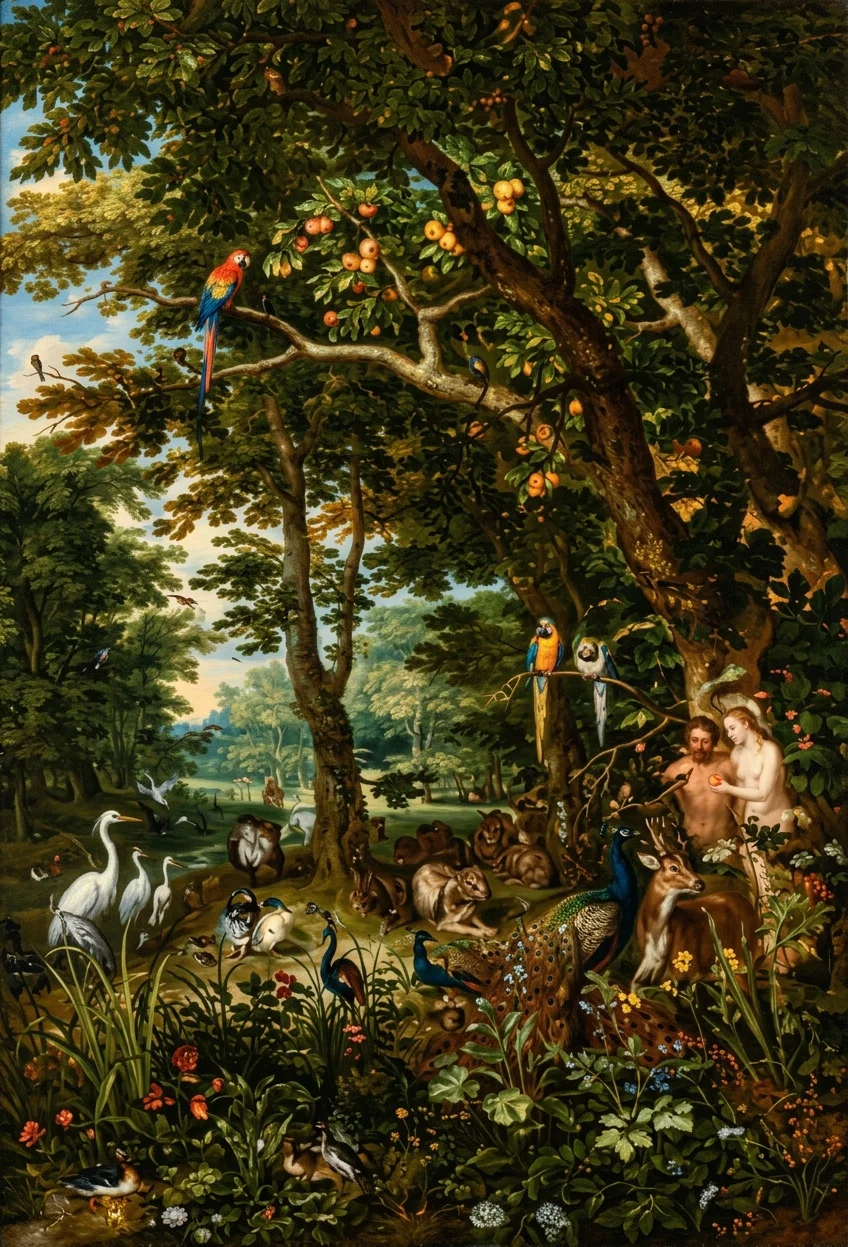
THE GARDEN OF EDEN — Jan Brueghel
When Adam came from the Creator’s hand, he bore, in his physical, mental, and spiritual nature, a likeness to his Maker. “God created man in His own image,” and it was His purpose that the longer man lived, the more fully he should reveal this image,—the more fully reflect the glory of the Creator. All his faculties were capable of development; their capacity and vigor were continually to increase. Vast was the scope offered for their exercise; glorious the field opened to their research. The mysteries of the visible universe—the “wondrous works of Him who is perfect in knowledge,”—invited man’s study. Face-to-face, heart-to-heart communion with his Maker was his high privilege.
Had Adam remained loyal to God, all this would have been his forever. Throughout eternal ages he would have continued to gain new treasures of knowledge, to discover fresh springs of happiness, and to obtain clearer and yet clearer conceptions of the wisdom, the power, and the love of God. More and more fully would he have fulfilled the object of his creation, more and more fully have reflected the Creator’s glory.
But by disobedience this was forfeited. Through sin the divine likeness was marred, and well-nigh obliterated. Man’s physical powers were weakened, his mental capacity was lessened, his spiritual vision dimmed. He had become subject to death. Yet the race was not left without hope. By infinite love and mercy the plan of salvation had been devised, and a life of probation was granted. To restore in man the image of his Creator, to bring him back to the perfection in which he was created, to promote the development of body, mind, and soul, that the divine purpose in his creation might be realized,—this was to be the work of redemption.
In the sentence pronounced upon Satan, was given an intimation of redemption. “I will put enmity between thee and the woman,” God said, “and between thy seed and her Seed; It shall bruise thy head, and thou shalt bruise His heel.” This sentence, spoken in the hearing of our first parents, was to them a promise. Before they heard of the thorn and the thistle, of the toil and sorrow that must be their portion, or of the dust to which they must return, they listened to words that could not fail of giving them hope. All that had been lost by yielding to Satan, could be regained through Christ.

Sin a Wall of Separation

By sin man was shut out from God. Except for the plan of redemption, eternal separation from God, the darkness of unending night, would have been his. Through the Saviour’s sacrifice communion with God is again made possible. We may not in person approach into His presence; in our sin we may not look upon His face; but we can behold Him and commune with Him in Jesus, our Saviour. “The light of the knowledge of the glory of God” is revealed “in the face of Jesus Christ.” God is “in Christ, reconciling the world unto Himself.”
“The Word became flesh, and dwelt among us, . . . full of grace and truth.” “In Him was life; and the life was the light of men.” The life and the death of Christ, the price of our redemption, are not only the promise and pledge of life, not only the means of opening again to us the treasures of wisdom; they are a higher revelation of His character than even the holy ones of Eden knew.
And while Christ opens heaven to man, the life which He imparts opens the heart of man to heaven. Sin not only shuts us away from God, but destroys in the human soul both the desire and the capacity for knowing Him. All this work of evil it is Christ’s mission to undo. The faculties of the soul paralyzed by sin, the darkened mind, the perverted will, He has power to invigorate and to restore. He opens to us the riches of the universe, and by Him the power to discern and to appropriate these treasures is imparted.

The Light of the World

Christ is the “Light which lighteth every man that cometh into the world.” As through Christ every human being has life, so also through Him every soul receives some ray of divine light. Not only intellectual but spiritual power, a perception of right, a desire for goodness, exists in every heart. But against these principles there is struggling an antagonistic power. The result of the eating of the tree of knowledge of good and evil is manifest in every man’s experience. There is in his nature a bent to evil, a force which he unaided can not resist. To withstand this force, to attain that ideal which in his inmost soul he accepts as alone worthy, he can find help in but one power. That power is Christ. Cooperation with that power is man’s greatest need.
Far more than we do, we need to understand the issues at stake in the conflict in which we are engaged. We need to understand more fully the value of the truths that God has given us for this time, and the danger of allowing our minds to be diverted from them by the great deceiver. The infinite value of the sacrifice required for our redemption, reveals the fact that sin is a tremendous evil. And as the sacrifice in our behalf was complete, so our restoration from the defilement of sin is to be complete. There is no act of wickedness that the law will excuse; there is no unrighteousness that will escape its condemnation. The life of Christ was a perfect fulfilment of every precept of the law. He said, “I have kept My Father’s commandments.” His life is our standard of obedience and service. He looks upon every soul who is turning his face toward Him as the Saviour. He knows by experience what are the weaknesses of humanity, what are our wants, and where lies the strength of our temptations; for He was “in all points tempted like as we are, yet without sin.” He is watching over you, trembling child of God. Are you tempted? He will deliver. Are you weak? He will strengthen. Are you ignorant? He will enlighten. Are you wounded? He will heal. The Lord “telleth the number of the stars;” and yet “He healeth the broken in heart, and bindeth up their wounds.” Whatever your anxieties and trials, spread out your case before the Lord. Your spirit will be braced for endurance.
Through faith in Christ, every deficiency of character may be supplied, every defilement cleansed, every fault corrected, every excellence developed.
“Ye are complete in Him.”

Man as Created

By A. O. Tait
As the Lord viewed His finished work in the morning of the creation, the record says, “God saw everything that He had made, and, behold, it was very good.” Gen. 1:31. The late Professor Harper used to say to his classes in Hebrew that the words rendered “very good” in this text have an intenser meaning than this English would signify. He rendered the text “good exceedingly,” but said that this still fell short of giving the strong meaning of the original words.
The statement that everything that He had made was “very good” applies to all of God’s creation, inanimate as well as animate. But speaking of the creation of man himself, the record says, “And God said, Let Us make man in Our image, after Our likeness: and let them have dominion over the fish of the sea, and over the fowl of the air, and over the cattle, and over all the earth, and over every creeping thing that creepeth upon the earth. So God created man in His own image, in the image of God created He him; male and female created He them.” Gen. 1:26, 27.

In the Image of God

Thus, while all of God’s creation is pronounced by divine Perfection to be “very good,” still man is exalted above everything else, and is made in the image of the Creator Himself. What must have been the sublime beauty of perfection presented in man when he stood in his innocency and power of both mind and body in creation’s happy springtime! When the foundations of God’s creation were thus laid in such infinite perfection, is it any wonder that we hear Jehovah saying, in speaking of that time in His challenge to Job, “The morning stars sang together, and all the sons of God shouted for joy”?
Man was “very good.” He was perfect in every way, in health, in physical strength and grace, in mind, in heart. His character was stamped with the perfection of righteousness. The perfectly natural thing for him was to do right. He was in the image of the God of righteousness, and there was imparted to him along with the divine image the impulses of right-doing.

A Candidate for Immortality

But man was not immortal. Immortality was set before him, to be attained through the development of a righteous character. God placed him in the midst of favorable environments to develop that character. But man did not choose to remain in that happy state. He listened, and then yielded, to the voice of the tempter. And when he committed sin, he passed under the dominion of sin, and in this way by his own voluntary act he changed his entire nature. He was clothed by his God in the beginning with the attributes and nature of right-doing. But now he clothes himself, by his own voluntary act, with the nature and attributes of wrong and of wrong-doing. And since he had become possessed with the evil nature, with all its tendencies to do wrong, he could not transmit to his posterity any other nature than the one he had taken upon himself. Hence the character and history of the entire human race is turned from its divinely bequeathed course. Utter ruin for the whole human family would have been the only result that could have followed had it not been for the redemption that was given in Jesus Christ.
“Behold, this only have I found: that God made man upright; but they have sought out many inventions.” Eccl. 7:29. These words from the writings of the wise man, Solomon, state in a sentence the facts already shown in the foregoing paragraphs. Man was made righteous and perfect in the beginning, but he did not choose to remain in that good way, but yielded his perfect nature for the imperfections of sin. And by this surrender to sin, not only was mankind thrown under the ruin of decay, but all the created world was made to suffer with them. Man by disobedience lost his opportunity, forfeited his Eden home, and transmitted to his posterity ruin and death.
But from this apparently hopeless condition the Lord provides a rescue. The Son of God Himself is given freely to save man, and the plan for a new creation is made. But in this new creation only those who choose to be created anew will enjoy its benefits. Those who do not make the choice will not have the advantages and blessings of the renewed life forced upon them.

The Promised New Creation

“Wherefore if any man is in Christ, there is a new creation: the old things are passed away; behold, they are become new.” 2 Cor. 5:17. Such is the marginal reading of the American Standard Revised Version of the foregoing text, and it expresses quite clearly the Gospel plan for the regeneration of mankind. Conversion takes the man as we find him, lost in sin through the transgression of Adam, and creates him anew. It makes him a new creation. And man is not all that is benefited in this “new creation.” All that was lost through Adam’s fall will be restored to those who accept Christ and His righteousness. One of the scriptures that tell of this new creation reads as follows:
“And I saw a new heaven and a new earth: for the first heaven and the first earth are passed away; and the sea is no more. And I saw the holy city, New Jerusalem, coming down out of heaven from God, made ready as a bride adorned for her husband. And I heard a great voice out of the throne saying, Behold, the tabernacle of God is with men, and He shall dwell with them, and they shall be His peoples, and God Himself shall be with them, and be their God: and He shall wipe away every tear from their eyes; and death shall be no more; neither shall there be mourning, nor crying, nor pain, any more: the first things are passed away. And He that sitteth on the throne said, Behold, I make all things new. And He saith, Write: for these words are faithful and true.” Rev. 21:1-5.
The beautiful earth, as it was given to man in all its perfection in the beginning, is to be redeemed; it is to be re-created, and given back to the redeemed of mankind. This is the direct purpose of God, as shown by His abundant promises. And when the time for this new creation is reached, all sin, together with every unrepentant, unregenerate sinner, will be destroyed forever. And when sin and sinner are thus destroyed, this new earth, o’erspread with all the indescribable splendors of the glorious Eden, will be given to those who have accepted the ways of righteousness, and will be their everlasting home.
The promise is that we are to be ushered into the joys of this new creation and this eternal existence at the second coming of Christ. Then can we be reasonably blamed for rejoicing because the evidence is so clear that His coming is right at hand? Let the good news be heralded that there is to be a new creation, in which there will be even a greater glory and a greater joy than in the Eden of old. And let it also be heralded to the ends of the earth that the time is right at hand for the realization of the soul-enrapturing prospect.
“Wherefore, as by one man sin entered into the world, and death by sin; and so death passed upon all men, for that all have sinned.” Rom. 5:12.
“Then when lust hath conceived, it bringeth forth sin; and sin, when it is finished, bringeth forth death.” James 1:15.

His Work and Cause

Let us with the apostles look up after an ascending Saviour, and send our wishes and our souls to heaven where He now is, and where He must remain till that important day in which He shall descend to the final judgment. In the meantime, may His cause and service be ever dear to us! And while He is attending to our concerns in the world above, may we, with grateful and joyful alacrity, pursue that which He graciously condescends to own as His interest here upon earth.—Doddridge.

A. W. SPAULDING

From the Valley of Cursing

LET it not be of me, my Lord, O Jehovah, Let it not be of me to bring Thee defame. Thy children who love Thee are threatened dishonor; Let it not be of me to cover with shame.
Afar from my kindred, and alien to lovers, The zeal of Thy cause hath led me away; And they that reproach me reproach Thee in common, Accept me, O God, and save me, I pray.
Thou knowest it, O Lord, my foolishness wanton; My sins that are hidden are not hid from Thee; But Thou art my covert, yea, Thou art my Saviour; From the grim swift avenger to refuge I flee.
Now through the abundance of Thy loving-kindness, O answer me, Lord, in the truth of Thy Word; And past earth’s wild jeers and vile imprecations Shall the sweet strains of heaven’s pæans be heard.

A. W. SPAULDING

Asheville, N. C.

What Is Man?

By C. P. Bollman
To the Bible question, “What is man?” the Bible returns the Bible answer in many texts, all testifying one thing; namely, that man is mortal, that is, subject to corruption and death. Indeed, natural, inherent immortality is, in the Scriptures, set forth as one of the divine attributes, not only distinguishing the true God from all false gods, but also distinguishing God from man. Says the psalmist: “Put not your trust in princes, nor in the son of man, in whom there is no help. His breath goeth forth, he returneth to his earth; in that very day his thoughts perish.” Ps. 146: 3, 4.
In Job 4:17 Eliphaz appeals to the well-known fact of man’s mortality to overwhelm the afflicted patriarch, putting into the mouth of a spirit the words, “Shall mortal man be more just than God? shall a man be more pure than his Maker?” But thus reminded of his dying nature, Job’s faith was unshaken, for his trust was not in himself but in God. He knew that he must die, but he knew also that there was One who was superior to death, and through Him he believed that he would one day receive as a gift immortal life. In the language of the most sublime faith the world had ever seen, the patriarch, with the evidence of his mortality most painfully manifest in his own body, exclaimed, “I know that my Redeemer liveth, and that He shall stand at the latter day upon the earth; and tho after my skin worms destroy this body, yet in my flesh shall I see God.” Job 19: 25, 26.
Another important Bible evidence of the nature of man is found in the marginal reading of 2 Chron. 14:11. Good King Asa, when confronted by “Zerah the Ethiopian with an host of a thousand thousand, and three hundred chariots, . . . cried unto the Lord his God, and said, Lord, it is nothing with Thee to help, whether with many, or with them that have no power; help us, O Lord our God; for we rest on Thee, and in Thy name we go against this multitude. O Lord, Thou art our God; let not mortal man prevail against Thee.”
In this text the contrast to which reference was made in the outset of this article is most sharply drawn. On the one side is the immortal Jehovah; on the other, one million mortal men. But the issue was not doubtful. Mortality, even tho multiplied by “a thousand thousand” and reinforced by “three hundred chariots,” could never be aught but mortality—simply corruption and death, tho piled mountain high; while, on the other hand, immortality, tho belonging by nature only to the Supreme Being, could never be less than eternal incorruption, unending life.
Nor is it alone in the Old Testament that this solemn and all-important truth of man’s mortality is taught. The New Testament abounds in texts illustrating and emphasizing man’s dependence upon God, not only for present existence, but for all future life. As shown in a former article, the apostle Paul makes all hope of a future life dependent upon the resurrection of the dead through Christ (1 Cor. 15:12-18); and again in verse 53 he testifies most pointedly to the mortal, corruptible nature of man, when, in referring to the resurrection, he plainly says, “For this CORRUPTIBLE must put on incorruption, and this MORTAL must put on immortality.” How different is all this from the popular idea that man is by nature an immortal being, incapable of death, and destined to live, either in happiness or misery, a life that measures with the life of God.

Righteousness and Life

By Abdiel
How can man be saved from the inevitable death which is the lot of the race? How may he become a living creature instead of a dying creature? He can not accomplish this of himself, for he is a sinner, sick, and doomed to death. All that he could do were he to render perfect obedience to the law, would be present duty. His whole past remains uncanceled. And, further, the normal law of his being has been transgressed; he is below his primal level, and his perverted faculties and powers can not fulfil the law, any more than his conscience, benumbed by sin, can appreciate its holiness. He has but one hope, and that is through Jesus Christ, the Son of God.
Repentance toward God, or, in other words, renunciation of all sin, complete submission to God’s will, and faith in our Lord Jesus Christ, reconciles us to God and gives us peace. Acts 20: 21; Rom. 5:1. God no longer counts us as enemies, but as friends. He not only takes away the sins of the past, but He takes away also that from which the sins sprang, which caused the enmity,—the carnal mind and the unregenerate heart. Eze. 36: 26; Rom. 8: 4-9. We are no longer at enmity with the law of God; we love it. We are no longer condemned, but justified. But how is this done?—That we do not know; it is one of the mysteries of the power of God. We do know, however, by what means. Faith in the promise of God clothes us with the righteousness of Christ, without works on our part; for of ourselves we could do no works acceptable to God. Springing from a sinful heart, the works would be sinful. The infinite fulness of Christ supplements man’s infinite need. “But now the righteousness of God without [the deeds of] the law is manifested, being witnessed by the law and the prophets; even the righteousness of God which is by faith of Jesus Christ unto all and upon all them that believe: for there is no difference: for all have sinned, and come short of the glory of God [and all believing]; being justified freely by His grace through the re- demption that is in Christ Jesus.” Rom. 3: 21-24.

Perfection of God Restored

The believer is no longer a sinner in God’s sight; the eye of Infinite Perception sees upon him only His own perfect righteousness. He looks not upon a heart which hates His holy law, but a heart which loves it, even as did his Lord, in whose heart was God’s law. Ps. 40: 7, 8. For notice that the righteousness with which God invests the believing sinner is the righteousness which the law approves or witnesses to. It is the righteousness of God, found abstractly in His holy law, and concretely in our Lord Jesus Christ. The law is the rule, and Christ is the Example, of God’s infinite righteousness. And the law of life in Christ Jesus makes the sinner free from the law of sin and death. See Rom. 8:1-3. Will he then keep God’s law?—He can not do otherwise. The transgression of any precept of that law would cause him intense pain and sorrow of heart. The righteousness of the law is fulfilled in those who walk not after the flesh, but after the Spirit. Rom. 8: 4.
But what does this righteousness bring him?—Life; for “by the righteousness of One the free gift came upon all men unto justification of LIFE.” Rom. 5:18. This is the purpose and power of God’s free grace, “that as sin hath reigned unto death, even so might grace reign THROUGH RIGHTEOUSNESS unto ETERNAL LIFE by Jesus Christ our Lord.” Verse 21. Having righteousness, therefore, man has life. That righteousness is wrought in him through the power of the Word and the Spirit of God. 1 Peter 1: 23; John 3: 5; Rom. 8:11. And that “Spirit is life BECAUSE OF RIGHTEOUSNESS.” Rom. 8:10. It was for the reason that Christ was righteous that death could not hold Him in bondage. Acts 2: 24.

Righteousness and Power

God’s infinite righteousness is a manifestation of His infinite power. This infinite power, manifest through His Spirit, works in us the same righteousness through faith. This righteousness being ours, eternal life is ours. “This Spirit is life [in us] because of righteousness.” “He that hath the Son hath life; and he that hath not the Son of God hath not life.” 1 John 5:12. See John 3: 36, and many other texts. This life is the life of the indwelling Spirit of God. Man may die, but his Lord has passed the portals before him. As death could not hold the all-righteous One, so it can not hold him on whom Christ’s all-righteousness rests. His righteous character before the throne of God is a check for eternal life at the resurrection, signed and sealed with the blood of the everlasting covenant.
For what should we seek—the righteousness or the life?—The righteousness. Having this, we have all. “Blessed are they which do hunger and thirst after righteousness; for they shall be filled.” “O taste and see that the Lord is good: blessed is the man that trusteth in HIM.”
“For God so loved the world, that He gave His only begotten Son, that whosoever BELIEVETH in Him should not perish, BUT HAVE EVERLASTING LIFE.” John 3:16.
“He that hath the Son hath life; and he that hath not the Son of God hath not life.” 1 John 5:11.
Continue reading: Life and Death