Your ShelfYour Projects

Signs of the Times, Vol. 32, No. 19.

AN EVERLASTING REFUGE
Earlier text: THE DEAD ARE UNCONSCIOUS

AN IMPORTANT SUMMARY.

"LET us hear the conclusion of the whole matter." It is highly important that we view often the summary of the most striking features of the life of our Saviour, from His lowly birth in Bethlehem to His ignominious death upon the cross,—in all of which we have found that truly He lived our Example, and died our Sacrifice. Hence, if His experience is to be our experience, how important it is that the experimental part of His earthly life be studied and made a subject of much reflection. Losing sight of this, we may be led to think that strange things happen unto us when tempted.
It is truly comforting to know and remember, when dangers, darkness, and discouragements press in upon us, and fierce, fiery trials beset us from without, that Jesus knows all about these from actual experience, and with infinite wisdom, power, and love, ever waits to strengthen us according to our day and need.
It is also a comforting thought that the sinner may share in the same blessed experiences of the Lord Jesus, such as being born of the Spirit, anointed of the Spirit, receiving the witness of the Spirit to their sonship, the communion and fellowship of the Spirit, and the ministration of holy angels continually. The same love of the same loving Father is extended to all who believe.
It may also be well to briefly note some of the more prominent features in the work of the Son of God, as a missionary or minister from the throne of God to a wicked and rebellious world. In all this we find that Jesus is the Christian’s Example, the ideal God-man. Every follower of Christ is called and sent out into the world by the same living and loving Father, as representatives of the same divine government, to be living illustrations of the same holy religion. As the Son of God finished the work given Him to do, with the fullest approbation of His Father, and was then highly exalted to a place at His right hand, so the sons of God may as surely finish the work committed to their hands, walk worthy of the vocation wherein they are called, hear the "Well done" from the same heavenly Father, and then be highly exalted to a place at the right hand of the Son of God, and have a seat upon His throne.
Again, it should be observed that the character and work of Christ as an ambassador from heaven to earth is set before the Christian as an example. In Jesus, man has a true, and the only true, ideal of an acceptable subject and servant of the living God. With Jesus, when among men, it was His Father’s doctrine, His Father’s words, His Father’s will, His Father’s commandments, and His Father’s good pleasure in everything, and continually, that He delighted in. And thus should it be, and will be, with all His followers.
Attention is now directed to some of the inexpressible honors conferred upon the Son of God after He had trodden the winepress alone. In the gift of Christ for sinful man, the Father poured out the richest of heaven’s treasures. When Christ had finished the mission planned by infinite love, and had returned to glory, then the Father again poured out the richest of heaven’s blessings to do Him honor. Likewise all the sons of God will follow Him into the realms of glory, behold His glory, and share His glory while the ages of eternity roll. Says Jesus, "They shall walk with Me in white; for they are worthy." Rev. 3:4.
And in the new creation, the new heavens and the new earth, with the New Jerusalem and Paradise restored, surrounded by all the travail of His soul—the church of the first-born, the church triumphant—the glorified Redeemer will attain to that superlative degree of exaltation, honor, and glory to which the Word of the Lord points. The hope of sharing with Him in that exaltation, honor, and glory is enough to create in us, even now, exceeding great joy, the joy of a well-founded faith.
But the joy of expectation can never measure with the joy of realization. "For as many as are led by the Spirit of God, they are the sons of God." "Beloved, now are we the sons of God, and it doth not yet appear what we shall be; but we know that, when He shall appear, we shall be like Him; for we shall see Him as He is." Rom. 8:14; 1 John 3:2.
H. A. ST. JOHN.

Sins Multiply

As SINS proceed they ever multiply; like figures in arithmetic, the last stands for more than all that went before.—Sir Thomas Browne.

MOTHER MARTHA'S FAITH.

THE children were certainly lost. Even brave little Martha, with all the dignity of her nine years, was finally obliged to acknowledge that she didn't know in what direction their home lay.
"We's turned upside down, isn't we, Marfie?" lisped Baby Bell, "and I's tired, I is!"
"Never mind, little sister; we'll soon be home again."
"But you said you didn't know which way to go!" piped Billy Boy.
"Well, let us try this way," said Martha in desperation. "I don't see how we lost the trail."
"I know," said Billy Boy. "Don't you 'member how we chased those jack-rabbits 'way into the woods?"
"'Es, and then we saw those bufully fwers and walked and walked so velly far," sighed Baby Bell.
"O, dear!" said Martha; "I wish those jack-rabbits had stayed at home."
"Wish I had, to," grumbled Billy Boy. "I'm tired and hungry."
"Me, too," said Baby Bell.
Meanwhile the children were trudging wearily on, and as the shadows grew deeper in the silent forest brave little Martha kept up a cheerful chatter, that the little ones might not feel frightened.
"Is we most home, Marfie? I's velly tired"—and Baby Bell dragged heavily on, holding to her sister's skirts. "'Cos if we isn'tmost home, I fink I'll say my p'ayer and lie down yight under this tree."
"O, no, baby musn't go to sleep, because sister couldn't carry her. But we can all say our prayers and ask God to show us the way home."
"All yight!" responded the little ones.
So the bewildered children knelt down and clasped hands under the shadow of the grim old trees, and after a short pause Martha said: "Lighten our darkness, we beseech thee, O Lord, and by Thy great mercy defend us from all perils and dangers of this night, for Jesus' sake."
"Amen!" chorused the children.
A moment's pause, then Billy began:
"Jesus, tender Shepherd, hear me! Bless Thy little lambs to-night; Through the darkness be Thou near us; Keep us safe till morning light."
And all the children said, "Amen!"
"Now, little sister," said Martha.
"O, dee! I so s-eepy I can't fink of any-fing."
"Try, little sister," urged Martha.
"All yight! B'ess de Lord, O my shole! I want to go yight home to my muzzer, I do! Amen."
"Amen!" echoed the older children.
Rising from their knees, Martha said: "Now, God will surely show us the way home! See! Billy Boy will carry the flowers, and sister will carry Baby Bell a little way, only Baby Bell must keep wide awake, and help to find the way."
"All yight!"—and the plump little arms were clasped lovingly about Martha's neck.
After walking a while, Martha suddenly stopped. "Listen! What is that?"
"A tow bell!" cried the baby.
"A horsie neighing!" cried the boy.
"And a man's voice!" cried Martha.
"Goody, goody!" said the boy. "We must be most home."
"Doody, doody! We's most home," gurgled the drowsy baby.
"Now, where is the cow, and the horse, and the man?" asked Martha.
"Over there!" cried the children, pointing in the same direction.
"I think so, too. Now we must hurry up and find them," said Martha, as she gladly deposited her precious burden on the ground. "Let us take hold of hands, and see how soon we can reach them."
Laughing merrily, the trio ran in the direction of the sounds, and soon came to a ranch on the edge of the forest.
"Well, if there ain't some fairies coming out of the woods," exclaimed a genial voice.
"O, no, Mr. Rockwell; we are not fairies, but just hungry and tired children, who lost their way this afternoon."
"Well, well, well! If it isn't little Mother Martha and her babies! Come right into the house, and let mother give you some bread and milk while I hitch up the team and take you home to your ma, you poor little lost lambs!"
"Marfie," whispered Billy Boy, as they rode home in the deepening twilight, "do you s'pose God made that cow ring her bell so loud, and the horsie neigh so many times, just so we might find our way out of the woods?"
"I am sure He did, Billy Boy."
After a warm bath and a good supper, the little ones were soon asleep, none the worse for their wanderings. But the motherly little Martha never forgot that anxious afternoon in the forest, and the immediate answer to their childish prayer.—Pacific Churchman.

THE DEAD BABE.

LAST night, as my dear babe lay dead, In agony I knelt and said: "O God! what have I done, Or in what wise offended Thee, That Thou shouldst take away from me My little son? Upon the thousand useless lives, Upon the guilt that, vaunting, thrives, Thy wrath were better spent. Why shouldst thou take my little son? Why shouldst Thou vent Thy wrath upon This innocent?"
Last night, as my dear babe lay dead, Before mine eyes the vision spread Of things that might have been; Licentious riot, cruel strife, Forgotten prayers, a wasted life Dark red with sin.
Then, with soft music in the air, I saw another vision there; A Shepherd, in whose keep A little lamb, my little child, Of worldly wisdom undefiled, Lay fast asleep.
Last night, as my dear babe lay dead, In those two messages I read A wisdom manifest; And, tho my arms be childless now, I am content; to Him I bow Who knoweth best. —Eugene Field.

INFLUENCE AND RESPONSIBILITY OF MOTHERS

III. TRAINING TO OBEDIENCE.

IT has been said, and that truthfully, that the best masters are they who have themselves learned to obey. Everywhere and always there has been a great premium upon obedience. Its stock is never below par. What would all the armies of the world be worth without it? What would the greatest business houses or banks or corporations do without this most blessed virtue?—They would "go to the wall," and that quickly.
And if needed in the business and political world, surely the church of Christ needs it. To insure obedience from a child, the first requisite is to expect obedience. Give a child to understand that you have confidence in him, that you make no provision for disobedience, and the battle is half gained. Say to him, "Johnnie, I shall have to punish you if you do not obey me," and the possibility of disobedience is at once suggested to him.
There is a great distinction between a forced obedience, and a willing, loving obedience cheerfully rendered.
"Now, Mary, I'm going over to grandma's," said a young mother to her little one, "I'm not going to be gone long, but now, Mary,—now, Mary,"—shaking her finger significantly at the wondering child, "don't you get into the preserves. See here; I'm going to set the jar away up on the top pantry shelf; I guess you can't reach it up there."
Well, when the mother returned half an hour later, she was astonished to see little Mary calmly perched on the shelf, whither she had climbed from the back of a high chair, enjoying the forbidden sweets immensely. Yes, the mother was astonished—but she ought not to have been. "You said you guessed I couldn't weach it, so I thought I'd twy," sobbed the disappointed cherub.
In sharp contrast to the above, let us consider the manner in which the Almighty dealt with our first parents: "Of every tree of the garden thou mayest freely eat. . . . But of the fruit of the tree that is in the midst of the garden, God hath said, Ye shall not eat of it, neither shall ye touch it, lest ye die." Well, the tree was "in the midst of the garden;" it was not placed upon a shelf out of reach.
There is a vast deal of difference between "innocence" and "virtue." Innocence knows no evil. It has never met the fierce temptations of life. It knows nothing of the sad effects of sin. Innocence is most beautiful in the little child—but it is weak. It has not the strength of virtue. It is to virtue as the tender vine to the giant oak. Virtue understands and appreciates the seriousness of a daily battle with sin, and she knows by living experience the true joys of the victor. She has met temptation fierce and strong, and has come off conqueror. She knows what it is to be assaulted by a wily foe, and to gain glorious victories for God and the right.
The little child must be taught the beauty of virtue. Innocence without this blessed grace is too weak to wage warfare against the subtle allurements of the flesh and the devil.
I am thinking just now of a mother who taught her little one not to meddle with the things on the center table. But the wise mother did not remove the things, O no. "Baby, you must not touch that." But the toy was bright, and the temptation strong. Again the little fingers reached the coveted object. "No, no; baby must not touch that," patiently repeated the mother. Once again the toddling feet ventured near the forbidden ground, and the toy was again reached. This time the mother spats the tiny fingers till they tingle. "Baby must mind mama," was firmly repeated, and the toy again replaced. Of course the babe cried for a minute, but the lesson was learned.
A number of years have passed since then, but I can say truthfully that I never dread to have this woman's children visit me. The toys on the "what not" are never interfered with, and I would as soon trust one of them to look over my choicest treasures as one of my own family. Why?—Because they were taught obedience in early infancy. They can be trusted. I have seen the baby sister make the entire circuit of my sitting room with her tiny hands firmly clasped behind her back, evidently so they will not be tempted to meddle, and so get into trouble. I just had to compliment that mother on her good sense and wisdom in training that child, for I thought it one of the strangest sights I had ever seen; for a mere baby to exercise such self control was wonderful.
I think it pays to begin early to teach the little ones to be obedient. How early?—I will give you the answer a learned physician once gave when an anxious mother asked the same question: "A hundred years before they are born." Of course, he was thinking of hereditary influence.
"But all children are not alike; and you would not have me punish a tiny baby?" O, no; but "tiny babies" are not very apt to disobey or to be rebellious, are they? But as soon as they comprehend what is being said to them,—and that is very early,—so soon should they be taught prompt obedience. But I do not think it wise or best to force an issue over some little question; for instance, if the child is particularly stubborn or fiery tempered, reason should teach one that it would be best not needlessly to arouse his childish temper. Certainly the little one ought never to be teased or tormented to afford amusement (?) to any one.
O, that every child, everywhere, were taught to learn and to put into daily practise the command which says, "Honor thy father and thy mother." MRS. L. D. AVERY-STUTTLE.

The Real Pure Food

That fulfils every requirement for a pure, healthful, nutritious, and economical substitute for offensive hog lard or butter for all cooking purposes is,
No odor "TRINITY" No taste

COOKING OIL

Guaranteed purely vegetable
Used and endorsed by thousands.
Send 10c in stamps for mail sample.
"COTTON OR PIG" a valuable booklet free on request.
A pure, sweet, oil is assured by ordering from
TRINITY COTTON OIL CO., Dallas, Texas.

GRAND CANYON

OF ARIZONA

"A whole chaotic underworld. Most sublime scene on earth. A mile deep, 13 miles wide, 217 miles long, and painted like a flower."
The great round world has nothing like it. A railroad to the rim. Excellent hotels: El Tovar, Bright Angel, and Grand View. Passengers going via Santa Fe may stop over at Williams for side trip to the Canyon. Round trip fare $6.50. Ask for pamphlet, "Titan of Chasms."
FRED W. PRINCE, city ticket agent, 649 MARKET ST., SAN FRANCISCO, CAL.

RENOVATING STRAW HATS.

THERE are several ways to renovate straw hats, and if properly treated they can be cleaned so they will look as good as new if the straw is good. To whiten a leghorn hat that has become soiled and yellow, first scrub it and let it dry; then put it into a barrel and give it a good smoking with sulphur. Keep the barrel tightly closed for several hours, and at the end of that time if the hat is not as white as it should be, rinse in cold water and put it back in the smoke until of the proper whiteness.
One of the easiest ways to renew white straw hats that are only slightly soiled is to scour them with corn meal moistened with warm water, then sponge with equal parts of lemon juice and water and dry in the sun. Another method is to scour with soap suds, then rinse in clear water, and when perfectly dry, wash with a solution of oxalic acid. A high or low crown to a hat can easily be changed as desired, by adding or removing a sufficient number of rows of braid.
A fine, large, brown, chip-straw hat that was faded was brightened by dissolving some diamond dye, for wool, in a little alcohol and applying to the hat with a soft brush, then it was bent into shape, and when perfectly dry the hat was given a coat of thin varnish. A faded red straw hat was renewed in the same way, then the edge was finished with a row of fancy straw braid of the same color, and it was as nice as a new hat. The popularity of fancy straws helps out wonderfully in transforming an old hat, for an edge of fancy straw sewed to a narrow brim may broaden it to the fashionable width, and the braid comes in every grade and color.
M. A. T.

THE WAY.

[Mary McGee Hall, in S. S. Times.]
THE way is narrow, straight, and long, I go in tears—sometimes in song, But not one step of joy or pain Shall ever more be walked again. For only once I pass this way In traveling to the Gates of Day.
'Tis only once. Shall my heart break Because no more this way I take? Shall I bewail that every night Forever shuts the past from sight? When sunset comes the stars arise, And morning never fails the skies.
Upon this way of earthly sod Are tented angels sent of God. So on I go,—the way is straight, The cross of Christ my only weight— The weight of wings the lark must bear In soaring heavenward through the air.

THE NORTHWESTERN LINE RUSSIA-JAPAN ATLAS.

Send ten cents in stamps to R. R. Ritchie, No. 617 Market Street, San Francisco, for Russo-Japanese War Atlas, issued by the Chicago & Northwestern Railway, three fine colored maps each 14x20, bound in convenient form for reference. The Eastern Situation shown in detail with tables showing relative military and naval strength and financial resources of Russia and Japan.

Millennial Text-Book

MILLENNIAL TEXT-BOOK.—Every known reference, over 500 arranged according to events, adapted for instant reference or profound Bible study; result of 12 years' search. Mailed for 10 one-cent stamps, or a dime. Eugene A. Brown, Phoenix, Ariz.

A MOST USEFUL HYMN BOOK

DEVOTIONAL SONGS

By three famous composers, Doane, Kirkpatrick & Main
ONE-HALF NEW SONGS THAT WILL NEVER GROW OLD. ONE-HALF OLD SONGS THAT WILL ALWAYS BE NEW.
256 pages, cloth, $25 per 100; 30 cents each by mail.
A returnable copy for examination will be mailed upon request. Published by the publishers of the famous "Gospel Hymns."
THE BIGLOW & MAIN CO., New York or Chicago.

IMPORTANT TO TRAVELERS

The WASHINGTON-SUNSET ROUTE announce the opening of their through line via New Orleans. Personally conducted cars, San Francisco to Washington, D. C., via Coast Line and Los Angeles, tri-weekly. Tickets at lowest rates to Washington, Baltimore, Philadelphia, New York, New England, and all Eastern points. Through the Old South. Quick time. Best service. Write Phil K. Gordon, 633 Market St., San Francisco, for full information.
THE ATONEMENT.—An examination of the remedial system in the light of nature and revelation. By J. H. Waggoner. This work is a critical and exhaustive treatise on the plan of salvation as revealed in the Scriptures, showing its harmony with the principles of justice and mercy, its consistency with reason, and its final results as affecting the destiny of the human race. Third edition, revised and enlarged, 368 pp. Cloth. Sent post-paid for 90 cents.
Address PUBLISHERS OF THIS PAPER.

"KO-NIEN."

Chinese New-year.

THE first Chinese New-year, little Joseph and I spent alone, as a snowstorm prevented us from attending the conference and enjoying its blessings with the rest of the brethren.
For about a month before New-year, we did not hear anything else but "Ko-Nien." Everybody was very busy getting ready, some did not sleep at all, night after night. Everybody—poor and rich—wanted nice clothes, good things to eat, and the yearly house-cleaning had to take place then; hence it was the busiest time during the whole year.
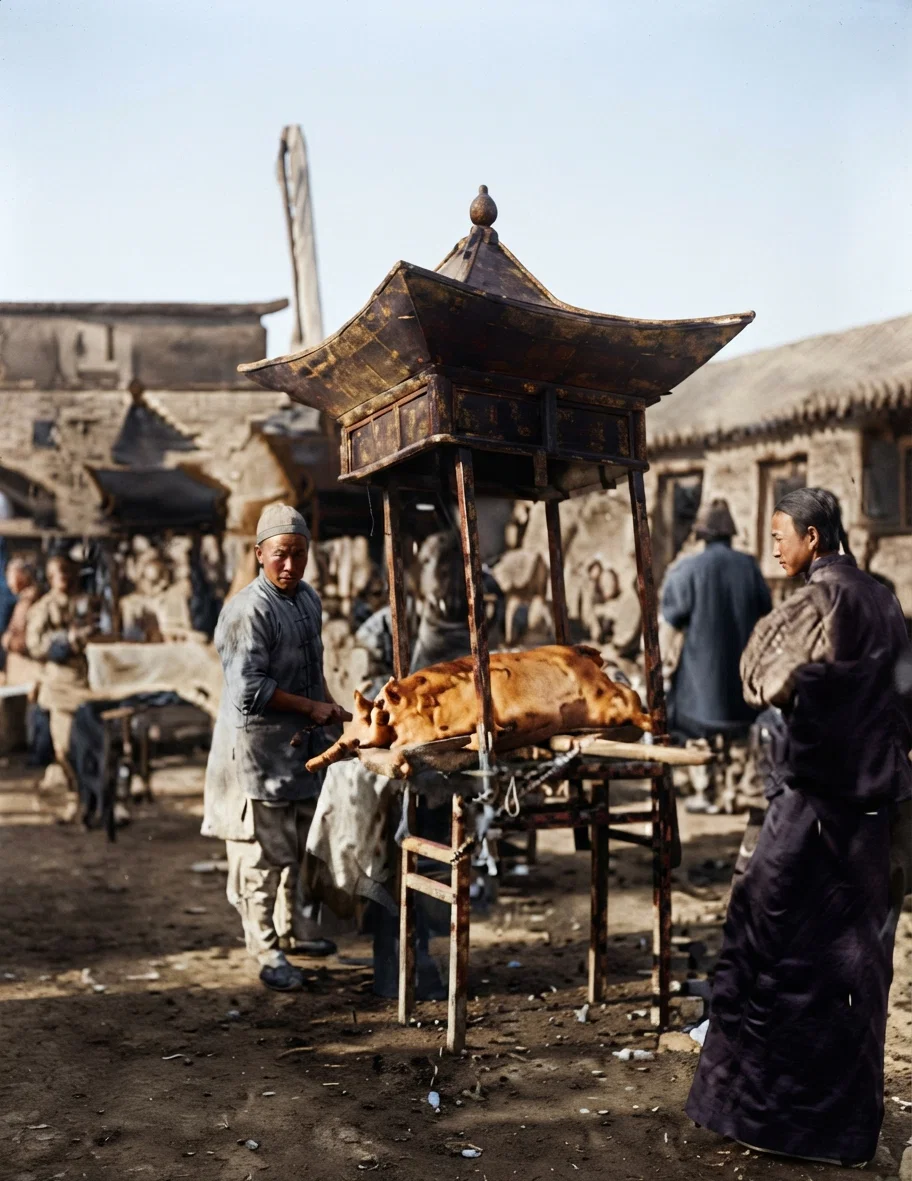
A Roast Pig.
A Roast Pig.
After New-year's eve, no one did buy or sell for about a week. For three days the Chinese did not do anything but visit one another and enjoy the fruit of their previous months' toil. As I listened to the shooting of firecrackers New-year's eve, all night long, and several days after, I was reminded of the Fourth of July in the United States. When my neighbors and friends talked to me about their Ko-Nien, I said: "You better be careful, not eat too much and get sick; if you do, you will have to come to us for medicine."
And, sure enough, I told the truth. I had the privilege of giving both medicine and treatments, as one case went so far that medicine was not sufficient. It was no wonder they got sick. First, they worked too hard to get ready, and were all tired out; so the digestion was slow and weak. Secondly, as they went from house to house wishing their friends a "happy New-year," they had to eat or drink something at every place. I was surprised to see that a good dose of plain medicine generally relieved them as quickly as the meat dumplings made them sick. Their systems are surely different from ours.
We all know that more people are sick from over-eating than from not eating enough; but I was especially assured of this during the Chinese New-year, as more people asked me for medicine then than when they have little to eat. Many of them half starve at other times in the year. Is not overeating one reason why they have so much internal sickness in America and other countries? A Swedish proverb says: "Too much and too little spoil it all." I think this fits in pretty well here. May God help us, who believe the end is near, to be willing to divide with those who are almost without food and raiment. The Scriptures say that one of the great hindrances for good is eating and drinking, and the cares of this life.
New-year's morning, our neighbors came, all dressed nicely, before we had our breakfast, to wish us a "happy New-year." After they had made their polite salutations (I watched them closely and imitated them as well as I could) and were seated, I hastened to wind up the music album. While they listened to the music, I put on the water kettle and slipped on my good clothes. Then I served them the good, pure water with foreign sugar, no cream, as the Chinese think that it is not edible. As they never drink water without a few tea leaves in it, they did not enjoy the water, but were very pleased to look at our foreign cups and spoons, and knew I did my best in entertaining them.
While they looked at the stereoptican views, I played the organ and sang "Jesus, Lover of My Soul," etc. When they went out they thanked me very much, and were just as pleased and happy as we were in taking in the British Museum. I did not count them, but I know that not less than fifty people came, wishing us a happy New-year, about half a dozen at a time. I had hardly time to eat my meals, as I was helping Sister Pilquist with the meetings every afternoon during the New-year season. But when I saw how nicely they behaved, I just made up my mind to receive and entertain all that came, and in that way remove the hard feeling that some of the Chinese have against the foreigners.
I heard the other day that one reason of this hard feeling is the false reports printed in their papers that many thousand Chinese have been killed lately in America. I believe our missionary work is not only to preach to the people that Jesus loves them, but at every opportunity let them see and feel that Jesus loves them through us. My heart is filled with thanksgiving, and my eyes with tears, when I, in a small measure, comprehend my dear Saviour's love to us all. He is indeed (as we sing in Luther's old hymn book) a Friend, the best One, no one like Him in this world. I learned it when I was confirmed, and still enjoy it. I am glad that I can truly say I love the Chinese.
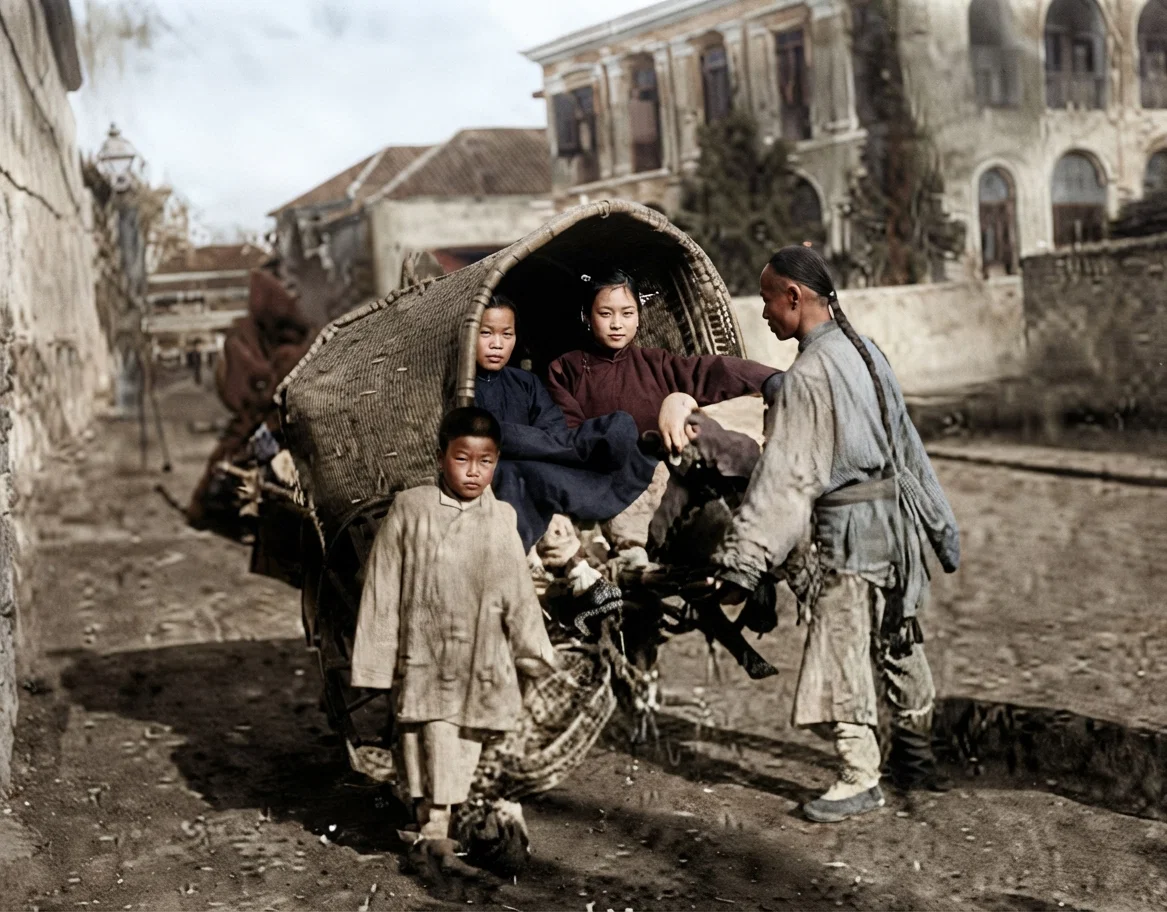
A Chinese Wheelbarrow.
A sister said to me as we were ready to leave for China, "Do you love them? I feel as if I could never be able to live among them." I answered, "Surely; I love those people and have a burden for them, else I would not go there." I praise God that this burden and love have increased since I came to China, and I can say the same for my dear companion.
My dearly beloved in the faith, may we not forget what Jesus willingly has done, is doing and will do, for all who love Him. The devil sometimes wants me to look at the sacrifices, which indeed are small in comparison with the sacrifice of Jesus; then I sing this song in Swedish: "Jesus left His heaven so glorious, His crown so beautiful," etc. What we miss most is a walk in the beautiful nature as a refreshment and change after studying the language. But we thank God that we have only a few steps to the city wall, where we can breathe the pure, high air.
The Chinese New-year celebration lastseighteen days. I told you how the men-folks came the first day; afterward the women and children came in gay clothing and with smiling faces. Yes, everybody was pleasant and happy at New-year. I received them the same way. The Chinese are very inquisitive, and like to examine everything that comes their way. To hinder them from being unpolite, I opened the door to the bedroom and showed them our spring beds, which seemed very wonderful to them. They looked the room over from ceiling to floor. Then I asked, "Would you like to see the room where we eat, and the little kitchen where we cook our food?" How quickly they staggered along on their little feet. It was a real amusement to watch them enjoy and hear them talk to one another about these wonderful foreign things. One reason why I showed them the house and how we live was that it was an education to them. Another reason was, I wanted to give the poor women and children a pleasant change in their everyday monotonous life.
The worst of all hindrances is that they can not read. Dear sisters, how should we be able to endure all the trials and temptations that come to us if we could not read the Bible, the blessed Bible, or other good books, of which we have so many, or if we could not write or receive a spiritual, interesting letter or a paper that tells about the signs of Christ's second coming and other elevating truths. This is just one point of all the good things we enjoy by the grace of God. If I should begin to tell you of the negative side of the women's lives in China, I am sure our hearts would be filled with genuine thanksgiving to our heavenly Father, not formality thanks.
When my teacher went home for his dinner, I went outside, in order to inhale the pure air and enjoy the blessed sunshine. I sat down to write on this article with my mittens and fur on. I had not been writing very long before a poor woman, whose face I recognized, stood before me, with her little grandchild by her side. She wept bitterly as she told me how her husband, sixty years of age, had been pounding her. I saw many marks of his abuse. I asked her to sit down by my side, and comforted her the best I could, cheering her with the blessed fact that Jesus loves her, and will soon come again to take us to l'ien t'ang (heavenly mansion).
Dear friends, when we get to those beautiful mansions that Jesus is preparing for us, we shall for the first time understand what it means to be really satisfied, because everything Jesus does is perfect and grand. But when we labor and toil to reach satisfaction in this world, we generally have the same experience as the Chinese do after celebrating their New-year. "Vanity of vanities; all is vanity." "That which is wanting can not be numbered."
But, brothers and sisters, here is a place where want will never be heard.
"When we shall see His glory face to face, Hear His glad welcome, feel His fond embrace, And feast on the fulness of His heav'nly grace, We shall be satisfied then."
May we all strive to meet in this place of perfect satisfaction, where we never shall part. But I understand that to strive to get there means to get others with us. I am glad to know that in Sinim's land are souls who shall go with us to that place, because God has said so in His Word. Isa. 49:12. Therefore I am glad we are here, and by the grace of God we shall bring some of these sheaves into the heavenly garner. HULDA J. WESTRUP. Lo Shan Hsien, Honan, via Hankow, China.
MISSIONS
MISSIONS

GOD'S ARMY.

DOWN on this sin-cursed earth, Of high and lowly birth, Are souls of precious worth, Strong little band; Soldiers in Gospel light, Girded with armor bright, Panoplied for the fight, Bravely they stand.
Out on the battlefield, Out with the sword and shield, Weapons of faith they wield, On earthly sod; Nor is one coward there, Not one who beats the air, Strong but to do and dare, Fighting for God.
On still and on they go; Telling is every blow, For the cause that they know, Cause that they love. Soon they their crowns will win, Then shall they enter in, Cleanse from all stain of sin, And reign above. KATHRINA BLOSSOM WILCOX.
Continue reading: OUR WORK AND WORKERS