Your ShelfYour Projects

Signs of the Times, Vol. 32, No. 19.

AN EVERLASTING REFUGE
Earlier text: AN IMPORTANT SUMMARY

OUR WORK AND WORKERS.

MEETINGS held at Wolf Lake, Ind., have resulted in fifteen converts to the faith.
THE Lake Union Conference will be held at Berrien Springs, Mich., May 8-18.
ON the 14th ult., three candidates were baptized at Santa Cruz, Cal., by Brother W. T. Knox, president of California-Nevada Conference.
AS A result of a short series of meetings at St. Helena, Cal., by Brother J. H. Behrens, five persons have been added to the church by baptism.
The brethren at Logansport, Ind., now have a house of worship of their own. They purchased a lot, then purchased a building and moved it onto the lot.
THIS item is from the Indiana Reporter: "Our workers at Connersville are still meeting success in their work. Recently some of the nurses went out one evening and sold eighty copies of the Signs of the Times."
MANY of our readers will be glad to learn that Brother Allen Moon, president of Lake Union Conference, is much improved since having his foot amputated. He was able to attend the recent council of the General Conference Committee at Washington, D. C.
FROM the Workers Bulletin we take this item of news: We have learned that preparations are being made to open a bank at College View, Neb. Our institutions there have felt a hesitancy about entrusting their funds with worldly institutions, sound as they may seem to be, and so arrangements are under way to have one operated by our own people. A brother who is financially able will finance the institution, and has agreed to release all his property from exemption in case of failure, thus securing to depositors as nearly absolute safety as is possible.
WRITING from Rock Lake, N. D., to the Union Reaper, Brother E. H. Huntley says: "We have placed reading matter in every home in town and country for a scope of several miles, and scores, who have previously manifested little or no interest in the study of the Bible, are now making the 'good old Book' a confidential study. The Congregational minister, tho opposed to this truth, said to me: 'One thing is certain, these lectures have turned the heads of all the people in town to thinking in your line. When I preach, they go home and forget it all, but now every old Bible in the vicinity is brought out to prove that 'Saturday is Sunday,' and those who have no Bibles are buying.' This explains to some extent the real condition. He also said that "all of his opposition did not amount to anything." The vital question now is, Will they heed the instruction of the "good old Book" after they have read it? The reading of it, yea, the studying of it, will do them no good unless they obey it. "Blessed are they that do His commandments."
"It Is Always So." Writing to the South Dakota Worker, a colored sister says: "Of course we need a church, as we have only a room to meet in. But it is going to take money to get it, and we are all quite poor, but the prospects of a good work could not be better. Now the white people need a church even more than we. But I am sure they will get theirs, as they get more help than we will. It is always so. But we are like the Syrophoenician woman—we will be glad for the crumbs from your table."
There is considerable truth in that incidental expression, "It is always so." God is no respecter of persons, but by some means the white race have come to regard themselves as the "masters" in this world. Consequently, first consideration is for the white people. The white people hold the world's purse strings, altho it is largely through some sort of advantage taken of what are regarded as colored races—black, brown, red, or yellow. Therefore what we "white" people dole out—even in a "missionary" way—toward the "colored" majority is always in small proportion to what we do for our own kind. That is the human nature that still clings to us. But, as a matter of consolation to our sister above quoted, and the little company in which she belongs, we would remind them that the greatest local work ever done through any church is recorded of one that had "only a room to meet in."

TO WHICH CLASS DO YOU BELONG?

THERE are two kinds of people on earth,—I mean The people who lift and the people who lean.
Wherever you go you will find the world's masses Are always divided in just these two classes.
And, oddly enough, you will find, too, I wean, There is only one lifter to twenty who lean.
In which class are you? Are you easing the load Of overtaxed lifters who toil down the road?
Or are you a leaner, who lets others bear Your portion of labor and worry and care? —Ella Wheeler Wilcox.

WHAT A SONG DID.

IN Macao, China, not far from Hongkong, the principal occupation of the inhabitants is gambling. Here on one occasion a traveler found a company of gamblers in a back room on the upper floor of a hotel. At the table nearest him was an American, about twenty-five years old, playing with an old man. They had been betting and drinking. While the gray-haired man was shuffling the cards for a new deal, the young man in a swaggering, careless way, sang a verse of Phoebe Carey's beautiful hymn, "One Sweetly Solemn Thought." Hearing the singing, several gamblers looked up in surprise. The old man who was dealing the cards, put on a look of melancholy, stopped for a moment, gazed stedfastly at his partner in the game, and dashed the pack of cards upon the floor under the table. Then he said, "Where did you learn that tune? But no matter," he continued, "I've played my last game and that's the end of it." The old man, having won money from the young one, about one hundred dollars, took it out of his pocket, and handing it to the latter said, "Here, Harry, is your money, take it and do good with it, I shall with mine." This song may have been heard at his mother's knee. It is to be hoped that it was the beginning of a new life in this man.—Selected.

WANTED FOR MISSIONARY WORK.

(Always prepay postage).
SIGNS, Life and Health, Little Friend, and tracts. Address, George R. Close, 201 Temple Court Building, Denver, Colo.
SIGNS, Instructor, Life and Health, and Life Boat. Address, Esther Levy, Cornwall-on-Hudson, Orange County, N. Y.

CHANGE OF ADDRESS.

THE address of the Southern Missionary Society has been changed from Edgefield, Tenn., to 24th Ave. and New Bridge Road, Nashville, Tenn. All matter sent to the Society, whether freight, express, or mail, should be directed to the new address. Checks, money orders, etc., intended to aid in the support of mission schools, should be made payable to the Southern Missionary Society as formerly. The funds for the Society will be handled by the treasurer of the Southern Union Conference, but the accounts will be kept in a separate set of books, and money deposited in bank as a separate account.
C. P. BOLLMAN, Secretary S. M. S.

The Bank of Mountain View

Was established before the Pacific Press Publishing Company located in our thriving town, and the Press building is the biggest in size, but we are both growing. If the town grows we both prosper. Hence we want to tell you about Mountain View so that when you come to California and locate with us we will be your bankers. Let us tell you something about this year-round-out-door country. Address

The Bank of Mountain View

Mountain View, Santa Clara Co., California

SUNDAY LEGISLATION IN CANADA.

A Jewish Rabbi's Defense of the Jewish Position.

[Reply of Rabbi S. Jacobs to statements of Rev. Dr. Hill, of Montreal.]
SOME few days ago a deputation of Jewish citizens waited on the premier and the minister of justice with reference to the bill, as drawn or suggested by the Lord's Day Alliance, for the more rigid observance of Sunday. This action on our part has provoked some adverse criticism. I don't know why it should, but certainly it has. Some of the objections are unworthy of comment. But surely, we who are Canadians have as much right to protest against the passing of any law as others have to seek for its enforcement. For we have equal rights with our fellow citizens. We are not even new comers, because, whilst General Wolfe was investing Quebec, Jewish officers, under Amherst, were fighting for the glory of England in the invading host. One became Seignior de Brancour, others large landowners. Long before 1768 there was a large and flourishing Jewish community in the city of
Montreal. They were accounted as men of sterling character and public-spirited in every respect. A hundred years ago a Jew was elected to represent the constituency of Three Rivers in the Parliament of Canada; and since then other Jews have been elected and set in the Parliament of Canada. Yes, in every respect we have now the same civic and political rights as our Canadian fellow citizens.
But Dr. J. Edgar Hill, president of the Lord's Day Alliance of Montreal, thinks otherwise. According to his line of reasoning, the Jew has no rights whatever as a citizen. It would be interesting to know on what ground. Would he deprive other religious bodies of their rights? Would he concede any to the Catholics, or to the Unitarians, or to the Seventh-day Adventists, or to any sects which think differently than himself?

A Weak Argument.

His statement that this is the bill of a Christian government in a Christian land is a weak argument in its favor. England is a Christian country, and yet has no such law on its statute book so drastic and severe as this law would prove itself. According to the Factories Act of 1878 and 1901, special privileges are accorded to Jews who keep their factories closed on the Jewish Sabbath. According to this bill now proposed, there are to be certain exemptions. Are we not as much entitled to them as other sects? But there are many who object to this proposed bill besides us Jews, even some who consider themselves, and are, Christians. How should they be dealt with? Surely the president of the Lord's Day Alliance would not subscribe to the
evil principle of making men religious through fear of the law, and to the pernicious doctrine of outwardly observing the Sabbath day, but inwardly chafing because the statute of Parliament compels them to do so. Even granting that the people of Canada by a large majority are in favor of this bill, we have still to learn that the president of the Lord's Day Alliance is their mouthpiece. Have not minorities also their rights? One man in a minority, espousing a good and righteous cause, is a majority with God.

Minorities the Saving Power.

If majorities were always in the right, history would have to be written afresh, and the tide of civilization turned backwards. Never were truer words spoken than that minorities lead and save the world, and the world knows them not till long afterward; and again, that "governments exist to protect the rights of minorities."
The president of the Lord's Day Alliance makes an uncalled-for attack on our co-religionists. We are told that, in his civic experience, we are not the law-abiding, Sabbath-keeping, and inoffensive people we claim to be. This statement is strangelyat variance with many facts and figures, and other authoritative facts, which can be quoted to the contrary. It might be of some little interest to Doctor Hill to learn, as he does not seem to know, that in the year ending June 30, 1903, only three Jews were incarcerated in the Dominion prisons—one in Kingston and two in St. Vincent de Paul—according to the statement of the minister of justice. Whose word is more reliable, Doctor Hill's or that of the minister of justice?
"The trouble with the Jews everywhere," continues the president of the Lord's Day Alliance, "is that in London, as well as in Montreal, the Jew is an anachronism in modern society." That is just what Pharaoh thought, just what Amalek thought, just what Haman thought, just what Antiochus Epiphanes thought, and what all Jew-haters and Jew-baiters since those days have thought. As the psalmist puts it, "Come and let us cut them off, so that they may be no more remembered." This good "Christian" divine does not tell us why we Jews are an anachronism. Let us hope that on some future occasion he will enlighten us on this point.

The Jew in London.

But he is singularly unfortunate in quoting the Jew of London as an anachronism, for in no city in the world does the Jew hold a higher position, commercially and socially, than in the metropolis of the British Empire. Its most popular of lord mayors and sheriffs have been Jews. Its most public-spirited citizens are Jews. It is an acknowledged fact that the most generous supporters and benefactors of the charities of the city of London are followers of the Jewish religion. Such names as the Rothschilds, the Moeattas, the Goldsmiths, the Montefiores, stand unequaled for loyalty to their country, for charity, for sympathy in the cause of suffering, and for being interested in every movement of public utility. There are Jewish peers of the realm, Jewish baronets, Jewish knights, Jewish members of Parliament, a Jewish under-secretary of state for the home government, Jewish judges, Jewish magistrates, Jewish lawyers, Jewish sailors, Jewish soldiers, yes, and even Jewish governors of British colonies.
And yet we are gravely told that the Jews are an anachronism in modern society. The late Mr. Gladstone did not think so. He quoted the public-spirited Jews of England as a proof that the Jew has justified his claim to emancipation and the right to full civic rights in whatever country he was located. And is the Jew in Canada an anachronism?—Not as long as he discharges the duties of citizenship worthily, and identifies himself with his fellow men in the public life of the country, and mixes with his fellow citizens of other creeds, and unites with them in works of loving sympathy and active benevolence. We in Canada are not ashamed of our record in the past, nor shall we be in the future, with God's help.

Behind the Times.

No, dear brethren, we Jews are not the anachronism; but it is the president of the Lord's Day Alliance who is behind the times, who, perhaps, if he had his own way, would again treat us to the unsavory atmosphere of the ghetto, to the hot, but unchristian, argument of the Inquisition, and to the burning argument of the stake. We say to him, "Good Christian brother,"—for we recognize all men as our brethren,—"surely you have spoken in haste, or in error, or thoughtlessly, when you tell us we are unfitted for the spirit of the times. In these materialistic days it should make you happy and gladden your heart to behold ten million of your Saviour's people, His kinsmen, fulfilling the mission and the word of that Holy Writ you profess to revere and teach. The waters of baptism could free us forever from the heritage of suffering which has been our portion, and would cause the curtain to fall on the tragedy which Israel has played on the stage of the world's history, but the truth and the Word of God and His promises are dearer to us than the wage of apostasy. Never, perhaps, before did the world need more the salutary lesson, that the satisfaction of conscience is worth any suffering of the body. Then, because we believe and carry out the Jewish faith, and are willing to make the sacrifice it entails, do not call us an anachronism.
Read the Scriptures again; yes, even the New Testament, tho its writers were Jews, and let your future utterances be more sympathetic, more just, and more tolerant to the people of Israel, who gave you a Saviour; for He Himself declared, "Salvation is of the Jews." Otherwise, Dr. Hill, you yourself are an anachronism.
[It is the unchristian attitude of professed Christian teachers that calls forth such replies as the foregoing, and makes them logical from the Jewish standpoint. If Christianity consists in the enforced observance of days by the power of civil law, the Jewish opposition to the whole fabric is logical. But the Word of Christ does not sustain such "Christianity." It is not Christianity in any sense. The New Testament was all written by Jews, who knew what Christianity means, and every principle announced is against enforced religion in any phase, or the compulsion of any man's conscience.—EDR. OF SIGNS.]

WILL THE LESSON GO UNHEEDED?

THAT the masses of the people in the cities stricken by the earthquake are not disposed to heed the lesson, and scatter over the millions of broad, unoccupied acres, instead of repeating the follies of the past is evident from many circumstances:
(1) Millions have been lost because invested in these cities; yet capitalists are in a rush to invest more millions in the same way, boasting the ability to thwart the earthquake and the fire. Like Babylon of old, the resources of the country are being perverted to the proud purposes of rearing and embellishing great cities. And, like Babylon of old, the investment will in the end prove unprofitable.
(2) Homes have been lost because they were crowded in the cities. Yet those who can raise the means, by borrowing or otherwise, will plant homes in the same localities. Men and women lose their lives, their health, their characters, by the criminal and immoral associations and surroundings of the cities; yet they seem oblivious to any way of living excepting by the scanty gleanings of city life.
(3) Men and women prefer meager wages and uncertain employment, together with life in loathsome and crowded tenements, rather than life amid the productive and healthful fields in the country. One man reports that he sought farm laborers among the needy men in San Francisco, and out of several hundred who professed to want work, he finally secured two who were really willing to go to the country.
(4) The hundreds of varying languages in the world stand as a great monument to God's displeasure with the folly of city-building. And the ages are strewn with buried and devastated cities, fallen under the wrath of God because of their moral and political corruption. The great dens of political chicanery, of business dishonesty, of moral depravity, of iniquity indescribable, to an extent that mortal vision can not perceive or mortal mind compute, are all hatched and brooded and nurtured in the cities.
The everywhere-expressed determination to rebuild greater, grander, and stronger, the recently-devastated cities, is an indication that capital has not learned the lesson. The persistence with which the poor wage-earners cling to the ruins or flock to other cities, would indicate that labor has not yet learned the lesson. But neither class know what else to do; they follow in the wake of their worldly education. It would require faith in God's Word to inspire courage to do otherwise, and this the masses do not possess. That which they have done they will do; and the folly and its fruits will be repeated. Here and there one will be wise, even at the expense of what seems to be for profit, and in the greater destruction yet to come it will be this "little flock" that will be saved.
The Word of God is full of warnings and instruction for the people of the last days, and never before were there, in His providence, so many instrumentalities for printing and distributing this Word. This is no mere chance coincidence. The definite purpose of the merciful Father is that the people shall be made wise, not merely as to the physical fact of the disasters that are coming upon the earth, but as to the means of escape in the time of trouble. There is no other means of escape than by taking heed to the Word, and fleeing to the only Refuge. "Trust in Him at all times; ye people, pour out your heart before Him; God is a refuge for us." Ps. 62:8. G.
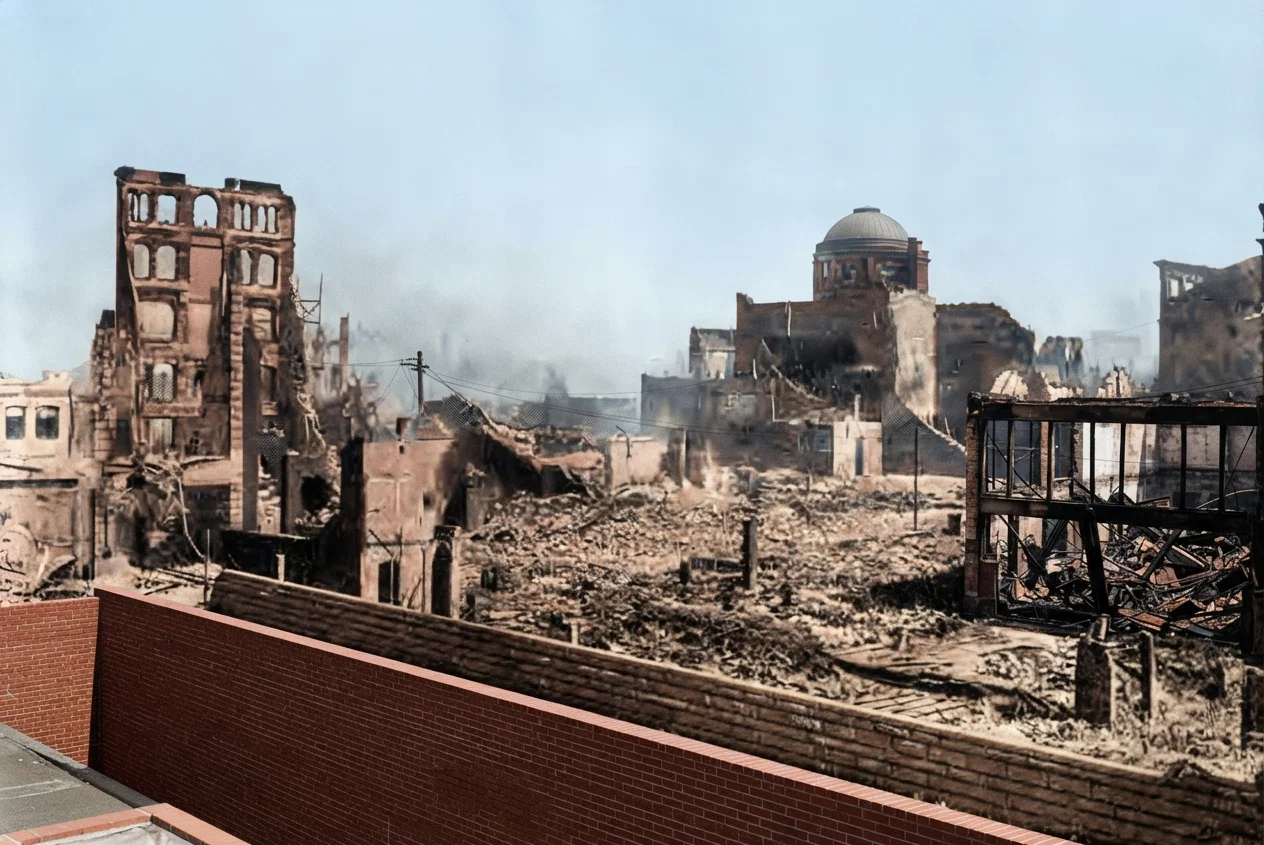
Looking from the Post Office, Seventh and Mission Streets, San Francisco, northward, after the fire.

The Battle of the Elements

Combatting the elements is the most shocking and enervating of all physical warfare. Some of the troops engaged in preserving order in San Francisco were Spanish War and Philippine veterans, and they say the scenes and surroundings on the city fire line caused the battlefields of Santiago, Manila, and Mindanao wilds to pale into insignificance. In the great battle of the elements when the almighty God shall pour out His plagues upon the finally impenitent hosts, there will be no human power that will be able to stand before His lightnings and hail and earthquake and abnormal heat of the sun. Revelation 16; also 17:11-18. The present earthquakes and fires are but advance warnings of the more terrible and more general terrors not far in the future. "Who shall be able to stand?" Rev. 6:17. "Who may abide the day of His coming?" Mal. 3:2.

Question Corner

1816.—Apostles Now.
If there is to be a restoration of all the gifts in the church, why do we not have apostles now?
Are you sure we do not? The word "apostle" means "messenger," "one sent." Has not God apostles among His workers, upon whom He has bestowed His Spirit, who are messengers to unopened fields, and through whom God works? Sometimes we do not see God's gifts and blessings before our eyes.
For answer to your second question on Acts 19: 5, 6 write to your conference president or to the Review and Herald, Washington, D. C.
1817.—Is it in the Future Life?
Please explain Isa. 65: 20, 22. What is meant by the tree in this connection?
1. Isa. 65: 17-25 is a vivid description of the blessed future of God's people who are faithful to Him. It is clothed in the words and language of that time.
2. Verse 17 refers to the new earth, indicating its great superiority over everything men have known here, so much so that we shall never recall them with regret, if at all.
3. The Jerusalem here mentioned is the New Jerusalem, which shall come down out of heaven from God. Rev. 21: 1-5; Isa. 62: 1-5; 54: 4, 5, and other scriptures.
4. In contrast with these times, from that day forward "there shall be no more thence [from that earth] an infant" or a failing old man. Why?—Because before that time arrives when the righteous shall enter into rest, those doomed to death will have died.
5. The hundred years there mentioned may be the "little season" after the resurrection of the wicked. Rev. 20: 3, 5, 7-10. During this time those who are young in years and sin can live to the age of the period permitted, and the more aged sinner continues also, doomed at the close of the one hundred years, the little season, to die eternally.
6. Thenceforward God's children will live in peace and joy unutterable. The tree referred to is doubtless the tree of life, in the midst of the Paradise of God. They are the children of God forevermore.
1818.—The Highway of Isa. 11: 16.
What is meant by this highway?
That highway is the way of God's commandments in Christ Jesus, the only way of salvation which the Scriptures offer.
1819.—The Hour of Temptation. Rev. 3: 10.
What and when is the hour of temptation? Is the hour symbolical? Also the half-hour silence in heaven of Rev. 8: 1, how long is it?
The hour of temptation, or sore trial, to God's people is when the secular powers of earth unite to give their power to the apostate church, and the power of that union is thrown against the devoted children of God, the only ones who protest against the union and the unscriptural claims of apostasy.
Then the ten horns will unite to give their power and strength to the beast, and the harlot church shall say, "I sit a queen, and am no widow, and shall see no sorrow." See Rev. 17: 12, 13; 18: 10, 17, 19; 3: 10. We believe it to be symbolical time—fifteen days, one twenty-fourth part of a year. Rev. 8: 1 is proportional time.
1820.—"Sprinkle Clean Water." Eze. 36: 25-27.
In Eze. 36: 25 it reads, "Then will I sprinkle clean water upon you, and ye shall be clean." Does this mean a form of baptism practised in that dispensation before Christ? Or what does sprinkle mean? In Heb. 10: 22 it speaks of "having our hearts sprinkled from an evil conscience, and our bodies washed with pure water." Will you please enlighten us through the Signs on this subject?
No, the sprinkling there referred to is no form of baptism. The reference is to Lev. 14: 1-8. The sprinkling of water in these ancient ceremonies was an authoritative declaration, a judicial pronouncement, that the person was clean. So God will cleanse His people in no ceremonial way, but by the washing of water by His own pure Word. The form of baptism in pre-Christian times was immersion. The thought in Heb. 10: 22 is the same.

INTEMPERANCE IN FRANCE.

The Saloons of Paris.

PARIS has only 17,000 bakers and 14,500 butchers, but it has 33,000 saloons. In the whole of France 160,000 persons are employed in making bread, but 500,000 are employed in saloons. An additional fact is that one-twentieth of the voters of the country are employed in this business. There are saloons for all classes and for all purses, and many in the large cities have become nothing more nor less than gambling-hells in which one may try his luck as merrily as possible. But the greatest evil is that the tavern, the faubourg of the great city of the village, has become a meeting-place for the people; the saloon is no longer a place in which to drink; it is a place in which to spend a large portion of one's time. Thus, little by little, the saloons have become public institutions—institutions which everything conspires to develop, even the apparent interest of the state. For it must not be forgotten that the saloon pays not only the octroi, or city taxes; it also pays a license, the taxes on drinks and alcohol, as well as other charges which indirectly affect all landlords and tenants.
Fifty years ago only three quarts of liquor per head were consumed in France, but to-day we have nine quarts per head. Fifty years ago bitters and absinthe were unknown, but to-day France consumes over 60,000,000 quarts of these beverages. And the evil is so great to-day that private initiative can not check it—we must turn to the state. The only thing that can do away with a portion of the evil is to restrict licenses, remove the saloons from the neighborhoods in which crowds collect, decree that the trade can not be plied by suspicious characters, and bar the road to the tavern so far as incorrigible drunkards are concerned. In addition to this, stringent laws must be passed making drunkenness a punishable offense.—Translated for Public Opinion from Paris Revue Bleue.

Alcohol and the Moorish Question

Alcoholic drink is playing a part in the Moorish question. The introduction of intoxicants has aggravated all sorts of troubles, and a few weeks ago at the Algeciras Conference, the Moorish delegate proposed that an almost prohibitive tax be placed upon the importation of alcoholic beverages. The proposal was unanimously rejected "with mingled feelings of amusement and annoyance," so the European papers say. The Christian nations of Europe are, therefore, forcing this alcoholic drink into a land where it is prohibited both by custom and religion. Is it any wonder that Mohammedans and Hindus are hard to reach with the Christian religion?

Prohibition of Absinthe in Switzerland

The Prohibitionists in Canton Vaud, one of the progressive districts of Switzerland, are agitating for a law prohibiting the sale of absinthe. A petition containing 80,000 signatures has just been presented to the Grand Council. The Council has reported favorably on the measure to the council of state. There is some doubt as to whether the project will be practicable, as Switzerland has an "interstate commerce law" that interferes with the cantons protecting themselves against the ravages of drink.

Publishers

Will our correspondents be especially patient? We are swamped with work, and the ring of hammer and trowel are going on on every side, while the cool breezes blow through yet unrepaired walls. We are doing almost the best that is in us to meet the situation. Our friends, we are sure, would not have us utterly exhausted by the effort, tho we have been pretty near it. But God is good, weather is pleasant, and every one is working hard and willingly.
Blessings and Losses to Our Sanitarium.—From Brother L. M. Bowen we have this note:
Please announce through the columns of your paper that the St. Helena Sanitarium is practically uninjured by the late earthquake, and we are receiving patients as usual. The Food Factory also escaped unharmed.
Our work in San Francisco was totally destroyed. The extent of our loss will depend upon the ability of the insurance companies to meet their obligations. San Francisco, San Jose, and Santa Rosa suffered very severely and will have to be practically rebuilt. Yours in the work, L. M. BOWEN.
Views of the Earthquake.—Of course we knew, as soon as we thought of it, that friends throughout the East would be glad to get good views of the earthquake. We decided, therefore, at the time of our last issue as the "Earthquake Special" was going to press at 1 A. M. to print on fine paper some of the best views we had obtained of the results of the earthquake, with description of the same. These are now in preparation. There will be more than forty half-tone reproductions, on fine paper, of San Francisco, San Jose, Santa Rosa, Stanford University, and Mountain View. This will include reproductions from the original signatures of three California earthquakes, or seismographic records. The price is twenty-five cents, post free. Address, Pacific Press, Mountain View, Cal.
The paper used in this issue is not, as our readers will readily discern, regular stock. Why?

AN ANXIOUS GENERATION.

THE question that millions of people are asking to-day is, What mean these phenomena of nature so strikingly and so frequently seen on every hand? They have seen the result of cyclones, frequent and increasing; of volcanic eruptions that have spread death and terror and ruin over large portions of populous districts; of earthquakes that have ruined cities, numbering their death lists by thousands, and working hand in hand with the fire fiend to lay low and devastate that upon which men had lavished wealth and art. The thoughtful everywhere are asking, What is the meaning of all this? What place does it all occupy in the economy of this world? Has it any connection with the things of God, and the closing of earth's history? The publishers of this paper believe—they know, for God's Word is sure—that there is the most direct and living connection between these specified phenomena of nature and the closing work of this dispensation. Thus believing and knowing, we have no hesitancy in recommending to our readers a book dealing directly with these things, and also with the social and political problems of the day. That book is "Heralds of the Morning," by Asa Oscar Tait. In this book of 354 pages these questions that are agitating the minds of anxious inquirers are answered in the light of the sure Word of God. Here are some of the striking topics considered: "A Remarkable Century;" "The Prevalence of Crime, a Sign of Our Times;" "Judgment Turned Backward;" "The Earth Filled with Violence;" "The Voice of the Elements;" "The Testimony of the Earth;" "The Nations Were Angry;" "Divine Restraint of the Spirit of War;" "A Time of Trouble;" "Our Refuge and Fortress;" and many other topics of equal importance. It is beautifully printed in large, clear type, profusely illustrated, cloth bound with marble edges—an excellent book for missionary work among friends and neighbors, as well as for home reading. Price $1.50. Order of this office.
A poem is going the rounds, finding place in the religious papers, entitled, "There Is No Death." This is a quite popular sentiment in these times, and is constantly gaining credence. Nothing could more conspicuously mark the general trend of departure from the Word of God. If there is no death, then the whole Gospel is a myth. Satanic ingenuity could not have invented a shorter cut to a denial of the whole story of redemption. If there be no death, then Christ did not die, nor was there any reason for His death. "There is no death" is simply a repetition of Satan's declaration in Eden, "Ye shall not surely die."
Possibly Not.—The vice-president of the National City Bank of New York came to San Francisco immediately on hearing of the great disaster to that city, and confidently proffers help. He says: "In my opinion, Eastern capital in general, realizing that the disaster which has wrecked San Francisco may not be repeated before the end of time, will not hesitate to again invest largely in this city." Possibly such a disaster may not recur until the end of time—in that particular city. But the "end of time" is much nearer than the men who are investing their all in this world's enterprises are aware of. "The day of the Lord will come as a thief in the night; in the which the heavens shall pass away with a great noise, and the elements shall melt with fervent heat, the earth also, and the works that are therein shall be burned up. Seeing then that all these things shall be dissolved, what manner of persons ought ye to be in all holy conversation and godliness." 2 Peter 3:10, 11.
Well expressed is the following paragraph from the Word and Way:
The attempt to Christianize evolution has been as great a blunder, and has brought to the cause of truth as serious results, as the attempt of Constantine to Christianize by edict the heathen world.
The same can be said of "the attempt to Christianize" the doctrines of immortal soulism and Sunday observance, as these are relics of the heathenism that was nominally "Christianized" by the aforesaid edict. From the former have grown Spiritualism, eternal torment, transmigration of souls, Universalism, saint worship, etc., etc.; while from the Sunday observance principle has arisen the long train of church "holy days," that only gratify the natural desire for display. "Christianized" heathenism has been the worst obstacle with which the church of Christ ever had to contend. Heathenism in Christian garb is tenfold worse than heathenism under its own banner.
This Paper and the Next.—The matter in this paper was almost wholly in type before we began on our Earthquake Special. We would be glad to present in this issue many things which we have on hand on the earthquake; but we can hardly do this under the circumstances. But next week we will present more definite statements and more photographs of the great calamity. Especially of the most stricken city, Santa Rosa, has little been said. Next week we will tell you of this and many other things. You will want to read it; your neighbors will.
On the Pacific Ocean, just across the mountain range from Mountain View, is the town of Halfmoon Bay. In reporting the effect of the earthquake for the Leader of our home town, Mr. H. G. Copeland says: "A peculiar feature of the shake in that section was the cracking of the earth. Hundreds of large crevices opened, through which water was forced, especially in close proximity to the creeks, and the large concrete bridge at the north entrance to the town was destroyed.
The newspapers are saying that "a stream of gold" will soon be pouring in from the East to rebuild San Francisco. There ought to be "a stream of gold" pouring in to carry the message of warning to the world, telling them what these things mean, and what the Word of God says to the people concerning these last days. What is the response of those who have the means and profess to believe these things?
One week after the earthquake in San Francisco there were issued in one day 349,440 rations. This means that about four-fifths of the population ate the bread of charity that day. But even in the midst of such dependence, men are boasting of what the "proud city" is going to do, on the theory that such disasters are seldom repeated in the same place.
Pacific Press, Mountain View, Cal., is ready for business. We can fill orders promptly for books, tracts, pamphlets, S. S. Quarterlies for January, April, and July.

THE EARTHQUAKE.

We are saving all our regular stock for our "EARTHQUAKE SPECIAL," and then we shall run short.
The margin on this paper is too close to trim at the top. Please do not complain; it is the best we can do till we get new stock. We have three car loads of SIGNS paper on the way, but just where it is we have not yet learned. We may have to print on manila paper, brown wrapping paper, or wall paper before we get it.
But if the paper looks strange, it is the same old SIGNS OF THE TIMES, still containing the same everlasting Gospel.

OUR NEXT ISSUE

will be the second edition of our "EARTHQUAKE SPECIAL." We must do it. There are other and later things which we wish to chronicle. There are later photos and facts which our readers will long to see and know. We have a better map of the city to present than we could first secure. We have a much more perfect seismographic record than the reproduction of the poor proof which we printed last week. The date of the Second Edition of the "EARTHQUAKE SPECIAL" will be May 16. Let the orders come in for the Second Edition.

You have reached the end of this edition.

Signs of the Times · May 9, 1906