THE reports indicate that the British are pushing the war in South Africa with a great deal of energy. There have been a number of engagements, and the British are said to be victorious, altho there has been a great slaughter on both sides. Every Christian should be earnestly praying for the return of the Prince of Peace, to forever bring to an end this terrible slaughtering of human beings. And, while we all pray for the coming of the Lord, we can at the same time be doing much to hasten His coming by faithfully working to give the last message of mercy that is now going to the world.
IT is reported that Great Britain's immense military preparations against the two insignificant South African republics are viewed with considerable curiosity in some of the European capitals, notably Paris and St. Petersburg. Diplomatic notes have been exchanged on the subject, and it has been hinted in unofficial quarters that inquiries will be addressed to the English Government as to the absorption of the two republics by the British Empire. It is interesting as well as instructive to watch the many different things which show how full the world is of the war spirit, and what possibilities there are for extended international complications. The time can not be far off when some of these things will start the great march to the battle of Armageddon.
THE Pullman Palace Car Co. has purchased the Wagner Palace Car Co. These two great firms are now consolidated, with a capital of $74,000,000. It is only necessary to make a note of current events in order to see that all the wealth of the world is swiftly coming under the control of a mere handful of men. And because of this many are exasperated, and breathing out threatenings against the rich. But could all such be led to inquire of the Word of God, they would there learn that the heaping together of treasure is one of the leading signs that we are in the last days. And consequently it is no time now for us to be picking a quarrel with the rich, or any one else. The one thing that all should do now is to prepare to meet their God face to face. The second coming of Christ is right at the doors, and every one should be made aware of it, and each one as he receives the good news should do all he can to pass it on to others.
MICHAEL DAVITT, a Nationalist in the British Parliament, characterizes the Transvaal war as a "hideous and damnable massacre." He further said there had never been such magnificent robbery by force, "doubtless because the prize was the greatest that ever tempted the cupidity of the empire." All war is a "hideous massacre." To be sure, some wars may seem to have more just grounds than others. War is the struggle of sin and unrighteousness. It is prompted by greed and unholy ambition, and is always cruel and heartless. It is altogether out of harmony with the tender sympathies of Christ. And while one war may seem more just than another, yet all wars are wrong. If men would only let the Lord Jesus Christ come into their hearts and govern their lives, they would find that there is absolutely no necessity for wars. It is only the sinfulness of men that seems to make it necessary.
THE Anti-Saloon League is planning a systematic attack upon the saloons of Chicago. Good! But it is to be hoped that this systematic attack will not resolve itself into that worthless and wicked farce, a skirmish for the closing of the Sunday saloon. So many times have great things been promised in the temperance field that have distilled themselves down to this dreg, that the heart nigh grows sick from hope deferred. As well might the law lay a Sunday embargo on polygamy, legalizing it thereby on the other six days of the week, as to close the saloon on Sunday, and thereby recognize its legality throughout the rest of the week. The consistent Christian can not compromise with evil. The saloon is evil and only evil. It should be closed twenty-four hours every day, seven days every week, and fifty-two weeks every year. If the League succeeds in closing the saloons of Chicago completely and utterly, it will have wrought a grand and noble work. If it succeeds in closing them only one day in seven, it has added to the evil by recognizing its right to run the other six days. The votes that would close Chicago's saloons on Sunday would close them every day in the week.
"FIFTEEN hundred Boers reported killed at Mafeking," is the flaming headline to a recent newspaper despatch from the Transvaal. This news will cause great rejoicing in England. There will be some of the English, of course, that will be made sad, but the great majority will hail the news with transports of joy. But how much sadness and misery does this news mean for hundreds of homes among the Boers! War is horrible! War is the crudest and the most cruel barbarism. War gloats over bloodshed and the destruction of property. It not only spreads misery on every side, but it glories over it, and rejoices in it. And what a strange misconception of Christianity must those persons have who think that the cruel and bloodthirsty barbarisms of war may be harmonized with the character and teachings of the Christ of God!
SOME negroes near the little village of St. Ann, Miss., burned a mother and her four children alive on the morning of October 19. The ringleader in the tragedy was taken by a mob and burned at the stake. It is painful to note the deeds of violence that are characterizing these times. But the sure Word of God has told us that terrible scenes of violence will be the order of the day, in the times just before the second coming of Christ. Indeed, one of the things that will make His second coming so urgently necessary, will be the violence and crime of the times, and He comes in mercy to destroy its perpetrators, and to relieve "them that sigh and that cry for the abominations that are done in the land."
IT is now considered certain that the Andrade government in Venezuela will be overthrown by the rebellion that is making such headway in that country, and the Bank of Venezuela has issued an order to stop the pay of all the consular and diplomatic representatives of the country. This is the bank that transacts all the business for the Venezuelan Government, and the managers say that since succeeding presidents who are established by a revolution always repudiate the debts and obligations of their predecessors, it will not be safe to let the government have any more money.
ONCE war is started there is no telling the course that affairs may take. For instance, since the war in South Africa began, it now develops that the native black men of South Africa are beginning to rise up to assert their rights. In some instances they stand with the Boers; in others, they stand with the English; and in still other cases they hate the English and Boers alike, and are preparing to make a general fight against any white man they may find in that territory. They hold a grudge against the white man for coming in there and taking their land from them.
A WRITER in the German scientific paper Prometheus, declares that overindulgence in tobacco will prove the ruin of South American people. Not only do children of three years smoke all day long, but mothers have been seen trying to quiet their babies by putting cigars in their mouths. As the action of tobacco on the most vital organ of the body is so well known, the ruinous effect of such a practise upon the longevity, vigor, and moral stamina of a people can easily be understood.
A CORRESPONDENT of the Keene, Texas, Reporter, writing from Abilene, in that State, says: "They have the strictest Sunday law here of any place that I have ever been. The only thing the confectioners can sell on Sunday is ice-cream. The law allows milk to be sold, and they sell ice-cream as frozen milk. A man can not buy feed at a livery stable even if his stock are starving. This is truly a priest-ridden country; people are afraid of their preachers."
THERE will be completed and added to the American navy within the coming year, five battle-ships, one armored cruiser, one cadet training ship, and twenty-five torpedo-boats and torpedo-boat destroyers, while others are planned for and to be completed during the following year.
WILLIAM H. APPLETON, the oldest member of the well-known publishing house of D. Appleton & Co., New York, died on October 19 at the ripe old age of eighty-five.
THE famine still continues in India throughout a district comprising about 350,000 square miles, and containing about 30,000,000 inhabitants. A little more than one-third of this territory is in the British possessions, and Lord Curzon, the viceroy of India, is going to make a personal visit to the district to see what can be done to relieve the distress. It is hoped that the worst of the famine has been reached, and that relief can be afforded in time to prevent any further prolonged suffering.
A FEW days since some cowboys and Mexicans had a fight at a little town on the Mexican border. Two cowboys had been arrested by the Mexicans in a fight on the Mexican side some time since. And now the cowboys are demanding their release, under the threat of making a raid along the Mexican border. Two hundred cowboys are assembled, and the excitement is running high. It is thought that great care will need to be exercised by the authorities to prevent an ugly clash.
THE latest advices from Japan inform us that the great typhoon of October 7 and 8 that swept the Japanese coast destroyed hundreds of houses, and in two little towns alone over 500 people were killed. The loss of life in various places was very great. Storms all over the world tell of the furious workings of Satan as he is making his last supreme efforts to destroy mankind.
REV. A. B. SIMPSON raised sixty-eight thousand dollars for missions at a meeting in Carnegie Hall, New York, October 15. It is said that women tore off their jewels, and the excitement finally ran so high that men took off their coats and vests and threw them into the collection. Mr. Simpson is the leading representative of the Christian Alliance Missionary Society.
A FEW days since the language question was under discussion in the Austrian Reichsrath. The minister of justice, Herr Kindinger, was literally bombarded with papers by his opponents, amid shouts of, "Resign." "The uproar finally became indescribable, and the president of the chamber closed the sitting."
ACCORDING to the Saturday Evening Post, "estimates show that the capitalization of the trust organizations for the present year will exceed twice the volume of currency, or five times the bonded indebtedness of the country."
MINERS returning from Surprise Lake, east of Atlin, Alaska, report that a volcano broke out in one of the mountains in that region on September 7. The eruption was preceded by tremblings in the earth for several days.
THE latest despatches state that General Cipriano Castro, the Venezuelan insurgent leader, has assumed control of the government, and formed a cabinet. General Castro is very popular just now.
SERIOUS rioting has broken out in the lower Chidwin district of Burma. The natives are demurring because of their strict quarantine in the cholera district, and the rioting is the result.
THE Navy Department is making preparations for extensive tests of Marconi's system of wireless telegraphy as adapted to naval warfare.
THIRTY-FIVE of the thirty-seven large bridge building plants of the country have combined. The new trust is capitalized at $67,500,000.
THE reports that the bubonic plague had reached Brazil have been confirmed. The dread scourge is now raging at Santos.
THE consideration of the Transvaal war is bringing out some very stormy discussions in the British Parliament.
NINE persons perished in recent blizzards in Montana, and it is feared that still others have perished.
THE family of the defeated president of Venezuela have gone to New York because of their imminent danger.
THERE has been a rapid increase in the price of diamonds since war in the Transvaal was declared.
THE rebellion in Santo Domingo has resulted in the election of General Jimenez as president.
A REBELLION has broken out in the republic of Colombia.
MANILA AND ITS SURROUNDINGS.
By Eugene G. Wood
THE city of Manila is situated on the east side of Manila Bay, on the western coast of the island of Luzon, about half way down the coast. It is spread out on a flat piece of ground, the main portion of the city being only a few inches above the sea level; it gradually slopes back from the river to higher ground.
This old city is the largest in the archipelago. It, with its many little suburbs, has a population of about three hundred thousand. Legaspi, the conqueror, entered the bay and established a form of government under Spanish sovereignty in 1571.
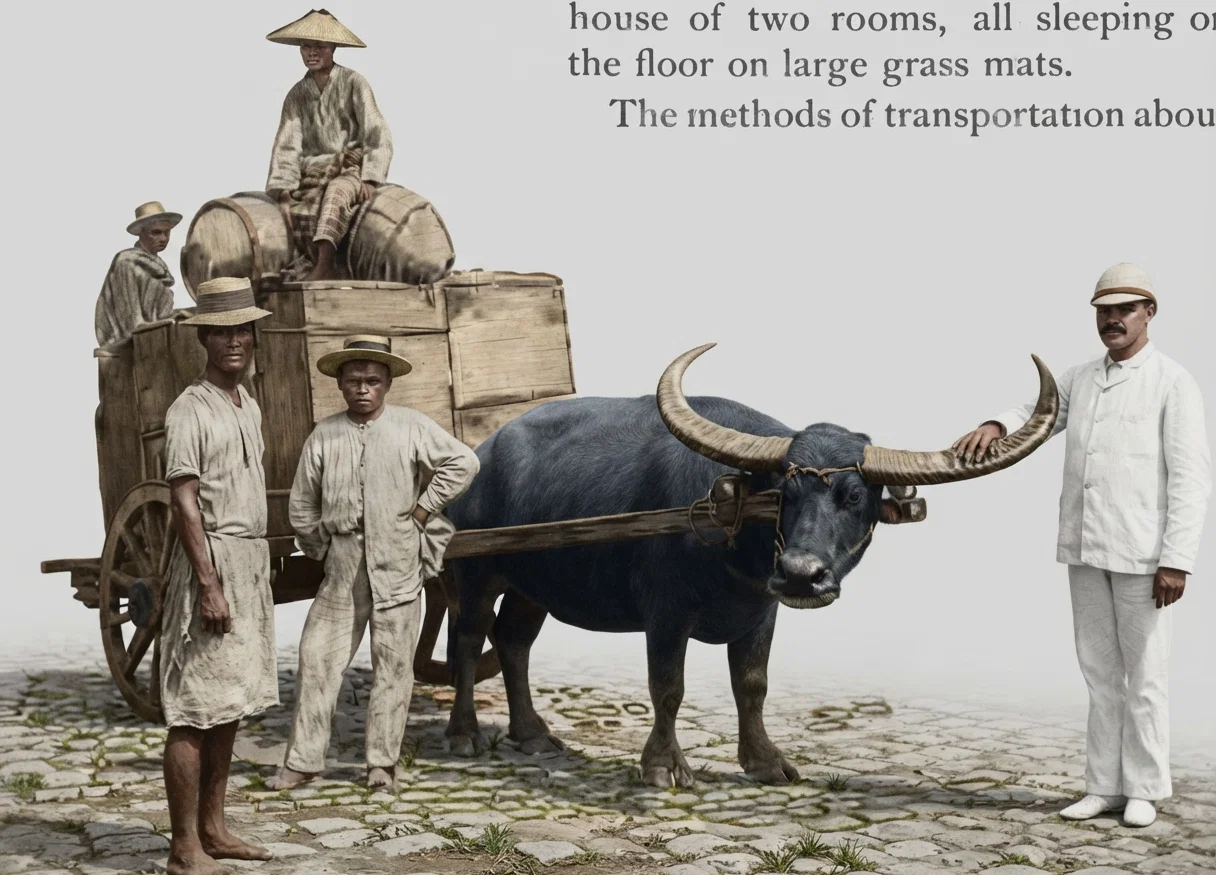
The city of Manila is full of interesting sights to one arriving from the Western world. The oriental customs, the queer-looking vessels, small boats, or bancas, the peculiar-looking little horses and cabs, or caromata, the huge water buffaloes yoked up to carts, the narrow streets, low, flat-roofed buildings with large, open windows and wide verandas, large cathedrals, stone bridges, etc.—these all lend enchantment to the American.
The city is divided into two parts by the Pasig River. That portion on the south is called the Walled City, or Old Manila; that on the north, the New City. The New City is more modern in its appearance; the streets are wider, and the buildings are of more modern structure. Most of the business is transacted in the New City. It contains all the large warehouses, factories, shipping quays, wharves, and railways. Many English, German, and Spanish firms do a large wholesale business with the entire world. They import foodstuffs, hardware, and clothing, etc., to the amount of $25,000,000, and export tobacco, hemp, and lumber, to the amount of $35,000,000 annually in Mexican currency.
The streets are quite narrow, and paved with large flat stones. The sidewalks are usually of stone, in many places not more than three feet wide. The Escolta, the principal street in Manila, is about sixty feet wide, and has sidewalks about six feet in width. All the principal retail stores are here. You find representatives of all nations vending their wares.
One can spend days sightseeing in the large bazaars. They contain most beautiful decorative art, curios from India, China, Japan, Ceylon, Egypt, rare silks, jewels, and precious stones.
The buildings are low and flat, and in the central part of the city they are mostly built of stone, and roofed with sheet iron or tile. They are rarely over two stories in height. The walls are often four to six feet thick; the floors are of tile. The large, cool verandas, with wide, open windows having no glass, but sliding shutters of wood, or thin, transparent shell set in panels, draws one's attention to them with much interest. These buildings are occupied as stores and residences by the European population of the city.
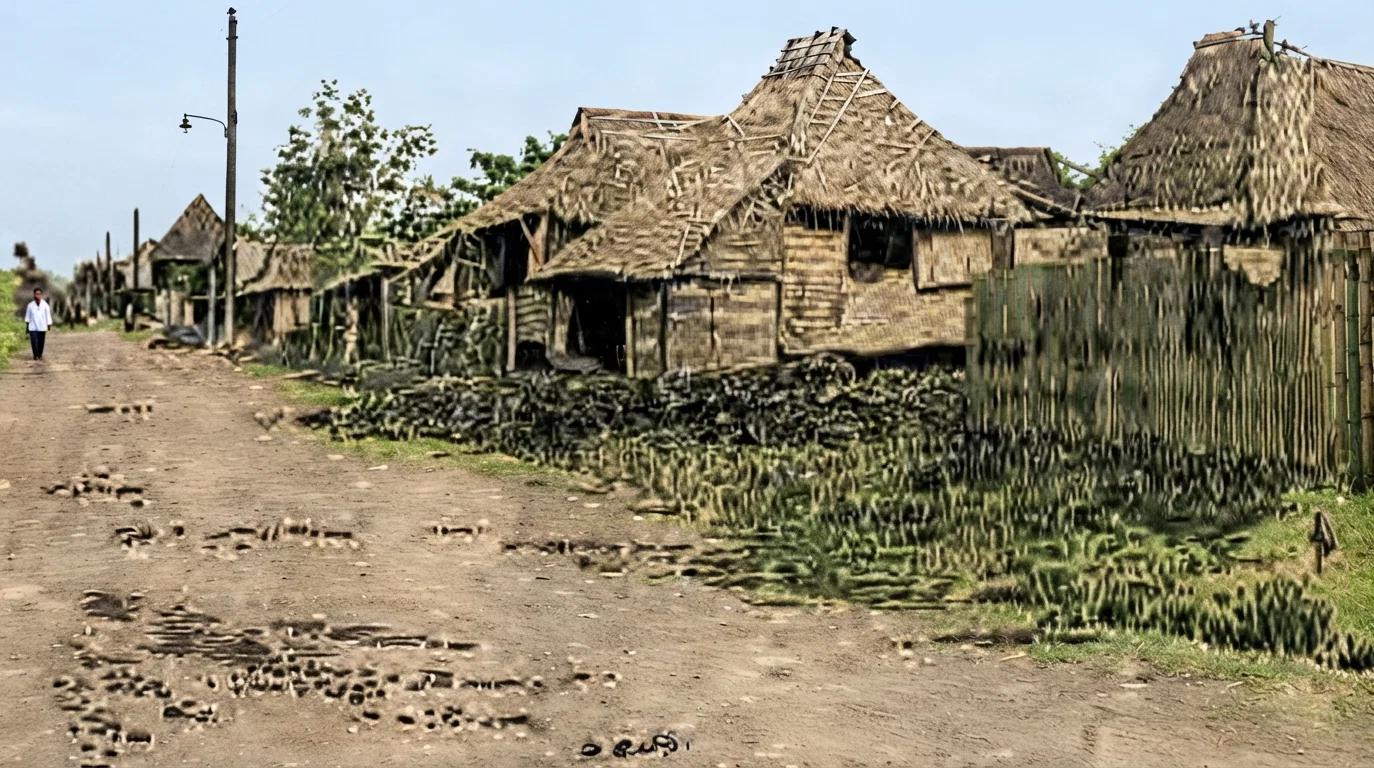
In the suburbs the streets are very narrow, and rarely if ever paved, but usually nothing but the black, sticky soil, which, during the rainy season, forms nothing less than a quagmire. The houses are small, built up four to six feet from the ground, with no sewerage. The main body of the building, or shack, is built of bamboo poles, the sides and top being made of nipa thatch, and the floors of split bamboo. Quite often a whole family, consisting of perhaps eight or ten persons, will live in one small house of two rooms, all sleeping on the floor on large grass mats.
Caraboo and Native Cart.
The methods of transportation about the city are unique. The street-cars, which are small affairs, are entirely open on the sides, with roller curtains of many colors, which serve as a protection from the scorching heat and rain.
The cars are drawn by two small native ponies, a little larger than a Shetland pony. The conductor sells tickets for two cents a section, which is about a mile; then an inspector goes through the car and punches each ticket. The road beds are poor, and the little ponies are often overloaded, and it is not an uncommon thing to see them balk and throw the car off the track.
The small native canoes, or bancas, are used as a means of conveyance to go up and down the river from one part of the city to another.
The caromata, a small, covered, two-wheeled carriage or cart, is a much-used vehicle. The driver sits on a small box seat, and it is drawn by one of the small ponies previously described. You can hire this for twenty cents an hour. The fare is regulated by the government; each driver has a license and number for his caromata. The caromatero is always looking for a new arrival. If he can succeed in getting him into his caromata, he will take him through the most tortuous route possible before landing him at his final destination, and will then demand a most exorbitant sum for his services; and it is often with great difficulty that one gets rid of him.
A Street in the Suburbs of Manila.
The Pasig River is spanned by many massive bridges, one a wire suspension of modern construction, the rest being of stone.
In the northern portion of the New City the Chinese quarters are located. The Chinese control most of the markets and do about all the retail trading with the Filipinos, as well as some wholesale business. In the streets you will see little booths, with gaudy-colored awnings, containing dry goods, jewelry, shoes, rice, nuts, fruit, drinks, cigars, cigarets, etc. These are usually attended by women.
Since the American forces have been in Manila, several hundred saloons and restaurants have been opened. Here the American soldier spends his monthly salary, oftentimes in advance.
Up to July 1 one firm had sold 21,000 barrels, or 2,100,000 bottles, of beer alone, not counting the other intoxicants. The smoking of cigars and cigarets is a universal habit with both woman and man in the Philippines. The La Insular Factory, one of the establishments manufacturing these goods, employs about two thousand men and women.
After looking over the New City, one takes a caromata, crosses the bridge of Spain, and starts for the Old City. As you cross the river looking west, you can see the shipping wharves and vessels discharging their cargo. All of this is done by hand, by cooly and Filipino labor. On the south side of the river the government coal-yards may be seen.
After leaving the bridge you drive over a smooth road for a quarter of a mile, when a great mass of stone looms into sight. Drawing near you see that it is a huge stone wall surrounding the Old City. In the early history of Manila this wall was erected as a protection to the Spanish against the hostile tribes of the islands. Of recent years it has served as a protection against the insurrection. This wall is surrounded by a huge moat, some places being seventy feet wide and quite deep, and so arranged that it can be filled with water at any time. At the present time the wall11presents quite a picturesque appearance, its ponderous gates, moss grown with age, covered with vines and lichens, studded with sentinel towers, and bristling with old brass cannon. The wall itself is from thirty to fifty feet high, and about forty feet thick. The interior is cavernous, divided into cells, and during Spanish rule was used to imprison those who were enemies to the Spanish crown and who would not sanction the actions of the dignitaries of the Catholic Church. If these old walls could speak, they could tell a tale of persecution, of murder, and starvation. Women and men were confined within the cold, damp walls for years because they would not submit to the wrongs perpetrated against them by the church and State. When the American forces entered Manila, in August, 1898, some fifteen of these poor unfortunates were liberated, many of them women, one who had been in those dark cells among the bats and beetles for eight years, because she would not submit to the belief and teachings of the Catholic Church. Passing through the Isabelle gate, the city comes in view. You do not hear the noise and bustle that there is in the New City. Often no one except a dreamy sentinel walking his beat at the gate is seen.
These are the old Spanish quarters. The streets are narrow, and paved with rock. The houses, usually of stone, are painted white, have low, flat tile roofs, and, the windows being covered with iron bars, remind one of a prison. It is here many of the old churches are located. After the fall of Manila, they were used as quarters for Spanish prisoners of war, some of them being large enough to shelter three thousand. The Spanish arsenal and all the government buildings are here.
The palace, as it is called, is about the middle of the city. It is a large stone building, with wide, winding stairs, beautiful tile flooring, high ceilings, and magnificent carved-wood furnishings. The corridors are filled with statuary, and the walls decorated with paintings. At the present time the building is used as headquarters for the U. S. Army.
Passing through the city to the western gate you emerge upon a beautiful driveway, called the Luneta. Going south you pass the band stand and promenade grounds, then into Ermeta and Malata, and through the suburbs, and finally reach Paco Cemetery, with its high walls and multiple vaults.
Cavite, fifteen miles from Manila, is used as a naval station. The American fleet is anchored a mile or more off the quay. The sunken Spanish fleet is in plain view, half submerged.
The suburbs of Manila are occupied almost entirely by the Filipino population. During the present insurrection they have all been laid waste, the houses burned, and the land uncultivated, the population either going back into the interior with Aguinaldo's retreating army, or coming into Manila in a peaceable manner.
One can not realize the desolation war brings upon a land until he experiences what it has brought upon the once peaceful and fertile Philippines. EUGENE G. WOOD.
MY RANSOM.
By M. Elizabeth Burns
"If the Son therefore shall make you free, ye shall be free indeed."
A SLAVE?
Who said? What one
Shall dare to hold that I,
Redeemed with ransom high,
Am doomed alone,
A coward slave to die—
That I in chains must lie
Supine, and none
To save?
O slaves,
I once was bound
With sorest chains; then He,
My Saviour, set me free,
My pardon found
On Calvary! My soul
His praises shall extol,
His name resound
Who saves.
M. ELIZABETH BURNS.
OUR WORK AND WORKERS.
By Editor
THE Chicago South Side church school has commenced another term.
A CANVASSERS' school is to be held at College View, Neb., the coming winter, beginning January 1.
THE Medford, Minn., church held a school session last winter, and will hold another term the coming winter.
FOUR converts are reported by Brother Covyeou, at South Bethel, Me., where a Sabbath-school of fifteen members was recently organized.
THREE have taken their stand at Brunswick, Me., to "keep the commandments of God and the faith of Jesus."
THREE converts are reported at Blue Lake, Cal., under the labors of Brother H. F. Courter and company.
A CHURCH school is now in operation at Joplin, Mo. Other schools are soon to begin, at Tarsney, Carthage, and Rockville.
SIXTEEN converts are reported at Mokane, Mo., where Brethren H. M. Stewart and R. C. Porter have been holding a series of meetings.
AT the last quarterly meeting at Hetherell, Minn., three names were added to the church roll. A house of worship is being erected by the brethren at this place.
A CHURCH of nine members was organized at Revere, Minn., October 15, by Brethren A. Mead and M. B. Van Kirk. Six others subsequently united by letter.
AT Deadwood, S. D., where Brother J. H. Wheeler has been laboring, five have recently accepted the faith, and the company are arranging to build a house of worship.
AT the Mount Vernon, Ill., camp-meeting, held September 14-22, fourteen candidates were baptized. The meeting was not large, but deeply interesting and profitable, in various ways.
THE addition of six members to the church at Oakdale, Neb., is reported by Brother George H. Smith. He also notes a good interest at Plainview, where it is expected soon to organize a church.
SEPTEMBER 30, thirteen members of the Brooklyn, N. Y., English Church were granted letters to form a new organization in another part of the city; and Sabbath, October 7, this organization was perfected.
THE use of the Mill Creek Baptist Church, near Mill Springs, Mo., was recently granted to Brother W. S. Cruzan, for a series of meetings, the pastor giving up the time of his own regular appointment.
A CHURCH was organized at Wheeling, W. Va., September 30, by Brother S. M. Cobb, president of the conference. There were nine members at the organization, but five others, unable to be present, waited another opportunity to unite with the church.
AT Lathrop, Cal., a Sabbath-school of twenty-six members has been organized in connection with the work of Brother J. H. Watson and wife and Brother C. N. Miller. They also have children's and young people's meetings Sunday afternoon, with good attendance.
OF the Scandinavian work at Battle Lake, Minn., Brother L. H. Christian writes to the Worker: "The English Methodists have given me the free use of their church building for a series of Scandinavian meetings, with the understanding that an English service shall be interspersed now and then."
OUR State conference papers, as also the Review and Herald, Youth's Instructor, and American Sentinel, are doing nobly in the way of bringing our World's Harvest special edition to the notice of the people. We very much appreciate their help and wish them all the blessing their liberality deserves.
A LUNCH-ROOM and free reading-room, where lunches will be served at one cent a dish, will be opened after November 2, at 609 Lake Street, between East Clinton and Fourth Streets, Elmira, N. Y. It is called the Home Mission. We hope it may be the means of pointing many to the higher, better home.
BROTHER ROBERT T. NASH, writing of his experience at Columbus, Miss., says: "I have had two trials for Sunday labor. At the time of my first trial there was not an Adventist in the community. Now we have there a neat little house of worship, with a good church membership and a church school, and are in need of a self-sacrificing teacher, who has been with Jesus and learned of Him." Tho others may not envy him, or court his experience, he certainly has no reason to regret it.
THE recent camp-meeting at Kingfisher, Oklahoma, was a signal success. Among other good results was the baptism of forty-five candidates, still others deferring the ordinance until arriving at their homes. The Gleaner notes that "there were nearly nine hundred people camped on the ground. Over four hundred dollars was given to foreign missions. Four hundred and sixty dollars was taken in cash and pledges for the Conference building now being put up in Oklahoma City. Nearly three hundred dollars was given to Keene Academy, and we understand that nearly two hundred was pledged to the Keene Sanitarium."
DICTIONARY OF THE BIBLE
By Editor
$5.50 for $2.25
By Dr. Wm. Smith
Size, 6 1/4 x 9 1/2 x 2 1/2 inches
1017 pages
Illustrated
It contains a full description of every custom, place, plant, mineral, animal, etc., and a biographical sketch of every individual mentioned in the Bible
Publishers' price, bound in cloth, $4.50
Our price, post-paid, with the SIGNS, one year, $2.25
Book sent free for five new yearly subscriptions and one renewal at $1.00 each
Prophetic Lights
By Editor
If you want a real help in the study of prophecy, you will find it in Dr. E. J. Waggoner's book,
"Prophetic Lights"
Heavy paper-cover edition - $0.50
SIGNS, one year - 1.00
Both, post-paid, $1.25
Book free for one new yearly subscriber and one renewal at $1.00 each
The Parker Jointless Fountain Pen
Is a constant comfort
A continual source of satisfaction
A thing of beauty
A joy forever
Having no shoulder where the fingers and thumb hold it, but gently tapering, it handles like an ordinary penholder, and is fitted with a good gold pen
THE JOINTLESS, LUCKY CURVE GEO. S PARKER FOUNTAIN PEN THE SUCCESS OF THE PEN AGE.
NO
screw to break
nozzle to get "stuck"
joint to leak
ink on your fingers, and
chance for the buyer to rue his bargain
Makers' price for pen, $2.50
Our price for pen and SIGNS one year, $2.50
Sent free for five new names
Address
# SIGNS OF THE TIMES
Oakland, Cal.
PLEASE DON'T TELL SUCH THINGS.
By Oscar
NEARLY all the papers and magazines are giving biographies of Admiral Dewey. And many of these biographies tell with much seeming pleasure of the various escapades of the admiral when he was a boy. They would try to have us believe that Mr. Dewey is all the greater hero because he did more or less mischief in his childhood.
Telling such stories, and telling them in the way in which they are generally told, has a tendency to make boys think that if they would ever be great like Dewey they must learn how to do a lot of tantalizing and marauding mischief. Boys are very apt to do all the mischief they can think of without any special incentives. But when they have a hero placed before their minds, and they read that when he was a boy he did this, and that, and the other mischievous thing, they will be incited to the greatest possible lengths in mischief, much of which tends to degrade and pervert.
We believe that boys should be boys, and that they should have all the opportunity that is best for them to use in true boyish plays and sports. But there is a vast difference between play that will make boys all the better for having engaged in it, and vicious and criminal mischief.
Dewey's mischief may not have been of either the vicious or criminal order. We have not read of any that was, at least. But the boy who reads of the boyish mischief of the "great admiral" will of course think that he must outdo him, and so there is no telling what turn his youthful exuberance will give to his mischievous and possibly criminal waywardness.
If Admiral Dewey has attained to greatness, it is not because he had some mischievous tendencies when he was a boy, but it has been in spite of that. Or perhaps, to state it more properly, Dewey had a restless, active disposition. Such a disposition, if not properly directed, will turn into mischief and cause the boy to do many things that are wrong. But if this disposition is taken hold of properly, and the boy given a careful and thorough training, so that he becomes interested in useful lines in which to direct his activities, he will become a man that may amount to something.
But the boy that does not have such training, and who reads that great men did certain things when they were boys that were not right, and yet they came out heroes in the end, is encouraged to do a certain amount of mischief, thinking that he too may become great because of it.
We are intimately acquainted with a number of boys that have heard their fathers tell of the mischief they did when they were young, and these boys seem possessed with the idea that they must do something of the kind, in order that they may have like things to boast of.
It is quite natural for all boys to be full of life, and it is a very easy thing for them to get into mischief, and even to do things at times that will tend to exasperate their parents. But boys may be trained out of such things and become useful men in spite of their mischievous tendencies. So parents should not lose heart, but keep right on faithfully drilling their children in correct principles. And it can be stated as a matter of encouragement to parents that very rude and even desperately mischievous boys and girls may be so trained as to overcome these evils and make good men and women. And while it may possibly be right to make mention of the fact that some mischievous boys make good men in spite of their youthful waywardness, in order that parents who have similar boys in hand may be encouraged, yet these things should be spoken of in such a way that the children who hear them mentioned will look upon them as wrong, rather than virtues to be imitated.
Anything that is wrong for a man is wrong for a child. The child may not know that it is wrong, and therefore would not have the moral guilt that the man would have, but the thing is wrong in itself anyway. Then the proper course to pursue is to hold forth the right, and the right only. And when some wrong thing that was done by a boy who afterwards became great is spoken of, it should be mentioned as a defect, as a blot, as a mar—something to blush at, and not to be proud of.
There is no estimating the evil that is done among youth by older persons telling and laughing over what depredations they were guilty of when they were "youngsters." Certainly no Christian home could think of permitting such a thing. I am glad to be personally acquainted in several homes where such things are not allowed under any circumstances.