Your ShelfYour Projects

Signs of the Times, Vol. 25, No. 45.

THE LIFE-GIVER

Signs of the Times

Nov 8, 1899

Pacific Press Publishing Company · OAKLAND, CALIFORNIA · Nov 8, 1899

THE LIFE-GIVER.
"In Him was life; and the life was the light of men." "With Thee," says the psalmist, "is the fountain of life." "For as the Father hath life in Himself; so hath He given to the Son to have life in Himself." "For the life was manifested, and we have seen it, and bear witness, and show unto you that eternal life, which was with the Father, and was manifested unto us."
CHRIST was the manifestation of the righteous, eternal life of God to the world. In Him the life of God flowed uninterruptedly, according to the law of that life—the righteous law of God. When Christ gave Himself for the salvation of the race, when He was about to come to this world and take the body of flesh prepared for Him, He said: "Lo, I come; in the volume of the book it is written of Me, I delight to do Thy will, O my God; yea, Thy law is within My heart." God's life flows free where God's law is supreme.
EVERY miracle wrought by our Lord was the manifestation of God's life. It was the life power of God over the elements, over Satan, over all manner of disease, over sin, over the climax of sin,—death. And so it is said concerning His works, at the close of one of the records of His personal, earthly ministry: "These are written, that ye might believe that Jesus is the Christ, the Son of God; and that believing ye might have life through His name."
THOSE who came to Jesus for help and healing appreciated, in a sense, at least, that He had power above themselves. Those who were instructed in the Scriptures, as Nicodemus, knew that His power must be from God. Some were moved upon for the moment, as were the nine lepers, who, as soon as healed, forgot the Healer. They received seed in stony ground; the grace received brought forth no fruit to eternal life.
FOR many to come to Jesus, looking at it from a worldly standpoint, meant humility, self-denial, and courage. Their very coming was a confession that they were not sufficient of themselves, nor did they find their sufficiency in the ornate ceremonies or ecclesiastical traditions of a worldly religion. These and self must be given up; and in so doing they broke from their associates, the proud Pharisees, scribes, and lawyers of the nation.
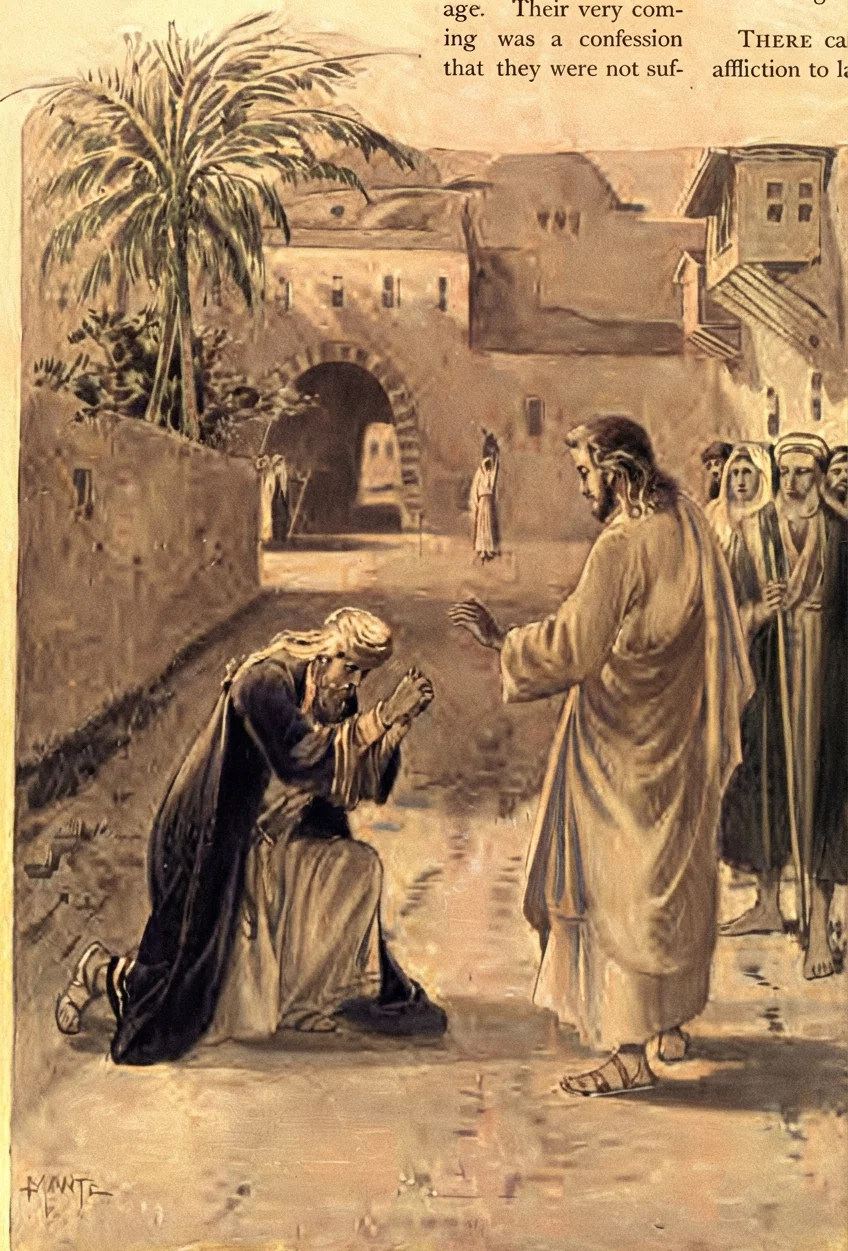
“And, behold, there cometh one of the rulers of the synagog, Jairus by name; and when he saw Him, he fell at His feet, and besought Him greatly, saying, My little daughter lieth at the point of death; I pray Thee, come and lay Thy hands on her, that she may be healed; and she shall live.” Mark 5:22, 23.
THUS it must have been with Jairus, the ruler of the synagog at Capernaum. (See Matt. 9:18-26; Mark 5:21-43; Luke 8:40-56.) He had, of course, heard of Jesus in many ways; he had doubtless heard him in the synagog. He had known of the healing of the centurion, who loved the Jews and built them the very synagog at Capernaum in which Jairus was ruler. Yet Jairus, in the face of all these things, acknowledges not the Lord.
THERE came a time when the Lord allowed affliction to lay its heavy hand upon the proud ruler's household. His loved and only daughter was stricken. Earthly physicians do all in their power; kind hands minister to her wants; but she rapidly grows worse. By whatever channel it matters not, but it comes to the ruler's mind that there is healing in Jesus. We may easily fancy that he sent faithful servants for the Master, who found Him not. He finally, as the death shade falls upon his daughter's countenance, goes forth himself, almost in despair. Angels guide him to the Master's presence. There is a heart in need; there is a Reservoir of riches to supply it. There is emptiness in the life of the hitherto haughty rabbi; there is fulness in the heart of Jesus to provide. Jairus finds the Life, casts himself, no longer proud or apprehensive of the speech of his fellows, at the feet of the Master, and pleads in the anguish of his soul, "My little daughter lieth at the point of death [yea, I fear is even now dead; but] come and lay Thy hands on her, that she may be healed; and she shall live." The ruler's faith encompassed the very life of God. When he cast himself at the Master's feet, he gave all; and the blessed Lord recognized the humility and faith. "And Jesus went with Him."
BUT how the faith of Jairus must have been tried on the way! The people throng the way. At every step they must crowd their way through the throng. Another soul, the timid woman with the simple faith, is healed by touching the border of His garment on His way. Jesus pauses to assure her heart. While He thus waits, an officious, unbelieving servantcomes from the ruler's household with the message, "Thy daughter is dead: why troublest thou the Master any further?" We can see in this how Jairus was urging Christ forward. The ruler's heart sank within him; but Jesus presses closer to the heart-broken man, and comforts him: "Fear not; believe only, and she shall be made whole."
WE need not follow them in detail the remainder of the journey. They arrive at the house and find the maid dead, and the mourners weeping for revenue. We hear the assurance of the Master of life that in His purpose she but slept, and the scornful rejection of His words; we see the putting forth of personified unbelief from the house, and the going in of Jesus, with the father and mother and His disciples. We see Him take the waxen hand of the still form in His own warm clasp, and we hear again the life-giving words, "Talitha cumi."—"Damsel, I say unto thee, Arise." We see the evidences of new life take possession of form and feature; the eyes open; she straightway arises; and Jesus gives her to her parents, forgetting not the fast of sickness and her need to be supplied by natural food. And as we see them, our hearts rejoice anew in the Life-giver.
FOR, reader, while all this work was wrought for Jairus and those who then lived, it was written for us who should come afterward. Jesus Christ changes not. He is "the same yesterday, and to-day, and forever." He is life now as He was then. He will meet your need as He met the needs of those in like circumstances. He will heal your heart if you will let Him. If you will yield to Him, He will put within you the life and light of God. And even tho your loved ones are buried in earth, in His purpose they sleep; and if in Him, they will awake to eternal life and beauty. But do not put off the precious lessons and message of this miracle; receive them now; for "behold, now is the acceptable time."

Speaking to Please God

"But as we were allowed of God to be put in trust with the Gospel even so we speak; not as pleasing men, but God, which trieth our hearts."

A LESSON FOR THE PRESENT.

WHAT a self-exaltation has taken possession of many in the professed Christian churches! This is especially manifest in the demands which have been so freely made that this nation or England should chastise Turkey or Spain, and thus avenge Armenia or Cuba or some other people.
Right in the very beginning God gave an emphatic lesson in a most aggravated case concerning this matter of avenging. It was not till millenniums later that He gave us the words, "Vengeance is Mine, I will repay, saith the Lord," but He gave us a demonstration of those words so plain as not to be mistaken.
Surely if there was ever a man whose death ought to have been avenged it was Abel's. If ever there was a man who ought to have been slain it was Cain, not alone for killing his brother, but for bringing by his crime an additional curse upon the ground. But God in His mercy lets the criminal live and reap the fruit of his own sowing. Cain recoils from it, appreciates to some extent the wrong he has brought upon others, and what their feelings will be, and he tells the Lord, "Whosoever findeth me shall slay me."
But the Lord would not permit this. Vengeance belongs to Him; therefore He declares: "Whosoever slayeth Cain, vengeance shall be taken on him sevenfold. And the Lord appointed a sign for Cain, lest any finding him should smite him." Gen. 4:15, R.V. God would give the wretched man opportunity to repent, and reserve the punishment if he did not; and He would even more severely punish any one who assumed His own prerogatives of Judge or Avenger.
Lamech pleads this act of the Lord in his own case. He sings to his wives (Gen. 4:23, 24, R.V.):—
"I have slain a man for wounding me, And a young man for bruising me; If Cain shall be avenged sevenfold, Truly Lamech seventy and seven fold."
That is, if the Lord would avenge Cain's killing by some self-appointed judge, when Cain killed a righteous man, surely He would avenge the killing of him who should slay Lamech, when Lamech killed a man in self-defense.
The lesson is that God Himself is Judge and the Executor of judgment upon all who transgress His holy law. Let Christians learn this lesson which God has so beautifully repeated in Deut. 32:35 and Rom. 12:17-20.

A Sign of Authority—How Receive the Mark—National Apostasy—Rome the Same—An Image to the Papacy—*The Trials of the Remnant Church

THE SEAL OF GOD. No. 2.

A Sign of Authority—How Receive the Mark—National Apostasy—Rome the Same—An Image to the Papacy—The Trials of the Remnant Church.

THE change of the Sabbath is a sign or mark of the authority of the Romish Church. Those who, understanding the claims of the fourth commandment, choose to observe the false sabbath in the place of the true, are thereby paying homage to that power by which alone it is commanded. The mark of the beast is the papal sabbath, which has been accepted by the world in the place of the day of God's appointment.
There are true Christians in every church, not excepting the Roman Catholic communion. None are condemned until they have had the light and have seen the obligation of the fourth commandment. But when the decree shall go forth enforcing the counterfeit sabbath, and the loud cry of "the third angel" shall warn men against the worship of the beast and his image, the line will be clearly drawn between the false and the true. Then those who still continue in transgression will receive the mark of the beast.
With rapid steps we are approaching this period. When Protestant churches shall unite with the secular power in sustaining a false religion, for opposing which their ancestors endured the fiercest persecution, then will the papal Sabbath be enforced by the combined authority of church and State. There will be a national apostasy, which will end only in national ruin.
Marvelous in her shrewdness and cunning is the Roman Catholic Church. She presents a fair front to the world, covering with apologies her record of horrible cruelties, and declaring that her spirit of persecution no longer exists. But she is the same as in the days of the Reformation, when men of God stood up at the peril of their lives to expose her iniquity; the same as when she assumed the power to control kings and princes, and claimed the prerogatives of God. She may clothe herself in Christlike garments, the better to carry forward her purposes; but she still retains the venom of the serpent, and her principles are exerting their influence in legislative halls, in churches, and in the hearts of men. Her spirit is no less cruel and despotic now than when it crushed out human liberty, and slew the saints of the Most High.
By compromises and concessions, Protestants have tampered with and patronized popery, giving her vantage-ground which papists themselves are surprised to see and fail to understand. The Protestant world needs to be aroused to resist the advances of this most dangerous foe to civil and religious liberty.
When the State shall enforce the decrees and sustain the institutions of the church, then will Protestant America have formed an image of the Papacy. Then the true church will be assailed by persecution as were God's people in ancient times. Almost every century furnishes instances of what human hearts, controlled by rage and malice, can do under a plea of serving God by protecting the rights of the church and State. The Protestant churches that have followed in the steps of Rome by forming alliances with worldly powers have manifested a similar desire to restrict liberty of conscience. How many non-conformist ministers have suffered under the power of the Church of England! Persecution always follows a restriction of religious liberty on the part of secular governments.

Rejection of Great Light.

It is urged by many that the intellectual and moral darkness prevailing during the middle ages favored the spread of dogma, superstition, and the oppression of popery, and that the general diffusion of knowledge, and the well-nigh universal acceptance of the principles of religious liberty, forbid a revival of superstition and tyranny. It is true that great light, intellectual, moral, and religious, is shining upon this generation. Since 1844 light from the heaven of heavens has beamed from the open door of the temple of God. But it is to be remembered that the greater the light bestowed, the greater the delusion and darkness of those who reject the Word of God and accept fables, teaching for doctrine the commandments of men.
Satan will excite the indignation of apostate Christendom against the humble remnant who conscientiously refuse to accept false customs and traditions. Blinded by the prince of darkness, popular religionists will see only as he sees, and feel as he feels. They will determine as he determines, and oppress as he has oppressed. Liberty of conscience, which hascost so great a sacrifice, will no longer be respected. The church and the world will unite, and the world will lend to the church power to crush out the right of the people to worship God according to His Word.
The decree which is to go forth against the people of God in the near future is in some respects similar to that issued by Ahasuerus against the Jews in the time of Esther. The Persian edict sprang from the malice of Naman against Mordecai. Not that Mordecai had done Haman harm, but he had refused to flatter his vanity by showing him the reverence which is due only to God. The king's decision against the Jews was secured under false pretenses. Satan instigated this scheme in order to rid the earth of those who preserved a knowledge of the true God. But his plots were defeated by a counter-power that reigns among the children of men. Angels who excel in strength were commissioned to protect the people of God, and the plots of their adversaries returned upon their own heads.
History repeats itself. The same masterful mind that plotted against the faithful in ages past is now at work to gain control of the Protestant churches, that through them he may condemn and put to death all who will not worship the idol sabbath. We have not to battle with man, as it may appear. We wrestle not against flesh and blood, but against principalities, against powers, against the rulers of the darkness of this world, against spiritual wickedness in high places. But if the people of God will put their trust in Him, and by faith rely upon His power, the devices of Satan will be defeated in our time as signally as in the days of Mordecai.
The decree is to go forth that all who will not receive the mark of the beast shall neither buy nor sell, and, finally, that they shall be put to death. But the saints of God do not receive this mark. The prophet of Patmos beheld those that had gotten the victory over the beast and over his image and over his mark and over the number of his name, standing on the sea of glass, having the harps of God, and singing the song of Moses and the Lamb.
To every soul will come the searching test, Shall I obey God rather than men? The decisive hour is even now at hand. Satan is putting forth his utmost efforts in the rage of a last despairing struggle against Christ and His followers. False teachers are employing every device possible to stimulate the hardened sinner in his rebellious daring, to confirm the questioning, the doubting, the unbelieving, and, by misrepresentation and falsehood, to deceive, if it were possible, the very elect. Who are prepared to stand firmly under the banner on which is inscribed, "The commandments of God and the faith of Jesus"?
Christ never purchased peace and friendship by compromise with evil. Tho His heart overflowed with love toward the human race, He could not be indulgent to their sins. Because He loved men and women, He was a stern reprover of their vices. His life of suffering, the humiliation to which He was subjected by a perverse nation, show His followers that there must be no sacrifice of principle. God's tried people must maintain watchfulness, with fervent prayer, lest, in their eagerness to prevent discord, they surrender truth, and thus dishonor the God of truth. Peace is too dearly obtained if purchased by the smallest concession to Satan's agencies. The least surrender of principle entangles us in the snare of the enemy.
Paul writes to the Romans, "If it be possible, as much as lieth in you, live peaceably with all men." But there is a point beyond which it is impossible to maintain union and harmony without the sacrifice of principle. Separation then becomes an absolute duty. The laws of nations should be respected when they do not conflict with the laws of God. But when there is collision between them, every true disciple of Christ will say, as did the apostle Peter when commanded to speak no more in the name of Jesus, "We ought to obey God rather than men."
MRS. E. G. WHITE.

THE CHRISTIAN'S MOTTO.

[By the late Pastor G. T. Wilson, of Australia.]
THE Christian's motto always is, "We walk by faith and not by sight." True happiness doth not consist In seeking after feeling's flight.
Faith is the cable to our ship, And hope the anchor in the vail. Long as our cable does not break, No storm against us can prevail.
Faith is a shield unto the soul, Which quenches every fiery dart; When Satan would thy soul assail, 'Tis faith that shields thy troubled heart.
Faith rests upon the Word of God, Upon His promises secure; And, tho the earth may vanish quite, "By faith we walk," and thus endure.
'Tis faith the blood of Christ applies, To heal the malady of sin; 'Tis faith that ope's the blinded eyes; "By faith," eternal life we win.
Faith is a cord from heaven let down, When by some precipice we walk; We grasp it as our safety there, And of its saving power we talk.
In prayer uncoil this blessed cord; Thy message it will bear to God, And Christ a message will return, To guide thee in the path He trod.
Would you your Saviour's presence share? Then just uncoil that cord each day; It stronger grows by sincere prayer, And holds thee safe on life's dark way.

THE SECOND COMING OF CHRIST.

Signs in the Religious World—The Divine Prediction—The Fulfillment—Fashions—Moral Degeneracy—Higher Criticism—Striving for Political Power—Earnest Hearts.

WHILE Christ placed His followers in the world, He designed that they should not partake of its spirit. They were to be distinct and separate from all around them. As He was a light, so He designed them to be lights likewise, and such lights as would penetrate the darkness, proving beacons to those who, in the wanderings and labyrinths of sin, desired a better service and a higher existence. Had the church of God in all ages been true to this commission, how widely different might have been the history of the world! how different the effect upon nations! how much more far-reaching the influence of the Gospel of Christ! Sad indeed it is that the church has fallen from its high and holy estate, lowering its standard of right and righteousness to meet the demands of the world. Far from the world itself being converted in the last days, the Scriptures say that even the professed church of God itself will stand in anything but an enviable condition before Him.
Paul, in his letter to Timothy, says that "evil men and seducers shall wax worse and worse, deceiving and being deceived." And he says further in the same chapter (2 Tim. 3:1-5), that right in the last days, among those professing a "form of godliness," who could be none other than the professed children of God, there would be found a long catalog of sins. "This know also, that in the last days perilous times shall come. For men shall be lovers of their own selves, covetous, boasters, proud, blasphemers, disobedient to parents, unthankful, unholy, without natural affection, truce-breakers, false accusers, incontinent, fierce, despisers of those that are good, traitors, heady, high-minded, lovers of pleasures more than lovers of God; having a form of godliness, but denying the power thereof; from such turn away."
It is but necessary for any reader of this article to look around him, and he will see in Christendom to-day the conditions here specified in the Scriptures. The distinctions existing between the church and the world have been broken down. The high and holy standard of the church of God has been lowered. The great churches of the land to-day have become great social, fashionable organizations, in which membership is sought not for the strengthening of Christian growth, but for the social advantages that may be secured thereby. This is not alone true of one church, but it is true of the great majority of churches throughout the world. In the church the standard of morality is but little higher than among worldlings. In almost every organization there are unholy, corrupt, wicked men, who maintain their church fellowship and are saved from righteous discipline on account of their wealth and social position.
The same spirit of degeneracy is seen in pulpit preaching. The simplicity of the Gospel of Christ is giving place to a style that caters to the spirit of the world. Questions of politics are brought into the sacred desk. Discussions of science and philosophy engage the attention of hundreds, to the exclusion of the plain, simple preaching of the Gospel of the Lord. And in the pulpit rather than in the pews are there found to-day more earnest advocates of so-called higher criticism, which throws discredit upon portions of the Word of God, and so explains the remaining part that it loses its simplicity and power. Large salaries have called many men into the ministry purely from business considerations, the same as they would enter upon worldly professions or mercantile pursuits.
In the majority of church services to-day there is a tendency toward the external and an appeal to display and form in the church ritual, such as captivated the minds of men in the days of Constantine. The same spirit of declination is witnessed in the methods employed by the church in raising means to carry forward its work. Church fairs and socials have taken the place ordained of the Lord for raising means for Gospel purposes. Many churches are now fitted up with rooms for suppers and social gatherings, and indeed some even have billiard tables and other forms of amusements.
But above all this is the weakness of the church manifested in its appeal to the civil arm. There is a reaching out to-day, as in the fourth century, for the power of the State to enforce the weak efforts of the church. In this action is a sign of the loss of power on the part of the church. Christ, her lawful Spouse, has departed from her, and now she reaches out to take hold of the arm of flesh to supplement the feeble power she is able to exert.
And yet, notwithstanding this spiritual declination and moral degeneracy in the professed church of God, in every denomination there are still true hearts that are reaching out for God. There are still hands upraised to Him. There are those who are lamenting the sins of Israel, who are mourning for the departed glory, and are longing for a return to the old paths of righteousness and simplicity. And God will not pass unnoticed a single outstretched hand. He will not turn deaf ears to a single desolate cry. He will send relief and send deliverance. In every heart which desires it, the power of His truth will be resuscitated. Based upon the signs given in His Word, there will go forth to every longing soul the message of deliverance. Of this message, and the work it is designed to do, further reference will be made hereafter.
FRANCIS M. WILCOX.

THE BLESSED LIFE.

If some great purpose fill thy soul, Inspiring thee for others' good, Press on with courage to the goal, Howe'er misunderstood.
Toil on, with pure, unselfish aim, In patience till thy task is done; Care not for either praise or blame, Enough the victory won.
All noble deeds, designed to bless, Are valued not by sordid price; Things born of struggle, storm, and stress, Bring fullest sacrifice.
All truth is meant to meet some need, And light the upward path of man, Who but for that were weak indeed, With all his power to plan.
Fear not; thy sacrifice shall be A greater and a nobler gain; The cloud that hides the sun from thee Will bring thee needful rain.
—Anon.

No One Stumbles Backward

"No MAN ever stumbles over an object in his rear."

THE NEW AND LIVING WAY.

What Is "the Holiest"?—What Is "the New and Living Way"?—What Is "the Vail"?—Type and Antitype.
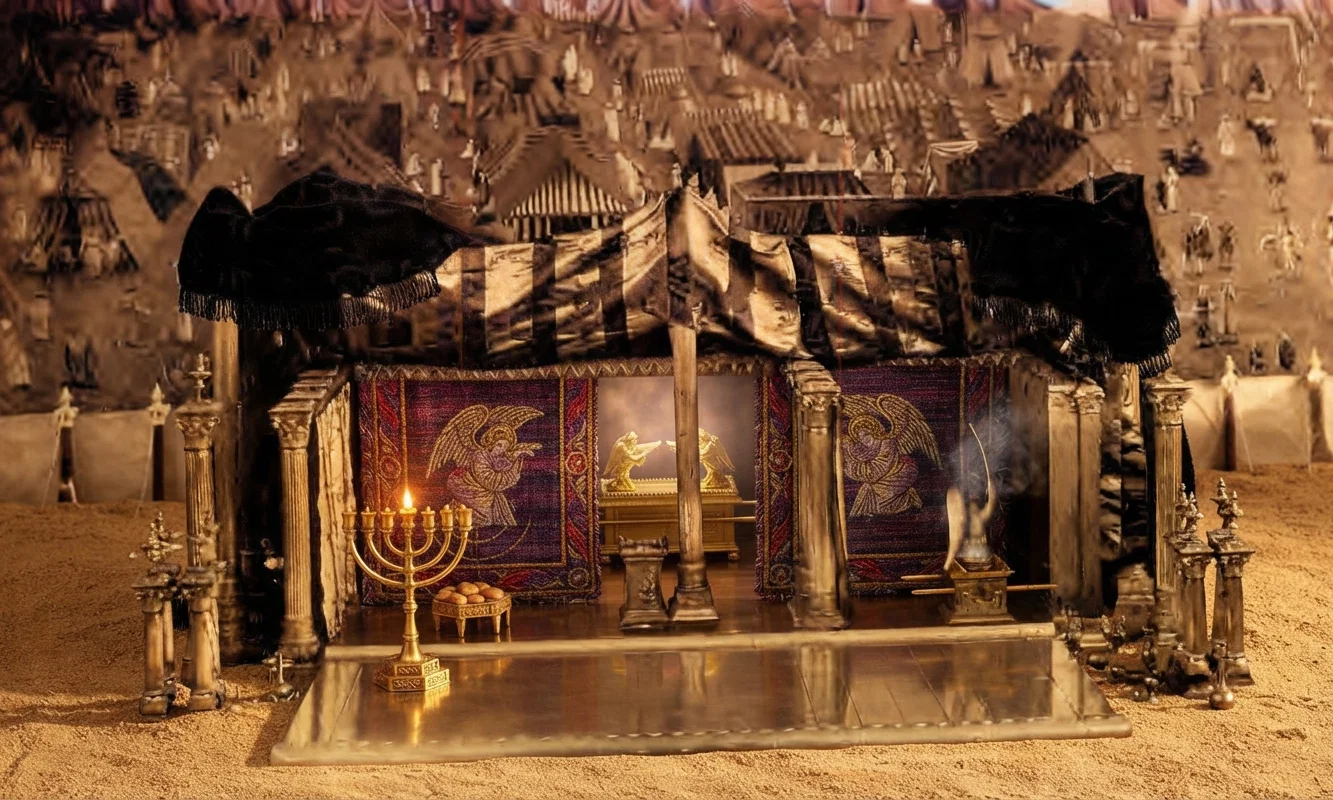
IN Heb. 10:19-22, Paul sets before his brethren this hope-inspiring announcement: "Having therefore, brethren, boldness to enter into the holiest by the blood of Jesus, by a new and living way, which He hath consecrated for us, through the vail, that is to say, His flesh; and having an high priest over the house of God; let us draw near with a true heart in full assurance of faith."
A number of terms in this passage arrest attention, and tacitly invite explanation. What is the "holiest," into which we are to have boldness to enter? What is the "new and living way," consecrated for us? What is the "vail"? And what relation has His "flesh" to these objects? Is it the vail, or is it the way? and to whichever term it applies, how does it come to perform that office? A way has been opened before us, the apostle declares, which is a new and living way. Then he introduces the vail, and, referring to one or the other of these, he says, "that is to say, His flesh." Every one, of course, must be anxious to know what this new and living way is, and how we may secure a passport to walk therein. The "way" is evidently our Lord Jesus Christ; for by no other passage except "the way" can we enter into the holiest; and we enter therein, the apostle had just said, "by the blood of Jesus."
But what is the "holiest"? and by what necessity, and in what manner, do we enter therein? The Greek word which the apostle here uses, and which the translators have seen fit to render "the holiest," is in the plural number, and means, not a single place alone, but must take in as many as two, at least, and should be rendered "the holies," or "holy places." This is not the first mention of these places in the book of Hebrews. Beginning with the eighth chapter, where Paul introduces the subject of the sanctuary and the new covenant, he declares that Christ is the minister of the "sanctuary and of the true tabernacle which the Lord pitched and not man." In chapter 9 he refers to a type of this heavenly building which once existed here on this earth, and that was the tabernacle erected by Moses in the wilderness, from a pattern which the Lord showed him. That typical building, a shadow of the heavenly, had two apartments: the first, or holy place, and a second apartment, or most holy place, separated from the first by a door or vail. In both of these apartments the priests here on earth ministered, serving, says Paul, "unto the example and shadow of heavenly things." Therefore the heavenly sanctuary has two apartments, a holy and a most holy place, like the earthly; and in both these Christ, as our great antitypical high priest, performs his antitypical ministry. Those, therefore, who come to Christ, who address the throne of grace, reach Him by faith in one or the other of those two holy places in the true tabernacle where He ministers, whether they have a theoretical understanding of His locality or not. And the word "holiest," as we have seen, being in the plural, and meaning "holy places," these must be the places referred to by Paul in the passage before us. But the translators, not having an understanding of the subject of the sanctuary, could conceive of nothing in heaven but the holiest of all, and so took the liberty to translate a plural noun by the singular number, and call it "the holiest." Into these holy places we enter "by the blood of Jesus," as we come unto Him by faith. Not, of course, into both at one and the same time, but into each, respectively, in which the service is going forward.
And this will call for an explanation of another feature of the sanctuary work. In the type the ministration of the priests was confined to the first apartment, or holy place, till the day of atonement,—the tenth day of the seventh month. On this one day in the year the high priest went into the most holy place and made the atonement; and the yearly round of service was then complete, to begin again at once in the holy place. Heb. 9:7; 10:3. And each of these yearly rounds of service in the type represented the one great round of service performed by our Lord in the sanctuary above, as Mediator for the world. In accordance with the type, Christ first ministers for a long period
in the holy place; and when the time comes for the making of the atonement, or the cleansing of the sanctuary, He transfers the ministration into the most holy place, and ministers there a sufficient length of time to complete the atonement; and then the work of intercession for the world is finished.
Abundant evidence can be presented that we have already entered upon the time when this final work is being done; for the sanctuary was to be cleansed at the end of two thousand and three hundred days (Dan. 8:14); and those days ended in 1844. So, while Christ was in the holy place, Christians found Him there; when He is in the most holy, as He is now, Christians find Him there. "Having therefore, brethren, boldness to enter into the holies by the blood of Jesus." This covers the whole Gospel dispensation; but we have now reached the time when we might adopt King James' translation, and say, "Having therefore, brethren, boldness to enter into the holiest by the blood of Jesus." The "way" to Jesus now leads us there.
But, on the strength of this text, especially what is said about the vail, which, it is claimed, is His flesh, we are met with the objection that the whole view of the subject of the sanctuary, as here presented, that is, a literal sanctuary in heaven, with two apartments, in the first of which Christ first ministers, and then closes His work, finally, in the second, is entirely fallacious; because, say they, Paul declares that Christ's flesh is the vail, which, according to your position, would be nonsense. If Paul did say so, that, of course, would settle the question, and call for a readjustment of the whole argument; but he does not say so. The sanctuary had two vails—one at the entrance, which constituted the door, and a second which divided between the holy and the most holy place. The apostle recognizes this fact in describing the tabernacle of Moses, which was built from the pattern of the heavenly, which God showed him. He says in Heb. 9:3, after speaking of the first apartment, "And after the second vail, the tabernacle which is called the holiest of all." Now if in the antitype Christ's flesh constitutes either of these vails, which one would it be? and then what would the other vail represent? It would have to be, of course, something analogous; but nothing can be imagined to answer that purpose. A little transposition in this text, both natural and legitimate, will remove all confusion, and make the meaning clear. Thus: "Having therefore, brethren, boldness to enter, through the vail, into the holy places, by the blood of Jesus, a new and living way which He hath consecrated for us; that is to say, His flesh." As Christ ascended bodily to heaven, and is a literal priest there for us, He must have a real place in which to minister; and that is the temple in heaven; and that, according to the figure of it given us here on earth, must have a vail, or its equivalent, dividing between its first and second apartments. The flesh of Christ is not this vail. There is no possible sense in which it could be imagined to be such. But by His flesh, or by His sacrifice, the blood is furnished by which we enter into these holy places. Very strikingly and beautifully, therefore, His flesh may be called the "way." And it was a "new" way, because before men had only the blood of animals with which to approach God. And it is a "living" way, because Christ, having once died our sacrifice, now ever liveth to make intercession for us (Heb. 7:25),—to invite us to God through Him, directing us in the path of salvation, and assuring us of acceptance; for has He not declared that He will in nowise cast out any one who comes to Him? He says of Himself, "I am the Way, the Truth, and the Life;" and He affirms that no man cometh to the Father but by Him.
The force of Heb. 10:20 lies not in defining what the vail is, but in showing what the way is; and that way is the sacrifice of Christ, represented by the words "His flesh." The wonderful thing connected with Christ and His work is the inherent life pertaining to Him and it. We have previously spoken of Christ as the living Sacrifice; here He is presented as the living Way to God. And he who enters this way is himself made alive to God. The resurrection of Christ is the key to the glory of the Christian system. How it transfigures with light and beauty the whole warp and woof of the divine scheme of redemption! Under the old dispensation, a sacrifice once offered was forever dead; here the sacrifice continues to live, because it was a Being who, having tasted death for every man, has been brought out from His expiratory tomb. There the priests had not died, and so could not sympathize with those for whom they ministered; here the One who died has been raised from the dead, and become the high priest, to plead His own blood for those for whom He has passed through every phase of temptation, disappointment, suffering, and death. He can therefore be a merciful high priest, touched with every feeling of our infirmities.
"With joy we meditate the grace Of our High Priest above; His heart is made of tenderness, His bosom glows with love." URIAN SMITH.
Continue reading: HUMILITY THEN GLORY