THE life of the human system depends upon its activity. "Activity" is written upon everything—even upon the "fixed stars" and the "eternal hills."
Man is the only creature who tries to disregard this universal law of nature. No one can successfully carry on their business and retain their health, and at the same time be indifferent to this law of exercise. Many need never to have been ill had they always obeyed that great law, which we see obeyed by the kitten and the lambs and the children.
Exercise tends to break down tissues and carry off waste substances. Bouchard, an eminent French medical authority and investigator, has found out that after a hard day's work, the secretion of the kidneys is not nearly so poisonous as when the individual has done little or no work, showing that exercise destroys a great many poisons which would otherwise float around in the system.
Exercise must be systematic. In the different lines of labor, we have grown away from the natural order of physical development, and some of the muscles are strong and some are weak. For instance, in a large audience of farmers most of them will be found in a bending forward position. How did they get that position? The farmer drives to town with his farm produce, and he sits with his chin resting on his hands and his elbows resting on his knees. He is sitting in this position because it is the most comfortable for him. And this position is the most comfortable because in his farm labor he has not strengthened the muscles of his back, but has strengthened those in front, and so he is gradually being drawn over.
While I was examining a dentist the other day, I found that he had a curvature of the spinal column. I asked him how he got that, and he said by the position he maintained in drilling teeth. Children acquire these deformities while sitting at their desks in the schoolroom. It is wicked to permit children to become deformed in this manner. This practise is not so bad now as it used to be, but the mischief has not yet wholly disappeared.
Now suppose I was sitting at a low desk and high seat, I must tilt over in order to reach it. There are thousands of children to-day who have to sit at that kind of desks. It does not take a growing cucumber very long to assume the shape of the bottle in which it is confined, and so it does not take a child a long time to become deformed by these bad positions. All should use their influence as far as it is possible to prevent this state of things.
Exercise must be properly graded and systematic. When a patient comes to us for advice, we don't tell him to go to the drug store and get something that will relieve his trouble; we first ascertain his condition, and then we know how to apply our remedies. So, in order to prescribe exercise in the gymnasium with benefit, a dynamometer has been devised by means of which we can determine the strength or weakness of all the groups of muscles. This system has been adopted all over the world wherever any scientific work of this kind has been conducted.
Those are fortunate who have opportunities for exercise in the open air. Walking is a good exercise, if one walks vigorously; but sauntering along is good for nothing as exercise; there must be snap and vim put into the muscles, the shoulders being back, the chest forward, and the chin drawn in, and then walking is a good exercise.
I want to say something in this connection about bicycle riding; I believe this form of exercise may be a great blessing to many; it has,13however, been much abused, and many persons have been greatly injured, and some have been ruined, by bicycle riding. The limbs of many persons are not strong enough to walk any distance, and by riding the bicycle and working its pedals, the strength of their weak muscles is much improved, and they derive much benefit from this form of exercise in the open air. There are many, however, who could not avail themselves of this means of exercise; but, fortunately, it is not necessary to have bicycles in order to get exercise. Yet we should take exercise just as religiously as we would pay our debts. If this is not done, many will drop into an early grave. Thousands die prematurely because they did not take sufficient exercise while attending school.
DAVID PAULSON, M.D.
WHEN PAPA'S SICK.
By Joe Lincoln
WHEN papa's sick, my goodness sakes!
Such awful, awful times it makes!
He speaks in, O, such lonesome tones,
And gives such ghastly kind of groans,
And rolls his eyes, and holds his head,
And makes ma help him up to bed,
While Sis and Bridget run to heat
Hot-water bags to warm his feet,
And I must get the doctor quick—
We have to jump when papa's sick!
When papa's sick ma has to stand
Right side the bed and hold his hand,
While Sis she has to fan an' fan,
For he says he's "a dyin' man,"
And wants the children round him to
Be there when "sufferin' pa gets through,"
And kiss us all, and then he'll die;
Then moans and says his breathin's thick—
It's awful sad when papa's sick.
When papa's sick he acts that way
Until he hears the doctor say,
"You've only got a cold, you know;
You'll be all right in a day or so."
And then—well, say! you ought to see,
He's different as a man can be,
And growls and scolds from noon to night
Just 'cause his dinner ain't cooked right,
And all he does is fuss and kick—
We're all used up when papa's sick.
—Joe Lincoln.
The True Test of a Ruler
"The true test of a ruler is the capacity to do more than others."
HECK, THE NEWFOUNDLAND DOG.
By E. Payson Hammond
I AM going to repeat to you a story, for the sake of leading you to think of Him who "loved us, and gave Himself for us."
The large Newfoundland dog, Heck, belonging to the St. Elmo Hotel, in the oil town of Eldred, Pennsylvania, was known throughout the Northern oil field for his great strength and almost human intelligence. The porter of the hotel was a favorite with the dog. He slept in a room behind the office of the hotel. One night the porter was drunk when he went to bed, and soon fell into a heavy sleep. Sometime in the night he was awakened by the barking of Heck, who was jumping on the bed and seizing the pillow with his teeth. The still drowsy man tried to make the dog go away, but the animal persisted in his efforts; and it finally dawned on the mind of the porter that the house was on fire. His room was full of smoke, and he could hear the crackling of the flames. He sprang from his bed, but was still so drunk that he fell to the floor. At last the faithful dog seized him by the coat collar, the porter not having removed his clothing on going to bed, and dragged him out of the room and half way to the outer door of the office, when the man succeeded in getting to his feet, and, unlocking the door, staggered into the street.
The dog no sooner saw that this helpless friend was safe than he dashed back into the house, and ran barking upstairs. He first stopped at the door of his master's room, where he howled until the inmate was made aware of the danger, and hurried out of the house.
A lady with a child in her arms tripped on the stair while hurrying out, and fell to the bottom. The child was thrown to the floor of the hall, some distance away. The woman staggered out of the door, leaving the child in the midst of the smoke that was pouring from the office door. The brave dog jumped in through the smoke, and, seizing the child by its nightclothes, carried it safely out.
The mother of the child being restored by the fresh air, cried out, "Anna is burning up in the house!" and made a dash for the building, as if to rush through the flames to seek her child. Heck had already brought the little one out, and he saw the frantic rush of the mother toward the burning building. He sprang forward, and disappeared with a bound over the burning threshold. The faithful animal never was seen again. His remains were found in the ruins. There is no doubt that but for Heck the fire in the hotel would not have been discovered in time for a single one to have escaped; and that the noble dog thought, from the half-crazed movements of the child's mother, that there was still another one in danger, and to rescue that one he gave his own life.
As you have read this touching story, young friends, have you not thought of our dear Saviour's sufferings and death for us? He said, "I have power to lay down My life." He was led by His great love for us to suffer—ah, much more than poor Heck for his friends! This noble dog did not intend to die, even the last time he rushed into the burning building; but Jesus knew when He came into this world all that He would have to suffer in our stead. Yet He gave Himself up to bleed and die that we might be saved. Those whose lives were saved by him speak of Heck, this noble dog, with much tenderness, and very likely at times with tears in their eyes. What a hard heart yours must be if you do not feel it going out with warm love to Him who suffered, the Just for the unjust, that He might bring us to God!
E. PAYSON HAMMOND.
LIBERTY! LIBERTY!
By Editor
Is the cry nowadays from every quarter. We want it ourselves, but deny it to others. The AMERICAN SENTINEL advocates the only true liberty and discusses this and kindred topics in a fearless and straightforward manner. It's worth reading. Sample for the asking. Address,
AMERICAN SENTINEL
39 Bond Street, New York City
Union Twilled Silk Adjustable Roof
$1 for a new
UNION
TWILLED
SILK
“Adjustable Roof”
A UNIQUE JOURNAL
By Editor
The AMERICAN SENTINEL is unique among all the papers published in the United States, in that it is the only journal devoted exclusively to the interests of Religious Liberty—Christian and Constitutional.
HAWAII
OCEANIC STEAMSHIP CO.
TO THE WONDERLANDS
OF THE PACIFIC
Samoa, New Zealand, Australia
Send for our illustrated pamphlets:
"HAWAII," 10c; "TALOFA, SAMOA," illustrated with colored plates, 20c
J. D. Spreckels & Bros. Co.
114 MONTGOMERY ST. SAN FRANCISCO
Bolton & Strong
HALF TONES
ZINC
ETCHINGS
COLOR
PLATES
ETC.
ENGRAVERS
OF . . . . .
High-ClassPrinting-Plates
510-512-514 MONTGOMERY STREET Telephone Main 5308 San Francisco Cal.
90% OF AMERICAN WOMEN
wash dishes three times each day. If you are one of these, wear a pair of "Goodyear" Rubber Gloves and always have soft, white hands. Sent by mail, post-paid, on receipt of $1.50. Agents wanted. Address, M. O. Dept.,
M. F. Reese Supply Co., Setauket, N. Y.
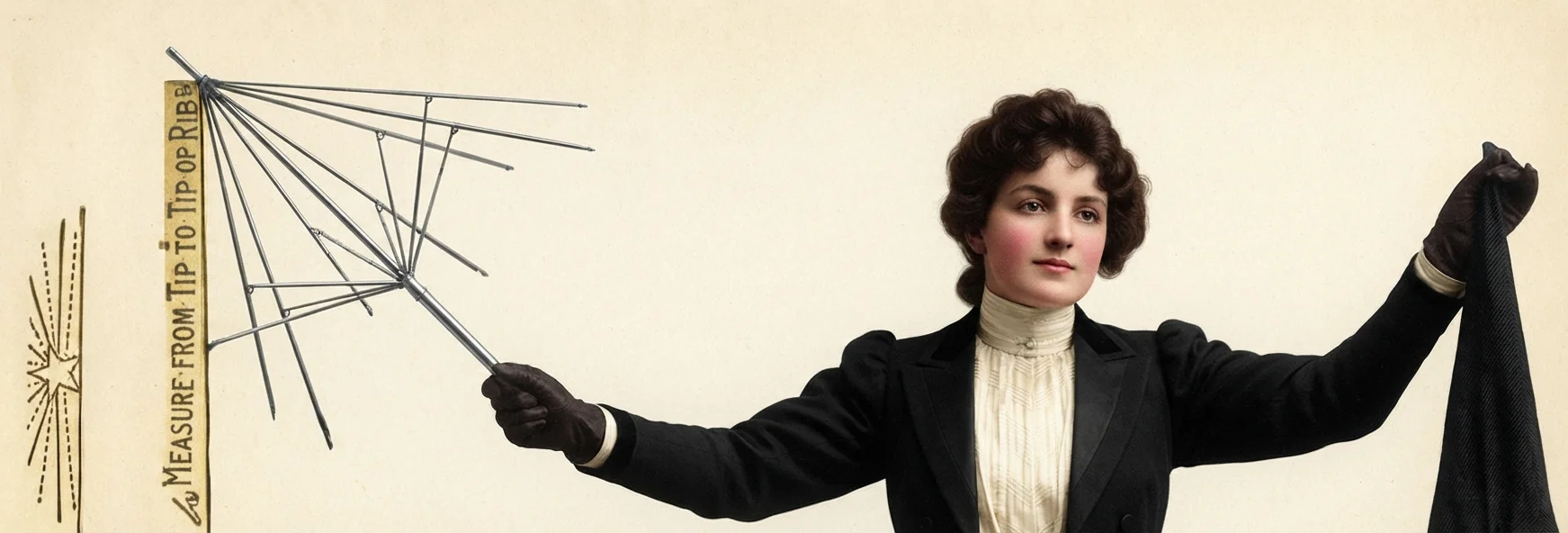
COVER YOUR OWN UMBRELLA
Don't throw away your old one—make it new for $1.00. Recovering only takes one minute. No sewing. A clumsy man can do it as well as a clever woman.
TEN DAYS' FREE TRIAL.
Send us $1.00 and we will mail you, PREPAID, a Union Twilled Silk, 26-inch "Adjustable Roof" (28-inch, $1.25; 30-inch, $1.50). If the "Roof" is not all you expected, or hoped for, return AT OUR EXPENSE and get your money back by return mail—no questions asked.
WHAT TO DO.—Take the measure (in inches) of your old umbrella. Count the number of outside ribs. State if the center rod is of steel or wood. Full instructions for putting on the cover will be sent with all orders. Our special price-list of different sizes and qualities mailed on request.
Send for our free book, "Umbrella Economy," anyway. Your umbrella will wear out some day, and you will be glad that you know about
29 "Who hath wo? who hath sorrow? who hath contentions?
Who hath complaining? who hath wounds without cause?
Who hath redness of eyes?
30 They that tarry long at the wine;
They that go to seek out mixed wine.
31 Look not thou upon the wine when it is red,
When it giveth its color in the cup,
When it goeth down smoothly;
32 At the last it biteth like a serpent,
And stingeth like an adder.
33 Thine eyes shall behold strange things,
And thine heart shall utter froward things.
34 Yea, thou shalt be as he that lieth down in the midst of the sea,
Or as he that lieth upon the top of a mast.
35 They have stricken me, shalt thou say, and I was not hurt;
They have beaten me, and I felt it not;
When shall I awake? I will seek it yet again."
NOTE.—Verses 29, 30, 31, and 32 may be dwelt upon as the four drunkard pictures; first, a mirror in which he may see himself; second, his pedigree; third, his snares; and, fourth, his inevitable harvest. Drunkards are not born, they are made; and they are made of just such material as the teacher of this lesson has before him. All drunkards were at first moderate drinkers. The perfect armor is total abstinence. They who refuse to touch liquor can never become drunkards. They who tipple are on the main line to a drunkard's goal, and there are very few switches.
Golden Text: "Wine is a mocker, strong drink is raging; and whosoever is deceived thereby is not wise." Prov. 20: 1.
SUGGESTIVE QUESTIONS.
(1) What is the first question the wise man asks concerning the intemperate man? The second? The third? The fourth? The fifth? The sixth? V. 29. Note 1. (2) What is his first answer to the questions? His second? V. 30. Note 2. (3) What warning does he give? (4) What specifications does he mention of the dangerous drink? V. 31. Note 3. (5) What is the final effect of the intoxicating draught? V. 32. Note 4. (6) What will the drunkard see? How will he speak? V. 33. Note 5. (7) To what does Solomon liken a drunken man's unreasoning and dangerous doings? V. 34. (8) What is the condition of one who is completely under the influence of liquor? Notwithstanding the evil effects of his intoxication, what does he say? V. 35. Note 6.
NOTES.
1. Who hath wo?—There is no naming the terrible15multitude of wos that crowd in upon the one who allows himself to be ensnared with strong drink. There are wos to himself, and wos to his family, diseases, poverty, disgrace, loss of self-respect, and finally loss of soul. The drunkard realizes these wos in his sober moments, and then tries to drown them in the drink that caused them. Contentions.—Quarrelings, bickerings, and the struggle within himself between what he does and what he ought to do. Complainings.—All the evil and unpleasant traits of one's disposition are magnified by drink. Wounds without cause.—Those received in causeless or unreasonable quarrels, when inflamed by drink; also wounds received in accidents due to drunkenness; and, above all, the wounds of character. Redness of eyes.—The word refers to the blurring or dimming of the vision.
2. They that tarry long at the wine . . . go to seek out mixed wine.—The tendency of drinking is to continue at the bar; often the whole night is spent in carousals, quarreling, gossiping, and talking evil things. The mixed wine evidently refers to that which has been medicated for the purpose of increasing its intoxicating effect. The Septuagint reads, "Those who hunt out where carousals are taking place."
3. Look not upon the wine.—Do not put yourself in the way of temptation. It is too dangerous a viper to take into one's bosom even for once. When it is red.—"Red wines were most esteemed throughout the East."—Peloubet. Therefore it was the more dangerous to tamper with. Giveth its color.—"The beaded bubbles upon which the wine-drinker looks with complacency;" "carries a bead."
4. Biteth . . . and stingeth like an adder.—This refers to the deadly bite or sting of the poisonous reptile. The East has many of these whose bite is death—a fit illustration of the intoxicating cup.
5. Thine eyes shall behold strange things.—There is no doubt that this refers to the terrible experience of the drunkard in delirium tremens, when his brain is on fire, and he sees a multitude of hissing reptiles of every sort.
6. I will seek it yet again.—The continued indulgence gradually but surely weakens the will power of the individual until he has no ability to resist the cravings of his unnatural appetite. He is then a slave; and only God can break for him the chains of that slavery. But the drunkard too often has lost his appreciation of divine things; the religion has been burned out of his soul, and he is lost.
41 "And He sat down over against the treasury, and beheld how the multitude cast money into the treasury; and many 42 that were rich cast in much. And there came a poor widow, 43 and she cast in two mites, which make a farthing. And He called unto Him His disciples, and said unto them, Verily I say unto you, This poor widow cast in more than all they 44 which are casting into the treasury; for they all did cast in of their superfluity; but she of her want did cast in all that she had, even all her living."
20 "Now there were certain Greeks among those that went 21 up to worship at the feast; these therefore came to Philip, which was of Bethsaida of Galilee, and asked him, saying, 22 Sir, we would see Jesus. Philip cometh and telleth Andrew; 23 Andrew cometh, and Philip, and they tell Jesus. And Jesus answereth them, saying, The hour is come, that the Son of 24 man should be glorified. Verily, verily, I say unto you, Except a grain of wheat fall into the earth and die, it abideth by 25 itself alone; but if it die, it beareth much fruit. He that loveth his life loseth it; and he that hateth his life in this world 26 shall keep it unto life eternal. If any man serve Me, let him follow Me; and where I am, there shall also My servant be; if 27 any man serve Me, him will the Father honor. Now is My soul troubled; and what shall I say? Father, save Me from 28 this hour. But for this cause came I unto this hour. Father, glorify Thy name. There came therefore a voice out of heaven, saying, I have both glorified it, and will glorify it 29 again. The multitude therefore, that stood by, and heard it, said that it had thundered; others said, An angel hath spoken 30 to Him. Jesus answered and said, This voice hath not come 31 for My sake, but for your sakes. Now is the judgment of this world; now shall the prince of this world be cast out. 32 And I, if I be lifted up from the earth, will draw all men unto 33 Myself. But this He said, signifying by what manner of 34 death He should die. The multitude therefore answered Him, We have heard out of the law that the Christ abideth 35 forever; and how sayest Thou, The Son of man must be lifted up? who is this Son of man? Jesus therefore said unto them, Yet a little while is the light among you. Walk while ye have the light, that darkness overtake you not; and he that 36 walketh in the darkness knoweth not whither he goeth. While ye have the light, believe on the light, that ye may become sons of the light."
NOTE.
NOTE.—The texts inclosed in marks of parentheses, while not essential to the lesson study, will be found to throw much light upon the lesson, and are suggested for those who wish to study further.
SUGGESTIVE QUESTIONS.
Having exposed the hypocrisy of the Pharisees and denounced their sins, where did the Lord next go? What did He do there? Mark 12:41. Note 1. (2 Kings 12:9.)
Who came with an offering? Of what did it consist? Verse 42. Note 2. (Brass money; see Matt. 10:9.)
Whose attention did He call to the woman's act? and what did He say of it? Verse 43. (2 Cor. 8:12.)
Why was her act so highly commended? Verse 44.
Among the worshipers at this Passover, who are specially mentioned as being present? John 12:20. (Acts 17:4.)
In their anxiety to know more of Jesus, to whom did these Greeks apply? What did they ask? Verse 21.
What did Philip do? Verse 22.
Without giving a direct answer, what did Jesus say? Verse 23. (John 13:31, 32.)
How did Jesus then explain the necessity for His death? Verse 24. (1 Cor. 15:36-38.)
What did He say about the lives of others? Verse 25. (Matt. 10:39.)
What did Jesus say His death would do? Verses 32, 33. Note 4.
What question did this statement raise among the people? Verse 34. (Ps. 89:36.)
In reply to this question what important truths did Jesus utter? Verses 35, 36. (John 8:12; 1 John 1:5-7.)
Side Lights.—"Desire of Ages," chapters 67, 68; "Spirit of Prophecy," vol. 3, chapters 4 and 5.
NOTES.
1. The treasury.—The woe had been pronounced in the outer court of the temple. The Lord, having done His duty in this line, calmly retired to the court of the women, the innermost point to which they were admitted, and there sat down opposite the treasury. This consisted of thirteen large chests, with openings shaped like the bell of a trumpet, to receive the free-will offerings of the people.
2. Threw in two mites.—These offerings were for the priests and poor people. It made no difference to this woman, in the warmth of her loving zeal, that she was poorer than some for whom a portion of the money was intended. Besides, she did not positively know just what disposition the priests would make of her offering. She simply answered a call of duty, and left results with Him who seeth and knoweth all things.
3. Let him follow Me.—Jesus was to die, so that He might, like the planted wheat, bring forth a product like Himself. If these Greeks would see Him, and be like Him, let them bear in mind His work, and follow Him in it, and then they would have assurance of eternal life; otherwise they would abide alone in their knowledge of Him. This lesson is for all to-day.
4. If I be lifted up.—Altho Satan was compassing the death of Christ in order to destroy the "Seed of Abraham," and so make God's Word of no effect (Rom. 9:6), yet the death of the "Seed" would prove not only its restoration, but the multiplication of it (Gal. 3:29). Like the kernel of wheat, if He die, instead of abiding alone, He would cause the "seed of Abraham" to abound everywhere, by drawing all to Himself.
"Ye have heaped treasure for the last days"
Such is the title of one of the twenty-four chapters contained in
HERALDS OF THE MORNING
THIS chapter is filled with instances showing the exact fulfilment of Scriptural predictions concerning the days in which we live.
Some of the instances cited are simply astounding, and were it not for the convincing proof introduced, would hardly be credited.
The latter part of the chapter is devoted to the effect this "heaping up" has upon the poor classes. In addition to giving statistics indicating their deplorable condition, the author quotes incidents which emphasize their desperate struggle for daily bread. We mention a few:—
"One man was asked to repair the roof over his workers. It was giving them rheumatism, asthma, and consumption. He said, 'Men are cheaper than shingles; no sooner does one drop out than a dozen are ready to take his place.'" And again:—
"The other day when I went to visit a house, a little bit of a girl met me outside the door, and seeing the basket on my arm, asked me if I had anything to eat in it: 'for, do you know,' she said pathetically as she laid her hand on a worn little apron, 'I feel awful queer there, kind of sore, you know?'"
"Is it any wonder, under these circumstances, that a gentleman who incidentally remarked in a 'sweat-shop' that he was forty-five years old, was met with the serious and deeply pathetic comment of a little girl, 'I should think any one would get so tired of living so long'"?
Near the conclusion of this chapter is the following statement by Bishop Potter:—
"The growth of wealth and luxury, wicked, wasteful, and wanton, as before God I declare that luxury to be, has been matched step by step by a deepening and deadening poverty which has left whole neighborhoods of people practically without hope and without aspiration."
Remember, the above is only a partial description of one chapter in this absorbingly interesting volume, and it contains twenty-three others all devoted to the signs of our times.
Agents find it an easy-selling book, because people are anxious to know the real solution of the world's present gigantic problems, and that solution may be here obtained.
It is thoroughly and strikingly illustrated, contains 279 pages, and is published in both English and German at the following prices:
Descriptive circular of this and a catalog of all our books sent free.
Pacific Press Publishing Co.
OAKLAND, CALIFORNIA
39 Bond St., New York City 18 W. 5th St., Kansas City, Mo.
Pocket Dictionary and Reference Book
"By far the best Pocket Dictionary and Reference Book on the market." Addison Blakeley, Ph. D., University of Chicago.
This Dictionary has in it all that other pocket dictionaries contain. It has also the following superior advantages:—
It is copied from the latest revision of Webster's, hence it is right up to date.
It is fully self-pronouncing, having all the marks of pronunciation on every word.
It has a second special index (not shown on cut) directing the user to any word almost instantly.
It has the "Columbian World-Builder," which adds 25,300 words, increasing the number of words to nearly 46,000.
Within the same covers are four other complete reference books, viz.: A Pronouncing Gazetteer of the World; a Parliamentary Manual; an Expert Calculator, with business and social forms; a Letter Writer and Literary Guide.
This little giant educator should be in the hands of every boy and girl at school, and a constant companion of every grown-up person of intelligence who speaks the English language. 600,000 sold. Send for sample copy and ask for agents' prices; 25 to 50 copies a day sold by agents. Agents wanted everywhere.
Prices: Cloth, 25 cents; leather, gold edges, 50 cents; morocco, with memorandum, calendar, and safety postage-stamp holder, 50 cents.
Address the
PACIFIC PRESS PUBLISHING CO.
OAKLAND, CAL.
39 Bond St., New York City.
18 W. 5th St., Kansas City, Mo.
Your Life Work
Is it of Men or of God? A new tract in the Apples of Gold Library. Order
A. G. L. No. 20. Price, 50 cents per 100 or one cent each in small quantities. Address, PACIFIC PRESS PUBLISHING Co., Oakland, Cal.; Kansas City, Mo.; or New York City, N. Y.
Book Department Notes
By Editor
Our Book Department is crowded with orders, and reports an unusually large demand for some of its new publications. The first is
A Friend in the Kitchen
which was issued last year in Australia, and has already had a sale of 30,000 copies over there. In addition to being a most excellent cook-book, it contains much practical information about healthful living which will be appreciated by every housewife.
As an evidence of the demand for such a book, we are informed that out of 1,250 circulars sent out, over two hundred orders were received. The Department believes that agents will be prompt to recognize in this volume an easy-selling book for the holiday trade. Price is only 60 cents.
Another booklet along the same line, but covering a different field, is
The Natural Food of Man
Its author gives only such recipes as contain no meat, milk, butter nor eggs—in fact, no animal products whatever. However, the student of this modest volume will find, on testing its generous list of recipes, that they are not only healthful but extremely palatable as well.
Its first part is devoted to a Biblical treatise on the subject of "Man's Primitive and Best Diet," and is easily the best presentation of the Bible argument on this great question ever published.
There has been more matter furnished for this pamphlet than was at first anticipated—it will contain nearly one hundred pages instead of sixty—but the original price will be adhered to, although there may be a little delay in date of publication.
At this writing—October 20—nearly a thousand copies have been ordered, although date of publication is yet two weeks future.
The cover is a heavy antique paper, on which is printed an original design in two colors. Price, 25 cents; discount in quantities and to the trade.
Pagan Counterfeits
In the Christian Church
This pamphlet has been recently published for the author, Mr. C. A. S. Temple, who is a Seventh-day Presbyterian. It treats upon the traces of Pagan and Papal doctrine still to be found in the Protestant churches.
It contains about 200 pages; price, 25 cents per copy.
Sure Word of Prophecy
For several months this valuable pamphlet has been out of print, but the large and continued demand for a brief exposition of the Book of Daniel has made it necessary to issue another edition. Price, 10 cents.
Circulars and Catalogs
The Book Department will be delighted to send its 12-page circular entitled "New Things," its 72-page "Fall Catalog," or its 40-page "Twentieth Century Bible Catalog" free of charge to those interested in its literature.
Pacific Press Publishing Co.
OAKLAND, CAL.
39 Bond St. New York City
18 W. 5th St. Kansas City, Mo.
Instructions for Ordering.
By Editor
1. REMIT by P. O. Money Order, Express Order, or Bank Draft on New York, Chicago, or San Francisco.
2. If paper money or silver is sent, register the letter.
3. Orders and Drafts should be made payable to the PACIFIC PRESS PUBLISHING CO., or to SIGNS OF THE TIMES.
Postage-stamps.—Please do not send postage-stamps, as they are liable to stick together, and are useless in this condition.
Foreign Money.—Do not send any.
Receipt.—No formal receipt is sent unless by special request. The address label on your paper will indicate the time to which your subscription is paid. In case of non-receipt of papers, or any other irregularity, please notify us immediately.
Expiration of Subscription.—All papers are discontinued at the expiration of the time paid for. Notification will be sent several weeks before date of expiration, thus enabling you to renew in ample time to secure unbroken files. Please be prompt, as we can not always furnish back numbers.
Change of Address.—When ordering change of address, please give both the old and the new address.
Important.—Use a separate sheet for SIGNS orders, separate for other papers, separate for books, for tracts, etc., and if you address the editor, use a separate sheet. All can be sent in one envelope, and the money all sent in one order, but write each kind of business on a separate sheet. In this way each order can be handed to the proper clerk and filled at once.
TO CONTRIBUTORS.
By Editor
THE SIGNS OF THE TIMES is a purely missionary enterprise. For this reason it has felt free to ask for contributions from its friends. It pays nothing for contributions, either prose or poetry, unless solicited by the editor, and then the fact is stated when the articles are asked for. This is a plan rarely followed, but sometimes deemed expedient.
Articles Desired.—Those which set forth in the Spirit of Christ the great saving truths of God, short and to the point. It is better to treat one important truth clearly, in a short article, than many points vaguely in a long one. We desire no caustic, critical productions, which might minister to personal pride or pleasure, but can not save souls.
How Prepared.—Write plainly, with typewriter or ink, with wide space between the lines, to freely admit of editing, writing of subheads, etc. Write on one side of the sheet only. Sign the name to the manuscript, as it becomes oftentimes separated from accompanying letter. Anonymous contributions are not used, whatever their merit. If the writer does not wish his name to appear, let him furnish a pseudonym for the public. But we wish the name.
Manuscript Returned.—We will return all unused manuscript desired if stamp and directions are inclosed. We are forced sometimes to return good manuscript mainly for three reasons: (a) Sometimes the articles are too long; (b) sometimes we have a number on the same subject; (c) sometimes our plans are such that an article can not be used till it is out of date. We therefore hope that no offense will be taken by those who have freely contributed their best thought if their productions are returned. When we receive so much matter, we can not use all.