Your ShelfYour Projects

Review and Herald, Vol. 91, No. 9.

Publicity for the March Protestant Magazine

Review and Herald

Feb 26, 1914

Review and Herald Publishing Association · Takoma Park Station, Washington, D. C. · Feb 26, 1914

Publicity for the March Protestant Magazine

TUESDAY evening, February 17, the manager of the Protestant Magazine delivered to the Associated Press management, Washington, D. C., hand-folded copies of the March Protestant containing the famous letter of the editor to President Wilson, and the latter's reply, regarding Mr. Tumulty and the White House mail. The wires were kept hot that night supplying these two letters and mentioning the Protestant Magazine to about 400 morning and 400 evening newspapers served by the Associated Press. See the February 18 papers. The Washington branch of the New York Sun also wired the letters to some 75 newspapers in the Sun's press association. This publicity will greatly help our agents everywhere in selling the March number.

THE WORK AND THE WORKERS

THE Massachusetts Conference has already furnished the February Protestant Magazine to 2,269 Protestant clergymen in that State.

Sample Copies of Liberty Requested

A PROMINENT official of the Knights of Malta requests us to send 2,000 sample copies of Liberty and 2,000 wrappers, and he will himself address them as sample copies to the members of that order, free of charge. Have you seen the "Thomas Jefferson," "Religious Persecution in Tennessee," and "National Prohibition" number, now ready? Send the magazine to ten friends for only $2.00,—regular price, $3.50.

March Life and Health Number

HAVE you placed your order for the beautiful March number of Life and Health? It has a beautiful "Niagara Falls" cover design in three colors—the most beautiful yet produced. Also contains timely articles—six on "What I Know About Rearing the Baby," etc.

Additional Magazine Department Helpers

An extra clerk has been added to our treasury department force, whose chief duty is to enter up the cash orders addressed to the Protestant Magazine. For the same reason three extra helpers have been added to our magazine department.

Enormous Demand for Protestant Magazine
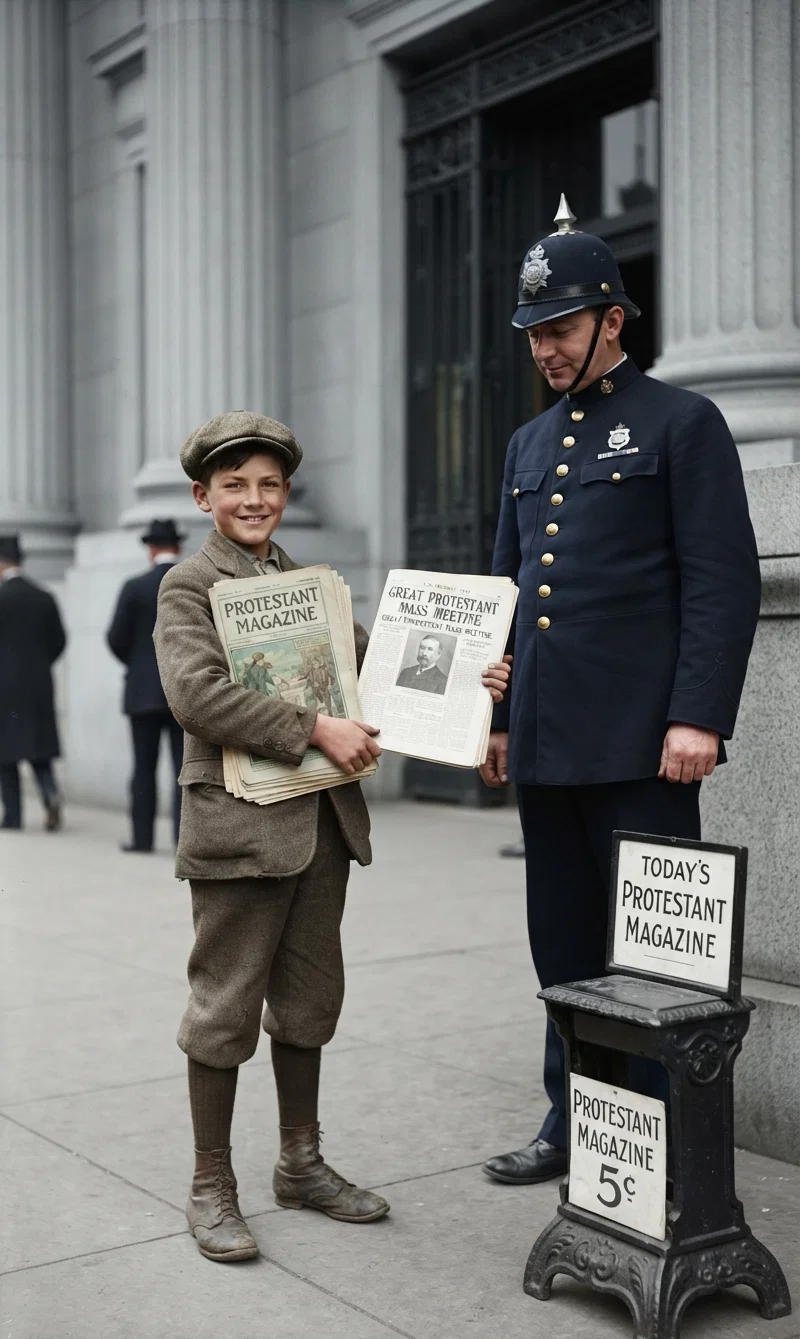
An Urgent Message From "Shorty," A Successful "Newsboy" at the United States Treasury Building. We Now Have His Standing Order for 100 Copies of the "Protestant" per Month.
This enterprising news dealer at the F Street entrance to the United States Treasury Building, Washington, D. C., quickly sold 60 copies of the February or "Great Protestant Mass Meeting" and "Roman Mask Put On Again" number of the Protestant Magazine, and has placed his standing order with us for 100 copies per month. In the picture he is seen soliciting from one of the Treasury guards. Read his hastily penciled post card. Rev. R. H. McKim's two speeches in the February number are truly creating an "enormous call" for the same everywhere, to use "Shorty's" unique phrase! Four large editions have already been published as follows: January 13, 27, February 6, 16—a total of 50,000 copies thus far! Holding forms for fifth edition! LET CAMPAIGNS BE INAUGURATED EVERYWHERE BY OUR CONFERENCES, SCHOOLS, CHURCH OFFICERS, AND PATRIOTIC SOCIETIES, TO INTRODUCE THE GREAT FEBRUARY AND MARCH NUMBERS TO CLERGYMEN AND MEN OF INFLUENCE. SPECIAL TRIAL SUBSCRIPTIONS, FOR FOUR MONTHS, ONLY 25 CENTS. SEND THE MAGAZINE TO FIVE DIFFERENT PERSONS FOR SIX MONTHS FOR ONLY $1.50—REGULAR PRICE, $2.50. Send $1.00 for 20 or $2.00 for 50 copies. Sell or give them away. Address all orders to your conference tract society or to Protestant Magazine, Washington, D. C.

Selling Protestant Magazine to Ministers

Pastor C. J. Buhalts, president of the West Texas Conference, writes: "We have only five organized churches in our conference, but have taken 600 copies of the February Protestant Magazine. Yesterday I personally visited sixteen ministers here in Abilene, and sold a copy to each of them. They were glad to get it. I visited the president of the Christian college, and sold him one. I have enjoyed this work with the ministers. Yours for success."

South Dakota Orders Protestant Magazine

LATEST telegram, just received: "Redfield, S. Dak., Feb. 18, 1914. South Dakota desires eight hundred to one thousand February Protestant. Order follows. C. N. Babcock." At this rate our fourth edition will not last long. Expect to print a fifth edition soon!

North Dakota Requests Protestant Magazine

THE North Dakota Tract Society requests the publishers to send the February Protestant Magazine to 767 of the Protestant clergymen in that State.

Poor Prospects for Peace

E. K. SLADE
A LEADING Paris paper, dated December 31, in reviewing the world's work for 1913, contained the following significant statements, which were reprinted in a recent number of the Cleveland Press:—
"Turkey has secured peace, but the Balkan States are still effervescent.
"Germany and Russia have become rivals over Asia Minor.
"Spain is enjoying an endemic political crisis.
"In Portugal a revolution is smoldering.
"Italy dreams of conquest, hoping to restore the prestige of the ancient Roman Empire.
"Austria is in the throes of internal race conflicts.
"China has awakened and is preparing mysteriously, while Japan is ready to champion the yellow race.
"Mexico is in the throes of a civil war, with brigandage of the worst description.
"The African continent is covered by France, Germany, and England."
"With all these volcanoes [the newspaper says that] peace in 1914 is assured"!
To the student of prophecy it is somewhat gratifying to observe that there are those who are not afflicted with that type of optimism which looks for universal peace in the near future in the face of conditions known to exist in nearly every land.
The spirit of strife and warfare that has actuated Turkey and her enemies during the past two years is not confined to any one locality, nor are the conditions in and about Turkey and in the other nations already named tapering off and merging into an epoch of peace. True to the prophecy contained in Rev. 16: 14, this war spirit is to "go forth unto the kings of the earth and of the whole world, to gather them to the battle of that great day of God Almighty." Armageddon is to be the outcome of the general unrest which is so apparent to this French writer.
The tendency toward war is not on the decline. In addition to these disturbances noted above, the abnormal preparations for war in all leading nations where peace prevails at present are no less significant. The amount of money thus spent by most nations is positively appalling. The arming of the nations must engage the attention of the whole world, yet peace is promised in the very near future by those who will not let the divine light of the Word enlighten them.
The statement, "China has awakened," signifies much in this connection. It serves to show that men of broad knowledge recognize conditions which the student of prophecy is warranted in looking for.
Mount Vernon, Ohio.

A Door of Hope

(Concluded)
MRS. E. G. WHITE
HAD Israel taken heed to the messages of the prophets emphasizing the value of "the great things" of God's law, they would have been spared the humiliation that followed. It was because they persisted in turning aside from his law that God was compelled to allow their enemies to take them captive. "My people are destroyed for lack of knowledge," was his message to them through Hosea. "Because thou hast rejected knowledge, I will also reject thee, . . . seeing thou hast forgotten the law of thy God." Hosea 4:6. In trial and affliction they were to learn lessons that under circumstances more favorable they had refused to learn.
In every age, transgression of God's law has been accompanied by the same result. In the days of Noah, when every precept of this law was set aside, iniquity became so deep and widespread that God could no longer bear with it, and he said, "I will destroy man whom I have created from the face of the earth." In the time of Abraham, the people of Sodom openly defied God and his law; and there followed the same wickedness, the same corruption, the same unbridled indulgence, that had marked the antediluvian world. The inhabitants of Sodom passed the limits of divine forbearance, and there were kindled against them the fires of God's vengeance. The time preceding the downfall of the northern kingdom was one of similar disobedience and of similar wickedness. God's law was counted as a thing of naught, and this opened the floodgates of iniquity upon Israel. "The Lord hath a controversy with the inhabitants of the land," Hosea declared, "because there is no truth, nor mercy, nor knowledge of God in the land. By swearing, and lying, and killing, and stealing, and committing adultery, they break out, and blood toucheth blood."
And as it was then so it is today. Men boast of the wonderful progress and enlightenment of the age, but God sees the earth filled with guilt and violence. Men declare that the law of God has been abrogated, that the Bible is not authentic; and as a result, a tide of evil, such as has seldom been seen since the days of Noah and the days of apostate Israel, is sweeping over the world. Lawlessness, dissipation, extravagance, and corruption are coming in upon us as an overwhelming flood. Nobility of soul, gentleness, piety, are bartered away to gratify the lust for forbidden things. The taking of human life is a matter of daily occurrence. The terrible record of crime daily committed for the sake of gain is enough to chill the blood and fill the soul with horror. "Judgment is turned away backward, and justice standeth afar off: for truth is fallen in the street, and equity cannot enter. Yea, truth faileth; and he that departeth from evil maketh himself a prey."
The time is right upon us when there will be sorrow in the world that no human balm can heal. The Spirit of God is being withdrawn from the world. Disasters by sea and land follow one another in quick succession. How frequently we hear of earthquakes and tornadoes, of destruction by fire and flood, with great loss of life and property. Apparently these calamities are capricious outbreaksof seemingly disorganized, unregulated forces, but in them God's purpose may be read. They are one of the means by which he seeks to arouse men and women to a sense of their danger.
"As the days of Noe were, so shall also the coming of the Son of man be. For as in the days that were before the flood they were eating and drinking, marrying and giving in marriage, until the day that Noe entered into the ark, and knew not until the flood came, and took them all away; so shall also the coming of the Son of man be. . . . Watch therefore: for ye know not what hour your Lord doth come."
The prophecies of judgment delivered by Amos and Hosea were tempered with prophecies of future glory. According to Hosea, the children of Israel were to "abide many days without a king, and without a prince, and without a sacrifice, and without an image, and without an ephod, and without teraphim. Afterward," the prophet continued, "shall the children of Israel return, and seek the Lord their God, and David their king; and shall fear the Lord and his goodness in the latter days."
This prophecy is to reach its complete fulfillment in the gathering out from all nations of a people prepared for the second coming of Christ. The remnant of Israel is symbolized by a woman, representing the Lord's chosen church on the earth. "Behold," he says, "I will allure her, and bring her into the wilderness, and speak comfortably unto her. And I will give her her vineyards from thence, and the valley of Achor for a door of hope: and she shall sing there, as in the days of her youth, and as in the day when she came up out of the land of Egypt. And it shall be at that day, saith the Lord, that thou shalt call me Ishi ["My husband," margin]; and shalt call me no more Baali ["My lord," margin]. For I will take away the names of Baalim out of her mouth, and they shall no more be remembered by their name."
In the last days of this earth's history, God's covenant with his commandment-keeping people is to be renewed. "In that day I will make a covenant for them with the beasts of the field, and with the fowls of heaven, and with the creeping things of the ground: and I will break the bow and the sword and the battle out of the earth, and will make them to lie down safely. And I will betroth thee unto me forever; yea, I will betroth thee unto me in righteousness, and in judgment, and in loving-kindness, and in mercies. I will even betroth thee unto me in faithfulness: and thou shalt know the Lord.
"And it shall come to pass in that day, I will hear, saith the Lord, I will hear the heavens, and they shall hear the earth; and the earth shall hear the corn, and the wine, and the oil; and they shall hear Jezreel. And I will sow her unto me in the earth; and I will have mercy upon her that had not obtained mercy; and I will say to them which were not my people, Thou art my people; and they shall say, Thou art my God." Hosea 2:14-23.
"In that day, . . . the remnant of Israel, and such as are escaped of the house of Jacob, . . . shall stay upon the Lord, the Holy One of Israel, in truth." Isa. 10:20. From "every nation, and kindred, and tongue, and people" there will be those who will gladly respond to the message, "Fear God, and give glory to him; for the hour of his judgment is come." They will turn from every idol that binds them to this earth, and will "worship him that made heaven, and earth, and the sea, and the fountains of waters." They will free themselves from every entanglement, and will stand before the world as monuments of God's mercy. Obedient to every divine requirement, they will be recognized by angels and by men as those that "keep the commandments of God, and the faith of Jesus." Rev. 14:6, 7, 12.
"Behold, the days come, saith the Lord, that the plowman shall overtake the reaper, and the treader of grapes him that soweth seed; and the mountains shall drop sweet wine, and all the hills shall melt. And I will bring again the captivity of my people of Israel, and they shall build the waste cities, and inhabit them; and they shall plant vineyards, and drink the wine thereof; they shall also make gardens, and eat the fruit of them. And I will plant them upon their land, and they shall no more be pulled up out of their land which I have given them, saith the Lord thy God." Amos 9:13-15.

Patching Up the "Old Man"

H. C. HARTWELL

The apostle says, "Seeing that ye have put off the old man with his deeds; and have put on the new man." The significant spiritual awakening which is coming just at this time, is leading many to discern as they have not before that the "old man" cannot be improved.
The "old man" is simply self. Somehow there has always been a universal tendency to feel that, after all, there is a great deal of good in the "old man." We admit that we fail on some points, but we seem to feel that if these things could be fixed up and strengthened a little so as to balance with those other admirable qualities which we feel we possess, such as tithe paying and observing the seventh day, self would then make a very presentable appearance.
This is what might be called patching up the "old man." All our righteousness, however, is but filthy rags, and to attempt to patch up such a miserable garment as this will certainly prove terribly embarrassing and disappointing in the judgment. "The Christian's life is not a modification or improvement of the old, but a transformation of nature. There is death to self and sin, and a new life altogether."—"Desire of Ages," page 172.
The second and third chapters of Revelation we understand do not apply to the apostate church, but to the different phases of the true church from the time of the apostles down to the end of time. It has been difficult for us to realize that the remnant church and the church of the Laodiceans are identical. So as we have read the terribly humiliating message of the last nine verses of Revelation 3, we have passed them on to other denominations for their benefit. In this we have made a decided mistake.
In the straight testimony of the True Witness no reference is made to errors in doctrine; the message is to those who have received the light of present truth, but who are not living up to it, yet who, on account of having received such an impregnable system of Bible doctrines, have deceived themselves into the idea that they are "rich, and increased with goods, and have need of nothing." This is a sort of religious auto-intoxication. It is similar to the feelings of the man who has become intoxicated with strong drink. Such persons sometimes imagine themselves to be possessed of great wealth, though perhaps everything about them indicates that they are in the depths of degradation and poverty.
The condition of the members of the Laodicean church is faithfully described by the True Witness. He says that they are "wretched, and miserable, and poor, and blind, and naked." This of itself would be a most deplorable state of affairs, but the worst feature of it all is that those who are in this condition do not know it.
Think it over prayerfully. Has our Sabbath keeping counted for very much when in most of the little everyday affairs of life we have been suffering defeat all the way along,—irritable with the children; unable to be patient and kind when the tired wife did not always speak as pleasantly as we thought she should; following the fashions of the world; ignoring the principles of health reform; neglecting prayer and the study of the Bible and the Testimonies; and in so many ways maintaining such a low standard of Christian living?
The True Witness knows our works; he cares very little for our profession. The members of the Laodicean church have not been controlled by the Spirit of Christ; he has been in their lives only in a very limited degree. He is represented as standing without, knocking for admission into their hearts, in order that he may work out in their lives the beautiful character that should be seen in his people.
Perfection is the high standard to which the members of the Laodicean church are expected to attain. This is necessary before they can be translated. The latter rain is to prepare them for this experience. But we read, "I saw that none could share the 'refreshing' unless they obtain the victory over every besetment, over pride, selfishness, love of the world, and over every wrong word and action."—"Early Writings," page 71.
To obtain the victory over sin we need expect no help from the "old man."Self will be selfish as long as he is permitted to live. Self is our worst enemy. The "old man" is continually getting us into trouble. The thing to do is to crucify him. He will not like it; and, in fact, as long as we are in the flesh, he will struggle for recognition. "In our own strength it is impossible for us to deny the clamors of our fallen nature." "The power of evil had been strengthening for centuries. . . . Sin could be resisted and overcome only through the mighty agency of the third person of the Godhead. . . . It is the Spirit that makes effectual what has been wrought out by the world's Redeemer. . . . Through the Spirit the believer becomes a partner of the divine nature. Christ has given his Spirit as a divine power to overcome all hereditary and cultivated tendencies to evil."—"Desire of Ages," pages 122, 671.
It is stated that the reception of this gift "would bring all other blessings in its train." (See "Acts of the Apostles," page 50.) Are we convicted of impatience? Have we become critical and unkind? Then we should pray for the Holy Spirit to take control of our hearts. This will develop the fruits of the Spirit in our lives; the power of the "old man" will be broken, and the divine nature, or the "new man," will grow up into the measure of the stature of Christ.
It is very evident that many of us have left the Holy Spirit almost wholly out of our reckoning in this battle with sin, and as a result we have had only a sort of half salvation,—sinning, repenting, and being forgiven,—and we have failed to grasp the glorious truth that ample provision has been made to keep us from repeating the same failures. We have grasped the promise of God to forgive our sins through the merit of Christ's sacrifice on the cross. Now we should claim the victory over sin by recognizing the office work of the Holy Ghost in this conflict, and allowing it to carry on the work of constantly resisting and overcoming every besetment. By this means we shall obtain a full and complete salvation.
South Lancaster, Mass.

Cause of the Egyptian Revolution

Does the History of Turkey and Egypt Since 1798 Fulfill the Prophecy of Daniel 11: 40-44?—No. 19
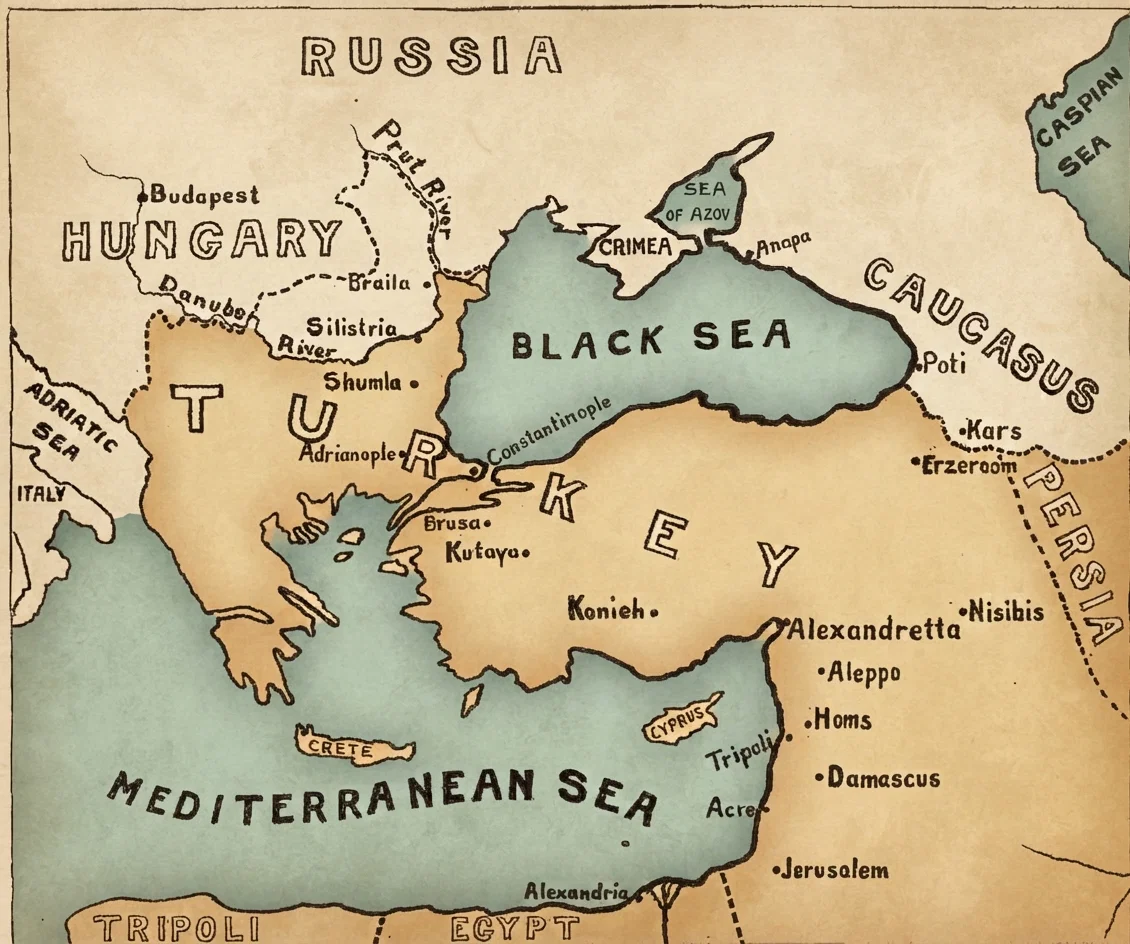
"Tidings out of the east and out of the north shall trouble him." Dan. 11:44. This was surely true of Turkey from the beginning to the close of the war with Russia in 1828-29. And when tidings came that two of her important cities, Adrianople, 125 miles northwest, and Erzerum, 600 miles east, with both in the possession of Russian generals, Turkey surrendered and signed the treaty of Adrianople.
But this did not end Turkey's troubles. While Russia was prosecuting this war against her, and wrestling territory from her northern and eastern dominions, a serious revolution was being set on foot by Mehmet Ali, governor of Egypt.
This revolution was not confined to Egypt; it was carried with success to the eastern part of the empire. It penetrated to the heart of Asia Minor, and but for the prompt and determined interference of European powers, Constantinople must surely have been taken and Mehmet Ali proclaimed sultan of Turkey. It resulted in the loss of Turkey's independence in 1840. This marked the close of the sixth trumpet of Rev. 9:13-21, which was to take place at the end of the prophetic period of "an hour, and a day, and a month, and a year." Verse 15.
DISTANCES FROM CONSTANTINOPLE
This is an event of great importance in the fulfillment of prophecy. It is full of meaning to the generation now living. The political events that resulted in the loss of Turkey's independence and marked the close of the prophetic period of the sixth seal in 1840 demand more than a brief, superficial statement. I shall, therefore, give as full an account of this part of Turkey's history as the limits of our space will permit.

Cause of the Egyptian Revolution

Of the purpose of this revolution Creasy says:—
"It was in Egypt that the most deadly storm was gathering. Mehmet Ali had resolved on founding an hereditary dominion on the ruins of the apparently doomed empire of the sultan. He had restored his navy after its destruction at Navarino; he possessed a veteran and admirably disciplined army, chiefly officered by Frenchmen; and, above all, he had a general of science, experience, prudence, and energy in his son, the celebrated Ibrahim Pasha."—"History of the Ottoman Turks," by Sir Edward Creasy, page 521.
"It was not in Europe alone that the reforming Sultan Mahmud had enemies to face. Scarcely had he ended the war with the Greeks and signed the treaty of Adrianople with the Russians than in 1830 his prestige was wounded in Africa by the French conquest of Algiers. . . .
"Far more serious than this moral defeat was the revolt of Mehmet Ali, viceroy of Egypt, in 1831, which threatened the very existence of the Ottoman throne. The ambitious Albanian was not satisfied with the reward which he had received for his services to his suzerain during the Greek war; Crete seemed to him an inadequate equivalent for the loss of the Morea; he in vain asked the sultan to compensate his son Ibrahim with the pashalic of Damascus; and refusal made him all the more eager to obtain it."
"Mehmet Ali could contemplate with self-complacency the condition of Egypt as compared with that of the rest of the Turkish Empire. A French officer had organized his army; a French constructor had rebuilt his fleet; a French doctor had taught his physicians; he was the sole landowner, the sole manufacturer, the sole contractor in the country, where human lives were reckoned of as little account as in the time of the Pharaohs. The one thing lacking was complete independence, and the moment seemed propitious for its attainment. An excuse was readily found in the refusal of Abdullah, pasha of Acre, to give up some Egyptian refugee victims of Mehmet Ali's state socialism, who had taken refuge in the old city of the crusaders. Ibrahim thereupon invaded Syria."—"The Ottoman Empire," 1801-1913, by William Miller, M. A., pages 144, 145.
"The Porte vindicated its dignity by pointing out that the governor of oneprovince could not make himself the censor and disciplinarian of a neighboring governor, without trenching on the prerogatives of sovereignty. But these reasonings had no effect on Mehmet Ali, who was bent on the conquest of Syria, for which the acts of Abdullah were merely the pretext."
"The number of men with which Ibrahim Pasha, who was named general in chief, undertook the conquest of Syria, was far larger than that which Bonaparte led across the desert to Acre; and equaled, if it did not surpass, those with which the whole French expedition to Egypt was attempted,—amounting to six regiments of infantry, four of cavalry, and a proportionate force of artillery,—in all, between thirty and forty thousand men."
"A large squadron effected a passage by sea, carrying the heavy artillery, ammunition, and supplies, and having on board Ibrahim Pasha and his staff, including Solyman Bey (the French officer of the empire, named Selves, already mentioned); while the cavalry and the bulk of the infantry, having started for El Araish in the first days of November, 1831, crossed the desert, and having taken Gaza and Jaffa without meeting with resistance, the squadron and the army effected a rally at the latter port. Ibrahim Pasha, disembarking with his staff, took the command in person, and marched northward to Acre, where Abdullah had concentrated his strength in the hope of turning back Ibrahim, as Djezzar had turned back a greater commander [Napoleon]."
"It must be admitted that the defense of Abdullah was a gallant one. His batteries replied to those of Ibrahim from the twenty-sixth of November, when the place was first invested, until February, 1832, when, a breach having been effected, two vigorous assaults were made, but without success."
"The last terrible assault was made on the twenty-seventh day of May, after daybreak. The battle continued through the whole heat of the day, and it was not until the afternoon, when many hundred men had been killed in the breach, that the place was surrendered."
"From Acre, Ibrahim marched to Damascus, which—situated in a luxuriant valley, without any considerable fortifications, and entirely commanded from the heights of Salahieh—was abandoned to him without firing a shot, the authorities having taken to flight. This city might have proved a new Capua to the general of the Egyptian troops; but Ibrahim, halting merely to replenish his commissariat stores, pushed on to Homs, where the pasha of Tripoli had under his orders thirty thousand men, forming the vanguard of the Ottoman armies."
"It was at Homs, the first city on the road from Damascus to Aleppo, that the two armies met on the eighth of July, 1832. Ibrahim did not make the first attack; but, placing his infantry in solid masses in the center, with the cavalry and artillery at the wings, he awaited the assault of Mohammed Pasha of Tripoli, who advanced in three columns. A well-directed, deadly fire of musketry and grape was opened on the Turks as soon as they were fairly within range, and, four battalions of the Egyptian guard vigorously charging the center with the bayonet before the Turks had recovered from their confusion while at the same time the cavalry acted on the wings, the Turkish army was put to utter rout."
"The victory was complete. The camp, the commissariat stores, the baggage, and the ammunition of the Turks, along with about two thousand prisoners and thirty-six guns, fell into the hands of the Egyptians, and the army of the Sublime Porte thus becoming an utter wreck, all Syria was placed at the feet of Ibrahim."—"History of the Egyptian Revolution," by Paton, Vol. II, pages 94-97.
"At Aleppo the Ottoman commander collected the scattered battalions and led them to Alexandretta, where the Turkish fleet lay at anchor. But Ibrahim, as usual, was swift to follow up his victory. On July 17, after a series of forced marches, he entered Aleppo; on July 29 he came up with Hussein himself, strongly posted in the Pass of Beilan near the sea. Once more the Egyptian arms were completely victorious; all Syria was lost to the sultan; and the vanguard of the Egyptian army, under Abbas, the future khedive, was free to pass the mountains and occupy Adana, in Asia Minor. The news of these crushing defeats struck the seraglio with consternation."—"Cambridge Modern History," Vol. X, pages 549-562.
"All Syria was lost to the sultan." Syria was a large and important division of the eastern part of the Turkish Empire. It extended from the borders of Egypt in the south almost to the Black Sea in the north, and from the Taurus mountain range in the west to the Euphrates River and Mesopotamia in the east. The revolt in Egypt, the southern part of the empire, had been a matter of regret and vexation at Constantinople, but not of serious alarm. But when this revolt was carried with uninterrupted success by the Egyptian pasha into upper Syria, the eastern division of Turkey, "the news [tidings] of these crushing defeats struck the seraglio [headquarters of the sultan] with consternation." Thus "tidings out of the east" continued to trouble him.

“Be Ye Also Ready”

D. T. SHIREMAN
“Take heed to yourselves, lest at any time your hearts be overcharged with surfeiting, and drunkenness, and cares of this life, and so that day come upon you unawares. For as a snare shall it come on all them that dwell on the face of the whole earth.” Luke 21:34, 35.
In Matt. 24:37-39 we read: “But as the days of Noe were, so shall also the coming of the Son of man be. For as in the days that were before the flood they were eating and drinking, marrying and giving in marriage, until the day that Noe entered into the ark, and knew not until the flood came, and took them all away; so shall also the coming of the Son of man be.”
The generation which was destroyed by the flood was warned by faithful Noah for one hundred and twenty years. He gave full evidence of his belief in the message he preached, by preparing an ark to the saving of himself and his family. To others his warning was but “an idle tale,” and they “laughed him to scorn,” continuing to eat and drink and to make merry.
The Saviour is now calling the attention of this generation to the dangers before them. The signs foretold in Matthew 24 and Luke 21 are fast fulfilling, and conditions obtain in the world as foretold by prophecy. However, instead of one family being left to sound the note of warning, hundreds are giving it with a loud voice; and the pen and the printed page are also proclaiming the joyful news that this generation shall witness the return of the Saviour.
God has given to the world his Word—the Bible—in many different languages, that men may read for themselves of this “blessed hope.” But they do not take time to read the warning contained in this Word, nor will they listen readily to the living preacher of this truth. We must take heed to ourselves, for there is danger that we shall become “overcharged with surfeiting, and drunkenness, and the cares of this life, and so that day come” on us unawares. We are bidden: “Watch ye therefore, and pray always, that ye may be accounted worthy to escape all these things that shall come to pass, and to stand before the Son of man.” We are living in a “fast age,” and surely this instruction is timely.
The warnings “take heed to yourselves,” “watch,” and “pray,” include the admonition to do all we can toward sounding forth the message. Often the daily life will preach louder than words. We should live as if we believe with our whole hearts that the Lord is soon coming, and thus all who come in contact with us will know that we are really in earnest, and will be without excuse. Paul says, in 1 Thess. 5:4-8: “But ye, brethren, are not in darkness, that that day should overtake you as a thief. Ye are all the children of light, and the children of the day: we are not of the night, nor of darkness. . . . But let us, who are of the day, be sober, putting on the breastplate of faith and love; and for an helmet, the hope of salvation.” Shall we not take this admonition to “be sober”?
The end of all things is just before us. “Stand therefore, having your loins girt about with truth, and having on the breastplate of righteousness; and your feet shod with the preparation of the gospel of peace; above all, taking the shield of faith.”
As I write these lines, a feeling of sadness comes over me; for from the same Holy Book I read that some servants will say, “My Lord delayeth his coming.”

Editorial

For the Love of the Truth

At a recent meeting of representatives of Protestant missionary societies in North America, we were impressed anew with what the love of this "blessed hope" prompts the little flock of Adventist believers to do for the missionary cause. It is not that we can look back with self-satisfaction and a feeling that we have done what we should have done. Every believing heart would cry out against this. We can only look forward to yet greater things that must be done by the grace of God and his enabling providence. Yet the statistics of missionary giving by all the societies, presented at the New York meeting, bears a testimony to the power of this truth that may well lead us to thank the Lord and take courage for yet greater things. The latest statistics of missionary giving were presented at the conference, and from this printed report we select the list of ten largest givers, as followers: —
Presbyterian, North .........$1,800,000 Methodist Episcopal .......... 1,500,000 Baptist ...................... 1,100,000 Congregationalist ............ 1,048,000 Woman's Methodist ............ 837,000 Protestant Episcopal ......... 823,000 Methodist, South ............. 790,000 Presbyterian, South .......... 637,000 Southern Baptist ............. 580,000 Seventh-day Adventist ........ 444,000
At first glance, it seems hardly possible that Seventh-day Adventists should come just here in the list, following the denominations that number their membership by the million or more. But there we are in the plain figures of the statistical report. In membership we are among the least of all, but in gifts for the missionary cause this denomination ranks among the largest.
It is all for the love of the truth and the urgency of the closing work. No human appeals could ever rally a few thousand people to accomplish these results year after year. It is the appeal that comes from heaven itself. And the basis of the response is the conviction, fixed by the Spirit in believing hearts, that this advent movement is born of God, that this third angel's message is
the truth of God for this time, and this people the remnant church of God, according to the sure word of prophecy, called into being for just this purpose of carrying the last message quickly into all the world. W. A. S.
Continue reading: Two Different Viewpoints