THE prophecy of Revelation 13 indicates that the one government of all others that will prove a stronghold to the papal hierarchy in the closing years of earth’s history is the United States of America. Of the work to be done by this Government the scripture declares:
“And he exerciseth all the power of the first beast before him, and causeth the earth and them which dwell therein to worship the first beast, whose deadly wound was healed. And he doeth great wonders, so that he maketh fire come down from heaven on the earth in the sight of men, and deceiveth them that dwell on the earth by the means of those miracles which he had power to do in the sight of the beast; saying to them that dwell on the earth, that they should make an image to the beast, which had the wound by a sword, and did live.”
True to prophetic prediction, the Papacy sees in the growth and progress of its work in the United States its hope for the future. The last decade has given many evidences of the determination of European powers to continue the work of shaking off the papal yoke. The papal church, recognizing this growing spirit of insubordination among its older children, turns to the New World, looking to the Benjamin of the nations for future support. These sentiments are voiced by the editor of America in his issue of September 24. We quote:
“The world at large is generally convinced that the Papacy is a wreck. In the northern countries of Europe its very name has been held in abomination for more than three centuries, and the Latin races are now moving in the same direction of revolt. The nation that formerly gloried in its title of the Eldest Daughter of the Church, has thrust out the pope with contempt, and refuses to recognize his existence. The churches are dismantled, the religious orders are expelled, and bishops and priests are haled before the courts as criminals for loyalty to the representative of Christ. Spain, ‘the Catholic,’ has announced its purpose of assuming the same attitude of hate. Little Portugal is also in revolt, and in the pope’s own dominions a usurper rules, while an atheist Jew is the mayor of the Eternal City, and is actively engaged in obliterating every memory of Christ from the very heart of Christianity. Worse conditions are promised for the year 1912.”
From this cry of lament over the waning prestige of the church in the Old World, the editor strikes a more hopeful note as he turns his view toward the western hemisphere:
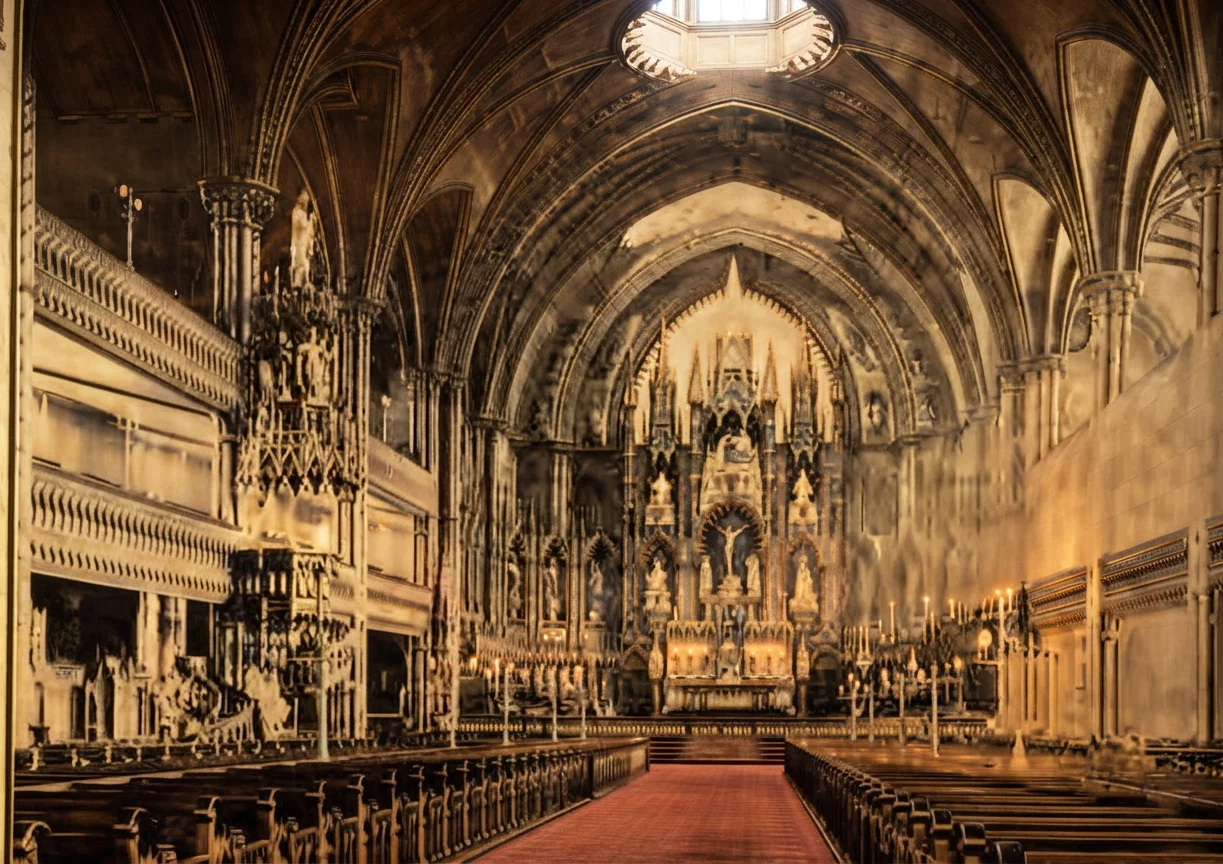
“Yet what is this occurring in the great city on the St. Lawrence? Half a million people are gathered there for a religious celebration. Triumphal arches span the thorofares; the public buildings are hung with the flags of every nation, and the facades of the houses are almost hidden by the decorations. Multitudes have hurried thither from all parts of the world. There are priests and prelates and laymen from the great Republic beyond the borders; from Italy and France and Germany, and England and Scotland and Ireland, from South America and the islands of the Caribbean. Even Greenland and South Africa and distant Jerusalem have sent their representatives. In the endless and gorgeous pageant that passed through the streets there were Negroes and white men, Indians in their war-paint and Chinese in silk robes with their flags of the flaming dragon. There were university professors in their insignia of office, tonsured monks in their varied garbs, military and ministers of state, priests in their sacerdotal robes, bishops with their copes and miters, cardinals in their royal scarlet, but one conspicuous figure stands out in splendid scene towering like Saul over all the people. In his hands is the Adorable Host which he is bearing from the great basilica to the altar on the Royal Mountain. After His Majesty of the Eucharist, this man is the center of all that splendor and pomp and magnificence, the cynosure of every eye, the one to whom all the cardinals and bishops and priests and people pay their obeisance, and eagerly and affectionately come with their tribute of homage.”
Interior of St. James Cathedral, where the Eucharistic Congress was opened by the papal legate
But hope for the Old World is by no means abandoned. The Papacy expects its cause to grow worse before it is bettered, but looks forward with confidence to the time when the nations of Europe, wearied of the anarchy and political chaos into which, they will believe, the abandonment of the church has thrown them, will once again find enrolment under the papal banner, and seek papal patronage in the bringing about of better political conditions. According to America the Papacy is still the hope of the nations. The editor continues:
“Nor is all lost in the Old World from which that people have sprung. England saw a similar scene two years ago in its great metropolis. In France for the last decade the atheistic government has neglected all its internal affairs, allowed its navy to rot, its army to be disintegrated, its Apaches to turn its boulevards into war-paths while it watched with feverish anxiety the specter of the pope that seemed to be ever startling its secret councils and cabals. Spain would have been long since in wild revolt had not the restraining hand of the pope held back the indignant Catalans, Castilians, and Basques. Rome is constantly thronged with hundreds of thousands of pilgrims from all parts of the world who journey thither, not to pay their respects to the usurper or the Jew, or to take a last glance at the vanishing glories of the past, but to beg on bended knees a blessing from the pope. Not only the poor and humble, but kings and presidents and emperors are there to solicit the favor of entering his presence. His words are more powerful now than ever before, and reach in an instant to the uttermost ends of the earth, where he guides or teaches. More than at any other period, perhaps, tho he is shorn of all earthly glory and power, does the pope of Rome reign, rule, and govern.”
Nor can we deny the correctness of this statement or the possibilities of the implied forecast of the future. The prophet of Revelation tells us that there will come a time when the deadly papal wound will be healed, and all the world shall again wonder after the beast, when the nations of Europe, which have forsaken her standard for a little time, and turned their faces toward the light, will forsake the way of truth, and turn back again by way of the wilderness of Roman superstition. Feeling that national prestige, and even existence, are dependent upon papal edict and churchly influence, the nations of the Old World, following the leadership of apostate Protestantism in the New, shall “have one mind, and shall give their power and strength unto the beast.” United under the leadership of antichrist “these shall6make war with the Lamb.” The real animas of this great false system, and the spirit which has controlled it for ages, is at last plainly revealed. Professing to be a representative of God on earth, the vicegerent of the Lord Jesus Christ, it proves its true character by waging war against the very One it has professed to represent.
But its kingly rule is over. There is a blessed sequel to this controversy between the forces of evil and the forces of righteousness. As the nations all array themselves against the truth of God and against the God of truth in a last superhuman effort to forever destroy from the earth the cause of righteousness, the record says: “The Lamb shall overcome them: for He is Lord of Lords, and King of Kings.” And the kingdoms of men which gave their strength to the beast and revived her old-time prestige and power, failing in the realization of their hopes, shall turn upon their pretended savior. “These shall hate the harlot, and shall make her desolate and naked, and shall eat her flesh, and shall burn her utterly with fire. For God did put in their hearts to do His mind, and to come to one mind, and to give their kingdom unto the beast, until the words of God should be accomplished.”
For a brief period this great false system shall stand forth in pretentious strength and splendor, with the kings of earth bowing low at its footstool. With resumption of power over the consciences of men, the queen of apostasy shall say in her heart, “I sit a queen, and am no widow, and shall see no sorrow.” But the divine penman adds, “Therefore shall her plagues come in one day, death, and mourning, and famine; and she shall be utterly burned with fire: for strong is the Lord God who judgeth her.”
These are the days of gathering strength for the Papacy, days when decadent Protestantism is shamefully bowing its head, and confessing that its stand for God and truth has been an error, and that after all the great papal system against which Luther and his colaborers contended was the true church of God. The wine of Babylon is making drunken the nations of men. But while this is true, and while the great Christian church, under the figure of Babylon, is represented as filling up with every abominable doctrine, God has a loyal people in every church connection, Roman and Protestant alike. And to them is the living message of God sounding to-day: “Come out of her, My people, that ye be not partakers of her sins, and that ye receive not of her plagues. For her sins have reached unto heaven, and God hath remembered her iniquities.”
These are the stirring events soon to take place on this earth; and we who are living, whether we will or not, must be participants in the controversy. The conflict is not between men, but between principles, between the great system of evil on the one hand and the truth of God on the other. To the world there is sounding a warning message, that all who love truth may be led to recognize the truth and take their stand upon the right side. To this end we should seek to extend the message of salvation. With hatred for sin, but with love for sinners, in humility of soul, but with fearlessness of spirit, leaving to God the consequences, those engaged in this great movement must give uncompromisingly the message designed to awaken a fallen church, and call to the standard of truth and righteousness those who honor and revere God and His requirements above the requirements of men. In simplicity and sincerity, in love and meekness, but with earnest zeal and holy boldness the message must be declared. The conflict before us will be sharp, but it will also be short and decisive. It will test the loyalty and strength of every soul. The degenerate and the weakling will go down before the fierce onset; but he who makes God his trust and the Scriptures of truth his guide, who with humble dependence upon the Lord of Hosts shall walk humbly before his God, him will the Lord safely guide through the perils before us, and bring him off a triumphant conqueror to the end. We need to fortify our souls against the conflict of the morrow by walking closely with God to-day.
Sowing and Harvest
By C. B. Allen
HARVEST follows seed-sowing. What shall the harvest be? Why, in kind as the seed scattered, wheat from wheat, weeds from weeds. The law is the same also in spiritual agriculture. To harbor unholy thoughts, sinful desires, and to be dominated by evil passions, leads inevitably to death. To think fine thoughts, cherish holy desires, to receive God's Word, and to regulate life by it, will result in joy, strength, peace — life eternal. The harvest is sure. It may be scant because the seed, falling upon hearts trampled hard by a thousand worldly interests or thronged with the cares of the world and the deceitfulness of riches, can not grow. It will be abundant when the seed falls into receptive and responsive hearts.—C. B. Allen.
The Folly of “Just This Once”
ONE of the chief dangers in any one’s life-course is the inclination to experiment in sin. In that direction is unexplored territory, with a touch of excitement in the excursion. Sin invites a trial, promises quick returns in self-gratification, and keeps any thought of the after-cost as far out of sight as possible.
One of sin’s most alluring forms of invitation is the call to an alleged harmless experiment in real life, a single excursion into that beckoning land. And devilish skill has invented no more plausible and no more destructive plea than the frank, open-faced, cheery call to “try it just once.”
Some of us like to think that we are no longer affected by such a call as that. There was a time when the keen curiosity of youth, the passion for experiment, the longing for anything forbidden, might have caused a great commotion of spirit within us. But all that is a thing of the past. We are buried now in a press of work. Life lacks the glamour it once had. The blood flows slowly where once upon a time it leaped. And we flatter ourselves that Satan’s schemes for our downfall have seen their best days, and a lull has come in the warfare of good and evil in us, especially in the tug of that old desire to experiment in forbidden things.
But the fight is not over. The form of the testing may be changed; the varieties of sin that once charmed us may have become detestable and loathsome, yet ears that are deaf to the call of these remote and hated sins are still capable of listening to the call of other sins, in the old and strangely plausible approach with their plea of “just this once.”
It is a curiously effective plea. After all we have learned about our proneness to become creatures of habit, after all we have observed in the failing lives of others, after all the agony we have suffered in the struggle to recover ground lost through experiments in evil, it would seem that sane men and women, young and old, would be as cautious against the approach of the old “just-this-once” plea as against the approach of a pleasant-faced thug and cutthroat well known to his intended victim. We know what he is after. But we let him come on to close quarters—well, just this once. And what more could he want?
The persistence of temptation is such that no man can comfortably assure himself that this method of testing has ceased in his case. A man of established principle, of upright life, will by no means escape the testings of “just this once.” Every strong principle he has will be attacked again and again, and many an argument will be pressed upon him to prove that while his principle is right enough in its way, he oughtn’t to be so hidebound, so strait-laced,7as to stick to that principle in this case, when his own interests and the interests of others will suffer by his peculiar notions.
A Christian college student at the end of a long and taxing course found himself face to face with a Monday examination for an important professional position. A long, quiet Sunday offered a rare opportunity for study, and yet that student, on principle, had not studied on Sunday during his whole college course. What should he do? He might break his rule just this once. He was keenly anxious about the examination. The struggle was severe. But he determined to spend that Sunday in rest and in Christian work as usual. In a letter to a friend he wrote: "About my chance, I don't think I have much. Whatever comes I shall accept in good grace, realizing that it is not my will, but His." That student did not secure the desired position, but he had already passed with honors a severer test than any professional examination, and he is unshaken in his conviction that he had no right to let go his principles to get more preparation for the test.
In contrast to this type of man is the man who assents to the rightness of certain principles, and practises them nearly always, almost without a break, hardly ever turning aside from them. He can not fairly be called a man of principle, because you can not be quite sure that he will think it desirable to stand by those principles under all circumstances. Once in a great while he has chosen to ignore in an open-eyed, perfectly frank way what he has been known in general to hold. To do what he did "just once" seemed to count for so little with him that you wondered how often the "just once" might be repeated if the desire were strong enough.
The American total abstainer who takes wine in Europe need not wonder at the lifting eyebrows and incredulous smile of some of the home folks who saw him dining over there, and who listen to his total abstinence pronouncements at home. The American Sabbath-keeper who is strict with himself and his family at home, need not be surprised to find himself and his nation lowered in the eyes of the Italian Christian who is asked to guide him to shops and shows on Sunday. The teacher who on principle never goes to the theater at home, but who decides to go when on a visit to the metropolis, just to see what it is like, understands only too thoroly the folly of "just this once" when she is greeted from the next row by one of her scholars whom she has been trying to help in the overcoming of the theater-going habit.
And even tho no one in our acquaintance ever knows of these deliberate departures from our principles, what a fearful loss there is in our inability henceforth to say squarely that these things we have wholly let alone! A reformed man was once telling at Northfield some of his terrible experiences of sin, and pressing home upon the spellbound audience the reclaiming power of Christ, when a minister on the platform leaned over to Mr. Moody and whispered, "I wish I had such a story as that to tell."
"O!" exclaimed Moody, "don't say that! Thank God you haven't. Thank God you haven't!"
No single experiment in sin can possibly be made without bitter results. We must not, as we value our allegiance to Christ, even begin to get used to the notion that the curse of sin is in its continuance. The true testing quality of "just this once" lies in its appeal to us to consider a single wrong act as morally unimportant, easily put into the background of life, and well worth experiencing while it lasts. We can assent to this, and set in motion a long procession of regrets, and wrestlings, and ugly personal problems; or we can meet the sinister sophistry with a rock-ribbed "No." Who of us in his right mind would not choose the clear, high levels of the land entered by that stout refusal, in preference to the tangled swamps of an experiment in sin?—Sunday School Times.
Death and the Grave
By Iva M. M. Lawson
By Iva M. M. Lawson
DEATH and the grave shall pass away
In the dawn of the morn of eternal day,
When life and light appear,
When, clad in the robes of eternal light,
The saints shall arise from their sleep of night
To behold evermore the glory bright,
Where death has passed with fear.
Death and the grave shall have no place
In the earth made new, by heavenly grace,
Where the saved of earth shall dwell.
No fears shall haunt our dreams of bliss,
Or cloud our sky of happiness,
Or e'er disturb our peaceful rest—
Banished are death and hell.
Death and the grave shall not be known
When the saints of light shall wear the crown
Of conquerors over sin.
When Christ receives at the portal wide
His children of earth for whom He died,
No fear of death can there abide,
When He bids us enter in.
Death and the grave shall have no power
To claim our loved, not for one brief hour,
Where life and light abide.
We need not fear, when our crown is won,
The sad good-by, at the setting sun,
Of lives so dear, our loved, our own,—
Death never there can hide.
Death and the grave are conquered now,
Since the God of life their gates passed through,
And holds the potent key.
He will lead us by His hand of might,
Through the gates of pearl to the city bright;
And there in the glorious home of light
Death nevermore shall be.
Riceville, Tenn.
The Judgment Hour
By O. P. Freeborn
By O. P. Freeborn
JEHOVAH, who spoke the word, and the heavens and the earth were created, declares, "My glory will I not give to another, neither My praise to graven images."
The papal church tramples under foot the holy law of God spoken at Sinai, which affirms that the "seventh day is the Sabbath of the Lord thy God," and exalts the first day of the week, "the venerable day of the sun," commonly called Sunday, a great living relic of Baal worship. And the multitude of professing Christians consciously and unconsciously accept this work of the Papacy.
Jesus Christ spoke, saying, "I am the Light of the world: he that followeth Me shall not walk in darkness, but shall have the light of life." The doctrine of the Light of the world is, I do the pleasure of My Father by keeping His commandments, and thus abide in His love. See John 6:38; 15:10. John, the disciple whom Jesus loved, wrote, saying, "Whosoever transgresseth, and abideth not in the doctrine of Christ, hath not God." "This is a deceiver and an antichrist." 2 John 9, 7.
The confederacy of the Protestant churches in America is antichristian in that it sets itself in array against the witness of Jesus Christ, who testifies that the way of eternal life is through the keeping of the commandments of God. Matt. 19:17. Not by this means does God set up His kingdom. It is not His purpose that man shall be glorified.
"Fear God, and give glory to Him; for the hour of His judgment is come: and worship Him that made heaven, and earth, and the sea, and the fountains of waters," is God's message for this time. When Satan, the usurping prince of this world, who is the power of darkness that has spread the veil of the mystery of idolatry over all nations, shall be dethroned by the glorious coming again of Jesus Christ, Christ, who is the true Light of the world, will glorify His saints by calling from their graves His sleeping ones, and translating the living. He is the rightful King of the throne of David (Eze. 21:26, 27; Luke 1:32, 33), and the Prince of the kings of the earth (Rev. 1:5; Dan. 7:13, 14).
In anticipation of that time we may sing: "Praise ye Jehovah. Sing unto Jehovah a new song, and His praise in the assembly of the saints. Let Israel rejoice in Him that made him: let the children of Zion be joyful in their King." "Let everything that hath breath praise Jehovah. Praise ye Jehovah." Ps. 149:1, 2; 150:6.
Rejoice and Sing
By Flora E. Warren
By Flora E. Warren
THE birdies warbled sweet notes of praise
One beautiful Sabbath morn,
As I mused on the likeness of joy and song
In the hearts of the Spirit-born.
What bird has storehouse with plenty filled?
Yet God for the sparrow cares.
Will He fail, then, to care for my daily need?
He has numbered my very hairs!
What bird can know, as it sings to-day,
The blessings next morn will bring?
Yet joyful each hour does their music swell;
Shall I wait to rejoice and sing?
God's Word holds promise for every bird;
Will He fail to hear my cry?
And He heareth whenever the ravens call;
He will ever my need supply.
No earthly storehouse or wealth is mine,
And stormy winds blow wild,
But the Father's sure promise will never fail;
He will shelter each trusting child.
My prayer, then, oft as the moments pass,
Is, "Father, supply my need;"
With a song of His praise I rejoicing go
Wherever His hand may lead.
WHY go I mourning all the day long? Ps. 38: 6. "Why art thou cast down, O my soul?" When shall I come and appear before God? Why panteth my soul for God? "By night on my bed I sought Him whom my soul loveth: I sought Him, but I found Him not." Why do I continue to hunger and thirst after righteousness? Why do I ask and receive not? Why do I seek and find not? Why do I knock and it is not opened unto me? My tears say unto me continually, "Where is thy God?" Why? O, why?
The failure must be with me. I ask amiss for lack of consecration, or I have not faith. I will still hope in God. It may be I shall yet praise Him for the light of His countenance, for the joys of His salvation.
H. A. ST. JOHN.
God Creates Matter
By William Jennings Bryan
It is easier for me to believe that God can create matter than to believe that matter can create man.— W. J. Bryan.
Temptations at the Door
"TEMPTATIONS are sure to ring your door-bell, but it's your fault if you ask them to stay to dinner."
The Meaning of Liberality
By Bruyere
LIBERALITY consists not so much in giving a great deal as in giving seasonably.— Bruyere.
What Christian Citizenship Means
By Editor
AMONG the purposes of the World's Christian Citizenship Conference, as set forth by the Rev. J. S. Martin, one of its chief promoters, is the following:
"The conference will be expected TO ADOPT and RECOMMEND to Christian citizens of all countries a program of action which may be helpful in their efforts to realize in their several countries A CHRISTIAN STATE OF CIVIL SOCIETY. This program will refer to such matters as public education, laws affecting the family, the day for rest and worship, righteous men for civil office, the removal of the curse of intemperance, the reformation of criminals, the abolition of war, the salvation of the cities, and, as fundamental to and including all these, a genuine revival of national religion."—(From article by Mr. Martin in this paper two weeks ago.)
It is proper for citizens in every land to interest themselves in public education, in that fosterer of governmental expense and crime, intemperance, in the just treatment and reformation of criminals, in the abolition of war, in the right government of cities. With all these a civil government may properly deal; but the day for rest and worship, the revival of national religion, the examination of men as to religious character, is no part of civil government. Just as soon as civil government enters the religious field it becomes intolerant and the tool of the bigots who may be able to use it. And there is no religious body on earth good enough and wise enough to be trusted with civil power. The proper reforms in the normal field of civil government are used as blinds to lead in the deadliest enemies to church and state. It is well that every man should have a weekly day of rest and worship, but that matter lies between him and his God. If a government affair, who shall decide? If a "Christian" government had any right to decide, it ought to choose that the day that Christ gave, honored, taught, observed—namely, the seventh day—should be the national day of rest and worship; but the Sabbath of the Lord needs no help from civil government, and the great mass of the people reject the day. Should the "Christian" government take the other side, it is inconsistent, contrary to the Christian Book, and could never have the united support of its citizens. Just as soon as the government defines in statute law or legal document the weekly day of rest and worship, it makes itself a party to religious controversy, which can result only in evil. By that very act it needlessly, foolishly, places itself in antagonism to many of its citizens who are as worthy of support, protection, and honor as are their opponents.
As to a national religion, the very term is nonsense. The nation is not a person. As a nation it can not repent, be baptized or saved. We might as well talk of the saving of a corporation, the Standard Oil Company, for instance. Christ saves men one by one, by persons, not by societies or nations.
The sad thing is that men who are professed Christians would advocate such a thing; yet we are told that
"this Declaration of Principles and this Program of Action will come before the conference with the concurrence and the endorsement, not only of the large and representative committee which shall prepare it, but of a far larger number of leaders in the religious world before whom it will be laid for their suggestions and their concurrence."
What it means may be learned by the following excerpt from a report of an address by Mr. Martin sent out by the chosen and duly appointed press association of the National Reform program committee:
"Let the MORAL LAWS of our country, based as they are UPON GOD'S LAW, be EMBODIED in a TEXT-BOOK and taught in all state institutions. And let the WORD OF GOD ITSELF be read there. Let every teacher understand that American patriotism calls for this, and let every opponent understand that this is CHRISTIAN AMERICA with the privilege, right, and DUTY of MAINTAINING A CHRISTIAN PUBLIC SCHOOL SYSTEM with the WORD OF GOD AND PRAYER and religious songs in it, and that THE CITIZEN WHO DOES NOT LIKE THIS COUNTRY, with the CHRISTIAN RELIGION THUS RECOGNIZED in its great educational training school and the civil and religious liberty it guarantees alike to native and foreign born, HAS THE PRIVILEGE OF SEEKING ANOTHER COUNTRY WHERE HE MAY FIND THINGS MORE TO HIS LIKING."
What tribunal will decide as to what are the "moral laws of our country" that are based upon God's law?
We may safely assert that Mr. Martin does not rightly represent Christianity. Whatever its perversions have been, true Christianity has always been fair. It has disfranchised no man politically; it grants equal freedom to all its opponents. Mr. Martin proposes to grant it to "Christians," to those wearing his brand of theology. For it need not be said that the non-conformist Christian or insurgent religious citizen—tho his life be as white as a Paul or Moses—would be expatriated, banished, outlawed, as truly as the veriest infidel. In the name of religion Jesus died while the infidels triumphed. Yet of the infidel even, Jesus said: "If any man hear My words, and believe not, I judge him not: for I came not to judge the world, but to save the world."
The New Testament Teaching Regarding the Second Coming of Christ
"The Passing of Apocalypticism" Again
WE noticed last week an editorial in the Biblical World for September regarding modern ideas and the second coming of Christ, in which the editor presents as "a great spiritual fact" that
"the conception of a kingdom of God already among us, slowly but surely moving toward the realization of its ideal of perfected personal character and perfected human society, has already largely displaced the hope of a day when the present order of things shall suddenly and forcibly be destroyed to make way for the instantaneous establishment of a heavenly kingdom."
In other words, the greater part of Christendom believes in a coming converted world through a process of evolution rather than in the second coming of Christ and its attendant events.
We were told by one who spoke as "a defender of the faith" that
"our Lord is recorded in the Gospels to have made predictions which certainly have not been, and can not now be, fulfilled." "The predictions, as they stand in the documents, clearly assert the return or coming of the Son of Man as imminent."
That the apostles and their disciples believed at some time that Jesus was soon coming again is clearly evident, for they did not see all things clearly; but that the New Testament teaches the constant imminence of Christ's coming at all times we deny.
One consideration which will help us to an understanding of its teaching is that the New Testament is one book. It came through different persons, bearing the stamp of their several individualities, but the Author is one, and the object of the multifold phases of the book is one. There are different instruments, but the Master Musician has brought them into harmony, and the music and the song are His. The various persons play various parts in the great drama, but the direction is His, and all parts teach singly and together the same true story.
The New Testament (or the Bible) is not an incongruous patchwork of the teaching of Christ, perverted by Petrine or Pauline theology; but it is all the theology of Christ, taught through various writers.
Another consideration is that the New Testament is given for all time. The apostles and other writers each wrote for his own time, but many of them wrote also for ours. Jesus spoke for that time; He spoke also for the last days.9
It was so with the ancient prophets. Isaiah prophesied for his time; he also prophesied of long centuries to come. He spoke of the "voice crying in the wilderness" (Isa. 40:3); and seven hundred years later nearly, John the Baptist literally fulfilled the prophecy by the River Jordan (John 1:23). He spoke of the Anointed of God who should open the prison for those who were bound, who would give liberty to the captives, and preach the acceptable year of the Lord (Isa. 61:1, 2); and nearly seven centuries later, Christ Jesus the Lord stood in the synagog at Nazareth and declared, "This day is this scripture fulfilled in your ears" (Luke 4:21).
The entire import of our Lord’s great discourse on the subject under discussion recorded in Matthew 24 and Mark 13 is against such a conception as presented by the Biblical World. By a series of events He places His second coming far in the future from His day, and that in direct response to the question of the disciples as to the time of His coming. He expressly declares that many world-noted events will take place, but "the end is not yet."
The brethren at Thessalonica seemed to get the idea from the teachings of Paul, whom the Spirit used for all time, that the coming of Christ was imminent; but the apostle declares that no such idea should be obtained or inferred from any word or letter from him "that the day of Christ is at hand." And he expressly and emphatically affirms that that day shall not come till the great apostasy foretold by the prophets has taken place. In the end of that apostasy Christ would come, and by the forthshining of His personal presence destroy the wicked. See 2 Thess. 2:1-10.
In the light of the above principles and considerations there are no contradictions in the writers of the New Testament, and we can emphatically say that our Lord is not recorded in the Gospels to have made predictions which can not now be fulfilled.
Again we say that God spoke for all time, and therefore according to His Word, He did not leave a gap in these last days to be filled by Higher Critics.
No Occasion of Stumbling
PEACE is not a condition of heaven alone; it is the privilege of the children of God to enjoy peace here. Says the psalmist, "Great peace have they which love Thy law: and nothing shall offend them." Ps. 119:165. The margin reads, "they shall have no stumbling-block;" and the same idea is conveyed by the Revised Version, "and they have none occasion of stumbling." This does not mean that the children of God will have no enemies or trials, for they will have the same as others, and more, as long as Satan is permitted to work; but they will permit none of these things to be to them a stumbling-block or an occasion of stumbling. Their affections are not set on men, but God. They love God; they love His law; their service belongs to Him; from Him comes their reward. What others may do or may not do will not affect God. Others wrong us, but the evil result falls upon those who do the wrong. Others fail to appreciate; God will always appreciate. Love of God means abiding trust in God; and he who trusts in everlasting strength and love, will not be ashamed, confounded, or offended.
—**—
A Worldly Ministry
The following quotation is taken from The Free Methodist: “Five hundred clergymen, representing all denominations in Greater New York, attended a special clergymen’s matinee of ‘The Fortune Hunter’ at the Gaiety Theater.” The Burning Bush, commenting on the above, says editorially under heading of “A Worldly Ministry:” “This shows up the worldliness of the ministry of only one city, but it is a good sample of what can be found all over the land. We never yet have met a minister or a professed Christian who attends the theater, who is not worldly and
does not have a love and relish for the world; and the Word of God plainly declares that such do not have the love of the Father in them. These clergymen represent thousands of church-members, and what their pastors approve of and do, in most cases the congregations that listen to them from Sunday to Sunday will approve of and do. What prospect can there be of any kind of a revival among these churches, when the god of this world has so completely blinded the eyes of both the ministers and their congregations? . . . It is a burning shame and a great sin; and every true-hearted servant of God should cry aloud against this apostasy and flood-tide of worldliness among ministers and in the churches. The time is come for us to ask as Moses did, ‘Who is on the Lord’s side?’ Let such come out from all worldliness and follow God.”
Result of Searching the Bible
A GENTLEMAN was asked what led him to embrace the Gospel which formerly he was known to have despised. He said, “A person put into my hands Paine’s ‘Age of Reason.’ I read it with attention, and was much struck with the strong and ridiculous representation he made of many passages in the Bible. I confess, to my shame, I had never read the Bible through; but from what I remembered to have heard at church, and accidentally on other occasions, I could not persuade myself that Paine’s report was quite exact, or that the Bible was quite so absurd a book as he represented it. I resolved, therefore, that I would read the Bible regularly through, and compare the passages when I had done so, that I might give the Bible fair play. I accordingly set myself to the task, and as I advanced, I was struck with the majesty which spoke, the awfulness of the truths contained in it, and the strong evidence of its divine origin, which increased with every page, so that I finished my inquiry with the fullest satisfaction of the truth as it is in Jesus, and my heart was penetrated with a sense of obligation I had never felt before. I resolved henceforth to take the Sacred Word for my guide, and to be a faithful follower of the Son of God.”