Your ShelfYour Projects

Signs of the Times, Vol. 37, No. 41.

A Song of Praise
Earlier text: The Hope of the Papacy

Our Bible Reading

Dependence upon God

1. Upon whom is every man dependent? Upon "God that made the world and all things therein, . . . seeing He giveth to all life, and breath, and all things." Acts 17:24, 25.
2. What is every man's position in this world? Every one is a servant. "Know ye not, that to whom ye yield yourselves servants to obey, his servants ye are to whom ye obey; whether of sin unto death, or of obedience unto righteousness?" Rom. 6:16.
3. Whose servant is every one naturally? "Whosoever committeth sin is the servant of sin." John 8:34. "All have sinned." Rom. 3:23.
4. Has man no power to uplift himself or his fellow man? "Put not your trust in princes, nor in the son of man, in whom there is no help." Ps. 146:3.
5. What was the result of Israel's trust in man? "Ye have plowed wickedness, ye have reaped iniquity; ye have eaten the fruit of lies: because thou didst trust in thy way, in the multitude of thy mighty men." Hosea 10:13.
6. To whose power, then, shall we look for freedom? "Look unto Me, and be ye saved, all the ends of the earth: for I am God, and there is none else." Isa. 45:22. "If the Son therefore shall make you free, ye shall be free indeed." John 8:36.
7. What has God promised dependent man concerning the necessaries of life in this world? "Trust in the Lord, and do good; so shalt thou dwell in the land, and verily thou shalt be fed." Ps. 37:3. "Seek ye first the kingdom of God, and His righteousness; and all these things shall be added unto you." Matt. 6:33. "Bring ye all the tithes into the storehouse, that there may be meat in Mine house, and prove Me now herewith, saith the Lord of Hosts, if I will not open you the windows of heaven, and pour you out a blessing, that there shall not be room enough to receive it." Mal. 3:10.
8. What protection to the harvest does obedience in this duty secure? "I will rebuke the devourer for your sakes, and he shall not destroy the fruits of your ground; neither shall your vine cast her fruit before the time in the field, saith the Lord." Verse 11.

Quakers and the Vanities of Fashion

At a conference of the Hicksite Quakers held at Ocean Grove, New Jersey, recently, thousands of Quakers from different parts of the United States and Canada were in attendance. But, says a newspaper report, “No one would have identified them from others by their dress. The women wore their hair in the latest fashions, their dresses were in present-day style; flowers and feathers adorned their hats, and they wore jewelry.” Thus a people whom God has greatly used in their original simplicity and characteristic humility are now indulging in the vanities of fashion. And they have chosen these things in preference to living by one of the principles this body has been called to witness for: “Whose adorning let it not be the outward adorning of braiding the hair, and of wearing jewels of gold, or of putting on apparel; but let it be the hidden man of the heart, in the incorruptible apparel of a meek and quiet spirit.”

Diligence and Sublime Patience

"You want to be true, and you are trying to be; learn these two things: Never to be discouraged because good things get on so slowly here; and never to fail daily to do that good which lies next to your hand. Do not be in a hurry, but be diligent. Enter into that sublime patience of the Lord. Be charitable in view of it."

Religion, Life, and the Word

The "Daily Province" of Vancouver, B. C., quotes a sermon preached by the Rev. Dr. Bland of that city on the general subject of a city for the people. He declares that one of the hopeful signs is that the church is not much attended. He intimates that the church does not come in touch with the people. He further declares that "indeed in many cases they see in the church very little religion," but in that new church which he hopes for there will be no "need of any holy days, because every day will be a holy day," etc., etc. He said some good things among the utterly impossible things. Somehow we have many good diagnosticians, but few physicians, for the ills of humanity. He tells us that "in religion there is only one damnable heresy, and that is the divorce of religion from life." This probably ought to be carried further, and that is the divorce of religion from the Word; for the Word would prove the life of the church if that Word was accepted as Jesus gave it, spirit and life. Unless the church does meet certain conditions, he feels that anarchy and trouble lie before us.

The Twenty-First International Eucharistic Congress of the Catholic Church

At Montreal, Canada, September 6 to 11
By C. M. Snow, Editor of "Liberty"

Congress Opened

(Continued from last week) THE opening of the congress on the evening of the 6th was a spectacular event. The formal opening to the papal legate took place in St. James Cathedral, a church which is an exact reproduction of St. Peter's in Rome, with the exception that it is only one half the size. This cathedral is a work of art in architecture within, and was most beautifully illuminated. Every niche where the most beautiful flowers could be placed was thus decorated. The hundreds of electric lights, the tall flickering candles, the nodding roses, lilies, and chrysanthemums, and the gorgeous apparel of cardinals, archbishops, bishops, priests, and altar boys, made up a scene such as is seldom witnessed in this world. All were designed to impress one with the glory of the Church of Rome and the importance of the eucharist.
With much ceremony the legate was led to the altar and given his place. A chamberlain read the letter of the pope appointing Cardinal Vincenzo Vannutelli as the legate to represent him at the congress. Following the reading of this letter, the cardinal spoke for three quarters of an hour, extolling the sacrament of the eucharist, and depicting what the acceptance of the dogma would do for the world.

The Papal Letter

The pope, in his letter of appointment to Cardinal Vannutelli, had declared that "by this public manifestation, the eucharistic bread, unhampered by space and division, will bind together the lands which the seas divide, stimulate distant nations to vindicate and proclaim the glory of God the Saviour, and to honor with due loyalty and submission the center of Christian unity, to wit, Christ's vicar on earth." This, therefore, gave the key-note to the cardinal legate's address. So he declared:
"Europe extends her hand to America; and this continent, in her sublime fervor, unites with the Old World to exalt together the greatest of the sacraments, under the supreme direction and with the encouragement of the supreme pastor of the church. . . . Why is it proper to celebrate, more especially here in Montreal, these first sittings of the Eucharist Congress which can be called international because it unites, for the first time, the Old and the New World in solemn praise of the eucharist?"
The answer given by the cardinal was that, in the earliest history of Canada, the eucharistic sacrament occupied a prominent part.
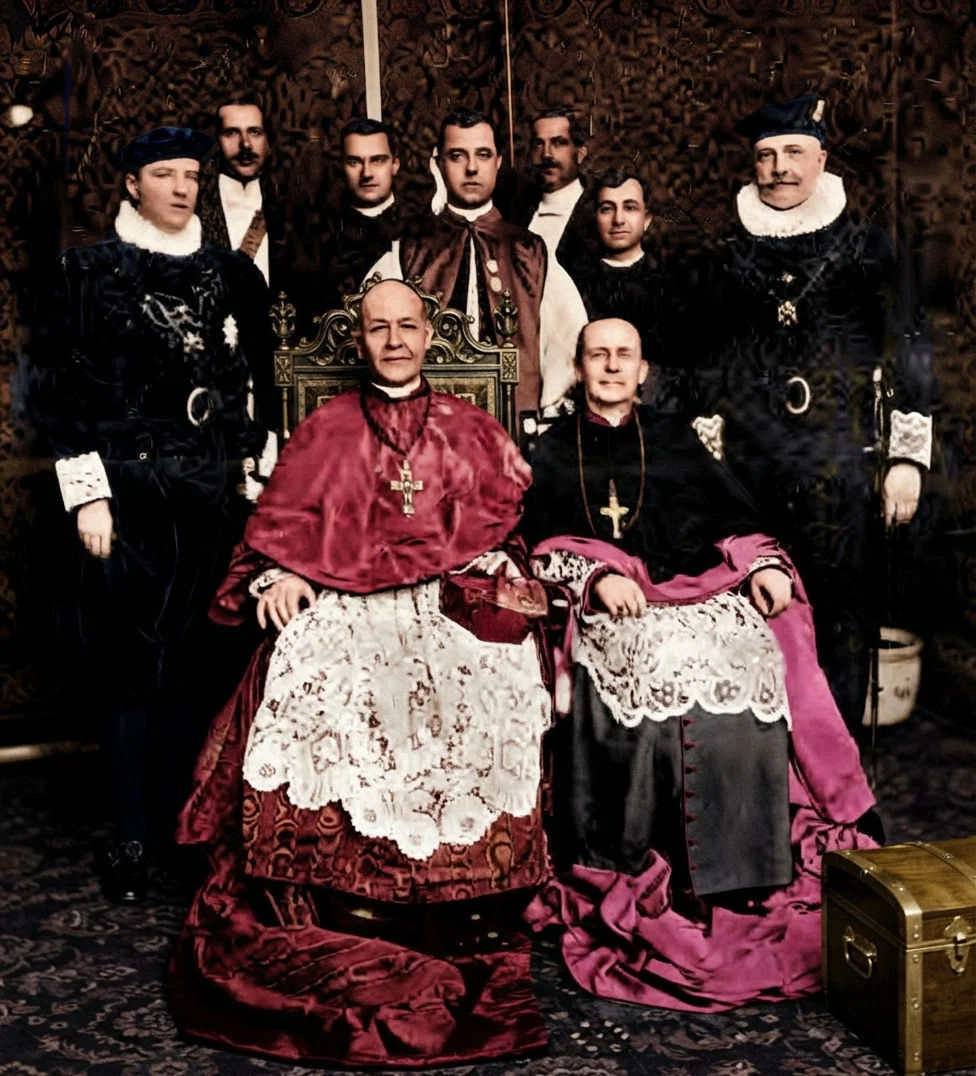
The papal legate with his guard of honor, and the organizer of the congress on his left
But the idea of the Roman Church is, as the two sentences from the legate's address indicate, that the whole world is to be brought into the Catholic fold through the sacrament of the eucharist. In that idolatrous practise the world is to bow to the feet of "the universal pastor," the pope. The High Church of England, as Father Vaughan declared, has already recognized the eucharist as a true sacrifice; and the whole purpose of these congresses is to impress upon the people the absolute necessity of the eucharist in the plan of redemption.

The Purpose of That Church

to dominate the earth was plainly declared by the pope's legate in these words:
"The day upon which He [God] permitted the discovery of America, God said to His church, as He had said to His divine Son: 'I will give thee as a heritage all the nations of the earth; I will give thee all the innumerable populations of these immense regions, and they will be added to those thou already possessest.'"
He prophesied that Canada would become the cradle of a great Christian civilization, the dioceses of which would multiply with great rapidity; and then continued:
"Scarcely two centuries and a half will have passed away [since the settlement of Canada] before Catholic North America will see all these flourishing dioceses attached to the ancient hierarchy of the churches of the Old World. Then the universal pastor, taking directly under his charge these new and immense spiritual domains, will show to an astonished universe the Old and New World realizing before the human race the universality of the church foreshadowed by our Saviour and His apostles."

Weakening Protestantism—Back to Rome

The archbishop of Montreal, in his reply to the legate's address, touched upon the same theme when acquainting the legate with the "extraordinary good-will with which our separated brethren greeted the news of our congress." After mentioning the different ways in which this sentiment had been expressed, he asked: "Is this the awakening foretold by many? Is it a step towards doctrinal unity? Are the old-time days returning? This is God's secret. . . . The civic authorities, as you have seen, have spared nothing to accord a worthy reception to the representative of the holy see. You will receive a no less respectful welcome from our federal and provincial governments."
At the close of the reception the Catholic clergy came up to the legate's throne, bowed the knee before him, and kissed his ring. There was much of this ceremony throughout the congress, the high dignitaries of the church sitting upon the rostrum and receiving this knee-bending and osculatory adoration from the priests and prelates of less degree.
The wide-awake Roman priest can not fail to see the narrowing of the gulf between weakening Protestantism (so-called) and alert, militant Catholicism; and the homage paid the dignitaries of the Eucharistic Congress by civil officials in every capacity could not but convince these ecclesiastics that Rome is winning her way in the New World with tremendous rapidity; and upon America they are depending as a chief factor in leading thetions of the Old World back to the feet of the Roman pontiff.
One of the most impressive scenes of the whole Eucharistic Congress was the procession of Catholic children from the church of Notre Dame to the St. James Cathedral to receive the papal blessing at the hands of the cardinal legate. There were between 25,000 and 30,000 of these Catholic school children in line. Those of the girls who had been confirmed during the present year wore their long confirmation veils of some white material that fell nearly to their feet on all sides. There seemed to be several thousand of these. Every child carried or wore some sort of papal emblem, most of them carried the papal or pontifical flag. The girls came first in platoons and by schools with their black-robed and rosary-bearing teachers; and these were followed by the boys similarly disposed and accompanied by their priest teachers. One could not prevent the reflection that from the natural increase alone, there were represented here for the next generation one hundred thousand Catholics.

The Coming Generation

As these passed in platoons before the gorgeous throne of the papal legate, his hand was waved over them in conference of the papal blessing. Here was the Catholicism of the next generation, educated in all the superstition of that church, and banded to do its bidding, no matter what the task appointed. Four days previous to this procession, Father Vaughan of England had declared that "anything like race suicide can not even be mentioned in a Catholic town." His declaration struck the writer as very apt in this special connection. He predicted that if the present conditions continue, Protestantism will die out and Catholicism take its place through the simple matter of the large birth-rate in Catholic families and the diminishing size of Protestant families.
The gorgeous repository in Fletcher's Field where open-air mass was celebrated, and to which the papal legate bore the "sacred host" on the great day of the procession.
Viewing this procession of children to the throne of the papal legate, the gorgeous apparel of the legate and the cardinals and bishops who occupied the throne with him, this text of Scripture came forcibly to the writer's mind: "I sit a queen, and am no widow, and shall in no wise see mourning. Therefore in one day shall her plagues come, death, and mourning, and famine; and she shall be utterly burned with fire; for strong is the Lord God who judged her." Rev. 18:7, 8. And the time draweth on apace.
Again and again was heard at this congress the declaration that North America is THE CATHOLIC CHURCH'S HERITAGE, and that through the medium of the eucharist the Old and the New World were to be united under the sway of the Papacy.
All the work of the week in council meetings for the priests and in open meetings for the general public, was leading up to the great demonstration of Sunday.

The Eucharistic Procession

in which the papal legate would march through the streets under a gorgeous palachin, bearing the monstrance containing the "host." To make this the most wonderful procession in the history of North America, no expense was spared. Large buildings were beautifully illuminated for the evening display after the procession, buildings public and private were lavishly decorated with flags and bunting, and the streets along which the procession was to march were studded with beautiful arches and hundreds of pillars from which flags of different colors were flying. The procession started about half past one, and darkness had shut down over the city before the legate with the "host" had reached the Repository in Fletcher's Field where the eucharistic ceremony took place.
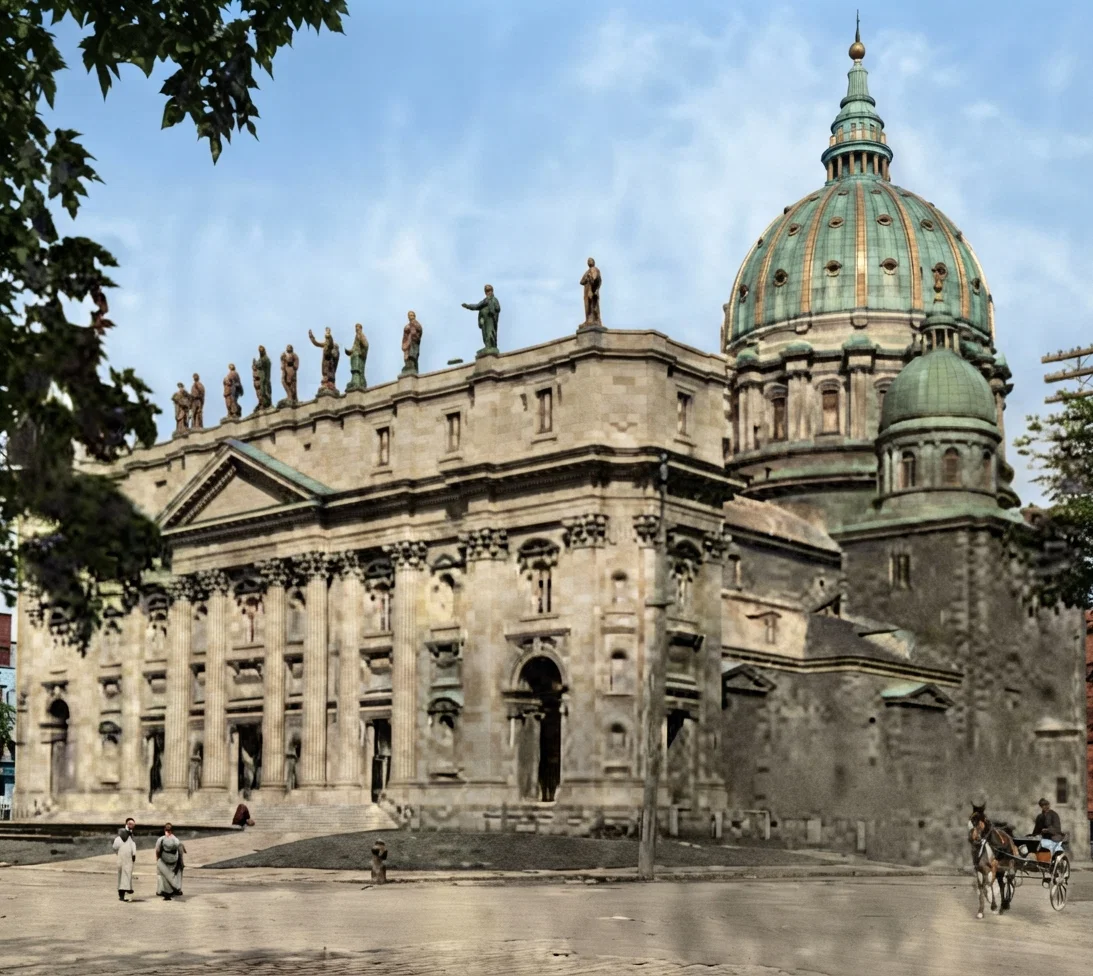
St. James Cathedral, where the official opening reception to the papal legate was held
It was a cosmopolitan parade, gorgeous and motley. It included English, Irish, French, Italians, Poles, Syrians, Lithuanians, Chinese, Indians, and even the governor of the STATE OF RHODE ISLAND with his staff in uniform. This latter seemed a veritable paradox and against nature. The procession included thousands of priests in their robes of office, altar boys by the hundreds, and Catholic men's societies from various portions of Canada and the United States, all with banners and many of them with bands. The legate with the "host" marched near the rear of the procession, attended by cardinals, archbishops, and chamberlains, and surrounded by a guard of honor from the survivors of the Zouaves who had fought for the pope in Italy. The Sixty-fifth Canadian Regiment also took part in the procession, the [sic] plainly informed by the officials at Ottawa that their participation in a procession of this nature was strictly illegal. Following the cardinals, marched all the dignitaries of the municipal and provincial governments, adding the prestige of their position to the glorification of the papal dogma of the eucharist.
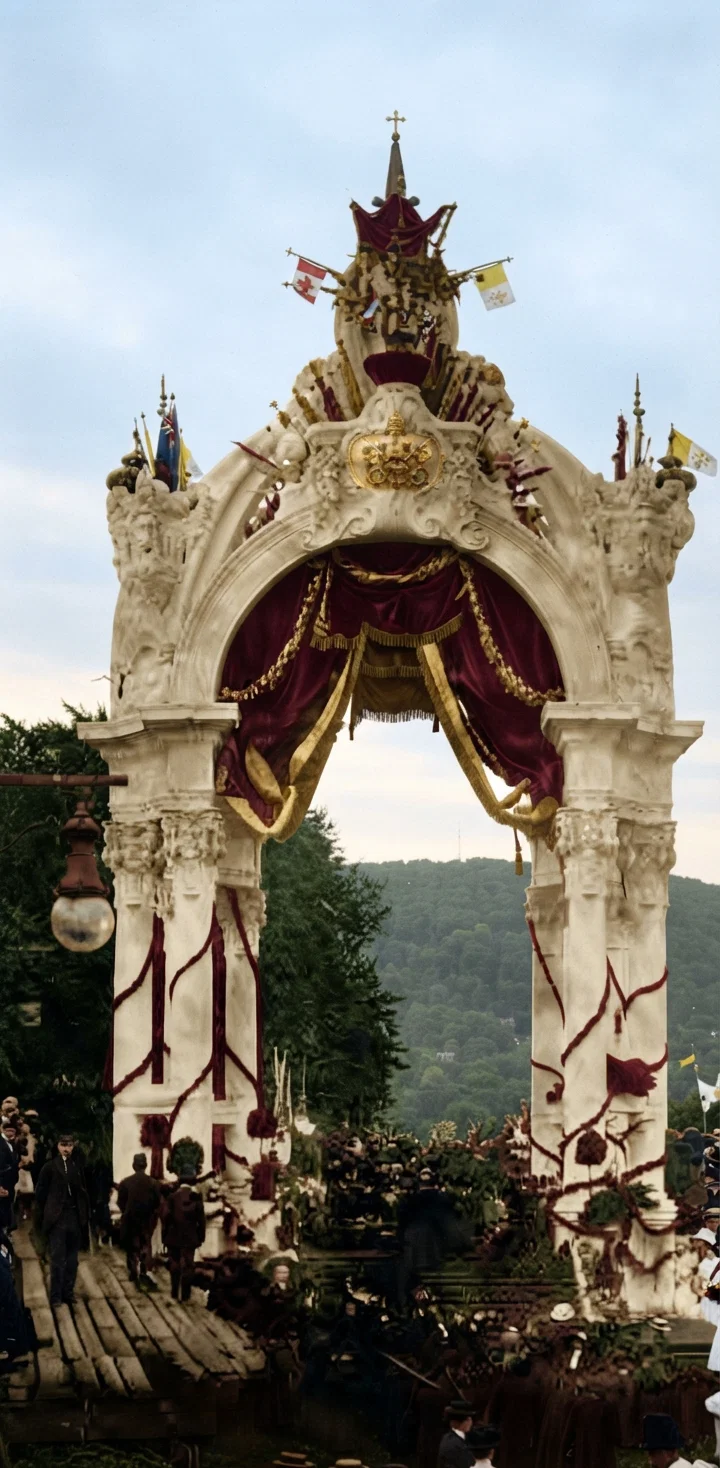
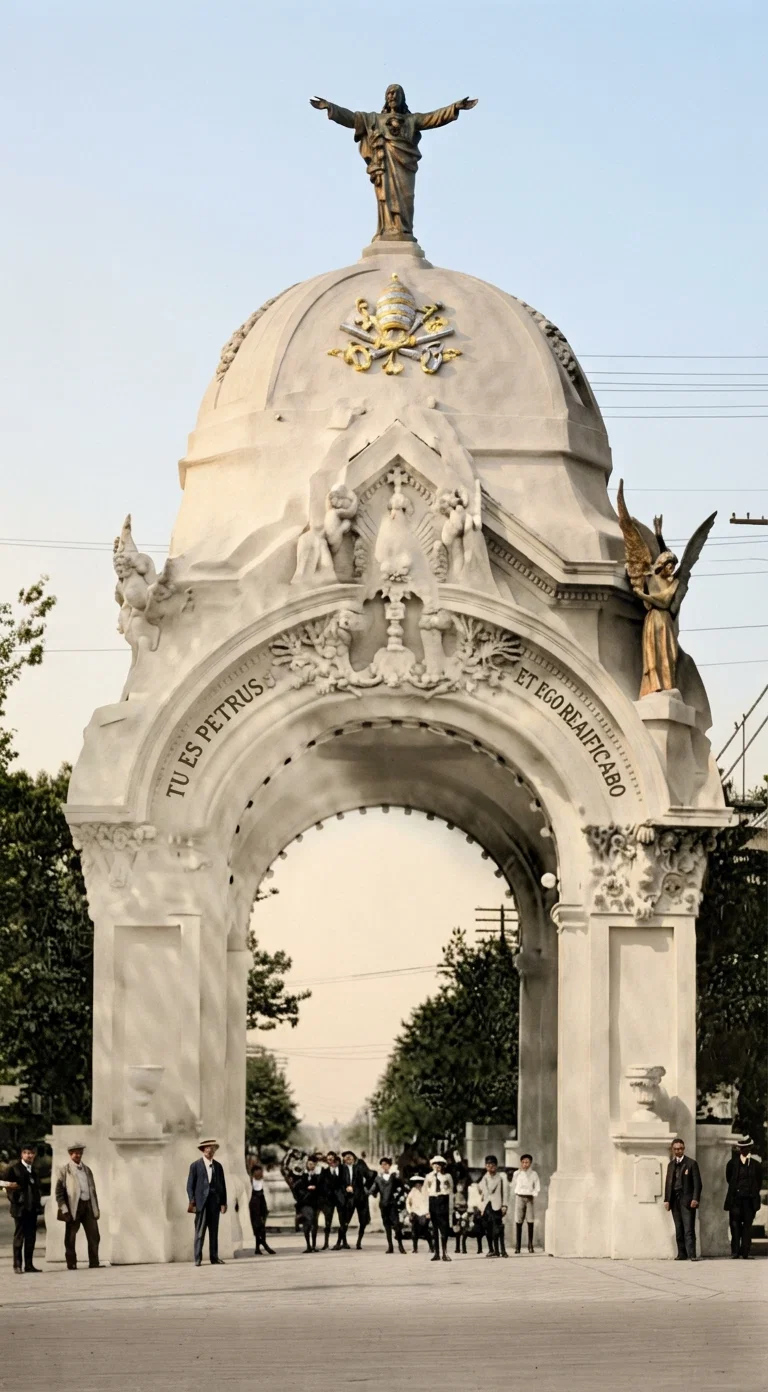
One of the expensive temporary triumphal arches under which the eucharistic procession marched
All along the route of the procession flower-boys were strewing roses in front of the cardinal legate, and the path from the street to the Repository was a veritable bed of cut flowers. Over this only the legate with the "host" and the immediate attendants passed.
Following the mass at the Repository in Fletcher's Field, the papal legate bore the "host" to the "Hotel Dieu" nunnery, where it is to remain.
This ended the congress, the most successful ever held, and a powerful testimony to

The Might and Influence of the Church of Rome

No one could attend that congress without being convinced that he was in the presence of the most ingenious and mightiest single organization that exists in this world at the present time; an organization which has apparently turned the very purposes of the Almighty upside down, and made idols out of the most sacred symbols of our Lord's passion; an organization which looks only to the accomplishment of its purpose, and permits no consideration of human rights to stand in its way. This is the power with which this generation has to deal from this moment on; and the indications are that Protestantism (so-called) has so emasculated itself with its Higher Criticism, Evolution, and New Theology, that it has no power to enter the contest with any hope of success. Rome sees her advantage, and is pressing it. We are rapidly entering the time when "all the world" will "wonder" after that power. It is indeed a time for individual heart-work, and for the proclamation of the last message given by God to this world to warn this generation against that power which robes itself in gorgeous apparel and traffics in the souls of men.
Takoma Park, Washington, D. C. — ★ ★ —

Increasing Wealth.

One of the signs of the last days is the piling up of riches, of which an apostle speaks so emphatically in James 5:1-8. How this stands out in a recent editorial in the New York World in which the house of J. P. Morgan & Company is spoken of as controlling and influencing capital to the amount of ten billiondollars and more. Even the great Beef Trust with its control of five hundred million dollars capital had to yield when the ten thousand millions spoke. The Beef Trust objected to higher freight rates; the great railway money trust demanded that the freight should be paid, and the Beef Trust will pay it. But it is pointed out that the consumer will find it with certain other frills and furbelows added to the cost of his dinner. And the writer of the editorial well remarks, "There is hardly a limit to the power of one man in this country if he chances to control ten billion dollars."

Shiloh: the Man of Sorrows

Chapter XXXIII. The Miracle at Bethesda

ALL and graceful, with an air of martial dignity which was very noticeable, the stranger leaned carelessly upon one of the richly carved marble columns of the mansion of the ruler Machhor of Jericho.
"Thinkest thou that He who hath healed thee is the Messiah — the Shiloh of Israel?"
It was the voice of the stranger addressing Cleopas; but so soft and musical were the tones, that there was scarcely a shade of surprise in the face of Machhor, as he replied courteously:
"Who art thou, stranger? Surely thou shalt abide in mine house and find rest until thou goest on thy journey. But, I pray thee, who art thou?"
"My name is Crispus, and my birthplace, Rome. I have abode many years in Jerusalem, that I might be healed of mine infirmities; but later abode I in Capernaum."
"Verily the physicians of Jerusalem are greater than those of Rome; but of a truth, man, thou hast no infirmities. Surely thou art a jester!" exclaimed Zilpha, casting a glance of astonishment upon the manly figure. The closely cropped hair was tinged with gray, but the eyes had the brilliancy and the fire of youth. The fresh, round face was almost boyish in its contour.
"It ill becomes one to jest, whose heart is filled with gratitude, and from whose lips naught but praise to the Almighty should come forth," replied the stranger, glancing respectfully toward Zilpha, and seating himself beside Matthias.
"If thou wilt answer my first question, young man," he said, as Matthias lifted his brown eyes to meet the kindly glance of the stranger at his side, "if thou wilt answer my question, then will I tell this woman how I spent many long months in Jerusalem by the pool of Bethesda. But the question: Thinkest thou that He who hath healed this man whose right hand was withered, is the Messiah, the Shiloh of Jacob?"
"Verily, I do believe that this Man is the Christ!" cried Machhor, the ruler, earnestly. "And of a truth, I should be minded to follow Him whithersoever He goeth; — but how can I leave my so great possessions?" And the head of the ruler sank upon his breast.
"Surely, thou hast said, O Machhor," added Matthias, "He who healed the hand of this man is the Messiah."
"Amen!" exclaimed Cleopas, the old man, rapturously, lifting his right arm high above his head.
"And believest thou that this Jesus of Nazareth is He who was born King of the Jews, in Bethlehem of Judea, — He whom the father of Antipas sought to slay in His infancy, — He who once was thine infant Guest, O Cleopas, when thou wast a merchant in Bethlehem?" The words poured from the stranger's lips eagerly, anxiously, joyfully.
"Verily it is He!" exclaimed Cleopas and Matthias in one breath, while Zilpha and Machhor regarded their stranger guest wonderingly.
"There, now," continued he, "now are mine eyes opened to understand the mysteries of the Almighty. The holy Babe which hath escaped the sword of Herod at Bethlehem, is also this Man of Nazareth, the Shiloh of Israel, He who hath also healed me, Crispus, — the impotent man by the Pool of Bethesda."
"What!" exclaimed Matthias eagerly; "art thou indeed he whom I have often seen lying upon his mat beneath the porch, close by the Pool of Bethesda?"
"Thou sayest it, young man;" and the stranger sighed deeply, and for a moment bowed his head as if in earnest thought; then began his recital:
"My father was a Roman, but my mother an Israelite. I was a centurion of Herod the Great, from the time of my appointment until I became afflicted with the awful malady which soon rendered me helpless. Ye know that the life of a soldier is beset with evil, tho Jehovah forbid that I should make excuse for my sins, which are indeed black enough, — aye, so black that despair and anguish seized upon my poor soul many a time. No man gave me comfort, but every one declared as did the rabbis, that Jehovah afflicts no man except for his sins; and peradventure, if those sins be great, so must also the punishment of the body be great, for the sins of the soul."
"The Nazarene teacheth not that doctrine," interrupted Cleopas, "but the priests and rulers insisted that I was but receiving the just reward for my sins. 'Wouldest thou not lay hold of a sheep, O Shaphan,' said the Nazarene, 'even as thou hast often done among the cliffs and pits of Nazareth on the Sabbath day? And who shall say that a man is not better than a sheep?' But," concluded Cleopas, again assuming a listening attitude, "why should I interrupt thee? Continue thy speech, O Crispus."
"Mine infirmity came upon me when I was yet a young man," responded the stranger. "Perceiving that a life of folly was telling upon my strength, I had abandoned my dissipated habits some time before, but it was too late. The seeds of a fearful malady had been sown; and that which I had sown, I must also reap. Even when the scribes and Pharisees reproached me for my sins, I myself realized that there was, alas! too much truth in their words; and while they lost no opportunity of condemning me in my wretchedness, my own heart condemned me also."
"While my father and my mother lived, I abode with them in Jerusalem, continually trying the efficacy of the medicines of the physicians. After a few years, my parents died. By this time I had no recourse but the charity of the people. My one and only hope was the healing power of the waters of Bethesda. For this reason, I abode under the shadow of the porches almost continually, wrapped in my abba, and lying upon my mat. Day after day, week after week, month after month, year after year, dragged slowly by, until even this hope was almost abandoned. But as I saw some who entered the pool, retire, apparently healed, I continued to beg of the passers-by to assist me once more to reach the healing waters."
"Some pitied my agonies; others paused to look upon me curiously, even as they might regard the wild beasts of the hippodrome; still others jested and shot out the lip as they passed me by. But whether moved by compassion or by rude curiosity, all were alike unable to render me any aid. Even the priests, the ministers of the holy temple, reviled me, as one under the especial curse of Jehovah. The Roman soldiers were kinder to me than they, understanding, as they did, that I had also once been a soldier."
"One day during the last Passover, I was more discouraged and cast down than ever before. The sweet scent of the green clods of the valleys and hills, and of the fresh flowers of the early springtime, was in the air. I had crept very near to the brink of the pool, waiting, watching, almost breathlessly, for the moving of the waters, which I had learned to anticipate so anxiously. While my hot eyes were fixed upon the glassy surface of the pool, suddenly the waters began to tremble and quiver in the sunlight. With a cry of exultation, I strove to throw my paralyzed body over the brink, down the stony steps of the deep pool. But in spite of my feverish haste, I moved so slowly that even when I had almost accomplished my object, another man, younger and far stronger than I, pushed me roughly aside, and leaped into the waters!"
"The cry of exultation upon my parched lips gave place to a moan of despair. So many times I had suffered the same or a similar disappointment, that I said aloud: 'Now hath the Almighty forsaken me on account of mine iniquities!'"
Crispus paused, and once more bowed his head, as if overpowered by the memory of his past wretchedness.
"Every incident of that Sabbath day stamps itself upon my heart," he continued. "The far-off hills of Judea, bright with the yellow glory of the low-hanging sun, were sharply outlined against the purple sky. The spotted night-hawk already circled above the walls of the city and cried to her mate. I closed my eyes and lay back upon my mat, wishing only that the end might come, and come quickly, and wondering if it might not be possible to destroy myself. But of one thing I was sure, — I could not live until the waters were again troubled. Life had become intolerable; hope was dead. My sins pressed so heavily upon my soul that I groaned aloud."
"Suddenly I heard the rustle of a garment near me, and the echo of a soft footfall. I opened my eyes, startled and confused, to see a face, compassionate and gentle, bending over me."
"Wilt thou be made whole?"
"The voice was full of melody as the music of an harp. For an instant only, my heart thrilled with a ray of hope. Surely this Man was willing to help me to enter the pool. But the opportunity was gone. It was too late. The angel had troubled the waters and had departed, and I had seen that the man who had jostled me aside, had been the first to enter. Those thoughts rushed through my brain, and I replied:"
"Sir, I am friendless. No man pities my condition, and I am not able to enter the pool unaided. I have many times undertaken to do so, but another, who is not so helpless as I, steppeth in before me."
"While I addressed these words to Him, I wondered who the Man might be. O mine host! this Man seemeth not like unto any other of the sons of men. I had heard of a mighty Miracle-Worker who had done great cures in Judea and Galilee and in Jerusalem, but my own heart was so filled with bitterness and despair that I said: 'There may be good, but verily it is not for me; for my sins are visited upon me, and my soul despaireth of good. Thirty and eight years have I suffered from this mine infirmity,' I continued, scarcely daring to look up at the Man, who was standing by my side, for I had learned to dread the reproach of men."
"After a moment, as the Stranger had made no move to pass on His way, I looked up into His face. My eye caught His. Verily I was astonished and spellbound at the unspeakable sadness and majesty of His countenance. The eyes that looked into mine melted my soul. I loathed the sin which had bound me. Fixing upon me a look of unutterable compassion and love, again He spake, while He reached out His hand and touched my feverish brow caressingly with His cool fingers, even as a mother might caress her helpless babe:"
"Rise; take up thy bed and walk!"
"Immediately a thrill of divine power shot through my benumbed body, and a sense of great peace and of perfect health possessed me. I had not risen to my feet for almost two score years; but I questioned not the authority of the One who bade me. I leaped to my feet, folded the mat upon which I had so long lain, and placing it upon my shoulder, I sprang into the street."
"Whither goest thou, fellow?"
"I turned mine eyes in the direction of the voice, and beheld Caiaphas, the high priest, together with a company of scribes and rabbis, among whom was the scribe Jazer. But I feared him no longer; for I stood before him in the strength of perfect manhood. The face of Caiaphas wore a dark frown; but I at once addressed him, bearing witness joyfully to the astonishing miracle which had been wrought in my poor body. 'Thou knowest me well, O Caiaphas,' I said, 'seest thou not that I am healed?'"
"Wherefore carriest thou thy bed upon the Sabbath day, contrary to the law, — for behold, the sun hath not yet set!" demanded Caiaphas in a voice hoarse with rage, not heeding my question, and pointing with his left hand, about which circled the straps of the phylactery, toward the low-hanging sun.
"He who hath made me whole, bade me take up my bed, O Caiaphas," I replied.
"What man is that who said this unto thee?" demanded Jazer.
"Then of a truth I remembered with shame that I had not only forgotten to express my gratitude to the mighty One who had healed me, but I had also neglected to ask Him His name."
"I wist not who it is that hath made me whole," I stammered; but as they passed on, the scribe Jazer hissed spitefully: "It is the Nazarene. What shall we do, O Caiaphas?"
"At once I made my way toward the temple, my heart filled with praises to Jehovah. I had scarce dared to hope that I might once again see my Deliverer; but as I was passing the Golden Gate of the temple, I saw Him walking in Solomon's Porch. While I was opening my lips to address Him that I might thank Him, He spake unto me:"
"Sin no more!" He exclaimed, holding up His hand with a gesture of warning. "Behold, thou art made whole; sin no more, lest a worse thing befall thee!"
"Then I thought to bring Annas and Caiaphas that they also might see Him; for I said, 'Surely, this is the Messiah.' But I understood not the anger of the chief priests and scribes, neither understood I their hatred against the Man; for behold, O Machhor," concluded the narrator, "behold, these men sought His life, and I knew it not."
(To be continued)

APPROXIMATE CHRONOLOGY, OR THE TIME OF THE CRUCIFIXION

Places in condensed form a few facts, from Scripture, history, and astronomy, that will enable the reader to understand the exact time of the crucifixion and resurrection of Jesus, giving the year, the month, the day of the month, the time of the moon, the day of the week, and the day of the Jewish month. Price 25 cents. Address H. H. Perry, 67 19th St., San Diego, California.
Having read the "Time of the Crucifixion and Resurrection of Christ," we testify that to our minds it contains a clear and interesting statement of the facts in the case, fortified with good evidence for the positions taken.
J. N. Loughborough, J. O. Corliss, E. J. Hibbard.

$3700--One Agent's Sales--$3700

"What," you say, "a single agent sold the Signs Monthly to the value of $3,700?" Fact; $3,781.70, to be exact. She makes it her business. She lives well, feels well, and is happy. Her hours of work are short, she comes and goes as she pleases, in fact she is her own boss.
Do you wish to better your condition? Are you ready to substitute this healthful, educational, pleasant, well-paying work for your present position? If so, get in touch with us at once. We have certain helps which are furnished free.
The November number of this magazine is NOW READY. Its leading features are of unusual interest to all — Christians and unbelievers alike. A good number to start with.
Some idea of the importance and excellence of this number may be gotten from the following partial list of contents:
Catholic Eucharistic Congress. Recently met at Montreal. The religious and secular press of America was stirred up because of derogatory anti-Protestant speeches by Father Vaughan. We had a special correspondent on the ground.
Recent Work of the Aircraft Men. This article takes the reader back to the first efforts of aerial navigators and makes mention of the most notable flights to the present date. The writer of this instructive article attended some recent demonstrations, and is eminently qualified to write intelligently on this important subject.
Opinion of a Noted Jurist.—This lawyer, after hearing the first reason given by a Seventh-day Adventist for keeping the Sabbath, said, "Hold on, that makes me think of a story." This story, altho amusing, showed that this reasonable man did not care for other reasons since the law of God so plainly commanded the observance of the Sabbath.
Inasmuch as this is our Thanksgiving Number the article "Origin of Thanksgiving" will be most appropriate. Limited space forbids a more lengthy description of this November issue. Other meritorious contributions coupled with those already mentioned make this number of the Signs Monthly fully equal to any former number.
$1.00 a year; 10 cents single copy; 5 to 40 copies, 5 cents each; 50 or more, 4 cents each.
SIGNS OF THE TIMES, MOUNTAIN VIEW, CALIFORNIA

Adventist Hymnbook for Sale

Seventh-day Adventist Hymn and Tune Book. The best selected and arranged hymn and tune book ever issued. Contains 1,413 hymns and 568 of the choicest tunes and sacred songs ever written. 640 large pages. Cloth, plain edges, 75 cents; half leather, marbled edges, $1.50; Russia, marbled edges, $2.00; Turkey morocco, gilt edges, $2.25; Levant, round corners, gilt edges, leather-lined, $3.25. Address this office.

Who Changed the Sabbath?

Have you seen the new illustrated edition of "Who Changed the Sabbath?" On the first page we have a clerical figure represented as chiseling out the Fourth Commandment of the Decalogue. Below it is this text, "He shall think to change times and the law." Some of the sub-headings are:
What Did the Prophets Say? Christ's Teaching and Example Who Wrought the Change? The Confession of the Guilty Protestant Testimony
Sixteen pages, $1.00 per hundred, post-paid. Address publishers SIGNS OF THE TIMES.
Continue reading: German Reference Bibles