Your ShelfYour Projects

Signs of the Times, Vol. 31, No. 12.

Pacific Press Address

Signs of the Times

Mar 22, 1905

Pacific Press Publishing Company · Mountain View, California · Mar 22, 1905

Pacific Press Address

Pacific Press Publishing Company, Mountain View, Cal.

THE MAN

I honor him who, with a crust of bread, Surveys the highest firmament of hope, Who yet can lift his wo-benighted head And scorn the depths where kings in folly grope; Who, in his rags, aspires to honor's shrine And worships there, in silence, with his soul, Who still can say, "The fruits of life are mine." Tho Time and Tide efface his every goal; I honor him.
I honor him, who, in the field of strife, Attains the halo of a sinless brow, Whose thoughts go Godward from the moil of life, The while his hand is fettered to the plow— Who, from the furrow of the common herd, Hath fixed his eye upon the astral plain— Whose soul is like the spirit of the bird, Whose heart is void of bitterness and pain; I honor him.
I honor him, who, with no gift of gold Can bribe the favor of untoward Fate, Whose honor, truth, and manhood are not sold To gain the key of Fortune's magic gate— Who stands alone, above, apart, away From all the masses that would mock his aim; Who only fears his Maker, and the Day When God shall view the glory and the shame; I honor him.
I honor him, whate'er his lot may be,— Who lives the part by destiny assigned, Who does his given duty, spirit free, With callous hand, brave soul, and stainless mind; Who still can sing when all around him weep, Who still can love when all but God betray, And who, in death, goes smiling to his sleep With sweet conviction of the Coming Day; I honor him. —T. Shelley Sutton.
AUTUMN
AUTUMN
WINTER
WINTER
SPRING
SPRING

Things New and Old

THE CONFLICT BETWEEN CAPITAL AND LABOR

HAT there is a mighty conflict now on, and many battles yet to be fought by the forces of organized capital and organized labor, must be apparent to all observing men and women. Each succeeding year the conflict grows more fierce; and intelligent, thinking people are becoming alarmed at the outlook. The various combines and organizations are rapidly reaching out and embracing all kinds of people, trades and professions, and sooner or later will affect every individual.
What relation we shall sustain to these two great world forces is of vital importance to us. Mr. E. T. Russell has just written a book under the above title which sheds much light on this troublesome question. He writes altogether from a non-partisan standpoint, treating both sides of the vexing problem with a view of helping to its peaceable solution. Not only are many interesting facts and figures given, but divinely revealed principles are set forth that will help us to meet the great question intelligently, and surely produce harmony if heeded.
The book is illustrated, contains 167 pages, and the price is only 50 cents.

Story of Daniel the Prophet

A study of one of the most remarkable lives of the Bible, by S. N. Haskell. The lessons drawn from Daniel's character—his integrity, his devotion to duty, his steadfastness in adhering to true principles in the face of the greatest apparent danger—are most striking, encouraging and helpful. Not only this, but the wonderful things foretold by the prophet are clearly portrayed, and the time of their application determined.
As the practised eye of the prospector discovers the gems of earth and readily discerns their value, so the writer has found the sparkling beauties in the life and character of this man of God, as well as the interpretation of the marvelous things foretold by him, in which is the key that unlocks history to the end of time.
• The book is illustrated, and arranged in a manner to please and profit both old and young. Three hundred and sixty-nine pages. Price, $1.00.

Power for Witnessing

One of the books that ever keeps fresh and new is the one with the above title. It endeavors to tell, not so much what the Holy Spirit is, as to illustrate by live experiences why we need it, and what it will do for us. Among the many good chapters we note the following: Something to Tell; Righteousness, Then Power; The Holy Spirit and the Unpardonable Sin; Secret of Rejoicing in Tribulation; How to Find Faith; The Laying On of Hands; Miracles and Healing; How to Seek Spiritual Gifts.
The truth concerning the Holy Spirit is unfolded in such clearness, beauty and simplicity, as will surely impart a new inspiration with the many practical suggestions and experiences given.
Two hundred and one pages, 44 chapters. Price, cloth, 75 cents; paper covers, 25 cents.

The Vegetarian Cook Book

For those who are looking for a better dietary than can be prepared from the flesh of animals, which is very liable to be contaminated with tuberculosis and various other diseases, we most heartily recommend the "Vegetarian Cook Book." It contains a large variety of thoroughly tested recipes of healthful dishes, and is so systematically arranged that any class of food or any particular dish may readily be referred to.
The book is the product of years of thought, experiment and observation of Mr. E. G. Fulton, manager of the Vegetarian Cafe, San Francisco.
Two hundred and sixty-five pages. About 450 recipes. Price, 75 cents.

Healthful Living

This book, on the fundamental principles of healthful living, is also going out rapidly. It contains, in convenient form, for ready reference, a large number of helpful suggestions on the subject of health and how to preserve it.
Two hundred and ninety-two pages. Price, 50 cents.

Sabbath Readings

This little volume is having a remarkable sale of late, and it is certainly deserving of such, for its pages are filled with a very choice selection of helpful, inspiring stories. The pure tone and elevating influence of this class of reading will commend itself to you as filling a useful place in the home, and will interest old and young.
The price now is 40 cents.

Bibles

We keep in stock a select line of Bibles of such standard makes as the Oxford, International and Nelson. Our stock has just lately been increased by the addition of something over a thousand of the various makes, styles and prices. A new feature just added is a line of illustrated Bibles for children, also a line of Red Letter Bibles and Testaments, containing all the words of our Saviour in red letters. A decided novelty is the Red Letter—illustrated Testament combined. We also have a choice stock of the American Standard Revised Bibles, which are becoming very popular.
We feel confident that we can please you in make, style, size and price.
Send for our latest Bible catalog and price-list.

SPECIAL MEETING OF STOCKHOLDERS.

NOTICE is hereby given of a special meeting of the stockholders of Healdsburg College at the College in Healdsburg, Cal., Monday, March 20, 1905, at 11 A. M.
This important meeting is called to consider and decide upon the plans on which the school shall be operated in the future; also its relation to the proposed Union Conference Training School in California, and intermediate schools in this conference.
1 Shall we approve this action of the Pacific Union Conference? 2 What shall we do with our property? 3 Shall we establish an intermediate school? If so, shall it be operated in our present buildings, or be started in a rural community?
It is very necessary, also, to have some changes made in our by-laws, place of meeting, etc. In order to do this we must have two-thirds of the stock of the corporation represented. We strongly urge a large attendance, for serious problems must be solved.
College Board, M. H. BROWN, President. H. G. LUCAS, Secretary.

Request for Signs of the Times

SIGNS OF THE TIMES, Mountain View, Cal.
Dear Friends:
Please send me a few copies of your issue of February 8. There is so much good matter on the Outlook pages.
JAMES DUBOIS. Moline, Ill.

Request for Weekly Subscription

H. H. HALL, Dear Sir:
I have read your magazine, Signs of the Times, and like it very much. Please send it to me weekly for three months, and I will send you forty cents. Kindly let me know how to send the money.
Yours truly, MRS. G. VETTER.

CO-OPERATION CORNER.

AN OPPORTUNITY.

BROTHER GEO. R. DREW, one of our old ship missionaries, a pioneer, if not the pioneer in that branch of our work, spent more than a quarter of a century in this work, most of it in Liverpool, England. He is now unable to carry the large loads of publications on board ships, and has been forced to leave that work. He is now living in Oakhurst, Fernhill Park, Woking, England. But he is still a missionary, and anxious to prosecute the work as his strength will permit, and to a far greater extent than he is able financially. Are there not those who would esteem it a privilege to donate toward a club of twenty SIGNS OF THE TIMES to be sent to Brother Drew this present year? If we receive more than sufficient we will put it to a similar good use. Let us hear from our liberal friends promptly. We can assure them that it will be a good investment.

TARRYING TOO LONG.

JERICHO was a city straitly shut up because of the children of Israel. None came in, nor went out. Joshua 6:1. The fear of God's wrath had fallen upon them, and they hoped to shut it out by walls and barred gates.
GOD, in wisdom, had decreed that Jericho should be the first-fruits of the land of Canaan; and the first-fruits belonged wholly to Him, absolutely devoted to His service. God had devoted Jericho to Himself. The use which should be made of the city depended on its character, the attitude of the people toward God.
THAT attitude had a little while before this been tested. Two of God's servants had been sent to that city, but the people sought to put them to death, and searched diligently that they might do this. Only one soul in all that city received them, namely, Rahab. She entertained them, secreted them from their pursuers, and let them down from the wall, by a crimson cord, to safety and freedom, because from what she had heard, she believed in Jehovah. Thus Rahab the harlot gained a name and a place among God's faithful ones; for "by faith Rahab the harlot perished not with them that were disobedient, having received the spies with peace." Heb. 11:31. More than this, in God's providence she became a link in the chain of the chosen seed, an ancestress of our Lord. Matt. 1:5.
YET God would not leave Jericho. He would give its people opportunity to turn their terror into wholesome fear, fear into reverence, reverence into acceptance of Jehovah. But there were to be no human terrors in that invitation. Not by force or human power was Jericho to be forced to feigned service.
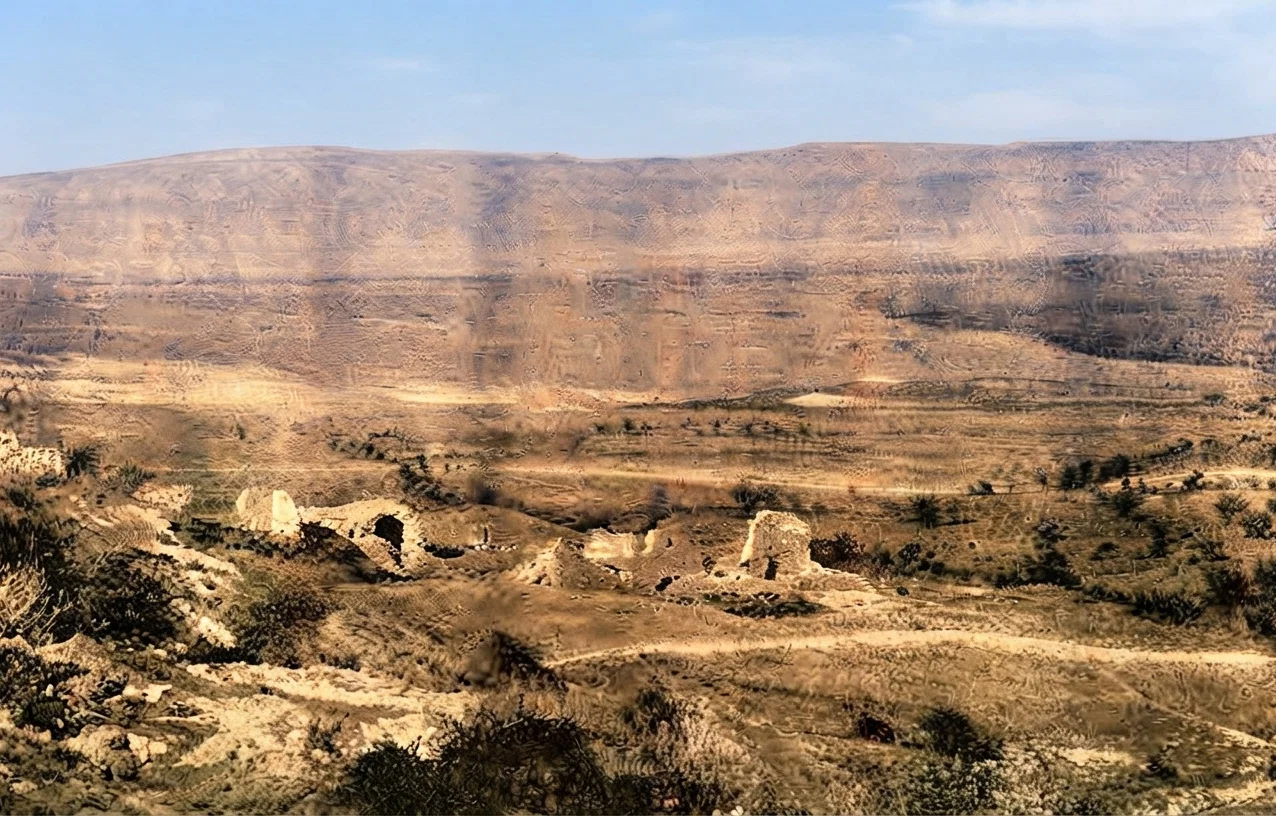
Ruins of Jericho, the Devoted City.
A LITTLE before this Joshua had met a shining warrior, with drawn sword. Joshua demands, "Art thou for us, or for our adversaries?" and the warrior responds, "Nay; but as Prince of the host of Jehovah am I now come." He was there to win devoted Jericho for Israel and for God.
HENCE the method of warfare. No siege guns, no battering rams, were deployed against her strong walls. Tell the host of Israel, the Lord says in effect, to place the men of peace, the priests, at the head, and once every day march around that city. On the seventh day repeat it seven times. Over and above them went the potent invisible army of God. What a mighty influence pervaded the very environment of Jericho. How every atom of atmosphere must have throbbed with the pleadings of God, as the silent armies wended their way in perfect order around the city devoted to God.
FROM Jericho's wall hung the scarlet cord of Rahab's faith. Surely, there must have been hope that it represented the faith of the people of the city, who would in a little while yield up their disobedience, open wide the gates, and cry, "Ye blessed of Jehovah, come in; ye are welcome." Day after day went by; silent and closed the city remained. Some, we presume, laughed; some scoffed at the strange daily march. The crimson cord of faith swung in the breeze, but its message fell upon insensate hearts. The silent, weaponless army, in its march, appealed to them daily. The mighty psychic forces of the army of God appealed to hard hearts, but all these were resisted. Seven times on the seventh day was the city the center of the grand march of the hosts of God, but its gates were still closed. God could not save thecity devoted, the first-fruits of the Goodly Land, to Himself; for they would not be saved. Cumberers of the ground, they must be cut down. One long blast upon the ram-horn trumpets by the priests, a great shout from the host of Israel, and the invisible army of God razed the walls of the self-doomed city, and Jericho is in ruins. Later, impious man attempted its building, but its curse rested upon him. To-day, as our photo-engraving declares, Jericho is a shapeless heap of ruins.
HOW TYPICAL all this is of lives into which God has wished to come, and has endeavored in every true way to find entrance for many years. At last Infinite Mercy has exhausted its resources, apart from forcing the will, which God can not do; and the soul is left to utter ruin. And the ruins stand out as great object lessons all along the way in nations, in cities, in men, and women.
DEAR soul, you are among the devoted ones, blood-bought by Jesus Christ. Whether you will be devoted to the service of God and live, or the service of self and Satan and die, rests wholly in your choice. "As I live, saith the Lord Jehovah, I have no pleasure in the death of the wicked; but that the wicked turn from his way and live; turn ye, turn ye from your evil ways; for why will ye die?"

BE COURAGEOUS.

THE Word of God abounds in exhortations to be courageous. And our poor human race is very much in need of these inspiring utterances, because sin has made cowards of us all.
When Moses was leading the children of Israel out of Egypt, he was directed to go by way of the Red Sea, and they encamped on its western shore. Then the Egyptian army pursued them, and their position was naturally a very perilous one. From a military standpoint, it was a veritable trap. Even the common people understood the situation, when they heard that Pharaoh was pursuing them, and they at once began to chide Moses. They were “sore afraid,” and “cried out unto the Lord.”
But Moses was calm, and said to the frightened multitude, “Fear ye not, stand still, and see the salvation of the Lord, which He will show to you to-day.” Discipline and faith had made Moses courageous; and in turn he was prepared to encourage the people. “By faith he forsook Egypt, not fearing the wrath of the king; for he endured, as seeing Him who is invisible.” The sequel to the word of encouragement spoken to the people that day was the joyful song of deliverance which they sang on the opposite shore the day following, when they realized that their enemies were all drowned in the sea.
So Moses went on, under the guidance and instruction of the Lord, encouraging the people under all kinds of trying circumstances for forty years. When he sent the twelve men into Canaan to spy out the land and report, he counselled them to be “of good courage.” Just before his death, when he had again brought them to the border of the promised land, after their long wanderings in the wilderness, his words were still full of courage. Altho he could no longer be a leader, he bade Godspeed to Joshua, his chosen successor. He “called unto Joshua, and said unto him in the sight of all Israel, Be strong and of a good courage; for thou must go with this people unto the land which the Lord hath sworn unto their fathers to give them; and thou shalt cause them to inherit it.”
After the death of Moses, the Lord repeated again and again to Joshua the injunction to be courageous. Before crossing the Jordan, the Lord talked with him and said, “Be strong and of a good courage; for unto this people shalt thou divide for an inheritance the land, which I swore unto their fathers to give them. Only be thou strong and very courageous, that thou mayst observe to do according to all the law, which Moses My servant commanded thee. . . . Be strong and of a good courage; be not afraid, neither be thou dismayed; for the Lord thy God is with thee whithersoever thou goest.”
Let it be noted that these words of encouragement are all connected with the journey from bondage to the promised land—typical, to some extent, of the sinner’s deliverance from sin, and his probationary journey to the heavenly Canaan. All the way through the Lord recognizes that we need to be courageous, and He has not left us without the encouraging Word. Before going away, He left the assurance, “Lo, I am with you alway, even unto the end of the world.” He knew just what we would have to contend against in the world; so He summed it altogether, and said, “Be of good cheer, I have overcome the world”—that is, everything that the world can possibly bring against any of His followers. Even in the face of death He could say to the sorrowing Jairus, “Fear not, only believe.”
In the last days we are told that there will be especially “perilous times.” Looking forward to this time, the seer cries, “Wo to the inhabiters of the earth and of the sea! for the devil is come down unto you, having great wrath, because he knoweth that he hath but a short time.” He is especially wroth with the “woman”—the church of God—and goes out “to make war with the remnant of her seed, which keep the commandments of God, and have the testimony of Jesus Christ.”
For this reason we have not only words of encouragement, together with counsel to “be patient unto the coming of the Lord,” and assurance that “he that shall endure unto the end, the same shall be saved;” but we have many examples of patient, courageous, faithful brethren written for our learning. The grandest, noblest example of all is that of Him who had the courage to take upon Him our human nature for the express purpose of suffering death in behalf of sinners. He has set us the example of even enduring death on the cross, in the faith of “the joy set before Him” in seeing the fruit of His sacrifice made partakers of His joy in His everlasting kingdom of glory.
In view of this example, and the many others that might be cited, shall we not look upon all the possible trials that come to the faithful, and, with Paul, reckon them all as “our light affliction, which is but for a moment”? Shall we not accept whatever comes to us as a consequence of our faith in Christ, as logically working for us “a far more exceeding and eternal weight of glory”? Such a view will at all times enable us to be “strong and very courageous.”
G.

LIFE ETERNAL.

JESUS says, in praying for His disciples: “And this is life eternal, that they should know Thee the only true God, and Him whom Thou didst send, even Jesus Christ.” John 17:3.
There are those in the modern theologies who would have us believe that we possess this eternal life ourselves, whatever our moral attitude; and that the real essential thing is not that we should know God, but that we should know ourselves, and know that God, the very Fountain of eternal life, dwells within us. They would picture us as a householder, who is dying of starvation while plenty of food is in his cupboard; nay, worse than this, we are feeding upon it all the time, but we do not know it.
Not so are we taught in the Gospel of Jesus Christ. There we are told that those who are living in sin are dead spiritually, “alienated from the life of God,” “separate from Christ,” “without God.” Of these Jesus said, “I came that they may have life, and may have it abundantly.” John 10:10. But to them He said, “Ye will not come to Me, that ye may have life.” John 5:40. And the Scriptures put the matter as strong and clear as this: “He that hath the Son hath the life; he that hath not the Son of God hath not the life.” 1 John 5:12. “He that believeth on the Son hath eternal life; but he that obeyeth not the Son shall not see life, but the wrath of God abideth on him.” John 3:36.
This last text is an illuminator of the one at the head of this article. He who obeys not the Son, shall not see life; while he who knows the Father and Son, finds in the knowing the life. The disobedience is the negative of the knowing, or the result of not knowing.
Now, to know God is not to know of Him, or to hear about Him. There are many who read of President Roosevelt, who have heard of him from others, who may have met him and spoken with him, but who do not know him. They have never come into harmony with his life.
There are many who know a little about music, who have heard of, or actually heard, Gounod’s “Redemption,” Handel’s “Messiah,” or Mozart’s “Requiem;” but they do not know these great productions till they have come into harmony with them, and the music itself is their own, and has brought into harmony with itself every fiber of their being.
So no one knows God until he is in harmony with God, until all rebellion is banished from heart and soul, until will and body, mind and spirit, are submitted to God. Then man knows God; then God knows man. For the one important thing of human experience is to be “known of God.” Gal. 4:9; 1 Cor. 8:3. Adam “knew his wife,” and the result of that knowing was the bringing forth of a son. It was a knowledge of life-union. “The Lord knoweth the way of the righteous.” Ps. 1:6. Of all the nations, Israel only was known of God. Amos 3:2. No other nation to thattime had known His power, His life, His presence. “If any man loveth God, the same is known by Him.” 1 Cor. 8:3. But He only loves God who has the Holy Spirit. Rom. 5:5. Knowing God, therefore, is harmony with Him,—is life-union with Him.
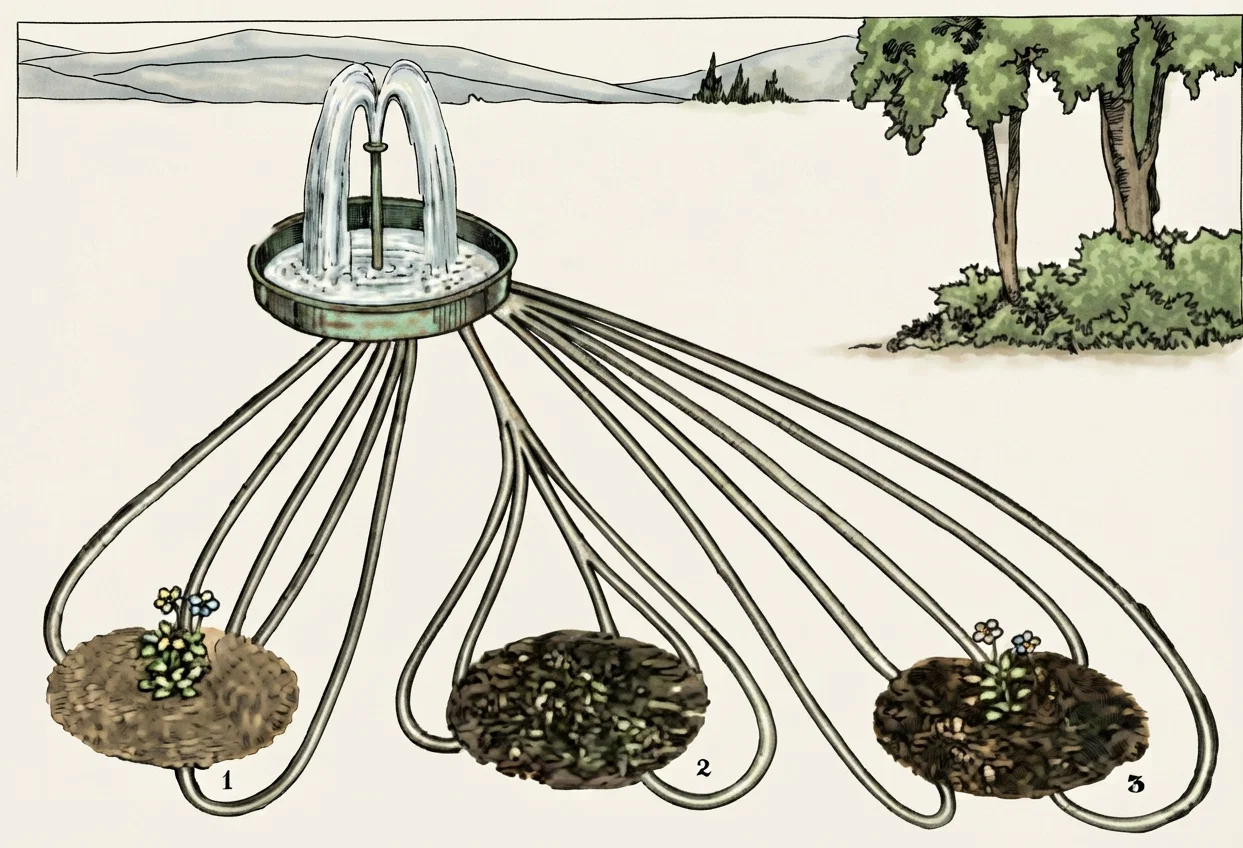
The little diagram will bring to us anew the illustration used last week. The fountain represents the Source of all life. The little patches of soil represent man in three conditions. The spiritual man is represented by the little plant in the midst of the plot of soil; the physical man, by the soil outside. The whole man receives life through two general channels: (1) Direct from the Fountain, in harmony with God’s spiritual law, summarily comprehended in the Decalogue; (2) through the food, air, and water, in harmony with the law of his physical being.
Before man sinned, represented by figure 1, his condition was that of a perfect, developing being, in harmony with perfect, unperverted law.
When man sinned (figure 2) he closed the avenue of God’s life direct to the spiritual man, and the whole man could receive life only through his lower nature. But even this lower nature, the carnal man, became corrupted; sin became infleshed, and the laws of man’s physical and spiritual being both became perverted, and so perverted the inflow of life, resulting in the death of the spiritual man, and finally of the whole man. Sinful men are to-day living after the flesh, the life perverted, and themselves subject to sin and death. “For they that are after the flesh mind the things of the flesh. . . . For the mind of the flesh is death; . . . because the mind of the flesh is enmity against God; for it is not subject to the law of God, neither indeed can it be; and they that are in the flesh can not please God.” Rom. 8:5–8.
But when the carnal man yields all to God and His law, and lets Christ in by His Spirit, the hedge is broken (figure 3), and the spiritual man comes once more into direct connection with the Fountain of life. It flows in upon the drooping plant. The water of life revives the thirsty soul, and, flowing out into the physical man and the deserts of sin, it vivifies and heals and strengthens the whole man. Isa. 44:3, 4. Then the spiritual man is no longer held by the bondage of sin. The body may be counted dead, but “the spirit is life because of righteousness.” Rom. 8:10. And then if that creative Spirit of God is cherished in the heart and life, so that it dwell there, life shall also be given to the mortal, dying body, through the now dominant spirit. Verse 11.
It is not the Gospel of Christ, it is not the Gospel of righteousness and salvation, to tell sinful and sinning man that he has the life of God—eternal life—now. He alone has divinity within who is in harmony with the divine. He only has the Spirit of God, whose heart is open by faith to receive it. He only has the life of God who is known of God and Christ Jesus our Lord.
But Christ has come that all may have the life; not the soulical life of the flesh, living—or dying—on the low plane of the flesh, but the life everlasting.
O soul, bound in the fetters of sin and death, give up the fleshly, carnal life, and let the life of God in the heart! Let it purify your affection. Let it cleanse away the sin. Let it illuminate and lead the way. Let it cleanse spirit and soul and body, and so fit you for the last great change to immortality, God’s seal of an incorruptible character.
Continue reading: PERVERTING THE WORD