Pacific Press Publishing Company · Oakland, California · Jun 3, 1897
Editorial
By Editor
Into the Name.—The baptismal formula, if the expression may be so used, found in Matt. 28:19, reads: "Go ye therefore, and make disciples of all the nations, baptizing them into the name of the Father and of the Son and of the Holy Ghost." R. V. The words are not designed, however, to express an exact form that should always be used (see Acts 2:38; 19:5), but to express an important fact as to what true discipleship means.
"Make Disciples."—Of course the apostles did not have power of themselves to make disciples. Their work was to "preach the Gospel" (Mark 16:15), "preach the Word" (2 Tim. 4:2), "preach Jesus Christ" (Acts 5:42); and the power to change the sinner to a disciple of Christ, a follower in his footsteps, a learner in his school, was given in the Word which they preached. The Word received "effectually" wrought. 1 Thess. 2:13. "Of all the nations" does not imply that each person of all the nations would become a disciple, but that "God is no respecter of persons," and that the Gospel is for all the world—Jew and Greek, Barbarian and Scythian, black and white; for God "did visit the Gentiles to take out of them a people for his name." All may come; the message is to all; but all will not come.
Meaning of Name.—Name in Scripture indicates character, especially those names given by divine direction. "Jacob," the name of Isaac's second son, meant "supplanter." This was a picture of his overreaching, grasping, natural disposition, but on that eventful night, at the Ford Jabbok, Jacob, having put away his sins by confession and restitution, prevailed with God by faith, and his character was changed. He was no longer Jacob the supplanter, but Israel the prince of God, the prevai ler by faith. Gen. 32:24-28; Hosea 12:4. The name of "Jesus" means "Saviour," with all it implies, and "Christ" means "Anointed."
Of the Father.—The Father's name is I AM, Jehovah, and it expresses the character of him who "is righteous in all his ways, and holy in all his works." When Moses besought God to show him his glory, the Lord answered, "I will make all my goodness pass before thee, and I will proclaim the name of the Lord." Ex. 33:18, 19. God's glory is therefore his goodness, and this is expressed in the Lord's name. Shortly after this the Lord fulfilled his promise to show Moses his goodness and proclaim his2name. "And the Lord descended in the cloud, and stood with him there, and proclaimed the name of the Lord [Jehovah]. And the Lord passed by before him, and proclaimed, The Lord [Jehovah], the Lord [Jehovah] God, merciful and gracious, long-suffering, and abundant in goodness and truth, keeping mercy for thousands, forgiving iniquity and transgression and sin, and that will by no means clear the guilty ["acquitting even him who is not innocent," Boothroyd]." Ex. 34:5-7. This is God's character; this is the meaning of God's name. To be baptized into his name is to receive of his mercy, his compassion, his forgiveness, his goodness. It is to be made righteous. Jesus came in his Father's name, having the Father's righteousness. Thus it was that Jesus in his own life "declared" the Father (John 1:18); thus will he "reveal" the Father to every seeking soul (Matt. 11:27); and thus Jesus Christ, having the Father's glory in himself, could impart that glory to the disciples; and thus, having the Father's name or character, he could declare that name to his disciples (John 17:22, 26). And yet again, as he was kept by the power of God's righteousness in him, so he prays that his disciples be kept in the Father's name. John 17:11, 12. And even so God desires to name his name upon all.
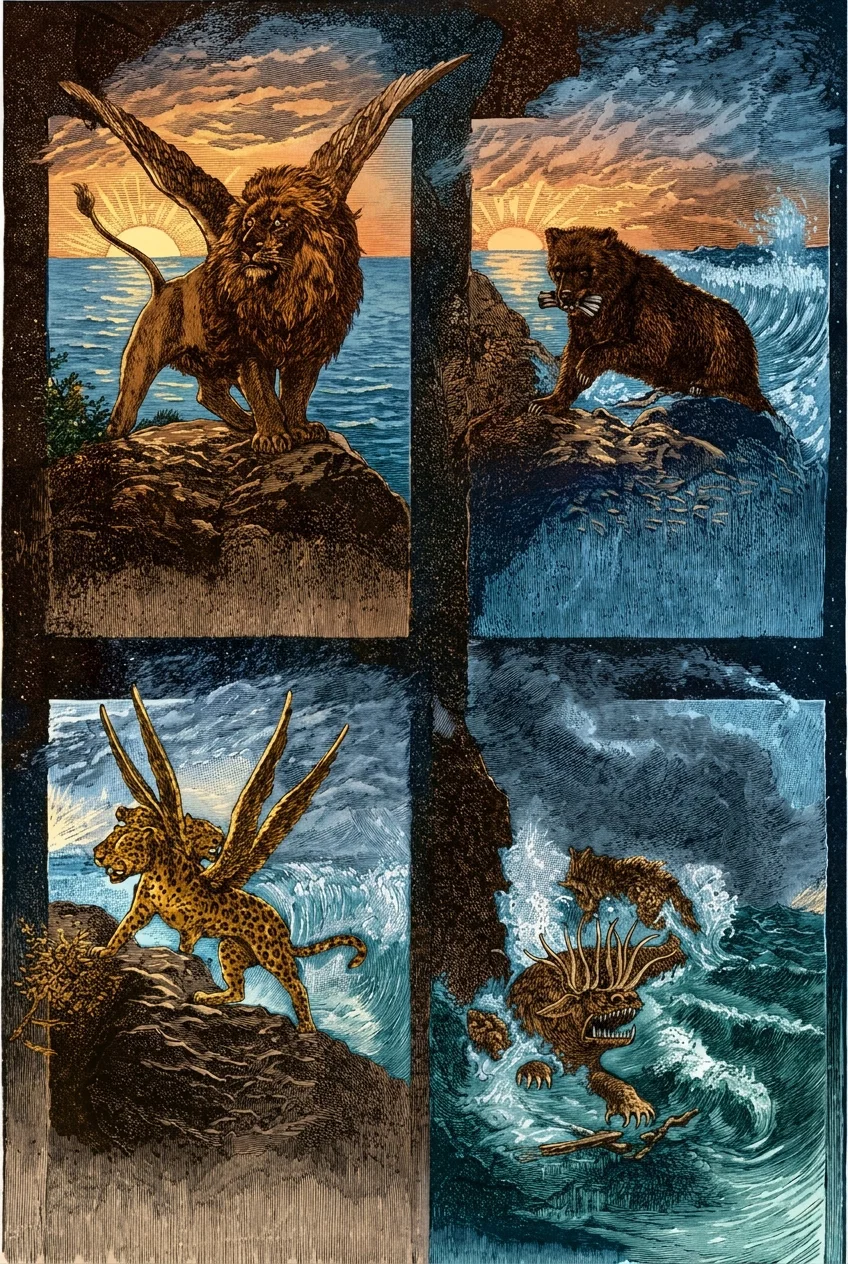
THE FOUR BEASTS OF DANIEL VII.
Into the Name of the Son.—The one great sublime fact in the character of the Son of God is that stated in Phil. 2:5-8. We quote from the marginal reading of the Revised Version, as it expresses the fact a little more emphatically: "Have this mind in you, which was also in Christ Jesus; who, being originally in the form of God, counted it not a thing to be grasped to be on an equality with God, but emptied himself, taking the form of a bond-servant, becoming in the likeness of men; and being found in fashion as a man, he humbled himself, becoming obedient even unto death, yea, the death of the cross." This was his mind—to humble himself, to empty himself, that he might save man. "Of mine own self I can do nothing;" "the Father that dwelleth in me, he doeth the works," are his words, repeated over and over again in various forms. To be baptized into his name is to renounce self, to give up all to God, to yield every desire, every ambition, every power and ability, and lay all at his blessed feet, that he may do with them and us as he will. This is consecration. This was the mind of Jesus. This is what must be done to be baptized in his name.
Into the Name of the Holy Ghost.—Everywhere in the Scriptures, the Holy Ghost, or the Spirit of God, is the agency of operation, the energy in working, the power of God manifest in the accomplishment of his purpose. It is the mighty life-force working out God's will in harmony with his holy law. It was the creative power in the beginning in creation, brooding over chaos and bringing forth order. Gen. 1:2. It is the power which recreates and peoples again the desolate earth. Ps. 104:30. It changes the heart and mind and gives birth to the new man in Christ Jesus. Eze. 36:26, 27; Ps. 51:10-12; John 3:3-5. It is that power in the Word by which we are sanctified, by which we are enabled to fulfil the righteousness of God's law, manifest in the fruits of the Spirit in our lives. 1 Peter 1:2; Rom. 8:4; Gal. 5:22, 23. That Spirit inspired the words of the prophets, and spoke through them the Holy Scriptures. 2 Sam. 23:2; 2 Peter 1:21; 1 Cor. 2:13. In short, it is by that mighty Spirit, that divine life and energy, that the love of God comes into the heart which erstwhile hated God's law, which rested upon our Lord with such fulness, which enabled him to work miracles, which fitted him for his blessed work of "doing good." Rom. 5:5; John 3:34; Matt. 12:28; Luke 4:18; Acts 10:38. It is the Spirit of God, the Spirit of Christ, the Spirit of Truth and of Grace, the Comforter, the mighty life-force and fulness of Deity, sent down to the world to save them and keep them.
Baptized into Service.—The baptism of the Spirit, being baptized into the name of the Holy Ghost, or Holy Spirit (Hagios Pneuma), is a baptism for service. It is the preparation which God gives that we may do his work in his way. But this baptism must be preceded by cleansing from sin and emptying of self. O, how many there are of God's professed children who come to God for forgiveness of sins, but go no further! How many there are of us who wish a life of ease, of enjoyment, who do not wish to do wrong, who prefer a sort of negative goodness, but want no more! How many there are of us who have never come to that place where we were willing to let God use us as he would, to send us on his mission, untrammeled by selfish considerations! We fear that our dignity will be lowered, our business interests injured, our pleasures curtailed, our associations with the world broken; and because of some such reason, unconfessed, perhaps, to ourselves, we are unwilling that God should give us that power which would make us a blessing for all eternity. The reason is that we have not the mind of Christ. If self, all of self, were emptied out, were given up, renounced, yielded to God, even as in Jesus Christ, God's Spirit would rest upon his church, and it would receive the heavenly anointing. This is what the church of Jesus Christ needs to-day, to be emptied of self, to be baptized for service. She would not be using worldly methods, nor seeking political power nor preferment. Her whole divine energy, like that of the Master, would be spent in "doing good."
Into His Name.—And yet while the matter is expressed in detail in Matt. 28:19 (R. V.), "into the name of the Father and of the Son and of the Holy Ghost," it is all included in the name of Jesus Christ; "for in him dwelleth all the fulness of the Godhead bodily. And ye are complete in him." Col. 2:9, 10. In him was the Father's name or character, his own character, and the fulness of the Spirit. Therefore when we read that the apostles baptized in his name, they carried out our Lord's injunction. Acts 19:5. The Spirit of God is his representative here, his life given to his children to fit them for service. Those who truly receive Christ will receive his Spirit also.
THE CHARACTER OF EARTHLY RULE.
An Important Prophecy.
IN our last two issues we studied the dream which God gave to Nebuchadnezzar, king of Babylon. In that dream was shown to the king a great image, composed of different metals, gold, silver, brass, and iron, and iron and clay, representing respectively the empires of Babylon, Medo-Persia, Grecia, and Rome both in its united and divided state. These are the four great dominions of earth which have molded its government, shaped its destiny, and perverted and modified true religion. Following this the image was broken and utterly destroyed by a divinely prepared stone, representing the kingdom of Christ.
These things were shown to Nebuchadnezzar under the symbol of an image, because he was an idolater, and such a symbol would arrest and hold his attention. But when the Lord reveals to his servant the great history in advance, he uses monstrous and cruel beasts, more fitly to represent their character.
The beast symbols of the same four empires were represented to Daniel in a vision of the night, as follows:—
"Daniel spake and said, I saw in my vision by night, and, behold, the four winds of the heaven strove ["brake forth," R. V.] upon the great sea. And four great beasts came up from the sea, diverse one from another. The first was like a lion, and had eagle's wings; I beheld till the wings thereof were plucked, and it was lifted up from the earth, and made stand upon the feet ["two feet," R. V.] as a man, and a man's heart was given to it.
"And behold another beast, a second, like to a bear, and it raised up itself on one side, and it had three ribs in the mouth of it between the teeth of it; and they said thus unto it, Arise, devour much flesh.
"After this I beheld, and lo another, like a leopard, which had upon the back of it four wings of a fowl; the beast had also four heads; and dominion was given to it.
"After this I saw in the night visions, and behold a fourth beast, dreadful and terrible, and strong exceedingly; and it had great iron teeth; it devoured and brake in pieces, and stamped the residue with the feet of it; and it was diverse from all the beasts that were before it; and it had ten horns." Dan. 7:2-7.2
Extended explanation of these symbols is not necessary. The "winds" are a symbol of strife and war among the nations, represented by the "sea." (See Jer. 25:32; Rev. 7:1; 17:15; Jer. 4:11, 12.) As the result of this strife among the nations of earth, these four great world-powers were developed.
The first of these was Babylon, an empire founded by Nimrod. In Jer. 4:7, 13 and 48:40 we have both the symbols of the lion and eagle applied to Babylon, and to her swiftness of conquest. The lion is a symbol of Babylon, which met its end in B.C. 538.
Medo-Persia.
The bear is a symbol of the Medo-Persian government, the successor of Babylon. The raising up of itself on one side doubtless refers to the dominancy of the Persian element, and the three ribs in its mouth to the provinces of Babylon, Lydia, and Egypt, which were cruelly oppressed by this conquering power. The same empire is represented in Dan. 8:3, 4, 20 by a ram with two horns, and is there named
Grecia.
The third symbol is that of the four-headed, four-winged leopard. This, like the four-horned goat of chapter 8, represents Grecia. Two hundred years before she came to power, God named her, and designated her first great king—Alexander the Great—by a single horn that had no like single successor. See Dan. 8:5-8, 21, 22. At the battle of Arbela, B.C. 331, Alexander became monarch of the world by conquering Persia. After eight years of conquest and riotous living, he died from a drunken debauch. After more or less wrangling and change for a few years, his empire was divided into four parts, among four of his generals. Syria was ruled by Seleucus, Asia Minor and Thrace by Lysimachus, Egypt by Ptolemy, and Greece by Cassander. The wings signify rapidity of conquest and soaring pride, and the leopard itself indicates the character of that government.
Rome.
To Grecia succeeded Rome, under the symbol of a great and terrible beast. With mighty strength and great iron teeth, it well represents the iron monarchy that ruled the world with such relentless power. Once started on her conquering career, Rome brought the world into subjugation as no other power had ever done, and became the world's mistress in B.C. 30, when Egypt, the last division of the Grecian Empire, became a Roman province. But the Roman Government came into connection with the people of God in a league with the Jews, B.C. 161.
"And it [the beast] had ten horns." "And the ten horns out of this kingdom are ten kings that shall arise." Dan. 7:24. By "kings" is meant "kingdoms," as the ruler stands for his dominion. See verses 17, 18, 23. "These beasts, which are four, are four kings, which shall arise out of the earth. But the saints of the Most High shall take the kingdom." "The fourth beast shall be the fourth kingdom." The ten horns are therefore ten kingdoms which should rise out of the Roman Empire, or in which that empire should be divided. Was this the case? Did Inspiration, eight hundred years before the imperialism of the iron monarchy of Rome was broken, indicate the number of those divisions? In the second chapter we are plainly told that the mixture of iron and
clay was to show that "the kingdom shall be divided," but we are not told there how many divisions there would be. Here we have the ten horns, indicating ten divisions of like character to the beast from whose head they sprung.
What are the facts?—Simply these: The "Decline and Fall of the Roman Empire," by Gibbon, shows that between the years A.D. 351 and 476 the empire of Rome was divided into ten divisions, as follows: Allemanni, Franks, Burgundians, Vandals, Suevi, Visigoths, Saxons, Ostrogoths, Lombards, Heruli. Some of these powers exist to-day, as the reader will note by the names. Germany is Allemanni, and its people are still called Allemans by the French. In the French are perpetuated the Franks; in England, the Saxons. The references to Gibbon may be found in chapters 10, 12, 19, 30, 31, 33, 35, 36, 38, 39, 42, 45, 49, and elsewhere.
Concerning the above there is little or no difference among commentators as to the main facts. All are agreed so far as we know on to what the four beasts symbolize, and that the fourth, representing Rome, was divided into ten parts, as indicated by the horns.
These four great empires are well represented by cruel beasts, so far as the people of God and true religion are concerned. In all these governments Church and State were united; all had some form of religion, the worship of some god or gods established by law. The State was in this supreme. The gods were to a certain extent created by the State, and largely consisted of her dead heroes deified. In direct conflict with this came the worship of the one true God whenever the two systems came in contact. That the people of God were not persecuted more, nay, blotted out of existence, is due to the fact that God in his providence restrained the wrath of these man-made governments, even as man may at times control vicious, wild brutes. At the head of this Church and State system is Babylon; in her scheme of rebellion and self-salvation it originated (see Gen. 11:1-9), and even to this day she has "made all the earth drunken; the nations have drunken of her wine [of her fornication]; therefore the nations are mad." Jer. 51:7.
But there is another important feature of the prophecy of Daniel 7, namely,
Another Little Horn,
which came up from among the ten, which should exist to the end, and would have much to do with the people of God. To what does this "little horn" refer? The specifications of the prophecy, the particulars which the Lord gives respecting it, are many and definite; can we tell from them to what power or system it applies? Here are a number of these particulars:—
1. It was to arise out of the Roman Empire at the time of its division into ten kingdoms. Verse 8.
2. Three horns, or three kings, should be plucked up before it. Verses 8, 24.
3. It would start small and manifest great strength and assumption; it "spake very great things," and its "look was more stout than his fellows." Verse 20.
4. It should be "diverse" from the ten kingdoms; it would possess a different form of government. Verse 24.
5. It should be shrewd and far-seeing. The other kingdoms are represented by blind horns of a beast; but the little horn had "eyes like the eyes of a man," showing its superior, far-seeing shrewdness. Verses 8, 20.
6. It should be a blasphemous power, speaking words against God. Verses 11, 20, 25.
7. It should "wear out the saints of the Most High;" that is, it would be a persecuting power. Verses 20, 21, 25.
8. It should think to change the times and laws of a power whose law it could only think to change, namely, God's times and law. Verse 25.
9. The saints and the times and the law should be given into the hand of this power for a certain definite time, called "time and times and the dividing of time." Verse 25.
10. Its power as a persecutor would be destroyed at the end of that time, and following that its dominion should be taken away. Verses 25, 26.
11. Yet it would at the very end of the age be a persecutor, showing that its power to persecute would be restored. Verses 21, 22.
Here are these definite, specific particulars. It is not in the least degree probable that they could apply to two powers; and it would show the marvelous foreknowledge of God to find one power to which each and all applied. But there is one such power. God, who declares "the end from the beginning, and from ancient times the things that are not yet done" (Isa. 46:10), has made no mistake. These specifications, the Lord will, we will study in our next.
Do You Love Jesus?
The question is simple, and the thought in its affirmative form quite common. But do you love Jesus? Would you delight to be in his company at all times were he here? If we love a friend, we love his personal presence. If we truly love Jesus Christ, we shall love his coming again, and we will prepare for that coming.
The Ensign of the Holy One.
The distinguishing characteristic of the true God is creative power. The ensign of his power is the Sabbath, around which cluster the great facts of a completed creation. It is the only commandment in God's holy law which reveals him for what he is, Creator and Redeemer, mighty to save, the Holy One of Israel. And yet when the badge of God's authority is lifted before the people, many ridicule, despise, and reject it. This the Lord himself foretold in Isa. 30:8-11: "Now go, write it before them in a table, and note it in a book, that it may be for the time to come forever and ever [marginal, Hebrew, "the latter day"]; that this is a rebellious people, lying children, children that will not hear the law of the Lord; which say to the seers, See not; and to the prophets, Prophesy not unto us right things, speak unto us smooth things, prophesy deceits; get you out of the way, turn aside out of the path, cause the Holy One of Israel to cease from before us." Men may hide God now, and may hide his truth from their eyes, but they will sometime meet it all in the judgment. They will then also meet their own delusions, which they have chosen, ripened to their own destruction. See verses 11, 12. Now the Lord says, "Turn and live."
“IF THOU HADST KNOWN.”
By M. E. K.
THE incident related in the nineteenth chapter of Luke of the weeping of Christ over Jerusalem, the unrepentant city, soon to be destroyed, is one of the most pathetic and moving narratives in the Scriptures. Judah was the one tribe preserved. The others had gone into perpetual captivity. That tribe and the scepter of its kingdom had been kept up by special providence until the Messiah should appear. Gen. 49:10. It was the last plant of the Lord’s vineyard, tended and pruned with great care, in the hope that fruit would appear. And the people of Jerusalem, its capital city, represented the last of that people whom God had called out of Egypt, and by divine power, and in a manner to astonish the world, placed in the land of promise. How long he bore with their sin and rebellion! How tenderly he cared for them when they had lost all care for themselves! He had sent them prophets, but they had shamefully treated them, “beating some, and killing some.” Mark 12:5. “Last of all he sent unto them his Son, saying, They will reverence my Son.” Matt. 21:37. And now as that Son, who, begotten of God, was by a mysterious miracle joined to that people as one of them, looked from the hill of Olivet upon that city which rejected him and his message of love, he burst into weeping, exclaiming, “If thou hadst known, even thou, at least in this thy day, the things which belong unto thy peace! but now they are hid from thine eyes.”
They did not know; and in their blind ignorance they took the life of the Son of God, killed the last messenger of mercy which God sent to us as a nation. Says Peter, “Ye denied the Holy One and the Just, and desired a murderer to be granted unto you; and killed the Prince of life, whom God hath raised from4the dead; whereof we are witnesses.” Acts 3:14, 15.
How did they come to make so deplorable a mistake? “And now, brethren, I wot [know] that through ignorance ye did it, as did also your rulers.” Verse 17. Yes, they were ignorant. They did not know that he was their promised Messiah; they did not know him. “Which none of the princes of this world knew; for had they known it, they would not have crucified the Lord of glory.” 1 Cor. 2:8.
Jesus looked down from Olivet upon the city whose people were so soon to cry out, “Crucify him, crucify him,” and his heart was full of compassion. He saw the city of David and of Solomon, with its teeming thousands, and with prophetic eye saw the Roman armies encompassing it, the famine, the pestilence, the burning temple, the fleeing multitudes seized, cut down, crucified, or sold into hopeless slavery; saw the long ages of Jerusalem’s degradation and the scattering of her children among the nations. Could we see it as he saw it, we would not wonder at the weeping, the sighs, the groans, and the exclamation, “If thou hadst known.” He knew it, and tried to warn them of what surely would come unless they repented. “O Jerusalem, Jerusalem, thou that killest the prophets, and stonest them which are sent unto thee, how often would I have gathered thy children together, even as a hen gathereth her chickens under her wings, and ye would not!” Matt. 23:37. The storm of wrath was gathering and would soon break. He would gladly shelter them, but they would not. They did not know.
The closeness with which the destruction of Jerusalem and the second coming of Christ and the end of the world are connected in Matthew 24, Luke 21, and other scriptures, evinces that the condition of the world at the time of the second advent will be very similar to the condition of Jerusalem at the time Christ wept over it. We are now living in the last days. God’s controversy, not with one nation only, but with all nations, is drawing to a close. As Christ bore a last warning message to the nation of the Jews, so now does he, through the preaching of the “everlasting Gospel,” as foretold in Rev. 14:6–12, proclaim the last warning message to the world. That message is being proclaimed. By the preached Word, by books and tracts, by correspondence, by numerous periodicals, by fireside teaching, in many ways, the momentous truths of the Lord’s soon coming, and the necessity of a preparation to meet him in peace, are being made known to the world.
Will the people of the world believe it?—Some will. They read in his Word, “So likewise ye, when ye see these things come to pass, know ye that the kingdom of God is nigh at hand. Verily I say unto you, This generation shall not pass away, till all be fulfilled.” Luke 21:31, 32. They read these words; they see the things—the signs foretold—come to pass; they recognize the fact that, since they see the signs, they must help to compose the “generation” referred to, and they believe, yes, know.
Others do not believe; they see no signs; they say, “My Lord delayeth his coming.” They ask, “Where is the promise of his coming?” They do not know. Why?—“But as the days of Noe were, so shall also the coming of the Son of man be. For as in the days that were before the flood they were eating and drinking, marrying and giving in marriage, until the day that Noe entered into the ark, and knew not until the flood came, and took them all away; so shall also the coming of the Son of man be.” Matt. 24:37–39. Thousands will not know that the coming of the Lord is near.
But what keeps them from knowing? What prevented the Jews from knowing that Jesus was the Messiah? They did not know it. Was it not that very common sin of unbelief?—Yes; and is it not so to-day? God has spoken; but men look wise, shrug their shoulders, shake their heads; they do not know. That is what thousands are doing to-day. And can not we hear once more that voice from Olivet, saying to the men of this generation, as to the people of Jerusalem, “If thou hadst known”? Brother, sister, friend, wake up. “Know that it [margin, “he”] is near, even at the doors.”
To know that the Lord is near will be a mighty stimulus to get ready to meet him. Jesus stands ready to exchange his righteousness for our sinfulness. Faith to lay hold of his Word in humble obedience will make us know that he is near, and that we are accepted in him.
“THOUGHTS OF PEACE.”
By G. T. Wilson
“I will hear what God the Lord will speak; for He will speak peace unto His people, and to His saints; but let them not turn again to folly.” Ps. 85 : 8.
O LORD, Thy thoughts toward me are good,
For they are thoughts of peace;
By Thee my wish is understood;
Thy goodness doth increase!
“Peace on the earth, good-will to man,”
Sang angels at Christ’s birth;
“Peace” is the watchword of that plan
Which gives man’s soul its worth.
My soul, acquaint thyself with God,
And with Him be at peace;
Peace is unknown where sinners plod;
Let selfish strivings cease.
Christ Jesus is my life and peace;
He makes me one with God.
Through Him from sin I find release;
I love the path He trod.
The peace He gives, the world knows not,
Nor can it take away;
“A troubled sea,” the sinner’s lot;
There is a happier way.
When Christ speaks peace, there spreads a calm
O’er all life’s troubled sea.
The soul that hears it, has the balm
Which makes repining flee.
When God has set at peace my heart,
No one can there make war.
Peace-making is a heavenly art
No being should abhor.