A mill that enables your cook to do the work of three mills on one combination mill, is up-to-date and economical. It grinds grains, makes nut butter, cuts up meats, figs, dates, pulverizes coffee, drugs, salt, etc.
Price $4.00
For circulars, terms, etc., address WILL T. DAWSON, Battle Creek, Mich. 117 Manchester Street
ALFRED MALLETT, Nyack, N. Y. (New Address)
By Alfred Mallett
$10 Paid to anyone proving that there is anything injurious to the clothes in E-Z WashingTablets. Guaranteed to wash cleaner with less labor than any other preparation, and positively without injury to the clothes or hands. A new discovery.
Three samples for 10¢.
Agents wanted to represent us everywhere.
A winner. Try it.
ALFRED MALLETT, Nyack, N. Y. (New Address)
I CAN SELL YOUR FARM
By W. M. Ostrander
no matter where it is. Send description, state price and learn how. Est. ’96. Highest references. Offices in 14 cities.
W. M. OSTRANDER, 1900 N. A. Bldg., Philadelphia
Lesson I.—October 4.—The Vision of the Four Beasts.
What picture was brought before him in his night vision?
What was seen to come from the stormy sea?
What was the appearance of the first beast? What peculiarity did the prophet observe about it?
What changes appeared while the prophet was looking?
What was the appearance of the second beast? What was its position? What special circumstance was noted about it? What command was given to it?
What was the appearance of the third beast? What was the first peculiarity noted? The second?
What was given to this third beast?
What three adjectives are used to describe the fourth beast? What did it have?
What was the fourth beast seen to do?
How did it compare with the other beasts?
What marked peculiarity was noted about the fourth beast?
What change took place as the prophet was watching the horns? How was this change brought about?
What two particulars are given in describing the appearance of this little horn?
Notes.
The first year of Belshazzar was 540 B.C. It was formerly supposed that Belshazzar was the same as Nabonadius in secular history, whose reign began in 555 B.C. (hence the date in the margin), but later researches have proved that Belshazzar was the son of Nabonadius, and that his reign dated from 540 B.C.
More than sixty years have, therefore, passed away since Daniel interpreted the dream of Nebuchadnezzar, as recorded in the second chapter of Daniel. In the meantime great changes have taken place in the kingdom of Babylon, and the great empire is approaching its end.
Daniel’s vision, as recorded in this seventh chapter, stands, evidently, in close relationship to Nebuchadnezzar’s dream of the second chapter. The language of this vision makes it plain, and the common consent of the Protestant interpreters emphasizes the fact, that the four beasts of this chapter represent the same four kingdoms as were represented in the different parts of the image of Nebuchadnezzar’s dream. The lion is Babylon, the bear is Medo-Persia, the leopard is Grecia, the great and terrible beast is Rome. But, as in the second chapter, the chief purpose of the dream was not to set forth the mere fact that there would be four world-kingdoms, so in this vision these four kingdoms are again brought forward, not merely to state their place in history, but in order to locate definitely the territory, the time, and the work of a kingdom small in territorial dimensions, but world-wide in power—the kingdom of antichrist. This will appear more plainly as we proceed with the lessons.
Historical Extracts.
“In the vision of the first year of Belshazzar, these four empires are symbolized by the four great beasts—the lion, the bear, the leopard, and the great and terrible nondescript beast. The lion of the vision in the first year of Belshazzar, therefore, corresponds to the head of gold of Nebuchadnezzar’s dream, and consequently represents Babylon.”
“Being first ‘a lion with eagle’s wings,’ it well represents the mighty power and swiftness of the conquests of the Babylon of the time of Nebuchadnezzar. Then it was ‘that bitter and hasty nation,’ whose horses were ‘swifter than the leopards,’ and whose horsemen should ‘fly as the eagle that hasteth to eat.’ And afterward the same lion, with his wings plucked, and lifted up from the earth, and made to stand on his feet as a man, with a man’s heart, well represents the same kingdom of Babylon shorn of its vigor, its power, and its majesty, as it was after the death of Nebuchadnezzar, through the reigns of the five weak and wicked kings whom we have been obliged to notice in that period.”
“As the lion corresponds to the head of gold of the great image, and so represents Babylon, so the bear of this vision corresponds to the ‘other kingdom inferior’ to Babylon, represented in the breast and arms of silver of the image in Nebuchadnezzar’s dream. Then in the vision of the third year of Belshazzar, which occurred in the very last days of Babylon, just as it was about to pass away, only three symbols are used—the ram, the goat, and the little horn which became ‘exceeding great;’ and the first of these is plainly declared by the angel to be ‘the kings of Media and Persia.’ This demonstrates, therefore, that the kingdom of the Medes and Persians was represented by the symbol of the bear, and was the one referred to when Daniel, in explanation of Nebuchadnezzar’s dream of the great image, said to him, ‘After thee shall arise another kingdom inferior to thee.’” (“Great Empires of Prophecy,” page 35.)
“Another symbol of this third, or Grecian, empire is a leopard having four wings. The symbol of the Babylon of Nebuchadnezzar was a lion with eagle’s wings, signifying that in the rapidity of his conquests he would ‘fly as the eagle that hasteth to eat.’ The four wings upon the leopard could signify nothing less. And so it was with Alexander; for ‘from Macedonia to the Ganges, very near to which Alexander marched, is computed at least eleven hundred leagues. Add to this the various turnings in Alexander’s marches, . . . we shall find that Alexander, in less than eight years, marched his army upward of seventeen hundred leagues, without including his return to Babylon.’” (Id., page 185.)
“The boundaries of the actual conquests of the Roman armies—the limits to which the Roman soldiers actually marched and conquered—were marked by the Tigris, the Danube, the Rhine, the Firth of Forth, the Atlantic Ocean, the Desert of Sahara, the Desert of Arabia, and the Persian Gulf. And Gibbon’s elegant lines alone would mark in Rome the fulfilment of the prophecy of ‘the fourth kingdom:’ ‘The arms of the republic, sometimes vanquished in battle, always victorious in war, advanced with rapid steps to the Euphrates, the Danube, the Rhine, and the ocean; and the images of gold, or silver, or brass, that might serve to represent the nations and their kings, were successively broken by the iron monarchy of Rome.’” (Id. page 319.)
Lesson 13.—September 28.—Review of the Quarter’s Lessons.
During the quarter we have had twelve of the lessons taught in Israel’s training-school in the wilderness. These are lessons for our day and generation as well as for Israel. They were taught directly to Israel, but they “were written for our learning,” Rom. 15: 4. They were not written merely for our memorizing, not merely as an intellectual accomplishment, an addition to our scholarship, but “that through patience and through comfort of the Scriptures we might have hope.” Only those who have studied the quarter’s lessons with this object in view, and have thus learned them, have been really benefitted. The lessons have been as follows:—
1. The Giving of the Manna—Ex. 16: 4–15.—After leaving Egypt and crossing the Red Sea by faith in God’s Word (Heb. 11: 29), the people were suddenly confronted with the problem of getting food for the vast multitude in the wilderness. So the Lord demonstrated His ability to feed His people under any circumstances. He had previously shown His power to heal bitter water. Ch. 15: 22–26.
2. The Ten Commandments—Duties to God—Ex. 20: 1–11.—While obedience to the whole law is a duty, we owe first duty to God (Eccl. 12: 13, 14; John 14: 15; 15: 14); the language of the first four makes this duty specific in the commandments themselves. The fourth establishes a memorial as a specific sign of obedience. Ex. 31: 12–17, Isa. 58: 13, 14. It is a memorial in special honor of God’s creative and redemptive power. Gen. 2: 2, 3; Deut. 5: 15.
3. The Ten Commandments—Duties to Man—Ex. 20: 12–17.—The last six of the commandments definitely forbid infractions of duty to our fellow-men, but they are the commandments of God. Being the law of God, the performance of the duties enjoined constitute obedience to Him. When the duties are neglected it is God that is dishonored. “Thou shalt love thy neighbor as thyself.”
4. Worshiping the Golden Calf—Ex. 32: 1–6, 30–35.—Because Moses was out of sight, the people could not trust God. Aaron, tho standing as the representative of God before the people, was afraid to deny their demand that he should make them a god. The law of God, to which they had assented but a short time before and covenanted to keep, had no power over them because it was not in their hearts. “It was weak through the flesh.” Rom. 8: 3. If the Spirit of Christ be in the heart, the law is written there, and has power to control the action of the individual.
5. The Tabernacle—Ex. 40: 1–13.—The tabernacle was built that God might dwell with His people. Ex. 25: 8. It was a type of the sanctuary in which Christ is now ministering in heaven, and its service was a type of His service in the heavenly sanctuary. Heb. 8: 1–6. The purpose of God is to dwell in the hearts of His people (1 Cor. 3: 16, 17; 6: 19, 20); but Israel had not let Him unreservedly into their hearts, so He could not dwell there. The tabernacle, with its furnishings and services, was a series of object lessons to teach spiritual truths.
6. Nadab and Abihu—Lev. 10: 1–11.—These young men lost their lives because they did not sense the sacredness of the house and the presence and the service of God. They did not discern the difference between the holy and the common. Selfish desire was heeded rather than the commandment of God. Their overt act was drinking wine and using common fire in the tabernacle; the underlying sin which led to this was unbelief. This is more than an ordinary temperance lesson. It teaches that the service of selfish desire and the service of God can not be combined in one individual.
7. Journeying toward Canaan—Num. 10: 11–13, 29–36.—After the building of the tabernacle at Sinai, after an encampment there of a little over eleven months, Israel set out for Canaan, piloted by the Angel of the Lord in the pillar of cloud. It was a shade from the sun’s hot rays by day, and a continuous light in the camp by night. See Ps. 34: 7 and 91.
8. Report of the Spies—Num. 13: 26 to 14: 4.—The ten spies, who discouraged the people with reports concerning the enemies that confronted them, had not learned the lesson that the God of Israel was invincible. The two spies, who saw victory by faith beyond the great obstacles portrayed by their brethren, had learned the lesson. The unbelief of the people, that hindered their entering into the land (Heb. 3: 19), had been manifested in their proposition to send spies to see whether they could go where the Lord was leading them.
9. The Brazen Serpent—Num. 21: 1–9.—There was no healing power in the “piece of brass” (2 Kings 18: 4, margin). Those who looked to it were healed by faith in the Lord’s Word. The lesson is that “as Moses lifted up the serpent in the wilderness, even so must the Son of Man be lifted up; that whosoever believeth in Him should not perish, but have eternal life.” John 3: 14, 15.
10. The Prophet Like Moses—Deut. 18: 9–19.—“The Lord spake unto Moses face to face, as a man speaketh unto his friend.” Ex. 33: 11. No other prophet in Israel held such intimate communion with God until Christ came. The people had looked for “that prophet” all the time from Moses’ day until Jesus appeared, and then rejected Him through unbelief.
11. Loving and Obeying God—Deut. 30: 11–20.—The Lord loves His people, and wants to bless them and give them eternal life. But if they are disobedient, they bring death upon themselves in spite of His love. “The wages of sin is death.” No profession of love will stand unless there be obedience. “This is the love of God, that we keep His commandments; and His commandments are not grievous.” 1 John 5: 3. They are not grievous when written on the heart.
12. The Death of Moses—Deuteronomy 34.—Moses had led the Lord’s people forty years in the wilderness; had led them to the border of the promised land, and then was not permitted to go in with them. Why?—Because on one occasion he failed to give God the glory as the provider of a needed supply of water. God was not selfish, but the welfare of His people required that they must in everything recognize dependence upon Him. The words of Jesus, “Without me ye can do nothing,” were true then, as they are to-day. Not even a Moses was an exception to this truth.
New England Conservatory of Music
has now the finest building devoted to music in the world. Founded 1853. Unsurpassed advantages in composition, vocal and instrumental music, and elocution.
George W. Chadwick, Musical Director.
Pupils received at any time. For year-book address FRANK W. HALE, General Manager, Boston, Mass.
Just . . . Published
A grand book logically presenting the true principles of Christianity and science in contrast with modern ideas of Christianity and science. It is written to arrest the downward drift of theology and place within the minds and hearts of its readers the soul-stirring, life-giving, character-regenerating doctrines of the Bible.
Cloth bound, 272 pagesPost-paid75c
Essentials of Our Language
By PROF. C. W. RINE
Accuracy in the use of words is easily attained by a careful study of this new book. The work has been prepared to aid those especially who have not had satisfactory school advantages, and is in every sense a most practical volume for home study.
282 pages, cloth bound, post-paid, 75c
Sunday in History
By C. H. EDWARDS
Is a book consisting of important historical facts concerning Sunday. When was Sunday observance instituted? What brought it about? Is there Bible authority for it? are unanswered questions in many minds. These and many other questions equally important and interesting are clearly answered.
272 pages, paper covers, post-paid, 50c
By
Pacific Press Publishing Co.
Oakland, California
BRANCHES { 11 West Twentieth Street, New York City
14 West Fifth Street, Kansas City, Missouri
The Revelation
By Editor
This is the grandest book of all the Scriptures, yet it seems to be understood by fewer people than any other book.
During the year to come the SIGNS OF THE TIMES will present to its readers an exposition of this wonderful revelation of Jesus Christ. To make simple the grand truths taught will be the prominent feature of this series of articles.
There will be many illustrations to help the reader to better understand the subjects presented.
No book in all the Bible is so filled with truth for this generation as the Revelation. Now is the opportune time to place the SIGNS in the hands of your friends and urge them to study the articles on the Revelation.
Rates of subscription: Single copy per annum, $1.50; six months, 75 cents. In clubs of five or more to one address the rate will be 70 cents per copy per year.
ADDRESS
_SIGNS OF THE TIMES_
OAKLAND, CALIFORNIA
A Golden Opportunity Booklet
SEND your name and address to the SIGNS OF THE TIMES, Oakland, California, and they will send you, free of charge, a beautiful booklet, entitled, “A Golden Opportunity.” It tells how you may commence without capital and in a short time earn a year’s scholarship, in a good Christian college. This scholarship covers your board and lodging, as well as tuition.
CO-OPERATION CORNER.
By Editor
MANY of our faithful missionary workers would gladly use much larger clubs of the SIGNS than they are now circulating if they could afford to do so, while there are others who would be just as glad to pay for such clubs if they knew who needed them.
For these reasons we have opened the “Co-operation Corner.” It will contain requests for clubs of papers for use in various fields, short reports from those who are using such clubs, acknowledgments of money received, and such other information as will bring together those who can use papers but can not pay for them, and those who can pay for papers but are not so situated that they can use them.
Last year a call was made through this column for donations to pay the expense of a club of 36 Little Friends for one year to an orphan asylum. The full amount asked for was raised, thus making it possible for the club to be sent one year. However, the subscription has now expired, and the following letter has just been received from the secretary: “These papers have been doing an immense amount of good, and the little folks in our school appreciate them very much. If there is any way in which you can repeat the gift through the donations of friends we will be glad to do our part in raising a little. All the donations contributed in the regular channels of the school come from the teachers almost exclusively, as the children have no means of making money for donations.”
The 36 Little Friends will cost $16.20 for the coming year. Must this club be discontinued entirely? Surely there are among the readers of this paper sixteen people who would feel it a privilege to contribute a dollar each toward supplying these poor orphan children with the Little Friend for their Sabbath-school.
Send all donations direct to SIGNS OF THE TIMES, Oakland, Cal.
The Monster of Martinique Island
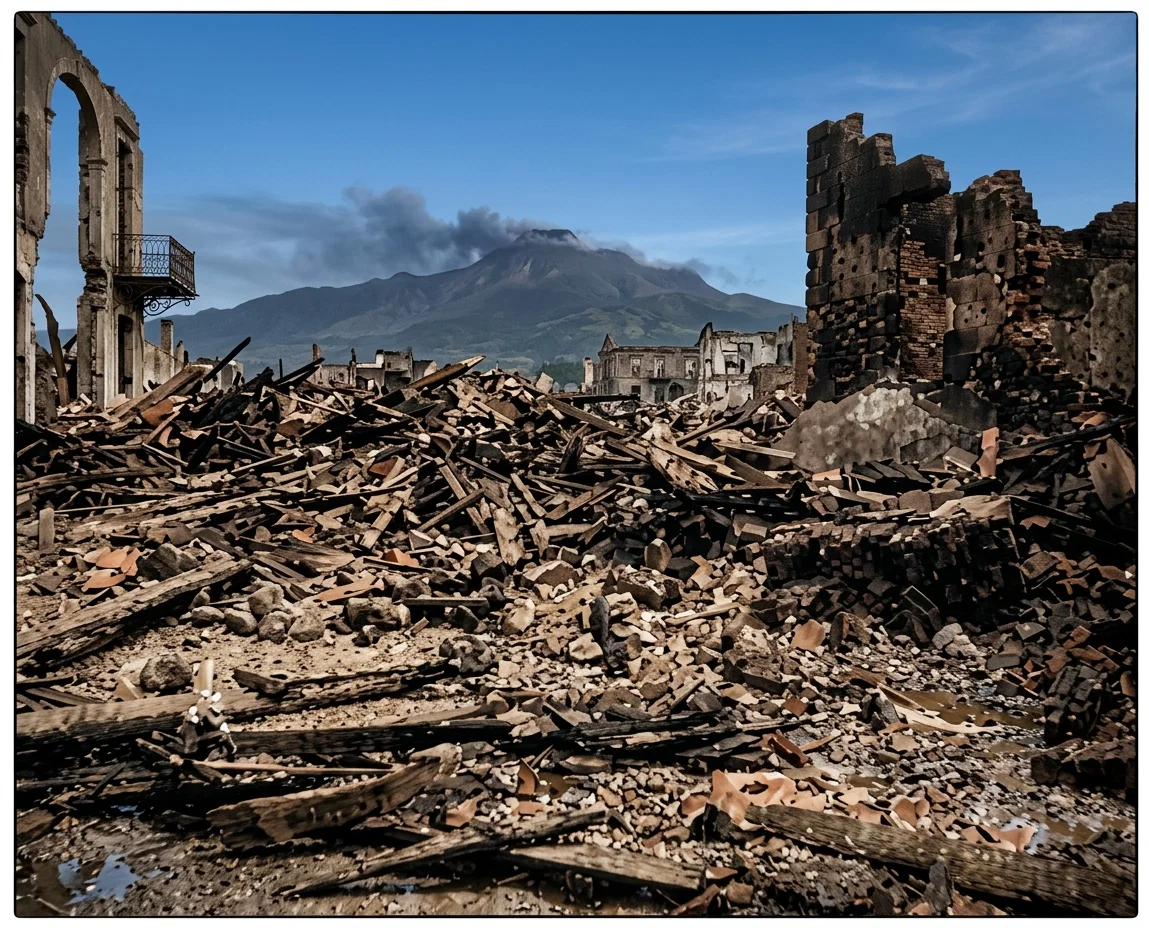
The Monster of Martinique Island is still belching forth his rage. Later despatches give an enormous loss of life. The Hearst papers summarize the loss of life as follows: May 3, loss of life 150; May 8, 30,000; May 20, 100; June 6, 100; August 30, 1,000; September 3, 2,000; a total of 33,250 lives lost by the eruption. Other conservative reports make the loss of life a few thousand less. It is probable that the 2,000 lives reported lost in the eruption of September 3 includes the 1,000 of August 30. The volcano on St. Vincent Island is also active, and the poor people of these and adjacent islands are terror stricken. Would that they could see that all these perversions and abnormalities of nature are the result of sin.
A General View of St. Pierre.
What volcanic eruptions and earthquakes, tornadoes and tidal waves, famines and pestilences, are to earth, infirmities and diseases are to man. Man is not normal when he is subject to bone-distorting rheumatism, burning fever, torturing headaches, and pain-racking affections of any kind. They all came as a consequence of sin. Their constant or frequent occurrence is indicative of old age, low vitality; decrepitude. So it is with Mother Earth. She is sick with sin. And all the fearful disturbances which rack and twist and torture her mammoth frame are so many evidences of the sore sickness within her, caused by the poison of sin.
Praise God, this old earth will not forever know her present calamities or similar ones. Sometime when sin shall have so borne its legitimate fruit of destruction, woe, and death, that all will see it, the great Master will cleanse the plague spot of the universe, and recreate that which sin has marred, and restore the equilibrium. That He is able to do this, He is continually demonstrating in this sinful earth from year to year in the renewal of life. He is demonstrating it in regenerating men and women by His power. All power is His, and His all-power will be used in His soon-coming good time, and He will “make all things new.” “Be of good courage, all ye that hope in the Lord.”
The greatest power which a man can desire is power over selfishness and sin. These are his greatest foes. No mortal can conquer them single-handed. They can only be conquered by Jesus Christ. He conquered them when here; He will conquer them now in you if you will only let Him. “He is able” “to save,” “to keep,” even to the end.
What Is the Law For?
In Gal. 3:19 is a question asked by the apostle, in our common version, “Wherefore then serveth the law?” In the Revised Version, “What then is the law?” For what was it given? Read Professor Derby’s answer to this question on page 4 of this paper.
A Study of Zechariah’s Prophecy
By Editor
We begin in this issue a series of papers on the Prophecy of Zechariah. The work of the prophet was wrought at the time of Israel’s restoration from Babylonian captivity, a type of the great restoration of the Israel of God in these latter days from the great mystical Babylon, and from the effects of the wine of her fornication. These articles are written to help the reader to understand the prophecy. Therefore read the articles carefully, study the prophecy faithfully. If you do not agree with all the writer of the articles may say, study the prophecy. That is what he desires you to do; that is what we desire; that is what God desires. And study by faith, with a heart to do His will.
Our Sabbath Experience Symposium.
By Editor
We are receiving replies to our queries (see page 5) at the rate of two and three or more a day. This is good. Let them be written now, while the matter is fresh. We shall publish them in the order received, and as rapidly as we have space. Now just a word to our correspondents: Do not try to tell us in addition to how you became convinced of your duty to observe the Sabbath, all that you have learned since. We have not space for that. Tell us the convicting, convincing truth which made you a Christian Sabbath-keeper. It is to be expected that you see much more now, but let some one else tell that, or leave it to be told in another way at another time. It is living, convicting testimonies which we desire in this symposium. Bring them within the limit of 500 words.
Christ the Only Saviour
Every system of religion, however great its pretensions, which teaches that man is his own saviour, that he has the power within himself to save himself, is false. He who knows Christ Jesus has the power of Christ in his soul. He who knows not Christ has “no hope” and is “without God in the world.” Only by an open, submissive heart toward God can we receive His presence.
The Cosmopolitan for September
The “Cosmopolitan” for September is a specially interesting number. In “A new Field for Speculation,” the editor, John Brisben Walker, offers a prize of $300 for the best paper on the wonderful element, radium. In “Captains of Industry,” article No. 5, the elements of success in method, character, etc., of the following are discussed: “John Henry Patterson, Sir Hiram Stevens Maxim, Henry Huddleston Rogers, John Warne Gates, Charles Ranlett Flint, John Arbuckle. There are other articles of interest and information.
A Wonderful Substance.
One of the most interesting discoveries of these later days is the finding of that wonderful metal, radium. The total mass thus far gathered, the September Cosmopolitan tells us, is only about one-thirtieth of an ounce, and it cost to collect it $10,000; the cost of producing an ounce, it is estimated, would exceed $300,000. It possesses the power of sending forth, at the velocity of over 60,000 miles a second, a constant stream of luminous particles, and that without any diminution of substance. We are told that “Science, with all the resources of its entrance upon the twentieth century, is at a loss to understand either the derivation or preservation of this energy. . . . The question arises, What renews this immense reservoir of power which is being eternally thrown out, yet with the store never dissipated?” It is said that the wonderful properties it possesses would make the gathering of it by the government cheap enough at $300,000 an ounce. That already gathered came from pitchblende, or uraninite. Glass brought into contact with it is permanently colored brown or of a violet tint. Oxygen is by it changed into ozone. Its brilliancy is such that a small portion would send forth a light so intense that the eyes and even the person would have to be protected from its power; and this power, they declare, has been with it from the beginning of creation. Surely it would seem that such things, as well as a multitude of the more common things of life, would lead men to see that God is back of all this. For aught we know, the suns of the universe may be supplied with radium. We read in Eze. 28:16 of the apostate angel: “Thou hast walked up and down in the midst of the stones of fire.” “I will destroy thee, O covering cherub, from the midst of the stones of fire.” What were these “stones of fire?”
Beauty versus Worth
The wise man says: “Favor is deceitful, and beauty is vain; but a woman that fears the Lord, she shall be praised.” Prov. 31:30. It has always been so. A contemporary points out the fact that most of the wives in divorce cases in “high society” in recent years have been beautiful women, and mentions not less than eleven of such by name; and the thought is expressed in the accompanying article that these women, as girls, were petted, and flattered, and praised, till they became so selfish that they made the lives of their husbands miserable. Presumably, their husbands were often of the same coming up. On the other hand, is mentioned the fact that often very plain women with strong, loving hearts win and hold the affections of men of the same stamp which their beautiful sisters lose. There are two old proverbs well to remember: “Beauty is but skin deep,” and “Handsome is that handsome does.” The most beautiful lives are the most unselfish and helpful.