In the year B.C. 538 the kingdom of Babylon was overthrown by the combined forces of the Medes and Persians, and “Darius the Median took the kingdom.” Dan. 5:31. In the reorganization of the government, the record says:—
“It pleased Darius to set over the kingdom an hundred and twenty princes, which should be over the whole kingdom; and over these three presidents; of whom Daniel was first; that the princes might give accounts unto them, and the king should have no damage. Then this Daniel was preferred above the presidents and princes, because an excellent spirit was in him; and the king thought to set him over the whole realm.”
Daniel was now not less than eighty-six years old, having been officially connected with the civil government of Babylon about sixty-five years. Owing to his temperate life, wherein he had glorified God in his body and in his spirit, he was yet able, both mentally and physically, to perform the duties of the great trust reposed in him by the new monarch. This ability, as well as faithfulness in every particular, is attested in the fact that the presidents and princes over whom he was placed became intensely jealous of him, yet they could not find any “error or fault” in him.
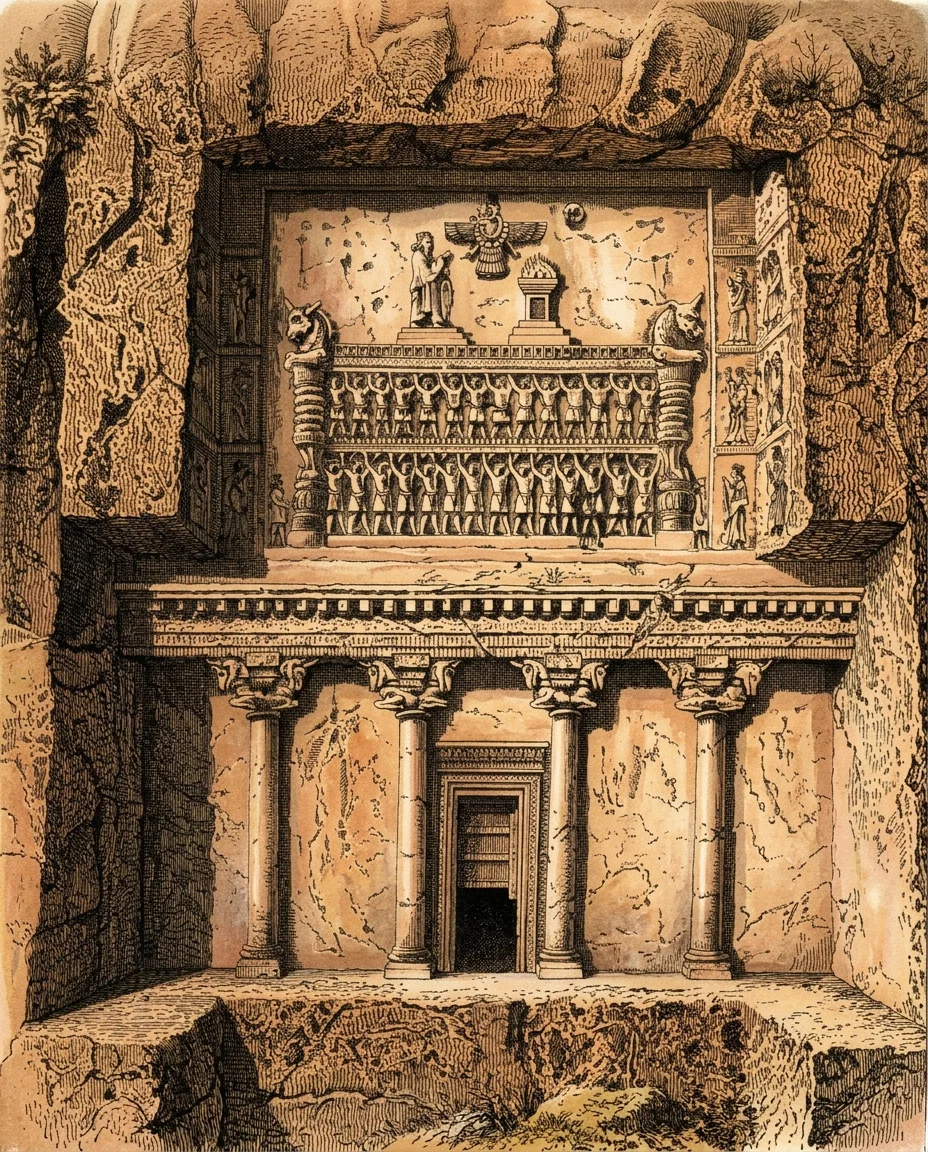
The Rock Grave of Darius.
Daniel was also a faithful servant of God, very scrupulous in regard to the requirements of His law, on which account the Lord had given him great wisdom in both temporal and spiritual affairs. Therefore we may look to Daniel as a reliable exponent of the true relationship of divine and human law. His example, the record of his action when brought face to face with the two authorities in conflict, being given to us in the Word of God “for our learning” (Rom. 15:4), it is well worthwhile to make special note of it.
When Daniel’s fellow-officers failed to find any “error or fault” in his work or character, they concluded to attempt his overthrow on account of his religion. They thought to find occasion against him “concerning the law of his God.” So they came in very subtle and patronizing manner to the king, and asked him to make a law.
When professedly religious men do not like the law of God, they always seek relief in human law. When jealous or overzealous people imbibe a hatred of those who adhere to the law of God, they are prone to trap the objects of their dislike in a “law of the land,” and then make complaint to the authorities. As it is to-day, so it was in Daniel’s time. Those ancient seekers after pre-eminence planned adroitly, making the king believe that they were exceedingly solicitous for his honor.
“Then these presidents and princes assembled together to the king, and said thus unto him, King Darius, live forever. All the presidents of the kingdom, the governors, and the princes, the counselors, and the captains, have consulted together to establish a royal statute, and to make a firm decree, that whosoever shall ask a petition of any God or man for thirty days, save of thee, O king, he shall be cast into the den of lions. Now, O king, establish the decree, and sign the writing, that it be not changed, according to the law of the Medes and Persians, which altereth not. Wherefore King Darius signed the writing and the decree.”
Daniel’s estimate of this statute as compared with the law of God is shown in the fact that he paid no attention to it. Nor did he endeavor to conceal the fact that he disregarded it. With his window open, “he kneeled upon his knees three times a day, and prayed, and gave thanks before his God, as he did aforetime.” Of course the men who had set the trap for him were watching him, and promptly reported his action to the king. Darius now perceived the secret purpose of his officers in desiring the decree, and was “sore displeased with himself” for having allowed them to deceive him. He “set his heart on Daniel to deliver him; and labored till the going down of the sun.” But they were inexorable; they had the law on their side, and even the king could not alter his own decree after it had been signed and sealed. Such was the law of the Medes and Persians. Verses 8, 15.
“Then the king commanded, and they brought Daniel, and cast him into the den of lions. Now the king spake and said unto Daniel, Thy God whom thou servest continually, He will deliver thee. And a stone was brought, and laid upon the mouth of the den; and the king sealed it with his own signet, and with the signet of his lords; that the purpose might not be changed concerning Daniel.”
Such was the consequence of enforcing a human law in conflict with God’s law. And the principle has been the same in all ages, and ever must be when carried to its logical end. But “the Lord bringeth the counsel of the heathen to naught; He maketh the devices of the people of none effect.” Ps. 33:10. King Darius could find no rest that night, either by sleep or by the soothing influences of music. So, early in the morning, “he went in haste unto the den of lions.”
“And when he came to the den, he cried with a lamentable voice unto Daniel; and the king spake and said to Daniel, O Daniel, servant of the living God, is thy God, whom thou servest continually, able to deliver thee from the lions? Then said Daniel unto the king, O king, live forever. My God hath sent His angel, and hath shut the lions’ mouths, that they have not hurt me; forasmuch as before Him innocency was found in me; and also before thee, O king, have I done no hurt.”
Thus we have illustrated in the life and character of Daniel and God’s dealings with him, as also in the faith and practise of our Saviour and His apostles, that “we ought to obey God rather than men.” Acts 5:29.
The subsequent action of the king in casting Daniel’s accusers into the den of lions, and their prompt destruction by the furious beasts, is also an essential part of the foregoing lesson. The king had a right to punish evil-doers (Rom. 13:4) who conspired against the life of an innocent man. Their destruction by the same animals that had been restrained by the angel of God from injuring Daniel, aptly illustrates two points: (1) “The angel of the Lord encampeth round about them that fear Him, and delivereth them.” Ps. 34:7. (2) Of the wicked God says, “He shall bring upon them their own iniquity, and shall cut them off in their own wickedness.” Ps. 94:23. This incident also demonstrated the fact that the Lord is on the side of them that hold His law as the pre-eminent authority, and against them that exalt human law above that of God. The principles of God’s dealings with men are ever the same. The consequences of disobedience are death (Rom. 6:23), but, owing to the long-suffering mercy of the Lord, the sentence is not immediately executed. And “because sentence against an evil work is not executed speedily, therefore the heart of the sons of men is fully set in them to do evil.” Eccl. 8:11.
King Darius acknowledged before his entire empire that the God of Daniel “is the living God, and steadfast forever, and His kingdom that which shall not be destroyed” (Dan. 6:26); but his decree, that all men should “tremble and fear before” Him, was not the utterance of a converted man; it was merely that political policy to secure temporal power in the name of the God of heaven which in our day is known as National Reform. It does not in any sense harmonize with the scriptural call to voluntary service, “Whosoever will, let him take the water of life freely.” Rev. 22:17.
W. N. G.
CONVERSION
By Daisy Morse
1. What is the natural condition of man?
“For all have sinned and come short of the glory of God.” Rom. 3:23.
2. What is sin?
“Sin is the transgression of the law.” 1 John 3:4, last part.
3. Can we keep the law while we have this nature?
“Because the carnal mind is enmity against God; for it is not subject to the law of God, neither indeed can be.” Rom. 8:7.
4. What then must we do in order to be saved?
“Verily I say unto you, Except ye be converted, and become as little children, ye shall not enter into the kingdom of heaven.” Matt. 18:3.
“CONVERT.—To change to another form or state.” —Webster.
5. Who only can make this change in us?
“If the Son therefore shall make you free, ye shall be free indeed.” John 8:36.
6. What kind of a nature does He give us?
“According as His divine power hath given unto us all things that pertain unto life and godliness, through the knowledge of Him that hath called us to glory and virtue; whereby are given unto us exceeding great and precious promises; that by these ye might be partakers of the divine nature, having escaped the corruption that is in the world through lust.” 2 Peter 1:3, 4.
7. What is necessary on our part?
“Repent ye therefore, and be converted, that your sins may be blotted out, when the times of refreshing shall come from the presence of the Lord.” Acts 3:19.
8. What leads to repentance?
“The goodness of God leadeth thee to repentance.” Rom. 2:4, last part.
9. What is it our privilege to believe?
“If we confess our sins, He is faithful and just to forgive us our sins, and to cleanse us from all unrighteousness.” 1 John 1:9.
10. How may we be kept in this condition?
“Who are kept by the power of God through faith unto salvation ready to be revealed in the last time.” 1 Peter 1:5.
DAISY MORSE.
Los Angeles, Cal.
CHARACTER
The most important thing in all the universe is character. The most precious thing in the sight of God is a good character; and, conversely, the most detestable thing in all His realm is a character of the opposite sort; for “the righteous Lord loveth righteousness,” and hateth wickedness.
And so ought every reasonable creature to regard character. But it is a strange fact that many persons regard reputation as of more value than character. That is, they regard what people think of them as of more worth than what they really are. On the face of it such judgment reveals a bad or defective character, which the possessor is willing to exchange for a good or uncertain reputation. Such a choice also reveals either that the chooser has no desire to better his character, or no faith that it will ever undergo transformation.
The supreme character of the universe, supreme in wisdom, strength, and goodness, is that of God; and “God is love.” That character has, besides other ways, been revealed to the world in the person of our Lord Jesus Christ. Wise is that character in that it took in all ages, all times, all lengths and breadths, all heights and depths, foresaw all exigencies which have or could arise, and laid a plan so full, so broad, so complete, so perfect and all-comprehending, that it has met all difficulties and exigencies without surprise, and demonstrated its capacity to meet them till the triumph of ultimate good.
So strong is that character that it triumphs always, even amid seeming defeat. It was thought by the personification of the character of evil that God was overthrown and that good had succumbed, when Jesus Christ was locked under Roman seal in the rock-hewn sepulcher, but by means of death, God destroys him who brought death into the world, the devil. God is strong; and the eyes of the Lord run to and fro throughout the whole earth, to show Himself strong in the behalf of him whose heart is perfect toward Him. His strength reaches not only to the end of this life or world, but reaches into the life to come; therefore, “trust ye in the Lord forever; for in the Lord Jehovah is everlasting strength.”
So loving is God’s character that He withheld not His only-begotten Son, but delivered Him up freely for us all. He commended His love toward us in that while we were yet sinners Christ died for us. Having given Heaven’s choicest gift, will Infinite Love withhold our needs?—Nay; He can not do it; for in giving Christ, He gave all in Christ. And all His attributes of character are perfected in love.
The character of love is the character which God desires in His people. “Be ye therefore perfect, even as your Father which is in heaven is perfect.” Matt. 5:48. God’s goodness, His perfectness, is His glory. Ex. 33:18, 19. Man has fallen short of that glory. His character does not meet the standard. He sold himself under sin. But God in His infinite goodness wishes to restore His character in man, and He has made ample provision that this may be done. That provision is through the sacrifice and mediation of the Lord Jesus Christ. He who will submit to God, who will by faith let God’s Word bring into his life the life of the Lord Jesus Christ, will be transformed to the same character. This God desires, yea, longs for with unutterable longing. He desires it so much that He gave His own Son, and empties heaven of its angelic host, that He may make characters to endure to all eternity.
But to do this, God must have our co-operation. If He has this, the precious treasure of character may be possessed by every one.
OUR HELPING HAND MISSION.
By Editor
The Resolution and the Action.
At the annual meeting of the stockholders of the Pacific Press Publishing Company, held May 4, 1897, the following preamble and resolution were adopted:—
WHEREAS, There is great demand and plenty of room for mission work among the submerged and needy classes in our large cities; therefore,
Resolved, That we would approve of work of this kind being inaugurated and carried on under the auspices and name of the SIGNS OF THE TIMES MISSION, if the incoming directors on fuller consideration consider it to be in the order of the Lord.
At a session of the State Conference held on the camp-ground in Oakland a few weeks later, a large number of the brethren from all parts of the State being present, the resolution was again formally indorsed.
Now the Board of Directors, having given the matter a much “fuller consideration,” do “consider it to be in the order of the Lord.” So certain are they that it is high time to “go out quickly into the streets and lanes of the city, and bring in hither the poor, and the maimed, and the halt, and the blind,” that they have set about to transform the resolution into practical action.
To this end they have called to their aid Brother B. F. Richards, who has made a success of this kind of mission work in the worst parts of Chicago. He is now on the ground, looking up locations in San Francisco and Oakland for work on the same lines.
But all this is only preliminary. There is something else needed, and that is money. While the SIGNS OF THE TIMES assumes the financial burden of rents and running expenses, there is necessarily a large outlay for fitting up such an establishment. There must needs be meeting-room, dining-room, bath-rooms, kitchen, reading-room, bedrooms, etc., which must be especially fitted for the work. Now who will esteem it a special privilege to help in this initial expense, and do it at once? The SIGNS OF THE TIMES desires its friends to share its blessings.
The command is to “go out quickly.” But, urgent as is the command, there must first be the place to which we can bring in those who are in need of immediate help, and those who can not be brought under the Gospel call in any other way. The publishers of this paper are assuming a very heavy burden, but they do so believing that it is the Lord’s work, and that many readers of the paper will be glad to help, at least to give the enterprise a start.
It is proposed not only to do evangelical work, but medical work; not only to reform men spiritually, but physically.
There are many “rough jewels” down in the slums of the cities, who have been brought down by oppression, by misfortune, and by drink. Who will help to raise them up, to cleanse them, and set them upon their feet, that they may be fitted for a place at the Master’s table? The good work is going on in many places, and the demand for it is increasing from year to year.
Send all donations of money to the SIGNS OF THE TIMES, Oakland, Cal. Be sure to state that the donation is for the Helping Hand Mission.
THE HOUR OF DARKNESS AND THE GREAT PROMISES.
By T.
The days just before the coming of the Son of man are made conspicuous because of the trouble that Satan brings upon the world, in his last efforts to deceive and thereby destroy mankind. Says the inspired Word: “Therefore rejoice, ye heavens, and ye that dwell in them. Wo to the inhabitants of the earth and of the sea! for the devil is come down unto you, having great wrath, because he knoweth that he hath but a short time.” Rev. 12:12. And again the Word says, “And there shall be signs in the sun, and in the moon, and in the stars; and upon the earth distress of nations, with perplexity; the sea and the waves roaring; men’s hearts failing them for fear, and for looking after those things which are coming on the earth; for the powers of heaven shall be shaken.” Luke 21:25, 26.
With the distressing conflict between capital and labor all about us; with the accounts of shockingly brutal murders meeting us at every turn; with bribery, embezzlement, and fraud, in both public and private life, glaring at us on every hand; with the plundering and pilfering highwayman making our nights a dread; with storm, earthquake, and pestilence in so many places; and, rising above it all, with the “alarm of war,” amid all the nations of earth as they rush on in this furiously maddening work of preparing for the destructive conflict of the “great day,” ay, with all these things before us, who can say that we are not even now in the midst of that very time when “the devil is come down unto you having great wrath, because he knoweth that he hath but a short time”? And who is there that does not see the vivid realities of the “distress of nations” all over the world? Everything is unsteady and seems to be tottering toward a universal destruction. And in the presence of this terribly awful situation, is it any wonder that, just as the Saviour foretold, there should be seen everywhere “men’s hearts failing them for fear and for looking after those things which are coming on the earth”?
At such a time, how earnestly must the men be seeking for a refuge whose hearts are “failing them for fear,” as they now actually behold “those things which are coming on the earth”! And what a joyous privilege it is for the Christian to point all such to that most precious of promises: “Let not your heart be troubled; ye believe in God, believe also in Me. In My Father’s house are many mansions: if it were not so, I would have told you. I go7to prepare a place for you, and if I go and prepare a place for you, I will come again and receive you unto Myself; that where I am, there ye may be also.” John 14:1–3. What gracious words! Why, these things that have been filling your heart “for fear,” are only the evidences that—and how the words fairly thrill with meaning—“I will come again, and receive you unto Myself”!
Our Lord leaves us in no doubt about the great promise that He will “come again” to this earth. The Word abounds with promises of His coming. As long ago as “Enoch,” “the seventh from Adam,” it was prophesied that, “Behold, the Lord cometh with ten thousands of His saints.” Jude 14. The keener pains of Job’s afflictions were borne away by the assurance that “I know that my Redeemer liveth, and that He shall stand at the latter day upon the earth,” “whom I shall see for myself, and mine eyes shall behold, and not another; tho my reins be consumed within me.” Job 19:25, 27. In poetic beauty David breaks forth in the song: “Let the sea roar, and the fulness thereof; the world, and they that dwell therein. Let the floods clap their hands; let the hills be joyful together before the Lord; for He cometh to judge the earth: with righteousness shall He judge the world, and the people with equity.” Ps. 98:7–9.
Isaiah tells us that “it shall be said in that day, Lo, this is our God; we have waited for Him, and He will save us; this is the Lord, we have waited for Him, we will be glad and rejoice in His salvation.” Isa. 25:9. The assurance from the apostle Paul is that “the Lord Himself shall descend from heaven with a shout, with the voice of the Archangel, and with the trump of God; and the dead in Christ shall rise first; then we which are alive and remain shall be caught up together with them in the clouds, to meet the Lord in the air: and so shall we ever be with the Lord.” 1 Thess. 4:16, 17.
Every reader of the Bible knows that the texts herein quoted are only a few from the many promises of our Lord’s coming. The inspired poets, prophets, and apostles, wrapt in exalted vision, have been permitted to cast their prophetic eyes to the very remotest years of this earth’s allotted time. And each has been cheered and strengthened to endure the conflict by seeing beyond the heart-sickening and heart-rending distresses, woes, and calamities of this world, the effulgent glory of the cloud that bears the adored Redeemer back to earth. His coming has been the one radiant star of hope, in the glorious brightness of which every sin, with all the misery and degradation that it has caused, will be forever destroyed. Then how fitting the apocalyptic benediction: “He which testifieth these things saith, Surely I come quickly. Amen. Even so come, Lord Jesus.” Rev. 22:20.
There is a promise in the text quoted from Thessalonians that should not be overlooked. The statement is that “the Lord Himself shall descend from heaven.” 1 Thess. 4:16. How good these words are! Our Lord does not send a messenger to us; He does not send a substitute; but it is the blessed “Lord Himself.” Are you personally acquainted with Jesus? Has He come to you by His Word and Spirit to pardon every sin, to sweeten every cup of sorrow, to be in you an ever-abiding tower of hope and joy? Have you found Him your ever-sympathizing Friend and constant Helper? Have you learned that His boundless love for you is outstretched toward you every moment, and that “surely He hath borne our griefs, and carried our sorrows”? Do you know that “He was wounded for our transgressions, He was bruised for our iniquities; the chastisement of our peace was upon Him; and with His stripes we are healed”? O, if you know the loving Master, the tender and sympathizing Saviour and Redeemer, how your heart is fairly bursting with joy that “the Lord Himself” is so soon to come again! Indeed, He has done such wonderful deeds of self-sacrificing and valorous love for us that we could not be satisfied with seeing any one else but Him. It must be “the Lord Himself” to meet our expectations and joys. Abraham, Daniel, Isaiah, Paul, John, and all that throng, whose names have become dear to us through the Inspired Record, will be looked for and embraced in that day. But our “Elder Brother,” who so valiantly entered the very “kingdom of darkness” to rescue us,—even our Lord “Himself,”—must be the one central figure in that glad day that will claim our first, our prolonged, and our most devoted attention.
Because He loves us with an everlasting love, and knowing of the affection that is welling forth in our hearts toward Him, and of our intense desire for His coming, He has taken particular pains to describe the manner of this great event so that we may not be deceived by any impostor. “And when He had spoken these things, while they beheld, He was taken up; and a cloud received Him out of their sight. And while they looked steadfastly toward heaven as He went up, behold, two men stood by them in white apparel; which also said, Ye men of Galilee, why stand ye gazing up into heaven? this same Jesus, which is taken up from you into heaven, shall so come in like manner as ye have seen Him go into heaven.” Acts 1:9–11. How definite and clear is this language! It is “this same Jesus,” and He “shall so come in like manner as ye have seen Him go into heaven.” “This same Jesus” that “was taken up; and a cloud received Him out of their sight,” “shall so come in like manner.”
How often do the promises of His coming mention that He comes in the “clouds”! But many other facts are given as well. “Behold, He cometh with clouds; and every eye shall see Him, and they also which pierced Him; and all kindreds of the earth shall wail because of Him.” Rev. 1:7. Here it is stated, not only that “He cometh with clouds,” but also that “every eye shall see Him.” Just as the eyes of the apostles beheld Him when He went away, so shall “every eye” “see Him” as He returns. But He does not return alone, “for the Son of man shall come in the glory of His Father with His angels.” Matt. 16:27. And again, “When the Son of man shall come in His glory, and all the holy angels with Him, then shall he sit upon the throne of His glory.” Matt. 25:31.
So then the event of His coming is considered of such great importance that all the glory of heaven is poured out upon Him and around Him as He returns. For He comes “in the glory of His Father!” He comes “in His glory.” Aye, and added to all this, in the blazing brightness with which God has surrounded each, He is escorted in that triumphal day by “all the holy angels”!
In view of this surpassing glory that attends His coming, is it any marvel that the dazzling brightness of the lightning should be used as the only fitting semblance with which to liken the scene? “For as the lightning cometh out of the east, and shineth even unto the west; so shall also the coming of the Son of man be.” Matt. 24:27.
The mind that has been reverently dwelling upon these blessed scriptures can never be led astray. None of the “false christs” or “false prophets” that the Word tells us will arise, can entrap his well-fortified soul. All the pretended glory and superficial glamor that can surround these impostors will not meet the heightened expectations of him who dwells amid the sublime realities of these promises of God.
And since the Word renders it so sure that He is coming again, are you prepared to meet Him? He loves you and wants you to be among them who will thrill with rejoicing in the glories of that day. Receive Him now, and “this same Jesus” will prepare you for the gladness of that near day when “the Lord Himself” shall return. T.
THE WORK OF THE CHRISTIAN.
The Christian is not called to a self-salvation. This is included in the call, but it is not its object. He is called to give, even to give his life. The life, the law of love is to give. God gave Himself in giving His Son. Jesus Christ gave Himself. To make the salvation of ourselves the object of our faith and work is to defeat our object. “Verily, verily, I say unto you, Except a corn of wheat fall into the ground and die, it abideth alone; but if it die, it bringeth forth much fruit. He that loveth his life shall lose it; and he that hateth his life in this world shall keep it unto life eternal.” John 12:24, 25.
This is the law of Christian life and work. It does not mean that the Christian shall commit suicide, or flagellate the body, or do penance in any way. But it does mean that the life, our life, with all its powers, shall be given to God, for Him to direct, to use for the salvation of other souls and the advancement of our Redeemer’s kingdom. It is the vicariousness of Christ’s life poured out through His followers for the salvation of others. “But ye are a chosen generation, a royal priesthood, an holy nation, a peculiar [purchased] people.” And what is all this for—“That ye should show forth the praises [virtues, excellences] of Him who hath called you out of darkness into His marvelous light.” 1 Peter 2:9. And Christ’s excellences of character His followers show forth by doing the same work in the same Spirit that He did.
Reader, is this your conception of Christian life and duty? or are you among those who are seeking only your own salvation? If this latter be the case, deceive yourselves no longer. Give yourselves to God. Go to work in the great white harvest-fields now.
Cherishing Sympathy
By J. Beattie
LET us cherish sympathy. By attention and exercise, it may be improved in every man; it prepares the mind for receiving the impressions of virtue, and without it there can be no true politeness. Nothing is more odious than that insensibility which wraps a man up in himself and his own concerns, and prevents his being moved with either the joys or the sorrows of another.—J. Beattie.
Question Corner
“Enquire and make search and ask diligently.”
693. Ezra and Nehemiah.
Does the number of the Israelites who returned to Babylon as given by Ezra agree with that given by Nehemiah?
They both give 42,360. See Ezra 2: 64 and Neh. 7: 66. There is a difference in the singing women of forty-five. One gives the round number; the other is exact. The items do not amount to the whole number, probably from the fact that there were some from other tribes whose genealogy could not be traced. There is nothing in this against the divine record.
694. The Soul and Visions.
If the soul or spirit of man does not leave the body, how is it that the Lord’s prophets have so often been taken to heaven, conversed with heavenly beings, etc., while the body was not moved, and apparently lifeless? L. C. H.
Do not people dream, and in their dreams go to other places and talk with other people?—But there is no separation of soul and body. God can by divine photography reveal to our minds that which the natural eyes can not see. Those in the prophetic trance are not dead; the bodily functions are only suspended; but “the body without the spirit is dead.” The prophetic trance or vision is not a separation of life, or soul, or spirit from the body, but divine telegraphy and photography, by which God speaks and portrays to the mind events not known to the natural man.
695. “The Letter Killeth.”
Please explain 2 Cor. 3: 6, “the letter killeth,” and verse 7 which speaks of “ministration of death,” and verse 9, “the ministration of condemnation,” also verse 11, “if that which is done away.” Does condemnation here refer to the Ten Commandments when transgressed? and what is “done away”? O. C. H.
The letter there referred to is the letter of the New Testament. The letter is the mere outward form, the mere theory, which will save no one. It will but condemn him who receives no more. Israel of old received the law in the letter alone, and were condemned. Moses received it by faith in the Spirit, the very Gospel, and was justified. God’s Word or law is a minister, if transgressed, of condemnation; if received by faith, of righteousness. What is “done away” is done away only in the believer. The condemnation is done away by the righteousness. The glory of the condemnation of the letter alone fades away in the glory of the righteousness by faith which receives the law in the heart. For fuller explanation see Bible Students’ Library, No. 149, 24 pp.; price, 2 for 3 cents; entitled, “From Glory to Glory.”
Will you please explain Matt. 25: 26, 27, which reads: “His lord answered and said unto him, thou wicked and slothful servant, thou knowest that I reap where I sowed not and gather where I have not strawed; thou oughtest therefore to have put my money to the exchangers, and then at my coming I should have received mine own with usury”? D. M.
It is a part of the instruction of the parable of the talents. It does not mean that God is a hard or cruel master; but it does teach that the wicked will have to give an account of their stewardship, as truly as the righteous. The wicked servant, knowing that he would be called to give an account, hid his talent in the earth, and excused himself on the plea that his Lord was an exacting master. All the more then he ought to have used his talent. He was judged out of his own mouth. See Luke 19: 22.
NEW FIELDS FOR CLERGYMEN.
Much was said in condemnation when an ex-United States senator consented to write his impression of a prize-fight for a prominent western paper. The latest sensation in this line is the securing of a clergyman for this purpose. A late prize-fight in New York was reported through a sensational paper of that city by John L. Sullivan and the Rev. R. H. P. Mills, pastor of Ravenswood Presbyterian Church, and their pictures appear side by side in the paper. This clergyman excuses himself on the plea of a “chance to speak boldly and write a protest to so great a multitude of readers,” and he had gone to see that he “might speak with authority, and, with God’s help, would stay it out.” And he did stay it out, and reported the fight. From this logic we would conclude that to speak boldly, to speak with authority, and protest against evil, one must know and see the evil. He must visit the theater, the prize-fight, the gambling-hell, the houses where virtue is sold and shame is not known. There was One who lived upon this earth who spake “as never man spake, who taught as one having authority and not as the scribes.” And what He taught was not what He learned at the prize-ring, but what He learned from God. John 3: 11. And when He sent forth His ministers, it was with the one sole mission of preaching the Gospel. And here is another field.
The New York Journal of December 17 reports that—
“The Rev. E. L. Stoddard, rector of St. John’s Episcopal Church, Jersey City, proposes to start a dancing class in connection with the church, and says that he will be prepared to give instruction at the rate of six cents a lesson. The rector further adds that he has already secured twenty pupils, and that when the list reaches forty, the class will be opened.”
It is a cause for weeping and mourning by every true Christian, and no wonder the world is disgusted at religion and hardened in heart when it beholds such travesties. And yet “the foundation of God standeth sure, having this seal, The Lord knoweth them that are His, and, Let every one that nameth the name of Christ depart from iniquity.” Such things as noted above are becoming more and more frequent, and less and less abhorrent. But they do not destroy God’s Word, nor should they destroy confidence in it, for they are the fulfilment of just what God said should come in the last days. Matt. 24: 12–14; 2 Tim. 3: 1–5. While they are a cause of grief to every loyal Christian heart, they are signs of our Master’s coming to usher in the reign of the good, the pure, the true.