Pacific Press Publishing Association · Mountain View, California · Oct 24, 1911
"IF YE WILL INQUIRE, INQUIRE YE."
By Editor
This Inquirers' Department is conducted for the purpose of helping those who are studying the Bible. The answers are oftentimes only suggestive. They are never to be considered infallible, only as they agree with the infallible Word. The writer who may answer them does not consider that his opinion is infallible. He will simply give the best that he has, and plead with the inquirer to search the Word. Such questions only will be answered as, to the editors, seem to minister to the good of the readers and to the mission of the paper. We can not answer repeatedly in the same volume questions upon the same scripture. The name and address must accompany question, not for publication, but as an evidence of good faith, and that answer may be made by letter if deemed advisable. No letters are answered which do not contain the name of the writer. It is well always to enclose stamp for reply.
3592 — Sabbath and Covenant
By Editor
Please give me Scripture to prove that Abraham kept the seventh-day Sabbath, and also explain why God says in Deut. 5:3 that He "made not this covenant with our fathers." Does that mean that Abraham was not under the law of Ten Commandments? H. B. L.
1. It is very clearly taught in both Gen. 2:2, 3 and Ex. 20:8-11, that one of the commandments of God, one of the laws of God, one of His precepts, is that which enjoins the seventh-day Sabbath; and the Word expressly declares concerning Abraham, "Abraham obeyed My voice, and kept My charge, My commandments, My statutes, and My laws." Please note that Abraham obeyed God's "voice," and that is just what the Ten Commandments are declared to be. Compare Ex. 19:5 with Ex. 20:1-17 and Deut. 5:22. This clearly shows that Abraham observed the Sabbath of the Lord, as God commanded.
2. "Our fathers" in Deut. 5:3 is used to emphasize the importance of Israel's obedience. It is not that God did not always wish His people to obey, but Moses would impress upon those who were listening to his voice that that covenant was made with them who were there. But that covenant is not the Ten Commandments; it was the agreement between God and the children of Israel. See Ex. 19:4-6. Do not get the wrong idea concerning the expression "under the law." Generally "under the law" does not mean under obligation to keep the law, but under the condemnation of the law. The expression is a New Testament expression. See the tract entitled " 'Under the Law,' or 'Under Grace'?" Bible Students' Library No. 163. This clearly explains all those expressions in the New Testament "under the law." He only is not under the law who obeys it. He who obeys it has the law of God written in his heart; he is with the law. He who is under the law is condemned by the law. Grace takes that condemnation away, but it does not take the condemnation away that man may break the law. It cleanses the man from sin, and takes away the condemnation, in order that the righteousness, the requirement of the law, "might be fulfilled in us, who walk not after the flesh, but after the Spirit." It is only the carnal mind that is in rebellion against God and His law.
Note
By Editor
Note.—These three schedules are given to bridge over the next two weeks, in which our great Missions Number will appear, and in this we have found no space for our Bible Band schedules. Our next regular issue will be November 14.
Our first four days' readings cover Psalms 95 to 106, a wonderful history, God's wonderful providences told in song, which Israel should ever keep before them.
The book of Acts begins with November 2, the book written by Luke, the "beloved physician"—really a companion book to his Gospel, addressed to the same one, Theophilus, and probably written very few years after the Gospel. It does not cover the lives of the apostles. After a few chapters on the early church, the outpouring of the Spirit of God, and the mighty power which attended it, it deals almost wholly with the work of the apostle Paul. Here is a good opportunity for those who are behind in their readings, but who are studying Acts in their Sabbath-school lessons, to drop it out of the regular readings, and catch up.
Inasmuch as this week's readings are wholly upon Acts, covering the same ground as our Sabbath-school lessons, dealing with matters that are clearly understood, we omit further comment.
Bible Reading Schedule
Schedule for Week Ending November 18, 1911
Sunday
November 12
Acts
20, 21
Monday
" 13
"
22-24
Tuesday
" 14
"
25, 26
Wednesday
" 15
"
27, 28
Thursday
" 16
1 Thess.
1-4
Friday
" 17
"
5
2 Thess.
1-3
Sabbath
" 18
1 Cor.
1-4
The book of Acts is concluded with the apostle Paul in Rome, in our reading of November 15. The study of the book in our Sabbath-school lessons concludes with the quarter.
In the three following days we cover the first two epistles written by the apostle Paul, Thessalonians 1st and 2d. They are addressed to Christians who lived in the city of Thessalonica, yet a considerable town in Western Turkey known as Saloniki. The first epistle was written in 54, probably the second either the same year or the next. Of Paul's early labors in the Macedonian city at the head of the Thermaic Gulf we have learned in Acts 17. In Paul's day it was a free city, governed by seven politarchs. It was rebuilt by Cassander in 315 B.C., and renamed after his wife, sister of Alexander the Great. From 146 B.C. it was the seat of the Roman government in Macedonia. After Corinth it was the second commercial city of the European Greeks, and is now the second city of European Turkey.
The first epistle of the apostle is very clear, very simple, commending the Thessalonians for their "work of faith," and "labor of love," and "patience of hope," warning them of dangers, and ever and again bringing before them the coming of the Lord. The second epistle shows that they had received a wrong idea from the first epistle, and thought Christ's coming was imminent in their day. This the apostle corrects, and tells them that the coming of Christ should not occur until the great apostasy had taken place, the character of which he very graphically describes.
The last day of the week we begin the reading of Paul's third epistle, the first to the Corinthians, altho some scholars place Galatians the year before. This was probably written in the year 55, altho some place it as late as 59. We have already learned of the founding of this church in the Acts, during Paul's stay at Corinth 52 to 54. His work there was continued by Apollos. Disorders crept in through Judaisers and Greek philosophy, the moral tone was greatly depressed, and this epistle of Paul was written to correct these things. This epistle and the one following reveal much of the personality of the apostle.
3591 — Is Polygamy Sin?
By Editor
God told man to be fruitful and multiply. Gen. 1:22, etc. It certainly was no evil, or sin, for a man to have more than one wife. See instructions given in Deut. 21:15-17. And there were many illustrious characters who had more than one wife. David did, and he is said to be "a man after God's own heart." H. M.
In the first place, it would seem that if God designed that man should have more than one wife, He would have made more than one wife for Adam. It does not say that he made them male and females, but "male and female," a female for a male. He gave to Adam one wife, and the divine expression is, "They twain [the two, not four nor five, nor three even, but the twain] shall be one flesh." We have no more reason to gather from the Scripture that polygamy is right than polyandry is right. Why has not the woman just as much right to two or more husbands as the man has to two or more wives? Tibet, we believe, has this law, but we would hardly want to take Tibet for an example.
Secondly, God wishes man to learn some things in the providential outworking of events, as well as by direct precept. Man had in the beginning God's plan clear and direct. He ought to have followed that plan. When the males were killed off in war and strife, man began to multiply wives to himself, contrary to God's plan. And man's devices have had some sad outworkings. Good men have failed to carry out God's plan. Their hearts have been right, and God has accepted them notwithstanding their sins, but this does not excuse their sins, or their bad example, or the bad results. Abraham had many trials and much sadness on account of his two wives. He would have saved much of his trial if he had believed God and refused to act on Sarah's suggestion. Isaac's life seems to have been a quiet and happy one; he had but the one wife. Jacob had two wives, and his life was miserable in consequence, on account of the jealousies of the wives and of the sons. David had more than one wife. He was a man after God's own heart in his sorrow for sin, in his devotion, in his faithfulness, in his willingness to receive God's reproof; but he certainly did not follow God's way in multiplying wives to himself, and went directly against the commandment of God, that the king should "not multiply wives" to himself. Deut. 17:17. But just as soon as a man has more than one wife at the same time he multiplies wives to himself. We have only to think of the sad history of David's family, of his rebellious and wayward sons, to see the folly of his many wives. So also with Solomon. In the teaching of Jesus He brings us right back to the original plan of Eden. "He which made them at the beginning made them male and female, and said, For this cause shall a man leave father and mother, and shall cleave to his wife [one]; and they twain shall be one flesh." Surely it is contrary to God and His truth and His plan to have more than one wife, and to be contrary to God is missing the mark, and missing the mark is sin.
Please explain the 20th verse of Isaiah 65. H. A. G.
Note the context. Verse 17 is God's promise of a new heaven and a new earth. Verses 18 and 19 are expressions indicating the rejoicing that there will be over the new Jerusalem, and the joy which God shall have in His people. He declares that at that time the voice of weeping shall be no more heard, nor the voice of crying. Then comes the verse in question, verse 20: "There shall be no more thence an infant of days, nor an old man that hath not filled his days: for the child shall die an hundred years old; but the sinner being an hundred years old shall be accursed." This end of sin and sinners seems to be just previous to the time when the children of God shall enter upon the new heavens and the new earth. Revelation 20 and 21 throw great light upon this passage. At the second resurrection the wicked are raised. Then they are deceived by Satan and gathered into great armies. It will take some time for Satan to organize these armies, to form governments, to forge weapons, to devise instruments of torture and destruction; and it may be safely said that the enemy of all righteousness will do everything in his power to make these things perfect and complete.
This period of time will be a hundred years in length. During that time children will be born, doubtless, to the wicked, who will be raised from the dead as they went down. There will be a mighty lesson for all the universe of God. Satan, who has charged God with unrighteousness and injustice, will have the earth, and absolute control of the peoples of the earth, so that he may demonstrate what kind of government he will have, what kind of characters will be developed in children born under such conditions. But at the end of that hundred years the children shall die, as those found worthy of death. They have not within them the seeds of life, which can come only by faith. And the wicked man raised at the beginning of that hundred years dies at the close a wicked man. God's character is vindicated in the destruction of sin and sinners. Then, too, the universe learns this lesson: Men have claimed to be able to persist in and of themselves alone, naturally immortal; but their experience at the end of the thousand years, in preparing to fight against God, shows that they are not worthy to be immortal, and are not immortal, for at the end of that time they die. Then God's children shall enter upon the new heavens and the new earth, upon which there shall be no remembrance of the curse, which has perished with sin. For fuller answer see the book "Questions and Answers," No. 238, page 228.
SIGNS OF THE TIMES
"Even as we have been approved of God to be entrusted with the Gospel, so we speak: not as pleasing men, but God, who proveth our hearts."
Christ Adjusts the Claims Between Earth and Heaven
By Mrs. E. G. White
By Mrs. E. G. White
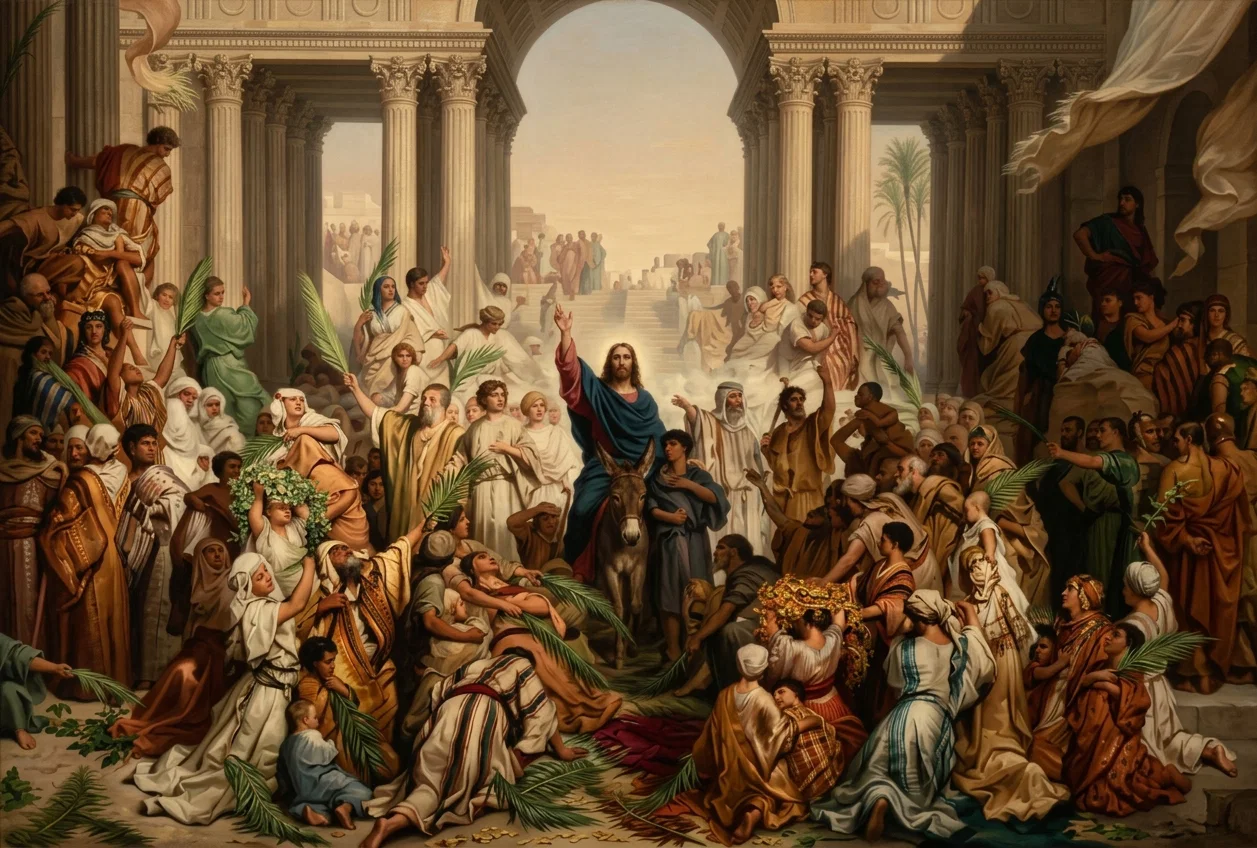
CHRIST RIDING INTO JERUSALEM
THE abominations of the earth have defiled the minds of men, and made gross their imagination, until nothing is pure to the mind's eye. God designed that the mind should be elevated and noble, that through the merits of the crucified and risen Saviour the soul should be pure and exalted; not through the contemplation of defiling things. Through setting the affections upon the so-called treasures of this earth, the mind is debased, and incapable of appreciating heavenly things. God designed that man's mind should be capable of rising to heights of pure delight, that we might take in the significance of things infinite and eternal, looking upon views of which God is the center; yet through submitting themselves to Satan, men have lowered themselves to fulfil the devices and plans of Satan, thus completing the ruin of soul, body, and spirit.
But "God so loved the world, that He gave His only-begotten Son, that whosoever believeth in Him should not perish, but have everlasting life." The Lord Jesus sees with what masterly power Satan is working to obliterate in man the image of God, and to place upon him his own image and character. Through His love for the fallen human family, Christ consented to come to this world. He clothed His divinity with humanity, and engaged in the task of correcting the evils which are ruining the world. As He looked upon the world, He saw that the senses of men were closed to the eternal realities, and He sees to-day the same blindness to spiritual things. He lifts up His voice in warning. Listen; what does He say?—"What shall it profit a man, if he shall gain the whole world, and lose his own soul? or what shall a man give in exchange for his soul?"
Earth and earthly things will perish with the using. A few years will pass by and death will come. Your eternal destiny will be fixed, eternally fixed. If your soul is lost, what will compensate you for its loss? Christ the Life-Giver, Christ the Redeemer, Christ the Lamb of God, who taketh away the sins of the world, points you to a nobler world. He brings it within range of your vision. He takes you to the threshold of heaven, and brings you to contemplate the glories of eternal realities, that your aspirations may be quickened to grasp the far more exceeding and eternal weight of glory. As you contemplate heavenly scenes, desire is kindled in your heart to have friendship with God, to be wholly reconciled to Him.
The Fear and Love of God
Our Saviour's work is to adjust the claims between earthly and heavenly interests, to put the duties and responsibilities of the life that now is in proper relation to those that pertain to eternal life. The fear and love of God are the first things that should claim our attention. We can not afford to put off till to-morrow that which concerns our soul's interest. The life which we now live we are to live by faith in the Son of God. We are redeemed from the beggarly elements of the world with a redemption that is full and complete, that can not be increased by any supplement from human sources.
But in the midst of this flood of mercies, this plenitude of divine love, many hearts continue in indifference, careless, and unimpressed4by the provisions of God's grace. Shall we who claim to be Christians make no effort to break the spell which Satan has cast upon these souls? Shall we let them go on in hardness of heart, without God, and without hope in the world?—No; altho every appeal we may make may be slighted and refused, we can not cease to pray for them and to make tender entreaty for their souls. We must do all we can, through the aid of God's Holy Spirit, to break down the barriers by which they have sought to make themselves impregnable to the light of God's truth. We must seek to open their eyes to their blindness, to loose them from the captivity of Satan. These poor, deceived, blinded, deluded souls look upon religion as something that will fetter them, that will deprive them of their liberty, when the truth is that an infinite sacrifice has been made in order to emancipate them from the slavery of Satan, to break every yoke, and to let the oppressed go free. They are victims of the father of lies, and it is the truth of God alone that can set them free, and sanctify them to a blessed service. They seem to feel afraid of the truth, lest it should bring them into subjection to Christ. Shall we who know the value of truth arouse our sleeping energies, and become laborers together with God, putting forth personal effort, that we may by both precept and example win souls to Christ?
If once the vision were cleared to behold eternal realities as they really are, many of these poor, deluded souls would decide for Christ and heaven. Would this incapacitate them for the affairs of this life?—No. But Christ would teach them the value of eternal life, and by comparing earthly treasure with heavenly treasure, would show them of how little esteem the world is in contrast with eternal blessedness among the redeemed hosts. He would show them that the world and its engrossing engagements are to be kept in subjugation to heavenly interests. Jesus did not come to annihilate the world and its appropriate interests. He made the world, and He had such respect for the world that He came in person to dispute Satan's usurped authority and power over His own purchased possession. In dealing with the souls of men, He deposes the world and its interests from its position of usurped authority, and assigns to it its proper place in subordination to the will of God.
The object of the world's Redeemer in coming to earth was to impress the minds of men with high and solemn considerations, so that every moment of life might be regarded by them as burdened with momentous interests and freighted with eternal results. The world was in rebellion against Him, and He might have swept away all rebellion by annihilating those who were in resistance to His will; but instead of this, He set before men the value of life, the attractions of the heavenly world, and He invites every son and daughter of Adam to seek first the kingdom of God and His righteousness. In place of exhausting the powers of brain, bone, and muscle in securing the bread which perisheth, He warns us not to drop eternity out of our reckoning, but to seek for the bread which cometh down from heaven. It is safe for us to put forth our chief endeavors to secure eternal substance. He encourages us to have our principal interest in heaven, and in so doing to secure our peace on earth, for where the treasure is, there will the heart be also.
Doré
The Early Christian and the Sabbath
By W. H. Bunch
(Concluded from last week)
By W. H. Bunch
[In his previous article Mr. Bunch gave evidence to show that the apostles and their associates respected only the seventh-day Sabbath, and that the Romans of the first centuries of the Christian era made no distinctions between Jews and Christians, and, along with this, historical data was presented showing that no controversy or discussion in that early period called in question the validity of the seventh day as the regular weekly Sabbath.—Editors.]
THE crime of Judaizing caused the banishment of the apostle John, together with many other influential Christians and Jews. The death penalty was inflicted on some for the same reason, among whom was Flavius Clemens, first cousin to the emperor Domitian. (“History of the Romans,” Merivale, volume 7, chapter 62, pages 124-127.)
Again we are confronted with the unavoidable conclusion that Christianity at the close of the first century retained all the fundamental principles and practises of the parent stem, and was not distinguishable from it by any changed attitude toward the Decalogue—the central fact in the matter of observance of the whole Mosaic system. Deut. 4:2; Eccl. 12:13. The year 182 A.D. marks the date when the Christians became known to the Roman government and people as a separate religious body from the Jews, and this separation was precipitated by the Jews themselves. (Idem, chapter 65, page 294.)
The Distinction Perceived
The immediate cause of their expulsion from Judaism is given by the historian as follows: “They [the Jews] complained that Hadrian had enrolled himself as a proselyte of the law, and were doubly incensed against him as a persecutor and a renegade. This assertion indeed may have no foundation; on the other hand it is not unlikely that this prince, a curious explorer of religious opinions, had sought initiation into some of the mysteries of the Jewish faith and ritual. But however this may be, he gave them mortal offense by perceiving the clear distinction between Judaism and Christianity, and by forbidding the Jews to sojourn in the town which he was again raising on the ruins of Jerusalem, while he allowed free access to their rivals.”—Idem, page 317. It is interesting to note that this distinction between Jews and Christians as it appeared to the emperor Hadrian rests principally on the rite of circumcision, which he now forbade the Jews to practise (Idem, page 317), and the doctrine of the trinity (Idem, chapter 66, pages 368, 369). Not once does the Sabbath inject itself as a distinguishing element between Judaism and Christianity. The year following, or in A.D. 133, the Christians began their experience as an independent religious body; and speaking of the reported regard in which they were held by Hadrian, the historian continues: “We hear indeed of the graciousness with which he allowed them, among other sectarians, to defend their usages and expound their doctrines in his presence; and doubtless his curiosity, if no worthier feeling, was moved by the fact, which he fully appreciated, of the interest they excited in certain quarters of the empire. But there is no evidence that this favor extended further than to the recognition of their independence of the Jews, from whom they now formally separated themselves, and the discouragement of the local persecutions to which they were occasionally subjected.”—Idem, chapter 65, page 319.
The Injection of Sunday Unavoidable
It may be asked if equally conclusive indications of the early observance of Sunday by Christians is not in evidence. The student of these rival institutions is fully prepared to admit not only this fact, but he is also sensible of the existence of conditions which made the injection of Sunday into the Christian system not only probable but almost unavoidable. Paul clearly shows the already developing tendency to set aside the claims of God’s law even in his day: “For the mystery of lawlessness doth already work; only there is one that restraineth now, until he be taken out of the way. And then shall be revealed the lawless one, whom the Lord Jesus shall slay with the breath of His mouth, and bring to naught by the manifestation of His coming.” 2 Thess. 2:7, 8, A.R.V. “I know that after my departing grievous wolves shall enter in among you, not sparing the flock; and from among your own selves shall men arise, speaking perverse things, to draw away the disciples after them.” And the disciple whom Jesus loved had a foretaste of this spirit of self-exaltation out of which grew all the errors and bloody experiences of the Middle Ages. “I wrote somewhat unto the church: but Diotrephes, who loveth to have the preeminence among them, receiveth us not.” 3 John 9.5As the Christians were themselves at first sectarians innovating on the national creed of Judaism till they were cast forth from its bosom, so there soon appeared within the pale of Christianity a strong disposition to discover fresh modification of Christian doctrine, and provoke expulsion from the new community. The church sought to convince the innovators alternately by argument and authority, and it is clear from her earliest traditions that she leaned to the second of these means at least as readily as to the first. Her discipline was drawn closer by the stricter organization to which she was now subjected; the decision of questions of doctrine was brought to a more definite point by the formal ratification of a canon of Scripture, and the interpretation of Holy Writ was referred to a tradition, the keys of which were lodged with her rulers, the bishops.—“History of the Romans,” volume 7, chapter 65, pages 294, 295.
Lawlessness and Greed Taking Possession
A startling glimpse is given of the extent to which the spirit of “lawlessness” and greed had taken possession of the Christian church, at least in Egypt, before the first half of the second century had passed. Let us keep in mind the fact that “the fundamental theory of the Egyptian religion was that whatever gave life was worthy of adoration. The sun, or the spirit that ruled the sun, was pre-eminently the giver of life; therefore the sun, or the spirit of the sun, was a god, and worthy of worship in the highest.”—Ridpath’s “History of the World,” volume 1, chapter 5, page 83. During Hadrian’s stay in Alexandria, he wrote a letter to Servianus, his brother-in-law, in which occur the following statements showing that sun-worship among the leading Christians of that city was at least countenanced: “I am now become fully acquainted with that Egypt which you extol so highly. I have found the people vain, fickle, and shifting with every breath of opinion. Those who worship Serapis are in fact Christians; and they who call themselves Christian bishops are actually worshipers of Serapis. There is no chief of a Jewish synagogue, no Samaritan, no Christian bishop, who is not an astrologer, a fortune-teller, and a conjurer. The patriarch himself, when he comes to Egypt, is compelled by one party to worship Serapis; by the other, Christ. They have but one god [alluding to their love of money]; him Christians, Jews, and Gentiles worship all alike.”—“History of the Romans,” volume 7, chapter 66, pages 373, 375. In “History of the Romans,” volume 6, chapter 54, page 218, it is stated that the day following the Sabbath was honored as the day of the Lord’s resurrection; and in a foot-note at the bottom of the same page is shown a digression from the primitive church in marriage ceremonials. The latter, he says, “are derived from heathen usage.” He makes no such charge as to the honoring of the first day of the week, but its setting shows that it was becoming a rival to the true Sabbath. Passing over the spiritual darkness of two centuries, we are brought face to face with the outgrowth of this commingling of Christian and heathen usages. “To this epoch belong the great activities of Constantine.”
A Fourth Century Sunday Law
He was indefatigable in promoting what he deemed to be the reforms demanded by the times. The bottom questions which he had to confront were essentially religious. His great principle of action looked to the union in one body of the Christian and the pagan populations of the empire. . . . In the year 321 a statute was enacted forbidding all secular employment and civil procedures on Sunday. . . . Meanwhile Licinius in the East looked with alarm and jealousy on the proceedings of his colleague. Himself more of a pagan than a Christian, and disliking the whole tendency of consolidation which Constantine had so diligently fostered, he sought to undo the political and religious fabric which his colleague was rearing around himself in the West. War broke out between the rival emperors in A.D. 323. . . . In A.D. 325 he convened a great council at Nicæa, the modern Nice, in Bithynia, and here was undertaken the work of unifying the dogmas of the faith. Constantine himself, supported by a body of soldiers, presided over the deliberations. He heard the testimony of the various priests and bishops as to the traditional beliefs which they had received and taught. Judgment was rendered on the questions at issue between the conflicting parties, and a standard of orthodoxy established for the future government of the Christian world!—Ridpath’s “History of the World,” volume 3, chapter 66, pages 329-331.
The utter abandonment of all moral restraint as a result of this merging of paganism and professed Christianity is aptly illustrated by a single example.
Several years before this event [or about A.D. 365] the pope Liberius passed away, and his death was followed by an unseemly and bloody contest among the aspirants for his place. The pontificate had now become the principal office in Rome. Every element in the lust of power whetted the appetite of him who sought the place of chief bishop of Christendom. Wealth, honor, luxury, the devotion of man, the adoration of woman, everything which could contribute to inflame the ambition and dazzle the vision of a vainglorious devotee, appealed to the imagination of the ecclesiastic contending for the prize. Two candidates, Ursinicus and Damasus, presented themselves for the suffrages of the church. Both claimed to be elected. Violent tumult ensued. The parties armed themselves and rushed to the conflict. The prefect of the city exerted himself in vain to maintain the peace. For several days the riot continued unabated, until what time the ladies of Rome, with whom Damasus was a favorite, interfered in his behalf and brought him off victorious.—Idem, pages 333, 335.
The First Anathema Against Sabbath Observance
Out of this vortex of lawlessness issued the first anathema against Sabbath observance by the so-called Christian church, date about A.D. 375. To keep the Sabbath “according to the commandment” was denounced as Judaizing by that semi-pagan organization — a charge still applied to those whose faith rests upon the Inspired Word rather than on the developments of the fourth century. “And then shall be revealed the lawless one, whom the Lord Jesus shall slay with the breath of His mouth, and bring to naught by the manifestation of His coming; even He, whose coming is according to the working of Satan with all power and signs and lying wonders, and with all deceit of unrighteousness for them that perish; because they received not the love of the truth, that they might be saved.” 2 Thess. 2: 8-10, A.R.V. The Sabbath and Sunday are emphatically rival institutions. The one has its origin with the Creator of this earth, who is also the Saviour of mankind. The other is inseparably associated with every apostasy of God’s children, from the earliest times to its most successful usurpation during the Dark Ages. Thus while history witnesses the fact that during the first two centuries of our era, the true Sabbath was held as sacred by the followers of Christ, it as clearly shows that during the succeeding two centuries its rival, with its attendant excesses, developed and so rooted itself into the Christian system as to completely baffle the overwhelming proofs of Bible and history to dislodge it.
After All
By R. A. Gilstrap
By R. A. Gilstrap
We build our nets of mighty steel,
Our lofty towers of brick and stone;
The farthest oceans know our keel;
Our thoughts are flashed from zone to
zone.
But who can spin the spider's net
In true design 'twixt petals light?
And who has ever gathered yet
The brilliance of a bubble bright?
Our engines run on tracks of steel;
Our guns may strew destruction forth;
And who can read, and can not feel
The life-throbs of the South and North?
But never stream has upward run,
And never crocus bloomed in June;
Or 'neath a chill December sun
Has robin sung his vernal tune.
We sail the air on silken wing,
Explore the deep in submarine,
To time and space defiance fling
In carriage sped by gasoline.
But spring and summer still hold sway;
No rain will come because we call;
The hurricane no man can stay;
And winter ever follows fall.
O man! They say thy power is great;
Thy knowledge broadens day by day;
But ever know that, soon or late,
Thy fretting soul shall pass away.
But oceans still shall ebb and flow,
And light and darkness still are sure;
Tho nations come and nations go,
'Tis God forever shall endure.
Denial
By Susan Coolidge
Not only Peter in the judgment-hall,
Not only in the centuries gone by,
Did coward hearts deny Thee, Lord of all!
But even in our time, and constantly;
For feeble wills, and the mean fear of men,
And selfish dread, are with us now as then.
To-day we vow allegiance to Thy name;
To-day our souls, ourselves, we pledge to Thee;
Yet if a storm-wind of reproach or blame
Rises and beats upon us suddenly,
Faltering and fearful we deny our Lord,
By traitorous silence or by uttered word.
We close our lips when speech would wake a sneer;
We turn aside, and shirk the rougher path;
We gloss and blink as if we did not hear
The scoffing word which calls for righteous wrath.
All unrebuked we let the scoffer go,
And we deny our Lord and Master so.
Come Thou, as once of old Thou camest in
And "looked on Peter" in the judgment-hall;
Let that deep, grieved gaze rebuke our sin,
Questioning, recalling, wakening, pardoning all,
Till we go out and weep the whole night long,
Made strong by sorrow as he was made strong.
—Susan Coolidge.
Instructed by the Bible
A ROMAN Catholic priest in Ireland was one day passing by some men and boys who were engaged in breaking stones for a new road. He said that the road there would be of great use. “And it is a long time,” said he, “since there was a road in this place.” “Not since Adam was a boy,” remarked one of the men. “And when was that? Can you tell me?” said the priest. “No, sir, I can not,” replied the man. The same question was asked of several persons, and a similar reply given. At length the priest turned to a young boy and said, “Can you tell me, my lad, when Adam was a boy?” “Sir, Adam never was a boy. God created him man, and made him perfect also.” “Are ye not ashamed,” said the priest, “to be excelled by a young boy like this?” “No,” answered one of them appealed to, “we are not; that boy reads the Scriptures, and has them explained to him; that is what is not done for us, and we are prevented from reading them ourselves.” The priest rode away without making any reply.—Selected.
The Gospel the Remedy
By Cumberland Presbyterian Banner
JUST what is to be gained in giving so much marked attention to social and political disorders on the part of the pulpit and church paper, presents a most serious and vexed problem. Of one or two things we are always sure: (1) Humanity has ever been in a state of unrest and inquiry. (2) There is nothing to compare with the Gospel of Jesus Christ as a complete and satisfying answer to that ever-present spirit of restless inquiry innate in every human heart. Hence we might conclude that one chief concern of the church should be in the exclusive ministry of the Gospel of Jesus Christ as offering the sole anchorage and satisfying answer to this ever-surging tide of inquiry. And to give a full and satisfying answer to this restless state of inquiry, means a cure for the many disorders that follow.—Cumberland Presbyterian Banner.