"Let the Revelation speak and tell what is truth. . . . Uplift Jesus as the center of all hope."
Copyright, 1910, by
Milton C. Wilcox
A Review
LAST week we completed our verse-by-verse and chapter-by-chapter study of the most wonderful book of the Bible. That study is not by any means exhaustive. Many were the leads which were not followed in the great mine; and in many of the rich veins of gold that were uncovered, the surface itself was barely worked. But we have learned many things.
1. We have learned this,— that it is a revelation to God's children. It is not a sealed book. It was not given to tantalize God's children. It is not a great mystical drama written for the entertainment of men, or to while away the time of the writer; it is a great revelation of God for His children. In both the beginning of the book and the close great blessing is pronounced upon those who will study and do it.
2. It is a revelation of Jesus Christ, the Son of God. It shows to us His wonderful character, His self-denial, His sacrifice. It reveals to us His work, which is not only the vindication of God's character of love, but which means also the everlasting triumph of His people and the utter blotting out of sin. He is the great Hero of this great drama of the ages. We see Him with the Father before the world was, the Creator of the heavens and the earth. We see Him when the great problem of sin entered the universe, stepping down from that high state and becoming one with the creatures that He Himself had brought into existence. We find Him as Michael the Archangel leading the angels of good against the forces of evil in the spiritual realms. We find Him stepping lower still and becoming one with the children of men, the Son of God yet the Son of Man. And even here He steps lower still and becomes obedient to death, giving His very life in order that He might redeem men,— the Lamb of God slain in purpose from the foundation of the world, but executed in fact on Calvary. But death could not hold everlasting righteousness; He breaks the power of the grave for Himself and all His, and ascends far above all principalities and powers, and sits in eternal triumph at the right hand of God, where He pleads as High Priest for His people, ministering to them constantly in great floods of light and love and power, to keep them through the trials and afflictions which they must undergo for Him in this world. We see Him again coming as the Reaper to gather the harvest of the earth, as the King of Kings and Lord of Lords, gathering His children home and taking to Himself His bride, the eternal kingdom, which shall nevermore know curse or sorrow.
3. We have seen, in this wonderful book of Revelation, the adversary of truth and righteousness and light and love. Failing in Adam, because of God's grace, he fails utterly in Christ Jesus; but failing in the person of Christ our Lord, he turns his whole power and skill and subtlety and machinations of evil against the truth of God. We see how he uses all the corrupt kingdoms of the earth for the accomplishment of his will. If he can not deceive, he will persecute; if he can not lead men to be willingly destroyed, he will violently destroy them — anything to blot and blast and blight the earth, and then charge it all, by his deceptions, to God. But we also see his end.
4. We see the agents of the adversary in this wonderful book, especially the mighty agents of church-and-state governments, symbolized by the beast. Such is every church-and-state government, such are all States which are wrapped up with class or religious legislation in any way. They have been modified by good men, held in check by noble souls who have protested, restrained by the power of God. But the principles upon which they are based have ever been evil, and this is revealed to us. But these church-and-state governments represented by the beast meet their doom as does the great adversary.
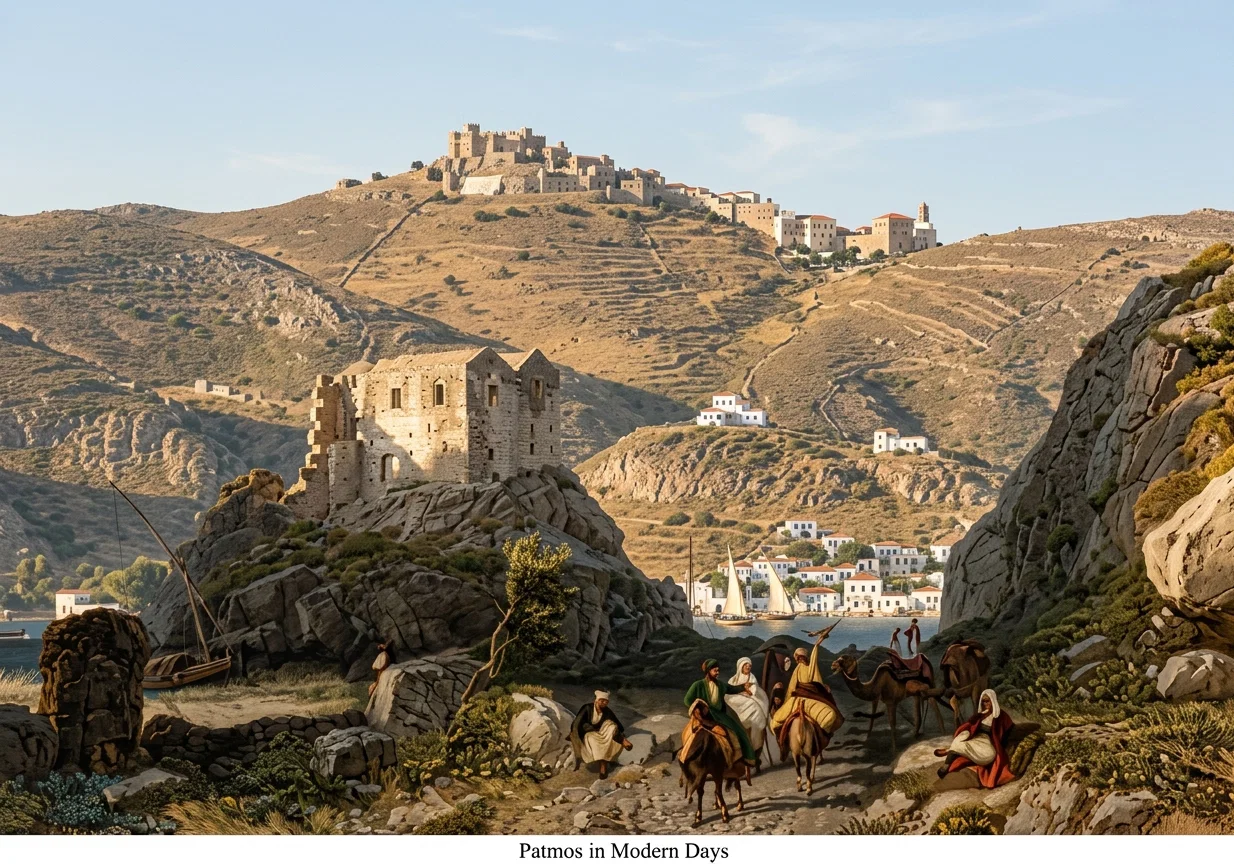
Patmos in Modern Days
5. We also find in this wonderful book the church, the people of God. Born from above, entitled by her birth to the blessings and glory of God, she is still a wanderer, a stranger, a pilgrim, a sufferer in the earth, oftentimes torn by her own internal strife, wandering in error, driven by persecution into the fastnesses of mountains, hunted as was her Lord; yet merging from all a glorious, triumphant church, crowned at last by the Master with everlasting triumph, standing before His throne singing praise to God and to the Lamb.
6. It reveals to us, does this wonderful book, God's purpose concerning the earth, the earth burdened and cursed by sin, racked by the diseases which have fallen upon her through the sin of man, her primitive lord; melting in the fires of the last days kindled by the glory of God, which utterly wipe from her all the wrinkling dross of sin. But by the power of her blessed Lord there come forth a new heavens and a new earth, on which the blighting curse of sin shall never again rest.
7. And then there is revealed before the weary pilgrim a glorious, endless future. We are told again and again that we want a religion that is for the present, for this world — what matter what lies before? There is revealed to us in this wonderful book a religion for NOW, but the "now" will sometime take in the everlasting "then," and so God gives us the promise not only of the life which now awaits, whatever that may be in consequence of sin, but the life also which is to come, in the glory of God's righteousness and love.
Seven Sevenfold Prophecies
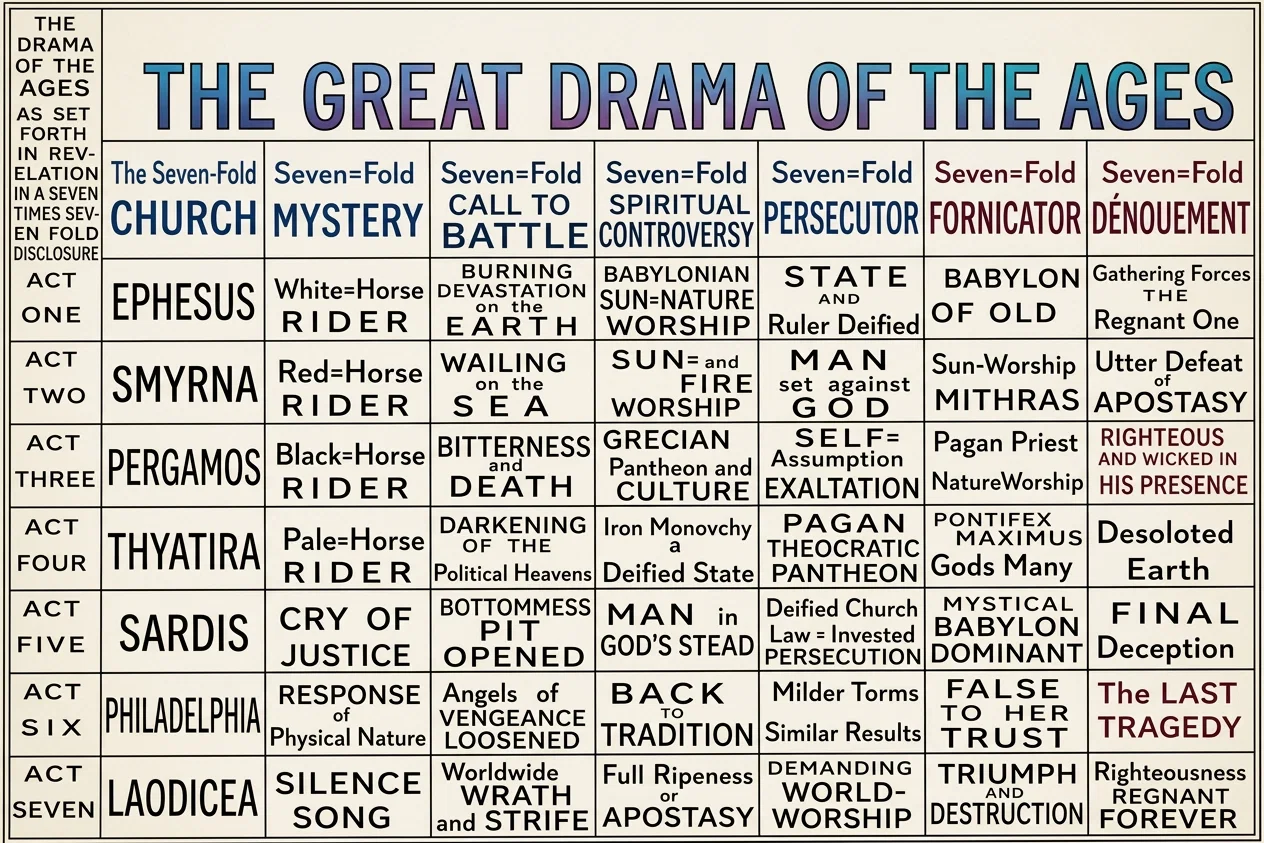
We have found, in this great drama of the ages, seven sevenfold prophecies, prefaced by the threefold blessing of God and the vision of our Lord Jesus Christ superintending His churches. The sevenfold prophecies are as follows:
1. The internal condition of God's church as represented before us by seven different churches. Chapters 2, 3. These seven complete the career of the church from the apostle's time to the close — Ephesus, the desirable condition of the apostolic church; Smyrna, the church in martyrdom; Pergamos, becoming connected with the world; Thyatira, the church of sacrifice during the Dark Ages; Sardis, the Reformation church falling away from the faith; Philadelphia, the church of brotherly love; Laodicea, the lukewarm, indicating a sordid lapse into insensibility as to real conditions. Yet God's call is out of Sardis, and out of Laodicea, into the condition of Philadelphia, the church which will met Him at His coming.
2. The second sevenfold prophecy is that of the seven-sealed book, opened by the prevailing power of our Lord Jesus Christ, revealing Him going forth on a white horse conquering and to conquer. Chapters 6 to 8: 1. And then follow war, plague, calamity, strife, and the very birth-pangs of nature; but through it all the white-horse rider goes forth for God, closing His work in the sealing of God's servants; and the four living creatures, looking forward to the glorious triumph, cry "Come" to Him whose right it is to reign. The last seal closes with silence in heaven, but with a song of triumph throughout all creation that Christ has come, Christ the Conqueror.
3. A sevenfold call to battle, represented by the trumpets, opening with the breaking up of the great Roman Empire, which controlled the world, followed by the darkening of the political heavens by Saracens and Turks, closing with the world-wide wrath upon the earth, and the kingdoms of the earth becoming the kingdom of our Lord and His Christ. Chapters 8-11. In the years of this prophecy of strife7God's Word bears double witness and the last phase of the Gospel goes forth.
4. Then follows the great sevenfold spiritual controversy, a controversy in the spiritual realms between Satan and Michael; Satan represented in the form of a dragon; Michael the Archangel, who becomes the Son of the woman; the woman, the church; the controversy, for the destruction of the church. Chapter 12. Satan's agents are represented by the heads, Babylonian sun- and nature-worship, Persian sun- and fire-worship, the Grecian pantheon- and art-worship, the iron monarchy of Rome a deified State, man in God's stead during the Dark Ages, back to tradition following that, and the full ripeness of apostasy and the persecuted church; the dragon still inspiring it all.
5. The dragon falls into the background, and we have the sevenfold persecutor which the dragon uses—the beast, this beast ex- [[FIGURE]] isting in seven different forms, represented by heads, each head giving a different phase to the beast; all inspired by the foe of righteousness—Babylon, Medo-Persia, Grecia, pagan Rome, papal Rome, apostate church-and-state Protestantism, and the last world-worship of the beast, which will come under the restoration of the Papacy. Chapter 13.
6. All this is presented before us again in a later phase in the seven-headed, scarlet-colored beast, upon which sits apostasy enthroned, guiding that beast to her own glory. The twelfth chapter of Revelation shows that the instigator of all evil and persecution is the dragon; the thirteenth chapter shows that that dragon uses the church-and-state governments of the world to persecute God's children; but in the last phase we are shown that there is an intermediate agent which Satan uses, and that is the great mystical harlot, Babylon, the mother of abominations in the earth, sitting upon the beast, representing the devil power, and in her hand a wine cup full of the filthiness of abominations with which she has deceived and made drunken the nations of the earth; and this same influence is potent all through the great antagonistic dynasties of earth. These have generally been restrained of God. He makes the wrath of men to praise Him; the remainder of wrath He restrains. And so it has been through all the periods of the past; and yet since our Lord Himself came, the church has been filling up what was left behind of the sufferings of her Master; great persecutions have come upon His people.
The last phase is yet to come, and this is clearly foretold in Revelation 17. In this threefold setting forth of the seven-headed opposers of the truth of God there are certain of these heads peculiarly emphasized. The chronological view-point of each line of prophecy is different. In other words, the "IS" of the prophecy comes at a different time in the reign of the beast power. That of chapter 12 is the beginning of the Christian era. The "IS" of the beast, the head ruling at that time, is that of pagan Rome. The chronological view-point of the 13th chapter, or the "IS" of the beast there, is during the 1,260 years of papal persecution; but the "IS" of Revelation 17 lies this side of the papal persecution; in the present condition of things in this world. It shows that the message of that chapter is that which is pending now; and God's great threefold warning of Rev. 14: 6-14 can be better understood, more fully appreciated and more clearly given, by the recognition of this great fact.
7. Last of all in this wonderful book comes the sevenfold dénouement. It is the last sevenfold act of the drama. We have the gathering forces of evil and good, with Christ the regnant One. We have the utter defeat of apostasy; we have the righteous and the wicked revealed in Christ's presence, the righteous able to endure the glory of His coming—in fact, rejoicing in it, the wicked perishing before His insufferable splendor. We have the desolated earth; we have the resurrection of the wicked and the final deception; we have the last great tragedy of Satan with all his host, root and branch, perishing in the overwhelming glory of God.
And then, the last development of all is the lifting of the curtain of the Revelation upon righteousness regnant forever. From this earth, cursed and blasted and blighted by sin, which God designed should be ever fair and glorious, that curse has been wiped away. Then it is said, "There shall be no more curse"—"no more falling away." "The throne of God and of the Lamb shall be in it; and His servants shall serve Him; and they shall see His face; and His name shall be in their foreheads." O, how long have the children been separated from their Father! They have believed Him, they have felt His presence, they have known His sustaining power; now they will see His face. The smiles of God shall wipe away all tears, illuminate all faces, cheer all hearts forever, in that kingdom which shall know eternal progress and everlasting joy.
A Pilgrim's Prayer
By Theodore Holzman Barrett
By Theodore Holzman Barrett
In the early morning hours,
In the first faint flush of day,
When the sun's light wakes the flowers,
Hear us, Father, while we pray.
When the noonday sun is shining,
As we pause along the way,
Toward Thy throne our thoughts inclining,
Father, hear us while we pray.
When calm evening steals upon us,
When the lengthening shadows lay,
Lord, incline Thine ear toward us,
While to Thee Thy children pray.
Pilgrims on life's sad, dark journey,
Trusting in Thy boundless love,
May we, through Thy care and mercy,
Reach our heavenly home above.
Six Dollars
EIGHTEEN years ago a home missionary, riding to a distant appointment, met an earnest young man who had prepared himself for college, but saw no way to go. The minister encouraged him, and running over the account of his probable earnings and expense, prophesied a sufficient saving in the intervening weeks to justify a beginning. Just at Christmas time the young man came to the minister to say that the undertaking was hopeless. The mill where he had been working had shut down; there had been unlooked-for expense; he had barely enough left, after buying his clothing, to pay his railroad fare. But the minister, undaunted, said: "If you really mean business, go home, pack your trunk, come back and stay with me to-morrow night, and the next day start for college. I can fit you out with second-hand text-books; I can get you free tuition, and I will loan you six dollars for your first month's board. Saw wood during your spare time the first month; and if you don't earn enough for your second month's board, let me know."9
The young man accepted the offer. Then the minister's wife asked, "Where are you to get the six dollars?"
"I have one dollar," said the minister, "and I shall find the rest somehow."
In the post-office that day was a letter, and in the letter a five dollar bill from a remote place where the minister occasionally preached. The woman who sent it said that as she was making up her Christmas gifts she wished to show her gratitude for the occasional religious services, which had been so helpful a reminder of days back East. The minister very rarely received such gifts. He went home, and said to his wife:
"It is a special providence, my dear. It is exactly the sum we lacked." And both rejoiced when the next day they placed the money in the hand of the young man and saw him on the train.
The story of that young man's education would be full of interest. He sawed wood during the school year; he worked as a carpenter during vacation, and found plenty of work in villages springing up along a new railroad. He graduated with no other help from the friend who had sent him to the college than the original six dollars.
Some time afterward the minister was fitting himself out in another and distant field. His work necessitated a weekly drive of nineteen miles and back across bleak prairies. He needed a fur carriage robe. The price was six dollars.
"I will consider it overnight," said the minister; for he did not have six dollars. But on his way home he stopped at the post-office, and found a letter from his friend, the graduate, who had worked late in the fall to clear up all college debts before going into his future duties. In the letter was the six dollars.
"Another providence, my dear!" cried the minister, as he threw the warm fur robe around his wife. And they knelt together and thanked God for it all.
In time the home missionary was called to a larger church, where no cold drive was necessary, and the fur robe was stored in the attic. But one day there came a request for a missionary barrel, and a list of articles needed by a minister with two appointments, miles apart, in a cold and thinly settled region. Then the robe came down from the attic, and was packed in the barrel with the other warm articles.—Anon.
The Vigil of Rizpah
By Hart Hall
By Hart Hall
There was a famine in the days of David three years, year after year; and David inquired of the Lord. And the Lord answered, It is for Saul, and for his bloody house, because he slew the Gibeonites.
THE Lord does not forget. His eyes "are in every place, beholding the evil and the good" (Prov. 15:3), and "tho hand join in hand, the wicked shall not be unpunished."
The children of Israel had made a league with the Gibeonites when they first invaded Canaan. The Gibeonites, it is true, practised deception, in their wholesome fear of the terrible conquerors from the desert. But the league was binding nevertheless; and Joshua, as a punishment for their deception, made them servants, "hewers of wood and drawers of water."
But Saul, years afterward, in a fit of enthusiasm or mistaken patriotism, had killed some of these inoffensive people, and evidently planned a wholesale massacre of the rest. God had noted this injustice, and now the land was suffering in consequence.
The Lord, on the occasion of the first murder ever committed, laid its curse upon the soil. To Cain He said, "When thou tillest the ground, it shall not henceforth yield unto thee her strength." And later the warning was given, "Ye shall not pollute the land wherein ye are: for blood it defileth the land: and the land can not be cleansed of the blood that is shed therein, but by the blood of him that shed it." Num. 35:33. But this warning was unheeded, and the prophecy in Deut. 29:22-25 was literally fulfilled: "The stranger that shall come from a far land, shall say, when they see the plagues of that land, and the sicknesses which the Lord hath laid upon it; and that the whole land thereof is brimstone, and salt, and burning, that it is not sown, nor beareth, nor any grass groweth therein, like the overthrow of Sodom, and Gomorrah, Admah, and Zeboim, which the Lord overthrew in His anger, and in His wrath. . . . Then men shall say, Because they have forsaken the covenant of the Lord God of their fathers, which He made with them when He brought them forth out of the land of Egypt." "The land can not be cleansed of the blood that is shed therein, but by the blood of him that shed it."
Therefore when David consulted with the Gibeonites, they asked not for revenge, but for Scriptural justice; and it was given. Seven of the sons of Saul were given up to the Gibeonites, who hanged them upon the hill in Gibeah "before the Lord."
Two of these victims were the sons of Rizpah, the concubine of Saul. "And Rizpah the daughter of Aiah took sackcloth, and spread it for her upon the rock, from the beginning of harvest until water dropped upon them out of heaven, and suffered neither the birds of the air to rest on them by day, nor the beasts of the field by night." 2 Sam. 21:10.
The Bible records many sad tragedies, but few are sadder than this brief narrative. From the beginning of barley harvest (first of May), throughout the long summer until water dropped from heaven (October), this woman kept her horrible, self-appointed vigil, with sackcloth cast upon that rocky, wind-swept hilltop for her resting-place, and her only canopy the blistering sky by day and the stars by night.
The law forbade that the bodies of any that were hanged should remain till the sun went down; and whether this gruesome laxity in regard to their civil code was due to carelessness or to a new superstitious regard for justice, we do not know. But when the execution was over and the crowd had departed, one lone woman remained.
The sun, large and florid, dipped quickly into the sea; and the evening breezes, whistling mournfully over the hill, began to sway and gyrate uncannily the bodies of the unfortunate seven. Night, damp and chill, palled the earth; and yet, through its eternal hours, a huddled figure crouches beside the long gibbet, alternating its occasional creaking with shuddering, tearless sobs.
Finally day comes, and with it unconsciousness, that lasts till the night comes again; and another day, and then a shrill scream arouses the prostrate figure, but it is only a swooping vulture that calls to its mate.
Another night and another day, and more vultures circle the hill. They alight upon the gibbet and flap their black pinions defiantly at the creature who rises frenziedly and strikes wildly, blindly at them. . .
Another night, and the hyenas, sniffing the decomposing bodies, bark and cry weirdly as they patter in a circuit about their prey, snapping cowardly at the watcher who strikes and flings at them.
Days pass, and the bodies fall, decapitated by their own weight. Then the bones appear, white and ghastly. The skulls grin in mirth at the never-ceasing battle of the watcher with beast and vulture.
Weeks pass, then months, centuries, perhaps, to the lone one on the bleak hilltop; and then one comes and gathers the bones, and they are buried. The vultures upon the long gibbet now scream unmolested, and the hyenas scratch and scurry over the hill at night, howling in disappointment,—the watcher is gone.
Who cared for Rizpah during her vigil? What was her fate?—We do not know. But we do know that many to-day are repeating in their own lives this experience of Rizpah. Many there are who are keeping weary vigils of their disappointments, sorrows, and sufferings, when common decency at least would suggest a burial.
Tragedies come into all lives, whether or no. Trivial incident to one is tragedy to another. A man in Los Angeles in 1898 killed himself because it did not rain. The drought was an incident merely to others. To him it was tragedy. Had he kept his vigil one day longer, all would have been well; for the next day it rained.
There is no doubt that the greatest of all tragedies is bereavement. Love is stronger than death; it is the greatest thing in the world. Consequently when it is separated from its own, this must necessarily be the greatest of all losses. But to watch over and nurse disappointments and sorrows is to shrivel and demean the soul until sympathy and kindness are shut out of the heart; till the eyes of faith are dimmed forever, and hope is killed.
To the real Christian, disappointments are His appointments. The bitter cup is accepted as a remedy for the soul. The chastening rod is received as from the hand of a loving Father who sees that it will work out in us the fruits of righteousness. David says, "Before I was afflicted I went astray: but now have I kept Thy Word." Ps. 119:67.
There is a peculiar refinement in suffering; it tenders and enlarges the heart, quickens the sympathies, opens the eyes of our understanding, and puts us in touch with a needy and perishing world. "For unto you it is given in the behalf of Christ, not only to believe on Him, but also to suffer for His sake." Phil. 1:29. "For as the sufferings of Christ abound in us, so our consolation also aboundeth by Christ." 2 Cor. 1:5.
Pomona, California.
A Song of Home
By Mrs. M. C. Sollars
By Mrs. M. C. Sollars
'Tis the thought that cheers me onward, 'tis my meditation sweet,
And the only thing that charms me is the coming of His feet.
O, my eyes keep turning homeward, ever, alway, more and more,
As our life-boat bears us nearer to the bright, celestial shore.
When earth's sorrows seem to grieve me, then above my spirits rise,
And transported to my home land, view the land beyond the skies;
And I walk those streets so golden, in a happiness supreme,
Robed in garments white, beholding visions of the great unseen,
Where the blest are never weary, where they never shed a tear,
Never know a doubt or sorrow, never feel a grief or fear.
Messengers of light, speed quickly! bear the tidings far away
Of His glorious appearing, of the glad and happy day!
Saviour, take my heart; I give it, cold, unfeeling, much like stone;
Gladly, freely, now I yield it. Cleanse, and make it like Thine own.
I would be a reaper, gathering sheaves to greet Thee in that day;
I would be a lighthouse keeper, guiding lost ones in the way.
I would be among the number standing on the crystal sea;
Sing the new, new song triumphant, glorious song of victory.
Ballard, Washington.
A Deadly Vapor
THE explosion of vessels carrying petroleum frequently occurs, and this is generally caused not by the cargoes of oil which they contain, but by the inflammable vapor which is left behind after the huge tanks of the ships have been emptied.
It is difficult to remove all the oil that adheres to the sides of the tank, and the evaporation of the oily film left in them after they have been pumped out takes place with great rapidity. Moreover, the vapor thus formed mingles readily with the air, and is capable of rendering more than two thousand times its own volume of the latter inflammable. A spark may thus cause a fearful explosion in the hold of a ship that is apparently empty.
A film of petroleum spreading over the surface of the water has been known to produce enough of this volatile and dangerous vapor to cause a conflagration by which a number of ships lying in a harbor have been suddenly unwrapped in roaring flames as if by a stroke of magic.
In some parts of the world, as at Baku, the center of the Russian petroleum trade, a film of oil continually covers the water for a considerable distance from shore, and warnings of the danger lurking there have more than once been given.—Harper's Weekly.
God's Message for To-Day
1. What is the language of the great threefold message that God's Word addresses to the last generation of men?
And I saw another angel fly in the midst of heaven, having the everlasting Gospel to preach unto them that dwell on the earth, and to every nation, and kindred, and tongue, and people, saying with a loud voice, Fear God, and give glory to Him; for the hour of His judgment is come: and worship Him that made heaven, and earth, and the sea, and the fountains of waters. And there followed another angel, saying, Babylon is fallen, is fallen, that great city, because she made all nations drink of the wine of the wrath of her fornication. And the third angel followed them, saying with a loud voice, If any man worship the beast and his image, and receive his mark in his forehead, or in his hand, the same shall drink of the wine of the wrath of God, which is poured out without mixture into the cup of His indignation; and he shall be tormented with fire and brimstone in the presence of the holy angels, and in the presence of the Lamb: and the smoke of their torment ascendeth up forever and ever: and they have no rest day nor night, who worship the beast and his image, and whosoever receiveeth the mark of his name. Here is the patience of the saints: here are they that keep the commandments of God, and the faith of Jesus. Rev. 14: 6-12.
2. What expression in the foregoing scripture shows that the close of probation is pending when the message is due to go to the world?
And the third angel followed them, saying with a loud voice, If any man worship the beast and his image, and receive his mark in his forehead, or in his hand, the same shall drink of the wine of the wrath of God, which is poured out without mixture into the cup of His indignation. Verses 9, 10.
3. What other scripture locates this solemn warning in the last days?
And I saw heaven opened, and behold a white horse; and He that sat upon him was called Faithful and True, and in righteousness He doth judge and make war. His eyes were as a flame of fire, and on His head were many crowns; and He had a name written, that no man knew, but He Himself. And He was clothed with a vesture dipped in blood: and His name is called the Word of God. And the armies which were in heaven followed Him upon white horses, clothed in fine linen, white and clean. And out of His mouth goeth a sharp sword, that with it He should smite the nations; and He shall rule them with a rod of iron: and He treadeth the wine-press of the fierceness and wrath of Almighty God. And He hath on His vesture and on His thigh a name written, KING OF KINGS, AND LORD OF LORDS. And I saw an angel standing in the sun; and he cried with a loud voice, saying to all the fowls that fly in the midst of heaven, Come and gather yourselves together unto the supper of the great God; that ye may eat the flesh of kings, and the flesh of captains, and the flesh of mighty men, and the flesh of horses, and of them that sit on them, and the flesh of all men, both free and bond, both small and great. And I saw the beast, and the kings of the earth, and their armies, gathered together to make war against Him that sat on the horse, and against His army. And the beast was taken, and with him the false prophet that wrought miracles before him, with which he deceived them that had received the mark of the beast, and them that worshiped his image. These both were cast alive into a lake of fire burning with brimstone. And the remnant were slain with the sword of Him that sat upon the horse, which sword proceeded out of His mouth: and all the fowls were filled with their flesh. Rev. 19: 11-21.
NOTE.—The foregoing scriptures, quoted from these two chapters of the book of Revelation, are worthy of the closest and the most careful study. It will be observed that the quotation from the fourteenth chapter presents a warning against the "beast and his image," showing that this united power of "beast" and "image" will seek to enforce a "mark" upon all; but against this God threatens His wrath "without mixture," which will be poured into the "cup of His indignation." "Wrath" "without mixture" is wrath and nothing else but wrath, and therefore there is no mercy in it. And it should be clear to any mind, that God does not cease to offer His mercy to the world until probation closes. Therefore this message is due when the close of probation is pending. The words quoted from the nineteenth chapter further fortify this thought, for they represent the armies of heaven led by the Lord Jesus Christ coming upon the scene in the grand climax of the Lord's second coming, and "the beast was taken, and with him the false prophet that wrought miracles before him, with which he deceived them that had received the mark of the beast, and them that worshiped his image. These both were cast alive into a lake of fire burning with brimstone." This language clearly refers to the warning message of the fourteenth chapter, and shows plainly that the "beast," his "image," and his "mark," against which this solemn warning is uttered, are active, and go "alive" into the lake of fire. Hence they could not exist at any other period than in the very last days.
NOTE 2.—Note particularly that the foregoing scripture foretells a world-wide conflict. On the one hand is the "beast" and his "image" demanding universal recognition. All are required to bow to his mandates. But his demands are the work of an apostate, for the Lord sends the strongest warning against them that can be found anywhere in all the Bible. This prophecy clearly predicts an apostasy that will unite all the world against the truth and work of God. World movements would have been an impossibility a century ago, for the means of communication and travel forbade them. But world movements are the possibility of and the talk of this time. The "brotherhood of the world" through the "federation of the world" are very familiar phrases of our day. And there is one great religious body in particular that thinks she should be placed at the head of all the affairs of this earth. It has been her dream for centuries, and this prophecy indicates that her dream will be realized, even tho it be in the face of God's deepest displeasure.
Giving to God Is True Having
By Charles Haddon Spurgeon
NEVER try to save out of God's cause; such money will canker the rest. Giving to God is no loss; it is putting your substance in the best bank. Giving is true having, as the old gravestone said of the dead man: "What I spent I had, what I saved I lost, what I gave I have."—C. H. Spurgeon.