THE Episcopalians of Newport, and Middletown, Connecticut, issued a "round robin" against the Sunday revels of the Newport four hundred. The reason for this is that these "activities have insensibly grown to such an extent as to encroach upon the hours of divine service, and detract from the sacredness of the day and of the home, and, furthermore, set an unworthy example before the young." All of which is doubtless true, with the exception of the "sacredness" of the day. Only God can make a day sacred, and He has never given us any word that Sunday is a sacred day. However, the clergy say: "Following the authority of Holy Scripture, the church has formulated the following canon, the obedience of which is incumbent upon every one of us:
"Canon 43, of the Due Celebration of Sunday.—All persons within this church shall celebrate and keep the Lord's day, commonly called Sunday, by regular participation in the public worship of the church, by hearing of the Word of God read and taught, and by other acts of devotion and works of charity, using all godly and sober conversation."
Of course the true Biblical student will admit, as have many Episcopal clergymen, that the sanctification of Sunday is not "following the authority of Holy Scripture." But, on the other hand, they have the right to make the protest to all their church-members; and those who have joined that church ought to follow the canons of that church, and be consistent to the vows which they have made, unless conscience demands otherwise; and then they ought frankly, honestly, to say that they could not be bound by its restrictions longer.
One of the great difficulties, we anticipate, in the enforcement of such discipline within the church, would be that many of the clergy themselves are too liberal minded. But high life in Newport society is probably not the best example to set before the young. Some of the clergymen declared that a certain Saturday night ball became an orgy, and ended in an "almost unbelievable disregard for the Lord's day." They say again, that there was a time when Newport, with all her fashion and gaiety, had some apparent outward respect for God's law. The institution of marriage was regarded as sacred, and there was not the gambling for high stakes at bridge which is now universal. As for bridge and the attendant gambling, it is only necessary to call attention to the fact that the laws of the State and God's laws are being broken. So general has the habit become that no one can expect to have a very good time unless able to play the game. All of which is true, and all of which indicates the deterioration and degradation of what may be called "high society," and all of which ought to call every sincere, honest soul back to the one standard of the Word and law of God, and the remedy for sin, the Gospel of the Lord Jesus Christ.
Conditions of Finance
SEVENTY clerks and eighty-three officials are busily engaged, and will be for some weeks to come, in dissolving the Standard Oil Company into the thirty-four companies that it swallowed up in its monopoly organization. And the decision in this case is pointed to by the big money men of the nation as a warning. This decision has produced an uneasiness that may, in spite of the most careful efforts, result in a general business panic.
Every movement of Mr. J. P. Morgan is closely watched, and the reporters are seeking every opportunity to ply him with questions in regard to the immediate future in the financial world. In a recent visit to Washington, D. C., he is reported through the New York "World" to have said:
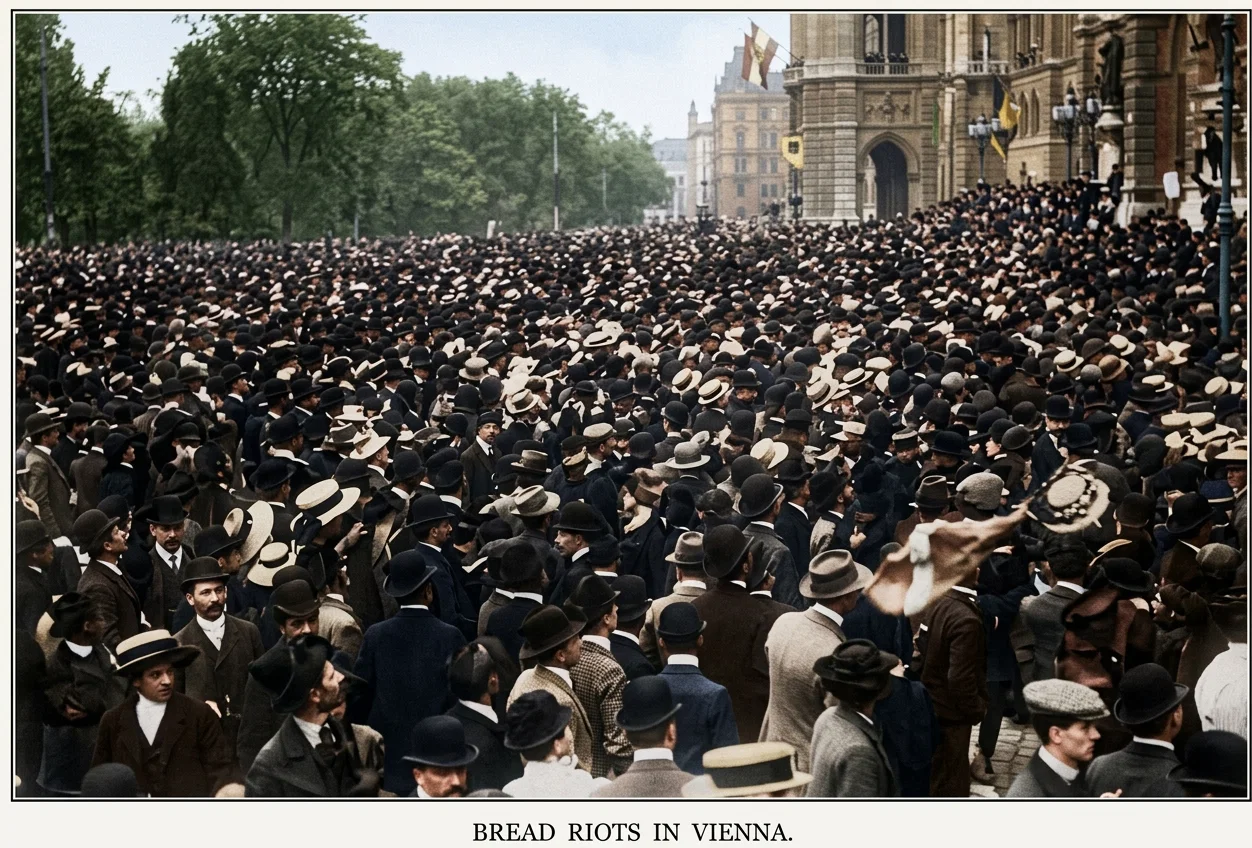
BREAD RIOTS IN VIENNA
The present attitude of the attorney-general toward the major business interests makes for uncertainty, and has made the country apprehensive. The apprehension is not confined to the officers and members of the great aggregations of capital, but to business men generally, whether their interests are with or against the big corporations or simply associated with them.
The foregoing quotation from Mr. Morgan really amounts to a statement that if the great corporations and monopolies are not let alone there will be a big financial panic. And in harmony with his statement are some of the utterances in one of "Holland's Letters" to the "Wall Street Journal." He says:
The abler business men are now convinced that we are entering upon a period of industrial and business depression, occasioned in great measure by the relation now maintained between the Government and what are called the big business interests of the United States. For if the determination of the President and of his attorney-general not merely to proceed against a large number of corporations (the attorney-general says at least a hundred) be maintained, but furthermore, if the Government maintains its present disposition absolutely to hold off, not deigning to give any counsel or in any way to enlighten the managers of these combinations so that they may know whether or not they are operating in conformity with the Sherman law, then it will be impossible to carry on great business in the United States until there has been ultimate determination of this entire matter. That, at least, is the unanimous opinion of the ablest and most reputable business men of this country.
After saying more of the same import, "Holland's Letter" states:
This is the condition which justifies our leading business men in predicting that if the situation be unchanged industrial depression is certain for the next two and possibly three years.
A sentence or two from a concluding paragraph of his "Letter" says:
Instead of mutual trust and coöperation, with intent to promote national prosperity, there has been developed distrust and even open war, or else an armed truce. This is all the more deplorable because the wealth of the country which is in corporate form is at least half the total wealth.
"At least half the total wealth" of the nation has been gathered into the corporations. This gives the corporations the position that enables them to produce a panic if they so desire, but they are not apt to have any such desire as that. On the other hand if conditions arise in the country that throw these big corporations in a position of uncertainty so that they are afraid to risk their capital in various enterprises, business becomes stagnated and a panic is the result whether the big combines want it that way or not. So no matter what may be the motive or the desire, the condition is there. The great aggregations of wealth are such in this country now that about a dozen men hold the balance of financial power, and it is necessary to keep that particular dozen men in a calm, even frame of mind in order to keep the country from being involved in a financial panic.
These great financial men are in a state of uneasiness right now. The foregoing authoritative quotations show it, and there are columns upon columns of additional quotations of the same character that might be given. The financial world is very unsteady, and we know not what a day may bring forth. The social world is very unsteady, particularly in the field of labor, and the outcome is looked forward to with anxiety. The war spirit is rampant, despite the heroic efforts that many good men and women are putting forth to secure a lasting peace. But there is not a single particle of it but what is on the prophetic program, and we may know definitely the meaning of it all if we will. T.
Troubled China
By Editor
CHINA has her troubles. A despatch from Peking September 20 states that a total of 2,000 insurgents besieging Cheng-Tu have been killed, but the foreign residents have not been able to leave the capital.
A cablegram from Shanghai, September 9, states that the floods in the province of Anhwei have destroyed 235,000 acres of rice. No hope remains for the crops. Half a million people are homeless, and are sheltered in straw huts, awaiting relief. Sickness, plague, and famine will probably follow.
A Chinese doctor, Ng Poon Chew, in Sierra Educational News for September, states that "the dawn of Chinese awakening is coming," but he does not set before us a roseate future. He declares that "the Chinese as a race believe in peace, not war, regarding brains above muscle, right above might," so much so that they had never provided themselves against foreigners. But now, he says: "We have learned a lesson from the Western nations. It has crystallized into the fact that might is right, and11nations are measured by the size of the big stick. Give us ten years, and we shall be in a position to defend ourselves. In all history we never had a standing army. We might have had a running or a sitting army, but we will have a standing army of one million soldiers. We have imported men who are the followers of the humble Christ, the Prince of Peace, to show us how to kill and be killed."
These are words worthy of weight; but another Chinese, a mandarin, writes in La Revue, of Paris, and declares that China is sinking under the results of her own vices. These vices, he declares, are gambling, drunkenness, and debauchery. The passion for gambling is such that it is carried to the utmost extreme. They will even use the combats of quails, crickets, and grasshoppers for the purpose of betting. They will stake their houses, their fields, and at last their wives, and sometimes the Chinese gamester will place upon the table the very clothes he wears. He will often go so far as to cut a joint out of his adversary. When a man has nothing more to lose, he and his fellows gather round tables where they put up as special stakes their fingers, which they cut off from each other with horrible stoicism. Consequently, wide-spread destitution.
Intemperance is another fearful evil, one of the great causes of pauperism. Sellers of the Chinese alcohol give a year's credit, and "when this passion for drink has seized, upon the head of a family, destitution with all its dismal train of suffering enters the home. Interest is paid on the debt, and the creditor takes land and house and furniture and clothes. And the debauchery of China is equal to its intemperance and gambling." He wonders what will come, and what hope there is, and says that to give answer, "the philosophers come, the economists come, the reformers come, the revolutions, they also come; but the solution of the question never comes." And it never can come, we may add, save under the regenerating power of Jesus Christ.
THE OUTLOOK
"Watchman, what of the night?"
War Preparations
THE tremendous cost of war is that which causes amazement of men in the highest circles. For instance, in a speech made recently by Mr. Taft, he declared that "steadily, throughout the world, the burden of the creation of armies and fleets has grown heavier and heavier. Steadily the competition has grown more fierce that is crushing the life and the hopes of the peoples."
How true it is! A little more than twelve months ago the chancellor of the British exchequer, Lloyd-George, reckoned the annual war cost of Europe at two and a quarter billion dollars, a total nearly doubled in twenty years, and if the present rate were continued would be doubled again by 1920. Europe is now under what is called "peace conditions." Her army is on the peace footing, but she has over four million men under arms. Her war debts have been estimated at twenty-six billion dollars by a no less authority than David Starr Jordan, of Stanford University. Ex-Representative Tawney, when chairman of the House Committee on Appropriations two years ago, estimated that seventy-one per cent of the national expenditures, outside the postal service, was for wars past and to come. He declared that in the ten preceding years of unbroken peace the expenditures for future wars, excluding pensions, were within four hundred million dollars of as much as the bonded debt of the United States at the close of the Civil War, in August, 1865. The entire cost of the naval establishment of the United States for the five years of the Civil War was $326,850,000; but during the five years of profound peace of 1906 to 1910 it was $573,022,000. But these are the conditions that exist elsewhere. The recent stir in Europe over the Morocco question will lead to feverish energy in the increase of navies and armies; and one of the great factors that helps to produce this enormous expense is the fact that the battle-ships which cost ten to twelve million dollars, are soon out of date, and must give place to larger and more modern ships. The United States for the last number of years has lost more from accidents and explosions on her war-ships than through fighting.
Paris has just had a loss which has almost startled the nations, in a recent explosion of the battle-ship Liberty on September 25. Fire broke out, and before it could be controlled it had reached the magazines, the explosion of which rent the vessel asunder, and destroyed the lives of 300 officers and men—the greatest disaster that ever befell the French navy, and in magnitude almost without precedent in the annals of the world's fighting ships. Other first-class battle-ships were also crippled by the explosion.
There seems to be great haste among the nations in building aeroplanes. New patterns are described almost daily. Mighty dirigibles which can face wind and storm and tempest are demanded, and this fourth arm of the military forces is rapidly developing.
Just recently there was launched from the Fore River yards in Massachusetts the biggest battle-ship in the world, for the Argentine Republic, Rivadavia by name, with a speed of 22½ knots an hour. With a world longing for peace, we have the strange spectacle of a world feverishly preparing for war.
What is the cause? Read it in Rev. 16:13, 14,—the spirits of demons that are going out into all the world, to gather together the kings of the earth to the great battle of Armageddon. The heart that will not submit to the righteousness of Jesus Christ, does not know peace; and the heart that does not know peace, however much it may long for it, will yield to the influence of the evil spirits of war.
Religious and National News
By Editor
Monsignor Rossetti, Papal Apostolic Delegate at Tripoli, sent the following wireless message to the pope on October 6, after the Italians had occupied the city: "For the first time since the Knights of St. John were defeated by the Turks and lost Tripoli in 1551 the cross of Christianity has been raised over this land. This time, next to the cross is the flag of Savoy."
Illinois University is to dedicate a hall to Abraham Lincoln, the cost of which will be $250,000. Its object is for advanced students in languages and philosophy. What would be better still is the adoption of the principles of liberty which actuated Abraham Lincoln.
There is now on foot a plan to erect a heroic statue to St. Francis in some prominent place in San Francisco. This, we presume, on the part of many of those engaged in it, is to honor the city itself; but to Roman Catholics it will mean much more than this. It will be designating San Francisco as a Catholic city, and anew devoting it to the memory of St. Francis. Strange to say (or is it strange?), this suggestion is made by Bishop William Ford Nichols, an Episcopalian bishop.
Rear-Admiral Winfield Scott Schley, the well-known hero who led the squadron that destroyed Admiral Cervera's fleet, July 3, 1908, fell dead while walking on a street near Fifth Avenue, New York City, on October 2. Admiral Schley fought under Farragut in the Civil War; and while some have tried to rob him of the honors achieved in the memorable battle with Cervera's fleet, the opinion is becoming more and more general that the success of that engagement was due to his abilities.
On October 10 an earthquake shock of nearly twenty-one minutes' duration was recorded by the seismograph at Lick Observatory, on Mount Hamilton, near San Jose, California. The instruments in St. Louis, Missouri, and New York City made a similar record at about the same time. They all agreed in indicating that a severe shock occurred at about 1,000 to 1,500 miles to the south or southeast.
The rebellion in China, together with the accompanying rioting and threatened dangers to the missionaries who are operating in the war zone, still continues. A number of the leaders of the rebellion have recently been caught and executed by the government. But this has seemed for the time being to intensify the conflict rather than to aid in terminating it.
In a Western city a spirit medium told a woman that her husband was not true to her. She told the husband of the story of the medium, and he protested his innocency and loyalty. But the wife insisted that the word of the medium should be taken above his, and so she left him. The court has granted the man a divorce on the ground of desertion.
A Pomona, California, church proposes to spend $10,000 for building a gymnasium as a part of its church. And the room where the gymnasium will be held will also be used for church suppers, Boys' Brigades, military drills, etc., etc. We wonder how many souls it will save.
Turkish soldiers that were driven out of Tripoli by the Italian war-ships continue to make attacks upon the city, and will not likely be put entirely to rout until the Italian troops that are being transported for the occupation of the territory reach the scene of action.
Fighting between the followers of Madero and those who oppose him still continues in Mexico. It would seem that he is having about as much trouble in holding his position at the head of the government as he had in wrestling it from Diaz.
The fall of Venice is predicted as the result of the deepening of her harbor. Water has filtered through under her great buildings. The doge's palace and St. Mark's Cathedral are cracking and crumbling.
The trial of the McNamara brothers commenced in Los Angeles October 11, and bids fair to inject into our already complex strifes one of the greatest social issues of modern times.
The first battle of the Tripolitan war was fought on the identical body of water where Antony and Cleopatra fled before Octavius in the celebrated battle of Actium.
The rioting in Portugal is of such a nature that the deposed king is made to hope that he may yet see the newly established republic set aside and he be reinstated.
LETTERS TO A YOUNG MAN
BY A YOUNG MAN
MY DEAR ROBERT,—
A friend of mine was asked the other day to draw up an anti-fiction pledge to be circulated among the pupils of an Eastern educational institution. He asked my advice in the matter, and it set me to thinking a little along the line of books and reading, and especially as to the relation that popular fiction sustains to the intellectual and spiritual life of the young people of to-day. In the first place, I understood, of course, that what was wanted of my friend was not really a pledge to abstain from everything that could come under the head of fiction. No sensible person would wish to exclude such books as Milton's "Paradise Lost," or Bunyan's "Pilgrim's Progress," and a few others I might mention, from the reading permitted to young people; but it is not such works as these that one means by fiction, using the term in the common sense. Rather one means novels or tales of adventure, of high or low character, but read chiefly for the pleasurable excitement to be got from the story. What is the effect of reading these books? and why are they so often condemned?
I confess personally to a feeling of injustice when I have heard some persons speak of novels. Their denunciation was so severe, and the character of fiction as depicted by them so far from true as regards all the best novels, that it seemed to me that their own remarks partook largely of the nature of fiction. For my own part, I have been inclined to let down the bars far enough to allow the reading of a good story once in a great while as a source of harmless recreation; but on the other hand, when I see how many excellent and inspiring biographies there are on the market, how many histories full of matter of the greatest interest and importance, and with real characters fully as graphically displayed as would be possible in a work of fiction; when I think of the books of travel and adventure, of the hundreds of volumes of meaty essays, of the poetry capable of lifting man above the sordid cares of every-day life into the very highest planes of worthy living and striving; and when I realize how little time young people find in which to read their Bibles, that treasure-house of good things that has come down through the ages; and finally, when I remember that the reading of fiction, if only in the strictest moderation, seems in some measure to unfit the mind for the more solid reading, then I am inclined to believe that the only safe rule to lay down for young people, so far as any rule may be necessary, is to eschew fiction altogether. The loss, I admit, will be something; but the gain very great.
And now that I am writing of fiction, I want to tell you what in my opinion is the worst thing about the modern good novel. I emphasize the adjective, because I consider that a great many of the novels coming out in these days are distinctly bad; not always because they contain improper language, or situations of great delicacy and suggestiveness, but rather because they confuse the right and the wrong, by so often sympathizing with the hero or heroine in a course of evident wrong-doing. However, with these I have nothing to do in this letter. I propose to give my personal impressions of the novel that may be properly classified as good in that it is free from these and similar faults, is written by a pure-minded man or woman, who evidently intended to give wholesome entertainment to the reader. My objection to this sort of novel is that in one way or another, sometimes directly, sometimes indirectly, it enforces a selfish, ease-loving manner of life. It makes one long, not for the battle and the striving, but for the rest and the unearned crown. I can not illustrate my meaning better than by sketching briefly the plot of a novel I have recently gone through rather hastily. It is the work of one of England's great novelists, and one that is often recommended, by people who are not of the novel reading class, as an uncommonly good one. The heroine is a young woman who is plain looking but of noble character. Left an orphan at an early age, she was brought up, first, in the home of an aunt who took an extreme dislike to her, and was harsh and exacting; later, in a boarding-school supported by charity, where the life was hard and monotonous enough, but enlivened with some friendships. Thus prepared, the heroine begins life as a governess at a near-by country-seat. Here her modest, unassuming ways and attractive mental qualities win for her the offer of marriage from a man somewhat older than she, but possessed of strong, manly qualities, well connected, and wealthy. The time is fixed for the marriage, but on the very eve of the ceremony, facts leak out that make the union impossible. The heroine acts with bravery and good sense in this crisis; she leaves the place immediately, and begins life, tho under the humblest circumstances, in a new place, where she undertakes the teaching of a village school, and gradually makes for herself a new circle of friends. Meanwhile she unexpectedly succeeds to a small fortune, which she generously shares with her new-found friends. About a year later she meets once more the man whom she all but married. The difficulty which once existed has been removed, but the man is somewhat broken in body, has lost the sight of both eyes, and one of his hands. In this crippled condition she marries him, thus testifying to the reality of the love she had professed for him under more favorable circumstances. Not long after the marriage, the man's sight returns in part, and the book ends with the two enjoying the highest of domestic bliss, feeling apparently that their sufferings are all in the past, and the remainder of life is to be peaceful and happy.
Now you will notice that this is no common book. The heroine, to begin with, is not even handsome, and she ends by marrying a man blind, one-handed, and broken in health. At the outset it may not seem open to the criticism I have passed on novels as a class; but consider the latter end. Marrying the man she loved is the goal for this intellectually attractive and richly endowed young woman. This in itself might not be so bad if only the man had some proper goal; but while he undoubtedly returns the affection of the young woman, he evidently has otherwise no idea except to settle down and enjoy himself. He is rich, and his wife has brought him more money; but beyond the ordinary comfortable donations to charity, they apparently have no thought of doing anything. That there is a needy, suffering world all about them, men and women needing in the highest degree the ministry they could have afforded, is apparently never uppermost in their minds. The man soon regains a good degree of health, he is only forty or thereabouts, and apparently has many years of usefulness ahead of him; but his whole plan of life is of the selfish order. The woman is unselfish in a way; she will live solely for him; but of her duty to live for her Lord and Saviour, there is nothing said. In a great crisis she has been true to the mandates of womanly purity; in the trying time when she was starting life over again, she manifested heroic qualities; in the little village school, she ministered at once to minds and hearts of her little ones, and was a teacher in the fullest sense. But all this rich experience is finally to be absorbed by a man who looks forward with apparent satisfaction to a life of ease and comfort quite divorced from the sufferings of a vexed and troubled and care-ridden world.
But the author does not stop with holding up as a hero this man of worldly aims and purposes. Another character is brought into the story, that of a man who has devoted his life to preaching the Gospel to the heathen. Here, one would think, is an opportunity to hold up high ideals, and make them attractive; but tho some sort of justice is done to this character, yet he is on the whole set forth in far less attractive colors than the chosen hero, so much so that the reader finds himself approving the choice of the heroine when she refuses to be the wife of this young missionary, and marries the hero instead, tho as already said, the latter is comparatively an old man and crippled, and has only worldly aims.
I have said enough to make my meaning clear. It need only be added that the other novels I have read, with almost no exceptions, offend in much the same way,—at least all those that have what is called a happy ending. The hero or heroine, or both, go through a good many trials and hardships, in the course of which they often manifest truly heroic qualities; but in the end everything is happily arranged, and the young couple enter upon present enjoyment of a kind of spurious earthly paradise with palm-trees, and wells of water, and soft evening breezes. And the reader, be he never so heroic a man, is, for the time being, somewhat affected by what he has read, and has a sneaking feeling that his life is rather more strenuous than it ought to be, and that he is entitled to more of the earth's good things than have fallen to his lot. Certainly such books can not nerve us for the conflict, they can not set the soul on fire; they can only weaken and enervate. And therein, it seems to me, lies the chief evil of such reading. No; if novels must be read, let them be of the kind that have sad endings. They may be less pleasant, but13they are often truer to life, and they don't usually make the reader wish to change places with the hero.
I was going to say something about poetry as an inspiration to the highest living, but I have space for only a word or two. Not all poetry is helpful; some of it may be about as enervating as the common fiction. Among the helpful poets not very much read by the young men of America, I feel like mentioning Wordsworth, the man who more than any other poet inspires one with a love for the fresh air of the open fields, for the trees, and birds, and flowers; the one, too, who pictures the beauty of honest, hard-working independence, and points ever to God as the author of all good, to whom every least creature owes grateful homage. Wordsworth, in his own words, sang "a simple song for thinking hearts." It was his aim, he said, "to console the afflicted, to add sunshine to daylight by making the happy happier; to teach the young and the gracious of every age to see, to think, and feel, and therefore to become more actively and seriously virtuous." But the character of the man and his poetry is perhaps best revealed in what he says of one of his own characters:
Love had he found in huts where poor men lay;
His daily teachers had been woods and rills,—
The silence that is in the starry sky,
The sleep that is among the lonely hills.
L. P.
Coming of the Lord
By Editor
Our Lord Will Come Again.
The Manner of Christ's Coming.
What the Coming of Christ Means to His Own.
What Christ's Coming Will Mean to Those Who Are Not His Own.
What Our Lord's Coming Means to the Earth.
The Millennium; The Great Day of the Lord.
Will there Be Warnings of His Coming?
Will there Be Signs of His Coming?
These articles will be written by Elder C. P. Bollman, an experienced writer and laborer, one who has for years been connected with the message. They will tell what the coming of our Lord means, and will include also, in their scope, that which is of growing importance, the millennium, the great day of the Lord. These will be illustrated by diagrams.
The Sabbath
The Origin of the Sabbath.
The Sabbath as Set Forth in the Law.
The Relation of Jesus to the Sabbath.
The Apostles and the Sabbath.
Is the Sabbath a Definite Day?
Prediction of Changes Regarding the Sabbath, and Their Fulfilment.
The Restoration of the Sabbath.
The Sabbath question is always to the front, and will be thoroly covered in all its phases.
Man and His Destiny
Man as Created.
Man Deceived.
Man in Death.
Fallen Man in Christ.
Man in the Judgment.
Man in the Kingdom.
The articles on man will cover man's nature and destiny from his creation in the beginning to his re-creation, when he will inherit the kingdom, and they will show the baselessness of Christian Science, Spiritism, etc.
The Testimony of Jesus
The Importance of Prophetic Study.
The Existence of Jehovah Proved by Fulfilled Prophecy.
Evidence that Jesus Is the True Messiah.
Infallible Proof that God's Word Is True and that the Bible Has No Rivals.
Marked Examples of Fulfilled Prophecy—as in the case of Cyrus, Alexander, Napoleon.
The True Church Identified by Prophecy.
Jesus Witnesses in His Remnant Church.
Prophecy of Vital Importance for the Church of Christ To-Day.
This will be a striking series of articles, presenting old truths in a new phase. By Elder G. W. Reaser. Pertaining to the ages, but of tremendous importance at this time.
The Book of Daniel to Be the Special Feature
God in Education.
God in Revelation.
God in Deliverance.
God the Ruler of Nations.
God the Arbiter of Nations.
God the Vindicator of His Children.
Persecuting Powers—
Two articles on Daniel 7.
True and False Ministry—
Two articles on Daniel 8.
The Times of Christ—Daniel 9.
Daniel 10.
Daniel 11.
Daniel 12.
These studies on the prophecies of Daniel will be designed expressly to show the great lessons which God gave through His servant for the times in which we are now living. By the Editor.
Editorials
There will be short editorial articles touching on important Bible truth and various phases of the message.
Question Corner
As usual, the Question Corner will be open for all questions of importance and interest.
The Law of God
What God's Law Is.
God's Law a Reflect of His Character.
His Law Universal and Eternal.
Christ and the Law.
Surely there is reason, in these days of lawlessness, for emphasizing the importance of the great law of God, the foundation of all law. The four articles on this subject will give a brief but clear, comprehensive idea of what the law of God is.
Israel
The Meaning and Origin of the Term "Israel."
God's Promises to Abraham.
Who Are "the Seed."
Who Are Israel, and the Restoration.
One of the great errors by which Satan would lead astray men in these days is over the promises to Israel, and the meaning of these promises. There will be four articles on Israel by Elder E. W. Farnsworth, which will help our readers greatly to understand this important subject.
Christian Science
" Replenished from the East."
The Source of Its Philosophy.
Its Philosophy in the Light of Reason and Revelation (Two Articles).
Christian Science as a Therapeutic Agency.
The search-light of truth is centered upon this subject, and its fallacies are revealed. Five good, strong articles from the pen of W. C. Thompson.
25 Articles
on practical godliness and Bible themes by Mrs. E. G. White. Every one is acquainted with the wonderfully elevating, uplifting, and inspiring articles of Mrs. White. They are always food for the soul, and instruction for every-day, practical, Christian life. This series promises to be fully as good as any which have issued from her pen.
Health and Temperance
There will be articles which will help build up the home. Dr. Mary Paulson, a practical physician, will write us a series of eight articles on health in the home.
W. C. Thompson will also furnish us five good, live temperance articles.
Special Home Articles
Ten home articles embracing the whole family.
Five Short Stories
Helpful, uplifting, inspiring, by various contributors. There are two or three good ones already in hand.
Bible Readings
Twenty-five Bible readings on the great topics of the message. A good study each week.
The Outlook
Three articles on Socialism, by G. W. Rine.
Three or more on war conditions, by A. O. Tait.
Three on the great peace movement, by E. W. Farnsworth.
Articles on temperance.
One or two on social evils.
One on prospective change in the world's calendars, by the editor.
Ten articles at least on conditions in Europe, Great Britain, India, China; by Bartlett, Wellman, Selmon, and others.
Missions
Special consideration will be given to the great India mission field. Other mission fields also will be considered as we may receive articles from our missionaries.
" Besides these serial articles," says the editor, "there will be many single contributions on all the various phases of the great threefold message for this time. We truly believe that this will be the best six-month series that has ever been given to the public, and we are sure that our people will find it a mighty helper in spreading the truths of the message and in winning souls to Christ. Earnest endeavor will be put forth by the editors to make these articles just as strong and clear, as well as helpful and winning, as possible."
WE COMMEND THESE ARTICLES TO OUR READERS, AND INVITE YOU TO FOLLOW THEM WITH US.
Single Subscriptions for the Series, each - - - 90c
Five or More to One Name and Address, each - - - 60c
Five or More to Separate Names and Addresses, each - - - 65c
Remittances should be sent to our authorized depository for your State. See list on page 15.
FIRESIDE BIBLE STUDY SERIES
By Editor
of the "Signs of the Times" Weekly
The grand, good Gospel truths, for which the "Signs" has stood for almost thirty-eight years, are to be given new and beautiful settings in this new six months' series of twenty-five numbers. The first number appears under date of November 14, 1911. The following is only a partial list of the contents: