Your ShelfYour Projects

Signs of the Times, Vol. 40, No. 6.

The Light for These Days

Signs of the Times

Feb 11, 1913

Pacific Press Publishing Association · Mountain View, California · Feb 11, 1913

The Light for These Days

“We have also a more sure word of prophecy; whereunto ye do well that ye take heed, as unto a light that shineth in a dark place, until the day dawn, and the day-star arise in your hearts.”

Question Corner

"IF YE WILL INQUIRE, INQUIRE YE."
This Inquirers' Department is conducted for the purpose of helping those who are studying the Bible. The answers are oftentimes only suggestive. They are never to be considered infallible, only as they agree with the infallible Word. The writer who may answer them does not consider that his opinion is infallible. He will simply give the best that he has, and plead with the inquirer to search the Word. Such questions only will be answered as, to the editors, seem to minister to the good of the readers and to the mission of the paper. We can not answer repeatedly in the same volume questions upon the same scripture. The name and address must accompany question, not for publication, but as an evidence of good faith, and that answer may be made by letter if deemed advisable. No letters are answered which do not contain the name of the writer. It is well always to enclose stamp for reply.

3954 — Not Justified by Works

Please explain Gal. 2:16. W. A. K.
The scripture reads: "Yet knowing that a man is not justified by the works of the law but through faith in Jesus Christ, even we believed on Christ Jesus, that we might be justified by faith in Christ, and not by the works of the law; because by the works of the law shall no flesh be justified." This is only stating the most obvious truth. Take it in civil matters, for instance. A man who breaks the law of the land is counted by that law a criminal. The law does not justify him; it condemns him. He can only get release from that law by the pardon of the government, through the grace of the executive. God's law can not justify man because the law points out sin. "By the law is the knowledge of sin." Rom. 3:20. "Nay, I had not known sin, but by the law." Rom. 7:7. Consequently the law could not justify, and Paul knew that a man is not justified, therefore, by the works of the law. If man, whom the law condemns as a sinner, had the power—which he has not—to keep the law from that day on, that would not justify his past deeds. Man can do no works of supererogation. After he has done all that he was told to do, as Jesus said, he can still count himself an unprofitable servant. But there is one who does justify, and that is God—freely through the grace of the Lord Jesus Christ. See Rom. 3:21, 22, 24. The righteousness of God in Christ is imputed to the sinner, and God counts the sinner just, because he has given up his sin. So the apostle says, "Even we believed on Christ Jesus, that we might be justified by faith in Christ." His hope, and only hope, was in Him, even as is ours. Therefore, man being a sinner, by the works of the law no flesh can be justified before God. But Jesus justifies from sin, and He not only does this, but writes the law of God in the heart, so that by the grace of Christ it is a real delight to observe it.

3986 — Perverted Sabbaths

Will you please explain Hosea 2:11? And there is another text in some of the Old Testament scriptures which speaks of God hating her Sabbaths. W. A. K.
The other text to which our correspondent refers is probably Isa. 1:13. The Lord does not here say, however, that He hates the Sabbath; but “your new moons and your appointed feasts My soul hateth.” Verse 14. The reason for this is shown by the context. Those feasts were kept, but they were kept by those whose hands were “full of blood,” and whose lives were filled with iniquity. The nation was sinful, laden with iniquity—children that deal corruptly. They had forsaken Jehovah, and despised the Holy One of Israel. “The whole head is sick, and the whole heart faint.” Read the entire chapter. Now when such a people as that come before God and profess to worship Him, even on God’s appointed day and at the time of God’s appointed feasts, their whole worship is mockery. It is not that God has anything against the days, or the feasts, or the Sabbaths; but it is the days and Sabbaths kept in the way that this backsliding people kept them. Their oblations were vain oblations. The very incense they offered was an abomination. The very meetings were simply meetings of iniquity. It was “your new moons and your appointed feasts My soul hateth: they are a trouble unto Me; I am weary to bear them.” God would not even hear their prayers, because they had set up their iniquity in their heart.
This, too, was the case with the ten tribes of Israel whom Hosea addressed. Read the context here. Israel had utterly turned away from God; and because she had been disobedient and had taken Baal-worship for God’s worship the Lord would take from her even her forms of worship, true tho these forms were. He would cause all her mirth to cease, and her feasts, and her new moons, and her Sabbaths, and all her solemn assemblies. Israel was taken away and sold as slaves into other lands, scattered among the heathen, where they could not keep their feasts and Sabbaths. All the ceasing was not because the Sabbath and the feasts were not good, but because Israel had made mockery of God’s worship.

30:5—Let Each Man Be Fully Persuaded

Please explain Rom. 14: 5, 6.
T. E. W.
About two or three times a year, we are asked by various ones for an explanation of this passage. Let us say, first, that the whole chapter of Romans 14 ought to be read. Grasp the great thought of the chapter, that we are not to judge God's children, or one another,—those who are in church relationship with us. That is the great thought of the chapter. Secondly, let us remember the next thing, that we are not to place a stumbling-block in our brother's way, or an occasion of falling, because each one of us shall give account of himself to God. We are to see that we, ourselves, are right; we are to look with charity and kindness upon the things our brother does that may not seem to be just as we would do. The thought is not that he is criminal, or sinful, but he may be following practices that we would not. Read verse 4,—“Who art thou that judgest the servant of another? to his own lord he standeth or falleth. Yea, he shall be made to stand [in spite of any judgment that we may give]; for the Lord hath power to make him stand.” And then the apostle gives an illustration: “One man esteemeth one day above another: another esteemeth every day alike.” We would not understand that the Sabbath comes in here at all. Compare with Ex. 16:4, in which the Sabbath is shut out from the ordinary “every-days.” There were other feast days and fast days, and some kept them and some did not, in the early Christian church. “He that regardeth the day, regardeth it unto the Lord.” The Revised Version leaves out the next clause. “And he that eateth, eateth unto the Lord, for he giveth God thanks.” Just let every man act as God has taught him and instructed him regarding these things, remembering that “whether we live, we live unto the Lord; or whether we die, we die unto the Lord.”
The passage does not give any one license to commit sin; it does not give any one license to break God's commandments; it does not give any one license to turn from the things which the Lord has instructed us to do; nor does it give any one license to set himself up as judge in the place of God. If we would remember these things, we would find the chapter a great blessing. No one would be excusing himself for the things that his appetite suggested, or that the devil tempted him to do. He would be doing everything in his power so that he would not put a stumbling-block in some one else's way; and on the other hand, the strictest disciplinarian of himself would not be sitting in judgment upon others.

3085.—The Age of Ahaziah

Please explain, or harmonize, 2 Kings 8:25, 26, with 2 Chron. 22:2. Is the Ahaziah mentioned in each verse the same man, or not? There seems to be a contradiction. W. E. W.
The Ahaziah is the same. He was evidently twenty-two years old when he began to reign, as given in 2 Kings 8:26. The "Companion Bible" understands 2 Chron. 22:2, that forty and two years old has reference to the house of Omri with which he was connected. Literally, the text would read, "a son of forty-two years." The note says: "That is, of the house of Omri, on account of his connection with it through his mother; 832 to 790 equals 42. In 2 Kings 8:26, Ahaziah's actual age (twenty-two years) is given when he began to reign (790) during the two years of his father's disease. His father, Jehoram, was thirty-two when he began to reign with Jehoshaphat, two years before the latter's death. 2 Kings 8:16. That was in 796. Jehoram therefore was born in 828. Ahaziah, his son, being twenty-two when he began his coregency, was therefore born in 812; his father being sixteen years old." That is, the house of Omri had reigned forty-two years when Ahaziah came to the throne. He was the son of the forty-two years, but his own age was twenty-two.

3057—The End of Judas

We read in Matt. 27:5 that Judas hanged himself. Acts 1:18, that he did not hang himself. Is this a contradiction? W. E. W.
No; Matt. 27:5 simply indicates that he hanged himself—only that, and nothing more. That was his own act, he committed suicide. But after he had hanged himself, the circumstances mentioned in Acts 1:18 occurred. Evidently he hanged himself on some ledge or hill, and afterward fell headlong down this ledge, and burst asunder. It is simply two parts of one description.

3959 — Jacob and the Tithe

In what way did Jacob pay the tenth to the Lord? Gen. 28:22. T. E. W.
We do not have means of knowing this. We can only suggest ways in which he might do it, namely, in the offering of sacrifices to God. If there were godly priests in that land, he may have offered through them. There may have been descendants of Shem. But when he had his own household, he himself was the priest of the household. Of course, we could conceive of various ways of how that money could be dedicated to God and used wholly for a sacred purpose. While we may not know the way in which he used it, we may know that he certainly recognized his duty to pay the tithe. While he was in his father's house, his father, of course, paid tithe for the whole household; but when he left his father's house he stood alone in the world, and he simply vowed that he would carry out what doubtless his father and grandfather had done before him.

2990 — Afflict Your Souls

What does it mean to "afflict your souls"? Lev. 16:29. T. E. W.
It simply meant to seek God so earnestly that all sin would be put away, and the soul would be right with God. The Jews fasted and prayed, doubtless confessed their sins. That is all that God asks of His children. To the sensitive soul who feels very keenly, the fasting may not be necessary; but to the one whose heart is hard and who does not recognize the sinfulness of sin, as given in God's Word, it is a good thing to do, to afflict the soul. Let there be fasting; let the mind get cleared up; let the person come to a realization that as without physical food his body would pine and perish, so without the spiritual food from God his soul would perish. But let him do this by faith, and having put away the sin, believe that God forgives.

Schedule for the Week Ending February 15, 1913

Day Date Reading
Sunday February 9 Exodus 16, 17
Monday February 10 Exodus 18, 19
Tuesday February 11 Exodus 20, 21
Wednesday February 12 Exodus 22, 23
Thursday February 13 Exodus 24, 25
Friday February 14 Exodus 26, 27
Sabbath February 15 Psalms 16, 17
Very interesting, indeed, is our lesson in Exodus, journeying with the children of Israel. They have come into the Wilderness of Sin. Their food is exhausted which they brought from Egypt; and God gives them the manna from heaven; using it also as a moral test as to whether they regarded Him or not, marking the Sabbath by a threefold weekly miracle, the beginning of forty years of testing. Some wars they met with on the way, but the Lord was with them. Amalek, as a bitter foe against God and His work, comes before us the first time in chapter 17, the wise counsel of Jethro in chapter 18, the preparation for God's law in chapter 19, and the holy law itself in chapter 20. Then comes the sad plea of Israel that God should not speak to them any more, but that Moses might speak. And yet had they been willing to listen to God, and put away all that brought the terror of God upon them, the Most High would have shined His law into their hearts, even as He did into that of Moses. Practical lessons, lessons containing preliminary instruction for the building of the sanctuary follow; closing the week with Psalms 16 and 17.

The Love of Christ

By Mrs. E. G. White
(Concluded)
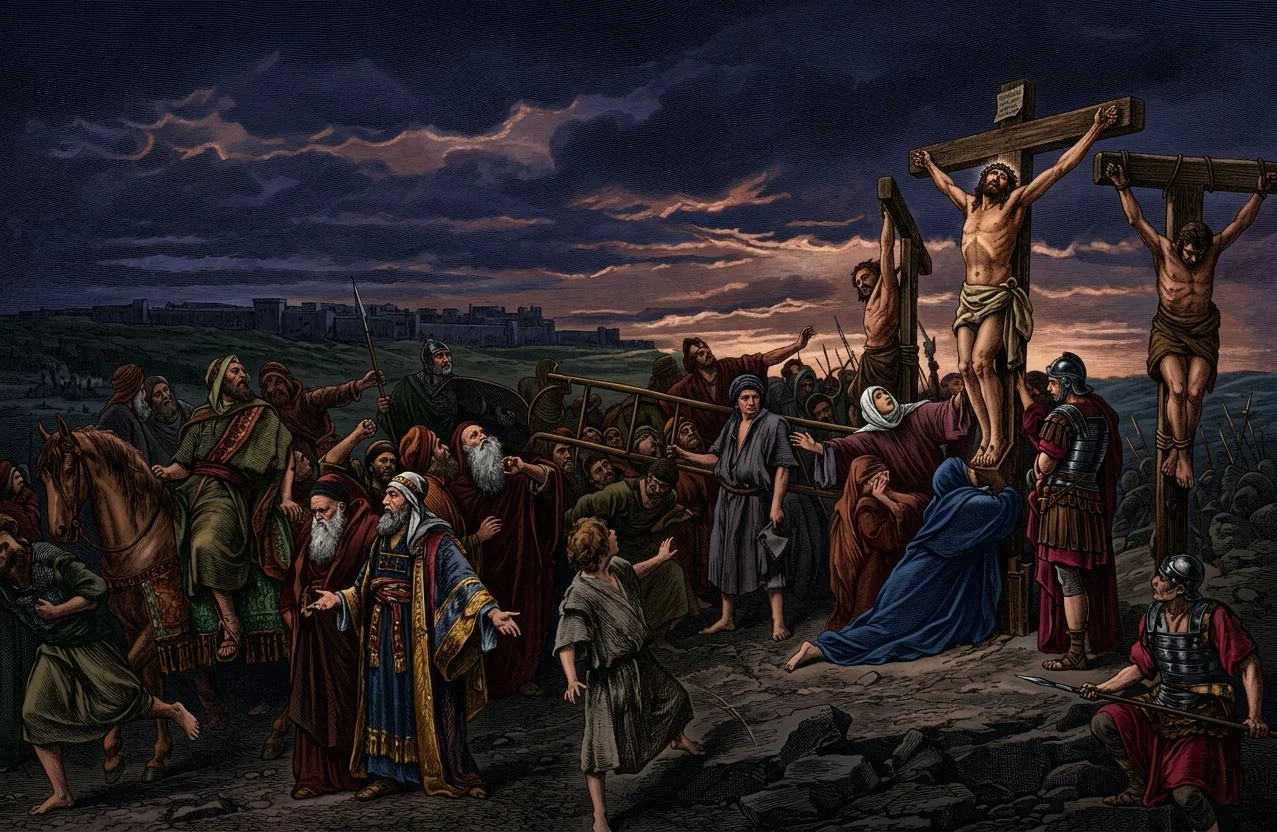
MUNKACSY'S GREAT PICTURE OF THE CRUCIFIXION
MANY who profess to be Christians become excited over worldly enterprises, and their interest is awakened for new and exciting amusements; while they are cold-hearted, and appear as if frozen in the cause of God. But here is a theme, poor formalist, which is of sufficient importance to excite you. Eternal interests are here involved. The scenes of Calvary call for the deepest emotions. Upon this subject you will be excusable if you manifest enthusiasm. That Christ, so excellent, so innocent, should suffer such a painful death, bearing the weight of the sins of the world, our thoughts and imagination can never fully reach, so that we can comprehend the length, the breadth, the height, and the depth of such amazing love. The contemplation of the matchless love of the Saviour, should fill and absorb the mind, touch and melt the soul, refine and elevate the affections, and completely transform the whole character. The language of the apostle is, “I determined not to know anything among you, save Jesus Christ, and Him crucified.” And we may look toward Calvary, and also exclaim, “God forbid that I should glory, save in the cross of our Lord Jesus Christ, by whom the world is crucified unto me, and I unto the world.” Considering at what an immense cost our salvation has been purchased, what will be the portion of those who neglect so great salvation? What will be the punishment of those who profess to be followers of Christ, yet fail to bow in humble obedience to the claims of their Redeemer, and who do not take the cross, as humble disciples of Christ?
Some have limited views of the atonement. They think that Christ suffered only a small portion of the penalty of the law of God, and that while the wrath of God was felt by His dear Son, they suppose that He had, through all His painful sufferings, the evidence of His Father’s love and acceptance, and that the portals of the tomb before Him were illuminated with bright hope. Here is a great mistake. Christ’s keenest anguish was a sense of His Father’s displeasure. His mental agony because of this was of such intensity that man can have but faint conception of it.
With many the history of the humiliation and sacrifice of our divine Lord does not stir the soul and affect the life any more, nor awaken deeper interest, than to read of the death of the martyrs of Jesus. Many have suffered death by slow tortures. Others have suffered death by crucifixion. In what does the death of God’s dear Son differ from these? It is true He died upon the cross a most cruel death; yet others for His dear sake have suffered equally, as far as bodily torture is concerned. Why, then, was the suffering of Christ more dreadful thanthat of other persons who have yielded their lives for His sake? If the sufferings of Christ consisted in physical pain alone, then His death was no more painful than that of some of the martyrs.
But bodily pain was only a small part of the agony of God’s dear Son. The sins of the world were upon Him, and also the sense of His Father’s wrath as He suffered the penalty of the law. It was these that crushed His divine soul. It was the hiding of His Father’s face, a sense that His own dear Father had forsaken Him, which brought despair. The separation that sin makes between God and man was fully realized and keenly felt by the innocent, suffering Man of Calvary. He was oppressed by the powers of darkness. He had not one ray of light to brighten the future. And He was struggling with the power of Satan, who was declaring that Christ was in his hands, and that he was superior in strength to the Son of God, that God had disowned His Son, and that He was no longer in the favor of God any more than himself. If He was indeed still in favor with God, why need He die? God could save Him from death.
Christ yielded not in the least degree to the torturing foe, even in His bitterest anguish. Legions of evil angels were all about the Son of God, yet the holy angels were bidden not to break their ranks and engage in conflict with the taunting, reviling foe. Heavenly angels were not permitted to minister unto the anguished spirit of the Son of God. It was in this terrible hour of darkness, the face of His Father hidden, legions of evil angels enshrouding Him, the sins of the world upon Him, that the words were wrenched from His lips, “My God, My God, why hast Thou forsaken Me?”
We should take larger, broader, and deeper views of the life, sufferings, and death of God’s dear Son. When the atonement is viewed correctly, the salvation of souls will be felt to be of infinite value. In comparison with the enterprise of everlasting life, every other sinks into insignificance. But how have the counsels of this loving Saviour been despised by many! The heart’s devotions have been to the world, and selfish interests have closed the door against the Son of God. Hollow hypocrisy and pride, selfishness and gain, envy, malice, and passion, have so filled the hearts of many that Christ can have no room.
He was eternally rich, “yet for your sakes became poor, that ye through His poverty might be rich.” He was clothed with light and glory, surrounded with hosts of heavenly angels awaiting to execute His commands. Yet He put on our nature, and came to sojourn among sinful men. “Behold, what manner of love the Father hath bestowed upon us, that we should be called the sons of God.” Here is love that no language can express. Our souls should be enlivened, elevated, and enraptured with the theme of the love of the Father and the Son. “And every man that hath this hope in Him purifieth himself, even as He is pure.” The followers of Christ should learn here to reflect back in some degree that mysterious love, preparatory to joining all the redeemed in ascribing “blessing, and honor, and glory, and power, be unto Him that sitteth upon the throne, and unto the Lamb forever and ever.”

A Bible Study on Man

By L. A. Reed

1. As Man Came from the Hand of God

If one were to judge what man was at the beginning, basing his conclusions on what man is now, he might make serious mistakes. A great change has come. Man has lost many things given him in the original creation.
For example, as created, God made man a little lower than the angels, crowned him with glory and honor, and set him over the works of creation, putting all things in subjection under his feet. And in this relation of nature to man, the subjection was complete; “for in that He subjected all things unto him, He left nothing that is not subject to him.” Heb. 2: 6-8. This relation of man to nature, however, did not continue; for the inspired writer says, “But now we see not yet all things subjected to him.” In other words, man has lost control of the wonderful kingdom over which he was made a divinely ordained king, not to be its tyrannical master, but its supreme crown and blessing.
Another evidence that a great change has come is furnished in the words of the scripture, “Behold, this only have I found: that God made man upright; but they have sought out many inventions.” Eccl. 7: 29. The inventions are not the inventions of mechanical skill or artistic craft, but they are the new contrivances of evil which man in every age has been thinking out and acting out—new plans, new schemes, new methods of transgression. It shows the low state into which man has come, that he gives his thought to planning new ways of doing wrong. It shows the awful change that has come from that time when man was made upright.
Reasoning, then, from what man is now, we would go wildly astray as to what man was at creation. Let us study for a few minutes regarding that being as he came forth from the hand of his Creator.

Created Upright

In the first place, he was upright. That is, there was nothing perverse in him, nothing tending toward transgression, or working at cross purposes with the moral excellency of God; and, following out the real meaning of the definition, there was not even a temptation to sin, or any impulse toward anything that was wrong, given by God to His creature. Man was upright.
We learn further that God made him a little lower than the angels (Heb. 2: 6, 7), or as some translations give it, for a little time to be lower than the angels, inferring that some day his nature would be on an equality with that of the angels; and this at some time future will be fulfilled, as promised by Christ, recorded in Luke 20: 35, 36. When God’s purpose is fully worked out, man is to be equal to the angels.
In the record of the creation, we find that man was formed of the dust of the earth. The material of which he was composed was of the earth, giving man a kinship with the kingdom over which he was to reign. Man was thus a part of the nature over which he was to rule, therefore in sympathy with it, and understanding it.

A Living Soul

But after forming man of the dust of the earth, the same materials of which the rest of the creation was formed, God breathed into man’s nostrils the breath of life, and man became a living soul. This is the origin of that principle of life which otherwise is so mysterious and so unexplainable.
Scientists to-day declare that there is no life without antecedent, or prior life; and following out the dictum rigidly—for it is a true one—man’s life must be accounted for in some way, and this is the only adequate explanation of the origin of human life.
The fact that man was made a living soul is used by Inspiration to show the difference between the man Adam and the man Christ. This difference is a difference in the nature of the two beings. The first man was made a living soul, the last Man was made a quickening Spirit. 1 Cor. 15: 45. Inspiration further explains that this first man was a natural being, but that the second Man is a spiritual Being. The first one partakes of nature; he is so allied with nature that he is defined by it as a title—he is natural. The other is allied with the Spirit of God. He partakes so intimately of the Spirit that it is used to define Him—He is a spiritual Being.

A Spiritual Being

The ultimate destiny of man, however, is that he is to have a spiritual body, and thus become like the second Man. This change will take place at the resurrection, when the natural body is raised a spiritual body. Verse 44. However, this spiritual body at the resurrection will be given only to those who have accepted the spiritual, moral life of Christ by voluntary choice. This work of changing the spiritual character takes place in this life, if it takes place at all.
Hence man’s spiritual body, being given him at the resurrection only on condition that he accept the spiritual life through Christ here, and this in turn being dependent upon his voluntary choice, it follows that man is on probation.
This is in accordance with the statement of Job 4: 17, that man is mortal,—that is, he is subject to death. The majority of mankind, even if they secure immortality, do so through the resurrection, when this mortal puts on immortality, and we have already shown that this immortality comes only to those who have accepted previously the spiritual character of Christ.

Who May Possess Eternal Life

That this eternal life is not for all, is plainly declared by the scripture, “He that hath the Son hath life; and he that hath not the Son of God hath not life.” 1 John 5: 12. Man was driven out of the Garden of Eden, lest he should put forth his hand, and take of the Tree of Life, and eat, and live forever. Gen. 3: 22. And the garden was guarded against man’s ever afterward entering and achieving this possibility of eternal
life, by the flaming glory of the cherubim. Gen. 3: 24.
We have no desire to go, in this article, into man’s condition under sin, but merely to show that man did not have, at the first, inherent immortality. He was a living soul, a natural being, placed on trial. If he continued upright as he was, his life would continue. If he failed, in the failure couched death. This was plainly told him by his Maker. Gen. 2: 17. Since man’s life as thus created depended upon his obedience, it is folly to speak of man as immortal in the sense of its meaning that he could not die, for life or death lay within the reach of his own choice. To obey meant continued life as he was, ever moving on to enlarged capacities. Disobedience meant death, and loss of all that God had granted him, or endowed him with.

The Power of the Word

The record, in stating that man became a living soul through the act of God’s breathing into his nostrils the breath of life, teaches us more than merely man’s thereby possessing life. The breath of God is merely another expression, in the Bible, for the acting, spiritual, living power of the Word of God. The picture is not merely that of air entering the breathing apparatus of man, but that the whole being was vivified, and the whole process of breath, and blood circulation, and cell action, began as a direct result of the active agency of God’s Word; and since that which is produced is, by the very nature of things, like that from which it was produced, it follows that man’s nature would be exactly in harmony with that word which made him. This explains his upright, perfect nature.
This imparted life, coming from God, of necessity had in it marks of its divine origin; but it is absurd to call it God’s life, because given to man, it becomes man’s life, and man and God are two separate beings. To connect them in any wise as one, would be pantheism.
In producing all the varied manifestations we call creation, God remains separate from that which He has produced. To show this distinct separation between God and His creation, the Word speaks with authority: “And, Thou, Lord, in the beginning hast laid the foundation of the earth; and the heavens are the works of Thine hands: they shall perish; but Thou remainest; and they all shall wax old as doth a garment; and as a vesture shalt Thou fold them up, and they shall be changed: but Thou art the same, and Thy years shall not fail.” Heb. 1: 10-12.

A Delegated Life

Man is a separate entity, a being free to act for himself. In this way only could his conduct be his own. In this way only could he be worthy of commendation or condemnation. On any other basis, he would be merely a machine. And being a separate entity, choosing to be like his Maker, to continue in the way in which God has started him, or to refuse and turn away into the unknown ways of sin and death, it appears clear that the life in man is a delegated life. It comes from God; but whether that life shall continue to represent God or not, depends upon him who for the time possesses it. In this possibility of perfection or of error lay man’s mortality or immortality. And until the choice has been entirely, irrevocably
made, man continues mortal; but when man’s probation has ended, and his choice eternally is fixed, then consistently God may acknowledge man’s choice as fixed, and grant him immortality.
It was for this life of immortality that man was made in the first place; but it existed only as a hope, a possibility that in time he might achieve.
And, thank God, now through Christ it may still be our hope. God’s original purpose to make man immortal is not lost. It must be worked out under harder conditions, but the hope through Christ is sure and certain. We may all attain to a life as measureless as the life of God. And since it comes only through Christ, it is a part of the unspeakable gift.

The Inheritance of the Righteous

By J. N. Loughborough

1. The Purpose of God Concerning the Earth

We judge of a man's purpose as we see him lay out a plat of land, or construct a piece of machinery, by noting what he does. Some people make the claim that we are likewise left to find out God's plan respecting our world, without any revelation. The late Henry Drummond, in an essay published in the San Francisco Examiner of November 14, 1901, said: “It is a principle of interpretation, well known to all theologians, that the Bible never reveals anything which man could find out for himself. Man could find out the way the earth was made.” This reads very different from the statement made by the Lord's prophet Amos, “Surely the Lord God will do nothing, but He revealeth His secret unto His servants the prophets.” Amos 3: 7. Looking at the various theories of the so-called “science” of the last seventy years, we would conclude that the world was formed in several different ways, and each way contradictory of the other.
The very first verse of the Bible tells us how the world was made: “In the beginning God created the heaven and the earth.” Gen. 1: 1. To him that believes that statement, the case is settled at once. As expressed by the apostle to the Hebrews, “Through faith we understand that the worlds were framed by the word of God, so that things which are seen were not made of things which do appear.” Heb. 11: 3. Accepting this statement, we are placed on a sure foundation. Otherwise, we are in a maze of speculation of evolution, and self-made worlds. Those who set aside revelation on the origin of our world, are thus represented by Townsend, in his “Ocean Beach Lectures” of 1884: “They are like a person coming upon a well-beaten road leading to a city, but take the course leading from the city. The farther he goes in that direction, the farther he gets from the city. So those who follow so-called ‘science,’ without revelation, go deeper and deeper into the mist of speculation.”
Persons born into the world, coming to years of understanding, observe many things around and above them, and several questions arise which they wish solved. (a) Whence came this earth and all I see upon it, and the lights shining above it? (b) How did man come to be here? (c) What is the object of his being here? (d) Why did death, and all these evils which I see, come to be here? (e) Is there no remedy for these things? (f) Is everything to go on thus eternally, or is there a future remedy for these things? (g) Am I left in ignorance, with no means of finding out what
I am so anxious to know? What a cold answer it would be to say to such a one: “The Lord has made no revelation on these things. You will have to wait, and study nature, and maybe you will find out for yourself.”
Suppose some multi-millionaire purchases fifty thousand acres of fine land; and after fitting it up with orchards of luscious fruits, fields of growing grain, gardens of edible vegetables, and flowers of the most beautiful kinds and fragrant aroma, places a family upon it, and leaves the country, never hinting to the man whether the land is his in sole possession, or intimating what is expected of him. You would say at once, “Such dealing by a man with his fellow man would be inconsistent, unreasonable, and unjust.” Indeed, “shall mortal man be more just than God?” Job 4: 17. But, really, this is in accord with the “higher critic” idea of “no reliable revelation from God, only what you obtain from asking yourself, and your reasoning.”
We could form some idea of God's purpose, by reading in His revelation what He did when He created the world; but in addition to this, He has been pleased to tell us, in that revelation, exactly what was His purpose. “And God said, Let Us make man in Our image, after Our likeness: and let them have dominion over the fish of the sea, and over the fowl of the air, and over the cattle, and over all the earth, and over every creeping thing that creepeth upon the earth.” Gen. 1: 26. In harmony with this are the words of the psalmist, “The heaven, even the heavens, are the Lord's: but the earth hath He given to the children of men.” Ps. 115: 16. The prophet Isaiah said, “Thus saith the Lord that created the heavens; God Himself that formed the earth and made it; He hath established it, He created it not in vain, He formed it to be inhabited.” Isa. 45: 18. In the past history of the race, we find that the inhabiting for the most part, has been by those who have openly rebelled against God, or who in their blindness and hardness of heart have worshiped false gods. We could not claim that this has fulfilled God's purpose respecting the earth. In Rev. 4:11 we read, “Thou hast created all things, and for Thy pleasure they are and were created.” The psalmist says, “The Lord taketh pleasure in them that fear Him, in those that hope in His mercy.” Ps. 147: 11. Of the creation of the earth with man upon it we read, “God saw everything that He had made, and, behold, it was very good.” Gen. 1: 31. So man must have then been sinless, and in harmony with God. As expressed by Solomon, “This only have I found, that God hath made man upright; but they have sought out many inventions.” Eccl. 7: 29.
These inventions were their idols, on which the Lord “took vengeance.” Ps. 99: 8. As man was in an upright state—free from sin—when the Lord gave him the earth, we conclude His purpose was to have the earth possessed by a race of beings who should, in obedience, worship Him. God gave to man the earth when he was in an upright state; but when he had sinned by partaking of the forbidden fruit, “the Lord God sent him forth from the Garden of Eden, to till the ground from whence he was taken.” Gen. 3: 23.

The Glorious Culmination

When man became sinful, and the decree had gone forth, “Dust thou art, and unto dust shalt thou return,” he lost right to the dominion, wherein all had been subjected to him. He had become a subject of death. The penalty must be met. So God, in His infinite love, planned for the rescue of man and the dominion, and the final accomplishment of the original purpose. Of this we read in the epistle to the Hebrews: “What is man, that Thou art mindful of him? or the son of man, that Thou visitest him? Thou madest him a little lower than the angels; Thou crownedst him with glory and honor, and didst set him over the works of Thy hands: Thou hast put all things in subjection under his feet. For in that He put all in subjection under him, He left nothing that is not put under him. But now we see not yet all things put under him [he sinned, and lost that dominion]. But we see Jesus, who was made a little lower than the angels for the suffering of death, crowned with glory and honor; that He by the grace of God should taste death for every man.” Heb. 2: 6-9.
As death is the culmination of all earth's woes, so, in the destruction of death, all the effects of the curse culminating therein will be removed, and those accepting by faith the proffered mercy will be again placed in that state where all things will be in subjection to man. And God's design respecting the earth will be carried out, and the earth be possessed by man in an upright state. The prophet Isaiah, when speaking of the future glorious kingdom of God, said, “Thy people shall be all righteous: they shall inherit the land forever.” Isa. 60: 21. In the words of Irving we may say:
“O, what a glorious thought—that the deluge of sin shall be baled out; that the long-covered hills and valleys of holiness shall again present themselves; that the slimy path of the old serpent shall be cleansed out of all nations, and the alloy of hell with fervent heat be burned out of the elements of the solid globe; that the kingdom, peopled with the redeemed, shall become meet to be presented in the presence of God, and remain forever.”
[“The Promised Seed” is the next topic in this series.]
Continue reading: Lincoln and Liberty