IN these simple, expressive, majestic words the Bible begins. It does not hide the beginning behind some obscure scientific term which might mean everything, or something, or nothing. We are not left to indulge in speculative fancies or conjecture as to the origin of the earth. “In the beginning God.” He was there. Before that beginning was, [[FIGURE]] and before every other beginning of which there is a record was, God was, enthroned in majesty sublime, the self-existent God.
God was the Creator in duality of personality. The Father said to the Son, “Let Us make.” “And He is before all things, and in Him all things consist.” Col. 1:17. “In the beginning was the Word, and the Word was with God, and the Word was God.” John 1:1. “Thou, Lord, in the beginning didst lay the foundation of the earth, the heavens are the works of Thy hand.” Heb. 1:10. And to man He says: “Where wast thou when I laid the foundations of the earth? Declare if thou hast understanding; . . . when the morning stars sang together, and all the sons of God shouted for joy.” Job 38:4-7. God is its Author, Architect, Maker; and He “is the true God; He is the living God, and an everlasting King.” Why, then, turn from the simple, reasonable, consistent story of Holy Writ? “If weak thy faith, why choose the harder side?” “In the beginning God.”
WHEN man sinned, he forfeited all the gifts and blessings of God. Then came to him in the darkness of despair a ray of kindling hope of whom the Author was God. “In the beginning [of man’s hope] God.” On Him and His Word is based the promise. In Him was the hope. Just as He spoke the cosmos of light and order and beauty out of the darkness of chaos, so it was the light of His love that pierced the dark void which sin had made, and brought the cosmos of regeneration and righteousness and life out of the chaos of sin and death. He is the Author of our faith. “In the beginning” of man’s redemption, God.
THE Sacrifice of the Universe was made “in the beginning.” He was the Lamb of God slain before the foundation of the world. God’s eternal purpose provided “in the beginning” all things needed by His children. His mighty purpose provided for all contingencies. He is surprised*by no aberration that sin could bring, no effort which the author of sin could put forth. When all is finished in the last great day of final assize, it will be seen that all the forces of evil have had every opportunity, every advantage, yet He who was in the beginning prevails by the everlasting power of righteousness.
2“In the beginning God!” The thought should be a suggestive one to the child of God. “In the beginning [of life] God.” Let the little child be taught to look up to the great kind Father who is love from the beginning. Teach the child and the older child to bring God into his thoughts and plans at the beginning of every day. Let the first moments and thoughts of morning be open to His presence, His guidance, His wisdom. Let Him spread over us His protecting ægis, proof against all the fiery darts of the enemy. Knowing and realizing His presence in the beginning, we shall desire His presence, His companionship, His guidance, all the way.
“IN the beginning [of every plan and scheme and device and trade and bargain] God.” Of old it is said of the wicked, “God is not in all his thoughts.” And how true is this of many professed Christians. How many plans are devised in human wisdom, in which self alone is consulted. How many trades and bargains are driven with which God has naught to do, and which, in consequence, hurt hearts and destroy souls. What a different world it would be if in all things Christians did have God in them from the beginning, if He were but their Author.
THERE may be those who read these lines who have not had God in the beginning of their life, in the beginning of their purposes, in their plans at all; and they have met and are meeting disappointment. To such we say, Despair not. Go on in disappointment no longer. Bring all the old life to God; give it to Him, and take from His heart, His own free gift, a new life, new affections, new birth. Make a new record, of which “in the beginning God” shall be your all in all. And your feet shall tread the pathways of disappointment no longer.
“In the beginning God!” He who is in the beginning is the same yesterday and to-day and forever. He is the Author of our faith; praise God, He is the Finisher. He is the Friend who abides with us all the way through. Friends turn from us here, and our hearts grow hard and bitter. Other friends die, and our hearts sorrow in bitter disappointment. But this Friend, God “in the beginning,” abides forever, our Creator, Redeemer, Saviour, Brother, Father, Friend.
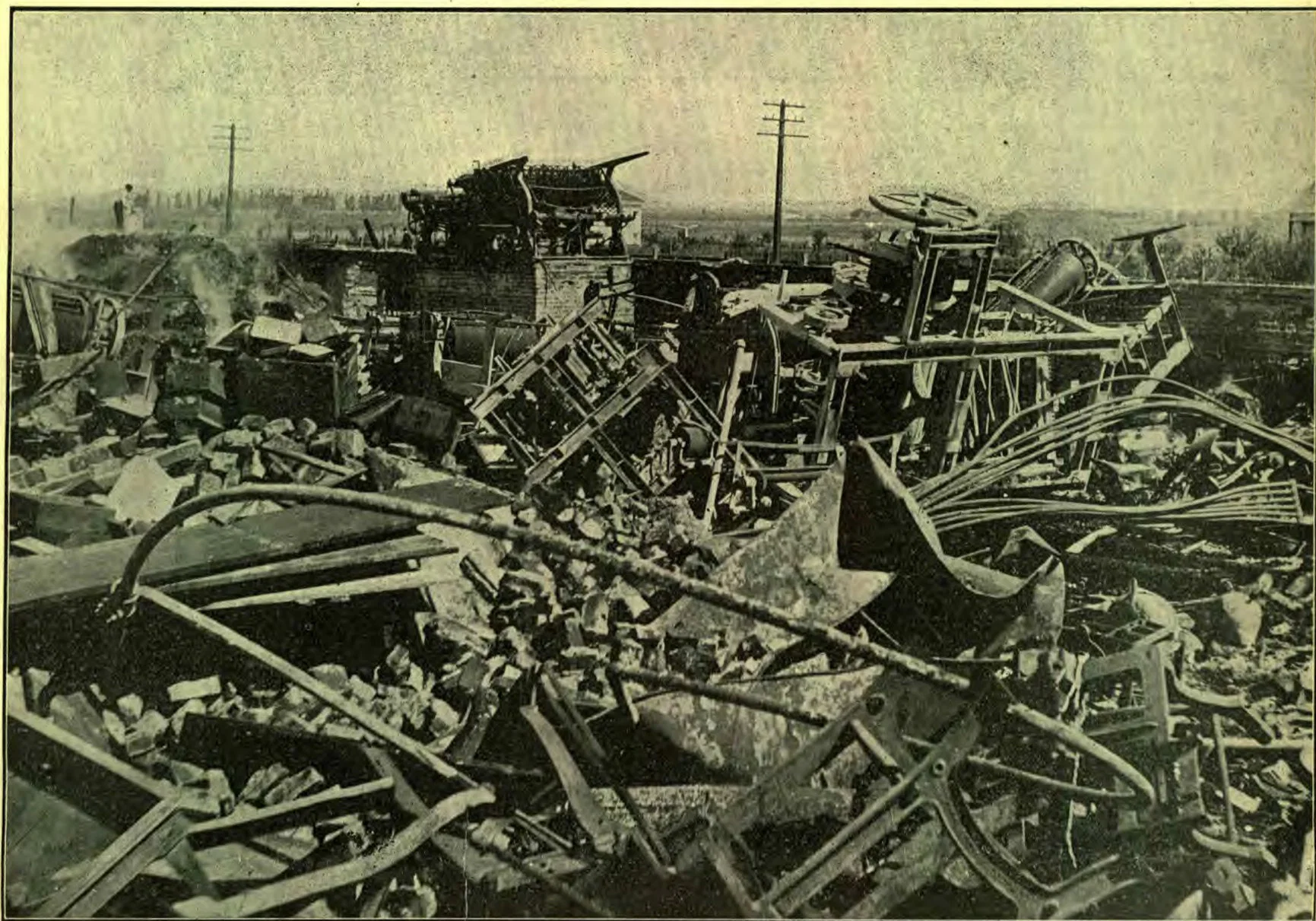
The ruins of some of the magnificent printing machines which have helped to herald the truth to the world. The press in the center background on the brick foundation is a Cottrell, which has run for twenty-five years, and was doing first-class work at the time of the fire. The large press at the right on its side is the SIGNS rotary press, installed in 1899. This issue is printed on a new Cottrell.
OUR DIVINE, HUMAN PRIEST
II. THE CORRUPTING OF THE FAITH.
IN our study of Daniel 8 last week we learned the meaning of the three symbols used in the first part of the chapter. The two-horned ram referred to Medo-Persia; the rough goat was a symbol of Grecia; the notable horn referred to Alexander the Great; and the four horns to the four divisions of the empire. The little horn which "waxed exceeding great" applied to Rome in the entirety of the career of that power.
Prediction of Its Work.
Among the things which it is predicted that power will do is the following:
"It magnified itself, even to the Prince of the host; and it took away from Him the continual [burnt-offering], and the place of His sanctuary was cast down. And the host was given over to it together with the continual [burnt-offering] through transgression; and it cast down the truth to the ground, and it did its pleasure and prospered.
"Then I heard a holy one speaking; and another holy one said unto that certain one who spake, How long shall be the vision concerning the continual [burnt-offering] and the transgression that maketh desolate, to give both the sanctuary and the host to be trodden underfoot? And he said unto me, Unto two thousand and three hundred evenings and mornings; then shall the sanctuary be cleansed [Hebrew, margin, justified]." Verses 11–14, A. R. V.
The "Continual."
We have placed "burnt-offering" in the three instances where it is used above, in brackets. It is not in the original, and is supplied by the translators as necessary to complete the sense; evidently because the adjective "continual" (in our common version "daily") is so frequently applied to that in the Old Testament. About a score of times it is used with burnt-offering; but it is used of other things as well. It is applied to the pillar of fire and cloud, to the sacred showbread, to the holy miter, to the incense, to the meal offering, to the ever-burning lamp; to all the various things relating to the service of God. The original word is rendered in our common version alway, always, continue, continual, daily, ever, evermore, perpetual.
The great thought of the word is continuance, constant. It here refers to no mere ceremony, like the burning of a lamb, or the offering of an oblation; but to the constant service of God. Christ is set before us in contrast to the things which fail. "They shall perish; but Thou continuest;" "they shall be changed; but Thou art the same." Heb. 1:11, 12. The abiding pillar of fire and cloud with Israel's host represented Christ's part of this constancy or continuance; and the spiritual service of Israel by living faith represented by their entire worship, was that which made effectual for them the continuance of Christ. That pillar of fire and cloud was a witness to His presence. The presence bread was a symbol of the life-giving, nourishing Word; the ever-burning lamp, the light of His Spirit; the daily sacrifices, of His offering of Himself once for all; the fragrant incense, the Spirit-given graces of contrition and faith which make prayer effectual at His throne.
All these offered by sincere hearts was the continual service which Jehovah prized:
"Seek ye Jehovah and His strength;
"Seek His face evermore [continually]."
1 Chron. 16:11; Ps. 105:4.
"Let them say continually, The Lord be magnified." Ps. 35:27; 40:16.
"I have set Jehovah always [continually] before me;
"Because He is at my right hand, I shall not be moved." Ps. 16:8.
"And take not the word of truth utterly out of my mouth. . . .
"So shall I observe Thy law continually." Ps. 119:44, 117.
And many other passages might be cited to show that the continuance is the continual abiding presence of God with His people, and their own spiritual, devoted service, responding to His presence and manifesting His life.
In the prophecy of Daniel this continual abiding union between God and His people, fruitful in all things good, is set over against the transgression which maketh desolate. It is God's desire for the church that He may guide her continually, satisfy her soul in dry places, and make her like a watered garden, and like a spring of water, whose waters fail not. Isa. 58:11. It is the object of the enemy to bring her into dry places that she may famish, to delude her and deceive her and make her desolate.
The little horn is one of the great agents of the evil one. It magnifies itself, ever assuming equality with the Son of God, and taking away from Him the continual, spiritual service which His people should render, holding Him as the Head, the center of all true worship.
How exactly is all this fulfilled in the great apostasy in the Christian church. When Jesus Christ ascended on high, He represented in Himself all the fulness of salvation; "for it pleased the Father that in Him should all fulness dwell." "In Him dwelleth all the fulness of the Godhead bodily, and in Him ye are made full." Col. 1:19; 2:9, 10. He was "the Head over all things to the church, which is His body, the fulness of Him that filleth all in all." Eph. 1:22, 23. But He became the Head of the church by becoming "the Head of every man." 1 Cor. 11:3; Rom. 7:4.
The great center of His presence, service, and work is in the sanctuary, at "the right hand of the throne of the majesty in the heavens." Heb. 8:1. There He pleads in our behalf His precious blood, a continual offering by a continual priesthood before God. Heb. 7:24–28; 10:5–24. He also has His sanctuary, His temple on earth, the faithful worshipers at the sanctuary above. 1 Cor. 3:16; 6:19. His people, His sanctuary, below is the visible manifestation to men of the effectual service of God, tho they are only a part of the great sanctuary service on high, represented by their adorable Head, who, when He ascended, "made us to sit with Him in the heavenly places." Eph. 2:6. While on the other hand, by His Spirit He dwells with His church militant on earth, "Christ in you, the hope of glory." Col. 1:27; Rom. 8:10; 2 Cor. 6:16. This is the abiding, the continuance, between Christ and His people: He abiding by His Spirit with them here, and manifesting His power through the fulness of spiritual gifts; and His church dwelling with Him by living faith in His divine headship, bound to Him by the life of His indwelling word.
All this holy beauty, effectiveness, and continuity of service has been broken by that apostasy represented by the little horn. Men arose out of the church speaking perverse things, and leading away disciples after themselves, instead of Christ. Acts 20:30. Man was exalted. The elders, the bishops, assumed authority God had not given. Cordons of priests and prelates and saints came between Christ and His people. Human intercessors and advocates were exalted, and Christ and His fulness of offering was made of none effect. For the all-potential Head of the church a substitute was placed in the Vatican at Rome; a new head, "the vicar of Christ was given the church;" and the church followed in the apostasy, transgressing more and more, until the man of sin was in the church, and the transgression that maketh desolate had taken the place of the continual before God. The great apostasy was on, and Christ and His blessed fulness of saving truth was lost to the world for centuries.
We do not mean by this that men were not saved during those truly dark centuries. The heart which follows one ray of light will find in it salvation. But the unifying, perfecting fulness of truth was lost to the world. The headship of Christ was set aside for a human head. The mass eclipsed the continual available offering of the sacrifice of Christ. Christ was Himself removed far away by intervening saints and prelates and priests. Purgatory and eternal hell blackened the justice and mercy of God. The law of God was transgressed, set aside, and human tradition substituted. The truth of God was cast down, and error and transgression prospered.
How long should this continue? How long would God's service and continual interflow of life and love be blasted? The angel answers: "Unto two thousand three hundred evenings and mornings, then shall the sanctuary be cleansed."
What is the sanctuary? What is its cleansing? are questions which will be more fully answered in our next.
A Decadent Liberalism
A Decadent Liberalism.—One of the decisions handed down by a German court, declares that lese-majesty pertains not only to criticizing a reigning monarch, but that monarch's ancestors. And that is one of the series of late decisions, the Literary Digest tells us, of the same tenor. The Welt am Montag of Berlin, we are told, voices well the feelings of its colleagues when it says that press freedom with a gallows beside it is the ideal in Prussia to-day. The constitution is supposed to grant liberty, article 27 declaring that "the freedom of the press is only limited by those restrictions which are now in existence," but the papers above referred to tell us that "from the lowest to the highest judicial body the press is denied the right to expose public corruption and evils. Indeed the attitude of all the courts toward the press and freedom of the press is the quintessence of animosity."
THE TERMS OF SALVATION.
MODERN preaching of the Gospel is tending more and more to the giving of half a message; perhaps we might call it a one-sided message. Great stress is laid on such texts as John 3:16, "God so loved the world, that He gave His only-begotten Son, that whosoever believeth in Him should not perish, but have everlasting life." Also verse 36, "He that believeth on the Son hath life; and He that believeth not the Son shall not see life," etc. These are the words of the Lord in person, and His servants Paul and Silas, when asked by the Philippian jailer, "What must I do to be saved?" replied, "Believe on the Lord Jesus Christ, and thou shalt be saved." Acts 16:30, 31.
It is not the intention here to discount these statements of the way of salvation, but to let the Scriptures give them their full meaning. This, we assert, is what modern Gospel preaching, to a great extent, fails to do. In order to get the full force of these promises of salvation, we must allow the Scriptures to define the idea of belief as a condition of salvation. Scripture belief is faith, and faith is a substantial, unerring evidence of something that is so sure that it is impossible for it to fail. Heb. 11:1. It is not merely conceding a thing to be true because of some human testimony, or even because of the testimony of one's own natural senses.
Faith is always accompanied by some practical evidence of belief. It is always a belief in God's Word, for there is no other ground of faith. Belief in or of anything short of this can not be any more than mere confidence, and confidence, however strong, may be misplaced. Therefore confidence may fail, because it may be placed in some fallible object. But faith can not fail (1 Cor. 13:13), for if it should cease to produce the tangible evidence—obedience to God's Word—it would cease to be faith.
The scripture tells us that "Abraham believed God, and it was counted unto him for righteousness." Now righteousness is right doing, as well as right being; for all of God's commandments are righteousness (Ps. 119:172), therefore to obey them is righteousness (Deut. 6:25). Abraham's belief is also called faith (Gal. 3:6-9), and it is this kind of belief that insures justification (verse 24; Rom. 5:1). When the Scriptures tell us of some person's faith, it is always said or implied that he did something to prove his faith. "By faith Abel offered unto God a more excellent sacrifice than Cain." "By faith Noah, being warned of God, prepared an ark to the saving of his house." "By faith Abraham, when he was called to go out, . . . obeyed; and he went out, not knowing whither he went." See Hebrews 11 for various other examples of faith attested by practical evidence.
It is further stated that "by faith Abraham, when he was tried [or tested], offered up Isaac." Thus his faith was characterized by obedience to God. This is shown, not merely by his going out from Mesopotamia, and by his offering his son, but the Lord testifies of him, "Abraham obeyed My voice, and kept My charge, My commandments, My statutes, and My laws." Gen. 26:5. So the disciples of Christ, being the children of Abraham (Gal. 3:7, 29), must have such a belief as Abraham had when he "believed God, and it was accounted unto him for righteousness" (verse 6). And as the evidence of that belief, or faith, was obedience, so the belief in Christ that will justify the sinner must be attested by the spirit of obedience.
The disciple of Christ must be not only a learner, but a follower of Him. He is our great Example, and we read of Him that, "being found in fashion as a man, He humbled himself, and became obedient unto death, even the death of the cross." Obedience is certainly a very important matter, when our chief Example and Teacher made so much of it as to sacrifice His life in the vindication of the principle. It was that implicit obedience of His to the law that sinners had transgressed that confirmed Him as a competent Saviour; and His obedience was "made perfect through suffering."
Then the full Gospel requirement is a belief that begets obedience—a "faith that works by love."
So the Lord puts the test in this way: "If thou wilt enter into life, keep the commandments." "Ye are My friends if ye do whatsoever I command you." "If ye love Me, keep My commandments." And Christ "became the Author of eternal salvation unto all them that obey Him." Heb. 5:9.
That Gospel belief is a belief that obeys, a belief that is synonymous with obedience, is shown by two Scripture witnesses: In John 3:36 Christ says that the wrath of God abideth on him that believeth not; and in 2 Thess. 1:7-10, the apostle Paul tells us that when the Lord Jesus shall be revealed from heaven He will take vengeance on them that obey not the Gospel. So the profession of belief in Christ goes for nothing unless there be a corresponding evidence of obedience. In the judgment the disobedient professor of discipleship will be classed with the unbelievers. G.
Question Corner
By Editor
1881.—The Matter of Eating.
Does the fifteenth verse of Mark 7, giving the words of Christ Himself, indicate that Christians are to choose what they eat or drink according to their liking? And as to science, should it enter into this question at all? Should not the Word of God be the guide alone? Your remarks, Mr. Editor, as to eating pork, are that it is unwise. So some tell us as to the use of tea and coffee, that they poison our systems. Now it is well known that thousand of good Christians consume tea and coffee as well as pork. It is hard to understand why pork should be placed as one of the most abominable things when we remember that all that God made was ''very good,'' according to His Word. I can not see what the investigation of slaughter-houses has to do with the eating of pork. Is it not like the Jewish washing of hands, of no vital importance? One Bible scholar takes Bible ground for the drinking of wine—of course not grape juice; another Bible scholar strongly condemns the drinking of fermented wine. Can both men be right? If so, should not the controversy on these questions cease and allow every sensible Christian to be persuaded in his own mind.
SEARCHER.
1. First of all let us say that Mark 7:15 does not refer to distinctions between clean and unclean foods at all. The question that was before the Saviour was not as to what beasts were fit to eat and what were not. It was a mere matter of following Jewish ceremonial laws of their own devising, or paying no attention to them. Let the context itself decide as to the meaning of the text in question.
2. We should not make our likings the guide in our eating and drinking. While our likings should not be ignored, they should certainly not be made primary. The primary thing in our eating and drinking, and all things else, is the glory of God,—"Whether, therefore, ye eat or drink, or whatsoever ye do, do all to the glory of God." True temperance is not moderation in all things, but moderation in all things good. We would smile even at the fatal result of a man who took prussic acid or potassium cyanide, in fatal doses, if he said before expiring that he took it in moderation! The best definition, as the word is used in the Bible, is self control, having absolute control over the appetite, passions, and physical emotions. Another good definition from our human view-point is, Moderation in all things good; total abstinence from all things evil.
3. As to science. Science means knowledge, and true science is true knowledge; and when the world has, through scientific experiment of six thousand years, demonstrated by science that the use of pork is not wholesome, why not accept it? Science, or knowledge, has demonstrated that a certain size post of a certain kind of timber will bear so much weight safely, and no more. If a builder or architect puts more than that weight upon the timber the building falls, and he is held responsible; not because he put timber in there, but because he did not give heed to knowledge which had been demonstrated. If one is ill of almost any disease, one of the first foods always prohibited by the wise physician is pork. Thousands upon thousands have used it for years to the detriment of their health, and have always been benefited when they gave it up. Is not this experience worth something? The use of pork is a sin if we are transgressing physical law in the use of it. It may be a sin of ignorance which God does not hold against us. It may be to the strong man whose bodily functions readily throw off the poisons in food of no effect, but through his using it, others who are weaker may be led to use it, and so become greatly injured thereby.
4. As to tea and coffee. The only reason in the world that people form the habit of using tea and coffee is for the toxic principle in these drinks. The thein in tea and caffein in coffee are poisons, and as poisons, intoxicating in a degree to all who use them. Used in large quantities they tend to disturb the entire system. There is no argument in their favor, there is every argument against them.
5. True it is that the Lord pronounced everything that He made ''very good,'' but that was before sin entered and perverted His work. He has certainly pronounced evil since that which is made evil because of perversion. It is well to remember that it is God's Word that classes swine's flesh with the abominable. See Lev. 11:7, 8; Isa. 65:4. No, the condition of slaughter-houses would not have any particular bearing as to whether the things handled there were good or bad, except for those who get their food from there.
6. As regards Bible wine. We are certainly told to "look not upon the wine when it is red, when it giveth its color in the cup, when it moveth itself aright." Prov. 23:31. There is other wine in the Bible that is commended. Certainly the ancients knew both fermented and unfermented wine. However, they knew no distilled drinks. Their intoxicating drinks were fermented; their unintoxicating drinks non-fermented. They had also a way of preserving the unfermented wine so that it could be kept. It is very difficult indeed to compare wine of the old Bible times with the wine of the present day. When the Word of God warns us against the drinking of it, when it declares, "Wo unto him that putteth the bottle to his neighbor's lips," when it classes drunkenness among such sins as murder and adultery, it certainly ought to mean something to a Christian. When it declares that it "is neither good to eat flesh nor drink wine, nor do anything else whereby thy brother stumbleth or is made weak," it certainly ought to mean something to a Christian. When thousands upon thousands abstain from these things constantly, and have abstained through all the ages of the past, and have been just as healthy and lived even more happily, this ought to mean something to the Christian. And certainly the progressive man ought to be willing to be instructed; and the agitation of these questions help to instruct. And yet it is true that every Christian, sensible or otherwise, ought to be "persuaded in his own mind" on all that he does. Whether right or wrong, whether to do or not to do, whether commanded of God or not commanded, "let every man be fully persuaded in his own mind;" but in persuading himself it is well that he take for his guide God's Word, and yield to that motive which is to the glory of God.
Mismanagement of San Francisco Relief
If San Francisco gets considerable advertising because of alleged strange doings in connection with the large relief fund being dispensed to her citizens, the responsibility will rest upon the local newspapers. For instance, we read in one of them that the application of a poor woman with four children was refused because it was not typewritten. Such unconcern for actual need may account for the disappearance of whole drayloads of supplies in ways that no one can explain.
OUR GREAT TREASURE-HOUSE.
By Mrs. E. G. White
By MRS. E. G. WHITE.
XIII. THE PROMISES OF GOD'S WORD.
We are pilgrims and strangers on this earth, looking for a city which hath foundations, whose builder and maker is God. The path in which we travel is narrow, and calls for the exercise of self-denial and sacrifice, but God has not left us without help. He has filled His Word with wonderful promises, to strengthen and cheer His children. In these promises He draws back the veil from eternity, and gives us glimpses of the far more exceeding and eternal weight of glory that awaits the overcomer.
A Few Examples of Promise.
"Trust in the Lord, and do good; so shalt thou dwell in the land, and verily thou shalt be fed. Delight thyself also in the Lord; and He shall give thee the desires of thine heart. Commit thy way unto the Lord; trust also in Him; and He shall bring it to pass. And He shall bring forth thy righteousness as the light, and thy judgment as the noonday."
"God is our refuge and strength, a very present help in trouble. Therefore will not we fear, tho the earth be removed, and tho the mountains be carried into the midst of the sea; tho the waters thereof roar and be troubled, tho the mountains shake with the swelling thereof." "For this God is our God forever and ever; He will be our guide even unto death."
"The Lord is gracious, and full of compassion; slow to anger, and of great mercy. . . . The Lord is good to all; and his tender mercies are over all His works. . . . The Lord upholdeth all that fall, and raiseth up all those that be bowed down. . . . The Lord is nigh unto all them that call upon Him, to all that call upon Him in truth. He will fulfil the desire of them that fear Him: He also will hear their cry, and will save them."
"Fear thou not; for I am with thee; be not dismayed; for I am thy God; I will strengthen thee; yea, I will help thee; yea, I will uphold thee with the right hand of My righteousness. . . . When the poor and needy seek water, and there is none, and their tongue faileth for thirst, I the Lord will hear them, I the God of Israel will not forsake them. I will open rivers in high places, and fountains in the midst of the valleys; I will make the wilderness a pool of water, and the dry land springs of water."
"Hast thou not known? hast thou not heard, that the everlasting God, the Lord, the Creator of the ends of the earth, fainteth not, neither is weary? there is no searching of His understanding. He giveth power to the faint; and to them that have no might He increaseth strength. Even the youths shall faint and be weary, and the young men shall utterly fall; but they that wait upon the Lord shall renew their strength; they shall mount up with wings as eagles; they shall run, and not be weary; and they shall walk, and not faint."
"And I John saw the holy city, New Jerusalem, coming down from God out of heaven, prepared as a bride adorned for her husband. And I heard a great voice out of heaven saying, Behold, the tabernacle of God is with men, and He will dwell with them, and they shall be His people, and God Himself shall be with them, and be their God. And God shall wipe away all tears from their eyes; and there shall be no more death, neither sorrow, nor crying, neither shall there be any more pain; for the former things are passed away."
"And he showed me a pure river of water of life, clear as crystal, proceeding out of the throne of God and of the Lamb. In the midst of the street of it, and on either side of the river, was there the tree of life, which bare twelve manner of fruits, and yielded her fruit every month; and the leaves of the tree were for the healing of the nations.
And there shall be no more curse; but the throne of God and of the Lamb shall be in it; and His servants shall serve Him; and they shall see His face; and His name shall be in their foreheads."
All along the pathway of life God places these fair flowers of promise, to brighten our journey. But many refuse to gather them, choosing instead the thorns and thistles. At every step they weep and mourn, when they might rejoice in the Lord.
Rejoice Always.
How much joy we might bring into our life here below if we would but make these promises our own. As we talk of the mansions that Christ is preparing for us, we shall forget the petty annoyances that we meet day by day. It is our privilege to sing the songs of Zion now, to turn our eyes to the light, to bring hope into our hearts and into the hearts of others. God desires us to gather up His promises, that we may be strengthened and refreshed. Let us take our eyes off the curse, and fix them on the grace so abundantly provided.
Comfort, encouragement, and support have been provided for every condition of life. Let us rejoice in the love of God. Let us praise Him who has made promises so royal. Let these promises keep our hearts in perfect peace. Jesus lives. His hand is guiding us. Constantly our hearts may be filled with the peace that passeth all understanding, even the peace that Jesus gives. Let us make the promises of God’s Word our own. In times of test and trial these promises will be to us glad springs of heavenly comfort.
THE HOUSEHOLDER'S RETURN.
By Max Hill
The Promise.
“Let not your heart be troubled;” we read in the Gospel by John, “ye believe in God, believe also in Me. In My Father’s house are many mansions; if it were not so, I would have told you. I go to prepare a place for you. And if I go and prepare a place for you, I will come again, and receive you unto Myself; that where I am, there ye may be also.”
These are the Saviour’s own words. Here is the expression of the Desire of all the Ages. “Let not your heart be troubled” was the first message of mercy to fallen man. In the Garden of Eden the promise of a Saviour came to the guilty pair, promise of forgiveness if obedient to Him. To them the blood of their daily sacrifices was a type of the blood of the Lamb slain from the foundation of the world. Down through the patriarchal and Jewish ages, from righteous Abel to Malachi, to John the Baptist,—Enoch, Noah, Abraham, and his seed, David, Samuel, the prophets,—all believed in God, and believed in the promised One who should “save His people from their sins.”
David sang of the Father’s house, in which he should dwell forever; Isaiah told of the New Jerusalem, where the “voice of weeping shall be no more heard,” where “they shall build houses, and inhabit them; and they shall plant vineyards, and eat the fruit of them. . . . And mine elect shall long enjoy the work of their hands.”
These all believed in the ultimate establishment of Christ’s kingdom on the earth, lived their lives of toil and ministry, died with the hope of eternal life their comfort and reward, rejoicing in the hope that they saw the land but dimly by the eye of faith. And here the Saviour tells His sorrowing disciples not to be troubled, for it is His desire to receive them unto Himself, to dwell with Him. Then not only has the hope of a Saviour been in the hearts of men, but He, the Desire of the Ages, has longed for the restitution as well.
The Object.
What more natural thing could be expected? Created pure and sinless, man fell from his exalted state, lost the face-to-face communion with the Creator and all the heavenly intelligence, forfeited all right to life and its blessings. At man’s creation the “morning stars sang together, and all the sons of God shouted for joy;” but how soon was their joy turned to mourning. Yet in the hopeless condition man was cheered with the promise of redemption. Who can imagine the shouts of praise and adoration that burst from that multitude of glorious creatures when the Son of God made known to them His plan to redeem man! Rebellious man must be of infinite value to Him who so loved the world. Will not He who did so much to redeem man finish the work? Will His love be satisfied till He has the faithful ones about Him, praising and reigning together?
That this is the great object of His coming is clearly indicated by many Scriptures. Matt. 24:31 reads: “And He shall send His angels with a great sound of a trumpet, and they shall gather together His elect from the four winds, from one end of heaven to the other.” Again: “Then shall the King say, Come ye blessed of My Father, inherit the kingdom prepared for you from the foundation of the world.” Matt. 25:34.
The angels that stood by the disciples and believers who watched their Lord ascend into the heavens gave the comforting message: “This same Jesus, which is taken up from you into heaven, shall so come in like manner as ye have seen Him go into heaven.” Paul writes to the Thessalonians: “The Lord Himself shall descend from heaven with a shout, with the voice of the archangel, and with the trump of God.” And John writes: “Behold, He cometh with clouds; and every eye shall see Him, and they also which pierced Him.”
So His message of love and comfort is recorded for us: “I will come again, and receive you unto Myself; that where I am, there ye may be also.” The prophets of old looked forward to that day; the angels, and the prophets of this dispensation bear the same message; and to those “upon whom the ends of the world are come” it is proclaimed with the same cheer and comfort as of old.
To reward the faithful is not the only object of our Lord’s return. This earth is full of sin. Not only has man fallen from his high estate, but every living thing has suffered as well. The ground was cursed as a consequence of sin, and as a result has brought forth thorns and thistles; the earth has waxed old like a garment, torn and seamed with age and internal forces ever at war with each other. All this must be changed, for the earth is to be fitted for the abode of the righteous; every trace of sin must be destroyed, every scar that sin has made must be obliterated. Peter writes of the “day of God, wherein the heavens being on fire shall be dissolved, and the elements shall melt with fervent heat,” “the earth also, and the works that are therein shall be burned up.”
Not only the earth and the works that are therein, but the wicked will be cast into the unquenchable fire prepared for the devil and his angels. Sinful man must perish with that to which he has clung so tenaciously. The Lord cometh “to execute judgment upon all, and to convince all that are ungodly among them of all their ungodly deeds which they have ungodly committed, and of all their hard speeches which ungodly sinners have spoken against Him.”
Where Do We Stand?
Will we hear the words of welcome, or the sentence of doom? With each is the choice, and that choice must be made soon. No one has promise of life beyond to-day, and the day hastens in which no man will have the power to choose. “Behold, now is the accepted time; behold, now is the day of salvation.”
“Seeing then that all these things shall be dissolved, what manner of persons ought we to be in all holy conversation and godliness, looking for and hasting unto the coming of the day of God, wherein the heavens being on fire shall be dissolved, and the elements shall melt with fervent heat?5Nevertheless we, according to His promise, look for new heavens and a new earth, wherein dwelleth righteousness. Wherefore, beloved, seeing that ye look for such things, be diligent that ye may be found of Him in peace, without spot, and blameless. . . . Ye therefore, beloved, seeing ye know these things before, beware lest ye also, being led away with the error of the wicked, fall from your own steadfastness. But grow in grace, and in the knowledge of our Lord and Saviour Jesus Christ.” 2 Peter 3:11-18.