Your ShelfYour Projects

Signs of the Times, Vol. 38, No. 30.

Question Corner

Signs of the Times

Aug 1, 1911

Pacific Press Publishing Association · Mountain View, California · Aug 1, 1911

Question Corner

"IF YE WILL INQUIRE, INQUIRE YE."
This Inquirers' Department is conducted for the purpose of helping those who are studying the Bible. The answers are oftentimes only suggestive. They are never to be considered infallible, only as they agree with the infallible Word. The writer who may answer them does not consider that his opinion is infallible. He will simply give the best that he has, and plead with the inquirer to search the Word. Such questions only will be answered as, to the editors, seem to minister to the good of the readers and to the mission of the paper. We can not answer repeatedly in the same volume questions upon the same scripture. The name and address must accompany question, not for publication, but as an evidence of good faith, and that answer may be made by letter if deemed advisable. No letters are answered which do not contain the name of the writer. It is well always to enclose stamp for reply.

3522 — Why Did God Make Satan?

Why did God make Satan? Does not this make God responsible for all sin? Would be very glad to have your opinion.
God did not make Satan, any more than He made alcohol, or whisky, or beer. God made Lucifer a shining angel of light, gave him the most glorious position that a creature could possess; he was one of the beings that was closest to God's throne. Read the description of this angel in the beginning of the 28th chapter of Ezekiel, there mentioned under the symbol of the king of Tyre: "Thou sealest up the sum, full of wisdom, and perfect in beauty. Thou wast in Eden, the garden of God; every precious stone was thy covering, the sardius, the topaz, and the diamond, the beryl, the onyx, and the jasper, the sapphire, the emerald, and the carbuncle, and gold: the workmanship of thy tabrets and of thy pipes was in thee; in the day that thou wast created they were prepared. Thou wast the anointed cherub that covereth; and I set thee, so that thou wast upon the holy mountain of God; thou hast walked up and down in the midst of the stones of fire. Thou wast perfect in thy ways from the day that thou wast created, till unrighteousness was found in thee." But God made Lucifer, even as He makes man and every other intelligent, rational creature in His dominion, a being of free will, and with power to choose. That must be the case in order to obtain acceptable service. It would not be acceptable, appreciated service to a king to know that all his subjects obeyed simply and solely because they could not do otherwise. There is excellent conduct manifested many times in the great prisons of the earth, because the men can not do wrong. Sometimes they are bound by chains to prevent them from doing wrong. Their negative conduct is not acceptable service to the State. If Lucifer had been made a mere automaton, one who must necessarily do right, he would be no more than a mere machine. That could bring no satisfaction to God. God wants willing service, service of choice; and so He made Lucifer, as He made us, a free moral agent, one who could choose or refuse.
Around every moral intelligence in His universe God places a circle sacred to that soul, and Omnipotent Power will not enter that circle to compel that soul to do right. That soul must choose. Said God to Israel, "I call heaven and earth to witness against you this day, that I have set before thee life and death, the blessing and the curse: therefore choose life, that thou mayest live." So it was set before Lucifer. Just how it was that sin came into his heart we do not know. This we do know: that the perversion of all God's blessings is sin. There was not one evil thing in the universe, as it came from the hand of God. All the evil things are the good perverted. Every faculty that Lucifer possessed could have been used to God's glory, and would have brought abundance of blessings back upon himself; but he chose to use them to himself. He took glory to himself instead of giving glory to God. As expressed in the chapter in Ezekiel from which we have already quoted, "Thy heart was lifted up because of thy beauty; thou hast corrupted thy wisdom by reason of thy brightness."
In order to have perfect service, God must take the awful risk of sin. Only so could character be formed. But with the risk of sin which the Lord saw would come, provision also was made for that; for "where sin abounded, grace did much more abound," and in God's great plan there was salvation for Lucifer after he became the adversary Satan, if he had accepted it. But he went on and on until every manifestation of grace was utterly rejected. The human soul may do the same thing if it choose. Or it may turn from the sin, yield all to God, and find grace sufficient for every time of need.

3521 — Sinning and Not Sinning. Eccl. 7:20; 1 John 3:9

There seems to be a contradiction between Eccl. 7:20 and 1 John 3:9. Will you please explain or show the harmony?
The first scripture reads in the Revised Version: "Surely there is not a righteous man upon earth, that doeth good, and sinneth not;" and the latter—1 John 3:9: "Whosoever is begotten of God doeth no sin, because His seed abideth in him: and he can not sin, because he is begotten of God."
The whole difference lies in the purpose. Sin is the transgression of the law. If one transgress God's law, whether he knows it or not, he sins. The perfection of that law is the very fulness of God. It demands wisdom and knowledge and power and love. If man has a heart which purposes to do God's will, God accepts that as the fulness of service, for "the eyes of Jehovah run to and fro throughout the whole earth, to show Himself strong in the behalf of them whose heart is perfect toward Him." God accepts the perfect heart for all the other perfections which are required. He knows that man does not have fulness of knowledge, or fulness of wisdom; but if he has perfect love, the will is accepted for the deed, and the man who is born of Christ Jesus has such love. He can say, "This is the love of God, that we keep His commandments: and His commandments are not grievous." 1 John 5:3.
The sense of the second passage, therefore, is not that man may not make mistakes, may not blunder, may not fail to follow up, in its very fulness, God's law; but he has no purpose to sin; he does not practise sin; it is not an object in his life; while the text in Ecclesiastes means that however perfect the man may be, however righteous he may be, he will make mistakes, he will fail in his knowledge or his wisdom in meeting the fullest requirements of God's law. Yet God does not count it against him, because he has a perfect heart. Sometimes it is said that we can not do what we will not do; as expressed by Shakespeare, "Look you, what I can not, that I will not do." So when the invitation went out to come to the supper, one man said, "I have married a wife, and therefore I can not come." Therefore, he did not have it in his will to come. So those who do not practise sin are those who do not have the will to do it; they have the will to do God's will, and God counts the will for the fulness.

3523 — The Word "Worlds"

3523 — The Word "Worlds"
Referring to a question in the "Signs" of May 23, 1911, I would like to ask, Does not Heb. 1:1, 2 show that there are other worlds? C. P. O.
The Greek word from which "worlds" comes in Heb. 1:1, 2 and 11:3 is aion, meaning "age," and ought so to be translated, to our mind, throughout the New Testament. If you will trace the word through a Greek concordance you will find it could be rendered that in every instance. Occurrences of it are found in Matt. 13:39, "The harvest is the end of the world," or "age," and Matt. 28:20, "Lo, I am with you alway, even unto the end of the world"—"age." Of course, we know that the end of the world or earth, does not come in either of these cases. It simply means that we come to that period of earth's history where a great change takes place. And so it was through Christ that God constituted the ages, and by faith we understand that those ages have been marked out, or designated, or constituted. There is other very strong inferential proof which amounts almost to a demonstration that there are other worlds in the universe, but that fact is not stated in so many words. There is a wonderful amount of truth which will come to those who study the plan of God in the light of the ages.

3524 — Lead Us Not into Temptation

James 1:13: "Neither tempteth He any man." Matt. 6:13 says, "Lead us not into temptation." How do you harmonize these texts? Is the word "lead" the right translation?
God is said to do or not to do what He suffers, or permits, to be done or not to be done. "Lead" or "bring" is a proper translation. We have heard uninstructed converts talk of going where temptation is thickest; they were ready to meet the devil anywhere. The prayer taught by Jesus is designed to teach us a sense of our own weakness in the plea that God will keep us from the power of evil. It is pleading His promises with a sense of our need. See 1 Cor. 10:12, 13.

Isaiah 19

3525 — Isaiah 19
Has the prophecy in Isaiah 19 been fulfilled, or is it a prophecy that will not be fulfilled because man has failed to comply with certain requirements? A. K.
Partly both. What part of Isaiah 19 is referred to? The whole chapter is too large a topic for this department. A great part of it has already been fulfilled in Egypt.

3526 — What Are the Husks, Luke 15:16?

What are the husks in the text above referred to? Is the article which I enclose consistent? Subscriber.
The article which our subscriber encloses is a consistent article. The husks are the fruit of the carob-tree, which was not considered generally a proper fruit for humanity, but for swine. And yet the poor prodigal was in that condition that he would gladly have eaten the food which he fed to the swine. His condition may be compared to that of some of the box makers in the cities of Europe, who become so hungry that they have eaten the paste that they use in the manufacture of the boxes, so that the manufacturers have compelled them to furnish their own paste.

3527 — The Four Beasts of Rev. 14:3

Who are or what are the four beasts of Rev. 14:3?
Read in the Revised Version, "the four living creatures." "Beasts" is not a proper translation of the term at all; "four living ones" it is given by some translations. These are the same as presented in Rev. 4:7, 8. Similar creatures are described in Ezekiel as cherubim (see chapters 1 and 10; compare also with Isa. 6:1, 2; see also studies on Revelation covering the four living ones). They represent, under the forms of those four creatures, the might, and patience, and wisdom, and glory of God working out God's plan and purpose in human affairs, and seem to be composed of angels in vast numbers working in that way, even as the angels of God came in the form of chariots and horses to take away Elijah. So we read in Ps. 68:17, "The chariots of God are twenty thousand, even thousands of angels."

Psalm 68:7 Explained

3528 — L. H.—Ps. 68:7 — The text is a reference to the time when the presence of God in the Pillar of Fire by night and Pillar of Cloud by day led the children of Israel through the wilderness on the way from Egypt to the promised land.
Schedule for Week Ending August 12, 1911

— * —

Schedule for Week Ending August 12, 1911
Sunday August 6 Ezekiel 21, 22
Monday " 7 " 23, 24
Tuesday " 8 " 25-27
Wednesday " 9 " 28-30
Thursday " 10 " 31-33
Friday " 11 " 34-36
Sabbath " 12 " 37-39
— * —
Our reading for this week lies wholly within Ezekiel; prophecies in which the messenger of God goes over and over again Jehovah's instruction to that people. For twenty-two years the prophet pleads with them to turn to God. He gives as illustrations the kingdoms on all sides of Israel and how God has dealt with them, how He has brought down their pride and will bring down the pride of those who still remain. Among the two great nations against which prophecy is uttered are those of Egypt and Tyre. Egypt, one of the former oppressors of God's people and the symbol of black infidelity, will be brought low and abased, never to rise again among the nations. Tyre, the great commercial city of the world, would be utterly wiped out of existence, so that the very place on which she stood would be "a place for the spreading of nets in the midst of the sea." Nebuchadnezzar, whom the false prophets said was not coming against Jerusalem, would capture Tyre, and from Tyre would conquer Jerusalem.
Chapters 37-39 are prophecies of what God would have done even then for His children if they would have yielded to Him. He would have brought back from the dead the faithful in Israel who slept, He would have conquered all their enemies far and near, and would have made Jerusalem a praise in the earth. And within that city would have been built the sanctuary which He promises in the closing chapters of the book. That sanctuary never was built, because Israel never yielded to God's plan. It never will be built, and never can be built, because God can not go back to the typical sacrifices which pointed forward to the Lord Jesus Christ, since our Lord Himself suffered and fulfilled all types. Our readers will see much more clearly the meaning of these prophecies if they will but remember that the conditions which we read in Jer. 18:8-10 are of universal application.

Saved to Serve

By Mrs. E. G. White
GOD so loved the world, that He gave His only-begotten Son, that whosoever believeth in Him should not perish, but have everlasting life." The ransom money has been paid for every son and daughter of Adam; but if those who have been ransomed by the precious blood of Christ, refuse allegiance to Him, it will not shield them from the retribution that will come upon them in the last day. They will have to answer for their neglect to use their entrusted talents for the Master. They will have to answer for their reproaches against their Maker and Redeemer, and for their robbery of God in withholding their talents from His service, and burying their Lord's goods in the earth.

All Are Stewards

The human family is composed of responsible moral agents, and from the highest and most gifted to the lowest and most obscure, all are invested with the goods of heaven. Time is an entrusted gift of God, and is to be diligently employed in the service of Christ. Influence is a gift of God, and is to be exerted for the forwarding of the highest, noblest purposes. Christ died on Calvary's cross that all our influence might be used to lift Him up before a perishing world. Those who behold the Majesty of heaven dying on the cross for their transgressions, will value their influence only as it draws men to Christ, and they will use it for this purpose only. Intellect is an entrusted talent. Sympathy and affection are talents to be sacredly guarded and improved, that we may render service to Him whose purchased possession we are.
All that we are or can be belongs to God. Education, discipline, and skill in every line should be used for Him. The capital is His, and the improvement is the usury that rightfully belongs to the Master. Whether the amount entrusted is large or small, the Lord requires that His householders do their best. It is not the amount entrusted or the improvement made that brings to men the approbation of Heaven, but it is the faithfulness, the loyalty to God, the loving service rendered, that brings the divine benediction, "Well done, good and faithful servant; thou hast been faithful over a few things, I will make thee ruler over many things: enter thou into the joy of thy Lord." This reward of joy does not wait until our entrance into that city of God, but the faithful servant has a foretaste of it even in this life.
Instead of burying our talents in the earth, those who are willing to trade upon them will not trade in vain. God pronounces His blessing upon unselfish, unwearied diligence; and tho we may have but one talent, and can make but a small investment, yet God will make the effort fruitful in results. The man who works in faith will realize that his intellect, his affections, his whole power, belong to God; and he will seek to make diligent use of his powers, and will improve his faculties and talents. But instead of realizing that all our faculties belong to God, how many are reckless, little thinking that their influence, their cheap, light words, are molding the characters of those with whom they associate, and bringing down their minds to a low level. If they did but understand what they are doing, and could realize that they are accountable for their influence, and that in the sight of heaven they are wasting their opportunities, would they so belittle their talents of speech and mind, and so mold the minds of their companions in what is low and ignoble, by their trifling, cheap conversation? It is by the influence of reckless triflers that the confederacy of evil is strengthened and the entrusted talents of God are corrupted and buried in the earth.
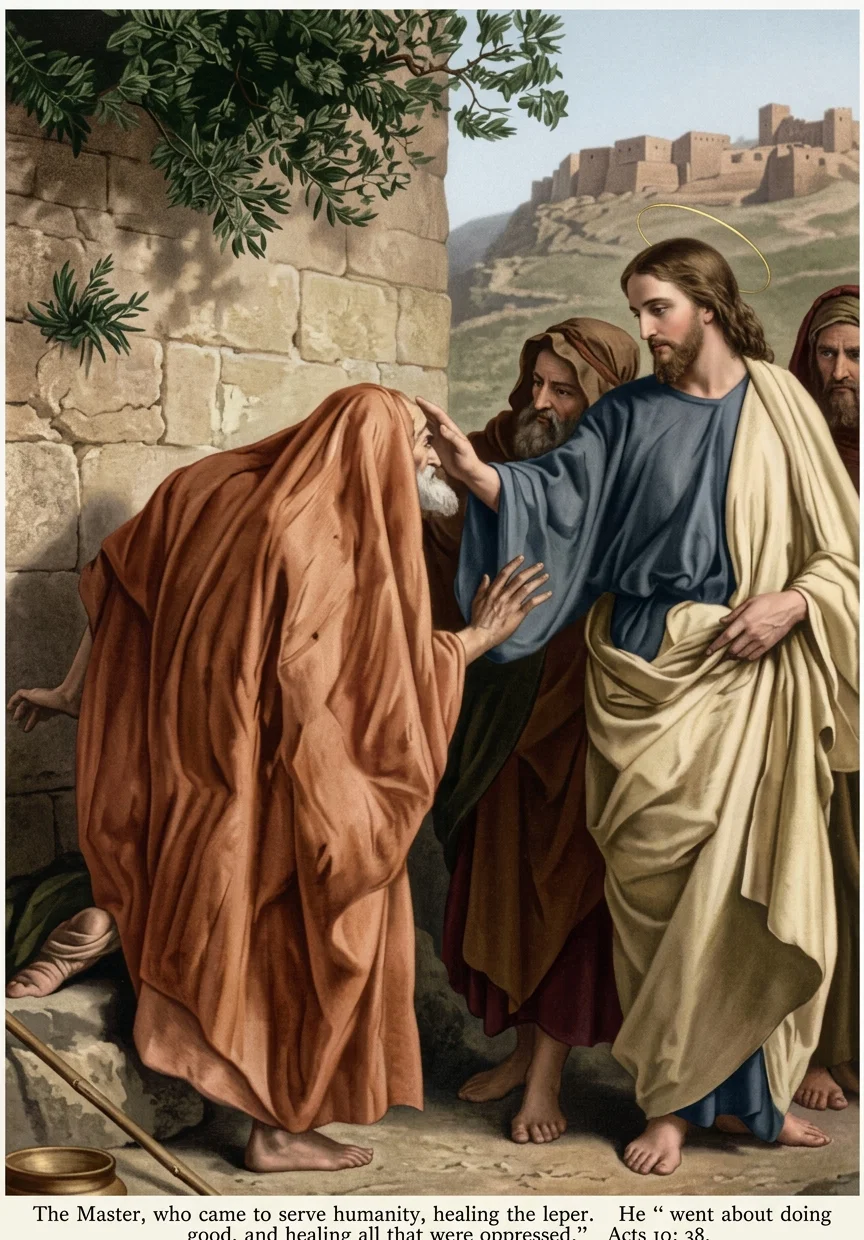
The Master, who came to serve humanity, healing the leper. He "went about doing good, and healing all that were oppressed." Acts 10: 38.
But the very talents that men pervert to the service of evil have been bestowed by the Lord for their elevation and the elevation of those with whom they associate. Through the exercise of the faculties of the mind, through the power of speech, they are to be constantly improving, and feeding other minds with rich intellectual food, thus becoming a blessing to the world. Shall we not individually make the best possible use of the natural powers of mind and body? Shall we not carefully treasure every entrusted talent, and by exercise strengthen every faculty, and live in such a way that the young and inexperienced and the aged and experienced shall be benefited by association with us?

Our Responsibility to Others

The atmosphere that surrounds the soul is fraught with influence for good or evil according to the character of the thoughts. It may be full of poison and malaria, or be fragrant and pure and health-giving. This moral influence will be according to our connection with Christ or our separation from Him, who is light and life. Those who are united with Christ will realize that He has given them trusts according to their several ability; and whatever their surroundings, they will consider them favorable for the development of moral character. We are to make the most of every advantage and opportunity. We may continually remember that we must train and improve our ability, that we may not disappoint our Master, but reach the highest possible standard, and thus influence others to follow in the footsteps of our Example. We may say, "Neither society nor intimate companions must have their ideas of Christian character cheapened by my course of action." Those who take and keep this position will find that the Gospel is the power of God unto salvation. Such will receive the commendation, "Well done, good and faithful servant."

SIGNS OF THE TIMES

"Even as we have been approved of God to be entrusted with the Gospel, so we speak; not as pleasing men, but God, who proveth our hearts."

The Sabbath Before Mount Sinai

By Roderick S. Owen

The Original Days

HE reason given in the fourth commandment for the observance of the seventh-day Sabbath, is that the Lord made the heavens and the earth in six days and rested on the seventh day, and therefore He blessed and sanctified it. In describing these days, the record says, "And the evening and the morning were the first day," "And the evening and the morning were the second day," "And the evening and the morning were the third day." On the fourth day God established the sun to be a light-bearer to the earth, and to rule, or measure, the day; and yet the fourth, fifth, and sixth days are described exactly as are the first three. Hence we conclude that the days of this primal week were all alike, and exactly such days as are now measured by the sun. The merest schoolboy can readily account for a period of seven days, each twenty-four hours in length, about one half of each being dark and one half light; but no scientific man will attempt, on scientific principles, to account for a succession of seven long periods of time, a thousand or a million years each (as some say), one half of each being dark and one half light,—that is, five hundred or more years dark, followed by five hundred or more years light,—and so on for six periods, then suddenly to be changed, by some unaccountable process, to periods only twenty-four hours in length, thus to continue to the present time.
Since creation is the act of speaking things into existence out of nothingness, the Creator could have completed His work in a much shorter period of time had He chosen to do so. To deny this, would be to limit His creative power.
In this recital we find the origin of the weekly cycle—a cycle recognized by all nations, both ancient and modern; and yet, unlike the day or the year, it is traceable to nothing in nature, and indisputably owes its existence to the Creator's work and rest.

The Crowning Day

The seventh day is the distinguishing characteristic of this cycle. It occupies so important a place in it, that among the Hebrews it gave its name to all the days of the week, thus: the first day into the Sabbath, the second day into the Sabbath, and so on until the seventh day, which is called the Sabbath. We can see the significance of these titles for the days of the week when we remember that the word "sabbath" means rest, and that the Creator's rest was a rejoicing in His new creation. Hence each day's work must have constituted a step into that rest; and when at the close of the sixth day God ended His work, the heavens and the earth being finished, He entered with all His intelligent creatures into the fulness of His rejoicing, thus constituting that day His Sabbath, for in it He rested, and was refreshed. Therefore wherever the weekly cycle is found, the Sabbath must exist.

Made for Man

We read that the Sabbath was made for man—mankind; and the steps by which it was made are: first, God rested; second, He blessed; third, He sanctified, or set it apart. "God is no respecter of persons." Having blessed and set apart the Sabbath for all men, He must have made it known to Adam, thus giving it to him, and through him to all his posterity. To have failed to notify man of the sanctification of the day, would have been to make Himself responsible for its desecration; and yet there are those who claim that the Sabbath was not made known until the law was spoken at Sinai, and that then it was given to the Jews only. This would indeed be a strange way to proceed,—to make, bless, and sanctify a day for all mankind, and then to say nothing about it until more than one third of earth's history had passed, and then to give it to only one small and comparatively insignificant nation. Against this idea we have the fact stated above; to wit, that nearly every known nation, ancient and modern, recognized the weekly cycle, and very many of them called the seventh day the Sabbath, or by an equivalent term.

Instances of the Septenary Cycle

That men marked time by the use of this cycle before the Flood, is shown by the record of Noah, of whom we read in Gen. 8:6-12, that to ascertain the condition of the earth's surface he first sent out a raven, then a dove, a first and second time, and that in each instance he waited seven days, or a week. That the patriarchs enumerated time by cycles of sevens, in both days and years, is shown by the account of the experience of Jacob in Gen. 29:18, 27, where we find him working seven years as a compensation for each of his two wives, with a week of festivities intervening.
This system of enumerating time we afterward find incorporated in the Jewish economy in the weekly cycle marked by the Sabbath; in the week of years marked by the seventh, Sabbatic year, or year of release; and in the seven weeks of years, followed and marked by the year of Jubilee.

The Sabbath in Egypt

Coming down to the time of the deliverance of the children of Israel from Egyptian bondage, we find that Pharaoh charged Moses and Aaron with turning the people away from their work and making them rest—Sabbatize—from their labor. It is quite evident from the account given in Exodus, fifth chapter, that Moses was teaching the people to observe the Sabbath. To prevent this, Pharaoh ordered more work to be laid upon them, not furnishing them straw as formerly, but requiring them to gather stubble instead; and at last, to exclude the possibility of their keeping a day, he decreed that they must deliver a certain number of bricks every day, and the marginal reading of verse 13 conveys the idea that they could not deviate from this rule in "the matter of a day in his day." Thus as servants in Egypt they were not allowed to keep the Sabbath. Moses refers to this fact in Deut. 5:14, 15, where he urges the Israelites not to deal with their servants as they had been dealt with in Egypt, but to allow their servants to rest with them on the Sabbath day.

In the Wilderness

In harmony with the thought of their knowledge of the Sabbath while in Egypt, we find it recognized as an existing institution shortly after they entered the wilderness; for thirty days before they reached Mt. Sinai, we find them observing the Sabbath in connection with the gathering of the manna, while God by a double miracle—that of giving the manna for six days and withholding it on the seventh, and by keeping it sweet on that day while it would spoil and become worthless if kept over any other day—was pointing out a definite day as His Sabbath. Thirty days after the giving of the manna, God spoke His law amid the thunders of Sinai; and then to the Sabbath was accorded its place in the very bosom of that code, which was given to that nation to be preserved by them, and by them to be passed on to other nations as the Creator's moral law for all time.
Then have we not clearly found that the Sabbath was made for mankind? that a knowledge of it was given to all nations? that the blessing God placed in it was laid at the door of all peoples throughout all ages, to be accepted or rejected by them, as it is to-day? "God is no respecter of persons." His Sabbath is still for mankind, a hallowed blessing.

Be True Thyself

Alas! no present saint we find; The white simar gleams far behind, Revealed in outline vague, sublime, Through telescopic mists of time!
Trust not in man with passing breath, But in the Lord, old Scripture saith; The truth which saves thou mayst not blend With false professor, faithless friend.
Search thine own heart, What paineth thee In others in thyself may be; All dust is frail, all flesh is weak; Be thou the true man thou dost seek!
Where now with pain thou treadest, trod The whitest of the saints of God! To show thee where their feet were set, The light which led them shineth yet.
The footprints of the life divine, Which marked their path, remain in thine; And that great Life transfused in theirs, Awaits thy faith, thy love, thy prayers!
—From Whittier's "Chapel of the Hermits."

The Remarkable Covenant of Salt

By Emma Hildreth Adams
To most Bible readers the book of Leviticus presents few attractions. They bestow small patience and but scant time upon reading its twenty-seven chapters of most interesting laws, regulations, and instructions, which portray the ceremonial life God required of Israel upon their entrance into the land promised Abraham four hundred thirty years preceding.
Some of these regulations—waiting for the time to be fulfilled—distinctly symbolized a momentous event yet to come—the advent, sufferings, and death of the Christ.
Others applied definitely to the model family relations of that people; now restricting their diet in important details, now enjoining extreme tidiness in personal habits, now establishing guards and guides for high morals.
Others demanded inflexible observance of the great Day of Atonement—full of deepest significance, and crowded with highest interests.
Now they pictured, in attractive colors, the gracious rest of the seventh-year and fiftieth-year sabbaths.
Now they painted in impressive hues the sorrow, the anguish of spirit, the desolation of heart, the sure withdrawing of God's blessing, which should quickly follow their sliding away into apostasy, the worshiping of gods formed by hands of men, the forgetting their masterful delivery from oppression in Egypt, the thrusting aside their miraculous entrance into Canaan.
One of the simplest yet most attractive of these ceremonies was the presentation of a "meat-offering" to the Lord—by His command. In present-day acceptation of the term, this "meat-offering" contained no meat. It consisted simply of fine flour dressed carefully with pure olive-oil and sprinkled with fragrant frankincense.
Notice: Every ingredient composing this "meat-offering"—the flour, oil, and aromatic element—was a product of the ground. No purer offering to the Creator could have been made by the hand of man. Every human heart ever offered has been tainted by sin.
Oil in that day was used as butter now is. "Symbolically, it represented the influences of the divine Spirit, just as the incense was an emblem of grateful prayer." The fine flour typified Him who said to the trans-Galileans: "I am the bread of life. . . . If any man eat of this bread, he shall live forever."
The frankincense was a fragrant resin exuded by a tree of Arabia, and was used to produce the sweet-smelling savor so agreeable to Jehovah.
The person who made the offering was to bring the pure, choice, typical constituents to the priest—one of Aaron's sons. From the fine flour the priest took but a handful, poured upon it some of the golden oil, and then sprinkled thereupon all of the sweet frankincense the offerer had brought.
Dr. Adam Clarke thinks all the aromatic resin was burned because it could not become, for the priest, an article of diet, as did the unburned portion of the offering.
The taking this tiny portion from the total offering was termed by Jehovah the taking "a memorial" thereof. It was placed upon the altar for burnt offerings and consumed completely.
God esteemed this offering "a thing most holy of all the oblations made unto the Lord by fire." He forbade the mingling of honey and leaven with this oblation, saying, "No meat-offering, which ye shall bring unto the Lord, shall be made with leaven: for ye shall burn no leaven, nor any honey, in any offering of the Lord made by fire." Lev. 2:11.
Both these articles are known to have been used in heathen religious rites of that day. Leaven serves as a symbol of simulation, of hypocrisy, and also of corruption, of putrefaction.
A step of interesting significance in the transaction was the seasoning the "memorial" with salt. God gave the order, saying, "Every oblation of thy meat-offering shalt thou season with salt; neither shalt thou suffer the salt of the covenant of thy God to be lacking from thy meat-offering." Lev. 2:13.
In several important respects the contribution of salt to the "meat-offering" added to the ceremony features of intense interest. First, it was a token to Aaron, and to his generations after him, that these reservations of food should never fail him.
Nineteen years after the above date, the Lord, in giving to Aaron explicit directions as to what portions of special offerings, made by the children of Israel, himself and his family should retain for "meat"—food—said, "All the heave-offerings of the holy things, which the children of Israel offer unto the Lord, have I given thee, and thy sons and thy daughters with thee, by a statute forever: it is a COVENANT OF SALT FOREVER before the Lord unto thee and to thy seed with thee."
Salt was an emblem of harmony in thought, feeling, and purpose, of stable friendship, of an unbreakable covenant.
Thus, when the priests ate the meat-offerings, they formed with God a "covenant of salt," bound themselves to faithful allegiance, to persistent service.
Five centuries later in Israel's unenviable, darkly stained history, after the division of the nation into two kingdoms, there arose an occasion when the northern portion was sharply reminded of the to-day existing "covenant of salt" made by God with King David when the latter, conscious of his own highly favored circumstances, proposed to build in Jerusalem a house for the Lord "to dwell in."
Standing upon an eminence of Mount Ephraim, near Bethel, King Abijah, leader of Judah's God-defended host that day—400,000 valiant men of war—cried to Israel's hostile general, at the head of 800,000 mighty men of valor (2 Chron. 13:3-12): "Hear me, thou Jeroboam, and all Israel! Ought ye not to know that the Lord God of Israel gave the kingdom over Israel to David forever, even to him and to his sons by a covenant of salt! . . . O children of Israel, fight ye not against the Lord God of your fathers; for ye shall not prosper."
In the great battle following they were defeated. We turn to the covenant made with David eighty-four years previously (2 Sam. 7:12, 16): "When thy days be fulfilled, and thou shalt sleep with thy fathers, I will set up thy seed after thee, . . . and thine house and thy kingdom shall be established forever before thee; thy throne shall be established forever."
In Psalm 89 occur these vastly significant words of God, referring distinctly to Christ, who is the seed, the descendant, the son of David, and with whom the covenant of salt will be fulfilled: "I have sworn unto David My servant, Thy seed will I establish forever, and build up thy throne to all generations. . . . My mercy will I keep for him forevermore, and My covenant shall stand fast with him. His seed also will I make to endure forever, and his throne as the days of heaven."
It is easy to see why King Abijah called this mighty covenant with David a "covenant of salt." In the nature of things it is indestructible. Neither party thereto will ever infringe upon it, ever transgress it.
Dr. Clarke says: "The grace of God through Christ is represented by salt. Through Him we must render all our service to God. He must never be lacking."
"The waters of the sea never become sweet. So shall the dominion never depart from the house of David."

Things We Can Not Afford

We can't afford to win the gain That means another's loss; We can't afford to miss the crown By stumbling at the cross; We can't afford the heedless jest That robs us of a friend; We can't afford the laugh that finds In bitter tears an end. We can't afford the feast to-day That brings to-morrow's fast; We can't afford the farce that comes To tragedy at last.
We can't afford to play with fire, Or tempt a serpent's bite; We can't afford to think that sin Brings any true delight; We can't afford with serious heed To treat the cynic's sneer; We can't afford to wise men's words To turn a careless ear; We can't afford for hate to give Like hatred in return; We can't afford to feed a flame And make it fiercer burn; We can't afford to lose the soul For this world's fleeting breath; We can't afford to barter life In mad exchange for death. But blind to good are we apart From Thee, all-seeing Lord. O, grant us light, that we may know The things we can't afford. — Selected.

Believing into Christ

WHEN the sinner is brought to a consciousness of his lost condition, and realizes that there is no hope for him, except in Christ Jesus, then is it that the soul believes "into" Christ. There is an entire self-surrender to be saved by the Saviour, just as He will, and a complete subordination of the will to the supreme authority and sovereign will of his Lord and Master. Here is the true involution of the soul, the deepest root and highest reach of faith, whence spring its true life and fruitfulness and glory. It is the finite and subdued will of the renewed man rolled inside the infinite will of the redeeming Lord, to be governed by and to beat in unison with His will. Its nestling prayer is, "Lord, what wilt Thou have me to do?"—Anonymous.
Continue reading: XXXVI. An Anomalous Power