Your ShelfYour Projects

Signs of the Times, Vol. 38, No. 9.

SIGNS OF THE TIMES

Signs of the Times

Feb 28, 1911

Pacific Press Publishing Association · Mountain View, California · Feb 28, 1911

SIGNS OF THE TIMES

Articles of Importance in This Number

Watchfulness and Prayer . . . 3 Mrs. E. G. White Condition of Man in Death . . . 4 Prof. George W. Rine Restoration of the Sabbath . . . 8 R. A. Underwood "From the Sunrising" . . . 5 Prof. L. A. Reed The Seal of God, the Sealed (Revelation Studies) . . . 6 The Law and Gospel (Bible Reading) 9 Secularizing the Church . . . 10 The Message Due in Our Large Cities 14
(For full Table of Contents see last page)

"IF YE WILL INQUIRE, INQUIRE YE."

This Inquirers' Department is conducted for the purpose of helping those who are studying the Bible. The answers are oftentimes only suggestive. They are never to be considered infallible, only as they agree with the infallible Word. The writer who may answer them does not consider that his opinion is infallible. He will simply give the best that he has, and plead with the inquirer to search the Word. Such questions only will be answered as, to the editors, seem to minister to the good of the readers and to the mission of the paper. We can not answer repeatedly in the same volume questions upon the same scripture. The name and address must accompany question, not for publication, but as an evidence of good faith, and that answer may be made by letter if deemed advisable. No letters are answered which do not contain the name of the writer. It is well always to enclose stamp for reply.

3364.—The Days of Daniel 12:11, 12

Will you kindly explain in Question Corner Dan. 12:11, 12, and locate the 1290 and 1335 days? V.
There seems to be clear historical evidence to show that the "abomination that maketh desolate," the putting of man in the place of God, was established in the period 503 to 508 A.D. 1290 years from that date brings us to 1793 to 1798, when this union of Church and State developed in the Papacy ended, its spiritual domination was broken. The 1335 days must begin at the same date, 508, and would therefore end in 1843 at the climax of the great advent movement at that time.

3358.—Stone and Rock, Matt. 16:18, 19.

Will you please explain Matt. 16:18, 19? What is the meaning of the Greek word from which "Peter" and "rock" are translated, also John 1:42? What are the keys of the kingdom of heaven?
1. Peter comes from petros, which means a stone or a mass of rock broken off from the great original rock.
2. "Rock" comes from petra, invariably translated "rock" throughout the New Testament, just as petros invariably has reference to Peter, a stone or mass of rock from the original rock. Peter had made a confession of Christ Jesus. Our Lord told him that that did not come of any wisdom which he possessed, but God had revealed it to him. And upon that rock, confession of Christ as Saviour, God would build His church. What the rock is is clearly shown in Deut. 32:4 and Ps. 18:31. "Who is God, save Jehovah? and who is a Rock, besides our God?" This very clearly shows that He only is the Rock. "His way is perfect." Again listen to the apostle Paul as to what the true foundation is: "For other foundation can no man lay than that which is laid, which is Jesus Christ." 1 Cor. 3:11. And Peter himself tells us very explicitly that believers are "living stones, are built up a spiritual house, to be a holy priesthood," but at the same time "the foundation Stone" is Christ Jesus, and He also is a "Rock of offense" to those who disbelieve. The word "rock" comes from petra, the same as in Matt. 16:18. See 1 Peter 2:4-8.
3. Keys are the things that open. The keys of the kingdom of heaven open the kingdom of heaven, and the kingdom of heaven is opened by faith in the Gospel of the Lord Jesus Christ. This Gospel was preached by Peter to the Jews on the Day of Pentecost. It was preached to Gentiles, Cornelius, the Roman centurion, by Peter. See Acts 2 and Acts 10. God chose Peter to present both, to the Jews and to the Gentiles this wonderful Gospel of which he had the keys. And so we read in Acts 15 the words of Peter himself: "Brethren, ye know that a good while ago God made choice among you, that by my mouth the Gentiles should hear the word of the Gospel, and believe. And God, who knoweth the heart, bare them witness, giving them the Holy Spirit, even as He did unto us." Acts 15:7, 8. But this did not elevate Peter above the other apostles; for at the very council in which Peter spoke these words, James himself presided, and Peter was there, as well as the other apostles. Upon the foundation of Christ Jesus and belief in that foundation God builds His church. It is not by any man or any men that the church is founded. It is founded by the power of God Himself through that Son who has given His life to redeem mankind. Every one who believes in Him is as Peter was, a living stone built upon that foundation.

3359.—Sun Standing Still, Joshua 10:12

How are we to understand Joshua 10:12? Does the sun move? Does this change the reckoning of time? F. A.
The language of Joshua 10:12 is quoted from a poem "The Book of Jasher," now unknown, and the language is the language of appearance just as we use it in common conversation, the rising of the sun, the setting of the sun. It so appears to us, altho in reality the earth revolves: No, the event did not change the time, tho the light period was longer; it is still called "a day." If that occurrence had changed dates doubtless some reference would be made to it. It is not a scripture which would in any wise affect our salvation. The whole record is given to show that God remembered His promise to His servant Joshua, to be with Him as He had been with Moses. Joshua 1:5.

3360.—Let the Dead Bury Their Dead, Luke 9:60

Please explain the text, "Let the dead bury their dead." L. H.
Read as in the Revised Version, "Leave the dead to bury their own dead." The young man wanted to follow Christ, but he wanted to wait, perhaps, till his father died. He did not rightly understand the relative importance of following Christ and abiding at home. He did not have clear ideas as to duty. Jesus said in substance, Let those who are dead to the great importance of soul-saving truth, bury their dead. They have time for this. But let him who is called of God, make God's work first.

3361.—The Heritage of Jacob

A correspondent (W. S. K.) contends that Isa. 58:13, God's instruction concerning His Sabbath, was all given concerning the heritage of Jacob.
True, the Sabbath was given to Israel to be a sign between them and God forever. Ex. 31:17. But let us note several other facts: (1) God's promise to Abraham was that he should inherit the world. Rom. 4:13. Isaac and Jacob were heirs with him of the same promise. Heb. 11:9, 13-16. (2) The very bounds of the inhabitable earth were according to the number of the children of Israel. Deut. 32:8. (3) All the promises of the Bible are to Israel. Rom. 9:4, 5. There is no hope to the Gentile as such only as he becomes Israel by faith. Eph. 2:11, 12. (4) There is hope for the Gentile if he will take hold of God's covenant, live the light, and observe the Sabbath. Isa. 56:1-7. (5) Jesus Christ is our justifier and example. He saves us by giving us His righteousness wrought out in obedience to all God's commandments, including that of the Sabbath. (6) He gives us His life that we may follow His example, and "walk even as He walked;" "leaving us an example, that ye should follow in His steps." 1 John 2:6; 1 Peter 2:21. (7) Therefore the hope of the Gentile is, to become an Israelite, a Jew. Rom. 2:27; John 4:24.

3362.—Week of Fasting and Prayer

Please explain through the paper about the week that is set apart for prayer and fasting. J. H. M.
We do not know what particular event is referred to. It is well for God's children to pray at all times, both singly and together. It is well to fast as occasion may demand or require. In times of trouble and in great crises God's people have frequently sought Him with fasting, and He has graciously heard, while He has condemned those who did not participate. See Joel 2:12-18; Isa. 22:12-14; Ezra 8:21-23; Matt. 9:14, 15. The Bridegroom is still away, and there are many times when it is fitting to fast.

3363.—Cain and His Wife, Gen. 4: 16, 17

Will you please explain for me Gen. 4:16, 17? And who was Cain’s wife?
Cain deserved to die, but the Lord reserved that punishment for Himself. Therefore, as the Revised Version reads, God “appointed a sign for Cain, lest any finding him should smite him.” Verse 15. Then Cain became a wanderer, for “the land of Nod” means “the land of wandering.” His wife was his own sister, one of Adam’s daughters. Many years may have elapsed between verses 16 and 17.

3365.—"Reverend"

Is it right to "Reverend" any man?
E. E. W.
We read in Ps. 111:9, "Holy and reverend is His name." There are many who will not use the word as applied to man. Not a few prefer "Pastor" or "Elder." Words in time undergo great changes. So with this word. It only means now that the one to whom it is applied is a preacher of some sort.

Readings from Numbers 33

OUR week's readings begin with Numbers 33, a good exercise in name pronunciation, and yet having its oases, like the fountains and palm-trees of Elim; then follows the death of Aaron, God's warning concerning the idolatrous inhabitants of Canaan, the border of the land, the cities of refuge, and Zelophehad's daughters.

The Book of Deuteronomy

The word "Deuteronomy" means the second law, or the doubling or repetition, by Moses, of the law. It is the rehearsal of God's doings and of His law to Israel, before the man of God should lay down his work to another. It is the last book of the Pentateuch. It is worthy of note that when our Lord met the devil on the mount of temptation with weapons from the Word, every one was drawn from the book of Deuteronomy; and contrary to the Higher Critics, who place it as late as or later than Manasseh, Peter attributes the book to Moses. Acts 3:22, 23. Its time of writing was the eleventh month of the fortieth year. The second verse has a wonderful lesson. From Horeb Israel started for the Promised Land. Kadesh-barnea is on its very border. Eleven days' journey only, yet it took unbelieving Israel nearly forty years! The "Companion Bible" gives ten discourses of Moses as follows: (1) 1:6 to 4:40; (2) 5:1 to 10:5; (3) 10:10 to 12:32; (4) 13:1 to 26:19; (5) 27:1 to 28:68; (6) 29:2 to 30:20; (7) 31:2-6; (8) 32:1-43; (9) 32:44-47; (10) 33:2-29. The portions omitted in the above are narrative or introduction. The promise of verse 8 is mentioned twenty-seven times in Deuteronomy; but how could men understand it without Genesis? It is a book worthy of much study.

Lessons from Deuteronomy Chapters Four and Five

CHAPTER 4 refers to the Decalogue, and presents the mighty appeal which follows as an incentive to Israel to observe it; in chapter 5 it is repeated in substance, and its manner of giving rehearsed to show its holiness and integrity. Israel is reminded of their own littleness, of God's goodness, and continually are they warned not to forget, but to take diligent heed. The reading presents nothing particularly new, but it presses home upon the heart with tremendous force God's great moral lessons. They are needed to-day.

Watchfulness and Prayer

By Mrs. E. G. White
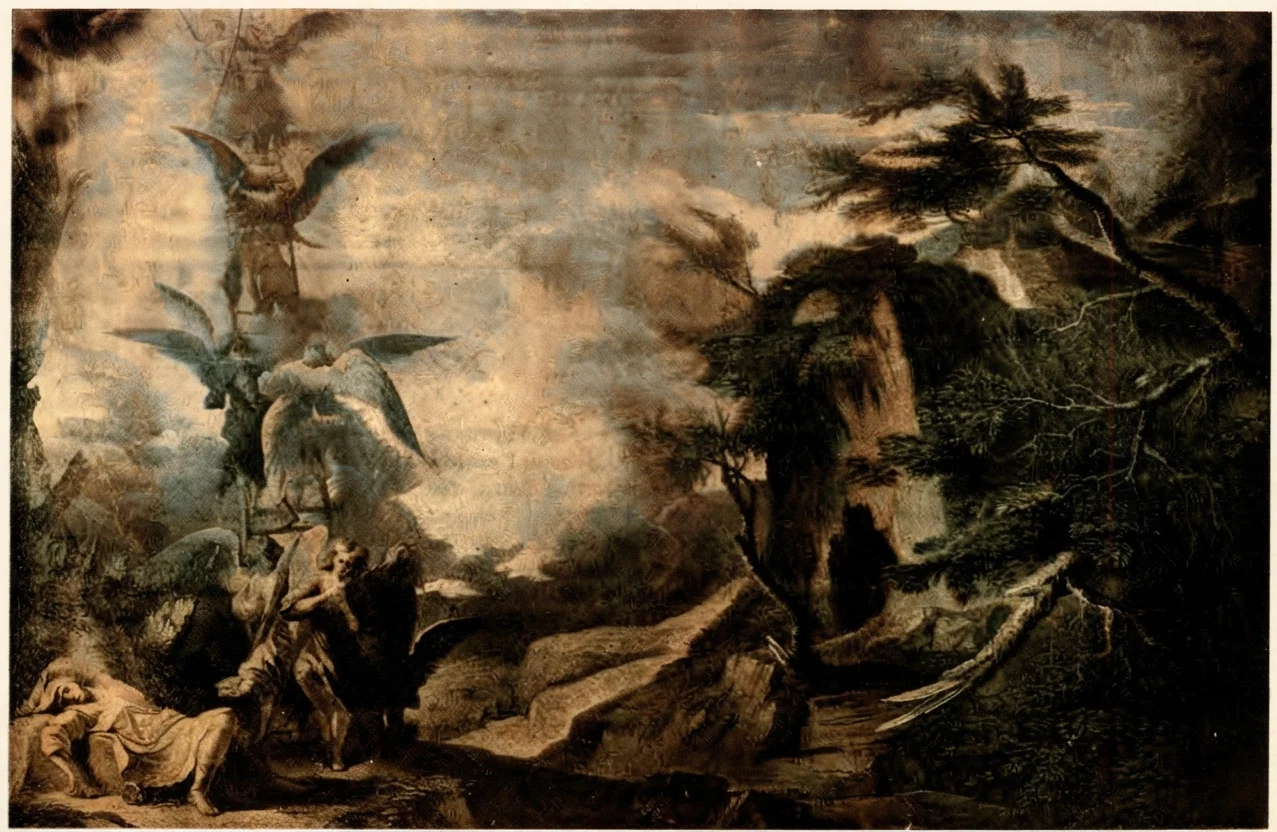
JACOB'S DREAM. Salvator Rosa
HOW many there are whose hearts are to-day aching under their load of care, and who are thinking, "O, if there was only some one to help me bear my burdens!" Well, there is some one to help you bear your burden; there is rest for you who are heavy laden. Jesus, the great Burden-bearer, invites, "Come unto Me, all ye that labor and are heavy laden, and I will give you rest." Here is the promise of the Master; but it is on condition. "Take My yoke upon you," He says, "and learn of Me; for I am meek and lowly in heart: and ye shall find rest unto your souls." "For My yoke is grievous." Is that what He says? No. "My yoke is easy, and My burden is light." The burden you are carrying, which is so heavy, and which causes such weariness and perplexity, is your own burden. You desire to meet the world's standard; and in your eager efforts to gratify ambitious and worldly desires, you wound your consciences, and thus bring upon yourselves the additional burden of remorse. When you do not want to be distinct from the world, but desire to mix up with it so that no difference is seen between you and the world, then you may know that you are drunken with the cares of this life. O, there are so many selfish interests, so many cords to bind us to this world! But we must keep cutting these cords, and be in a condition of waiting for our Lord.
The world has forced itself in between our souls and God. But what right have we to allow our hearts to become overcharged with the cares of this life? What right have we, through our devotion to the world, to neglect the affairs of the church and the interests of our fellow men? Why should we manufacture for ourselves burdens and cares that Christ has not laid upon us? Why should we, through distrust of His promises, suffer from wearing, anxious care? He says: "Take no thought, saying, What shall we eat? or, What shall we drink? or, Wherewithal shall we be clothed?" "for your heavenly Father knoweth that ye have need of all these things."
"Consider the lilies of the field, how they grow; they toil not, neither do they spin: and yet I say unto you, that even Solomon in all his glory was not arrayed like one of these." The magnificence of Solomon was not to be compared to the beauty of one of these little flowers, with its delicate colors, which the God of heaven had painted upon it by His wondrous skill. Will not He who has taken so much thought for the flowers of the field, care for your mortal bodies? Will He not see that you have bread to eat and raiment to put on, O ye of little faith? And more than all this, will He not also clothe you with the garment of His own righteousness?
Our heavenly Father has a thousand ways to provide for us that we know nothing about. But we are not excused from effort. While we may trust His constant care, we must not conclude that we may be slack in that which our hands find to do. We are to be "not slothful in business; fervent in spirit; serving the Lord." "If any providenot for his own, and specially for those of his own house, he hath denied the faith, and is worse than an infidel."
There is one thing in which we must be deeply in earnest, and that is in the service of God. There is no danger of having too much zeal here. If we would only work with an eye single to the glory of God, the mists would roll away, and our views of right and wrong would become clear. We should consecrate our property. The language of our hearts would be, "Lord, here is the means for which Thou hast made me responsible; what wilt Thou have me do with it?" And we should make straight paths for our feet, lest by any false step the lame be turned out of the way. The whole effort of our lives would be to glorify the Saviour, the Man of Calvary, and to prepare for the life immortal.
"Watch ye therefore, and pray always." There is great need of watchfulness, not for our own sakes only, but also for the sake of our influence upon others. Our influence is far-reaching. We may think that it is confined to our own households; that only the members of our own families know what we are and what we are doing. In some cases this may seem to be true; but in some way the influence of the home life goes out beyond the home.
And what do we learn from this? That in our homes and in all the relations of life, we should be watchful and prayerful.
Solemn, sacred duties devolve upon us. We should so speak and so walk that the Spirit of God may be in our hearts, and His blessing in our homes. If we had more of the love of God in our hearts, and His praise were oftener upon our lips, we should be better prepared to glorify Him here and hereafter. But what will our words accomplish, if they are not backed up by a holy life?
"Watch ye therefore, and pray always," "that ye may . . . stand before the Son of Man." What a position to stand in before the world, to be ready and waiting for the coming of the Lord, that at His appearing we may be able to say, "Lo, this is our God; we have waited for Him, and He will save us." What a triumph it will be to enter in through the gates into the city of God, bearing the palm branch of victory! what a privilege to have a right to the Tree of Life, and to eat of its precious fruits!
If we would share in the glorious reward promised to the overcomer, we must fight the good fight of faith. This is what the apostle Paul did, and he says: "Henceforth there is laid up for me a crown of righteousness, which the Lord, the righteous Judge, shall give me at that day." Let us be of the number of those that are "rich in good works," "laying up in store for themselves a good foundation against the time to come, that they may lay hold on eternal life."

Signs of the Times

"Even as we have been approved of God to be entrusted with the Gospel, so we speak; not as pleasing men, but God, who proveth our hearts."

Man in Death

By George W. Rine

THE paradoxical question, "Are the dead alive?" is nearly as old as the human race. Millions are still asking the same hoary question, just as if God, the Creator of man, had not, thousands of years ago, given us a categorical answer. The well-known journalist, Mr. Fremont Rider, recently gave to the public a book with the title, "Are the Dead Alive?" The book, we are told, is having an unprecedented sale. Nearly thirty years ago the famous Society of Psychical Research was created in London primarily for the purpose of discovering the true answer to this time-old question. It is through the scientific investigation of the phenomena of Spiritism that the society has prosecuted its quest of the coveted answer. The membership of the society has always consisted of scientists and authors of international fame. Branch societies have been organized in Italy, France, and America.
Now if these learned researchers, and the world generally, really believed the testimony of God given through His Word as to the state or condition of the dead, the Society for Psychical Research would never have existed, and the question of the centuries, cited above, would never have been asked. God's answer to the question is so clear, simple, and definite that a child can not mistake its meaning. When the Creator announced to our first parents that if they disobeyed Him — ate of the forbidden fruit — they would surely die, He meant exactly what He said. True it is that Satan, the father of lies, as he is of all other forms of sin, contradicted God by declaring to the mother of the race that even if she should disobey her Creator, she would not die, but be all the wiser and happier for her disobedience. Strange to say that not only our first parents, but nearly all their posterity, have accepted the pronouncement of Satan rather than that of God, as to man's condition in death.
Do you really know, dear reader, whether the dead are or are not actually dead? Do you want to know? If you do, why not accept the witness of God as set forth in His Word respecting this otherwise baffling question? Should not the testimony of the omniscient One be accepted as conclusive, as final? Through His servant Solomon, man's Creator bears the following unmistakable testimony: "For to him that is joined to all the living there is hope: for a living dog is better than a dead lion. For the living know that they shall die: but the dead know not anything. . . . Also their love, and their hatred, and their envy, is now perished." Eccl. 9:4-6. Should not this direct, clear-cut dictum as to the condition of man in death, forever settle the question in the mind of every sincere believer in the God of the Bible? Does man possess a consciousness or personality that survives the death of the body, if, as God asserts, "the dead know not anything"? No one denies that love, hatred, and envy are attributes of mind. God tells us that these states of mind perish with the dissolution of the body. We all believe that God made man, and that He, as He Himself says, "knoweth our frame." Can He, therefore, be mistaken when He asserts that "the dead know not anything"?
The divine declaration recorded in verse 10 of the same chapter is significant in respect to the question we are considering. It runs thus: "Whatsoever thy hand findeth to do, do it with thy might; for there is no work, nor device, nor knowledge, nor wisdom, in the grave, whither thou goest." Observe, please, that the Author of man here asserts unqualifiedly that the dead have no "knowledge," no "wisdom." This being true, they can have no consciousness, no mind, no life. All who believe in the God of the Christian, believe in His Word; and believing in His Word, they know that "the dead know not anything."
The inspired psalmist entertained no doubt as to man's inability, when dead, to remember God or to offer Him thanks; for he says in addressing God, "For in death there is no remembrance of Thee: in the grave who shall give Thee thanks?" Ps. 6:5. He again declares, "The dead praise not the Lord." Remember that David under the inspiration of the divine Spirit made this declaration respecting all the dead — the righteous as well as the unrighteous dead. It is because they "know not anything," because they are not alive, that the dead neither "remember" nor "thank" nor "praise" the Lord. Who is the more trustworthy, David, the chosen of the Lord, or the modern salaried teacher of theology?
In the 38th chapter of Isaiah we have narrated an incident in the life of Hezekiah which is strikingly pertinent to our inquiry. The facts of the story are these: Hezekiah the King "was sick unto death." Through the prophet Isaiah the Lord sent the King a message to the effect that his illness would end fatally. But for some cause Hezekiah felt so averse to dying at that time that he turned his face to the wall and with weeping entreated the Lord to spare his life. In answer to the King's contrite petition the Lord sent him this message by the hand of Isaiah: "I have heard thy prayer, I have seen thy tears: behold, I will add unto thy days fifteen years." In the joy and gratitude of his heart for having been so wondrously saved from death, Hezekiah, guided by the Spirit of God, passionately exclaimed: "Thou hast in love to my soul delivered it from the pit of corruption. . . . For the grave can not praise Thee, death can not celebrate Thee: they that go down into the pit can not hope for Thy truth. The living, the living, he shall praise Thee, as I do this day." (See verses 1-5, 17-19.)
The meaning of Hezekiah's words can not be mistaken. He is praising and magnifying the Lord. He declares that if he had died and gone down into the grave, he could not"praise" and "celebrate" the Lord as he was now doing. But he was alive, and hence able to offer to God, who had saved him from the power of death, praise and thanksgiving. So he rapturously exclaims, "The LIVING, the LIVING, he shall praise Thee, as I do this day." Only the living, declares good King Hezekiah, can praise and worship God; for he knew that the dead were actually dead, and therefore incapable of thought and love and thanksgiving. He knew, as the Scriptures teach, that if he had died he could not have gone into the presence of God at death, but would have lain unconscious in the "pit," or grave, until that day when "the dead in Christ shall rise first."
Those who hold the doctrine of inherent human immortality, believe, of course, that it is the mind, the conscious personality, which survives the change called death. The powers of thought and feeling, they maintain, can not die. It is a dogma that has its roots, not in the teachings of Holy Writ, but in the occult sacerdotalism of ancient Egypt, in the philosophy of Plato, of Socrates, and in the vapory and often grotesque scholasticism of the Dark Ages. True it is that in Eden the dogma was first enunciated, not, however, by the Author of life, but by the prince of darkness, the father of lies. Hence it belongs to what the inspired apostle characterizes as the "doctrines of devils."
The theory is in flat contradiction to the testimony of the divine Spirit. In His Word God has given us an express declaration to the effect that at death the mind as well as the body, the rational as well as the physical powers, are dissolved, aye, perish. Surely not one of my readers can fail to grasp God's pronouncement when He says: "Put not your trust in princes, nor in the son of man, in whom there is no help. His [man's] breath goeth forth, he returneth to his earth; in that very day his thoughts perish." Ps. 146:3, 4. Not simply man's physical organs, with their functions, perish at death, but also his "thoughts"—his mind. Had Solomon, then, any warrant for his asserting that "the dead know not anything"? Aye, he had, as we now see, the unqualified declaration of omniscient God for his warrant. Can God, the Author of man, be mistaken as to the status of man in death? How often Jesus said that He came to declare the words of God the Father! Hence He said just what we should expect Him to say respecting Lazarus after the latter's death. The Master first said, "Lazarus sleepeth." But the disciples placing a false construction upon the word "sleepeth," Jesus said plainly, "Lazarus is DEAD." The Master did not say that Lazarus was in heaven, or in glory, or had gone to God; but He did say, "Lazarus is dead." Not Lazarus's body, but Lazarus as a personality, all there was of Lazarus, was dead.
But, thanks be to God, tho Lazarus was really dead, he was not irretrievably dead; for Jesus proceeded to restore Lazarus to life, not by recalling him from heaven or from Paradise, but by raising him from the dead—by a resurrection. It was at this time that our Lord declared, "I am the resurrection and the life," and then vindicated His stupendous claim by raising His dead friend to life. Whom shall we believe, Plato or Solomon? Socrates or David? Satan or Christ? It was the Spirit of God and of Christ who affirmed through the psalmist that when a man dies, "in that very day his THOUGHTS perish."

"From the Sunrising"

By L. A. Reed
IN the book of Revelation there are wondrous visions of history told in advance.
Among the scenes beheld by the prophet John, was that of the work in the earth of the demons in the last final conflict of earth's history, spirits of demons "which go forth unto the kings of the whole world, to gather them together unto the war of the great day of God, the Almighty." Rev. 16:14. And these kings thus led by the satanic spirits are seen coming from the sunrising! It is thus that the history of the world has been told for ages.
From the sunrising—in this direction have moved the mighty events of the nations for thousands of years. From Babylon to Medo-Persia, from Medo-Persia to Greece, from Greece to Rome, from Rome to Europe, from Europe to the United States, from the United States to the Philippines, Japan, and China—such has been the trend of events through the years. Following the sun, moving with the movement of the light, so civilization has marched with the years. "Westward the course of empire" has taken its way.
But preceding the picture of the nations being led astray, we have another picture, another vision given the prophet, recorded in the 7th chapter of Revelation, verse two: "And I saw another angel ascend from the sunrising, having the seal of the living God: and he cried with a great voice." "From the sunrising comes God's angel." From the sunrising—the providence of God precedes the deceptive work of the spirits of demons! Through the years God's work, God's providence, His angelic representatives move ever in advance of every other work whatsoever. God leads the way. Blessed are they who keep pace with Him.
But sad for those who fall behind! In the rear, coming behind, trailing in the dust and the mist, are the deceiving spirits leading hosts who have rejected the counsels of God and are opposed to His purposes. From the sunrising, therefore, move those, it is true, led by the demons of wrong; but ahead of them, triumphant, mighty, moves majestically the work of God, conquering,—from the sunrising.
It is good to know that God's work is in the lead. It is good to know that God's agencies are far in the advance. It is good to know that all things are clear to the vision of our Creator. Out of His calm eternity He beholds all things that concern humanity. He controls, as we shall all see at last, the destiny of the world. May we follow His providence—from the sunrising. May we too move with the light. May the angel of God that comes from the sunrising, crying with a great voice, be our leader.
May we not be among those who follow the lying spirits, moving also from the sunrising, but failing to keep pace with the merciful providence of God. All these are led by unclean spirits, spirits of demons, and they gather the nations for Armageddon.
"Behold, I come as a thief. Blessed is he that watcheth, and keepeth his garments, lest he walk naked, and they see his shame." Rev. 16:15.

Psalm XXIII

The Lord is my Shepherd; I shall not want. I shall not want REST. “He maketh me to lie down in green pastures:” I shall not want REFRESHMENT. “He leadeth me beside the still waters.” I shall not want HOPE. “He restoreth my soul:” I shall not want GUIDANCE. “He leadeth me in the paths of righteousness for His name's sake.” I shall not want COMPANIONSHIP. “Yea, tho I walk through the valley of the shadow of death, I will fear no evil: for Thou art with me;” I shall not want COMFORT. “Thy rod and Thy staff they comfort me.” I shall not want SUSTENANCE. “Thou preparest a table before me in the presence of mine enemies:” I shall not want JOY. “Thou anointest my head with oil;” I shall not want DRINK. “My cup runneth over.” I shall not want ANYTHING IN THIS LIFE. “Surely goodness and mercy shall follow me all the days of my life:” I shall not want ANYTHING IN ETERNITY. “And I will dwell in the house of the Lord forever.”
— Selected.

Founded on an Empty Tomb

Said an unbeliever, sneeringly, "The Christian church is founded on an empty tomb." And so it is. This blessed fact, first of all, makes life endurable and the burdens of life bearable. Luther at a time of great perplexity and fear sat by his table with bowed head and heart. Soon he lifted his face triumphantly toward the light, and his finger began to trace upon the table, "He lives! He lives!"
We wonder not that the disciples ran to the sepulcher when first they heard that it was empty. Our own hearts beat more quickly as this truth takes possession of us. —The Classmate.

Consecrated Parents and Converted Children

“WHEN the parents are consecrated, the children are early converted.”

Trusting God for Past and Future

“He can not trust God for his past who is trembling as to the future.”

The Power of the Least Prayer

“The least prayer that reaches God’s throne shakes His footstool.”
Continue reading: The Four Angels and Four Winds