Pacific Press Publishing Association · Mountain View, California · Aug 19, 1913
"IF YE WILL INQUIRE, INQUIRE YE."
By Editor
This Inquirer's Department is conducted for the purpose of helping those who are studying the Bible. The answers are oftentimes only suggestive. They are never to be considered infallible, only as they agree with the infallible Word. The writer who may answer these questions does not consider that his opinion is infallible. He will simply give the best that he has, and plead with the inquirer to search the Word. Such questions only will be answered as, to the editors, seem to minister to the good of the readers and to the mission of the paper. We can not answer repeatedly in the same volume questions upon the same scripture. The name and address must accompany question, not for publication, but as an evidence of good faith, and that answer may be made by letter if deemed advisable. No letters are answered which do not contain the name of the writer. It is well always to enclose stamp for reply.
4154 — Marriage and Divorce
By Editor
Is it allowable, for any cause, to dissolve the marriage vow? and if the marriage is dissolved, can either or both parties marry again?
This question is asked, we presume, that it may be answered from the Bible view-point; for from the purely legal point of view, marriage bonds are easily dissolved, and generally in this country both parties are free to marry again. God suffered these conditions during the commonwealth of Israel. If a wife did not please her husband, he could, under certain restrictions, give her a bill of divorcement and send her away. See Deut. 24:1-4. In the divine ordination of marriage, such a thing as sin was not contemplated. The great Creator, as He gave woman to man, expressly declared, "Therefore shall a man leave his father and his mother, and shall cleave unto his wife: and they shall be one flesh." Gen. 2:24. Our Lord, in the church He was establishing, sought to lift the marriage to its primitive exalted foundation, and upon this we have the following utterances:
"It hath been said, Whosoever shall put away his wife, let him give her a writing of divorcement: but I say unto you, That whosoever shall put away his wife, saving for the cause of fornication, causeth her to commit adultery: and whosoever shall marry her that is divorced committeth adultery." Matt. 5: 31, 32.
"The Pharisees also came unto Him, tempting Him, and saying unto Him, Is it lawful for a man to put away his wife for every cause? And He answered and said unto them, Have ye not read, that He which made them at the beginning made them male and female, and said, For this cause shall a man leave father and mother, and shall cleave to his wife; and they twain shall be one flesh? Wherefore they are no more twain, but one flesh. What therefore God hath joined together, let not man put asunder. They say unto Him, Why did Moses then command to give a writing of divorcement, and to put her away? He saith unto them, Moses because of the hardness of your hearts suffered you to put away your wives: but from the beginning it was not so. And I say unto you, Whosoever shall put away his wife, except it be for fornication, and shall marry another, committeth adultery: and whoso marrieth her which is put away doth commit adultery." Matt. 19:3-9.
"And in the house His disciples asked Him again of the same matter. And He saith unto them, Whosoever shall put away his wife, and marry another, committeth adultery against her. And if a woman shall put away her husband, and be married to another, she committeth adultery." Mark 10:10-12.
"Whosoever putteth away his wife, and marrieth another, committeth adultery: and whosoever marrieth her that is put away from her husband committeth adultery." Luke 16:18.
Now it is a right principle of interpretation of all law that the broader, fuller statement shall govern, or modify, the meaning of the more meager. Two of the above, Mark and Luke, make the simple, broad statement, with no qualifications whatever, while the two statements in Matthew qualify by the expressions "saving for the cause of fornication," and "except it be for fornication." The first of these is given in the broad statement of our Lord's teaching in the sermon on the mount; the second is called out by direct questions of the Pharisees. The two other statements are the expression of the general positive side, with no mention of any modification or exceptions. The two latter should be understood in the light of the former.
It is therefore clearly evident that our Lord recognized one proper cause for divorce, namely, fornication, or adultery. That is, the innocent party, husband or wife, could divorce the guilty party, husband or wife; but He recognizes no other cause. One may find a hundred defects in wife or husband. For none of these may divorce be obtained unless there is involved a transgression of the seventh commandment. Anything less than this is not cause for final separation; and consequently no true marriage can follow. And he who marries the one divorced without just cause, is guilty, because the one he marries is still, in God's sight, joined to another. Then, too, if a man puts away an innocent wife, he says to the world, She is guilty, and thus places upon her the stigma of adultery. It is therefore to the innocent person put away that our Lord refers in the expression, "Whosoever marrieth her when she is put away committeth adultery." See Matt. 5:32, last part; 19:9, last part; Luke 16:18, last part.
That a divorce is proper if one party to the marriage prove false is evident from a little study of our Lord's words. He would not have His children guilty of fornication primarily or secondarily, either practising such things themselves, or living in life union with one that does, and so become partakers with the guilty; for "Know ye not that he that is joined to a harlot is one body? for, The twain, saith He, shall become one flesh. . . . Flee fornication." See 1 Cor. 6:15-18. Therefore for a Christian to hold as inviolate the marriage bonds with one who proves false to marriage vows and so continues, is to make himself a partaker of fornication.
Such a separation is therefore final. They are no longer one flesh. One has broken the vow, and, according to our Lord's words, has made just cause for its dissolution. The innocent party, after legal separation, stands alone. The adulterer or adulteress is no longer with him or her one flesh, and he or she is free to marry another. He is dead to his former wife, or she to him. But how about the innocent divorced party? May she marry?—No, not till her former husband dies, or is guilty of fornication, so that she may secure divorce on proper ground. Then, and not until then, may she properly marry. What of the guilty?—Of such the Lord says nothing. They are separate from His plan, out in the world. If they come to Him, are born again, become new creatures in Christ Jesus, to our mind, they could properly marry; but not to former spouses. But the matter ought to be made a subject of prayer, and the clear guidance of God ought to be manifest to others besides the interested parties.
4152 — Suffer the Little Children
In Matt. 19:14, to whom did Christ refer? Did He mean actual young children, or all that came to Him, whether old or young? G. R.
The context clearly shows here that He had reference to little children, that is, little children according to the flesh; for "then were there brought unto Him little children, that He should lay His hands on them, and pray: and the disciples rebuked them." The disciples seemed to think that those children were too young and too small to claim the Master's attention at all; and our Lord left it on record, for all time, that it was not the older ones alone who were to come, but the little ones as well. Then in the latter part He shows us just what kind of individuals will inherit the kingdom of heaven,—"to such belongeth the kingdom of heaven," that is, to those who have the trusting mind of the child. This is shown in Matt. 18:3, 4: "Except ye turn, and become as little children, ye shall in no wise enter into the kingdom of heaven. Whosoever therefore shall humble himself as this little child, the same is the greatest in the kingdom of heaven." That is, they should have the simple, yielding, trusting heart of the child. As expressed by an apostle, "In malice be ye children, but in understanding be men;" but keep the trusting child heart all the way.
4153 — One Hour
By M. H. R.
What is meant by "one hour" in Rev. 17:12—"one hour with the beast"?
M. H. R.
If we understand it aright, it means just this: that sometime in the near future beast worship will be restored in a fuller sense than ever before; that the last great confederation of the Old World will unite in restoring the beast power; that this complete restoration will continue for one twelfth of a prophetic day, or thirty literal days. John 11:9. During this time, apostasy will seem to triumph, and will say, "I sit a queen, and am no widow, and shall see no sorrow." Rev. 18:7. Five times in the Word is this one hour seemingly brought to view,—in the 17th chapter as the time of beast triumph; in chapter 18:10, 17, 19, marking the termination of that period when all the power and wealth and glory in this aggregate conspiracy shall have come to naught; and in chapter 3:10, as marking a time when the people of God will be passing through one of the greatest trials the world has ever known, but out of which God promises to save them. This period will come in connection with the close of probation.
4155 — Blasphemy
Matt. 12:31 reads, "Therefore I say unto you, Every sin and blasphemy shall be forgiven unto men; but the blasphemy against the Spirit shall not be forgiven." Are not a great many blasphemers and do not know it? Is it in the rejecting of God's Spirit, the saving power? or is it in words or deeds?
Doubtless there are many who blaspheme and do not recognize that they are blaspheming. Paul even blasphemed the Holy Spirit; that is, he attributed the work of the Spirit of God in Stephen to the work of the enemy. But he tells us in 1 Tim. 1:13: "I obtained mercy, because I did it ignorantly in unbelief." But those who did as did the Jews, in the light of the mightiest evidences of the working of God's Spirit, in the healing of the sick, in the restoration of all sorts of afflicted persons, and even the raising of the dead,—to reject such things as these deliberately and attribute them to Satan, was blasphemy which could not be forgiven, because there is no repentance. The man who would reject such evidence as that, will reject all evidence. That is, nothing can be brought to bear upon him that will bring him to see the enormity of his sin, or that will lead him to true repentance. The unforgivable sin is the unrepentable sin. We may do this in deeds and in words, but we must, above all things else, do it in heart. God has two means of reaching and cleansing the soul,—the blood of our Lord Jesus Christ and the power of the Spirit through His word. If we reject these, He has no other means of reaching us.
The week's reading begins with the 10th chapter of Ezekiel, in which the vision of the first chapter is in great part repeated, showing that the great God has a care over His work and over His people. This is followed by some of the most searching moral instruction to be found in the Word to chapter 27. Many of these are predictions of the last days. Chapters 16 and 23 present the awful sins of Judah and Israel, under the figures of lewd women. We would suggest that they be read in private, altho some passages in them are properly read anywhere. Chapter 20 is very striking indeed, as showing the importance of the Sabbath, revealing God not only as God, but as Sanctifier and Redeemer. The 21st chapter points out the destruction of the kingdom of Judah, and the change in human dominion. Three more overturnings were to take place, by Medo-Persia, by Grecia, by Rome, and then Christ would come and the kingdom would be His.
Beginning with the 25th chapter, we have prophecies regarding other nations from which we may learn much. Ammon, Tyre, Moab, and others around Judah, had rejoiced at her humiliation. They had said "Aha!" when God's sanctuary had been made desolate, and therefore the Lord points out the specific destruction which should come upon them. Rabbah, the capital city of Ammon, was to be a "stable for camels," a "couching place for flocks." Tyre, the merchant city of the Mediterranean, was to be "a place for the spreading of nets in the midst of the sea;" and the end of the great instigator of Tyre's wickedness is also predicted in chapter 28, the first of our readings next week.
WHEN Jesus returned across the sea with His disciples, a great crowd were waiting to receive Him, and they welcomed Him with much joy. The fact of His coming being noised abroad, the people had collected in great numbers to listen to His teaching. There were the rich and the poor, the high and the low, Pharisees, doctors, and lawyers, all anxious to hear His words and witness His miracles. As usual, there were many of the sick and variously afflicted, entreating His mercy in their behalf.
At length, faint and weary with the work of teaching and healing, Jesus left the multitude, in order to partake of food in the house of Levi. But the people pressed about the door, bringing the sick, the deformed, and the lunatic, for Him to heal. As He sat at the table, one of the rulers of the synagogue, Jairus by name, came and fell at His feet, beseeching Him: "My little daughter lieth at the point of death: I pray Thee, come and lay Thy hands on her, that she may be healed; and she shall live."
The father was in great distress, for his child had been given up to die by the most learned physicians. Jesus at once responded to the entreaty of the stricken parent, and went with him to his home. The disciples were surprised at the ready compliance with the request of the haughty ruler. Altho it was only a short distance, their progress was very slow; for the people pressed forward on every side, eager to see the great Teacher who had created so much excitement, begging His attention and His aid.
There was one poor woman among that crowd who had suffered twelve long years with a disease that made her life a burden. She had spent all her substance upon physicians and remedies, seeking to cure her grievous malady. But it was all in vain; she was pronounced incurable, and given up to die. But her hopes revived when she heard of the wonderful cures effected by Jesus. She believed that if she could come into His presence, He would take pity on her and heal her. Suffering with pain and weakness, she came to the seaside where He was teaching, and sought to press through the crowd that encompassed Him. But her way was continually hedged up by the throng. She began to despair of approaching Him, when Jesus, in urging His way through the multitude, came within her reach.
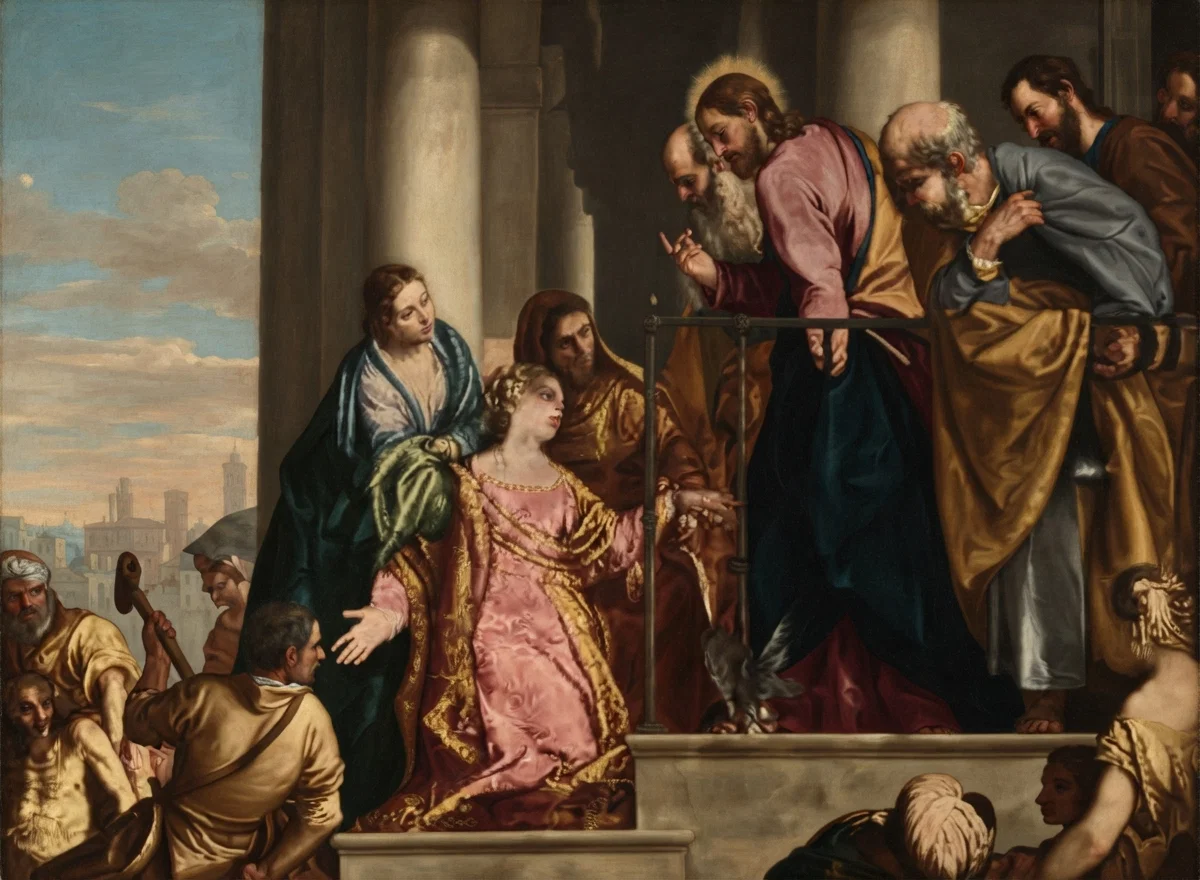
The healing of the woman who touched the hem of Jesus' garment. The artist, Paolo Veronese, here represents her as healed and well, confessing her faith and the Master's power.
The golden opportunity had come; she was in the presence of the great Physician! But amid the confusion, she could not be heard by Him, nor catch more than a passing glimpse of His figure. Fearful of losing the one chance of relief from her illness, she pressed forward, saying to herself, If I but touch His garment I shall be cured. She seized the opportunity as He was passing, and reached forward, barely touching the hem of His garment. But in that moment she felt herself healed of her disease. Instantly health and strength took the place of feebleness and pain. She had concentrated all the faith of her life in that one touch that made her whole.
With a thankful heart she then sought unobtrusively to retire from the crowd; but suddenly Jesus stopped, and all the people, following His example, also halted. He turned, and looking about Him with a penetrating eye, asked in a voice distinctly heard by all, "Who touched Me?" The people answered this query with a look of amazement. Jostled upon all sides, and rudely pressed hither and thither as He was, it seemed indeed a singular inquiry.
Peter, recovering from his surprise, and ever ready to speak, said, "Master, the multitude throng Thee and press Thee, and sayest Thou, Who touched Me?" Jesus answered, "Somebody hath touched Me: for I perceive that virtue is gone out of Me." The blessed Redeemer could distinguish the touch of faith from the casual contact of the careless crowd. He well knew all the circumstances of the case, and would not pass such confidence and trust without comment. He would address to the humble woman words of comfort that would be to her a well-spring of joy.
Looking toward the woman, Jesus still insisted upon knowing who had touched Him. Finding concealment vain, she came forward tremblingly and knelt at His feet. In hearing of all the multitude, she told Jesus the simple story of her long and tedious suffering, and the instant relief that she had experienced in touching the border of His garment. Her narration was interrupted by her grateful tears as she experienced the joy of perfect health, which had been a stranger to her for twelve weary years. Instead of being angered at her presumption, Jesus commended her action, saying, "Daughter, be of good comfort: thy faith hath made thee whole; go in peace." In these words He instructed all present that it was no virtue in the simple act of touching His clothes that had wrought the cure, but the strong faith that reached out and claimed His divine help.
The true faith of the Christian is represented in this woman. It is not essential to the exercise of faith that the feelings should be wrought up to a high pitch of excitement; neither is it necessary, in order to gain the hearing of the Lord, that our petitions should be noisy, or attended with physical exercise. It is true that Satan frequently creates in the heart of the suppliant such a conflict with doubt and temptation that strong cries and tears are involuntarily forced from him; and it is also true that the penitent's sense of guilt is sometimes so great that a repentance commensurate with his sin causes him to experience an agony that4finds vent in cries and groans, which the compassionate Saviour hears with pity. But Jesus does not fail to answer the silent prayer of faith. He who simply takes God at His word, and reaches out to connect himself with the Saviour, will receive His blessing in return.
Faith is simple in its operation and powerful in its results. Many professed Christians who have a knowledge of the Sacred Word, and believe its truth, fail in the child-like trust that is essential to the religion of Jesus. They do not reach out with that peculiar touch that brings the virtue of healing to the soul. They allow cold doubt to creep in and destroy their confidence. He who waits for entire knowledge before he can exercise faith, will never be blessed of God. "Faith is the substance of things hoped for, the evidence of things not seen."
The diseased woman believed that Jesus could heal her; and the more her mind was exercised in that direction, the more certain she became that even to touch His garment would relieve her malady. In answer to her firm belief, the virtue of divine power granted her prayer. This is a lesson of encouragement to the soul defiled by sin. In like manner as Jesus dealt with bodily infirmities, will He deal with the repentant soul that calls on Him. The touch of faith will bring the coveted pardon that fills the soul with gratitude and joy.
A Predicted Power
By Andrew Nelson
IN Dan. 7:25 God through His inspired prophet foretells a power that would arise among the kingdoms of earth, that would speak great words against the Most High, and think to change the times and the law. This power was to manifest itself after the fourth universal earthly kingdom had been divided into ten divisions, or kingdoms; and it would subdue three of these kingdoms, and establish itself. This power would make war against the saints of God, and would assume to legislate for the God of high heaven, and make the people obey its laws or be put to death.
Here are a few words quoted from a standard work, published by this power, entitled, "A Catechism of the Catholic Religion," translated from the German of the Rev. Joseph Deharbe, S.J., edited by the Right Rev. P. N. Lynch, D.D., bishop of Charleston, published by the Catholic Publishing Society Company, 9 Barclay Street, New York, page 115, paragraph 411:
"Can the church do more than give commandments? She also has a right to see that these commandments are obeyed and to punish those who disobey them."
Thus this power declares to the world her assumption of right to legislate for the church of the living God, to compel all to obey her commandments, and to punish those who will not submit to her authority.
All this authority she exercised in her palmy days before the Reformation, when millions were proscribed and many were banished, starved, burned, buried alive, smothered, suffocated, drowned, assassinated, chained to the galleys for life, or immured within the horrid walls of the church and state prisons. All this is not because Roman Catholics are worse than or different from their fellow men; for Protestants, following the same principles of church and state union, have also persecuted and put to death those deemed guilty of heresy.
That same church, with the same principle, is now bidding for power in this country; and if that is once obtained, we may look for the same cruel oppression and persecution in our fair land. Then the import of the words attributed to the archbishop of St. Louis, will be realized. He said, "When the Catholics once, which will surely happen sometime, obtain the majority of votes, then there will be no religious liberty." But that will be too late to protest successfully. Now is the time to defend our God-given liberties, and be true to the principles of the gospel of Christ.
ANDREW NELSON.
Sanitarium, California.
Does Not Indicate Greater Morality
By T.
WE have organization after organization that is working for the moral uplift of society. We have civic leagues; we have vice commissions; we have peace societies, church federations, and so on to the end of the long, long list. We are assured that this great army of organizations is working to one great, common end of bringing humanity to such a high moral plane that the millennium will be ushered in. They expect, through publicity, to cast such odium upon crime and wickedness of every sort that these evils will be completely cured. But does this multitude of organizations indicate that we are going to have a greatly improved condition of things in this world? Does it not rather indicate that the world has become so manifestly filled with immorality that one doctor after another arises, thinking that his particular remedy is the one thing needed to cure the social ailments?
There seems to be a general consensus of opinion that things are going very much wrong; and under the exciting and exhilarating influences of some of the large conventions that are held for the purpose of finding and administering a remedy for the ills of society, it is very easy to see that people under the intoxication of the occasion might be led into the belief that they are going to do some wonderful things. But when the excitement dies down, and each one of these individuals who has attended the convention settles into the actualities of real life, they must be convinced that conditions are growing worse and worse.
Many of these organizations may be doing much to retard the progress of the disease in the social patient, but nevertheless the malady continues to become more alarming, and in reality these many organizations are only so much evidence that the patient is extremely sick and that it has become necessary to have a multitude of doctors. This condition will keep up until finally it will seem necessary to have a world-wide consultation of these social physicians. When they come together, they will embody a great many ideas along all the lines of religion, sociology, politics, etc., and eventually we will have a combination of all of these organizations with one great, overweening power taking the lead in things. When we look about for the one leading power that is world-wide and dominant in this field of activity, our minds naturally go to the great church that has its headquarters on the Tiber in Italy. It will be the one power that will cause all of these organizations to cohere in one supreme effort to advance the many reforms that they are seeking to put forward. And then we will have the greatest religious combine that this world has ever seen. And we will have a short, sharp conflict that will put in the shadow all similar conflicts of the past ages, because we are in times when nervous energy is keyed to the highest pitch. In this high-tension condition, movements go with swiftness and intensity.
This is no fanciful picture that will never come, but any one is able to see that the great movements that are forming in society are headed clearly in the direction of one great central world-movement that will undertake to be all-embracing in its ideas of reform. As this movement progresses, the notions of many men will undergo much change. They will throw away a great deal of that to which they are now holding. And they will do it because we are rapidly coming under the spell of federation, and are being taught with great enthusiasm and little reason that we want to subordinate our "little differences and come together on some great common platform." That means that a few strong minds will subordinate everything to themselves, and a federal despotism will finally be reached. Such a world-wide organization would be a grand thing if it could be formed on correct lines and upon a sound basis and permeated with true principles, but such will not be the case. All of the similar religio-social and political organizations of the past have been despotic, bigoted, and narrow; and such will be that which is forming in these times.
If any one desires prophetic evidence for the statements made in these paragraphs, he needs only to study carefully the second chapter of Isaiah and the fourth chapter of Micah. There are many other scriptures that are of the same general import, but these two are very concise and specific in telling of the great world federation that shall be drawn together in the last days under the influence of the "many people" who will be stirring popular sentiment in a world-wide movement. T.
The Touchstone
NEVER was there a period in the history of the world when the followers of Christ had need of greater watchfulness than at the present. Deceptions are abroad in the land, and on every side men are striving to draw away disciples after themselves. With feigned words they would make merchandise of souls, and they do lead away the unwary. But none need be deceived. The Lord says, "To the law and to the testimony: if they speak not according to this word, it is because there is no light in them." The law and the testimony mean simply the commandments of God, and the testimony which from time to time He has given through inspired men. These are the touchstone, and whoever rejects any part of God's truth is not to be trusted. However plausible the teaching, however smooth the words of such teachers, the Lord says, "There is no light in them." This is the test to which everything must be brought, and that which will not stand the test must be rejected.