A RIDE through Switzerland and across the Alps, viewing scenery which the Europeans claim to be the grandest in the world, is a fitting experience for one who is going to visit Rome, because in the mountain one is impressed with the sublimity of God and the grandeur of His handiwork; while in Rome we see the crumbling remains of man's greatest effort in building. The great tombs which were intended for lasting monuments have either disappeared altogether, or are a heap of ruins. Rome is very choice of these antiquities because they bring so many visitors and revenue, and we can not but notice how suitable in comparison with the government itself are its colossal ruins.
American travelers in Europe necessarily have very different ideas of what they see, as some seek antiquities, some, perfection in arts, and some, society; but to the Christian who awaits his Lord's appearing, there are signs on every hand which show that that event is not far distant. For in spite of the fact that we naturally try to hide it from our minds, the world is degenerating in many ways; and while inventions give an appearance of progress, yet a glimpse at even the ruins of ancient work shows us that we are weaker than our forefathers.
To-day, as we paused on an eminence along the Appian Way (the road by which Paul entered Rome), and viewed the massive walls which surround the city, being sixteen miles in circumference, and saw the remains of the baths of Caracalla, built nearly one thousand seven hundred years ago, and noted the great Colosseum, and recalling the experience we had just had in the Catacombs, with their eleven miles of underground passages, we asked the guide if such work could be performed now. He shook his head and said, "Where are the men to design them? and if designed, where are the strong, skilled workmen to do the work? and if done, where is another Michael Angelo or Bernini to adorn them?" We think it wonderful, with all our machinery, to bring an obelisk from Egypt, yet Augustus Cæsar brought several, and they stand in the public squares in Rome to-day.
A little chapel along the Appian Way attracts considerable attention, because of its connection with the book "Quo Vadis," which has been in such demand of late years. It is believed by many that Peter, the apostle, started to flee from Rome to escape persecution, and met Christ at the place where the chapel now stands. This inscription is over the door: "Hæc Petrus a Xsto Petiit, 'Domine, Quo Vadis?'" ("Here Peter asked of Christ, 'Lord, where goest thou?'") The legend is that Christ answered, "Venio iterum crucifigi" ("I go again to be crucified"), and then vanished, leaving a footprint.
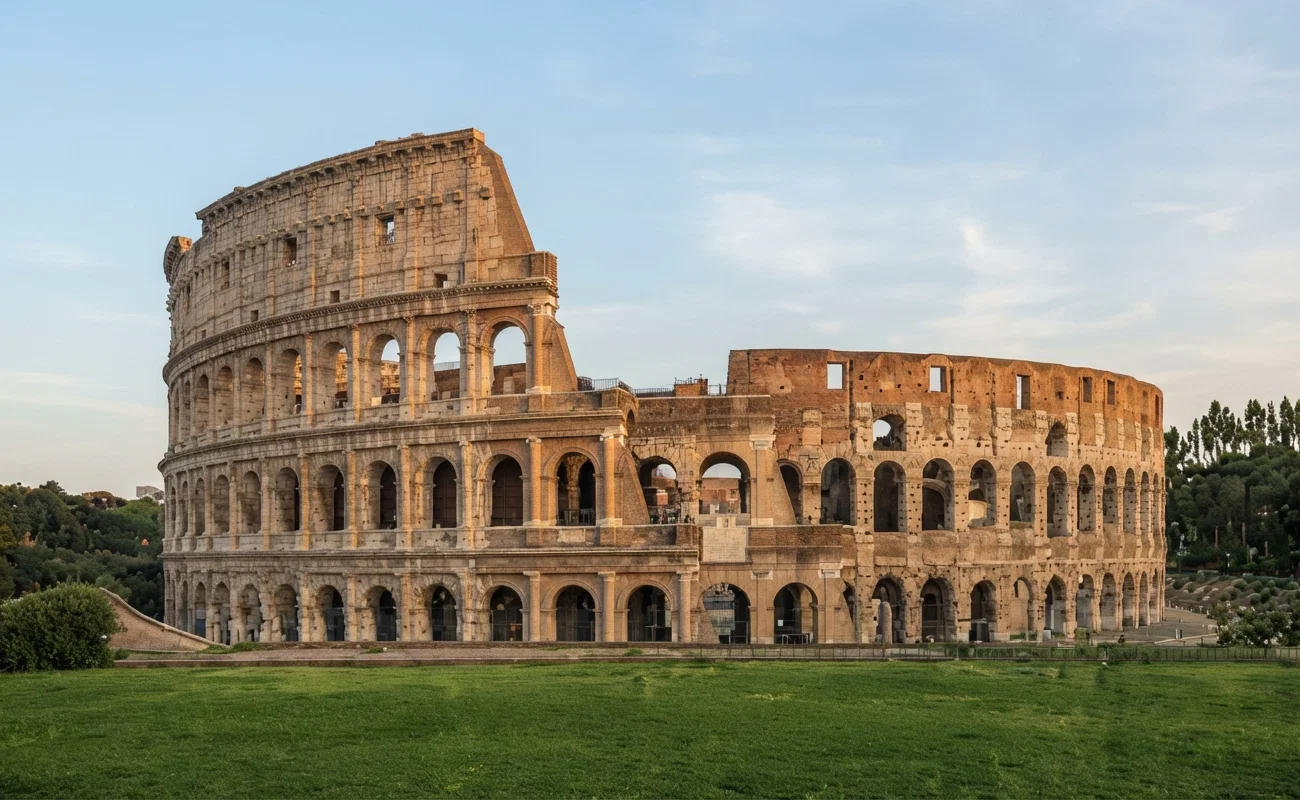
Ruins of the Colosseum or Amphitheater.
Peter understood this, and returned to Rome and was crucified head downwards. The footprint is now preserved in a church near by and worshiped by the deluded people.
Come with us, reader, as we pass through the Porta S. Sebastiano into the old city. Turning to the right, we go by the Arch of Constantine, built over the Via Triumphalis, with its three arches and eight columns of the Corinthian order, raised A.D. 315 to commemorate Constantine's victories over Maxentius and Licinius, and stop in front of the gigantic Colosseum. A feeling of sacredness seems to steal over us, as we think of the trembling ones who, no doubt, have entered this same passage to seal with their life's blood their faith in Jesus Christ, and that in a most barbarous manner, yet happy to suffer with their Saviour and witness before the many thousands. May God give us such faith if He should will to again purify His church by such trials. But let us listen to our guide.
This amphitheater was begun by Vespasian in A.D. 72, on the site formerly occupied by the fishponds of the garden of Nero. It was completed by Domitian. The height of the outer wall is 157 English feet. It is composed of three stories of arches, eighty arches to each story. The style of architecture varies at each tier. The first being Doric, the second Ionic, and the third Corinthian. The length of the arena is 278 and the width 177 feet. It was capable of containing over a hundred thousand spectators. The emperors and their families, the vestals, the senators, the patricians, and the priests, had a separate place allotted to each class. We shudder as our intelligent guide describes the bloody contests which took place right where we stand, how the gladiators and the wild beasts fought, until we almost imagine we see fierce eyes gleaming in those dark recesses under the amphitheater.
With a lingering look we leave the Colosseum, and, turning northwest, ascend the Palatine Hill. On our right are the ruins of the home of the Cæsars. (See p. 13.) What a mammoth place it must have been! Its great arches are still standing, and the hill under it seems to have been a perfect labyrinth of passages. We are all familiar with the debauchery, drunkenness, and crimes perpetrated within its walls, and now all is silent, and we speak with bated breath as we view it. It is a monument to the truth that, "All is vanity;" "Man is but grass;" "But the Word of God endureth forever."
What is this excavation in front and to the left of us, some twenty feet deep, three or four hundred feet wide, and twice as long, with a company of men in it excavating with great care? It is the remains of the Roman Forum. Here and there stand a few marred columns, marking the spot where once stood the beautiful temple of Castor and Pollux, Saturn, Vespasian, the Vestal Virgins, and the temple of the deified Julius Cæsar built on the spot where Cæsar's body was burned. The temples have perished, as have the honors of the gods for whose worship they were built. We next notice the spot where Cæsar fell, and the rostra from which Cicero addressed the people.
There is one place we must not overlook. Situated near the temple of Concord, is the church of "S. Giuseppe dei Falegnami, with the chapel of S. Pietro in carcere below it." Under the latter is the traditional prison of S. Peter, the ancient carcer. In its rock floor is the miraculous (?) spring.
There are five other forums in Rome, surrounded by magnificent monuments, but, as in the Roman Forum, the statues have been removed to some museum.
Rome is full of interesting places, but perhaps that which attracts the most attention in the modern world is St. Peter's and the Vatican. Volumes have been written concerning them, and it would be useless to attempt a10description here. They must be seen in order to be really appreciated. "It required three and a half centuries to bring the building of St. Peter's to completion. At the close of the seventeenth century its cost was estimated by Carlo Fontana at ten millions of pounds" ($50,000,000). In the Vatican is an immense art gallery, museum, and library.
Rome and vicinity is dotted with costly churches. We asked our guide, "Who pays for all this elegance?" He answered, "Those poor people kneeling before the altars, clothed in rags, pay a great deal, but we pay most of it." We asked whom he meant by "we." He told us that the people paid taxes, and their taxes went to support the church. He said it was not right, but they could not help it. Poor down-trodden people! but the government must be supported; those soldiers who are found everywhere must be fed and clothed. The army of monks and priests that are so common here must be cared for. And the pomp and show of royalty must be kept up.
Night is about us and, with the exception of a few late revelers, sleep has silenced the multitudes. Many are weary with the day's sight-seeing, more with toiling for the sustenance of life. Then there are those crowds of beggars, large and small, maimed and decrepit, whom one meets at every turn, and who, in the poorer parts of the city, flock around you asking alms. In the sight of their needs you wonder how the public granaries could have ever been discontinued. But now the people of Rome are quiet, some resting on downy beds, others on the stone pavements. But decay and destruction are still going on. Moment by moment those great monuments and baths are crumbling into dust. The angel of death is hovering over many, and we think of Xerxes, who, after having counted his vast army of over 5,000,000 men, wept at the thought that in one hundred years not one would be alive.
Many centuries have passed since then, each giving stronger proof of man's weakness. "For all flesh is as grass, and all the glory of man as the flower of grass. The grass withereth, and the flower thereof falleth away; but the word of the Lord endureth forever." 1 Peter 1:24, 25.
"Swift to its close ebbs out life's little day,
Earth's joys grow dim, its glories pass away;
Change and decay in all around I see;
O Thou who changest not, abide with me!"
H. A. HENDERSON.
Athens, Greece, Hotel Alexander the Great.
FAITH.
By Anna E. Hamilton
FAITH is a grasping of almighty power,
The hand of man laid on the arm of God—
The grand and blessed hour
In which the things impossible to me
Become the possible, O Lord, through Thee!
—Anna E. Hamilton.
Seeking Emolument in Two Kingdoms.—
By Editor
According to the following paragraph in the Missionary Herald, it would appear that, as in the so-called “Christian nations,” the professed Christians of Japan are also seeking places in the world:—
“It is a notable fact that ever since the establishment of the Imperial Diet of Japan the number of Christians who have been elected as members has been quite out of proportion to the Christian population of the empire. The president of the House of Representatives of the late Diet was Mr. Kataoka, an elder of the Presbyterian Church in Kochi, who has been a member of every Diet since a representative government began. Rev. Mr. Loomis, of the American Bible Society in Japan, reports that recently Mr. Kataoka called a meeting at his official residence for prayer and thanksgiving, which was attended by other Christian members of the government, with several personal and official friends. At this meeting Mr. Kataoka spoke with much feeling of the answers to his daily prayer for guidance in connection with his official duties. News has also come that a staunch Christian layman, Hon. Y. Nakamura, a well-known member of the Fourth Kumi-ai Church of Kyoto, was elected a member of Parliament in August last. It is noteworthy, also, that on the committee chosen to act for the newly-organized party which now controls the government, consisting of four members, the two who represent the liberal wing are both Christians, Mr. Kataoka and Mr. Ebara, the latter being connected with the Canadian Methodist school in Tokyo.”
The foregoing was designed to show how Christianity is appreciated by the people of Japan, but it really emphasizes another fact, namely, that they have not yet been taught the Christianity of Christ. When they shall have been so taught, they will not be looking for its exemplification in the government officials. “If any man love the world, the love of the Father is not in him.” 1 John 2:15. No worldly office-seeker can well say that he does not love the world.
OUR WORK IN THE SOCIETY ISLANDS.
Brother Joseph C. Green and wife, who went on the Pitcairn as missionaries to the Society Islands three years ago, arrived in San Francisco on the 26th ult. They return on a visit to their friends, and left for Battle Creek, Mich., on the 29th. Brother Green says the work in the Society group presents a very promising aspect. Brother B. J. Cady and wife, who went there on the first voyage of the Pitcairn, have been devoting the most of their time for the past nine months to the island of Raiatea, where they have lately bought a coconut plantation. They intend to start a boarding-school at this place, and, as far as possible, to make it self-supporting. Their object is to train native laborers for this group.
Just prior to the arrival of the Pitcairn last March, Brother Cady was asked by the deacon of a large native Protestant congregation to become its elder. Two European families and a young lady have recently been baptized, and others were awaiting baptism when Brother Green left. Brother Stringer is at work on a church building in the city of Papeete, Tahiti. Land for that purpose was secured some time ago, but on account of lack of means and calls in other places, the work on the building has been delayed. This building will be a valuable addition to the work, as many of the people, especially the whites, do not care to attend services in a private house. The lot upon which the church is being built is large enough to admit of erecting a mission home, and it is designed to build such a home as soon as the means is available.
The little company in the district of Paea, Tahiti, are about ready to erect a house of worship. Brother Deane, the oldest native Sabbath-keeper there, is busy distributing literature and giving Bible-readings.
Self-Support
Self-Support. — Discussing this subject in the Indian Witness, Rev. C. B. Ward, of Shelandu, says: "For more than twenty years I have fully believed that India is better able to support Christianity, that blesses, than heathenism, in which there are no compensations. From the most careful and oft-repeated investigation, I am left no room to doubt that heathenism costs the poorest of its devotees two tithes of all that ever comes to him, in cash, or kind, and in the majority of cases much more than this."
He adds that in thirty years he has never known a Christian to lose by tithing for Christ's sake, while he has known many who were wonderfully prospered of God both in body and soul by so doing.
Not a Bad Showing.
By Editor
In the "Missions" department of The Examiner (Baptist) of April 2 we find the following item:—
"Professor Dean C. Worcester, the Hon. Charles Denby, Admiral Dewey, and others are agreed that the Filipinos are better capable of self-government, and otherwise more intellectual, than the natives of Cuba. Our Missionary Magazine now adds that only seventeen per cent. of the Filipinos can not read, while in Spain only seventeen per cent. can read. The Missionary Union is quietly arranging to take up the work in the Philippine Islands as soon as possible."
OUR WORK AND WORKERS.
By Editor
SEVEN members were recently added to the church at Lehigh, Kansas.
FIVE candidates were recently baptized at Elgin, Kansas, by Brother Brock.
THE church school started at Mankato, Minn., March 15, now has twenty-two pupils.
A CHURCH of fourteen members was recently organized at Russell, Lucas County, Iowa.
MAY 13, three new members were added to the church in Topeka, Kansas. On the same day two were added to the church at Cambridge.
THE Omaha, Neb., church school has been moved from the city to the country, where a few acres of ground have been secured for the use of the pupils.
NINE persons were baptized at Burlington, Iowa, May 6, by Brother C. A. Washburn. He also baptized eleven candidates on the 13th, at Mount Pleasant.
UNDER the labors of Brother J. W. Scoles at St. James, Ill., fifteen have been added to the church, together with a Sabbath-school organization of about twice that number.
A NEW house of worship was dedicated at Glenwood, Iowa, May 7. This is the only church owned by our people in Mills County, and has attracted considerable attention.
THE steamer St. Louis, which sailed from New York to England, May 3, carried thirty-five of our people, bound for different parts of the world in the interest of the cause of truth.
THE brethren of Nebraska have decided to open an orphans' home at College View. The use of a house and grounds have been donated for the purpose of inaugurating the enterprise.
AT Hutsonville, Ill., Brother Ernest Miller reports that six persons have begun to keep the Sabbath "according to the commandment." Also that a Sabbath-school has been organized.
IN a report to the Review from Brother Juan McCarthy, concerning the cause in Argentina, we note the organization of two companies,—one at Ocampo with twenty-one members, and one at San Antonio. Most of these were formerly Roman Catholics.
BROTHER F. I. MEAD and party of missionaries reached Buluwayo, Rhodesia, Africa, April 4. Brethren Anderson and Armitage met them at the depot with an eight-mule team. After driving all night and until 4 P.M. the next day, they reached their destination at the mission farm.
AT Port Elizabeth, on the southeast coast of Africa, Brother W. S. Hyatt, formerly president of Kansas Conference, was holding tent meetings in April. On the 14th of that month he wrote a letter to the Kansas Worker, from which we take these items: "This is a very important shipping point, and one of the largest towns in this country. There are about 30,000 inhabitants, people of all classes. Less than half of them are white. The colored people here are very much like those in America. They are of all shades, from the coal black to those that are nearly white. I never was in a section where there are so many children; they are of all shades, and a tougher set of little fellows would be hard to find."
A REPORT of the church school in a suburb of Topeka, Kansas, which appeared in a recent number of the Worker, says: "Altho it was of only three months' duration, the benefits were very marked. The pupils who before had been taught in the public school, among other things, that the earth was not created in six days, but in six indefinite periods, and that it gradually evolved, were in the church school instructed in the truth of God, and the influence was decidedly for the better. Among other interesting circumstances, he related the case of two boys who could not agree, and had become enemies. After considerable study over the matter, the teacher decided to have a season of prayer with them. He took them into a room by themselves, and, after a short talk about their ill-feeling toward each other, he had prayer with them. The result was a complete change of feeling on the part of the boys, and they became friends."
30 "And the apostles gather themselves together unto Jesus; and they told Him all things, whatsoever they had done, and 31 whatsoever they had taught. And He saith unto them, Come ye yourselves apart into a desert place, and rest a while. For there were many coming and going, and they had no leisure 32 so much as to eat. And they went away in the boat to a 33 desert place apart. And the people saw them going, and 34 many knew them, and they ran there together on foot from all the cities, and outwent them. And He came forth and saw a 35 great multitude, and He had compassion on them, because they were as sheep not having a shepherd; and He began to 36 teach them many things. And when the day was now far 37 spent, His disciples came unto Him, and said, The place is desert, and the day is now far spent; send them away, that they may go into the country and villages round about, and 38 buy themselves somewhat to eat. But He answered and said unto them, Give ye them to eat. And they say unto Him, Shall we go and buy two hundred pennyworth of bread, and 39 give them to eat? And He saith unto them, How many loaves 40 have ye? go and see. And when they knew, they say, Five, 41 and two fishes. And He commanded them that all should sit down by companies upon the green grass. And they sat down in ranks, by hundreds, and by fifties. And He took the five loaves and the two fishes, and looking up to heaven, He blessed, and brake the loaves; and He gave to the disciples to set before them; and the two fishes divided He among them all."
11 "But the multitudes perceiving it followed Him; and He welcomed them, and spake to them of the kingdom of God, and them that had need of healing He healed."
23 "And after He had sent the multitudes away, He went up 24 into the mountain apart to pray; and even when even was come, He was there alone. But the boat was now in the midst of the 25 sea, distressed by the waves; for the wind was contrary. And in the fourth watch of the night He came unto them, 26 walking upon the sea. And when the disciples saw Him 27 walking on the sea, they were troubled, saying, It is an apparition; and they cried out for fear. But straightway Jesus spake 28 unto them, saying, Be of good cheer; it is I; be not afraid. And Peter answered Him and said, Lord, if it be Thou, bid 29 me come unto Thee upon the waters. And He said, Come. And Peter went down from the boat, and walked upon the 30 waters, to come to Jesus. But when he saw the wind, he was 31 afraid; and beginning to sink, he cried out, saying, Lord, save 32 me. And immediately Jesus stretched forth His hand, and 33 took hold of him, and saith unto him, O thou of little faith, 34 wherefore didst thou doubt? And when they were gone up 35 into the boat, the wind ceased. And they that were in the 36 boat worshiped Him, saying, Of a truth Thou art the Son of God. And when they had crossed over, they came to the land, unto Gennesaret. And when the men of that place knew Him, they sent into all that region round about, and brought unto Him all that were sick; and they besought Him that they might only touch the border of His garment; and as many as touched were made whole."
26 "Jesus answered them and said, Verily, verily, I say unto 27 you, Ye seek Me, not because ye saw signs, but because ye ate of the loaves, and were filled. Work not for the meat which perisheth, but for the meat which abideth unto eternal life, which the Son of man shall give unto you; for Him the Father, even God, hath sealed."
48 "I am the bread of life. Your fathers did eat the manna in 49 the wilderness, and they died. This is the bread which com- 50 eth down out of heaven, that a man may eat thereof, and not 51 die. I am the living Bread which came down out of heaven; if any man eat of this bread, he shall live forever; yea and the bread which I will give is My flesh, for the life of the world."
63 "It is the Spirit that quickeneth; the flesh profiteth nothing; the words that I have spoken unto you are spirit, and are life."
SUGGESTIVE QUESTIONS.
NOTE.—The texts inclosed in marks of parentheses, while not essential to the lesson study, will be found to throw much light upon the lesson, and are suggested for those who wish to study further.
Upon the apostles returning from their first missionary trip, what did they tell Jesus? Mark 6: 30. (John 15: 5.)
What did He declare concerning Himself? Verses 48-51.
What did He mean by this? Verse 63.
Side Lights.—"Desire of Ages," chapters 38-41. "Spirit of Prophecy," vol. 2, chapters 20-22, 25.
NOTES.
1. In a desert place.—The news of John's death had doubtless to do with suggesting the proposed rest. It was to Christ the warning that His labors in Galilee must also soon terminate through the people's rejection of Him, and the shadow of His own violent death as well. There were many things to communicate to His apostles which could not well be said before the multitude. Besides, they needed a spot for quiet meditation and prayer. The Bethsaida, or Fish-house, here mentioned as the place of retirement, is supposed to have been a place six miles from Capernaum, at the head of the Sea of Galilee, east of Jordan, sometimes called Julias, in honor of Julia, a daughter of Emperor Augustus. It was beyond the territory of Herod Antipas, and in the tetrarchy of Philip, therefore entirely distinct from the place by that name west of the Sea of Galilee. Bethsaida was at one time the home of Andrew and Peter and Philip. It was doomed because of its rejection of light.
2. Fourth watch.—Formerly the Jews had but three watches of the night, enumerated as the first, or "beginning of the watches (Lam. 2: 19), the middle watch (Judges 7: 19), and the morning watch" (Ex. 14: 24; 1 Sam. 11: 11). These were respectively from sunset to 10 P.M., from 10 P.M. to 2 A.M., and from 2 A.M. to sunrise. At this time, however, they had mostly given up their own computation of the night watches, and adopted that of the Romans, namely, four watches, from 6 P.M. to 6 A.M., and known as even, midnight, cock-crowing, and morning. Mark 13: 35. The "fourth" watch must, therefore, have been between 3 and 6 o'clock in the morning.
LESSON I.—SUNDAY, JULY 2, 1899.
GRACIOUS INVITATIONS.
NOTE.—The name Hosea means "salvation." The name of the prophet's father was Beeri. His ministry was "in the days of Uzziah, Jonathan, Ahaz, and Hezekiah, kings of Judah, and in the days of Jeroboam [II.] the son of Joash, king of Israel." Amos, belonging to Judah, but prophesying in Israel, and Isaiah, prophesying in Judah, were contemporary with Hosea.
"O Israel, return unto the Lord thy God; for thou hast fallen by thine iniquity. Take with you words, and return unto the Lord; say unto Him, Take away all iniquity, and accept that which is good; so will we render as bullocks the offering of our lips. Asshur shall not save us; we will not ride upon horses; neither will we say any more to the work of our hands, Ye are our gods; for in Thee the fatherless findeth mercy. I will heal their backsliding, I will love them freely; for Mine anger is turned away from him. I will be as the dew unto Israel; he shall blossom as the lily, and cast forth his roots as Lebanon. His branches shall spread, and his beauty shall be as the olive tree, and his smell as Lebanon. They that dwell under his shadow shall return; they shall revive as the corn, and blossom as the vine; the scent thereof shall be as the wine of Lebanon. Ephraim shall say, What have I to do any more with idols? I have answered, and will regard him; I am like a green fir tree; from Me is thy fruit found. Who is wise, and he shall understand these things? prudent, and he shall know them? for the ways of the Lord are right, and the just shall walk in them; but transgressors shall fall therein."
Golden Text: "Come, and let us return unto the Lord." Hosea 6: 1.
SUGGESTIVE QUESTIONS.
(1) What appeal does the prophet make to Israel? Why does he make this appeal? V. 1. Note 1. (2) What were the people admonished to take with them to the Lord? What were they to say to Him? V. 2. Note 2. (3) What confession were they to make in regard to former dependence? Then what would they find in God? V. 3. Note 3. (4) What would the Lord do for them? How could He do this? V. 4. Note 4. (5) What would the Lord be to Israel? And what would be the result? V. 5. (6) How would this affect his appearance and pleasure-giving qualities? V. 6. (7) What is said of them that dwell under such blessings? V. 7. Note 5. (8) What then will Ephraim say? V. 8. Note 6. (9) Who shall understand these things? V. 9. Note 7.
NOTES.
1. Israel's condition.—In order to fully comprehend this chapter, it is necessary to study the whole book, with its contemporaneous history. Hosea came to the front in what to Israel was an ominous time. Israel was in a fallen condition morally, and consequently was declining politically. Succeeding the three victories over Syria which Elisha had promised to Joash, king of Israel (2 Kings 13: 14-19), there was a period of great prosperity to both Judah and Israel. But increase of power and wealth brought also increase of wickedness, and in Hosea's time Israel was confronted with conditions that must surely bring disaster. Hence the warning message of the prophet.
2. "Take with you words."—Note that the "words" suggested are words of penitence and supplication. Here is a lesson in true national reform. The secret of all political corruption is moral depravity on the part of the people. The secret of political reform is moral reform, returning to God and the observance of His law,—"Thou shalt love the Lord thy God with all thy heart, . . . and thy neighbor as thyself." Time and again the Lord sent His prophets to Judah and Israel, as also to Nebuchadnezzar, Darius, and others, with messages of reform morally that they might be prospered politically. But in every instance the appeal was to voluntary repentance; in no case was the appeal suggestive of civil law to compel a moral reformation, nor was there any attempt on the part of the prophets to secure official power. The National Reformers of to-day would reverse this order; they would purify politics by political methods, in order to compel moral reform by political force, or civil law. The absurdity of such a proposition is manifest when compared with the Lord's way.
3. "Asshur shall not save us."—"Asshur" was Assyria, of whom both Israel and Judah had formerly sought help (chap. 5: 13; 7: 11; 8: 9). "Not ride upon horses."—These come from Egypt, and were "a vain thing for safety." Ps. 33: 17. See, also, Ps. 20: 7; Prov. 21: 31; Isa. 31: 1, 3. These and other scriptures give emphatic lessons that moral reform can not come through the power of flesh. The true penitence suggested in this verse is shown in putting away the works of human hands, which have been depended upon as gods, and looking to the living God for mercy. The principle involves the putting away not only of images, but human methods as well.
5. Dwelling under his shadow.—Dwelling under the shadow of Israel repentant and reformed would be practically dwelling under the shadow of God. The "shadow" of God indicates a place of safety, a nearness to Him. See Ps. 17: 8, 9; 91: 1.
6. Ephraim stands for the kingdom of Israel as separate from Judah. Ephraim was the principal tribe in the northern kingdom, and the capital (Samaria) was in the land of Ephraim. "From Me is thy fruit."—The complement of this verse is John 15: 5: "I am the Vine, ye are the branches, he that abideth in Me, and I in him, the same bringeth forth much fruit; for without Me ye can do nothing."
7. Who shall understand these things?—The wise. Who are the wise?—They that fear the Lord. "The fear of the Lord is the beginning of wisdom; a good understanding have all they that do His commandments." Ps. 111: 10. See, also, Deut. 4: 5-9. Let the Word of Christ dwell in you richly in all wisdom." Col. 3: 16. Christ is "the wisdom of God" (1 Cor. 1: 24), and He is "made unto us wisdom" (verse 30). Therefore whoever has learned to know Christ may understand this lesson.