MAN2sinned, and death is the penalty of sin. Christ bore the penalty, and secured for man a period of probation. In this time of probation we are now living. We have been given an opportunity to prove our loyalty to Him who gave His only-begotten Son, that we should not perish, but have everlasting life.
GOD is testing us. He entrusts us with talents, to see whether we will be thoroughly unselfish in the use we make of them. Physical, mental, and spiritual gifts are placed in our possession. And on the use that we make of these gifts depends our eternal destiny. God's Word tells us plainly: "He that is faithful in that which is least is faithful also in much." "If ye have not been faithful in that which is another man's, who shall give you that which is your own?"
God expects us to use His gifts in a way that will give us an increased knowledge of the things of heaven. We are to make constant improvement, daily becoming purer, nobler, more refined. In this world men and women are to fit themselves to take their place among the nobility of heaven. In this world they are to prepare for translation to the courts above. Here Christians are to be examples of what, through the grace of Christ, all must become who enter the holy city. Here we are to learn Christ's meekness and lowliness, co-operating with Him, wearing His yoke, and bearing His burden. Our lives are to reveal His attributes. Thus we are to work out our own salvation, knowing that God is working in us, to will and to do of His good pleasure.
WE are not our own, to do with ourselves as we please. We have been bought with a price, and we are to obey the law of God's kingdom. We are to reach the high standard that God has placed before us. Through the infinite sacrifice made in our behalf, we can in this world live pure, holy lives, carrying out the principles of the kingdom of heaven.
THE Word of God does not repress activity, but guides it aright, pointing us to a work that, if faithfully done, will make us worthy of the immortal inheritance. God knows exactly what each one needs to fit Him for heaven. He puts the Bible into his hands,—a treasure that is not to be ignored or cast aside as of no special importance. "Search the Scriptures," Christ says; "for in them ye think ye have eternal life; and they are they which testify of Me." The Word of God tells man how he may become an heir of God and a joint heir with Christ. Knowing that it is man's nature to accumulate and amass, God in His Word reveals to him the unsearchable riches, a treasure the worth of which can not be estimated. Knowing that man's strongest impulse is to stand on vantage ground before all, God points out to him an ambition that he may safely cherish. "I will make a man more precious3than fine gold," He says, "even a man than the golden wedge of Ophir." That man may obtain the life which measures with the life of God, the Lord breaks up his worldly, ambitious projects, which, if permitted to engross the mind, would unfit him for the future world.
THOSE who do not value their high calling, those who do not strive to fulfil God's purpose for them, who fail of fulfilling the conditions laid down in His Word, cut themselves off from God. They prove themselves to be entirely unfit to serve the interests of their Master. They may profess to be Christians, but their lives are a dishonor to Christ. They are serving the enemy, and God can not co-operate with them. Their defects of character are constantly increasing. How can the Lord work with them? How can He place responsibilities in their hands? How can He entrust His work to men whose hands and hearts are not consecrated to His service?
IN all that we do, we are to seek the glory of God. "They that are in the flesh can not please God. But ye are not in the flesh, but in the Spirit, if so be that the Spirit of God dwell in you. Now if any man have not the Spirit of Christ, he is none of His. And if Christ be in you, the body is dead because of sin, but the Spirit is life because of righteousness. But if the Spirit of Him that raised up Jesus from the dead dwell in you, He that raised up Christ from the dead shall also quicken your mortal bodies by His Spirit that dwelleth in you."
The Room of Forgiveness
By Roderick S. Owen
(Continued.)
BY RODERICK S. OWEN.
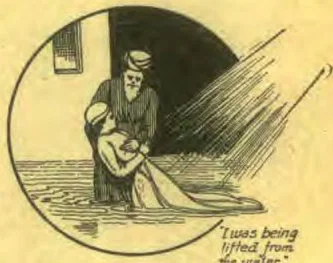
WHEN I again became conscious I was being lifted from the water, after which I was carried back to the chair, and was placed with my face toward the window. A Faith pillow was placed for my head-rest, and I looked out upon the scene before me. A light was shining over it all, like the light of a glorious morning, and I heard a voice saying, 'Your sins, which are many, are all forgiven you.'
'I then noticed that the name of the window was Forgiveness, and, as I rested and looked, wave after wave of glory rolled over my soul. Peace filled all its chambers; that peace that passeth understanding; that peace which floweth like a river. A glory seemed to gild the face of nature as I looked upon it. The world seemed to rejoice with me. The grass smiled, the ripple of the brook was turned into laughter. The trees of the wood clapped their hands, while all united in a chorus of praise. I realized that the joy of sins forgiven was mine, and I shouted, 'Glory!' 'Give thanks unto the Lord; for He is good; for His mercy endureth forever.'' Ps. 136:1.
'I then observed that the name of the chair in which I was sitting was Mercy, and that it was the same chair from which I had seen the pictures; for it was the mercy of God which had led me to repentance. And now, my friend, I trust and rest in this chair, and I dearly love this room and everything in it; even the thought of it brings me joy.'
'But,' said the neighbor, 'you do not often visit this room, do you? I have known people who think that there is but one such experience for each soul.'
'Yes, I know that some think so. I thought so myself at one time; but one evening, after carefully reading my Guide-book, I was led in here almost unconsciously. I sat down in the chair, and there appeared some pictures of the scroll I had not seen before; and by these I found that I had been doing some things ignorantly which were not in harmony with my Lord's desire. I also saw written at the head of these pictures on the scroll the words, 'I die daily.' 1 Cor. 15:31. Then I passed through the former experience entire, excepting the burial in water; and this was followed by the same joy and peace. Since then I have made it a practise to visit this room at the close of each day, and, after reading the Guide-book for more light, I enjoy this now blessed experience.
'Now come, my friend, we will next visit the room called the Estate of Man. You will notice that it has three windows placed side by side. The higher one in the center is called Immortality. The one to the right is called The State of the Dead, and the one to the left is called The Destiny of the Wicked.'
'O,' said the neighbor, 'this is the room of which I have heard so many speak, and indeed it seems a dreary room to me. That central window is a little bright and cheerful, but it is so narrow. Why, in our house that window is so wide that you can look out and see all the human family through it.'
'Yes, it is narrow,' was the reply, 'but you notice it is very long, and reaches up so as to give a good view of heaven, and to allow its light to fall upon all parts of the floor.'
'Yes, that is nice,' said the neighbor. 'And this one to the left (Destiny of the Wicked) is about the same as the one in my house, and I never like to look through it. Some of my neighbors have left it out entirely. I feel sorry to think of the terrible scenes of suffering now going on, and which must continue eternally.'
'O, that is not the idea which I get from reading the Guide-book,' answered the builder. 'I do not understand that the suffering is now going on at all, as you will see when I explain more fully the window to the right. The Book tells me that, after the judgment, the wicked will be punished according to the deeds done in this life, and then they will cease to be.'
'O, you do not mean that they will pass out of existence, do you?' queried the neighbor.
'I certainly do,' was the reply, 'for does not the Guide-book say that the unjust are reserved unto the day of judgment to be punished (2 Peter 2:9)? and that 'the day cometh, that shall burn as an oven; and all the proud, yea, and all that do wickedly, shall be stubble; and the day that cometh shall burn them up, saith the Lord' (Mal. 4:1-3)? And did not John the Baptist say of the wicked, The chaff He will burn up with unquenchable fire? Matt. 3:12.
'Many other texts also speak of the punishment and complete destruction of the wicked. So I am told that, after they are destroyed, this window will be taken out, and in its stead will be placed a most beautiful panel, richly decorated, containing the words, God is love. Then, in the light of His love, we shall ever after see the destiny of the wicked.
'And now, my friend, in order that you may better understand the other two windows, I wish to relate an experience I had in this room not long since.'
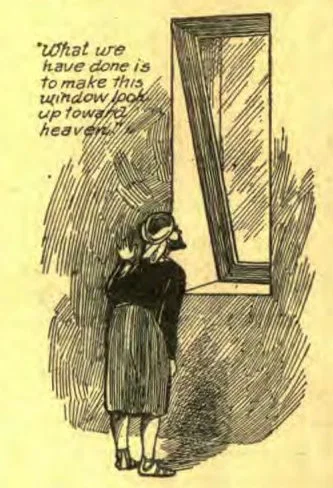
'But,' said the neighbor, 'let me first tell you how I and many others have arranged this (State of the Dead) window. You see the way yours is set, it looks a little downward, and consequently you can see nothing through it, aside from that dismal graveyard. That is the disagreeable feature of the whole thing. Now, what we have done is to make this window look up toward heaven instead of toward the grave, and this we accomplished by throwing the bottom outward and upward, and we have raised ours so high that one can not see the graveyard at all, except by standing on tip-toe, and making a special effort, which, of course, most people do not care to do; so that the unpleasantness of this window is almost entirely removed. I said almost, for altho there
is such a bright outlook toward heaven, there is also another way leading from this window, over through the light of the Immortality window into that terrible scene in the window to the left. And O, it is sad to relate, but so many of the human family walk that way. All I can do is to shut my eyes, and not follow them.'
'Yes, that is a sad thing to contemplate,' was the reply, 'but let us see these windows in the light of my experience. Well, one day I
entered this room, feeling especially weak, realizing the frail nature of man. In this mood I seated myself in this chair, called Contemplation, and began to look first through the Immortality window. I could not look up, for I was sad, and consequently but little light entered my vision. Beneath this window, Immortality, I saw the entire human family moving along in a dark shadow, which I saw was the shadow of death. Rom. 5:12. I then saw that they were going to the graveyard, and, in order to get a better view of them, I moved my chair to the window, State of the Dead. As I did so, I heard a voice saying: 'Dust thou art, and unto dust shalt thou return.' Gen. 3:19. 'The soul that sinneth, it shall die.' Eze. 18:20. 'And so death passed upon all men, for that all have sinned.' Rom. 5:12.
'From my new view I could see the long caravan of people moving into the open grave. The little mounds were rapidly increasing on every hand. I noticed one grave near the center which was considered important by many who were burying their dead; for, as they turned away from newly-filled graves, they would cast an interested look toward that central grave, and lift their eyes to heaven. At this the sorrow would give place to joy, while some would even sing among the graves.'
(To be continued.)
WE ARE NOT OUR OWN.
By Alonzo Briggs
BY ALONZO BRIGGS.
WE should not live for self, or selfish purposes; for we are not our own, but have been bought with a price—the precious blood of Jesus. "Love not the world, neither the things that are in the world; if any man love the world, the love of the Father is not in him." Let us, as the apostle says, in all things give God the pre-eminence. Pride, avarice, and self-seeking are worldly characteristics; but they have clandestinely found their way into many of the churches, defeating the real object for which the latter were established; that is, the salvation of the people.
The Scripture declaration that "no man liveth to himself" is sufficient proof that we have a more worthy object in life than ministering to self alone. Kind, generous, and unselfish deeds have a weight and influence for good, which the enemies of Christ and His truth can not counteract nor gainsay. If we could fully realize that we are not our own, how much more easily could we surrender our all unto Him, who counted His life not dear, but laid it down for the enemies of the cross. How wonderfully unselfish was Jesus!
We are not our own; and we should be glad we are not. If we belonged absolutely to self, we, no doubt, would sow to the flesh, for the carnal mind "is not subject to the law of God, neither indeed can be." God is our heavenly Father; all men, white or black, are our brothers. The Lord is no respecter of persons; He sends the rain on the just and on the unjust. He died for us all, that we might live. It is now high time for us to be up and doing, for our redemption draweth nigh.
What a sad thing it is for any one to live a narrow, selfish life, when there are thousands, yea, millions, that are perishing, not only for daily provisions, but also, and especially, for the bread of life! Many Christians, I am sorry to say, are doing comparatively nothing for the dissemination of God's last warning message in this dark and sinful world. May all who profess to know the Lord, from this time on, resolve to be earnest, prayerful laborers together with God. May we realize, as never before, the shortness of time and the importance of zealous, persistent work in His vineyard.
Morganhill, Cal.
THE IDEAL.
By L. D. Santee
BY L. D. SANTEE.
THERE is living with the singer,
All too grand for mortal tongue,
An ideal throb of music
That his voice has never sung.
All the major strain of gladness,
And the minor undertone,
With its rhythm of joy or sadness,
Liveth in his heart alone.
And the music haunts the singer,
Tho 'tis far beyond his art,
Filling all his life with yearning,
Filling with unrest his heart.
Ah, he tries to grasp the phantom,
With an eager heart and brain!
But he hears it still before him,
And his efforts are in vain.
Ah, that thrilling chord of music,
With its passionate refrain,
Living ever in the spirit,
Dwelling ever in the brain!
For those chords, angelic, real,
He is reaching evermore,
But alas, the sweet ideal,
Lingers always, just before.
Like some note from land elysian,
Some fair mirage, raised in air,
Ever in the poet's vision
Soundeth chorals passing fair.
But these wondrous strains of music
Never crystallize in speech,
For the thrilling sweet ideal
Lingers just beyond his reach.
Ah, that melody, and metre,
That the world should never hear
Than all earthly music sweeter,
Ravishing the singer's ear!
And he reaches for the real
Till the tomb affords him rest.
But he leaves the fond ideal
Unaccomplished, unexpressed.
HOW TO STUDY THE BIBLE.
By H. A. St. John
BY H. A. ST. JOHN.
Come directly to the Word, without a human mediator. Ask and receive the Holy Spirit to guide into all truth. Never forsake the Word for second-hand matter from the highest human origin. He who gets his knowledge of the Word of God by the study of commentaries, systems of theology, and such like works, however much good there may be in them, is like the man who gets his knowledge of a romantic country by traveling straight through it in a railroad car. How little he sees and knows of that country, as compared with the man who travels as a pedestrian, over hill and valley, through cities, towns, hamlets, and the beautiful meadows by the riverside, calling on the people in their quiet homes, visiting every pleasant nook and shady fountain, breathing the morning freshness, delighting in the sunsets and twilight, and drinking in at every step all the blessed influence of all the changes of nature. In like manner let the student of the Bible travel over the diversified fields of the inspired revelation of God, drinking from the deep well-springs of the Old and New Testaments. At every step, as the progressive revelation opens before him, he will breathe new life from God, and his pathway will shine more and more unto the perfect day.
"THE SOLITARY BIBLE CLASS."
By L. D. Santee
BY L. D. SANTEE.
THERE is a department in the Ram's Horn bearing this title. In the issue of February 13 the subject was "Christ and the Sabbath." The following clipping, which I take from it, will be of interest:—
"As a matter of fact, Jesus faithfully performed every duty which the Fourth Commandment required. He attended church, He read the Scriptures, and preached the Word of God to the people. He hallowed the day with deeds of mercy; no word or act of His can be construed into an excuse for a lax observance of the Sabbath. It is true that He ignored the senseless additions which a Pharisaical church had attached to that day, and which did not belong to the original law, but He remembered the Sabbath, and kept it holy, as a day set apart for God's service. A religious observance of the seventh day is commanded, because it is indispensable to the welfare of mankind, as you may readily see by observing the degradation of the nations and people who keep no sabbath, whereas those nations that observe the day constitute the world's most intelligent and civilized inhabitants."
"Taking for granted the truth of your statement," said the cynic, "if the Sabbath be so indispensable to the welfare of the human race, I would like to know why the world was left in ignorance of a law so vital to its best interests for the thousands of years before the Commandments were given at Sinai."
"It is a curious fact," the leader replied, "with such as consider it a mark of superior intelligence to find fault with the Bible, that at one time they declare that all the moral laws incorporated in the Decalogue were in existence long before they were written by the hand of God on the tablets of stone, and at another time complain because the world was left without instruction for so long a time. The truth is that the division of time into periods of seven days was known as far back in remote ages as we have any record. It was customary to observe the seventh day as a day of rest by the Chaldeans, who named it Sabbatu, day of rest. The Persians and Egyptians also observed this division of time long before the Exodus. However, all this is of minor importance compared to a right understanding of the nature and use of the Sabbath. All of God's commands have their most important relation to eternal things. The Sabbath was not given merely as a day of rest from manual labor. It was never intended as a time for idle repose and slothfulness or frivolous sport, but a day in which secular affairs should be set aside in order that the mind might be employed with higher interests, and man's thoughts turned from earthly worries and distractions to find rest and relief in a closer fellowship with God."
"The seventh day in time prefigures the eternal rest of the soul. A merely external observance of Sunday, such as attending divine service, Sunday-school, and so forth, with a sober face and good clothes, profits nothing, unless the thoughts be withdrawn from worldly schemes and ambitions and fixed upon the Lord."
Do you wonder that I was surprised when I read the last paragraph? He has told us, "A religious observance of the seventh day is commanded, because it is indispensable to the welfare of mankind." Now what has that to do with the observance of Sunday, the first day of the week? Again, he says that Jesus kept the Fourth Commandment. And again, "No word or act of His can be construed into an excuse for a lax observance of the Sabbath."
It is a continual wonder to me how he can bring the observance of Sunday into the lesson. His comments are based on Matthew 12, where Christ plucked corn on the Sabbath. It was on the day that the Jews regarded as the Sabbath; otherwise they would not have condemned Him. Was that Sunday? What right has he to use the Fourth Commandment for any other purpose than to teach the seventh day, as the commandment does? I read in Eccl. 3:14, "I know that, whatsoever God doeth, it shall be forever; nothing can be put to it, nor anything taken from it; and God doeth it, that men should fear before Him."
Again: "My covenant will I not break, nor alter the thing that is gone out of My lips." Ps. 89:34. Of Him it is said, "In whom is no variableness, neither shadow of turning." James 1:17. Then God is unchangeable, and His law changeless. In the light of this knowledge, what right has any man to use the Fourth Commandment, except to enforce the keeping of the day that the commandment specifies? I read in 1 Peter 4:11, "If any man speak, let him speak as the Oracles of God." The Oracles of God say, "The seventh day is the Sabbath of the Lord thy God; in it thou shalt not do any work." Now, if I "speak as the Oracles of God," what will I say? I fear that the writer in the Ram's Horn has not heeded this admonition. To use the claims of God's law in behalf of a day that the law has never mentioned is, to say the least, misleading.
Leading men have frankly acknowledged that there is no divine command in either Testament for the observance of Sunday. When we see men assuming the very thing that needs proof, we are reminded of Eze. 22:28, where the false prophet said, "Thus saith the Lord God, when the Lord hath not spoken."
Now for a standard authority on this subject. "Smith's Bible Dictionary," article "Lord's Day," after giving all the texts referring to Sunday, speaks of the proof as "scarcely adequate." That is, it does not quite prove it. "Dwight's Theology," vol. 4, page 104, says, "The Christian sabbath (Sunday) is not in the Scriptures, and was not by the primitive church called the Sabbath." Again: "It is true there is no positive command for infant baptism, . . . nor is there for keeping the first day of the week."—*4Binney's Theological Compendium*, pages 180, 181. I might enlarge this list of authorities, but it is unnecessary. A careful study of the Bible will tell you that these things are true.
In concluding this subject, let me present a few facts. The man that works on the seventh day (Saturday) is a sinner against God, just as truly as "sin is the transgression of the law." 1 John 3:4. I do not condemn him; he may be sinning ignorantly; but a careful reading of the Fourth Commandment will prove the truth of my statement. On the other hand, the man who works every first day (Sunday) has not sinned; for "sin is not imputed when there is no law." Rom. 5:13.
Let us not have a "Solitary Bible Class." Let us invite God into the class; for "the entrance of Thy Word giveth light" (Ps. 119:130); and, above all, let us endorse the words of Jesus, "Every plant, which My heavenly Father hath not planted, shall be rooted up." Matt. 15:13.