By Emma Hildreth Adams, Author of "Martin Luther," "John of Wycliffe," "Digging the Top Off," etc.
"Is true freedom but to break
Fetters for our own dear sake,
And with leathern hearts forget
That we owe mankind a debt?"
—Linzell.
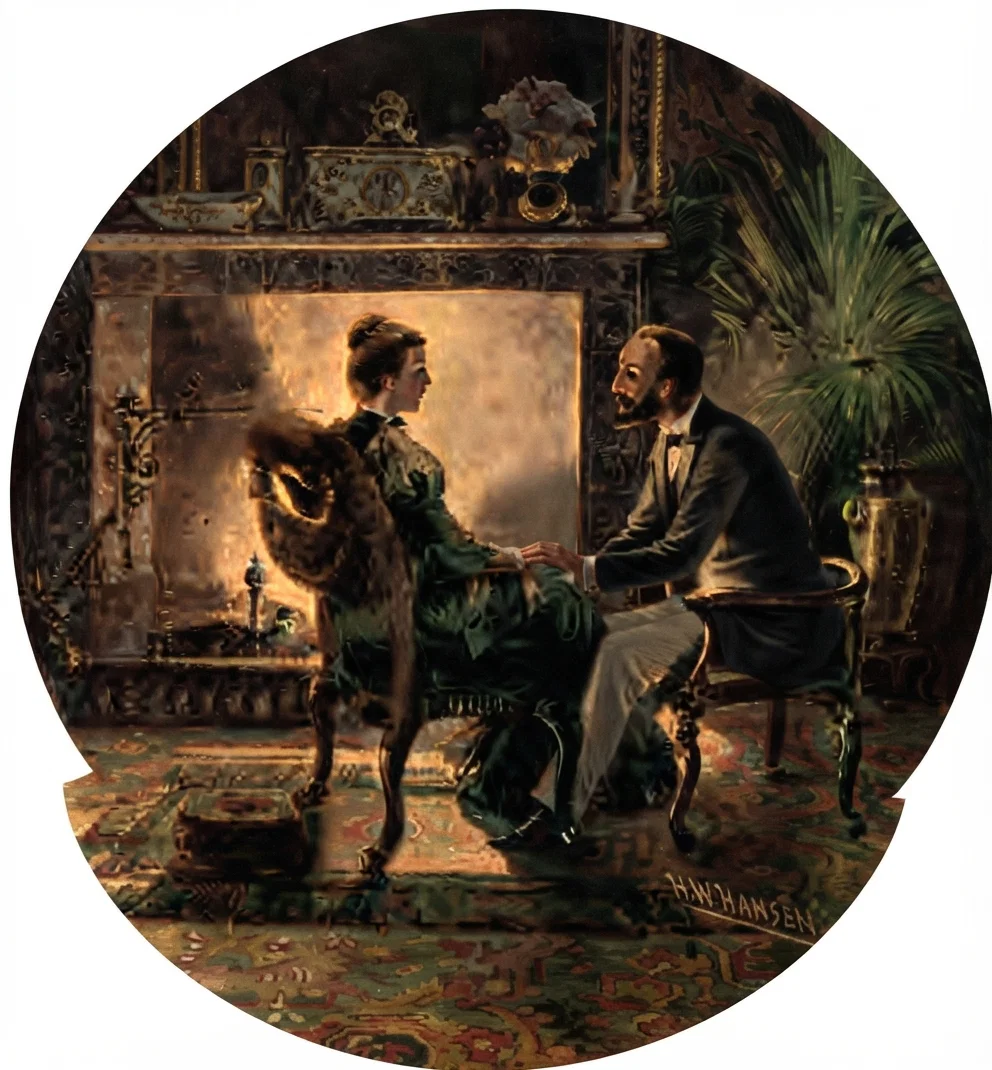
“ANNIE, I HAVE WITHDRAWN FROM THE COMPANY.”
MIDNIGHT of a stormy day, late in January, 188-, was drawing near. Snow had fallen steadily, rapidly, since before day. And now a heavy covering of the soft, cold crystals lay all over the wide, deep lawns bordering for miles on the North Side, Cleveland's famous avenue.
In many of the mansions crowning the long, sloping eminence which extends from Erie Street to Wilson Avenue, lights had been extinguished for the night two hours since.
Yet in one of the most elegant among them burned a bright jet of gas in the spacious hallway, and in one of the upper front rooms one could discern, reflected upon the handsome ceiling, the ruddy glow of fire in an open grate.
Alone before this fire sat a gentle woman, slightly past thirty years of age. She was reading. Every feature of her face was interesting. Its lines seemed to have been shaped by a habit of lofty feeling.
At the hour this history opens, Mrs. Kinnear—so the woman was called—was awaiting her husband's return from an important business engagement in Bank Street. He was a man of extremely regular habits, and his absence until so late an hour of the night caused her some uneasiness.
Finally, leaving her room, and running down the staircase she opened the front door and looked out into the white night. The storm had ceased. The stars were shining brilliantly, and the cold was intense.
A moment only had passed when Mr. Kinnear opened the street gate, two hundred feet away, and hastened up the snow-covered walk. Reaching the house, and finding his wife in the doorway, he exclaimed with some feeling:—
"Why, Annie, you are not up and waiting for me at this hour of the night?"
"Yes, Wilkie, to sleep was impossible, so I turned watcher, just to learn how I should feel were it your custom to do this thing. Something very unusual must have detained you."
"You have surmised rightly, Annie. Come to our room, and I will tell you all about it."
They had barely taken seats before the cheerful fire, when Mr. Kinnear, turning to his wife, and taking her hand, said, in a manner painfully serious: "Annie, I have withdrawn from the company. I hope you will approve my step. I wished to talk the matter over with you, but I could not. I had to act on the spot."
"I am astonished, Wilkie, but I can form no judgment in the case until you tell me all about it," answered Mrs. Kinnear calmly.
"You know," he continued, "what measures the president and two or three other members of our company have proposed, of late, to adopt with reference to small dealers in our commodity. Well, this matter was brought to a crisis at our meeting to-night. These members, who form a majority, came together determined to force their plan to a conclusion; that is, to compel Douglass and myself to consent to it. This I could not do. So I have withdrawn."
"What is their scheme in whole?" asked Mrs. Kinnear, deeply interested.
"As a first step, they propose to depress the price of the article in which we deal, to so low a figure as to make it impossible for two of the parties to continue in business. Our company, with its vast resources, can hold the price down until there is no hope for these men. They must close out.
"Then there is in the city a young company, operating upon a moderate capital, which has been at work about two years. Its prospect of success is altogether too flattering to be agreeable to our company. The proposition is to secure quietly a controlling amount of this young company's stock. The remainder it will then be glad to sell at our own figure, and we can close the concern."
"What, then," asked Mrs. Kinnear, "will become of all the men whom your company has driven out of business?"
"That, according to the argument to-night, would be no concern of ours. Let them do anything they can, or nothing at all. This disposition has been growing for months. I have deplored it, and have foreseen to-night's issue, so far as I am concerned."
"And you have withdrawn from the company because you will not be a party to these proceedings?"
"Yes, Annie, I am unable to discern why I, who am the possessor of a munificent fortune, should scheme to extinguish the business prospects of other men, simply that I may add their income to mine. Their right to live and to thrive is as distinct, as just, as God-given, as is mine.
"All of them are men struggling for a livelihood. The measures proposed to-night will set them back for years, in the road to comfortable, liberal living, and possibly render another attempt thereto impossible."
"But, Wilkie," interrupted Mrs. Kinnear, "what will you do with your means? You can not let it lie simply idle. It is your duty to employ it, just as it is every man's duty to use his natural abilities."
"Annie," replied her husband, in a tone so serious as to startle her, "I propose to be a child of God, by a new birth. I believe I am such. In a natural sense—not in a spiritual sense—every man is my brother. I can but regard myself as his keeper. Indeed, every man, from this standpoint, is his brother's keeper, scoff at the statement as men may.
"On this principle I propose, with your help and the blessing of our Father, to act hereafter. Most of my wealth has come to me without effort of mine. None of it, so far as I know, has come by scheming to any man's detriment. And now I propose to employ it—as you say—in helping poorer men to live.
"And further, Annie, I propose, with your consent, to sell this magnificent property on which we live, and build for ourselves, further out on this avenue, a suitable home, worth much less than this.
"I feel strongly that, as God's spiritual children, we are not justified in occupying a home valued at $100,000, while multitudes of families have none at all. We are living for eternity now, Annie, and the home on which our hearts are set must not be of this world."
"I myself," replied Mrs. Kinnear, "have had very serious thoughts on that subject, and certainly I shall be very willing to occupy a home far less valuable. But just how do you propose to aid poor men? by giving them homes outright? If so, I fear few will appreciate your gift, and they would still have their livelihood to gain."
"You are right, Annie. Every man possessed of health and strength should earn his home. The Word of God not only commands men to work, but furnishes them the powerful personal examples of Christ, of Paul, and of others, as an encouragement thereto. I would simply open the way for laboring men to do so with some hope of success.
"I have thought long and seriously over this problem, in anticipation of the probable result of our meeting to-night. The secretary, who shares my views, as you well know, will undoubtedly resign to-morrow, and withdraw from the company.
"Then together we shall start in the spring a manufacturing business which will certainly prove lucrative. In the enterprise we may employ, before the year closes, two hundred men. To these men we shall pay good, living wages from the beginning.
"Furthermore, at the end of the year we shall divide to every employee a portion of the net earnings of the establishment. This share will be proportioned to each man's wages; and all will be given the privilege of placing their amount in the business immediately, and it will be regarded as their stock in the institution during the next year.
"Thus will every man have an interest in the business other than that of daily wages. In other words, he will be a partner therein. It will be his business. For its success, if he be a true man, he will work, and he will not be likely to impoverish himself by engaging in a strike against the company."
"Well, my husband, if you can make your plan work, I shall rejoice. But remember that the little you can accomplish in this direction will be but a drop in the bucket. Not one of a thousand business men will follow your example, so universal is the greed for gain. And the world will be still full of poor and homeless people."
"I have not a doubt of our success, Annie. Next to the president, Douglass is the best financier in the company. He is cautious, and has a great talent for attention to details. And bear in mind, too, that we shall not engage in this undertaking to make money solely for ourselves. Our prime object will be to help men less fortunate than we. Not a dollar of the net earnings will be ours. In short, we become keepers of our brothers, for Christ's sake. Can we fail of His blessing? Will He not regard our work as done unto Him?"
The next morning Wilkie Kinnear met Mr. Douglass in his office soon after 10. The latter had just written his resignation as secretary of the company of which both had been members. It lay on the desk before him. The two men greeted each other warmly, the former saying:—
"Douglass, never in all my life have I experienced a feeling of independence so exhilarating. The thought that I may now spend my means and my energies for my fellow-men gives me genuine joy."
They passed a few moments in speaking of the important step they had taken, and of its effects upon the interests of the company, and then arranged to meet at the home of Mr. Kinnear in the evening to plan for their enterprise.
The result of their conference was the taking immediate measures to embark in the work. Both men were exceedingly active, and the middle of April found them ready to give daily employment to nearly a hundred laborers, skilled and unskilled.
Care was taken, first of all, to secure men capable of performing the work in the various departments, and, second, to engage those who had families to support, if they were men not distinguished for bad habits.
For several days before the formal opening of the place, a schedule of the wages which would be paid, from manager and foreman down, was placed conspicuously inside the general office, and every successful applicant was engaged in accordance with that scale of prices.
This was a unique step, but it appeared to give general satisfaction. The mere fact of knowing what every other man received acted as a curious solace to him who could command but the smallest wage. A help to this end, also, was the unusually liberal recompense which he himself received.
But, above all this, there was a certain indefinable frankness in the thing which pleased him. It looked like a family understanding of the matter. There was a brotherliness in it which brought to mind vividly his childhood fireside, where no member concealed aught from another.
Nothing had been made public as to the motives of the proprietors in establishing the business, and nothing concerning the unusual features which were to distinguish it. Hence no curiosity existed with regard to it.
Eight o'clock was the hour appointed for assembling the first morning. An hour before the time appointed, the two proprietors entered the building alone, and, going directly to their private office, earnestly sought God's blessing upon their undertaking.
Upon rising to their feet, Mr. Kinnear said: "Douglass, I propose that we ask the men to step into the main office, when we open, and that we there invite them to repeat these words: 'One is your Master, even Christ; and all ye are brethren.' 'Therefore all things whatsoever ye would that men should do to you, do ye even so to them.' Do you approve?"
"Most heartily," answered his friend. "And I would make the repeating a passage of Scripture every morning a custom of the house. I think few of the men are Christians, and the brief exercise will acquaint them, if but slightly, with the Word of God—the very thing we so much desire."
Just before 8 Mr. Kinnear threw open the doors,27said, "Good-morning," cheerfully to the men assembled, and requested them to tarry a moment in the main room. Then, stepping to his desk and taking a Bible therefrom, he said in kindly tones:—
"Men, we cordially invite those of you who feel inclined, to repeat with us a verse of Scripture before we begin work. And this we shall do daily at this hour. We wish to show our respect for the Word of God. We want the blessing which comes from obeying it."
Every man uncovered his head instantly. Then many of them repeated slowly, after their employers, the words: "One is your Master, even Christ; and all ye are brethren." "Therefore all things whatsoever ye would that men should do to you, do ye even so to them." The manager then stepped forth and conducted the men to their tasks.
Among the company was a slender, delicate man, not more than thirty-five, who was noted for his skill in a special department. As he passed to his position, he said within himself: "'All ye are brethren!' Is that big, brutal Joe Curtis, who has striven so hard to crush me, my brother? —No! Brother of mine? —No! I'm sorry he is to be employed in this establishment."
When the bell rang to stop work that evening, this frail man was detained at his task a few moments. Presently "big, brutal" Joe Curtis entered the room, advanced toward him, extended his hand, and said, while every feature of his face evinced strong emotion:—
"My brother, I've come to beg you to forgive my very unkind treatment of you. That puzzling text we repeated this morning, 'All ye are brethren,' has been shouting in my mind all day. It doesn't let up a minute. Does all Scripture talk to a man like that? I didn't know you were my brother. Forgive me."
"God bless you, Joe," replied the pallid-faced artisan. "Let us hereafter be brothers indeed."
Soon the two men left the place together, and wended their way homeward, happier men, better men, than ever before.
Returning to his home that evening near the dinner hour, Wilkie Kinnear said to his wife: "Well, Annie, at last our enterprise is fairly at sea. We prefaced the work this morning with two gentle, quieting texts of Scripture, and there has been no friction all day. Douglass and I have tried to remember that the weakest man of the force is our brother. And I tell you, Annie, in a business sense, neither of us were ever so happy."
Next morning every man stood attentively while Mr. Douglass read John 3:16, adding thereto no remarks. Then all repeated the words, "For God so loved the world, that He gave His only-begotten Son, that whosoever believeth in Him should not perish, but have everlasting life," after which they hastened to their duties.
Thus, every morning, did these faithful stewards of the Master sow the living seed of the kingdom—the simple Word of God—in the hearts and minds of their men, assured that it must take root and bear blessed fruit.
Midwinter was drawing nigh. The business had grown until the laborers now numbered nearly two hundred. Never had there appeared among them a token of discontent, but, instead, daily a remarkable readiness to work.
Therefore it was not surprising that one day, after the company had repeated that striking passage, "God is able to make all grace abound toward you; that ye, always having all sufficiency in all things, may abound to every good work," Mr. Kinnear should have been startled somewhat when "big, brutal" Joe Curtis stepped to his desk, cap in hand, and said to him:—
"Mr. Kinnear, some of us poor fellows are dissatisfied with our wages, and we have decided to strike for larger pay. But, first, we wish to talk the matter over with you and Mr. Douglass. Would you oblige us by inviting the men to meet in this room at half past 12, after we have taken our luncheon?"
"With pleasure, Joe," responded Mr. Kinnear, determined not to be surpassed in politeness by one of his men, and also resolved to take the matter as coolly as did the great fellow before him.
At 12:30 Mr. Kinnear and Mr. Douglass were awaiting their men. A moment later they came in from every quarter, looking little like men with a grievance to settle. Barely were they assembled when Joe Curtis, who, because of his ready speech, had been appointed their leader, addressed Mr. Kinnear, saying:—
"Mr. Kinnear, you remember how, the first day we began work here, you let the blessed Book say to us: 'All ye are brethren,' and, 'Whatsoever ye would that men should do to you, do ye even so to them.' Well, we can't account for it at all, but somehow—I guess it's by God's blessed Spirit—those words have stuck in many of our hearts, and they, with all the other scriptures we have repeated, have changed us into different men, little by little, working like leaven.
"And, Mr. Kinnear, you remember another saying of that morning, 'One is your Master, even Christ.' Well, very soon a number of us learned better. We found that Satan was our master, and that he had been a hard, cruel, and unmerciful master. Well, Mr. Kinnear, we've become tired of him. We don't like the pay we get, nor the many hours of labor he requires of us daily. And we've resolved to strike for all time. No longer will we toil for Satan, if we understand our hearts.
"And we want to ask you if you won't place our names on the pay-roll of the other Master, even Christ. We will serve Him. We want that last thing he pays, Mr. Kinnear, eternal life. Won't you take our names now? We can't return to work until we know this thing is settled."
Overcome by his emotions, Mr. Kinnear had risen to his feet. Tears were falling from his cheeks. When Joe ceased, he said, with quivering lips: "God bless you, men. This is the work solely of His blessed Word and of His Holy Spirit. With all our hearts let us praise Him."
Then, taking paper from his desk, Mr. Kinnear wrote at the top of the sheet:—
THE MEN WHOSE NAMES ARE HERE AFFIXED HAVE RESOLVED TO LIVE TRUE CHRISTIAN LIVES. Then he invited every man who had so determined to subscribe his name thereto.
The room was filled with men. Most of them realized what was taking place. None of them were uninterested. A moment passed, and Joe Curtis stepped forward and wrote his name. Some forty others followed his example. Then came the bell-call to resume work.
During several days following, Mr. Kinnear busied himself in learning what had been the earlier religious training and possible church relationship of these men.
And, one morning later, when satisfied on these points, he suggested to them that regular attendance upon Gospel services would prove of great advantage to them and their families.
They themselves had been thinking on the subject, and now asked, "Mr. Kinnear, would you not consent to our worshiping in this building? Numbers of us live near."
"But you are quite a flock. Some of Christ's under shepherds should look after you," said their friend.
"Won't you yourself, or Mr. Douglass, lead our meetings, at least until we get well along in the way? We are Germans, and Swedes, and Danes, and Irish, and here is one colored man. Yet all we are brethren. We can't scatter among the churches. We are poor men. Besides, our families will double our number. Let this building be our place of meeting for a while."
To this proposition both men assented, after much earnest reflection, and in brief time fitted up a room invitingly for the purpose.
It would be too much to say that this entire company of men was won to Christ, by either the drawing power of Christ's Word, or by the kindness of their employers. Sadly enough, some rejected light, and walked on in darkness.
Time went on, and the first business year of "Kinnear & Douglass" drew to an end. For some days both men had been busy taking account of stock and footing up their expenses. The net earnings of the house were ascertained to be about $6,000. At once, in accordance with their purpose at the outset, they arranged to divide the amount among their employees.
Accordingly, on the final morning, after the two men had sought earnestly the special help and blessing of God upon the step they were taking, and after the brief religious service—now held in the chapel—the workmen were requested to tarry for a moment. With few words Mr. Kinnear explained to them what had been his purpose in engaging in the business; why he had apportioned to each man a sum proportioned to his wages; read to them the amount each was to receive, and tendered every man the privilege of placing his little sum in the business as stock therein.
The effects of these announcements were most surprising. Most of the men were dazed for a moment. Numbers of them could hardly believe the statements of their friend. Stock in a prosperous business! Themselves owners of capital! Doing business on their own account! Never had they looked into the future with any such hope.
Several wept. Others were dumb. Some gathered around their employers, grasped their hands, and begged them to forgive every lack of fidelity on their part. A few, white and faint, bowed their heads upon a chair before them, and thanked God.
In that hour Wilkie Kinnear reaped his HARVEST OF RIGHTEOUSNESS for the year 188-.
THE BUILDING OF A HOME
By J. R. Miller
By J. R. Miller, D.D., Author of "Home-Making," "Silent Times," etc.
It is not the house that is the real home. There may be a palace and yet in it no life of love. There may be a little thatched cottage, and in it a bit of heaven. It is well to make the house beautiful and fill it with lovely things, but it is better to make the household life within one of love and joy.
Every member of the household has a share in the building of the home and a responsibility for the enriching of its life. One instrument that fails to do its part mars the music of an orchestra. One discordant life in a family makes the music of love in the home less sweet.
Really the making of the home begins before the home is set up—it begins when two agree to unite their lives in marriage. The marriage ceremony does not necessarily ordain happiness. There are lives wedded which never blend. Marriage should not be entered upon hastily, heedlessly, but always reverently, discreetly, prayerfully.
When the marriage tie has been formed, each has a sacred part to perform in making the home one of happiness, of love, of blessing. The husband has a share. Not every man who assumes this relation thinks of the responsibility he accepts when he takes a young girl away from the shelter of parents' love, the warmest, softest nest in the world, and leads her into a new home, where henceforth his love is to be her only shelter. No man is fit to be a husband who is not a good man. He need not be great, nor rich, nor brilliant, nor clever, but he must be good. His love must be so true that it will not fail in any experience, and will continue strong as ever when both have grown old; and it must be so warm and tender that it will never weary in its thoughtfulness and kindness. The love a true woman's heart craves is gentle as well as strong, affectionate as well as true.
"I pray you think
That love will starve if it is not fed—
That true hearts pray for their daily bread."
Home is a woman's kingdom. There the wife must be strong and beautiful. There she must be her best and always bring her best. She may do good things outside, in church and society, if she can do them without slighting the duties that are hers within her own doors. But if any calls for service must be declined, they should not be the duties of her home. These are hers and no other one's. Whatever may be the share of others, the happiness of the household, in the last analysis, depends upon the wife. Her spirit gives the home its atmosphere; her heart, makes its warmth. And the end is so worthy, so noble, so divine, that no woman who has been called to be a wife, should consider any price too great to pay in order to be the light, the joy, the inspiration, of a home. Men with splendid gifts think it worth while to live to paint a few pictures which shall be admired for generations; or to write a few songs which shall sing themselves into people's hearts. But the woman who makes a sweet, beautiful home, filling it with love and prayer and holy inspirations, is doing something finer than aught else her hands could find to do beneath the skies.
In the making of home happiness children also have their place. It is a sacred hour in a home when a baby is born and laid in the arms of a young father and mother. It is the final seal upon wedded love. In its coming it trails fragments of heaven with it to earth. Much of home's deepest happiness along the years is made by the children. They teach their parents ofttimes greater and better lessons than any the parents teach them. They enrich the life of the true home.
Motherhood is one of the holiest secrets of home happiness. God sends many beautiful things to this world, but none is richer than that which he bestows in a mother who has learned love's lessons well. One writes:—
"God thought to give the sweetest thing
In His almighty power
To earth; and, deeply pondering
What it should be, one hour
In kindest joy and love of heart
Outweighing every other,
He moved the gates of heaven apart
And gave to earth—a mother."
Fatherhood should also bring its enrichment to the home. God is revealed to us as our Father in heaven. Every earthly father should be a true interpreter of God to his household, not in his words alone, but especially in his life, his character, his disposition. No doubt there are parts of the parental duty which a woman can do better than a man. Men's hands are clumsy and often hurt when it was meant they should help. Yet the father has his part, and no father should think that he has done his whole duty to his home when he has provided, however luxuriously, for his material wants. His strength should be the secure shelter beneath which his wife and children may safely abide. His character should be a continual revealing of the love and goodness of God. He is the high priest of his house, and should speak daily to God for his family. Through him benedictions should come perpetually to his home.
Brothers and sisters also have their part in the building of the home. Not in every home, however, do they live so as to make the music one glad, sweet song. Too often there seems to be at least a tacit feeling that home affections do not require the culture that other friendships require. We can not be brusque with other people and expect them to hear patiently with us in spite of our discourtesy. But our home friends—we are sure of them, so we let ourselves believe—and do not need to be careful of the amenities. Thus in many homes brothers and sisters never form close intimacies. They remain almost strangers to each other's better life. In this way they fail to do their full part in the making of happiness. The relation of brothers and sisters has in it almost infinite possibilities of good. They should learn to live together in unity, whatever the cost may be. Love's first lesson is that of giving up one's own way, denying one's self, bearing all things, enduring all things. Where this spirit is cultivated, the spirit grows quiet and gentle, and the daily intercourse becomes affectionate, with its thousand little ways of thoughtful courtesy. In a larger measure than they imagine do the younger people in a household hold in their hands the best interests and the best happiness of the family life.
Thus in the building of a home every one has a part, and the one who fails tears down what the others have been building. Religion is the great master secret of all true home life. The Spirit of Christ alone will enable a family to live together in perfect peace. The presence of Christ in a home is a perpetual benediction. If He is our guest, we can not have strife and contention; we can not be irritable and exacting; we can not be bitter and unkind. Where Christ is, love is. Then even the burdens and shadows bring new blessing. Sorrow draws all hearts closer together and reveals new secrets of joy.
Nothing else we can do in this world is really better worth doing than the building of a beautiful and happy home. He who does this builds a sanctuary for God, and opens a fountain of rich blessing for men. The children who are brought up in an ideal home go out trained and ready for life's tasks and struggles, carrying in their hearts a secret of strength which will make them loyal and faithful to God, and will keep them pure in the world's sorest temptations.
We may each do worthy service, therefore, by helping to make one home—the one in which we dwell—brighter and sweeter. No matter how plain and old-fashioned it may be, if love be in it, if prayer connect it with heaven, if Christ's benediction be upon it, it will be a transfigured spot. Poverty is no cross if the home be full of cheer. Hardest toil is light if love sings its songs without break amid the clatter.
THANKSGIVING DINNER MENU FOR SIX.
By J. E. Paterson
By J. E. Paterson, St. Helena, Cal.
Sago Cream Soup
Celery Fricasseed Protose
Baked Macaroni Walnut Lentil Paddies
Escalloped Tomatoes
Green Peas Sugar Corn
Pumpkin Pie
Nut Cake Fruits
Raisins and Nuts Temperance Eggnog
Vegetarian Recipes
Sago Cream Soup.—Two qts. milk, 1½ pt. cream, 1 egg, ½ cup sago, salt. Bring the milk to a boil, wash the sago, and add it to the milk, and simmer for 40 minutes; add the cream, which should be previously boiled; beat the yolk of the egg and add it to this soup, being careful to avoid curdling; add salt and serve. A laurel leaf steeped in the soup for a few minutes before serving will give the soup a nice flavor.
Fricasseed Protose.—One can of protose, 2 onions, 2 eggs, 2 heads of celery root, 3 large tomatoes, teaspoonful of parsley, bread to garnish, vegetable broth. Slice the onions, celery root, tomatoes, and bake in the oven to rich brown, without burning. Add enough vegetable broth to make 1½ qts. When strained, cook a few minutes longer, and strain through a soup strainer. Rub as much of the vegetables through as possible, cut the protose in cubes of about one inch in size, and simmer in the gravy from thirty to forty minutes. Beat the eggs and add them with the parsley a few minutes before serving. Garnish with green peas, or sippets of toasted bread, and serve hot.
Baked Macaroni.—Half pound of macaroni, 1½ qts. of milk, 1 pint of cream, 3 eggs. Cook the macaroni in plenty of water until tender, then wash in a colander with a quart or two of water. Let drain; turn the macaroni in an agate baking-pan, make a custard of the eggs and milk, salt to taste, and pour it over the macaroni. Sprinkle a little granola or bread crumbs over the top and bake ½ hour. Add ½ pt. of milk to the cream, bring to a boil, thicken with a little flour, and serve as cream sauce with the macaroni.
Walnut Lentil Paddies.—One lb. of German lentils, ½ of a teaspoon of sage, 1 onion, cup of bread crumbs, ½ lb. of chopped walnuts, parsley, and salt to taste. Cook the lentils in 2 qts. of water until nearly done; add the onions, sage, parsley, and salt; cook until done without burning. Strain what little broth there is when done, and mash the lentils through a small mash colander. Add the bread crumbs and walnuts, mix well, flour the hands, and make the mixture into balls. Brush over with a beaten egg or cream. Bake on a greased baking-pan 15 minutes. Serve with tomato sauce.
Escalloped Tomatoes.—Six large tomatoes, 1 cup of bread crumbs, a little sage, a leek, 2 eggs, ½ teaspoonful salt; mince fine. Select large, smooth tomatoes, wash and cut them in half, remove the seed with a teaspoon without breaking the outer skin. Moisten the mixture with the eggs. You may need to moisten with a little water; if so, use the juice from the tomatoes. Fill the tomato shells with the mixture; bake in a moderate oven ½ hour.
Pumpkin Pie.—Six cups of cooked pumpkin, 1 cup of light brown sugar, 1 cup of flour thickening or 6 eggs, 1 pt. of milk, ½ teaspoon of salt, ½ lemon rind; mince fine. For the crust 3 cups of flour, 4 tablespoonfuls of olive-oil, 3 cups of water, a little salt. Drain the pumpkin dry after cooking, and mash it through a strainer. Stir in the sugar, the braided flour, the salt, mince lemon rind, and, lastly, the milk, and, if the eggs are used, omit the flour, beat well, and add with the milk. Mix the oil thoroughly in the dry flour, the same as butter is mixed in the making of an ordinary pie paste; add the water and mix into a soft dough. Flour the bread board and lay the dough on it. With the knuckles press it out evenly to ½ inch in thickness. Then fold the paste over and press the edges together to prevent the imprisoned air made by the knuckles in the dough from escaping. Repeat the process of kneading and folding three times, when the paste will be ready for use. Cover pie pan with dough after it has been rolled out in the ordinary manner; fill with the pumpkin, and bake ¾ of an hour.
Nut Cake.—One lb. walnuts, 3 cups of flour, 1 heaping cup sugar, 12 eggs, 1 tablespoonful vanilla or lemon extract, 1 pt. cream, 3 spoonfuls almond meal. Shell and chop the nuts, break the eggs and separate them, add the sugar and cream to the yolk, and beat as stiff as you can get it; add the nuts, beat a few minutes longer, and stir in the flour. Whip the white to a stiff froth, and fold it into the mixture; add the almond meal and extract last. Grease a cake mold, put in the mixture, and bake 1 hour.