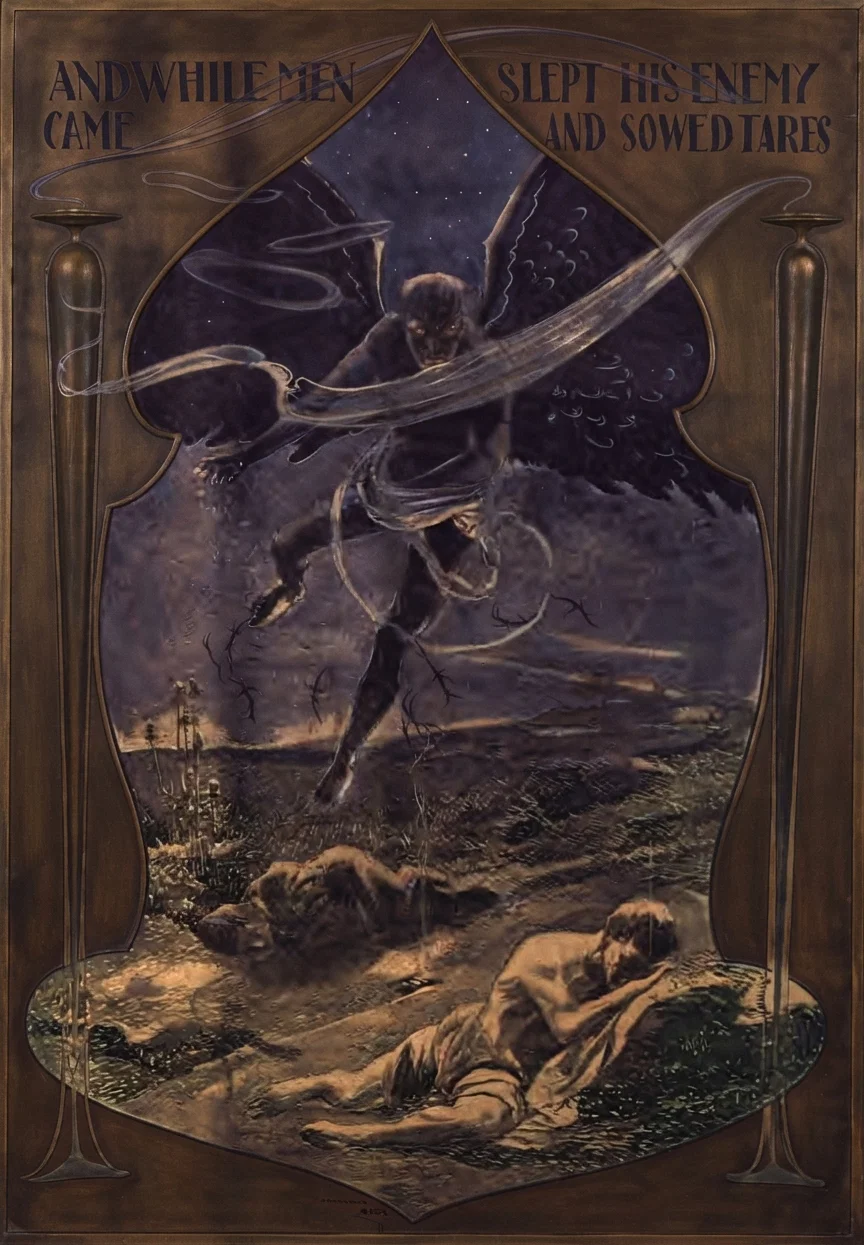
LONG ago the prophet Ezekiel said, "Make a chain; for the land is full of bloody crimes, and the city is full of violence." Certainly this time has been reached, for the land is full of bloody crimes, and the cities are full of violence. Within the last few years there has sprung into existence a type known to students of economics as the "criminal classes." There is an ever-augmenting stratum of society nowadays from which nothing but crime is expected. Their fathers and mothers are criminals. The children were conceived in crime, born in iniquity, and reared in sins too horrible to contemplate. This class may now be found in all of our large cities, and the portions of the cities where they reside are so dangerous to human life and limb that they are not safe to enter unless accompanied by an armed guard. In these places wickedness of all kinds is the regular order of things, and righteousness the rare exception.
But, aside from the criminal classes proper, the record of crime is something appalling. Witness the terrible lynching affairs in various parts of the country of late. Such crimes "outcrime" that which they are designed to punish and to check. The perpetrators of them are husbands, fathers, and sons, members of farming communities. They were not criminals in the legal sense of the term.
A report from the largest city in the country is as follows: "In several quarters of the city life is no longer safe. The night streets of the district lying between Union Square and Long Acre and Seventh and Third Avenues are in the possession of the disorderly elements. The police force is already demoralized, and the demoralization is progressing rapidly toward chaos. . . . What shall be done? What can be done to avert chaos and restore order and security? Is it impossible for a community as intelligent as this to find some mean between the exasperating crushing of personal liberty and the terrifying domination of criminals and semi-criminals?"
The testimony given by reputable witnesses before the now famous Mazet Committee in New York goes to show that the governmental machinery organized for the very purpose of preventing crime is engaged in a most wholesale fashion in aiding and abetting it. I refer to the metropolitan police force. Saloons, gambling dens, pool-rooms, opium dens, houses of ill fame, and every evil of the kind, is protected in its business on payment of a certain percentage of its receipts to the officers of the law. Nor does iniquity stop here. Boards of Aldermen are given over to the influence of boodle, and representatives and senators are amenable to bribes.
In more than one instance of late trusts and giant corporations have resorted to the use of explosives to get rid of their competitors. These things are well known in the petroleum industry. Attempts have been made by one powerful corporation to blow up the refineries of another. Men who could fasten the crime have been made away with, and never heard from again. (See the testimony in Buffalo Explosion Case, printed in "Trusts," Congress, 1888, p. 894.) These giant aggregations of capital have stopped at nothing. Attempts have been made by the most wealthy men of the land to bribe State attorney-generals.
Even ordinary every-day business and commerce are being invaded by crime of the most deplorable and cold-blooded kind. A committee of the last Congress has obtained valuable information as to the adulteration of flour. Investigations show that in 1897, when the business was only in its infancy, there were manufactured and sold in the United States between 5,000,000 and 6,000,000 barrels of adulterated flour.
Thus it appears that everywhere, in every line of life, view it from whatever standpoint you may, there are crimes of the most fearful kind being committed. How long before a just and holy God will visit retributive judgments for all this fearful Harvest of Crime?
Sin and the Law
“Whosoever committeth sin transgresseth also the law; for sin is the transgression of the law. And ye know that He was manifested to take away our sins.”
THE HARVEST OF INTEMPERANCE
By Mahlon E. Olsen
INTEMPERANCE, Christianity's greatest enemy, "the devil's most potent instrument," is not here and there but everywhere. Its baleful seeds have been scattered throughout the civilized and a large part of the uncivilized world, producing everywhere a harvest of crime and misery and wo that is appalling.
It is a picture dark and forbidding which this harvest presents to our view; but if letting the mind's eye rest upon it for a few moments will have the effect of stirring our hearts, awakening our soul energies, and moving us to earnest, concerted action, it will be well worth the effort.
"Who hath wo? who hath sorrow? who hath contentions? who hath babbling? who hath wounds without cause? who hath redness of eyes? They that tarry long at the wine; they that go to seek mixed wine." Thus wrote Solomon three thousand years ago. Under the divine inspiration he pictured intemperance as the first cause of wo, sorrow, contention, and disease. Such it was then, such it is to-day, such it always will be.
The prophet Isaiah draws a striking picture of the results of intemperance: "Wo unto them that rise up early in the morning, that they may follow strong drink; that continue until night till wine inflames them! And the harp, and the viol, the tabret, and pipe, and wine, are in their feasts; but they regard not the work of the Lord, neither consider the operation of His hands. . . . Therefore hell [the grave] hath enlarged herself, and opened her mouth without measure; and their glory, and their multitude, and their pomp, and he that rejoiceth, shall descend into it."
An awful doom for the drunkard! Yet thousands of men and women bought by the precious blood of Christ, are hurrying on in this broad way to destruction. The grave has opened her mouth indeed, and multitudes of deluded mortals are blindly rushing in. Where is the Christian who will utter his voice in warning? Nay, where is he who will, in love and pity, put forth the hand and seek to rescue some destruction-bound soul by the power of the Gospel?
Let us now consider more in detail the evil effects of this terrible plague.
As regards crime, note the testimony of a lord chief justice of England: "Judges are weary of calling attention to drink as the principal cause of crime, but I can not refrain from saying that if they could make England sober, they would shut up nine-tenths of the prisons."
Mr. Simmons, governor of the Canterbury prison, says: "The number of prisoners who have been committed to the prison with which I have been connected during the last 15 years, amounts to 22,000. Among them I have come in contact with ministers of the Gospel, numbers of persons who were once members of Christian churches, as also children of pious parents; but I never met with a prisoner being a teetotaler. From the experience I have had, I calculate that from 90 to 92 per cent. of all crimes are committed through taking intoxicating drinks, in a direct or indirect manner."
Not less clear and unequivocal are the words of one of our own chief justices: "An experience of more than twenty years of judicial life has taught me that more than seven-eighths of the crimes committed in this country—which involve personal violence—were traceable to the use of intoxicating liquors; . . . that of all the crimes of sin and misery, of pauperism and wretchedness, intoxicating liquor stands forth the unapproachable chief."
General Eaton, late United States Commissioner of Education, recorded it as his opinion that "eighty per cent. of the crime of our country is the result of intemperance, and ninety-five per cent. of the depraved youth are the children of drunken and depraved households."
But the dark categories of crime, the prisons, reform schools, and workhouses, contain but a very small part of the Harvest of Intemperance. Poverty, in all forms and shapes, whether on some heavily-mortgaged farm in the country or in the slums and back alleys of our large cities, is to a very large extent due to intemperance. Thousands of poor children cry in vain for bread and clothes because their father has spent his last nickel in the saloon; and pale, worn-out mothers ply their needles in the uncertain light of some loathsome garret, trying to earn a few pennies to keep the wolf from the door, dreading the footsteps of the man whom drink has changed from a loving husband and father to a something worse than a brute.
THE HARVEST OF INTEMPERANCE By Mahlon E. Olsen, Battle Creek, Mich.
Canon Farrar has this to say concerning drink and poverty: "What makes these slums [of London] so horrible? I answer with a certainty, and with the confidence of one who knows, Drink! . . . I tell the nation with conviction founded on experience that there will be no remedy until you save these outcasts from the temptation of drink. Leave the drink, and you might build them palaces in vain. Leave the drink, and before the year is over your palaces would be reeking with dirt and squalor, with infamy and crime."
Disease, great and growing evil, is in large part due to the drink habit. It is a well-known fact that yellow fever almost invariably finds its victims amongst the intemperate, and when cholera visits a city it is this class that are the first to succumb to its ravages.
As to insanity, which is of late increasing at a most alarming rate, the superintendent of the Ohio State Asylum says: "My experience and observation would lead me to say that seventy-five per cent. of the cases of insanity is not too large a number to ascribe to alcohol." This testimony is amply corroborated by that of other superintendents.
Of the influence of alcohol on the general health we may judge from the following testimony of Dr. Higgenbottom, an eminent English surgeon: "I consider I shall do more in curing disease and preventing disease in one year by prescribing total abstinence than I could do in the ordinary course of an extensive practise of one hundred years."
One of the saddest features of the drink question is the fearful havoc which liquor has wrought in heathen lands. The South Sea islanders are rapidly dying off through this cause; the American Indian is practically extinct for the same reason; and the Kaffir of South Africa is following in his footsteps. Of the situation in India, judge from the testimony of Archdeacon Jeffries, who, speaking from a residence in that country of thirty-one years, said that for one really converted Christian as the fruit of missionary labor, the drinking practises of the English have made a thousand drunkards.
America is equally blameworthy. From America are going a few missionaries to the inhabitants of Africa; from the port of Boston alone there were sent in one year a million gallons of rum.
Alcoholism is by no means confined to men. New York City reports fifteen thousand arrests of drunken women in one year, and of course this represents but a small part of the women who are slaves to the habit. Drinking is practically universal in the huge army of prostitutes, and whisky is considered one of the necessaries of life by both men and women in a large part of the slum district.
A good deal might be said about the economic phases of this question, but space will hardly permit it. Suffice it to say that the traffic in alcoholic drinks in the United States in one year amounts to the sum of one billion dollars, a sum unappreciable. When we add to this the enormous sums required for maintaining the poorhouses, jails, penitentiaries, reform schools, workhouses, and, to a very large extent, the hospitals and other public charities, all of which may be considered as a direct result of the prevalence of the drink habit, we have a grand total that is simply astounding. Yet this is only a small part of what alcohol costs this nation. What is money compared with the heartaches and bitter tears of mistreated wives, the sufferings of innocent children, and the grief of heart-broken mothers and gray-haired fathers, brought often to an untimely grave by the wayward course of their intemperate children!
Painful as it may be to view the Harvest of Intemperance as it affects the nation's exchequer, this is of little moment compared with its baneful effect upon the individual characters of the men and women who are slaves to liquor, and upon their offspring. We read of men being possessed of devils in the days of Christ. To-day the prince of evil finds a ready entrance into men through the instrumentality of alcohol. The debasing effect of this poison on the character is vividly manifest in every city of our land.5Go to our penitentiaries, and you will find many a man under a life sentence for killing his wife or his child. While sober an industrious workman, a kind husband and father; but in the frenzy brought on by strong drink, he cruelly murdered one whom he loved more than his own life. Others are there for taking the life of a mother, or a father, or a friend, or a rival; but, in almost every case, it was alcohol that blunted the moral faculties, and aroused the lower passions, and thus made the fearful crime possible.
We have feebly sketched some of the evil results of the drink habit; but intemperance does not stop here. The slave to tobacco is just as truly an intemperate man as is the alcohol fiend. Tobacco is an unnatural stimulant, a deadly poison, and as such an evil to be fought as earnestly as alcohol itself by all lovers of mankind. In the same class belong tea and coffee, which, tho less filthy, are yet wholly useless as articles of food, and are taken solely for their stimulating and narcotic qualities.
Leading up to each and all of these abnormal appetites are doubtless wrong habits of life, especially errors of diet, such as the large use of flesh foods, condiments, spices, and rich pastries, and other hurtful dishes. The healthy system does not crave a stimulant. The limbs are supple, the mind clear and keen, and there is a joy in mere existence. The fresh air and simple, nourishing food afford a natural stimulus, and the whole system is so full of energy and life that work becomes a pleasure rather than a task. On the other hand, let the stomach be worn out by improper food so that the digestive powers are impaired, the system is then poorly nourished, and, as a consequence, there is frequently an all-gone feeling; the mind and body seem to require some artificial stimulus to set them to work, and this is found in tea and coffee and tobacco, and in still greater degree in strong drink.
Thus we see where the seeds are sown that ultimately blossom and bear fruit in the crime and misery of intemperance. Parents, look to it well that none of these seeds are sown about your home. Cultivate simple tastes in your children. Keep pepper, mustard, vinegar, ginger, and all such things out of their way. Give no quarter to pampered appetite. Encourage them in the development of strong muscles, erect, vigorous frames; and teach them the awful results of intemperance even from the cradle.
While seeking to avoid the curse in your own family, lend a listening ear to the sobs and groans that are coming up from your fellow-men. Use all the influence you can wield in behalf of the grand cause of temperance. Do not wait for some large opportunity, but begin right where you are to work for the uplifting of the fallen, the salvation of the lost and perishing. Fight intemperance in any form in which it appears, with all the power of your being. Be no longer indifferent, but wide-awake, watchful, earnest, vigilant. God expects you to do your duty. Souls are in the balance. Eternity is right before us. We have but a little time in which to work. Therefore, whatever is done must be done quickly. May God lay upon every honest heart a burden for this work.
EVERY MAN THAT STRIVETH FOR THE MASTERY IS TEMPERATE IN ALL THINGS