THERE is a sowing of Righteousness and a sowing of Sin.
There is the Harvest of Righteousness and Life; there is also the Harvest of Sin and Death.
There is a gathering time for heaven; there is also a gathering time for earth.
In Matthew 13 the former is represented by the wheat and its garnering; the latter, by the tares and their burning. In Rev. 14:14-16 is represented the reaping of the sheaves of wheat by the Son of man; in verses 17 to 19 is set forth the sad other side, in the following words:—
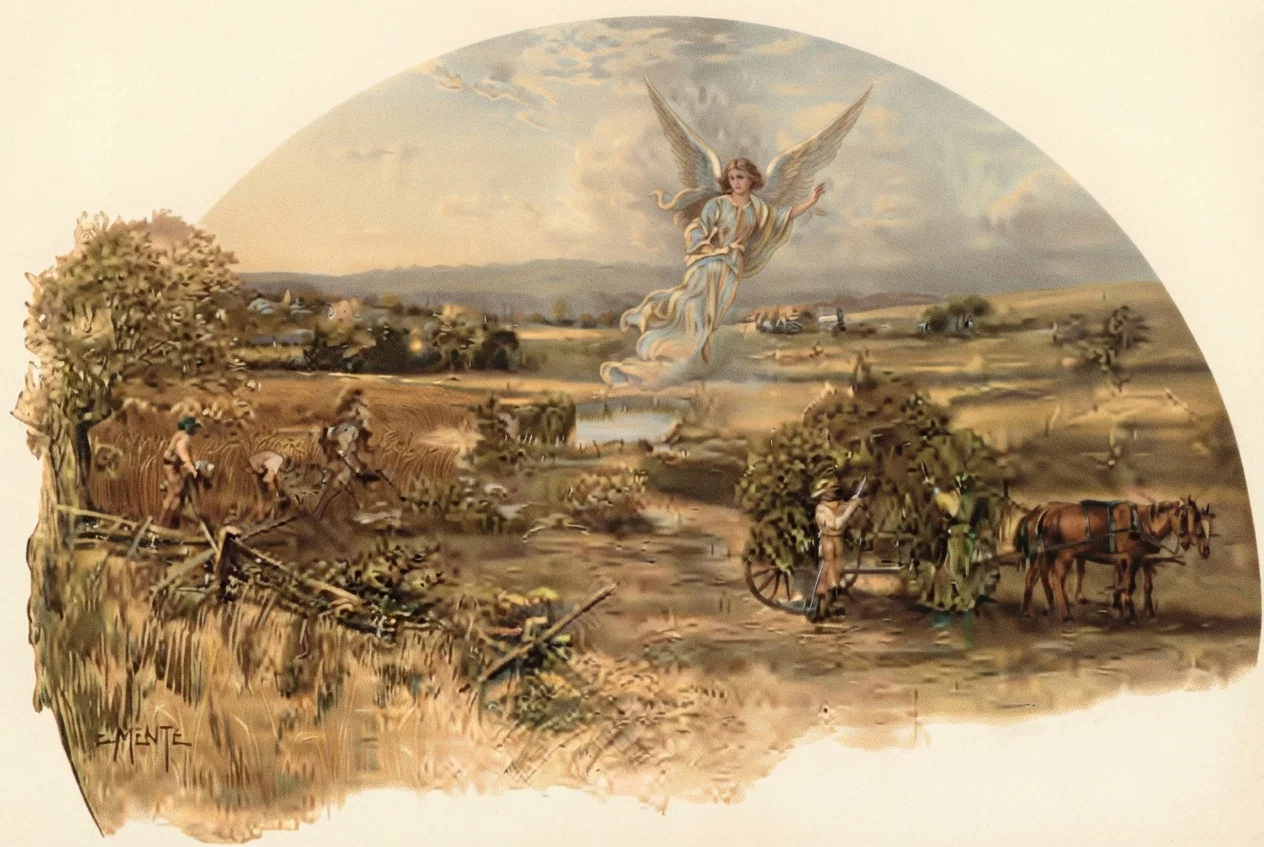
"And another angel came out of the temple which is in heaven, he also having a sharp sickle. And another angel came out from the altar, which had power over fire; and cried with a loud cry to him that had a sharp sickle, saying, Thrust in thy sharp sickle, and gather the clusters of the vine of the earth; for her grapes are fully ripe. And the angel thrust in his sickle into the earth, and gathered the vine of the earth, and cast it into the great wine-press of the wrath of God."
Righteousness and life are from above; for with the Lord "is the fountain of life" (Ps. 36:9), and He also is "the Lord our Righteousness" (Jer. 23:6). "Their righteousness is of Me, saith the Lord." Isa. 54:17.
He who is in reality the child of God is "born from above" (John 3:3, margin), "not of blood, nor of the will of the flesh, nor of the will of man, but of God," "of water and of the Spirit." John 1:13; 3:5.
The heaven-born are the fruit of the seed-sowing, the "incorruptible" seed of "the Word of God," sown by the Son of man. 1 Peter 1:23; Matt. 13:37.
The opposite class are the earth-born, sown unto selfishness and death, "the children of the wicked one," "the children of disobedience," "the children of wrath." Matt. 13:38; Eph. 2:2, 3. Every soul has the privilege of saying whose progeny he will be; for "whatsoever a man soweth, that shall he also reap. For he that soweth to his flesh shall of the flesh reap corruption; but he that soweth to the Spirit shall of the Spirit reap life everlasting." Gal. 6:7, 8. He who yields himself to receive the seed of the Word, sows to the Spirit, to righteousness, to life. He who will not receive the good seed, has a soil prepared for the seed of sin, with its Harvest of Death.
We may better understand the seed-sowing and harvest by a careful reading of the chapter in which this harvest scene is set forth, namely, the fourteenth of Revelation, beginning at verse 6. While this prophecy has its special application to the last generation, it is in itself an epitome of all the ages. Note, then, among other important things, the following:—
1. The everlasting Gospel—the message of good tidings, God's means of saving men in all ages, "the power of God unto salvation to every one that believeth"—is proclaimed to every people and tongue and tribe and nation in connection with the impending judgment. He who receives this message the judgment will acquit. He who rejects it meets the consequence,—death.
2. The time of the message is the close of the Gospel work. Paul preached of judgment to come (Acts 24:25), but this message is burdened with "the hour of His judgment is come," it is now impending over a shelterless world, save for Him in whom alone the faithful find refuge. The time of the message is also shown in what follows its third part, the coming of the Son of man to reap. Verse 14.
3. The first part of this message is positive truth, calling the church of God away from the fear and glory and worship of men to the fear and glory and worship of God, to His creative power, and, logically, to the memorial of His power, exercised in creation and redemption,—the Sabbath. This message, which began in 1840, was designed to heal the scattered and torn condition of the church, represented by "Babylon." The second part sadly announces the fall of Babylon,—the spiritual decline of religious bodies, because of the rejection of the healing message of the Gospel. The third part, represented by the third angel, solemnly warns against the overflowing last-day substitutes for the Gospel, and the union of Church and State and its worship. The consequence of rejecting this message is the reception of the unmixed wrath of God.
4. This great, threefold, world-wide message develops a class of whom it is said, "Here is the patience of the saints; here are they that keep the commandments of God, and the faith of Jesus." Verse 12. In other words, through faith it develops a class in whom the character of Christ is reflected. They have His name and the Father's name written upon them. They are saints, holy in His holiness. They keep the commandments of God, not seven of them, nor nine of them, nor one of them. It could not be said that a man kept the laws of a State who was continually transgressing one. To keep the laws of the State, he must keep all. So likewise when it is said of a class that they "keep the commandments of God," it means that they keep all His commandments, the whole Decalogue. They are seventh-day observers; for one command of God declares: "Remember the Sabbath day, to keep it holy. . . . The seventh day is the Sabbath of the Lord thy God." Neither are they19nominal Jews; for they keep "the faith of Jesus" also. His is the faith "which worketh by love," the love that counts it the highest joy to obey; "for this is the love of God, that we keep His commandments; and His commandments are not grievous." Gal. 5:6; 1 John 5:3.
The rejection or perversion of the everlasting Gospel leaves man in sin and death.
During all the ages God has interposed His mercy to save man. Altho man had sinned, altho his sin was working out wrath or death (for "sin, when it is finished, bringeth forth death," James 1:15), God has ever interposed His mercy to stay the wrath. "For in the hand of the Lord there is a cup, and the wine is red; it is full of mixture; and He poureth out of the same; but the dregs thereof, all the wicked of the earth shall wring them out, and drink them." Ps. 75:8.
Since Adam fell, God has been pouring out of His mixture of mercy and wrath. The wrath has been manifest in the curse upon the ground, in the shortening of man's natural life, in allowing sin at times to develop its inherent evil, that man might sin and forsake it; but an abundance of infinite mercy has been mixed with the wrath, abundance for the pardon and salvation of every sinful soul, abundance to restrain all wrath which will not eventually redound to God's praise and the good of all who trust Him—mercy infinite in its giving, costing not only the eternal sacrifice of the Son of God, but the giving of countless human lives that sinful man might be won to righteousness and life. Where sin abounds, grace doth superabound. His mercy and grace have been, and are being, poured out without stint to restore a wicked world. All temporal good, all necessities of temporal life, all mental resources, all moral and spiritual enlightenment—perverted and turned even against God, as they are—are all manifestations of infinite mercy to a sinful world, in order that the goodness of God may lead to repentance.
Mercy not only restrains the outworking of sin, but it vails God's glory, lest sinful man seeing it gaze and perish. Jesus Christ was but the glory of God—eternal righteousness—vailed in humanity, that man might see the excellence and beneficence of the glory, and so believe without fear and serve without compulsion. Even the glory of heavenly orbs is dimmed that sinful man may not perish; for we are taught that "the light of the moon shall be as the light of the sun, and the light of the sun shall be sevenfold, as the light of seven days, in the day that the Lord bindeth up the breach of His people, and healeth the stroke of their wound." Isa. 30:26. But in the Lord's glorious metropolitan city, in the glory of His immediate presence, "the moon shall be confounded, and the sun ashamed, when the Lord of hosts shall reign in Mount Zion, and in Jerusalem, and before His ancients gloriously." Isa. 24:23; Rev. 21:23; 22:5. And yet God's people, in whom the incorruptible seed of His Word has borne the fruit of His righteousness, "shall see His face," and rejoice forevermore in His presence.
Christ is now withholding the forthshining of His presence. He has not yet come to reign in this earth purchased by His life. He swears by Himself: "As I live, saith the Lord God, I have no pleasure in the death of the wicked; but that the wicked turn from his way and live; turn ye, turn ye from your evil ways; for why will ye die?" "He delighteth in mercy." "The Lord taketh pleasure in them . . . that hope in His mercy." And therefore He pours it out upon a revolting world.
But there will come a time when every overture of divine and infinite mercy will be rejected; and the day draws on apace. All that will be left of the offered cup in Jehovah's hand will be the dregs of wrath. Then the Lord will do that which through all the ages He has had a right to do, come into His own and let His transcendent glory fill the earth as the waves fill the sea.
That will be all. The great Harvest of Earth, the eternal fate of the wicked, will be but leaving them to their own choosing. Christ will leave His priestly intercession, then utterly rejected, and take His restraining hand from off the agencies of destruction, and plague and pestilence and storm and earthquake will devastate the earth. He will come again in His own glory, in the glory of the Father, and of all the holy angels, and shall speak eternal peace to those who know Him within. Then, also, "that Wicked [posing hitherto as righteousness] shall be revealed, whom the Lord shall consume with the spirit of His mouth, and shall destroy with the forthshining of His personal presence." Matt. 16:27; 25:31; 2 Thess. 2:8. "Who shall be punished with everlasting destruction from the presence of the Lord, and from the glory of His power." 2 Thess. 1:9. But His glory and power will then fill the universe. And then neither the wicked nor his place, tho sought diligently, shall be found again. Ps. 37:10.
"Our God is a devouring fire," but only to devour sin. The offering which Israel of old brought, if they were whole-hearted and sincere in repentance and confession, represented their sin. Sin was confessed and laid upon their victim. Then "the glory of the Lord appeared unto all the people. And there came a fire out from before the Lord, and consumed upon the altar the burnt-offering and the fat; which when all the people saw, they shouted, and fell on their faces" and worshiped. Lev. 9:23, 24. The sin was devoured; the people, separate from sin, lived. In the next chapter another history is recorded. Contrary to God's command, drunken to indifference, Nadab and Abihu offered "strange fire" before the Lord. They said by their acts that God and His commands were of little account, and could be set aside as a matter of convenience. They identified themselves with the sin; and "there went out fire from the Lord, and devoured them." See Lev. 10:1-11. So will it be with the wicked when they stand at last before "the great white throne," in the end of the great day of God's wrath. Rev. 20:9. The everlasting glory—to them the everlasting fire of wrath—devours all sin and all identified with sin; the universe is clean; God has made a full end of sin, and "affliction shall not rise up the second time." Nahum 1:9. "There shall be no more curse." Rev. 22:3. The wicked have reaped their own harvest, have eaten "of the fruit of their own way;" and God's universe is free from sin and death and wo and weeping. Rev. 21:3-5.
Voluntarily, in infinite mercy, Christ, the Son of God, became "sin for us," "that we might be made the righteousness of God in Him." 2 Cor. 5:21. He would place in us His own power and glory by sowing in our hearts the incorruptible seed of His Word. That Word received by faith is Spirit and life. If our sins are yielded to Him, His Spirit in His Word will burn out all the dross and sin, and sin will die, and we shall live. And then at His coming the glory of God within us will respond to the transcendent glory of His presence, and, as we are changed from mortality to immortality, with rapturous hearts we will sing: "Lo, this is our God; we have waited for Him, and He will save us; this is the Lord; we have waited for Him, we will be glad and rejoice in His salvation." "In Thy presence is fulness of joy; at Thy right hand are pleasures forevermore."
And I saw another angel fly in the midst of heaven, having the everlasting Gospel to preach unto them that dwell on the earth—
The Harvest of Sin
By C. M. Snow
SIN'S HARVEST
The shades of sin are length'ning
Over the dark'ning land;
The sun of the day is setting.
The silently slipping sand
Runs lower each passing moment,
Sinks swifter in the glass—
We're viewing the last of the harvest
As the ominous moments pass.
The sun of the day is setting, and silently, swiftly, soon,
They reap the last of the harvest by the lingering harvest moon.
There'll be no other sowing, no other planting year;
The old earth nears her Sabbath, the harvest of God is here.
Six thousand years of sowing, six thousand years of sin,
Six thousand years of sorrow, bring all their reapings in.
The books of God are closing their record of the years—
For some a home in glory, for others bitter tears.
The cruel hate we've harbored,
The cruel deeds we've done,
Have borne a mighty harvest—
A hundred fold from one.
For every act of hatred,
For every hidden wrong,
The sickle of Jehovah
Is reaping down a throng.
The sullen seed of anger
That seamed a brother's brow
Has yielded sheaves of murder
From Adam until now;
And all the land is taken
With tare and tumble-weed,
Whose seeds are thickly falling
From hearts engrossed in greed.
The pampered child of pleasure (wherever rest the blame)
Finds now a horrid harvest behind the doors of shame.
The painted, gilded sepulchers, with curtains wove in gold,
Each day are closing thousands within their hopeless fold.
A thousand weeping mothers each day increase the throng
That bosom bore a heart-thrust to rankle for the wrong
Of one that bosom nourished, of one that heart adored,
Now sinking in that current no human foot can ford.
The burning flood of evil
That simmers in the still,
Or bubbles in the brewing vat
To work a devil's will,
Has here a hateful harvest
In sheaves of ruined souls,
Who bartered home and heaven
To pay their tippling tolls.
The harvest of the heedless,
Who slumbered in their sin—
While Christ was waiting, knocking,
And would not bid Him in—
Is piled in myriad bundles
Upon the waiting plain,
No longer gaily waving
Among God's chosen grain.
And strife and wo and hunger the harvest hours press,
With ragged waifs for children, the fruits of selfishness.
Adown the darkening landscape the bending reapers swing—
It is the last great harvest, the harvest of the King.
God's golden grain is garnered from all this mingled mass—
What are the angels reaping to my name as they pass?
Is mine that glorious harvest of God-appointed deeds,
Or will it sin-bound bundles be to burn among the weeds?
C. M. Snow.
SOWING TO THE SPIRIT.
HOW many good overruling spirits are there? “There is one body, and one Spirit, even as ye are called in one hope.” Eph. 4:4.
2. In order to be Christ’s, what must we have? “If any man have not the Spirit of Christ, he is none of His.” Rom. 8:9.
3. How may we obtain that Spirit? “Receive the promise of the Spirit through faith.” Gal. 3:14. “Ask, and it shall be given you. . . . If ye then, being evil, know how to give good gifts unto your children; how much more shall your heavenly Father give the Holy Spirit to them that ask Him?” Luke 11:9-13.
4. What will that Spirit received do for us? “The love of God is shed abroad in our hearts by the Holy Spirit which is given unto us.” Rom. 5:5.
5. What will be the fruit borne in the life? “The fruit of the Spirit is love, joy, peace, long-suffering, gentleness, goodness, faith, meekness, temperance; against such there is no law.” Gal. 5:22, 23.
6. Why is there no law against such fruits? Because “the righteousness of the law is fulfilled in us, who walk not after the flesh, but after the Spirit.” Rom. 8:4.
7. Who possessed the Spirit of God in its fulness? “God anointed Jesus Christ of Nazareth with the Holy Ghost and with power.” Acts 10:38. “God giveth not the Spirit by measure unto Him.” John 3:34.
8. How did He regard God’s law? He said, “I delight to do Thy will, O My God; yea, Thy law is within My heart.” Ps. 40:8. “I have kept My Father’s commandments, and abide in His love.” John 15:10.
9. How will those who have the Spirit regard God’s law? “For this is the love of God, that we keep His commandments; and His commandments are not grievous.” 1 John 5:3. “Ye are my friends, if ye do whatsoever I command you.” John 15:14.
10. What will thus sowing to the Spirit bring? “He that soweth to the Spirit shall of the Spirit reap life everlasting.” Gal. 6:8.
THE OUTLOOK EUROPEAN
By H. P. Holser
By Pastor H. P. Holser, Basel, Switzerland.
In the growing troubles of Europe the Papacy sees her opportunity, and, through her priests and the Jesuits, fans the flames, in the hope that, driven to desperation, the rulers will appeal to her as arbiter, and thus restore the pope to his ardently-sought supremacy. The power of the Papacy, whose subjects constitute nearly half the population, united with the laboring classes of all creeds, is a standing menace to the thrones of Europe. The failure of the Peace Congress will strengthen the pope's claim that he alone is the true arbiter of nations.
Another factor contributing largely to the state of unrest, is the rapid increase of the saloon. Even among farmers, alcoholism is making terrible inroads. The nations are aroused to combat this evil, but in vain; its destroying power increases unabated.
Among the items which will mold the future of Europe must be noted the flocking of the masses to the cities. Nearly all large towns have in an incredibly short period doubled their population, while some have quadrupled. City life, the excitement of business competition, and the employment of the masses in factories, tend to impair health and increase nervousness and irritability. Add to this higher wages for fewer hours, the multiplication of saloons and places of amusement, the enforced idleness caused by overproduction, the intrigues of politicians and the Papacy, and we have some of the chief causes of the rapid increase of Socialism and the general state of unrest. As these elements are constantly growing, their unfailing effects will continue to increase till the explosive point is reached.
A potent element of disturbance is the heavy and increasing tax to support such large standing armies, and to increase and improve armaments. The land and sea forces of the chief military powers are:—
Army footing in peace.
Army footing in war.
War vessels, all kinds.
France . . . . .
650,000
4,000,000
487
Russia . . . . .
930,000
3,400,000
380
Germany . . . . .
607,000
3,600,000
215
Austria . . . . .
390,000
1,880,000
138
England . . . . .
325,000
850,000
730
Italy . . . . .
275,000
1,250,000
385
Totals for six powers
3,177,000
14,980,000
2,335
Taking an average of the last three years, the annual cost of maintaining the peace footing in Europe is $693,461,540. The total debt of Europe is twenty-six billion dollars, making $69.20 per capita; the amount is greatest in the chief military powers, France heading the list, with $161 debt per inhabitant. These facts the Socialists use with telling force, hence the annual budget is one of the most troublesome items for parliaments, frequently causing riots among the people and crises in cabinets. That these nations have reached the limit and must have relief from some source is evinced by the unprecedented Peace Congress. That having failed, relief must come from another quarter; and from the present situation what else can result than war abroad or revolution at home? As any nation would prefer the former, it is not hard to foresee the outcome of the present expansion policy, with the nations dangerously near one another in foreign territory, and each striving for the mastery.
Closely connected with the colonial extension policy for the relief of Europe is the Eastern Question. After the vast expanse of the Dark Continent had been disposed of, the remaining territory of Asia became the next object of seizure. Russia, the central figure in the Eastern Question, had advantages over all other nations when the general rush on Asia began. Far from being content with this, she made it the pretext for seizing more.
England, whose interests in Asia come next to those of Russia, is no less zealously guarding them. Every advance of Russia is followed by a similar move by England. When the Russians approached the Pamirs, England hastened to establish military stations in the Pamir heights; when Russia gained Port Arthur, England secured a port in the vicinity. These two nations are now face to face in China, in the Pamirs, and, to the west, on the borders of India and Persia, while Germany, France, and Italy are strengthening their hold in the East.
Russia has advanced so far, and her interests in Asia are so great, that she is becoming unusually sensitive, and, backed by France, is growing very bold. See how unceremoniously she seized Port Arthur, against the threatening protests of England; and when England, in retaliation, seized Wai-hai-wai, in the vicinity, Russia growled loudly at this as an insolent act, claiming that it was a menace to the interests which were hers by right. When the Siberian railway is completed, Russia will be in a position to execute her designs with still less regard for the claims of others.
The nations of Europe are advancing dangerously near one another in Asia; and under the pressure of commerce and social relations at home, they are not likely to retreat; it looks more probable that the great struggle of Europe in settling the Eastern Question will break out in adjusting their mutual relations in Asia. This is apparent to the politician; and the certainty of it is sealed by the prediction of divine prophecy, which declares that in the final struggle the kings will come from the East,—east of Palestine, hence from Asia. Rev. 16:12.
Perhaps still more weighty in molding the policy of nations than the elements already named is the ambition of the great powers to hold the balance of power in Europe, and hence of the world. England is acknowledged by all as peer on the seas, and she controls the largest portion of the land on earth; but Russia, France, and Germany boast respectively of the greatest land forces. All are about equally near the point of holding the balance of power; the present alliances are only for the purpose of holding one another in check till the supreme moment to strike arrives. Evidently the territory in the far East will be brought under their control before the domains of Turkey will be disposed of; hence the Ottoman Empire is likely to become the last bone of contention in the settlement of the ambitious designs of Europe.
Reading the future of Europe in the light of present conditions one is forced to the conclusion that by the state of unrest of the masses, by the excessive taxation, by the strength of Socialism and the resultant embarrassment of the governments, by the intrigues of the Papacy, by the overproduction of manufactures, and by the unbounded ambition of the nations to become greatest and for their own security to hold the balance of power—these nations will be urged on and on in their colonial and expansion policies; and that thereby their international troubles will be increased till nothing but appeal to the sword will settle them. How far arbitration will succeed, the recent Peace Congress illustrates. The principles now developing in Europe can not but end in trouble. The disease is upon the nations; it is too far advanced to be checked; it is running its course and must soon break out. While man deceives himself with the fancy that this outbreak will purify the body and lead to renewed health, prophecy plainly declares that the disease is fatal; its only cure is the Gospel; all who reject its healing balm will surely be swept away by the all-devastating plague.
The Moment to Decide
By James Russell Lowell
Once to every man and nation comes the moment to decide,
In the strife of Truth and Falsehood, for the good or evil side;
Some great cause, God's new Messiah, offering each the bloom or blight,
Parts the goats upon the left hand, and the sheep upon the right;
And the choice goes by forever 'twixt that darkness and that light.
—James Russell Lowell.
THE OUTLOOK TEMPORAL
By A. O. Tait
By A. O. Tait, of the "Signs" editorial staff.
A SIDE from all divine prophecies of the future of this world, what is the real outlook from the purely human standpoint?
There is no end to the material progress that is being made. Every day adds some new discovery in science, or some new invention in mechanics, that tends to make the burdens of life easier and its joys fuller and richer. There never was an age when life was more interesting. The progress of each succeeding year leads one to feel that he would like to live on, and on, and on, so that he might behold and enjoy all the new developments as they arise.
But amid all this flowering of genius that is giving so much of seeming worth to the material world, there are vexing problems that threaten the very foundation of the social and political order.
The God-given genius of man that has enabled him to seize upon the forces of steam and electricity, and thread the continents with railroads and telegraphs, and connect the two hemispheres with steamships and ocean cables, has placed the power of commercial centralization within the grasp of a favored few. And these few have not been slow in laying hold of the wealth of nations and gathering it to themselves. This gives us the question of capital and labor, which, as Mr. Chauncey M. Depew says, is the "century-vexing problem."
The mechanical genius that has given us the great machine-shops, with all of their labor-saving products, has also invented the most awfully destructive implements of war; and unprecedented armies and navies are being built up and equipped with these engines of terrific slaughtering capacity. Particularly in the Old World has the military burden become so heavy that it can not be endured much longer without a collapse. And even in the United States there are strong indications that this nation, too, is about to take upon itself a very greatly increased load in the way of navy and army expansion.
The possibilities of present-day war The heart stands still in silent dread before the possibilities of present-day war. For, while there is much talk about a universal peace, yet the facts in the case are that there is a general quarrel among the nations of the whole world, and no one can safely say how long hostilities can be averted. Everything shows that a universal war is drawing on; there is absolutely nothing pointing in the contrary direction. Even the Peace Congress so recently convened at The Hague shows that the spirit of the age is the spirit of war and not of peace; for if the blessed influences of peace were ruling in the minds of men to-day, there would have been no necessity for calling a Peace Congress. It is only in times of actual or threatened war that councils of peace are thought of. And the utter lack of any real, tangible thing accomplished by The Hague Peace Congress shows that the representatives of the nations are actually afraid to commit themselves to an agreement that will in the least impede their progress in organizing armies and building navies.
In the first half of the present decade the murders in this country increased more than one hundred per cent., at least, so says Judge Parker, of the United States District Bench, in the North American Review. And testimony almost without limit could be produced from recognized authorities to show that crimes and vices of every sort are tremendously on the increase. But such authorities are not needed. Common observation convinces one that the whole political fabric is one vast school of evil. It is commonly remarked nowadays that politics is a great immoral cesspool, and through jobbery and bribes it contributes to every form of vice and corruption.
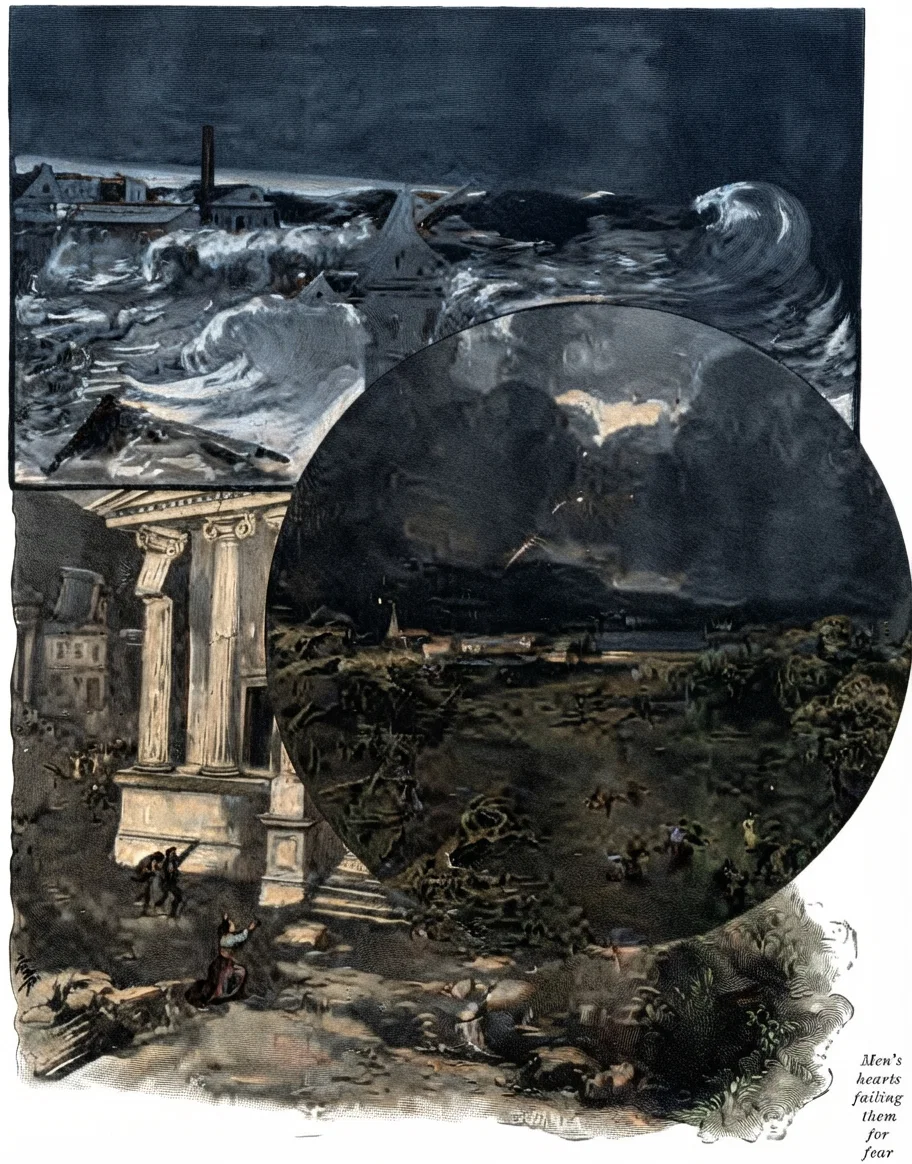
Men's hearts failing them for fear
The much-praised genius that has established the great factories has drawn men from the farm to fill up villages and colossal cities. These men can not at all times find work in the shops, and so this factory age has given us the great army of vagrants that we commonly call "tramps." And the same conditions have also augmented in our great cities that other twin evil that we call the "slum problem."
The distressed conditions of labor Intelligent and true-hearted men are seeking to relieve the distressed conditions of labor, and whether it is wise and right or not, yet they nevertheless order strikes. At the times of these strikes the "tramps" from all over the country flock to the centers of disturbance, and the "slums" turn out their vast hordes of half-starved and desperate wrecks of humanity. These irresponsible persons are only too willing for any violent deed, and stand ready for riotous action whenever the opportunity is offered.
The chemist's laboratory has discovered one agent after another that have been combined into most powerful explosives. These things are very useful in the development of the mine and in other industrial fields; but they only serve to give another illustration of how discoveries that might be helpful to man are used to serve as agents in his destruction; for not only is the high explosive made to do terrible execution in killing men in war, but violent and bloodthirsty anarchy has allied itself to the bomb, and in the scenes of strife that lie just before us, not only whole houses, but whole blocks, and even whole cities, may be speedily wrecked. The possibilities, yea, even the probabilities, in this direction strike men with terror.
The dangerous conditions of these times are seen by all serious observers. Men are free to affirm that the world is threatened with social and political calamities with which all the darkest records of all past time do not furnish a parallel.
Speaking of military matters, Lord Salisbury, England's prime minister, says: "The burden has become so serious to many nations that many have thought that the day will come when nations will rather rush into war and provoke a decision once for all than to continue to groan under the suffering which modern necessity forces upon them."
Again Mr. Salisbury says: "But what has been pressed upon us is that the subject matter of war is terribly prevalent on all sides. . . . Still more serious is the consideration which recent events have forced upon us that these wars come upon us absolutely unannounced and with terrible rapidity. The war cloud rises in the horizon with a rapidity that obviates all calculation, and, it may be, a month or two months after the first warning you receive you find you are engaged in or in prospect of a war on which your very existence is staked."
A little more than a year ago, Gen. Nelson A. Miles said: "I have seen all the great armies of Europe except the Spanish army. What I have seen does not indicate that the millennium is at hand, when swords shall be beaten into plowshares."
The late Bishop Newman's version of the situation is that "this is the most unsettled condition of the world since the crucifixion of Christ. The stability of government is no longer a fact. Change is in the atmosphere. It is just as true now as a thousand years ago, 'Thou knowest not what a day will bring forth.' . . . Statesmen are at their wits' end. Philosophers speculate in vain."
Archbishop Ireland says: "The bonds of society are relaxed; traditional principles are losing their sacredness, and perils hitherto unknown are menacing the life of the social organism."
Leo XIII., in his encyclical on the condition of labor, says: "The momentous seriousness of the present state of things just now fills every mind with painful apprehensions; wise men discuss it; practical men propose schemes; popular meetings, legislatures, and sovereign princes, all are occupied with it; and there is nothing which has a deeper hold on public attention."
Mr. Benjamin Kidd, in his book "Social Evolution," writes: "The problems which loom across the threshold of the new century surpass in magnitude any that civilization has hitherto had to encounter."22Prof. E. Benjamin Andrews, formerly president of Brown University, and now superintendent of the public schools of Chicago, remarks: "No well-informed person in Europe seems to believe that peace is destined to endure there very long. On all hands people are preparing for war. Armies and navies are strengthened; fortifications multiplied; immense war treasures of gold piled up; all possible hypothetical plans of campaign, offensive and defensive studied and discussed; firearms, great and small, ceaselessly experimented upon and improved; civil measures subordinate to military, and statesmen to great army men and navy men."
On all hands people are preparing for war Signor Crispi, Italy's greatest statesman, says: "Europe resembles Spain from a certain point of view. Anarchy is dominant everywhere. To speak frankly, there is no Europe. The European Concert is only a sinister joke. Nothing can be expected from the Concert of the Powers. WE ARE MARCHING TOWARD THE UNKNOWN. Who knows what to-morrow has in store for us?"
A quotation from Jesus of Nazareth is a fitting conclusion to these present-day sayings of men: "And there shall be signs in the sun, and in the moon, and in the stars; and upon the earth distress of nations, with perplexity; the sea and the waves roaring; men's hearts failing them for fear, and for looking after those things which are coming on the earth; for the powers of heaven shall be shaken. And then shall they see the Son of man coming in a cloud with power and great glory." Luke 21:25-27.
If we are not standing in the very midst of the fulfilments of this great prophecy, given by the Christ of God, then, pray tell, where are we?