Your ShelfYour Projects

Review and Herald, Vol. 90, No. 10.

Untrue to Self

Review and Herald

Mar 6, 1913

Review and Herald Publishing Association · Takoma Park Station, Washington, D. C. · Mar 6, 1913

Untrue to Self

CANON FARRAR
MOST of these our sufferings are self-inflicted. We are cruel to ourselves. We feather the arrows of our enemies, and make the wounds rankle, which otherwise they were powerless to inflict. We anticipate misfortunes which never come. We brood over injuries at which it would have been far wiser to smile. We neglect or despise the joys which God otherwise would freely give us. We will not know the things which make for our peace, and in things which we know naturally, like brute beasts made to be taken and destroyed, in these we corrupt ourselves. Ah, how true, how true it is that heaven seems to be “everywhere if we would but enter it, and yet almost nowhere, because so few of us can.” Alas, my brethren, all this might be otherwise, but, as we ruin our bodies by excess and ignorance, so we ruin our minds by greed and care.— Selected.

“Tea and Coffee” and “Deep Breathing” Number

Life & Health THE NATIONAL HEALTH MAGAZINE WASHINGTON, D. C.
NATURAL BRIDGE, VIRGINIA
PRICES, POST-PAID Yearly subscription - - - - - $1.00 Six months - - - - - .50 (Subscriptions for less than six months not accepted) Three years (or 3 subs. 1 year) - - - 2.00 Five years (or 5 subs. 1 year) - - - 3.00 Five copies, one year, to one or more addresses 3.00 NO EXTRA CHARGE ON FOREIGN SUBSCRIPTIONS

“Tea and Coffee” and “Deep Breathing” Number

$1.00 a Year 10 Cents a Copy

MARCH FEATURES

What to Do First Consumption a Curable Disease The Hygiene of Deep Breathing How to Feed the Sick Prostituted Periodicals Education and Health Saloon Versus Safe Travel How to Make Good Soups
Chronic Rheumatism Your Children’s Teeth Archery for Health The Farm Baby: Remedies— Contagious Diseases Are Tea and Coffee Harmful? Help the Man Lower Down Chronic Appendicitis
Try selling this “Tea and Coffee” and “Deep Breathing” number in your neighborhood. Our agents make from $2.00 to 5.00 a day.
Earn your own subscription by sending us two yearly subscriptions at $1.00 each.

ORDER THROUGH OUR NEAREST AGENCY

(If you do not know the address of our Agency, ask “Life and Health,” Washington, D. C.)
NATURAL BRIDGE, VIRGINIA

“THE END JUSTIFIES THE MEANS”

Rome’s Policy Proved By Court Records!
In the March, April, May, and succeeding numbers will appear the startling court record concerning “A Convent Tragedy,” also other records of Rome’s policy of KIDNAPING CHILDREN, from the times of the Waldenses (1100 A. D.), before the word “Protestant” was known, until now.

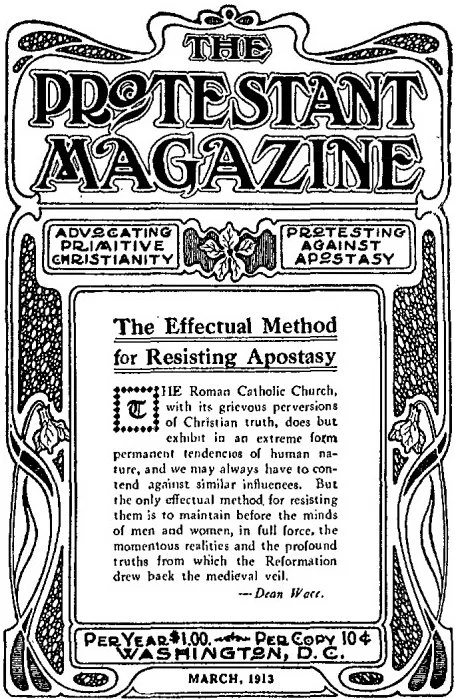
WHERE ARE THE PROTESTANTS?

Where are the Protestants in America? The very name “Protestant” itself was repudiated by the so-called “Protestant” Federal Council of Churches in Chicago, Ill., Dec. 5, 1912, on the plea that it is “a word that is NOT A UNITING BUT A DIVIDING WORD,—a word that recalls a most unhappy and trying experience.” One of the delegates argued thus: “By using this word you make it more difficult for many of your Christian brethren to work with you.” This action was taken to express the “earnest hope” for the “FELLOWSHIP OF CATHOLIC UNITY.” “Then,” says an eye-witness, “the report was promptly and unanimously adopted, and with applause.”

Show Your Protestantism By

Sending the PROTESTANT MAGAZINE to Your Friends

BE A SUBSCRIBER. You can earn your own subscription by sending us two yearly subscriptions accompanied by $2.00—three for $2.00.
TO TEN FRIENDS. You can send $3.00 for 10 six months’ (or 5 yearly) subscriptions, in behalf of your friends. These will be sent to as many different names (your own included) as desired, or all to one address. Hundreds send 5, 10, and 20 subscriptions, others as many as 300, in a single letter.
BE OUR AGENT. You can become our agent for your locality, and purchase from 5 to 1,000 copies every month at the wholesale rates: 5 to 40 copies ordered at one time, cash with order, 5 cents a copy; 50 or more copies, 4 cents a copy.
Only a very few more subscriptions can be started with the January number.

ORDER THROUGH OUR NEAREST AGENCY

(If you do not know the address of our Agency, ask the “Protestant Magazine,” Washington, D. C.)

A. G. DANIELLS

Does the History of Turkey and Egypt Since 1798 Fulfil the Prophecy of Dan. 11:40-44? — No. 7

A. G. DANIELLS

It may be helpful at this point to take a fresh look at the text upon which these studies are based.
“And at the time of the end shall the king of the south push at him: and the king of the north shall come against him like a whirlwind, with chariots, and with horsemen, and with many ships; and he shall enter into the countries, and shall overflow and pass over.” Dan. 11:40.
The distinct points in this statement are these:—
1. “At the time of the end.” This particular period of time began in the year 1798 A. D., at the expiration of the twelve hundred sixty years allotted to the supremacy of the Papacy. In that year the papal church received a deadly wound dealt by the hand of France, which broke for a time and to a degree its supremacy over the consciences and liberties of men.
2. “Shall the king of the south push at him.” This king of the south is the one whose origin and history are so fully and clearly foretold in Dan. 11:5-15. This kingdom was founded by Ptolemy, in B. C. 301. It became a Roman province in B. C. 30, passed into the hands of the Arabs in 639 A. D., was conquered by the Fatimite Arabs in 969, became the empire of the Mamelukes in 1171, was conquered by the Ottoman Turks in 1517, but gradually passed back under the control of the Mamelukes, who were the “real lords and tyrants over the country” at the time of the end—1798 A. D.
3. “And the king of the north shall come against him.” The king of the north is inseparably connected in the prophecy with the king of the south. It is the kingdom founded by Seleucus, in B. C. 281, which extended from the Bosporus and Dardanelles to Persia, beyond the Euphrates and Tigris. It was conquered by Rome in B. C. 65, and gradually passed into the hands of the Turks, who began their invasion of eastern Rome in 637 A. D. In 1453 they took Constantinople, and completed the destruction of the Eastern Empire of Rome. Thus, Turkey became the king of the north of Daniel’s prophecy, and has held that place, without interruption, to the present time.
If the interpretation of these predictions as here given is correct, it is plain that in 1798 there was to begin a sharp conflict between Egypt and Turkey and a power designated by the pronoun “him.” The fact that just such a conflict as this prophecy foretells was begun in the year 1798, between Egypt and Turkey and France, leads us to believe and confidently to affirm that France is the power referred to by the pronoun “him” in verse 40.
This position is sustained by the undeniable facts of history which meet the specifications of this prophecy. In this we follow the course we pursue in the interpretation of the other parts of this prophecy. The subject of verses 5-15 are the kingdoms of the north and the south. Verse 15 tells of the “king of the north” being at war with the armies of the south, and verse 16 says: “But he that cometh against him shall do according to his own will.” Who is the antecedent of the pronoun “he” in verse 16? Is it the king of the north or the king of the south? These are the two powers specified in the preceding verse.
From the use of the pronoun “he” in this verse, one would naturally suppose that it points to the king of the north of verse 15. But it does not. It refers to Rome, a power not mentioned in verse 15. Here a world power slips into the prophecy by a little pronoun with no antecedent expressed in the preceding verse.
Our ground for the claim that Rome is the antecedent of the pronoun “he” in verse 16, is because it is Rome that meets the specifications of that verse and of those that follow to the point where another power is introduced. In this we take into account more than the construction of the language. We give due regard to all the specifications mentioned, to the history of the times, and to other prophecies relating to Rome and the period of time covered by its history.
Another instance similar to this occurs in verse 31, where a transition is made from the Roman Empire to the Papacy, without any indication whatever in the language. The pronouns “his” and “they” in verse 31 seem to refer to Rome, the subject of the preceding verse, but they do not. They point to the Papacy, a power not once mentioned before in this prophecy. This we know by the specifications that follow, and by other prophecies of the Papacy, and by its history. Thus an entire change is made, and a wholly new power is introduced by a pronoun, the same as in verse 16, where, without a word of warning, a change is made by a pronoun from the kings of Syria and Egypt to Rome. So in verse 31, the papal church takes the place of the Roman Empire without any change in the language to indicate it. In reaching conclusions as to the meaning of these passages, we are guided more by the specifications and the history that fulfils them than by the nouns and pronouns.
The prophecy points to a definite, specific time, and declares that “at thetime” which it designates there will be conflict between powers that we know to be Egypt and Turkey with another power. The time referred to came in 1798, and the conflict came also. In that very year France began the conquest of Egypt and Turkey. Egypt resisted,—pushed at him,—but was conquered. Turkey’s fate, however, was different. Turkey triumphed over the armies of France, and overflowed and passed over just as the prophecy said would be done. The full history of the invasions, the resistances, the victories, and the defeats of that war which began in 1798, meets every specification of the prophecy, and this is the only history of nations that answers to these predictions. If those events did not fulfil the prophecy, it is still unfulfilled, and we are thrown into great uncertainty and confusion regarding the meaning of the closing part of this great line of prophecy. We shall now trace the history of Egypt and Turkey which fulfils the last part of this prophecy.

A Constant Spirit

WORTHIE HARRIS HOLDEN
No swiftly rising waves wind driven to beat Assault upon the strand ere they retreat, No lurid flash which by its vivid light Reveals the veiled specters of the night, But constant and abiding evermore His legacy of peace from heaven’s store, And e’er increasing light of dawn to bless,— The rising of the Sun of Righteousness.
So, heaven-wrought, our souls in hallowed life Are kept unsullied through our earthly strife, And Israel are children of the light Though Egypt gloom enshrouds, and it is night; Fore’er within the spring of life o’erflows,— A stream of joy to bless where’er it goes,— And love abides forevermore to stay To crown our bliss supreme through endless day.

Presiding in the Church

The Holy Spirit — No. 8

Presiding in the Church

G. B. THOMPSON
The article last week was given to a consideration of the advent of the Holy Spirit at Pentecost, in fulfilment of prophecy and the promise of Jesus to his disciples. It was seen how the Holy Spirit, from Pentecost till the end of the church's warfare against sin, has taken up his abode with the church on earth. The Spirit has his home and office in the church. The church is a “holy temple in the Lord: in whom ye also are builded together for an habitation of God through the Spirit.” The Spirit tabernacles in the church, and God tabernacles there also, through the Spirit. The only temple the Lord has on earth, during the present dispensation, is his church. And while Christ is ministering in the “true tabernacle” in heaven, the Spirit, his own representative, is ministering in the temple on earth, the church.
“If a man love me, he will keep my words: and my Father will love him, and we will come unto him, and make our abode with him.” John 14:23. It is through the Spirit that Jesus abides with his people, for, speaking of the Spirit, the Saviour said, “He dwelleth with you, and shall be in you.” John 14:17. The Spirit not only dwells with us, but is in us as well. Blessed mystery!
Through this Spirit, who comes not to speak of himself, but to exalt and glorify Christ, we have access unto God, and he will take of the things of God and show them unto us. He sits, not as a critic, but as a helper, enabling us to overcome sin and proclaim the gospel “with the Holy Ghost sent down from heaven.”
Our need is not so much the sending from heaven in some mysterious way some new power in answer to prayer, as it is the recognition of a power already here. We need consecration and the forsaking of sin, the yielding to the Spirit, that we may be used to do God’s work.
Having found that the Spirit has a place in the church, not simply as an influence, as light radiates from the sun, but as a real presence, it will be interesting to notice briefly a few instances recorded in the book of Acts which clearly indicate his presiding presence in the early church.
After Pentecost Ananias and his wife Sapphira, members of the church at Jerusalem, having sold a possession, conspired together to withhold “part of the price.” When Ananias came to make his gift, Peter said to him, “Why hath Satan filled thine heart to lie to the Holy Ghost, and to keep back part of the price of the land?” Acts 5:3. And a little later when Sapphira came in, Peter said to her, “How is it that ye have agreed together to tempt the Spirit of the Lord?” Verse 9. The lie was “to the Holy Ghost.” Back of the visible church to whom the vow was made, there was One presiding over the church as Christ’s representative, who by an awful act of judgment made known his presence in their midst. And this lesson is for the church for all time, and should not be forgotten. Once for all God has made “an example of an offender in some of the prominent forms of sin; such as, of Cain in murder, of Lot’s wife in loitering, of Achan in coveting, of Korah in presumption, of Uzziah in profanation, of Saul in disobedience.” This instance stands as an awful warning against the sin of breaking vows, and thus lying to the Holy Ghost. The Holy Spirit is in the true church now as truly as at Pentecost.
In the sixth chapter of Acts we have an account of the choosing of certain officers—deacons—in the church. Notice the qualification of these officers. “Wherefore, brethren, look ye out among you seven men of honest report, full of the Holy Ghost and wisdom, whom we may appoint over this business.” The Spirit of God was recognized. It was not fluent talkers, shrewd business men, secular brethren who would deal in a cold, legal manner, that were to be selected, but spiritual men, men filled with the Holy Ghost.
Here also is another lesson for the church to-day. If there was ever a time when the church needed spiritual leaders, it is now. And in selecting church officers the consideration should not be how long they have been in office, just how they will feel if not continued in the responsible position, but, Are they spiritual leaders? Will they feed the church? Has the Holy Spirit set his seal of approval upon them?
“A unique lesson on church life, indeed! Let us lay stress on it, by repetition. Secular men—men of worldly type of character and a secular spirit—have no place in the church of Christ; above all, no official place, though it be only in administering ‘secular’ affairs, and though they be men both of honest report and of wisdom. The natural man, even when that term is used of the princes of this world, can not receive the things of the Spirit, because they are spiritually discerned; and therefore, so far as we put into office or allow to occupy official positions in the church, men who have not the Spirit of God, who are chosen without reference to spiritual qualifications, we at least consent to an administration which is unspiritual in character, which is an offense to the Spirit, a virtual disputing of his headship, and, we hesitate not to add, in so far an actual unseating of the Spirit from his throne of control!”
“If this appears to any to be an extreme position, let such consider what, in other spheres of business, is the common course pursued when it is desired to rid a corporate body of its controlling or presiding head. We shall suppose a corporation to have a man as president whom for some reason it is deemed desirable quietly to oust, or displace. Gradually, in the subordinate offices and board of trustees or directors, men are placed who are opposed to the presiding officer in method and spirit. They quietly antagonize his measures, obstruct his plans, thwart his policy. Instead of co-operation and support, he meets inertia and indifference, if not violent opposition; until at last, unable to conduct affairs, he resigns from sheer inability to carry out what he regards as a true policy of administration.”—“Acts of the Holy Spirit,” pages 62, 63.
Again, in what has been called “The birth hour of early missions to the Gentiles” we read, “As they ministered to the Lord, and fasted, the Holy Ghost said, Separate me Barnabas and Saul for the work whereunto I have called them. . . . So they, being sent forth by the Holy Ghost, departed unto Seleucia: and from thence they sailed to Cyprus.” Acts 13:2-4.
“I have called them.” The pronouns I and me refer to the Holy Spirit. The Spirit speaks here in the first person. He speaks, calls by name, and sends forth chosen missionaries. The personality and activity of the Spirit of God in the direction of the church could hardly be any more clearly shown than here. We should not overlook the obvious lesson that this teaches. The Holy Spirit is present in the church to-day, the same as in apostolic times, and should be recognized. Those to-day who go forth in the work of saving souls, should be “sent forth by the Holy Ghost.” God, of course, desires at all times to work through his organized body on earth. This calls for great consecration of life in those entrusted with official responsibility in the church of God.
At the council at Jerusalem, where matters which greatly disturbed the church were studied and after careful consideration decisions reached, in narrating the conclusions of the council the record says, “It seemed good to the Holy Ghost, and to us.” Acts 15:28. Here the Holy Spirit is first. He is recognized, and treated as a fellow counselor whose presence had been with them in their deliberations. On the lesson here taught Dr. A. T. Pierson says:—
“Here is a lesson for all ages on the true character of church councils. What we call a ‘court of Jesus Christ’ has too often been more like an assembly of unbelievers, if not like a ‘synagogue of Satan.’ When in church meetings for business,—even business so sacred as the election of a pastor,—and when in those higher courts where the wider interests of the churches are adjusted, we find subtlety and diplomacy, worldly policy and temporizing expediency, even downright deception and dishonesty, practised; when we find a party spirit existing, and warring factions, hot with controversy, waging ecclesiastical warfare, and politicians pulling wires and pursuing personal and selfish schemes; when we hear little prayer or praise, and much noise and confusion and clamor of excited if not angry debate, and occasionally witness scenes of uproar that would disgrace a political caucus,—we have been compelled to stop and ask, Is this a court of Christ? Is the Holy Ghost here? Is this the see of a divine Archbishop, or is it the ‘seat of Satan’?”—“Acts of the Holy Spirit,” page 109.
We have perhaps never witnessed just such scenes in the church as are here described. We devoutly hope not. But wherever “pulling wires,” “debate” or “caucus” may have appeared among us, whether in different form or lesser degree, the principle remains the same. The Holy Spirit is greatly grieved.
When Paul and his companions in labor were seeking to know the place where they should labor for God, they were “forbidden of the Holy Ghost to preach the word in Asia,” and when they “assayed to go into Bithynia,” “the Spirit suffered them not.” But while restrained from certain fields, they were directed to Macedonia. In some marked way the Spirit of God was present, directing his chosen laborers. And though they were soon imprisoned at Philippi, yet the Lord glorified his name, and before the morning dawn they were encouraged by having a company of baptized believers.
To-day, as truly as in Paul’s time, the Spirit of God is present to help and strengthen his church. It “awaits our demand and reception.” Speaking concerning the great conflict through which his laborers must pass, the following most encouraging words have been written:—
“They [his laborers] are to contend with supernatural forces, but they are assured of supernatural help. All the intelligences of heaven are in this army. And more than angels are in the ranks. The Holy Spirit, the representative of the Captain of the Lord’s host, comes down to direct the battle. Our infirmities may be many, our sins and mistakes grievous; but the grace of God is for all who seek it with contrition. The power of Omnipotence is enlisted in behalf of those who trust in God.”—“Desire of Ages,” page 352.
“More than angels” in the ranks! The Holy Spirit, who is here called the “representative of the Captain of the Lord’s host,” is present, directing the battle, and commanding all the “intelligences of heaven.” The Spirit, by means of these heavenly intelligences, is everywhere present. With such a mighty leader in our midst as the direct representative of Heaven, with “ten thousand times ten thousand, and thousands of thousands” of mighty angels, cherubim, and seraphim at his command, truly the powers of hell shall not prevail against the church.
O that we might recognize the presence of the Holy Spirit in a fuller sense than ever before, and allow him to preside in our lives, to be the presiding officer in the General Conference, every union conference, every local conference, every church, and every individual heart.

Have Changed Their Minds

C. A. HANSEN
It is an astonishing fact that the Protestant churches, which have contended with one another so earnestly for many years in order to maintain their peculiar views, have now suddenly and without any apparent reason changed their minds, turned about, and to a large degree cast away their differences in order to unite; and not only so, but have also paved the way for union with the Roman Church. Such a movement could not have been foreseen by the most optimistic of men, and yet it was definitely foretold by the seer of Patmos nearly twenty centuries ago. This is a further illustration of the fact that when God has spoken, there is nothing to do but to get ready for the fulfilment.
Simultaneous with this peculiar development the federation of churches purposes to unite religion and the state by the passing of religious laws, which fulfils that prophecy relating to the making of “an image to the beast.” Rev. 13: 14. That word beast designates that principle, or power, which stood for the union of church and state in the days of Rome, and which resulted in the establishment of the Roman Catholic Church. One of the points on which that union was effected was the making and enforcing of Sunday laws, and we hear that one of the strong hopes of the newly formed federation is the securing of a strict Sunday law. We then begin to discern in this movement the rise of the “image.”
A new doctrine has come with all this, that “it makes no difference what a man believes.” How strange that sounds to a Bible student or to a reader of church history! Jesus Christ himself could not have belonged to that organization, for he said, “In vain do they worship me, teaching for doctrines the commandments of men.” Martin Luther could never have started a reformation, nor could any new sect ever have arisen.

Satan’s Aim in This

Now the main aim of the great deceiver in spreading this soul-destroying theory is to make it unpopular to preach the present truth. Even now in many communities when the servant of God preaches the message that God bids him speak, we hear this cry: “We don’t believe in running on other churches.” But God himself makes the declaration that “Babylon is fallen.” It can not be wrong, then, for the servant of God to warn Babylon of its fallen condition and the necessity of repentance. And Jesus did not err when he told the Pharisees their true condition, that, knowing it, they might turn from their course and be saved. The world was then and is now full of churchianity without Christianity—the shadow without the substance.

And John Wondered

When John saw the workings of the beast, he wondered with great admiration (Rev. 17: 6, 7), and indeed we all wonder at the strange way that all these things are brought about; but we know with all assurance that in a short time the prophecy concerning the beast and his image will be fulfilled, and we shall see that power manifesting its character and carrying on its work as only God could have described it, “with all deceivableness of unrighteousness.”
Now is the time for the honest in heart to come out of Babylon, to believe and practise and teach the commandments of God and the faith of Jesus. While it will mean trial and tribulation, it will mean everlasting triumph when the saints possess the kingdom.
Nashville, Tenn.

J. L. SHULER

Faithfulness

J. L. SHULER

It is a duty God requires of us. 1 Peter 4:10; 1 Cor. 4:2.
It is a characteristic of the saints of God. Rev. 17:14.
A lesson Christ has taught us by his life. Heb. 3:2.

Faithfulness in What?

1. In the Lord. 1 Cor. 4:17.
2. In our dealings. 2 Kings 22:7; Dan. 6:4.
3. In our doings. 2 Chron. 19:9.
4. In the payment of tithes and offerings. 2 Chron. 31:12; Luke 16:11, 12.
5. In our work. 2 Chron. 34:12.
6. In speaking the word. Jer. 23:28.
7. In all our duty. Matt. 24:45, 46.

Promises to the Faithful

1. They shall abound with blessings. Prov. 28:20.
2. The Lord will preserve them. Ps. 31:23.
3. They will have a crown of life. Rev. 2:10.
4. The Lord will judge us according to our faithfulness. 1 Sam. 26:23.
5. We should be faithful in little things. Luke 16:10.
Fidelity depends not on the amount entrusted, but on the sense of responsibility. He that feels this in little will feel it also in much. Faithfulness in little things counts with the Lord. It costs something to be faithful. May we hear the well done. Matt. 25:23.
Martinsville, Ill.

The Connecting Link

MANY times in the history of this movement have we rendered, and most justly, praise to God for the advancement that has been made. Year by year we take note of the gain in membership, of the increase in church funds, of the enlarged sale of our denominational literature, of the new mission fields that have been entered, and of scores of other points which indicate the progress that has been made during the last twelve months. We are thankful for the many agencies that have been brought into being in the promotion of this cause; for our publishing houses, schools, and sanitariums.
But while we consider with gratitude all that has been accomplished, we stand almost speechless as we contemplate the work that remains to be done. We have sent missionaries to many lands, but we have touched, as it were, only the outer fringes of vast territories. We have made but a beginning among the many millions of unwarned. How shall we fulfil the commission entrusted to us? How shall we carry to all nations, peoples, tongues, and kings the message for this last day, of which the Lord has made us the bearers? We can never accomplish this work through material agencies. The message can never be given alone through the influence of our publishing houses, schools, and sanitariums, nor even by men and means.
We have accomplished much in the past for the reason that we have taken hold in some small degree upon the arm of the Lord. We have accomplished so little, comparatively, for the reason that we have trusted so largely to our own resources, and have by this means obstructed so greatly the working of divine power. If the work committed to us shall be accomplished, this order must be reversed. There must come in between us and God a connecting link. We must take hold of the resources of heaven, the strength of Omnipotence, in order to accomplish in God's way and in God's time the work that he has given us to do.
In the world's business everything is brought down to the computation of dollars and cents, and is viewed from a cold, commercial basis. There is danger that we shall view the work of God in this manner; that in the enumeration of facts and the contemplation of figures, we shall seek to measure our strength, to number Israel, as did David of old, and not recognize that a higher, divine power must spiritualize our energies if we shall accomplish successfully the work committed to us.
The principle of the old covenant was doing by works. It is necessary for us to work, to show our faith by our works; to labor and toil and sacrifice, and die, if need be, for the cross of Christ; but O, let this be but the result of a living, transforming, inspiring faith that shall fill our hearts and souls and become the actuating motive of all our efforts! As righteousness is obtained by faith, so this work must be accomplished by faith. Prayer and faith must be the links that connect us with the power from on high. This all-prevailing prayer, this simple, childlike faith, we need to-day. Before these, mountains will fall, the barriers will be removed, the darkness will be dissipated, and life and light and energy will flow through the material agencies of God's work, causing them to throb and pulsate with mighty power.
In Ezekiel's vision of God's throne he saw many wheels, wheels within wheels, a beautiful and glorious mechanism. But that which made the wheels powerful in the accomplishment of God's mighty purpose was the spirit that was within them. The need of the church of God to-day is more of this spirit. A spiritual dearth has entered into the lives of some of our church-members. Leanness of soul, lives without fruit bearing, are apparent in every company of believers. There is needed to-day in our ranks the divine touch. This is needed above men, above silver and gold, above institutions, above conference organizations. And when the Holy Spirit fills the hearts of God's people, the gold and the silver will not be withheld. Offers for hard and enduring service will not be lacking. The treasury of the church will be filled to overflowing. Thousands will respond, "Here am I, Lord; send me." This spirit of consecration must precede the day of power. For this consecration let us plead. Let us humble ourselves under the mighty hand of God, knowing that in his own time and in his own way he will exalt us and manifest before us the power of his saving truth.
F. M. W.
Continue reading: God's Word Their Target