The first issue of our new Yiddish magazine is lately from the press. It is intended for circulation among the Jews of this country. Many Jews are delighted to find that there are some Christians who honor the Bible Sabbath and worship the God of Abraham, and are made ashamed at the thought of how many of themselves have ceased doing these things.
BEATEN FOR HIS FAITH
Some Roumanians who accepted the advent message in Ohio have had to face severe opposition. One was badly beaten by a relative, and windows of another's house were broken by former friends. Still another was threatened with shooting.
ONE THOUSAND TWO HUNDRED NINETY-FOUR BAPTIZED
During the summer, reports have come of 1,294 new baptisms and new Sabbath keepers in the United States, distributed among thirty-seven of the states. Michigan has the largest number, reporting two hundred four; and California the next largest, one hundred forty-four. The largest number of baptisms in any one place and at about the same time was in North Dakota, during the camp meeting at Jamestown, where seventy-five, mostly young persons, went forward in this rite. The next largest report is from near Cedar Lake, Michigan, where over sixty took their stand for the truth of God. A camp meeting in western Oregon was the occasion of forty-eight baptisms; another in South Dakota, of thirty-three. Twenty-eight new members were baptized in St. Charles, Michigan, May 29. An effort among colored people in Grove, Kentucky, resulted in the winning of twenty-three.
ACCESSIONS IN CANADA
In Canada, meanwhile, one hundred thirty-nine accessions were reported. In Saskatchewan alone, over sixty came in during the first quarter of 1915, as the result of ministerial labor.
Most of these new believers are English-speaking whites. Some of the native French are included, however, as well as over one hundred colored people, and numerous immigrants. Of the latter, there were some twenty Germans, four Russians, four Roumanians, two Galicians, three Italians, and an unspecified number of Scandinavians, Portuguese, etc.
DEVOTION AND SUCCESS IN MAURITIUS
The message for the last days was first brought to the French-speaking island of Mauritius, in the Indian Ocean, through the efforts of a believing sailor, employed on a ship voyaging between there and Australia. After a time, three sisters went there from Switzerland; and later, at their request, Pastor Badaut was sent out. Under his ministry, a small church was organized, which has since been growing.
Early in the year, eight baptisms of adults were reported. One of these converts came in through his zeal to convert Pastor Badaut. A first attempt, in company with friends, to confound the pastor in street-corner debate, met with defeat; and a second attack, well munitioned with arguments from the priest, also failed to overthrow the defense founded on the Scriptures. After that, he adopted the attitude of a learner, and is now in the church.
Another recent convert of this island, though blind, so desired to help give the truth to his neighbors, that he committed to memory the contents of a little book of Bible readings, and has developed the power of remembering almost perfectly the discourses that he hears in meetings.
THE UNSEEN COMPANION
Last fall, J. J. Hokland, a young Norwegian missionary to the Laplanders, had a remarkable experience. In a journey in Lapland, he had to pass over a mountain trail that was very dangerous. In order to be safer, he went barefoot, and further committed himself to God in prayer.
He reached the valley in safety, and there met a couple who had been journeying on the opposite side, in view of him. Their first question was, “Where did your companion go?” They could scarce believe his assertion that he had been alone, as they thought they saw another with him. It recalled to his mind, he said, the verse, “The angel of the Lord encampeth round about them that fear Him.”
LEPERS TURNING TO GOD
In British Guiana, not very long ago, a young man who had previously heard the gospel through an Adventist missionary, contracted leprosy, and was sent to the leper colony on the island of Mahaica. Here he turned to meditate on the message he had heard before, but had rejected at the time. He not only accepted it to his own salvation, but preached it to his fellow sufferers, so that before long, thirteen of their number put on Christ in baptism.
Little Things Done for God
By F. W. Faber
Love’s secret is to be always doing things for God, and not to mind because they are such little ones.— F. W. Faber.
Why Not Divine Telephony?
By M. C. W.
May We Not Talk with God?
RECENTLY, at the great Panama Exposition, I sat down in the comfortable little auditorium of the American Telegraph and Telephone Company, and listened to the talk and viewed the moving pictures on the progress of electric communication from its feeble starting on the Atlantic coast till the wonderful mechanism of the telegraph and the telephone had, with pole and wire, topped the mountains, spanned the desert, and, with pencils of light, illuminated the whole country.
In life-size and wonderfully lifelike moving pictures, Mr. Thomas Watson stood before the audience, and told, in clear enunciation, illustrating by various objects, of the early struggles of Alexander Graham Bell, and his association with Mr. Bell in the development of the telephone. He told of repeated failures, and of Mr. Bell's faith that yet it would succeed.
The first long talking was over a distance of two miles. Then the instrument was perfected so that six miles became the limit; then forty-five, if I remember correctly; then from Boston to New York; a little later, from New York to Chicago; and when they could talk from New York to Denver, it was thought that the climax was reached. Not so, however. The sensitiveness and perfection of the telephone was still further developed, and now men are talking with one another from New York to San Francisco, over three thousand four hundred miles of wire.
I, with a hundred others, more or less, heard a man in New York talking. He told us the state of the weather. He gave us the latest news from the seat of war, also local news of the East. We saw and heard the waves breaking on the Atlantic beach, and the surf of the eastern sea surging over the sands.
Two men, one before us on the platform, and the other in New York, carried on a conversation, social, commercial, and otherwise, and we heard them both. We heard a New York band play, and then a man in New York sang that sweet old Southern song, “My Old Kentucky Home.” It did not sound as though he were singing 3,400 miles away, but over in Oakland, as it were.
It is a modern miracle. It would seem almost like wizardry unless we knew of its development. It surpasses the imagination of the “Arabian Nights”; and if it had been sprung upon the world a hundred years ago—a world that did not know the various steps in the development—its marvel would be increased a hundredfold.
Yet man invented this. Man executed it—man so feeble, so insufficient in many ways, and still the offspring of God. Men believe in these wonders. They are tangible enough for human minds to grasp—at least sufficiently to believe the rest. Strange that these men cannot believe that God can speak! You could see that there were doubters in the audience at the exposition. Every now and then, some one would remove the telephone from his ears while the surf was surging on the beach, to see if he could hear it without—whether it were not some sound, after all, close by. But the surge of the surf ceased to be heard as soon as the telephones were removed from the ears. The doubt was dissipated.
There are many who doubt God, and the sad fact is that they doubt God more than they doubt man. The majority of those who listened to the wonderful workings of the telephone, did not understand them. Even the men who have dealt with electricity the longest, say that it is still a mystery; yet it can do things, or men can do things with it. Why doubt God, who is infinite where man is finite? God can speak to His children, and He does. God knows, and knew long before men knew anything about it, the art of telegraphy and telephony and—to coin a new word—telepathy. That is, He can write afar off, and He can speak afar off, and He can make men who are in harmony with the laws of His operations, see afar off.
Men worked a long time to get electricity to speak so it could be understood. It took years to devise instruments that would transmit and receive the sound. God had all this in His mind when He made men to hear and to see. The ear and the eye are of His creation; but there must be harmony with God in order that we may hear and in order that we may see, and there must be willingness to hear. The soul must stand as did Samuel of old, saying, “Speak, Lord; for Thy servant heareth.” He must be willing to do as Ezekiel did when God called him up into the mount to see “visions of God”; for God has messages to His people, and has spoken them through His chosen servants at various times in the past. Read in His book of where “the word of the Lord came to Isaiah,” and “the word of the Lord came to Jeremiah,” and “the word of the Lord came to Ezekiel,” and “the word of the Lord came to” others, and they heard God’s word, and took the word that God gave them.
Visions?—Yes, He gave them visions; gave Daniel visions of all the centuries following him until the history of this earth in its present sinful condition should be completed; gave Ezekiel visions; gave Isaiah visions; gave John, the beloved disciple, visions, which he recorded for us, in the last book651of the Bible. Yet God wants us now to listen to His voice, and to see this world—its history of the past and its future—in the light of the visions that He gives. He wants to speak to our heart. One of His messages is: “Comfort ye, comfort ye My people, saith your God. Speak ye comfortably.” The literal Hebrew is indicated in the margin, “Speak ye to the heart.” God comforts by speaking to the heart.
God has foretold us all these various things that are occurring in the world at the present time, which have a molding power upon men and nations; told them through His chosen servants. He spoke to them by divine telephony. He made them see visions of God, seeings of God, seeing the things as God saw them. He writes upon men’s hearts and in men’s minds the great law of His government—the mighty principles that will mold character. This is divine telegraphy. Why not believe it?
We believe in human telephony. Why not believe in divine telephony? We believe in human telegraphy. Why not believe in divine telegraphy? God wants us in this uncertain age to come into that relationship with Him where He can speak to us, talk to us, lead us. And He is no respecter of persons. All that He asks is that we shall know the harmony of the divine. He will do the rest. And through all these various channels, as we communicate with Him, there will come life and power. M. C. W.
HOW A FIJIAN REASONED
By J. E. F.
He Desired a Text from the Book—How He Would Reason with the Judge
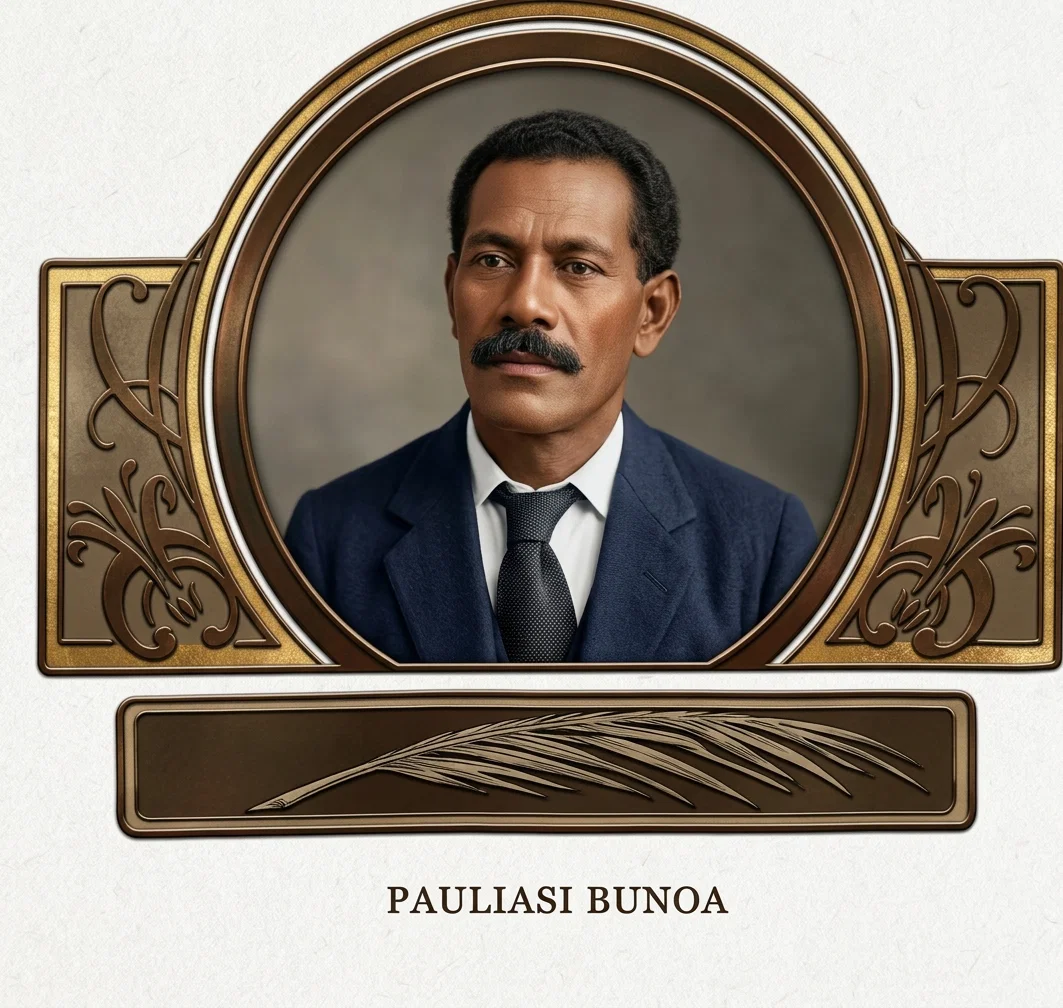
PAULIASI BUNOA, a Fijian native, for ten years a Wesleyan missionary in New Britain, but now an Adventist minister, gave a remarkably strong argument on the Sabbath question, well worth repeating.
SENT FOR THE WISE PREACHER
He had only recently accepted the Sabbath truth, and there was an unusual stir in the native village. The dark-skinned theologians had found themselves unable to solve the question. They therefore sent for nai talatala vuku—the wise preacher, the white man—to demonstrate that Pauliasi was an apostate, and utterly at fault in keeping the seventh-day Sabbath.
The white preacher came one Sunday morning, and the large congregation sat in silent expectancy for the texts proving that Sunday was ordained of God to take the place of the original Sabbath. Some of the natives, anxious to have their conscience salved, may have got some satisfaction; but many wanted definite Scripture proof, and were disappointed, for such was not given.
GIVE ME ONE TEXT
At the close of the service, the minister placed his Bible under his arm, and passed out of the church. Near the entrance, he greeted Pauliasi, the native preacher, saying: “We are sorry, Pauliasi, that after your long association with us, you have left the church we thought you loved. We hope you will return.” Pauliasi answered: “I am sorry indeed to leave the church I have loved so long. Even now, if you can give me one text from that book,” pointing to the Fijian Bible under the minister’s arm, “that tells us Sunday is the Sabbath, I will turn back, and remain with you. But you didn’t give us proof in your sermon to-day. It was only a sermon of man’s arguments. I want a text from the Book.”
HE HAD NO TEXTS
A large crowd had by this time gathered about; and the preacher, somewhat embarrassed, tried to make up for the unconvincing sermon by giving additional arguments to bolster up his case, but no texts were given. Pauliasi again and again vainly appealed for the Scripture, and then himself presented a masterly argument, which all would do well to remember.
PAULASI BUNOA
One of our native Fijian preachers
A JUDGMENT APPEAL
After the vapid and worn-out arguments of the minister had been given, Pauliasi, in a somewhat commanding tone, said: “Mr. ——, in the day of Judgment, you will not be the judge, neither will I; but God will be Judge. And if, in that day, I am found to be wrong in keeping the seventh day as the Sabbath, I am going to bring a charge against Jehovah, who came down upon Mt. Sinai, and wrote with His own fingers in tables of stone the Ten Commandments, the fourth of which commands us to observe the seventh day. I will bring a charge against Moses, who brought that law down from the mount, and taught it to the people. I will bring a charge against the Lord Jesus Christ, who on the mount said, ‘Think not that I am come to destroy the law, or the prophets: I am not come to destroy, but to fulfill.’ And He kept the Sabbath, and said that it was made for man. I will bring a charge against the apostle Paul, who, long after the cross, said the law is holy and just and good and spiritual. I will bring a charge against all the apostles and prophets of the New Testament.
NO EXAMPLE TO PLEAD
“Against all these I will bring my charge, if I am found to be wrong in regard to the Sabbath. And Mr. ——, if, in that day, you are found to be wrong, against whom will you bring a charge, or whose example will you plead?” There was no reply. God had given to the man of color an unanswerable argument.
J. E. F.
ARE THE DEAD CONSCIOUS?
By G. B. T.
MODERN theologians affirm that they are. The doctrine of inherent immortality is an important part of the creed of the present day. We are told that the soul is immortal, and that at death it continues an uninterrupted existence. Friends are comforted, on funeral occasions, with orations setting before them the idea that the one for whom they are mourning is enjoying the felicity of endless life. In our study of this question, however, a number of questions come to us. Among these are the following:
1. The Bible affirms that the “dead know not anything” (Eccl. 9:5), and that at death, “his breath goeth forth, he returneth to his earth; in that very day his thoughts perish” (Ps. 146:4). Do we not, then, plainly contradict the inspired statements when we say that the dead are conscious? And what process of reasoning is there which will sustain us in asserting that a man whom God has pronounced dead, is yet alive, and knows more than before his death?
2. If it is the immortal soul that feels and sees and hears, and exercises all the attributes of intelligence, why do not animals, which feel and see and hear, have immortal souls?
3. If the soul can see, independent and apart from the body, why does a man become blind when his eyes are removed? Why does not the soul continue to see?
4. The Lord says, “The soul that sinneth, it shall die.” Ezek. 18:4. Then is it not in direct contradiction of that which is noted in the Scriptures of truth, for us to say that the soul cannot die?
5. If the soul, and not the brain, is the thinking part of man, then why cannot a person think without brains?
6. If this body is simply a clog, a house in which the real man resides, why does God propose to restore life to this body, and place the soul in it again? And in what does the soul live between death and the resurrection? Does it live in a body? If so, what will become of that body when the Lord brings to life the first body? Will immortal souls in eternity have two bodies?652
7. If man has an immortal soul that enters upon its reward in heaven at death, then death is the gate to heaven; and did not Satan open this gate by causing sin to enter the world? See Rom. 5: 12. Would it, therefore, be proper to speak of death as an enemy, if it opens the gate to endless bliss, and lands us in heaven?
8. If the dead are immortal, and enter upon the reward immediately at death, as we are told, what is the need of a general resurrection? The Lord says: “I will ransom them from the power of the grave; I will redeem them from death: O death, I will be thy plagues; O grave, I will be thy destruction: repentance shall be hid from Mine eyes.” Hosea 13: 14. Why a resurrection for a man who has been in heaven thousands of years?
9. The Saviour, in order to comfort His sorrowing disciples when they learned that He was to leave them, said, “And if I go and prepare a place for you, I will come again, and receive you unto Myself; that where I am, there ye may be also.” John 14: 3. But how could He receive us to Himself at the resurrection, if the dead are conscious, and the righteous have been with Him from the time of their death until His second advent? Does not the doctrine of consciousness in death antagonize the doctrine of the second coming of Christ, and make it unnecessary? And can any doctrine which thus strikes at one of the great fundamental doctrines of the Scriptures, such as the second coming of Christ, be based upon the Scriptures? We think not.
10. The Lord declares that there will be a future Judgment. “He hath appointed a day, in the which He will judge the world in righteousness by that Man whom He hath ordained; whereof He hath given assurance unto all men, in that He hath raised Him from the dead.” Acts 17: 31. But if the dead go to their reward immediately at death, what is the need of a future Judgment? Why judge a man who has been in heaven or hell for centuries?
11. In this connection, the case of Lazarus, who had been dead four days, comes to our minds. Was Lazarus conscious in death, and enjoying the bliss of heaven, in the society of God and sinless angels, during that period when he lay in the tomb? If so, was it an act of mercy in the Saviour to recall him from his happy abode, and place him again in this world of sin, on probation?
12. The word of God declares that man is mortal (Job 4: 17), and that God only has immortality (1 Tim. 6: 16). In view of these statements, what right have we to say that man possesses inherent immortality, and that his soul survives the stroke of death, and maintains uninterrupted consciousness?
13. If the soul is immortal and immaterial, then it has neither body nor parts; it is without head, hands, feet, eyes, ears, tongue, brain, or any other organ of a body. How can it sing songs of praise and adoration before the throne of the eternal God, without a tongue? How can it see His glories, without eyes? How can it meditate upon the wonders of eternity, without a brain? How can it walk the golden streets of the New Jerusalem, without feet?
14. Notice this statement: “The dead praise not the Lord, neither any that go down into silence.” Ps. 115: 17. Seeing that the all-wise God affirms that the dead do not praise the Lord, is it possible for any of the dead to praise Him around His throne, without being raised from the dead?
15. The words “soul” and “spirit” being found something like one thousand seven hundred times in the Scriptures, and never once qualified by “immortal” or “undying,” who has authority to say that there is an immortal or undying soul?
A number of other questions could be asked along this line, but we think these are sufficient to show the fallacy and unscriptural sophistry of that system of theology which declares that man has a deathless soul. As surely as God’s word is true, the dead are asleep. They are unconscious of events taking place about them. They will so remain until the Archangel’s voice shall reverberate to the depths of the grave, and animate the dust of the silent sleepers.
Man’s hope is in the resurrection. All in the grave shall live again. When Jesus shall come the second time, His voice will be heard, and the dead in Christ will come forth. The living righteous will be changed, and all will be caught up together, to meet Him in the air. This is indeed a glorious hope. May this glad day soon dawn! G. B. T.
CONDEMNED FOR ITS WIDE INFLUENCE
By J. O. C.
IT has been many times demonstrated that the more singular and active one's religion becomes, the more unpopular it grows. When first made known, not much attention is paid to it; but as it gathers force and gains expanse, the world condemns it.
During the first thirty years of Christ's earthly career, little was said of Him; but after His miracles of healing, and other evidences of divinity, many were ready to say that He had a devil and was mad. His path narrowed each year of His open ministry. The first year, multitudes thronged Him. The following year, applause waned, and the crowds withdrew as Jewish counsels aroused opposition. His last year was marked by greater persecution and a narrower pathway. One disciple betrayed Him, another denied Him, and others forsook Him to die alone, amid the solitude of awful darkness, until, as His divine heart was at the breaking point, He cried, “My God, My God, why hast Thou forsaken Me?”
The same spirit must ever pursue the true follower of the Master; for has He not said, “All these things will they do unto you for My name's sake, because they know not Him that sent Me”? John 15: 21. J. O. C.
NOT GLOOMY OR PERPLEXED
THERE are hundreds of souls to-day who are perplexed. They do not know what to do or which way to turn. They see the evils that are filling the world, and do not see any way of escape. But he who truly knows God, he who is a careful student of the Bible, and not only studies the blessed Book, but whole-heartedly believes what it says, is prepared to point every one who is perplexed and in fear to the one great Refuge. His Christianity is not a sham. He is neither a Pharisee nor a hypocrite. He knows the Lord Jesus Christ, and knows the power of His word. And since he has this sure foundation, and his mind is illuminated by the clear light of the word of God, he is able to read the meaning of the vexing and perplexing problems of this time; for the bright rays of prophetic light have penetrated the gloom, and he who has God's word in his mind and heart is standing in the place where he can see clearly.
The Heart Opened by God
By G. B. T.
Of Lydia of Thyatira it is said that the Lord opened her heart. There is no other one who can open hard, rebellious, stony hearts. We can carry the multiplication table in the head, but the Golden Rule must be in the heart. Only the power of God can open the deceitful heart of man, and write upon it the law of God, requiring us to love God supremely, and our neighbor as ourselves. But the heart that is yielded to Him will experience this great transformation. G. B. T.
POWER EQUAL TO THE NEED
IN these days of peril, when men's faces are growing pale before the possibilities and probabilities of the immediate future, the real Christian has perfect peace. There are many professors of Christianity who do not enjoy this peace, but it is because they do not have a personal acquaintance with the Author of salvation. If we really know Christ, if we have genuine Christianity, and not a counterfeit, we can have no fear; for He who is the Protector of the Christian, “hath measured the waters in the hollow of His hand, and meted out heaven with the span, and comprehended the dust of the earth in a measure, and weighed the mountains in scales, and the hills in a balance.” His power is so great that He says “the nations are as a drop of a bucket, and are counted as the small dust of the balance: behold, He taketh up the isles as a very little thing. . . . All nations before Him are as nothing; and they are counted to Him less than nothing, and vanity.” Isa. 40: 12-17.
Question Corner
By M. C. Wilcox
Conducted by M. C. Wilcox
178 — SEEING GOD
Will you please explain Ex. 24:10, 11? I cannot reconcile this statement with 1 John 4:12. E. A. C.
The expression in Exodus 24 simply has reference to the glory of God with a part of His being, as in Ex. 33:18-23. Moses pleaded that God would show him His glory—that is, so he could look upon Him. God tells him, “Thou canst not see My face; for man shall not see Me and live.” Verse 20.
1 John 4:12 has reference to looking upon God in the way we would look upon others. “No man hath beheld God at any time.” The unapproachable light and the ineffable glory of God is so great that men could not live in that presence. It is only in a very modified way that men have looked upon God. There will come a time, however, when man has been changed into God’s image, and the weakness of his mortality changed to immortality, that the blessed assurance of Christ will be fulfilled, “Blessed are the pure in heart: for they shall see God,” or as stated in Rev. 22:4, “And they shall see His face; and His name shall be on their foreheads.”
179 — THE SIGN OF THE SON OF MAN
What is the sign of the Son of man? E. A. C.
The expression is used in Matt. 24:30: “And then shall appear the sign of the Son of man in heaven.” It would seem, from parallel scriptures, that this is the first appearance of Jesus, the Son of man, in the clouds of heaven. Rev. 1:7: “Behold, He cometh with clouds.” See also Acts 1:9-11. Luke 21:27: “Then shall they see the Son of man coming in a cloud.” This would seem to put the appearance of the cloud some time before the outlines of the person of Jesus and the angels are fully discerned.
Do the three days and three nights of Matt. 12:40 refer to just seventy-two hours? QUERY.
Not necessarily nor probably. The Jewish manner of reckoning time counted a part of a day as a whole day. Here is the following from the Chosen People, a magazine that is working for the salvation of the Jews:
“In religious matters, the Jewish law always counts parts of the first and last days of a religious observance as whole days. For instance, the law is, to sit on the ground and mourn over the dead for seven days. The first and the seventh day of the mourning are counted as whole days, if only part of them, even an hour, has been spent in mourning. The Jewish reckoning of days always includes the preceding night. Christ lay in the grave part of Friday, which counted a whole day, the preceding night included; Friday night and Saturday, making the second day; Saturday night and part of Sunday, making the third day.”
If we would remember these customs among the Jews, and the method of reckoning time, it would save us from other errors based on a wrong conception of the same text.
181 — BAPTIZED IN HIS NAME
Please explain Matt. 28:19; Acts 2:38; Acts 8:16. Are these statements in perfect harmony? Is it essential that the name “Lord Jesus Christ” only should be used for one to receive the baptism of the Holy Spirit? M. M.
Matt. 28:19 expresses the great thought and scope of baptism. The text does not say that this is the formula which should be followed. It is not presented for that purpose. It is proper enough to use, and it is often, if not generally, used in the rite of baptism, for it expresses the meaning of baptism more than any other scripture. See the tract on “Bible Baptism,” B. S. L. No. 204.
Baptism into the name of the Father is baptism into His character, His righteousness; into the name of the Son, into His character, or the emptying of self, the yielding up of self for service. Baptism into the Holy Spirit is baptism for service.
All these things are included in the name of the Lord Jesus, because He was the representative of all these. Therefore baptism in the name of Jesus Christ may be regarded as sufficient. Through Him the Father did the work. Consequently the righteousness of God came through Jesus Christ. The humiliation and meekness of the Saviour came in the same way, and He it is who gives the Spirit. It is therefore not essential that the name “the Lord Jesus Christ” only should be used, in order for one to receive the baptism of the Holy Spirit. In fact, the name may be used, or any name or formula may be used, and yet the one immersed may not receive the Holy Spirit. On the other hand, it is true that some have received the Holy Spirit who were not baptized. See Acts 10:44-48. They were baptized after they received the Holy Spirit. God does not have to work by formulas. It is the submissive heart, the heart that is wholly yielded to Him, that brings His blessing.
182 — THE SCOPE OF THE RESURRECTION
Please let me know if the people who died before the Flood will be raised at the second coming of Christ. O. H. S.
Yes, His own people will—those who have part in the first resurrection. See 1 Thess. 4:14-16; Rev. 1:7; and other scriptures. The promise is that “the hour is coming, in the which all that are in the graves shall hear His voice, and shall come forth; they that have done good, unto the resurrection of life; and they that have done evil, unto the resurrection of damnation.” John 5:28, 29. See also Acts 24:15. There will be a resurrection both of the just and of the unjust; and when God’s children are raised, there will be no difference between those who have lived in one age and those who have lived in another. All will come forth, as stated in the passage in 1 Thessalonians.
The Three Best Ways to and from California
The Overland Route via Ogden
The Overland Limited
Extra Fare Train
The Pacific Limited
The San Francisco Express
All Making Less than Three Days to CHICAGO
“The Sunset Route”
Via the Elegant Sunset Limited
Three Days to New Orleans
Connecting with Palatial Southern Pacific Steamers, or Trains for the East
“The Shasta Route”
Through the beautiful Shasta Region, through Portland and the North
All protected throughout with automatic block signals. Inquire of any agent, or
C. S. Fee, Passenger Traffic Manager
Flood Building, San Francisco
SOUTHERN PACIFIC
SPECIAL NOTICE TO FOREIGN MISSIONARIES
Freight Rates across the Pacific advance Jan. 1, 1916
Order now and only pay $1.50 per hundred pounds from Chicago to Yokohoma, Kobe, Shanghai, Hongkong, Manila
Our Missionary Bureau takes this opportunity to announce to our customers and their friends in America that our low carload rate of $1.50 per hundred pounds will only be in effect until Dec. 31, 1915. The rate is so absurdly low compared with other war-time ocean freight rates now in effect the world over, that we must concede the rail and ocean carriers are quite justified in advancing it.
After Jan. 1, next, the rate will be $1.75 for each hundred pounds. This is not much of an advance and the new rate will still be lower than any other rate that we know of for anywhere near as long a haul.
Our Missionary Leader
We specialize in shipments to all Mission fields. Whether you buy of us or not, you can save money by having us attend to your shipments. Write to Mr. M. D. Howell, Manager, Missionary Bureau for our circular of shipping and packing information, and our special circular of folding organs suitable for Missionaries and church workers.
You still will be able to purchase household necessities, cloth, food, etc., from us at a great saving over what you would pay for such articles elsewhere.
It was the intention of the carriers to advance this freight rate much earlier, but we induced them to postpone it until January first so as to give our customers an opportunity to place at least one more order under the old rate.
If you are thinking of shipping goods to the Orient next Spring, better ship now and save 25c on each hundred pounds. This is quite an item on a big heating outfit or a lot of hardware for a hospital, a church bell, a fire-proof safe, a piano or other heavy goods.
Whether you are at home or abroad you can cut down the high cost of living by purchasing many of your supplies from us. Four million families regularly supply their needs from Montgomery Ward & Co.
Our Grocery List, published every sixty days, tells you the right prices to pay for high grade, standard groceries. We will gladly put you on the mailing list, upon receipt of your request.
Get out our catalog to-day and send in your order. It is not too soon to send in Christmas orders and our big book will give you many suggestions.