Signs of the Times, Vol. 41, No. 25.

Tradition and Its Authority

Signs of the Times

Jun 30, 1914

Pacific Press Publishing Association · Mountain View, California · Jun 30, 1914

Tradition and Its Authority

The Jewish Theory in Conflict with the Written Word — The Master Brushes Aside Their Speculative Theories

The Common People Can Understand Him — The Conflict with Tradition in Our Own Day

By WILLIAM A. SPICER
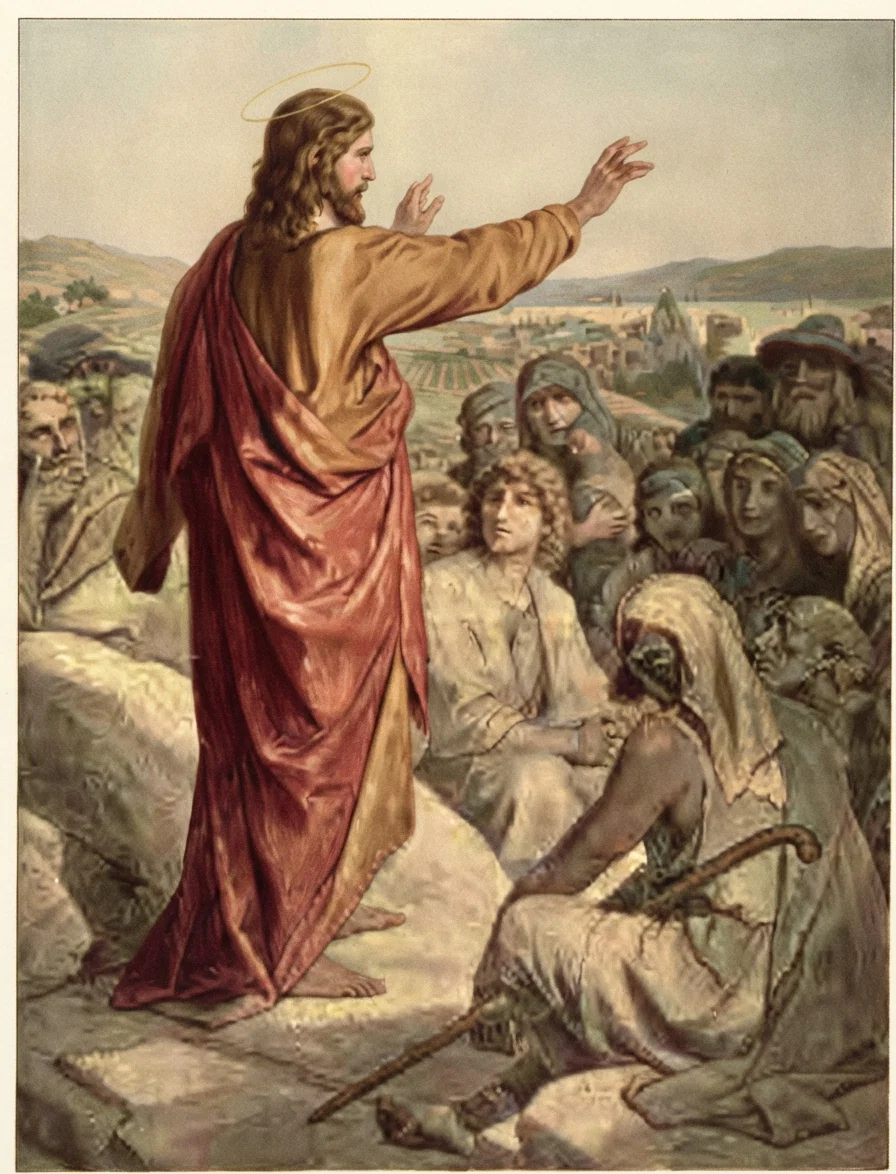
THE Jewish teachers in the days of Christ had set tradition above the written Word. The scribes and the Pharisees came once to Jesus with the question, "Why do Thy disciples transgress the tradition of the elders?" He answered by another question, "Why do ye also transgress the commandment of God by your tradition?"

CHARGED WITH SEEKING NOVELTIES

They thought that Christ was encouraging His disciples to seek after novelties in doctrine and practise, and to depart from the old, established customs of the church. As a matter of fact, Jesus was but sweeping aside the novelties introduced by the authority of tradition. He was calling the people back to the written Word and the truth which was from the beginning.
IT IS SAID IN THE NEW TESTAMENT THAT THE COMMON PEOPLE HEARD CHRIST GLADLY
To justify their departure from the Scriptures, and to give a semblance of divine authority to ecclesiastical traditions, the Jewish elders had developed the theory of oral tradition, and it is worth while noting the parallel between the Jewish theory and the modern theory of tradition.

THE JEWISH THEORY OF TRADITION

It was the teaching of the Jews that when Moses went up into the mount to receive from God the Ten Commandments, and the instruction that was written in "the book of the law," for preservation and future study, much instruction was given him which was not written. This, according to the theory, he transmitted orally to Joshua, Joshua in turn taught it to the elders, and they passed on this unwritten wisdom, these traditions of the elders, to the men of the Great Synagogue, the doctors of the law.
Thus was laid down a theory which sought to give divine sanction to the traditions that had accumulated through the centuries. By the days of Christ, these traditions had been exalted as of equal authority with the word of God; and inevitably, whenever the human places itself theoretically on a level with the divine, it exalts itself even above that which is divine. So in actual practise, there was given to these traditions of the church an authority above the word of God.

NONE BUT LEARNED DOCTORS HAD IT

In fact, it was the theory that only the learned doctors of the church, who had possession of this fund of traditional learning, could understand and interpret the word of God. Thus the divine Word was explained by human tradition, instead of human tradition being tested by the divine Word.
It is said in the New Testament that the common people heard Christ gladly. They could understand what He said; and under His teaching, they could understand the blessed truths of the word of God. The Pharisees, however, said, "This people who knoweth not the law are cursed."

HE SWEPT THE TANGLE AWAY

Christ swept all this tangle of human tradition aside, and laid bare the word of God, the written Word which God Himself had committed to the Jewish people as living oracles to give to all the world. "Full well," He told the Pharisees, "ye reject the commandment of God, that ye may keep your own tradition." "In vain they do worship Me, teaching for doctrines the commandments of men."

THE MODERN THEORY OF TRADITION

In almost exact parallel to the ancient Jewish theory of church tradition has come about the modern theory. In order to account for doctrines and practises not found in the word of God, the Catholic Church has developed the theory of church tradition.
The apostles are supposed to have received instruction and teaching not contained in the written Gospels and epistles. They are said to have passed these on to their successors. So there has developed a great body of teaching in the hands of the church which has been exalted not only to a level with the Scriptures, but really, as Catholic authorities declare, it is held that ecclesiastical tradition is the safer rule of faith. The Scriptures are to be understood in the light of Catholic tradition.

MAY THE COMMON PEOPLE KNOW?

Hence again, just as in the olden time among the Jews, the common people are not supposed to be able to understand the Scriptures. These must be expounded by the doctors of the lawin the light of the great mass of ecclesiastical tradition. Thus as of old tradition makes void the word of God.
It is ever the way, and the only safety now is in following Christ's example of sweeping aside human tradition and laying hold of the word of God itself as the divinely appointed standard of faith and doctrine.
This is the Protestant platform. And the message of Christ's soon coming is a call to Protestants and Catholics alike to turn from doctrines and practises not founded in the living Word.

The Federation of the Churches of America
Emphasizing the Social Message Rather than the Religious — The Kings of Finance in the Pews of the Church
Turning to the Labor Leaders — The Church and Economics — Is there Not a Far More Important Question?
By B. G. WILKINSON
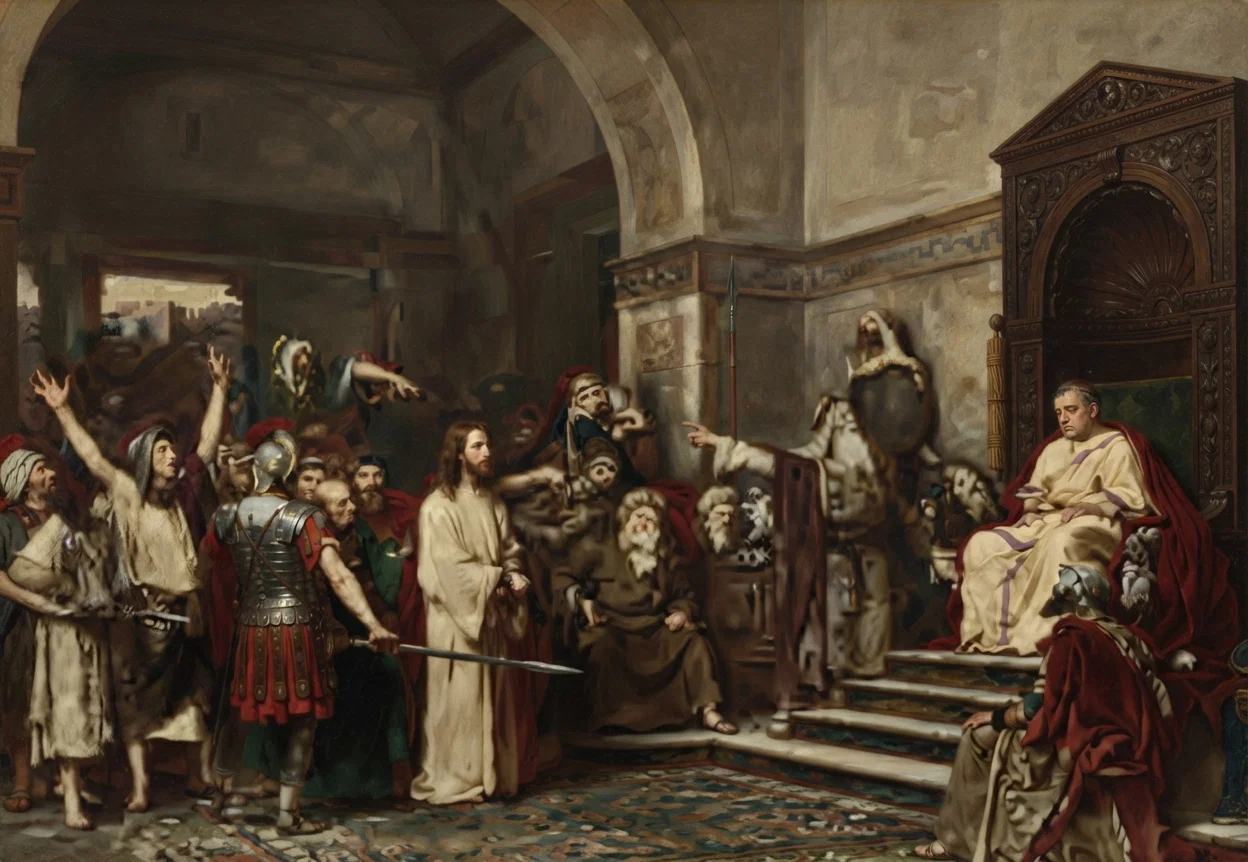
"Pilate . . . delivered an innocent man over into the hands of a howling mob."
THIS is the second of some five or six articles by Elder Wilkinson on the subject of church federation. Last week he recounted the steps in the formation of the movement, called attention to some dangers that are lurking in it, and spoke of the tendency to domination that is threatened by such a large ecclesiastical body. Later articles will discuss more fully the purposes and methods of the federation, the threat of its tendencies, and the menace to religious freedom.
EDITOR.
"I was during the epoch when there were sects and heresies that Christianity made the conquest of the world." — The Hon. Camille Pelletan, French statesman.
If church federation means a social message as the mission of the churches, then the churches have stepped down from having a religious message as a denomination, to having only a social message as a federation.

SIGNIFICANT SIGN OF THE TIMES

If this is so, it is strikingly significant as a sign of the times, for religion is God's agent for the uplifting of the world. The decadence, then, of religion is a great sign. It is the very sign emphasized by Christ when He said, "And because iniquity shall abound, the love of many shall wax cold"; and by Paul when he said: "This know also, that in the last days perilous times shall come. For men shall be lovers of their own selves, . . . having a form of godliness, but denying the power thereof."
There can be no real reform unless led by a religious reform. Convictions from God put backbone into men. Pilate, because he had only the worldliness of paganism to lean upon, delivered an innocent man over into the hands of a howling mob. When a mob set upon the apostle Paul, he begged of his friends to be allowed to go out and face the raging populace rather than bring the misfortunes of the hour upon his friends. William Lloyd Garrison, laying upon the consciences of Americans the crime of slavery, raised up an army of men to fight behind Grant, and a legion of voters to support President Lincoln. There could be no real social reform aside from religious reform.
The churches had it, and have had it in their power to produce an effect upon the great commercial leaders who sat in their pews; but what have they done in this direction for a Rockefeller, Carnegie, and others?
Let us hear what the Federal Council of the Churches of Christ in America says:
"Multitudes are deprived, by what are called economic laws, of that opportunity to which every man has a right. When autonomic movements cause injustice and disaster, the autonomy should be destroyed. That to these impersonal causes are added the cruelties of greed, the heartlessness of ambition, and the cold indifference of corporate selfishness, every friend of his fellow must with grief and shame admit. . . . The homes of the wage-earners in our great cities are an indictment of our civilization. The meager income, which is easily reckoned sufficient by the fortunate who are not forced to live upon it, is without warrant of reason. The helplessness of the individual worker, the swift changes in location of industrial centers, the constant introduction of labor-saving appliances, the exactions of landlords, add uncertainty to privation. The hazard of the mine, the monotony of the shop, the poverty of the home, the sickness of the family, the closing of the doors of higher opportunity, react with dreadful precision upon the temperament and mar character."—"The Church and Modern Industry," page 11.

MANY EXACTING LANDLORDS IN THE CHURCH

Yet many of these landlords of whose exactions complaint is made, and many of the wealthier mercantile kings whose systems are here indicted, sit in the pews of these churches. To such an extent is this fact recognized that some economic writers have classed the churches — the Christian churches — along with oppressive monopolies and selfish corporations.
It is a sorry confession that the church has failed to reach the heart. She has been unable to convert the leaders of these oppressive systems who sit in her pews. There is therefore a confederation, and a turning to the support of the law, to do by physical force what they have not accomplished by spiritual persuasion.

TURNING TO THE LABOR-UNIONS

Having failed to lead an economic reform, the church now turns to the labor-unions, which organized to protect themselves. And this is done with the manifest intent that the church might keep, by federation, the supremacy which she lost by spiritual leadership. Thus we read again the following recommendation of the federation:
"That the church in general not only aim to socialize its message, to understand the forces which now dispute its supremacy, to stay by the people in the effort to solve with them their problems, but also modify its own equipment and procedure in the interest of more democratic administration and larger social activity."
In other words, the labor-unions have gone ahead without the church; hence now it is necessary for the church to come over to their program and ideals if the church is to maintain its supremacy.

HOW DIFFERENT FROM CHRIST!

How different does this sound from the record of Christ! Jesus might have been at the head of the social order if He had been willing for the crowd to make Him king. The Saviour, however, understood full well that reform in men and reform among men could not be accomplished simply by study and attention to material things and industrial problems. This is His authoritative statement: "Seek ye first the kingdom of God, and His righteousness;
and all these things shall be added unto you."
When a young man came to Christ petitioning that He command this young man's brother to divide the inheritance, the Saviour caused it clearly to be understood that His message was not to deal with material problems and so equalize economic conditions. He refused to enter into even the discussion of such a question. The Church Federation, however, proposes to do the opposite.

THE THEOLOGICAL SEMINARY AND ECONOMICS

The denominational college, which heretofore has been set apart for such studies as would equip the ministry for its spiritual task, must now carry into its class rooms the debates and the problems tossed backward and forward between the capitalist and the laborer. Even the church itself is to become a forum for the pros and cons of industrial arguments. Listen to the following recommendations from the Church Federation:
"That to this end, in all theological seminaries, and so far as practicable in other schools and colleges, there be established, wherever they do not now exist, courses in economics, sociology, and the social teachings of Jesus, supplemented, wherever possible, by investigation of concrete social facts, and —
"That study classes and reading courses on social questions be instituted in connection with the churches and their societies, to foster an intelligent appreciation of existing conditions, and to create a public sentiment through which relief and reform may be more effectively secured.
"That the churches, with quickened zeal and keener appreciation, through their pastors, lay leaders, and members, wherever possible,
enter into sympathetic and fraternal relations with working men, by candid public discussion of the problems which especially concern them, by advocating their cause when just, by finding the neighborly community of interest, and by welcoming them and their families to the uses and privileges of the local churches."
And as if the above methods would not be invasion enough, by the church, in the social and industrial fields, it is further recommended that in order to do this, the church "modify its equipment and procedure in the interest of more democratic administration and large social activity; that more generally in its buildings provision be made for the service of the community as well as for the public worship of God."

MORE FACILITIES FOR SOCIABILITY AND PLEASURE

That is to say, if there are not now enough pool-rooms, assembly halls, kitchens, and dining-rooms, connected with the church buildings, more must be added. No matter how many of these things the church has already had, it is apparent that she has failed to maintain the social supremacy, and therefore more of them she must add.
It is clearly evident, then, that church federation means the endorsement of whatever social activities the church has already been conducting; and wherever there has been a lack of these, it means more completely the socializing of the functions and activity of the pulpit. It is an adaptation of herself to what has already been going on round about her rather than a bringing up of that which has been going on round about her to that which has been taking place within her. Spirituality is practical, every one knows; but spirituality is not material. Spirituality works upon human forces, but does not look toward them. It is "not by might, nor by power, but by My Spirit, saith the Lord of hosts." Zech. 4:6.

ANOTHER SIGN OF THE TIMES

Another great meaning of church federation which is also another significant sign of the times is that the movement does not emphasize the Biblical solution of the present-day strife between capital and labor. Let us hear what is said upon this in James 5: "Go to now, ye rich men, weep and howl for your miseries that shall come upon you. . . . Behold, the hire of the laborers who have reaped down your fields, which is of you kept back by fraud, crieth: and the cries of them which have reaped are entered into the ears of the Lord of sabaoth. . . . Be patient therefore, brethren, unto the coming of the Lord."
The present social unrest was not unforeseen by God. Neither did He leave His servants in ignorance of "things which must shortly come to pass."
Now, if we have a correct understanding of James, what God wants His people to see in the present great strife between capital and labor is that it is going to wind up shortly in the second coming of Jesus Christ. That great event, when our invisible Leader shall return to this earth as our visible King, is absolutely more worthy as a theme of study for the true children of God than all the vast ramifications and perplexities of our modern social and economic conditions.
There will be many astonished people when the great realities of the future ma-
terialize before our eyes. They will then understand that Jesus meant what He said, when He commanded His followers to preach the gospel to every creature, baptizing them in the name of the Father, the Son, and the Holy Ghost. Church federation has turned the trend of modern church thought toward a social message, or toward socializing its message. But if we understand the gospel aright as spoken by Christ in His last great discourse in Matthew 24, and by the apostle James in chapter 5, the present external facts in the industrial and social world demand that the trend of modern church thought should distinctively and altogether be toward the second coming of Jesus Christ.
Is not this a sign of the times? Is not this again another evidence to be added to all the others that that second coming is near at hand?

The Offering for the Leper

The Complete Healing of the Disease, and the Complete Cleansing from Sin

By CLARENCE SANTEE
"BUT we are all as an unclean thing." Isa. 64:6. Sin is well represented by leprosy, and the sinner by the leper. As the leper could only cry, "Unclean, unclean" (Lev. 13:45), helpless, incurable, so the sinner may strive in vain to cleanse himself. A new creation must accomplish the cleansing, or death must result.
Naaman, the Syrian, was healed of his leprosy by creative power placing purity and cleanness in the place of the diseased impurity of the leper. "His flesh came again like unto the flesh of a little child, and he was clean." 2 Kings 5:14, last part.

AN OFFERING FULL OF SIGNIFICANCE

An offering that was full of significance was given to ancient Israel regarding the leper, and, as will be seen, was also to teach them that there is hope of cleansing on the same basis on which cleansing can come to the sinner. This offering is described in Lev. 14:2-7, 14-18. "This shall be the law of the leper in the day of his cleansing. . . . Then shall the priest command to take for him that is to be cleansed two birds alive and clean, and cedar wood, and scarlet, and hyssop." Verses 2, 4. The margin reads, "two sparrows."
This was continued to the time of Christ, and was used by Him to reveal His Father's love. He said: "Are not two sparrows sold for a farthing? and one of them shall not fall on the ground without your Father." Matt. 10:29.

THE HEALING POWER

Shall we learn the lesson that was given to them that even the leper could discern God's boundless love, and, believing, claim and receive healing power?
With the two sparrows, they were to take cedar wood and scarlet and hyssop. One of the birds was to be killed "in an earthen vessel over running water." Lev. 14:5. Then the living bird, the cedar wood, the scarlet wood (Heb. 9:19), and the hyssop were to be dipped in the blood of the dead bird. Lev. 14:6. The man was also sprinkled with the blood seven times.
The number seven is often used to denote completeness. In this instance it evidently represents a complete cleansing. The living bird is then let go free. But it goes out marked with the blood of the dead bird. The price is stamped upon it as it is made free.

CLEANSING FOR ALL

As all creation was cursed because of man's sin (Gen. 3:17), so in the blood of Christ, represented by the blood of the bird, cleansing is provided for all. In the type, the cedar and the hyssop—the vegetable kingdom; the scarlet wool and the bird—the animal; the earthen vessel and the water—the mineral,—all were touched by the cleansing blood. Even the air was sprinkled, as the bird, dipped in the warm blood, fluttered away. All this is comprehended in the words of our Saviour, "The Son of man is come to seek and to save that which was lost." Luke 19:10.
Man's innocence, his dominion, his life, all were lost. In Christ innocence is restored. "If we confess our sins, He is faithful and just to forgive us our sins, and to cleanse us from all unrighteousness." 1 John 1:9. Eternal life is assured. "I give unto them eternal life." John 10:28. "The kingdom and dominion, and the greatness of the kingdom under, the whole heaven, shall be given to the people of the saints of the Most High, whose kingdom is an everlasting kingdom, and all dominions shall serve and obey Him." Dan. 7:27.
"The inhabitant shall not say, I am sick: the people that dwell therein shall be forgiven their iniquity." Isa. 33:24.

THE EAR, THE HAND, AND THE FOOT CONSECRATED

Returning to the type, Lev. 14:14-18, we read that the priest should take some of the blood of the trespass-offering, and put it upon the right ear, the right thumb, and the great toe of the right foot, of the man who has been cleansed.
This signifies that the ear has been purchased with blood, and that it is now turned to hear the voice of the Master. Ps. 40:6. Christ said, "Take heed therefore how ye hear." Luke 8:18. The hands and the feet, touched with the blood, will labor and walk in the way of life. "My hands also will I lift up unto Thy commandments, which I have loved." Ps. 119:48. "I thought on my ways, and turned my feet unto Thy testimonies." Verse 59.
The priest then took the anointing oil, and touched it to the ear, the thumb, and the toe, but it was to be placed only upon the blood that had been put there. Lev. 14:17. This taught that only where the blood of Christ has been accepted and applied, can His righteousness be imparted. No man by doing right can make himself right. "Who can bring a clean thing out of an unclean? not one." Job 14:4. The blood must be applied to cleanse the leprosy of sin, then the oil of Christ's righteousness can be imparted.

Treasures of the Bible

"THE Bible is a casket containing jewels of inestimable value, which should be so presented as to be seen in their intrinsic luster. But the beauty and excellence of these diamonds of truth are not discerned by the natural eye. The lovely things of the material world are not seen until the sun, dispelling the darkness, floods them with its light. And so with the treasures of God's word; they are not appreciated until they are revealed by the Sun of Righteousness."

"Thy Sins Be Forgiven Thee"

In the Chains of Both Sin and Disease—Was in Abject Despair—Drawn to the Master, and Found Perfect Relief in Mind and Body

By MRS. E. G. WHITE
MANY of those who came to Christ for help had brought disease upon themselves; yet He did not refuse to heal them. And when virtue from Him entered into these souls, they were convicted of sin, and many were healed of their spiritual disease as well as of their physical maladies.

HAD LOST ALL HOPE

Among these was the paralytic at Capernaum. Like the leper, this paralytic had lost all hope of recovery. His disease was the result of a sinful life, and his sufferings were embittered by remorse. In vain he had appealed to the Pharisees and the doctors for relief. They pronounced him incurable. They denounced him as a sinner, and declared that he would die under the wrath of God.
The palsied man had sunk into despair. Then he heard of the works of Jesus. Others, as sinful and helpless as he, had been healed, and he was encouraged to believe that he too might be cured if he could be carried to the Saviour. But hope fell as he remembered the cause of his malady. Yet he could not cast away the possibility of healing.

SOUGHT RELIEF FROM SIN

His great desire was relief from the burden of sin. He longed to see Jesus, and receive the assurance of forgiveness and peace with heaven. Then he would be content to live or to die, according to God's will.
“LET HIM DOWN AT THE FEET OF JESUS”
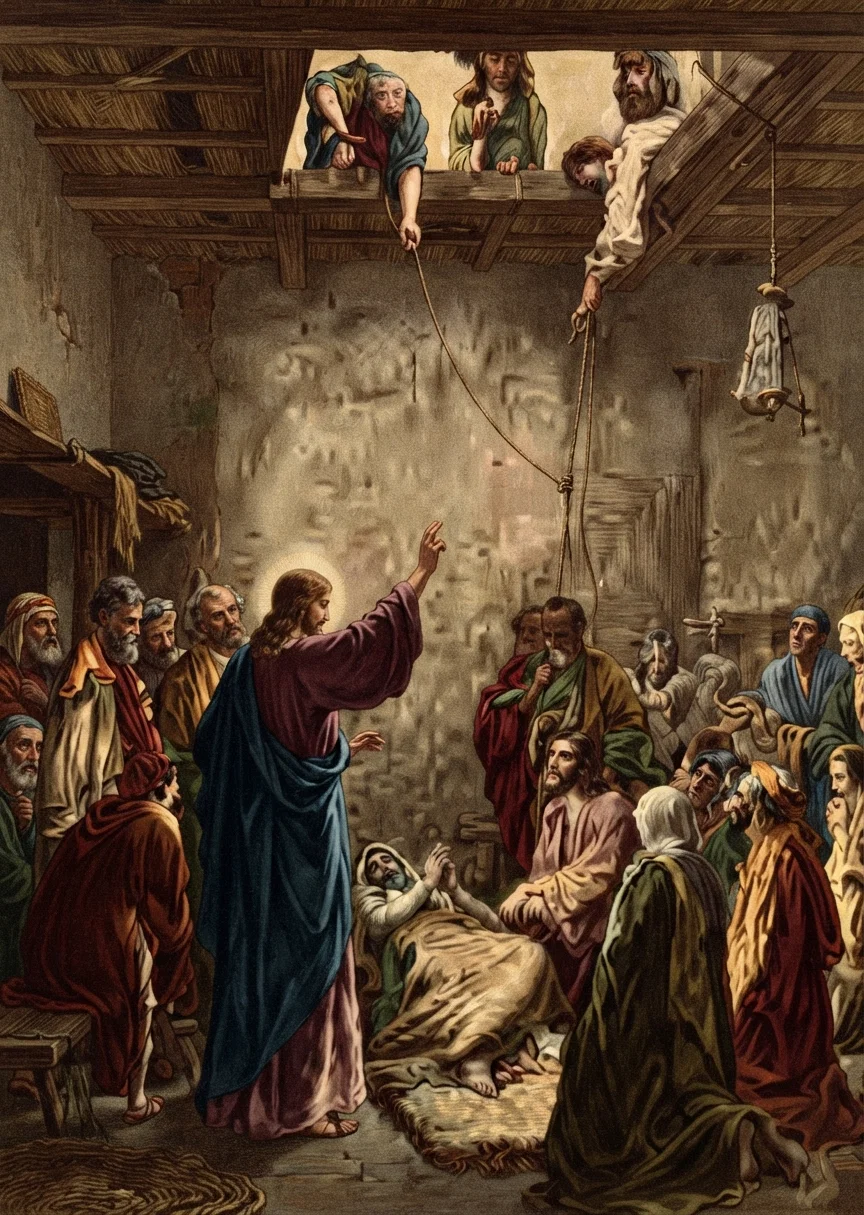
There was no time to lose. Already his wasted flesh bore signs of death. He besought his friends to carry him on his bed to Jesus, and this they gladly undertook to do. But so dense was the crowd that had assembled in and about the house where the Saviour was that it was impossible for the sick man and his friends to reach Him, or even to come within hearing of His voice.
Jesus was teaching in the home of Peter. According to their custom, His disciples sat close about Him, and "there were Pharisees and doctors of the law sitting by, who were come out of every village of Galilee and Judea and Jerusalem." Luke 5:17, A. R. V.
Many of these had come as spies, seeking an accusation against Jesus. Beyond these thronged the promiscuous multitude, the eager, the reverent, the curious, and the unbelieving. Different nationalities and all grades of society were represented. "And the power of the Lord was present to heal."

THE SPIRIT OF LIFE BROODED THERE

The Spirit of life brooded over the assembly, but Pharisees and doctors did not discern His presence. They felt no sense of need, and the healing was not for them. "He hath filled the hungry with good things; and the rich He hath sent empty away." Luke 1:53.
Again and again the bearers of the paralytic tried to push their way through the crowd, but in vain. The sick man looked about him in unutterable anguish. How could he relinquish hope, when the longed-for help was so near? At his suggestion, his friends bore him to the top of the house, and breaking up the roof, let him down at the feet of Jesus.

THE PLEADING EYES WERE FIXED UPON HIM

The discourse was interrupted. The Saviour looked upon the mournful countenance, and saw the pleading eyes fixed upon Him. Well He knew the longing of that burdened soul. It was Christ who had brought conviction to his conscience when he was yet at home. When he repented of his sins, and believed in the power of Jesus to make him whole, the mercy of the Saviour had blessed his heart. Jesus had watched the first glimmer of faith grow into a conviction that He was the sinner's only helper, and had seen it grow stronger with every effort to come into His presence. It was Christ who had drawn the sufferer to Himself. Now, in words that fell like music on the listener's ear, the Saviour said, "Son, be of good cheer; thy sins be forgiven thee." Matt. 9:2.

THE BURDEN OF GUILT ROLLED AWAY

The burden of guilt rolls from the sick man's soul. He can not doubt. Christ's words reveal His power to read the heart. Who can deny His power to forgive sins? Hope takes the place of despair, and joy of oppressive gloom. The man's physical pain is gone, and his whole being is transformed. Making no further request, he lay in peaceful silence, too happy for words.
Many were watching with breathless interest every movement in this strange transaction. Many felt that Christ's words were an invitation to them. Were they not soul-sick because of sin? Were they not anxious to be freed from this burden?
But the Pharisees, fearful of losing their influence with the multitude, said in their hearts, "He blasphemeth: who can forgive sins but One, even God?" Mark 2:7, A. R. V.
Fixing His glance upon them, beneath which they cowered and drew back, Jesus said, "Wherefore think ye evil in your hearts? For whether is easier, to say, Thy sins be forgiven thee; or to say, Arise, and walk? But that ye may know that the Son of man hath power on earth to forgive sins," He said, turning to the paralytic, "Arise, take up thy bed, and go unto thine house." Matt. 9:4-6.
Then he who had been borne on a litter to Jesus rose to his feet with the elasticity and strength of youth. And immediately he "took up the bed, and went forth before them all; insomuch that they were all amazed, and glorified God, saying, We never saw it on this fashion." Mark 2:12.

CREATIVE POWER DID IT

It required nothing less than creative power to restore health to that decaying body. The same voice that spoke life to man created from the dust of the earth, had spoken life to the dying paralytic. And the same power that gave life to the body, had renewed the heart. He who at creation "spake, and it was," who "commanded, and it stood fast" (Ps. 33:9), had spoken life to the soul dead in trespasses and sins. The healing of the body was an evidence of the power that had renewed the heart. Christ bade the paralytic arise and walk, "that ye may know," He said, "that the Son of man hath power on earth to forgive sins." Mark 2:10.

THE FOUNDATION OF THEIR MALADIES

The paralytic found in Christ healing for both the soul and the body. He needed health of soul before he could appreciate health of body. Before the physical malady could be healed, Christ must bring relief to the mind, and cleanse the soul from sin. This lesson should not be overlooked. There are to-day thousands suffering from physical disease, who, like the paralytic, are longing for the message, "Thy sins are forgiven." The burden of sin, with its unrest and unsatisfied desires, is the foundation of their maladies. They can find no relief until they come to the Healer of the soul. The peace which He alone can impart, would restore vigor to the mind, and health to the body.
The effect produced upon the people by the healing of the paralytic was as if heaven had opened, and revealed the glories of the better world. As the man who had been cured, passed through the throng, blessing God at every step, and bearing his burden as if it were a feather's weight, the people fell back to give him room, and with awestricken faces gazed upon him, whispering softly among themselves, "We have seen strange things to-day." Luke 5:26.

GREAT REJOICING

In the home of the paralytic there was great rejoicing when he returned to his family, carrying with ease the couch upon which he had been slowly borne from their presence but a short time before. They gathered round with tears of joy, hardly daring to believe their eyes. He stood before them in the full vigor of manhood. Those arms that they had seen lifeless were quick to obey his will. The flesh that had been shrunken and leaden-hued was now fresh and ruddy. He walked with a firm, free step. Joy and hope were written in every lineament of his countenance, and an expression of purity and peace had taken the place of the marks of sin and suffering.
Glad thanksgiving went up from that home, and God was glorified through His Son, who had restored hope to the hopeless, and strength to the stricken one. This man and his family were ready to lay down their lives for Jesus. No doubt dimmed their faith, no unbelief marred their fealty to Him who had brought light into their darkened home.
"Bless the Lord, O my soul: And all that is within me, bless His holy name. Bless the Lord, O my soul, And forget not all His benefits: Who forgiveth all thine iniquities; Who healeth all thy diseases; Who redeemeth thy life from destruction; . . . So that thy youth is renewed like the eagle's. The Lord executeth righteousness And judgment for all that are oppressed. . . . He hath not dealt with us after our sins; Nor rewarded us according to our iniquities. . . . Like as a father pitieth his children, So the Lord pitieth them that fear Him. For He knoweth our frame; He remembereth that we are dust." Ps. 103:1-14.
Continue reading: FOR THE LOVE HE BORE TO MEN