Pilgrim Fathers, Church Monopoly, and True Patriotism Number
Page 2
Review and Herald
Apr 30, 1914
Review and Herald Publishing Association · Takoma Park Station, Washington, D. C. · Apr 30, 1914
Pilgrim Fathers, Church Monopoly, and True Patriotism Number
By Editor
Read James Madison, Daniel Webster, and Other Patriots on Religious Liberty, Government Chaplains, etc. See Also Church and State Cartoons
The fight for our Constitutional rights of free speech, free press, and free assembly is not won! Witness, for example, the canceling of two hall contracts recently in Columbus, Ohio, through pressure on the part of Roman Catholics, when our editor, Prof. Chas. S. Longacre, had been advertised to lecture upon the subject "Shall America Adopt a National Religion?" in the Chamber of Commerce and the A. I. U. halls, respectively. HELP TO EDUCATE THE PUBLIC BY CIRCULATING THIS MAGAZINE!
Send $1.00 for 20 or $2.00 for 50 copies
NOTE THESE OTHER FEATURES
Important Judicial Decisions — Daniel Webster's Oration on Religious Liberty — James Madison on Government Chaplains — Religion in the Public Schools — Church and Politics — Limits of Rightful Authority — Governor Patterson on "Why I Changed Front on the Liquor Question" — America Traveling in the Wrong Direction — Are Sunday Laws Constitutional? — Conservation of Natural Rights, etc.
35 CENTS A YEAR — 10 CENTS A COPY
10 yearly subscriptions, for yourself and nine friends, only $2.00 — regular price, $3.50.
Post-office Stamp Books Accepted.
LIBERTY MAGAZINE :: Washington, D. C.
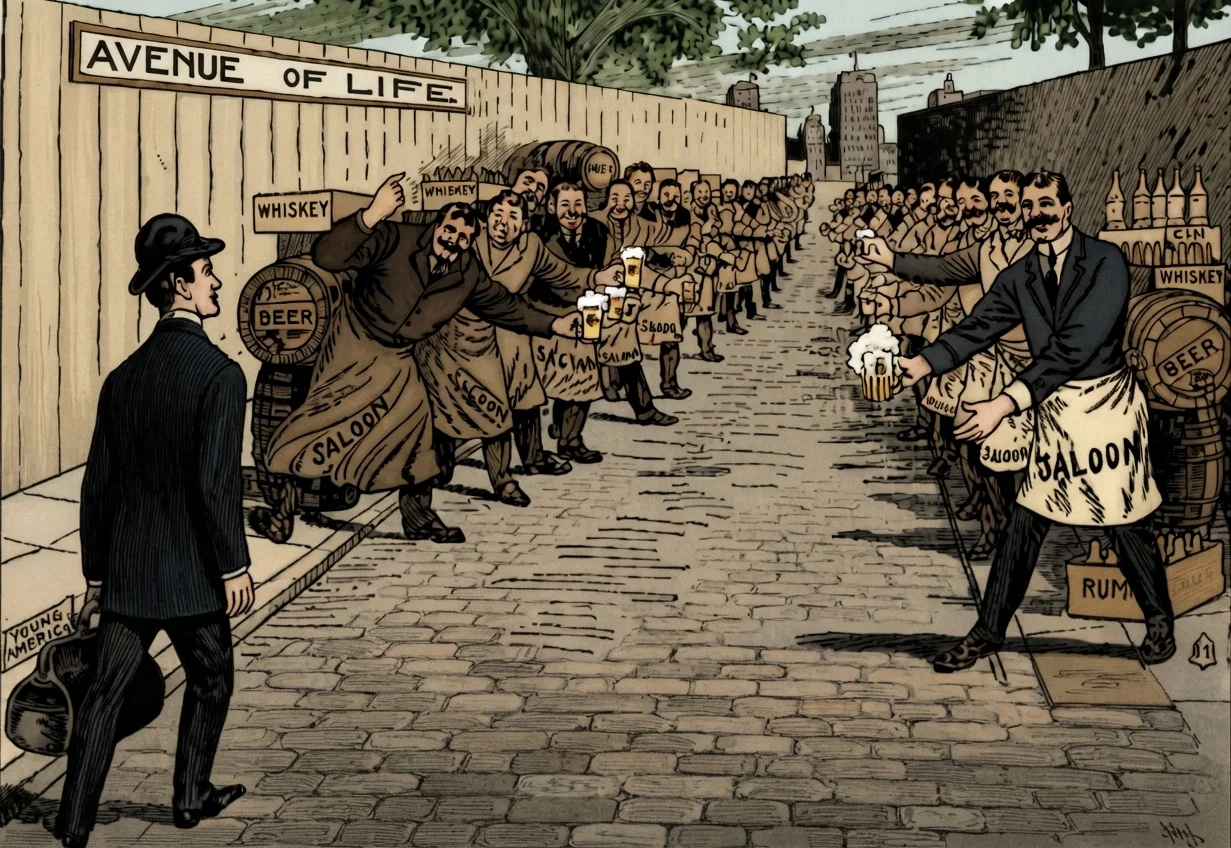
The Liquor Gantlet
Our government wisely spends large sums of money annually in educating its youth. Great care is taken in preserving the health of its pupils. The physical, mental, and moral development is carefully guarded. But when graduated from our schools they are started down the avenue of life through a legalized liquor gantlet almost impossible to run and not fall. The process is simply
TRAINING, THEN DESTROYING
But the Temperance Instructor is leading a crusade against the government licensed liquor gantlet, cleaning up the avenue of life by preparing the way for the removal of one of its most deadly perils — the saloon.
We need the help of all the temperance people of the land.
Priest or Pastor?
By F. D. Starr
F. D. STARR
CONFESSING sin is a very necessary act. "I acknowledge my sin unto thee, and mine iniquity have I not hid. I said, I will confess my transgressions unto the Lord; and thou forgavest the iniquity of my sin." Ps. 32:5. Two important points are to be observed; namely, whose sins are to be confessed, and to whom they are to be confessed. I am to confess "my sin," and confess it to the Lord, and to those I have injured.
In the Roman system, the confessional is a very important factor. The sinner confesses his sin; but to whom does he confess?—To a fallible human being like himself. Confessing his own sin is right, but in the other point he is wrong, for he confesses to man instead of to God.
But we are not Romanists; we do not do that way. We do not have priests; we have preachers or pastors. Let us in imagination accompany the Protestant pastor on one of his visiting tours, that we may compare his work with that of the papal priest. He calls on Brother S., and his parishioner is very glad to see him, for he has something very important to tell him. He lays before his pastor the indiscreet conduct of Brother J., telling what a reproach this man is bringing upon the church, and expressing his own deep sorrow that such a state of things should exist, but prefers that nothing be said about it. With this burden upon his mind, the pastor goes to visit Brother J., who is equally glad to see the minister, for he has been wanting an opportunity to relieve his mind of a burden that has been troubling him. He proceeds to relate the details of the unchristian conduct of Brother S., setting forth the matter in glowing colors. The sins of Brother S. and Brother J. have now been quite fully disclosed. In how many points have these brethren taken the right course?
The Scriptural method is for each one to confess his own sin, and confess it to God. The papal method is for the sinner to confess his own sin, but confess to a human priest. The plan just considered is for each one to confess his brother's sin and confess to a man like himself. The first method is correct in both points, the second is right in only one point, and the third is decidedly wrong in both points.
It may be said that a case like that is very rare. Very well; yet it is not quite so rare as it ought to be, as no doubt some pastors can testify. Conduct of this sort would put the Protestant pastor in a less enviable position than the Catholic priest. If each person would but know the "plague of his own heart," and confess his own sin, such irregularities as those already suggested would never occur.
God's ancient people were very dear to him, but it is on record that in certain instances they did "worse than the heathen." Far be it from us as his people today to do worse than the misguided devotees of a false system. If the plain directions in Matt. 18:15-18; 1 John 1:9; Prov. 28:13 were always followed, all of us would be in a condition to encourage the minister by sharing with him the legitimate burden of soul winning, and thus all be "laborers together with God."
"Let not revenge or dark despair
Be to my bosom known;
O, give me tears for other's woes,
And patience for my own!"
The Health Reform
By Ellen G. White
Early Counsels on Medical Work—No. 5
The Health Reform
MRS. E. G. WHITE
[COMPILER'S NOTE.—It was during the sojourn of Elder James White and wife with tried friends at Rochester, N. Y., soon after their departure from the Dansville (N. Y.) Health Home, that counsel was received regarding the duty of the Seventh-day Adventist denomination to establish a health institution. There had not been a general and hearty response to the light on health reform that had been given in the vision at Otsego, Mich., June, 1863, and the people were now called upon to make a decided advance in the adoption of health principles and in the undertaking of gospel medical missionary work. In these counsels are outlined many of the truths that lie at the very foundation of all medical missionary endeavor, whether in the individual life-practice, or by medical evangelists in mission fields and in our medical institutions. The instruction contained in the articles to follow is, therefore, of general interest to all.]
IN the vision given me in Rochester, N. Y., Dec. 25, 1865, I was shown that our Sabbath keeping people have been negligent in acting upon the light which God has given in regard to the health reform; that there is yet a great work before us; and that, as a people, we have4been too backward to follow in God's opening providence, as he has chosen to lead us.
I was shown that the work of health reform has scarcely been entered upon yet. While some feel deeply, and act out their faith in the work, others remain indifferent, and have scarcely taken the first step in reform. There seems to be in them a heart of unbelief, and as this reform restricts the lustful appetite, many shrink back. . . .
The health reform, I was shown, is a part of the third angel's message, and is just as closely connected with it as are the arm and hand with the human body. I saw that as a people we must make an advance move in this great work. Ministers and people must act in concert. God's people are not prepared for the loud cry of the third angel. They have a work to do for themselves which they should not leave for God to do for them. He has left this work for them to do. It is an individual work; one cannot do it for another. "Having therefore these promises, dearly beloved, let us cleanse ourselves from all filthiness of the flesh and spirit, perfecting holiness in the fear of God." . . .
In order to be fitted for translation, the people of God must know themselves. They must understand in regard to their own physical frames, that they may be able with the psalmist to exclaim, "I will praise thee; for I am fearfully and wonderfully made." They should ever have the appetite in subjection. . . . The body should be servant to the mind, and not the mind to the body.
I was shown that there is a much greater work before us than we as yet have any idea of, if we would insure health by placing ourselves in the right relation to life. . . . Shall those who are "looking for that blessed hope, and the glorious appearing of the great God and our Saviour Jesus Christ; who gave himself for us, that he might redeem us from all iniquity, and purify unto himself a peculiar people, zealous of good works," be behind the religionists of the day who have no faith in the soon appearing of our Saviour? The peculiar people whom he is purifying unto himself, to be translated to heaven without seeing death, should not be behind others in good works. In their efforts to cleanse themselves from all filthiness of the flesh and spirit, perfecting holiness in the fear of God, they should be as far ahead of any other class of people on the earth as their profession is more exalted than that of others.
Some have sneered at this work of reform, and have said it was all unnecessary; that it was an excitement to divert minds from present truth. They have said that matters were being carried to extremes. Such do not know what they are talking about. While men and women professing godliness are diseased from the crown of their head to the soles of their feet, while their physical, mental, and moral energies are enfeebled through gratification of depraved appetite and excessive labor, how can they weigh the evidences of truth, and comprehend the requirements of God? If their moral and intellectual faculties are beclouded, they cannot appreciate the value of the atonement or the exalted character of the work of God, nor delight in the study of his Word. . . .
I saw that our Heavenly Father has bestowed upon us the great blessing of light upon the health reform, that we may obey the claims which he has upon us, and glorify him in our bodies and spirits, which are his, and finally stand without fault before the throne of God. Our faith requires us to elevate the standard, and take advance steps. While many question the course pursued by other health reformers, they, as reasonable men, should do something themselves. Our race is in a deplorable condition, suffering from disease of every description. Many have inherited disease, and are great sufferers because of the wrong habits of their parents; and yet they pursue the same wrong course in regard to themselves and their children which was pursued toward them. They are ignorant in regard to themselves. They are sick, and do not know that their own wrong habits are causing them immense suffering.
There are but few as yet who are aroused sufficiently to understand how much their habits of diet have to do with their health, their characters, their usefulness in this world, and their eternal destiny. I saw that it is the duty of those who have received the light from heaven, and have realized the benefit of walking in it, to manifest a greater interest for those who are still suffering for want of knowledge. Sabbath keepers who are looking for the soon appearing of their Saviour should be the last to manifest a lack of interest in this great work of reform. Men and women must be instructed, and ministers and people should feel that the burden of the work rests upon them to agitate the subject, and urge it home upon others. . . .
Our people should have an institution of their own, under their own control, for the benefit of the diseased and suffering among us, who wish to have health and strength that they may glorify God in their bodies and spirits, which are his. . . .
As the health of invalids improves under judicious treatment, and they begin to enjoy life, they have confidence in those who have been instrumental in their restoration to health. Their hearts are filled with gratitude, and the good seed of truth will the more readily find a lodgment there, and in some cases will be nourished, spring up, and bear fruit to the glory of God. One such precious soul saved will be worth more than all the means needed to establish such an institution. Some will not have enough moral courage to yield to their convictions. They may be convinced that Sabbath keepers have the truth, but the world and unbelieving relatives stand in the way of their receiving it. They cannot bring their minds to the point to sacrifice all for Christ. Yet some of this last-mentioned class will go away with their prejudice removed, and will stand as defenders of the faith of Seventh-day Adventists. Some who go away restored or greatly benefited will be the means of introducing our faith in new places, and raising the standard of truth where it would have been impossible to gain access had not prejudice been first removed from minds by a tarry among our people for the object of gaining health.
Others will prove a source of trial as they go to their homes. Yet this should not discourage any, nor hinder them in their efforts in this good work. Satan and his agents will do all they can to hinder, to perplex, and to bring burdens upon those who heartily engage in the work of advancing this reform.
There is a liberal supply of means among our people, and if all felt the importance of the work, this great enterprise could be carried forward without embarrassment. All should feel a special interest in sustaining it. Especially should those who have means invest in this enterprise. . . .
Many who profess the truth are growing close and covetous. They need to be alarmed for themselves. . . . There is now a good opportunity for them to use their means for the benefit of suffering humanity, and also for the advancement of the truth. This enterprise should never be left to struggle in poverty. These stewards to whom God has intrusted means should now come up to the work and use their means to his glory. . . .
Those to whom God has intrusted means should provide a fund to be used for the benefit of the worthy poor who are sick and not able to defray the expenses of receiving treatment at the institution. There are some precious, worthy poor whose influence has been a benefit to the cause of God. A fund should be raised to be used for the express purpose of treating such of the poor as the church where they reside shall decide are worthy to be benefited. Unless those who have an abundance give for this object, without calling for returns, the poor will be unable to avail themselves of the benefits derived from the treatment of disease at such an institution, where so much means is required for the labor bestowed. Such an institution should not in its infancy, while struggling to live, become embarrassed by a constant expenditure of means without realizing any returns.
The Sacrifice of Love
By Worthie Harris Holden
WORTHIE HARRIS HOLDEN
Love, in its sacrifice and self-denying,
Begets a love uniting man and God;
For Calvary means more than simply dying —
It is the altar of the mighty Lord.
An altar we must raise upon the mountain
To sense the Love that freely gave its all
That for our souls a healing, cleansing fountain
Should flow for every creature, great and small.
We may not find a ram by thicket hidden,—
Bare Mt. Moriah only looms in view,—
But faith-insisting sacrifice is bidden,
Our stricken hearts know nothing else to do.
Thy altar is not mine, but he who heaven
Rules in his majesty and power and love
Permits in every life a cross be riven,
And sends his benediction from above.
O Calvary, divine thy inspiration,
Redeeming, sanctifying all our loss!
For heaven holds our earnest expectation
When altar fires have burned away the dross.
Self-Forgetfulness
By Eliza H. Morton
ELIZA H. MORTON
Wells says, "No one has liberty until he is free from thoughts about himself." The very essence of humility is self-forgetfulness. The certainty that God dwells within the heart comes from a consciousness of right doing; and when5we are sure of that, it is easy to forget self and to think of others. Christ's life was the very acme of unselfishness. He gave up all for us. There is no sacrifice too great for us if we can only have his Spirit and power, for they will give us every advantage in life. As running streams make the meadows green, so the sacrifices of unselfish souls make the world brighter and more beautiful as a dwelling place.
It may be asked, What is it to forget self? It is to be oblivious to rebuffs, slights, and ill treatment. It is to go on bravely when everything seems against us. It is to be kind, patient, and calm when others are nervous, unkind, and unreasonable. It is to care more for perishing souls than for dollars and cents. It is only those who thus forget self who will find eternal life.
Help us, O Lord, to lay aside
All thoughts of self, all thoughts of pride.
A. G. DANIELLS
By A. G. Daniells
Does the History of Turkey and Egypt Since 1798 Fulfill the Prophecy of Dan. 11: 40-44?—No. 25
A. G. DANIELLS
THE ultimatum of Turkey and the powers was placed in the hands of Mehemet Ali, pasha of Egypt, Aug. 17, 1840. He was given ten days in which to reply. Counting the day on which he received the ultimatum, the tenth day would fall on the twenty-sixth. The steps taken on that day by the representatives of the powers are reported by the correspondent of the London Times as follows:—
'In the morning of the twenty-fifth, M. Laurin and Colonel Hodges waited on the viceroy (Mehemet Ali). They advised him to yield, as the period of ten days granted by the treaty was about to expire; but they found the pasha immovably fixed in his resolution to resist.'
'On the morning of the twenty-sixth the Austrian, Russian, English, and Prussian consuls again formally presented themselves to Mehemet Ali, with Rifat Bey, to propose the liberation of the Turkish fleet, and that he should cede Syria, with the exception of the pashalic of Sayde (Saint-Jean d'Acre), the interval of ten days having elapsed since Rifat Bey had announced to him the treaty signed at London on the fifteenth of July. The pasha witnessed their approach from the window of his palace. . . . When they entered the hall of audience, Mehemet Ali caused coffee to be served, and then addressed them thus:—
''I know why you are come here, gentlemen; but I have already told you my mind on this business, and I have no other answer to give.'
'On the English consul's wishing to engage him in a conference, he said, 'I beg you will not speak to me any more on the subject.'—The Times (London), Friday, Sept. 11, 1840.
The real attitude of Mehemet Ali is given by the correspondent in another letter to the Times, in which he gives the following statement made by Mehemet Ali:—
Statement by Mehemet Ali
'An unjust and violent treaty has been entered into against me. I will not attack those who signed it. I shall remain patient and moderate, but I will shed the last drop of my blood in order to preserve the empire which I have founded. . . .
'I am the representative of Islamism. I will proclaim the holy war, and every good Mussulman will range himself on my side. They think to frighten me by a coalition of the four powers. I shall know how to dissolve it by marching on Constantinople. I will light such a fire as that Europe will have enough to do to mind her own affairs, and the Ottoman Empire will be saved. Whatever happens, I shall have done my duty, and I submit to the will of God.'—From Mehemet Ali's statement to M. de Walewski, published in the Times (London), Sept. 8, 1840.
Mehemet Ali's refusal on the tenth day to accept the terms of the ultimatum closed the offer of the pashalic of Saint-Jean d'Acre and the southern part of Syria for life. The ultimatum gave him ten days more in which to consider the offer of the hereditary rule of Egypt. This period of ten days would terminate September 5. The outcome was reported to the Times:—
'ALEXANDRIA, Sept. 6, 1840.—Yesterday the pasha's second and final reply to the ultimatum of the four powers was received. It is professedly acquiescent, but virtually and practically a refusal to yield to their demand.
'Rifat Bey, Mr. Alison, the four consuls, etc., waited on him at the palace at ten o'clock in the morning, to receive the formal reply demanded by their governments at the end of the second ten days, involving the fate of Egypt, and that of Mehemet Ali himself. He was not visible (being still very unwell . . .), and his reply was delivered by his minister and secretary, Boghos Bey and Sami Bey.
'It amounted to this, that he accepted the hereditary pashalic of Egypt, and had forwarded a petition to Constantinople last Sunday, by Count Walewski, to be permitted to hold the pashalic of Syria for life. . . .
'Further, that until he had received the sultan's reply, he refused to attend to the request of the great powers either to give his master's fleet into their hands or to surrender an inch of ground on the coasts of Syria.'—The Times (London), Sept. 28, 1840.
This closed all negotiations with Mehemet Ali. The representatives of these powers received instructions to quit Egypt, which they did as reported by the Times correspondent:—
'ALEXANDRIA, Sept. 24, 1840.—The consuls general of England, Russia, Prussia, and Austria, and suites, embarked yesterday afternoon (September 23) in pursuance of their orders, on board the Tuscan steamer for Constantinople, having first presented themselves at the palace to communicate le fait accompli of their own removal and the formal annunciation of that of the pasha to follow. . . .
'The consuls then returned, pulled down their flags, bade adieu to their compatriots, and put off to the steamer 'Ferdinand.'
'After the departure of the four consuls general, on the 23d ult., the pasha issued orders to both fleets to prepare for active operations and get ready to put to sea.'—The Times (London), Oct. 17, 1840.
Mehemet Ali's response to the departure of the consul general was reported as follows:—
'CAIRO, Oct. 3, 1840.—After the sudden departure of the four consuls general from Alexandria, the authorities of Cairo were ordered by the viceroy to enjoin the vice consuls of the same powers to strike their flags, and quit the city in twenty-four hours.'—The Times (London), Oct. 28, 1840.
How Shall I Spend Vacation?
By V. O. COLE
V. O. COLE
No doubt this is a question that many of our students are seriously thinking of just now. Their minds have been very active throughout the school year imbibing many of the great principles of life that make up a Christian education. They have spent their means, their time, and their strength in the search for knowledge found in books. Late hours at night and early hours in the morning have no doubt found many of them digging for the hidden treasure, as a miner digs for precious metals in the earth.
The time has almost come for a new order of things. The question now is, How can I make the best use of the knowledge already gained, and, at the same time, add more to my storehouse? In the business world, the successful financier will tell us that it is the money in circulation which brings returns, and not that which lies in the vaults. While it is a good thing to have a reserve fund, it is not a successful policy to reserve all the funds.
He is not a successful financier who knows only how to accumulate or to reserve funds, but he who has also learned the art of making the best use of them. The same principle will apply to knowledge. It is not enough simply to accumulate this treasure, but the important thing is to make the best use of it. The servant of the Lord has a splendid suggestion for us on this point. It is this:—
“Let those who have been in school go out into the field, and put to a practical use the knowledge they have gained. If canvassers will do this, using the ability that God has given them, seeking counsel from him, and combining the work of selling books with personal labor for the people, their talents6will increase by exercise, and they will learn many practical lessons which they could not possibly learn in school. The education obtained in this practical way may properly be termed higher education. There is no higher work than evangelistic canvassing, for it involves the performance of the highest moral duties.”—“Manual for Canvassers,” pages 68, 69.
It has been truly said, “Practical men, and practical truth, and practical measures for applying and diffusing the truth, are the paramount wants of a practical age.” The question is asked, “How then shall such men be trained?—Not by study alone, not by action alone. . . . Let him take his bundle of books, and, with his eyes and ears open, go on foot to all classes of people. Let him go where all the conventional restraints are removed; where poverty is pressing; where enterprise is struggling; where iniquity, and sensuality, and infidelity, and a backsliding Christianity are hiding themselves; where various religious interests and denominations are conflicting, and he will get more insight to the true feelings of the people, their wants, their prejudices, their strange misapprehensions, and the best way of approaching them, than he could by hearing lectures, or preaching as a settled pastor all his days. Let him do this three months a year for three years, and his training will be all that could be desired. . . .
“Book knowledge without field work makes a student top-heavy. It gives him too much sail in proportion to his ballast. He becomes heavy, abstract, and impractical in his work. The book knowledge needs to be worked into the real sinews of life by personal service for his fellow men, or it will be of little value. Colportage provides the best possible opportunity for such preparatory training.”—“The Printing Press and the Gospel,” pages 150-152.
May each student seek the Lord earnestly for counsel in planning his summer's work. He has invested his means, time, and strength for nine months in school; now may that investment that he has made, with its accumulated wealth of knowledge, be reinvested in the salvation of precious souls out in the field; and, for a time at least, may he throw himself into the furrow of the world's need, and thereby not only have his own perceptions of life's duty sharpened, but bring blessings to others by his faithful service.
How Can God Declare One Righteous Who Is Not Righteous?
By H. W. Pope
"Therefore being justified by faith, we have peace with God through our Lord Jesus Christ." Rom. 5:1. The word justify means to reckon or declare righteous. Forgiveness is a negative term, meaning to put away or remit. Justification is a positive act, and means not simply forgiving the sinner, or letting him off from the punishment which he deserves, but declaring him righteous. Rom. 4:5.
How can God reckon one righteous who is not righteous? This is a fair question, and we must face it. Suppose a merchant in a small town had fallen into debt. He is not a good buyer, he is not accurate in his accounts, and he is shiftless. Suppose a rich uncle who has made a fortune in the same business, and has retired, should pay him a visit. After a few days he says to his nephew: "John, I hear bad reports about you; people say that you are sadly in debt and that your credit is poor. I have had a good year, and I believe I will help you. If you will foot up all your debts, I will give you a check for the whole amount."
John accepts his offer and pays off his creditors. As they go out of his store they say to one another: "We are fortunate in getting our money this time, but we will not trust him again. He is the same shiftless John, and he will soon be as badly in debt as ever." Now what has his uncle accomplished for John? He has paid his debts, but he has not restored his credit.
Suppose, on the other hand, that the uncle had said: "John, I have been out of business a few years and I find that I am getting rusty. I like this town, and I have about decided to go into partnership with you." John is delighted, of course. The uncle says: "I will put in all my capital and experience, but I shall insist upon being manager of the business. You can be the silent partner and work under my direction. And, John, I think you had better take down that sign over the door, for your name does not command the highest respect in this town. Suppose you put up my name instead, & Co. I think it will look better, and you can be the company."
John gladly complies with the conditions, and the business opens under new auspices. John goes out to buy goods, and what does he find?—Instead of refusing to trust him, every merchant in town is glad to give him credit, because his rich uncle has become identified with the business. In the one case the uncle paid his debts, but did not restore his credit. In the other case he restored his credit by going into partnership with him.
God's law says that the soul which sinneth shall die. When Jesus took our place on the cross and died for our sins, that paid our debt, but it did not restore our credit, it did not make us righteous. Had there been no resurrection of Jesus, we could not have been justified, though it is conceivable that we might have been forgiven. But when Jesus rose from the dead and identified himself with us by faith, coming into our heart and taking possession of our life, then he not only paid our debts, but he restored our credit. He made it possible for God to declare us righteous, since we have gone into partnership with a righteous Saviour, who has not only kept the law perfectly himself, but who is able to help us to keep it. He is the managing partner, and we simply obey his orders. We have even taken down the old sign, and now we bear his name—Christian.
Martin Luther said: "If any one knocks at the door of my heart and inquires if Martin Luther lives here, I should reply, 'Martin Luther is dead, and Jesus Christ lives here.'" Paul had the same idea, for he said: "I live; yet not I, but Christ liveth in me." "For ye are dead, and your life is hid with Christ in God."
If Jesus lived a holy life in one body, he is surely able to do it in another, if that body is yielded to his control. God then can properly and justly reckon the believer righteous because of his union with the righteous Saviour, who has atoned for his past sins by his death on the cross, and who guarantees his present and future conduct because that life has been committed to his keeping.
If, as he says, he is able to save unto the uttermost, able to keep us from falling (Jude 24), and if he guarantees to present us before the presence of God's glory absolutely faultless, surely God can safely reckon us as righteous. The ground of our justification, then, is not what we are, but whose we are, not our own good works, or our desire to be righteous, but our union with the Lord Jesus, who was "delivered for our offenses, and was raised again for our justification." Rom. 4:25.—Rev. H. W. Pope, in Glenburn (N. Dak.) Advance.
The Meaning of Cheerfulness
WHAT, indeed, does not that word cheerfulness imply? It means a contented spirit; it means a pure heart; it means a kind, loving disposition; it means humility and charity; it means a generous appreciation of others and a modest opinion of self.—Thackeray.
Tell the Good, Quell the Evil
"WHEN you hear of good in people,
tell it.
When you hear a tale of evil, quell it.
Let the goodness have the light,
Put the evil out of sight,
Make the world we live in bright,
Like the heaven above."
Looking Heavenward
By Richter
WHOEVER can turn his weeping eyes to heaven has lost nothing; for there, above, is everything he can wish for here below. He only is a loser who persists in looking down on the narrow plains of the present time.—Richter.
The Secret of Winning Souls
"We all wish to be loved. We may not confess it, but it is true, and it is nothing to be ashamed of. Well, then, let us be worthy of being loved, and let us love. This is the secret of winning souls into the kingdom."
Press Toward the Reward on High
By E. L. Magoon
CHILD of earth and earthly sorrows, child of God and immortal hopes, arise from thy sadness, gird up the loins of thy mind, and with unfaltering energy press toward thy rest and reward on high.—E. L. Magoon.