Your ShelfYour Projects

Signs of the Times, Vol. 36, No. 30.

Blessings of the Righteous

Signs of the Times

Aug 4, 1909

Pacific Press Publishing Association · Mountain View, California · Aug 4, 1909

“Blessings of the Righteous”

“Blessed is the man that walketh not in the counsel of the wicked, Nor standeth in the way of sinners, Nor sitteth in the seat of scoffers: But his delight is in the law of Jehovah; And on his law doth he meditate day and night. And he shall be like a tree planted by the streams of water, That bringeth forth its fruit in its season, Whose leaf also doth not wither; And whatsoever he doeth shall prosper. The wicked are not so, But are like the chaff which the wind driveth away. Therefore the wicked shall not stand in the judgment, Nor sinners in the congregation of the righteous. For Jehovah knoweth the way of the righteous; But the way of the wicked shall perish.”

Question Corner

[To Our Inquirers.— (1) The name and address of all who ask questions must accompany questions, not necessarily for publication, in token of good faith, and that we may reply by letter if thought best. All communications will be considered confidential if so desired, and no name will be published unless requested. But we have no time to give to anonymous or unsigned epistles or articles. (2) Let the questions be to the point. Do not say, “Explain Josh. 7:1-8,” but state the thing upon which help is desired. (3) Questions can not be answered immediately in this department. Sometimes it will mean a month or more of waiting. We can not reply to the same question frequently. Read answers to other questions; you may find reply to yours. (4) Members of the Bible Band will kindly enclose stamp if answer is desired by letter. Others will please enclose ten cents. This does not begin to meet expenses oftentimes. (5) “Foolish . . . questions avoid.”]

2903.—Signs and Superstitions

Please give Bible references and also opinion on these two questions: (1) Some people believe that birds flying into a home will cause the death of one of its members. What about it? (2) Should people who are followers of Christ seek shelter in caves and dungeons during severe high winds and hail storms, or should they trust to God to keep and protect them? J. S.
1. We do not know what scripture could be given concerning the first question. It is a superstition pure and simple. The writer was a member of a family of father and mother and nine children. All these children grew to manhood and womanhood. During all these years no death occurred in the family. Yet looking-glasses were broken repeatedly through carelessness or otherwise; birds flew into the house and out of the house occasionally as in almost every country home, and all sorts of things which generally arouse anxiety on the part of the superstitious, occurred, but nothing untoward, so far as we can remember, ever came from any of these omens, or were pointed out by them.
There is a scripture which declares: “The curse causeless shall not come.” Prov. 26:2. The Revised Version gives the text: “As the sparrow in her wandering, as the swallow in her flying, so the curse that is causeless alighteth not.” If there is death in the family there is a cause for it. There doubtless is a cause where birds fly into a house. They may be chased there by a bird of prey; so there may be many reasons for many other superstitions.
2. God asks His children to use wisdom and prudence in all temporary matters. Therefore, we read in Prov. 22:3: “A prudent man foreseeth the evil, and hideth himself; but the simple pass on, and are punished.” The Revised Version reads: “A prudent man seeth the evil, and hideth himself; but the simple pass on, and suffer for it.” Again, in Prov. 14:15 we read: “The prudent man looketh well to his going.”
Humanity in general, even fanatics, protect themselves from cold and inclement weather by building houses and securing clothing. They do this without thinking, because the cold and inclement weather comes regularly. The fearful electric storms that sweep over the earth, and which have been increasing during the past years, come occasionally and irregularly. We know not why one should not protect himself from them just as far as prudence could foresee, as well as from the regular evils which may arise. Faith is not presumption. There are certain things which man can not do. There are certain things which the Lord requires him to do. While He does ask us to believe in Him for salvation, because it is not in our power to do anything to save ourselves, He does ask us to give ourselves wholly to do the work which He only can do for us, and which He must do through us.

2904.—Two Difficult Texts.

Will you take time to explain again Phil. 1:21-23, and 2 Cor. 5:6-8? Do these texts teach that the soul goes to God at death? A. A.
Phil. 1:21-23 reads as follows: “For to me to live is Christ, and to die is gain. But if I live in the flesh, this is the fruit of my labor; yet what I shall choose I wot not. For I am in a strait betwixt two, having a desire to depart, and to be with Christ; which is far better.” 2 Corinthians 5:6-8 reads thus: “Therefore we are always confident, knowing that, whilst we are at home in the body, we are absent from the Lord: (for we walk by faith, not by sight:) we are confident, I say, and willing rather to be absent from the body, and to be present with the Lord.”
Turning to Philippians note what the apostle says in verse 20, that Christ shall be magnified in his body whether it be by life or by death, and therefore for him to live is Christ, and to die is gain for Christ. In either case God would be glorified, in either life or death. Therefore the apostle declares he did not know which to choose between those two. If it were to live, suffering awaited him; if he were to die, still God would be glorified in his death, and he would rest from all the suffering. Therefore what I shall choose between these two, the apostle declares, “I wot not”—he knew not. “For I am in a strait betwixt two,” that is, the dying and the living. But he did have a desire for a third thing, “to depart, and to be with Christ; which is far better.”
When the apostle expected to be with Christ he has very clearly shown in other scriptures. As for instance, 1 Thess. 4:13-18. He there tells us that when Christ comes the second time, the living shall be changed and the dead shall be raised, and so shall we ever be with the Lord. The same thought is expressed in 2 Tim. 4:8: It is “at that day,” when Christ shall come; also Phil. 3:21, when Christ “shall change our vile body, that it may be fashioned like unto His glorious body.” Jesus teaches the same truth in Matt. 16:27. “For the Son of Man shall come in the glory of His Father with His angels; and then He shall reward every man according to his works.” This was the thing which the apostle desired, a translation either at or before the second coming of our Lord. The original word rendered “depart” comes from the same root as does “return” in Luke 12:36. The word “return” in that text clearly refers to the second coming of Christ.
Now as regards the second scripture. Study the context. 2 Cor. 5:1-10. Note the three states or conditions which the apostle there presents.
First, our earthly condition here, indicated by the following terms: “Our earthly house of this tabernacle,” “in this we groan,” “in this tabernacle,” “mortality,” “at home in the body,” “absent from the body.”
Secondly, the condition of death, indicated by “dissolved,” “found naked,” “unclothed.”
Thirdly, the future state for which the apostle longed, “the building of God,” “an house not made with hands eternal in the heavens,” “clothed upon with our house which is from heaven,” “swallowed up of life.”
These we are sure will be clear to the reader—these three conditions. One, in which the apostle and all other mortals are, a condition subject to trouble and trial and sickness, sadness, and death, in which all groan and long for some other condition.
Secondly, the condition of being unclothed, or dissolved. Having no dwelling-place, so to speak, an utterly undesirable condition.
Thirdly, being at home with the Lord or forever with Him where mortality is swallowed up of life. Compare this with 1 Cor. 15:51-54, when this mortal shall put on immortality, and this corruptible shall put on incorruption, at the last trump, at the second coming of Christ. Note also again the parallelism between verses 2 and 4, and Rom. 8:23, where the apostle declares that we also who “have the first-fruits of the Spirit, even we ourselves groan within ourselves, waiting [not for death but] for the adoption, to wit, the redemption of our body.” That occurs at the resurrection, when “mortality shall be swallowed up of life.” Therefore the apostle tells us that while here we walk by faith not by sight, looking forward to the glorious hope and culmination of the Christian warfare, he labored that whether present or absent, whatever our condition when He came, whether living or dead, we may be accepted of Him, “For we must all appear before the judgment-seat of Christ.” That is the climax of the apostle’s statement, and it was to that time that he looked as a time not of condemnation, but of joyful triumph in his Lord. Therefore, neither of the texts when properly understood and explained by other scriptures, teaches the immortality of the soul or the soul’s conscious existence apart from the body; but they very emphatically teach that the only hope of the Christian is the second coming of our Lord.

2905.—The Father’s Name

Please explain Rev. 14:1. M. M. M.
The scripture reads: “And I saw, and behold, the Lamb standing on the Mount Zion, and with Him a hundred and forty and four thousand, having His name, and the name of His Father, written on their foreheads.” The class mentioned are set in contrast to those that worship the beast and his image of the previous chapter. The worshipers of the beast are those who receive the mark of the beast and are stamped with his authority. The worshipers of God are those who are said to receive His name, and the name of Christ—name standing for character. “The Lamb” refers to our Lord, as shown in chapter 5:8. There the Lamb is represented as being slain; in Rev. 14:1 He is represented as triumphing. He has triumphed over all sin and gathered with Him this special company of those who have been through the severest of all struggles—the last closing conflict against all the powers of darkness. This representative company of 144,000 are sealed with His name, and the name of the Father. That is, they have passed through such temptations and such trials as fit them preeminently to be named as first-fruits unto God and unto the Lamb. Not first in point of time, but first in pre-eminence.

OUR BIBLE BAND

Schedule for the Week Ending Aug. 14, 1909.

Suggestive Notes.

Our Old Testament morning readings begin with the seventy-fourth Psalm and close with the wonderful ninetieth Psalm, the prayer of Moses the man of God. Most of these Psalms were written by Asaph. Three of them seem to have been special songs of the sons of Korah. Psalm 86 is a psalm of David. Two were written by Heman, the Ezrahite, and the ninetieth Psalm by Moses. Most of them were therefore written after the captivity or during the captivity of the children of Israel. Psalms 84, 85, 86, and 87 are preeminently worthy of memorizing. Psalm 89 brings before us the steadfastness and faithfulness of God in keeping covenant with His children.
Our New Testament lessons begin with the sixteenth verse of the ninth chapter of Romans and close with the fourteenth chapter, covering Paul's argument in respect to the Jews, and closing with the excellent teaching that Christians should not condemn fellow Christians.
In these chapters the apostle shows conclusively that the Gospel of God goes to all men, so that all are left without excuse, and demonstrates that the only hope of salvation is through our Lord Jesus Christ. Israel, looking to their own righteousness, failed to reach the righteousness of God, while those who looked past their own righteousness to that of Christ, found His righteousness covering their sin and meeting all their need. The branches of Israel were broken off in unbelief; the branches of the Gentiles were grafted in, partaking of the virtues of the stock of Israel, and thus themselves becoming Israel.

The Temple Cleansed

By Mrs. E. G. White
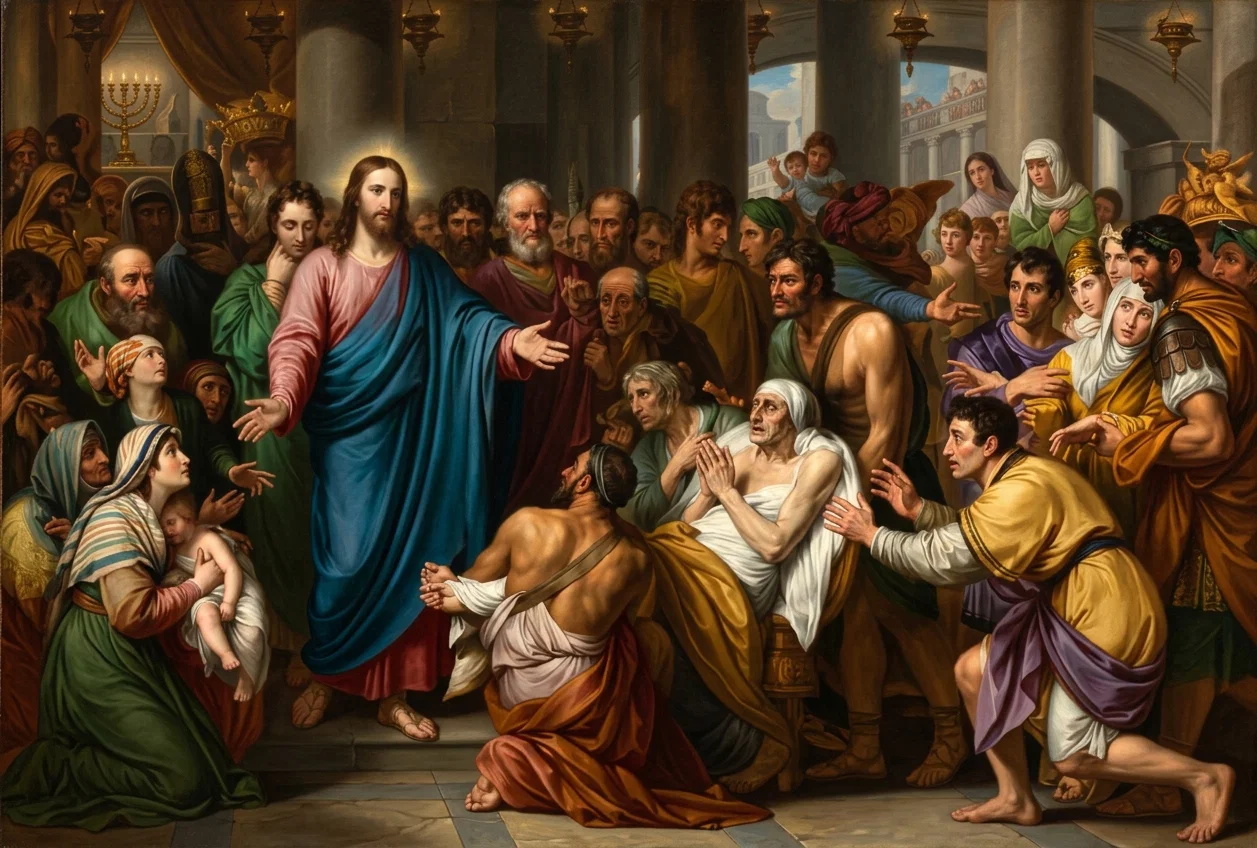
“The people pressed into Christ's presence with urgent, pitiful appeals” — Benjamin West, R.A.
Overpowered with terror, the priests and rulers had fled from the temple court, and from the searching glance that read their hearts. In their flight, they met others on their way to the temple, and bade them turn back, telling them what they had seen and heard. Christ looked upon the fleeing men with yearning pity for their fear and their ignorance of what constituted true worship. In this scene He saw symbolized the dispersion of the whole Jewish nation for their wickedness and impenitence.

Why They Fled

And why did the priests flee from the temple? Why did they not stand their ground? He who commanded them to go was a carpenter’s son, a poor Galilean, without earthly rank or power. Why did they not resist Him? Why did they leave the gain so ill acquired, and flee at the command of one whose outward appearance was so humble?
Christ spoke with the authority of a king, and in His appearance and in the tones of His voice there was that which they had no power to resist. At the word of command they realized, as they had never realized before, their true position as hypocrites and robbers. When Divinity flashed through humanity, not only did they see indignation on Christ’s countenance, they realized the import of His words. They felt as if before the throne of the eternal Judge, with their sentence passed on them for time and for eternity. For a time they were convinced that Christ was a prophet; and many believed Him to be the Messiah. The Holy Spirit flashed into their minds the utterances of the prophets concerning Christ. Would they yield to this conviction?
Repent they would not. They knew that Christ’s sympathy for the poor had been aroused. They knew that they had been guilty of extortion in their dealings with the people. Because Christ discerned their thoughts they hated Him. His public rebuke was humiliating to their pride, and they were jealous of His growing influence with the people. They determined to challenge Him as to the power by which He had driven them forth, and who gave Him this power.

As a Deliverer

Slowly and thoughtfully, but with hate in their hearts, they returned to the temple. But what a change had taken place during their absence! When they fled, the poor remained behind; and these were now looking to Jesus, whose countenance expressed His love and sympathy. With tears in His eyes, He said to the trembling ones around Him, Fear not; I will deliver thee, and thou shalt glorify Me. For this cause came I into the world.
The people pressed into Christ’s presence with urgent, pitiful appeals, Master, bless me. His ear heard every cry. With pity exceeding that of a tender mother, He bent over the suffering little ones. All received attention. Every one was healed of whatever disease he had. The dumb opened their lips in praise; the blind beheld the face of their Restorer. The hearts of the sufferers were made glad.
As the priests and temple officials witnessed this great work, what a revelation to them were the sounds that fell on their ears. The people were relating the story of the pain they had suffered, of their disappointed hopes, of painful days and sleepless nights. When the last spark of hope seemed to be dead, Christ had healed them. The burden was so heavy, one said; but I have found a,helper. He is the Christ of God, and I will devote my life to His service. Parents said to their children, He has saved your life; lift up your voice and praise Him. The voices of children and youth, fathers and mothers, friends and spectators, blended in thanksgiving and praise. Hope and gladness filled their hearts. Peace came to their minds. They were restored soul and body, and they returned home, proclaiming everywhere the matchless love of Jesus.

The Responsibility of the Priests

The crowd that had fled from the temple court, after a time slowly drifted back. They had partially recovered from the panic that had seized them, but their faces expressed irresolution and timidity. They looked with amazement on the works of Jesus, and were convicted that in Him the prophecies concerning the Messiah were fulfilled. The sin of the desecration of the temple rested, in a great degree, upon the priests. It was by their arrangement that the court had been turned into a market-place. The people were comparatively innocent. They were impressed by the divine authority of Jesus; but with them the influence of the priests and rulers was paramount. They regarded Christ’s mission as an innovation, and questioned His right to interfere with what was permitted by the authorities of the temple. They were offended because the traffic had been interrupted, and they stifled the convictions of the Holy Spirit.
Above all others the priests and rulers should have seen in Jesus the anointed of the Lord; for in their hands were the sacred scrolls that described His mission, and they knew that the cleansing of the temple was a manifestation of more than human power. Much as they hated Jesus, they could not free themselves from the thought that He might be a prophet sent by God to restore the sanctity of the temple. With a deference born of this fear, they went to Him with the inquiry, “What sign showest Thou unto us, seeing that Thou doest these things?”

The Sign

Jesus had shown them a sign. In flashing light into their hearts, and in doing before them the work that the Messiah was to do, He had given convincing evidence of His character. Now when they asked for a sign, He answered them by a parable, showing that He read their malice, and saw to what lengths it would lead them. “Destroy this temple,” He said, “and in three days I will raise it up.”
In these words His meaning was twofold. He referred not only to the destruction of the Jewish temple and worship, but to His own death,—the destruction of the temple of His body. This the Jews were already plotting. As the priests and rulers returned to the temple, they had proposed to kill Jesus, and thus rid themselves of the troubler. Yet when He set before them their purpose, they did not understand Him. They took His words as applying only to the temple at Jerusalem, and with indignation exclaimed, “Forty and six years was this temple in building, and wilt Thou rear it up in three days?” Now they felt that Jesus had justified their unbelief, and they were confirmed in their rejection of Him.
As referring to the temple at Jerusalem, the Saviour’s words, “Destroy this temple, and in three days I will raise it up,” had a deeper meaning than the hearers perceived. Christ was the foundation and life of the temple. Its services were typical of the sacrifice of the Son of God. The priesthood was established to represent the mediatorial character and work of Christ. The entire plan of sacrificial worship was a foreshadowing of the Saviour’s death to redeem the world. There would be no efficacy in these offerings when the great event toward which they had pointed for ages was consummated. When the Jews sealed their rejection of Christ by delivering Him to death, they rejected all that gave significance to the temple and its services. From that day sacrificial offerings and the service connected with them were meaningless.

Coming of Better Things

“In three days I will raise it up.” In the Saviour’s death the powers of darkness seemed to prevail, and they exulted in their victory. But from the rent sepulcher of Joseph, Jesus came forth a conqueror. “Having spoiled principalities and powers, He made a show of them openly, triumphing over them.” By virtue of His death and resurrection, He became the minister of the “true tabernacle, which the Lord pitched, and not man.” Men reared the Jewish tabernacle; men builded the Jewish temple; but the sanctuary above, of which the earthly was a type, was built by no human architect. “Behold the Man whose name is the Branch; . . . He shall build the temple of the Lord; and He shall bear the glory, and shall sit and rule upon His throne; and He shall be a priest upon His throne.”
The sacrificial service that pointed to Christ passed away; but the eyes of men were turned to the true sacrifice for the sins of the world. The earthly priesthood ceased; but we look to Jesus, the Minister of the new covenant, and “to the blood of sprinkling, that speaketh better things than that of Abel.” “The way into the holiest of all was not yet made manifest, while as the first tabernacle was yet standing; . . . but Christ being come an high priest of good things to come, by a greater and more perfect tabernacle, not made with hands, . . . by His own blood He entered in once into the holy place, having obtained eternal redemption for us.”

The Sabbath Through the Ages

II. The Sabbath During the Days of the Patriarchs

By Charles L. Taylor

The Sabbath from Eden

“The Sabbath was made for man.” As shown in the preceding article, the Sabbath as a great life-giving and life-saving truth was given to all men, throughout all ages and generations. God so appointed. Did His appointment miscarry?
Were there no affirmative evidence forthcoming, were both later Scripture and all history silent, were men left with absolutely no testimony other than the good word of God, which “can not be broken,” which is “yea” and “amen,” and which “shall not pass away,” the child of God could still know that the Edenic plan announced in Gen. 2:3 would be fully carried out: God spoke not in vain. The Sabbath which was made for mankind has been known to mankind throughout all the ages and generations which have come and gone. Like the glorious Gospel of which it is a part, it has known an unbroken history “from the foundation of the world,” and has always had its faithful observers and witnesses.

The Sabbath in the Patriarchal Age

The Patriarchal Age was no exception. During that age, extending from Adam to Moses, from Eden to Sinai, the Sabbath day was known and kept. Concerning this very important fact we are not left to mere assumption. Abundant testimony has been given, and of such character that upon it the child of God may rest his faith, for he finds running throughout it the golden chain of the Divine.
First, the witness of the Scriptures. While writing to the church relative to another thought, the apostle Paul incidentally gives an unanswerable argument showing that from Creation to Sinai the Sabbath was known, and that for its violation men were held responsible. After stating that sin was the cause of death (Rom. 5:12), he adds, “For until the law [that is, until spoken on Sinai] sin was in the world: but sin is not imputed when there is no law.” Verse 13. “For where no law is, there is no transgression.” Chap. 4:15. “Nevertheless, death reigned from Adam to Moses.” Chap. 5:14. Tracing out his thought, we find (a) death from Adam to Moses and, consequently, (b) sin from Adam to Moses and, consequently, (c) the law from Adam to Moses and, consequently, (d) the Sabbath from Adam to Moses.
The fact that the Sabbath is not specifically mentioned by Moses in his inspired account of those early days, is no argument that it was unknown. No other commandment is given specific notice, and yet no one will say that men were not held accountable for blasphemy, theft, or idolatry. The perfect law of God, of which the Sabbath was an important and inseparable part, was all there, and constituted then, even as now, the great standard of uprightness. By its holiness men were enabled to detect sin (Rom. 7:7), “for sin is the transgression of the law” (1 John 3:4), and by its perfection they could be converted. Ps. 19:7.

Abraham a Sabbath-Keeper

In the face of such divine logic, human reasoning must stand aside. The law existed and therefore the Sabbath existed. Menobeyed the law and therefore they kept the Sabbath. Of Abraham, “the friend of God” and the patriarch of faith, Jehovah said, “Abraham obeyed My voice, and kept My charge, My commandments, My statutes, and My laws.” Gen. 26:5. The same was true of Noah (Gen. 6:9; 7:1), and of all others who walked with God, and thus all honored the Creator in the honor which they showed to His Sabbath memorial.

The Week

One of the first stories with which the divine pages are filled, gives to us a distinct reference to the weekly cycle—the cycle for which the Sabbath alone is responsible. The record is, “And in process of time it came to pass, that Cain brought of the fruit of the ground an offering unto the Lord. And Abel, he also brought of the firstlings of his flock.” Gen. 4:3, 4. The offerings of Cain and Abel were unto the Lord and were made “in process of time,” or, as expressed in the margin, “at the end of days.” The “end of days” undoubtedly has reference to the end of the weekly cycle of days or the Sabbath, at which time the brothers came to worship God. The custom of making offerings upon the Sabbath, during holy time, was known throughout both the patriarchal and Levitical dispensations. See Num. 28:9, 10; Eze. 46:4, and kindred texts.
In harmony with this, Jamieson, Fausset, and Brown’s Commentary says that this happened “probably on the Sabbath.”

Origin and Meaning of the Week

Perhaps it may be in place to state here that aside from the appointment of the Sabbath as the conclusion and climax of the cycle of seven days, there is absolutely no reason to be found for the existence of the week. Appealing to the heavenly bodies, we discover laws for the day, the month, the year; but God’s word alone reveals the origin of the week, and in doing so, it reveals Jehovah’s Sabbath.
And this brings to view another and most wonderful fact. The weekly cycle with its closing day of Sabbath was known to all the great nations of antiquity, even from the time that nations first began to exist. Not only that, the records of nations that have been, as well as of nations that are, furnish unimpeachable testimony to the truth that the weekly cycle has come down to us from Eden unbroken and unchanged. The seventh day—the Sabbath—of the first week is the same seventh day and the Sabbath of this present week.

The Testimony of the Nations to the Sabbath

Speaking of “A Chart of the Week, Showing the Unchanged Order of the Days and the True Position of the Sabbath, as Proved by the Combined Testimony of Ancient and Modern Languages,” a copy of which the writer possesses, a leading writer has said: “It gives . . . the names of each of the days in the original language, the transliteration, and the translation into English in one hundred and sixty ancient and modern languages and dialects; and one hundred and eight of these languages know the seventh day by the name ‘Sabbath’ or its equivalent, while the entire number bear testimony to the identity and order of the days of the ancient and modern week.” “Their testimony is equally positive that the order of the days of the week is the same now as from the beginning of nations; that the seventh-day Sabbath came from God, and was once recognized by the nations as such, and that it is now recognized by the majority of the great nations by name.”—“The Lord’s Day the Test of the Ages,” pp. 20, 21.
And this is not all. Ancient records show that the seventh-day Sabbath was at one time actually observed by nations that afterward lapsed into idolatry. China, for example, in what is known as the “Book of Diagrams,” furnishes the following remarkable statement: “On the seventh day the passages are closed.” And one well qualified to speak, adds, “It is plainly to be seen that in the times of the ancient kings, on the day of the Sabbath, all classes kept at rest and observed it.” Similar testimony comes from Assyria and from a time more than five hundred years before Moses. The Assyrian word is from an account of Creation and reads,
“On the seventh day He appointed a holy day, And to cease from all business He commanded.”
Of the tablet from which these words are taken, Mr. H. Fox Talbot says, “The fifth tablet is very important, because it clearly affirms, in my opinion, that the origin of the Sabbath was coeval with Creation.”

The Sabbath Heritage

But why go further? God gave His Sabbath to mankind. By Adam, by Enoch, by Methuselah, by Noah, by Abraham, it was observed and passed on down to the nations. Well, indeed, had it been if those nations had proved faithful in its observance. That they did not the records plainly show, but the failure and its consequent idolatry and rank heathenism of all kinds should be to us who now live a spur to greater faithfulness in our service of Sabbath-keeping.
“The seventh day is the Sabbath of the Lord thy God.”
Continue reading: The Church