Pacific Press Publishing Association · Mountain View, California · May 7, 1912
"IF YE WILL INQUIRE, INQUIRE YE."
By Editor
This Inquirers' Department is conducted for the purpose of helping those who are studying the Bible. The answers are oftentimes only suggestive. They are never to be considered infallible, only as they agree with the infallible Word. The writer who may answer them does not consider that his opinion is infallible. He will simply give the best that he has, and plead with the inquirer to search the Word. Such questions only will be answered as, to the editors, seem to minister to the good of the readers and to the mission of the paper. We can not answer repeatedly in the same volume questions upon the same scripture. The name and address must accompany question, not for publication, but as an evidence of good faith, and that answer may be made by letter if deemed advisable. No letters are answered which do not contain the name of the writer. It is well always to enclose stamp for reply.
3747 — Making of Worlds
By Editor
Were the worlds made at one time, or was our earth made later than other worlds? And was the Sabbath kept before creation?
There are a great many things that God has not fully revealed to us, nor can eternity reveal them, because our minds are finite, while God in His works and His creation is infinite. We read in Gen. 1:1 that "in the beginning God created the heaven and the earth." Just how much time, as men look upon it, is covered in that expression "in the beginning," we do not know. It may be that all the various suns and worlds in space were created at one time. So far as the Scripture reveals, we know of nothing which would give us any information upon that point. Astronomers think that the evidence goes to show that some worlds are a great deal older than other worlds; but they are judging things wholly from this earth, that has been blasted by sin.
The term "worlds" itself, to which our questioner seemingly refers, in Heb. 1:2 and 11:3, does not mean world in the sense in which this earth is a world, a material globe, but refers to ages, a more literal translation of the Greek term. Some of these wonderful things we will have to leave to the study of the glorious eternity which lies before.
As to the Sabbath, we understand it to be a general law of God's universe adapted to all worlds for all worshiping creatures, a joy, a delight, a blessing.
3750 — Question on Tithing
By Editor
When a crop is harvested and sold, is it proper to pay tithe on the full amount, or would it be robbing God to first withdraw the necessary expense of raising and harvesting the crop, such as buying sacks for potatoes, for instance?
J. G. W.
That necessary expense would justly be taken from the sales before the amount was tithed. One does not take the value of his own time, however, from his work; but if it were necessary for him to hire a man to help him in the harvesting to the extent of $100 for instance, that would be deducted from it before the amount was tithed. That is not robbing God. That is a part of the expenses that are necessary to the harvesting of the crop, of which the man himself stands nine tenths, and God one tenth; consequently it is taken from the whole amount before the remainder is tithed.
Schedule for Week Ending May 18, 1912
3745 — The High Calling
By E. H.
What is the "high calling," and why is it called a mystery?
Our inquirer makes no reference to any passage of Scripture. The term "high calling" is used in Phil. 3:14,—"I press toward the mark for the prize of the high calling of God in Christ Jesus." This is referred to as the "heavenly calling" in Heb. 3:1, and as the "holy calling" in 2 Tim. 1:9, but in no case is the calling said to be a mystery. The high calling is God's call to character, to crown, and to victory, to be His child and His alone. The "mystery" is God's power in the Gospel which effects the work for which He has called us. As expressed in the context in Philippians 3, "Not as tho I had already attained, either were already perfect: but I follow after, if that I may apprehend [or lay hold of] that for which also I am apprehended [or was laid hold of] of Christ Jesus." God called Paul to salvation, to a special, particular work for Him, and laid hold of him for that call. Paul yields himself to Christ, that the power of the mystery of God may work out in him the very things to which God called him. And this power which thus works is the mystery of the Gospel set forth in Col. 1:26, 27. And in the soul that believes, that mystery develops "Christ in you, the hope of glory." No human mind can fathom it, no human mind can understand it, no human mind can comprehend it; but every soul can by faith apprehend it, or lay hold upon it, and God in His own wisdom and power will do the work.
3746 — Creed and Union
By Alonzo Trévier Jones
Is it necessary for man, or a combination of men, to formulate a creed to carry into effect 1 Cor. 1:10?
A. J. S.
The scripture reads as follows: "Now I beseech you, brethren, through the name of our Lord Jesus Christ, that ye all speak the same thing, and that there be no divisions among you; but that ye be perfected together in the same mind and in the same judgment." Now if the apostle Paul thought that a creed would bind the Corinthians together, why did he not give it? Why was it not given in the very first place, when they were converted, and the church was organized down at Corinth? Of course the obvious answer to this question is this,—that there is no form, or doctrine, or creed, that men may make which will bind souls together in the Lord Jesus Christ. One of the most fearful causes of division in the Christian church has been the formulation of creeds. If the Word of God were itself taken, and men would hold to that Word, there would be no need of creed. They would find ample room for growth in the development of the great truth of the Gospel; they would find eternal principles that would hold them to oneness in all essentials. But just as soon as the dead hands of men, the cold, inex-pansive creeds, are set to mold the faith of men, living souls are bound to break from them, and in breaking from them, of course gather around themselves other souls, sometimes mere discontents, and a new organization is formed; and in the history of the past, the new organization itself has formed a creed, and the same thing has been repeated through the ages. There is but one bond of union with the Lord Jesus Christ, and that is life union. There is but one mind to control any union with Him, and for this the apostle pleads: "Let this mind be in you, which was also in Christ Jesus." Only so can His children be of one mind and one heart. The creed bondage has been the curse of Christendom.
3748 — As the Angels
By Editor
Please explain Mark 12:25, "For when they shall rise from the dead, they neither marry, nor are given in marriage; but are as the angels which are in heaven." A. P. F.
It would seem to us that the text is about as plain as can be. It is the direct statement of our Lord that in that life to come the righteous, who rise from the dead, neither marry nor are given in marriage; and therefore we do not understand, as the question is asked, that there will be families on the earth, and that children will be reared. "Of the increase of His [Christ's] government and peace there shall be no end," reads Isa. 9:7; and that may be true, also, of the increase of subjects in His government. Just as long as eternity shall last, there will be more worlds created and more worlds peopled, and Christ is Lord of all. But we do not gather from this that that increase will come in the new earth as it does in this world, through physical generation.
Isa. 11:8, and other similar Old Testament passages, present before us in the language that people could understand at that time, the glories of the future, when all would be submitted to the Lord Jesus Christ. God would have wrought all those things for the Jews then, even on this earth, if they had all yielded to Him. But they did not. If they had done so, then His righteous rule would have brought final perfection, the poor would be judged with righteousness, and the meek of the earth with equity; but now all those things will be fulfilled in a far larger, greater measure when Christ shall come the second time. We certainly should understand these Old Testament scriptures as not contradictory to the words of our Lord.
Associations in the new earth would naturally have to do with associations here. We do not believe that God will take from those who are saved in the new earth the pleasant, helpful, uplifting associations of this world; and families who have struggled together for God and His truth, will be associated more closely, in the very nature of the case, in the world to come. For all who are saved in this world God will have great work to do. They will reveal to other worlds, yet uncreated, perhaps, and the inhabitants of other worlds, the wonderful glory and love of God. The true, high, holy pleasures of spiritual life will far transcend any of the sensual pleasures of this world.
3749 — A New Creation
By E. H.
When does the birth of the new creation take place?
When man fully accepts of the Lord Jesus Christ as his one and only Saviour, and God accepts him as His child. It may be said that in a far fuller sense this is true when man is raised from the dead, immortal. The real thing, after all, however, in any individual, is character; and man is born into the beginning of character when he is born from above. John 3:3-5 (margin). That development, of course, is a matter of growth in his Christian life. The resurrection of the body, or the changing from mortality to immortality, is just simply God's placing His own stamp upon the incorruptible character.
Our readings for the week lie wholly within 2 Chronicles, chapters 23 to 32, closing for the Sabbath reading with Psalms 39, 40, and 41. The record covers the reigns of the evil rulers, Athaliah, weak Joash, unstable Amaziah, wavering Ahaz; and the reigns of the good kings, among whom we count Jehoiada the priest, Uzziah, Jotham, and the great and good Hezekiah. Of wonderful interest are these names. We learn from them that doing duty brought blessing, departing from God brought strife and captivity and great loss. Some things might have been so different if men had remembered God. Yet how willing was He to turn to the help of His people when they sought Him with all the heart! How mightily He wrought for them! One can not help being sorry for Asa, in turning to the physicians instead of God in his latter years, after such a worthy reign; and also regarding the mistake and presumption of Uzziah. Very cheering and helpful are the psalms for this week. The 40th is especially prophetic of our Lord.
Our readings cover the last four chapters in 2 Chronicles, all of the first five chapters of Ezra which is given in our schedule, and Psalms 42 to 44. Chronicles sketches very rapidly the decline of the kingdom of Judah. Hezekiah prayed for an extension of life. In the fifteen years added to his life, Manasseh was born, one of the wickedest kings that Judah ever had; and his reign was one of the longest, 55 years. And yet he is a marvelous instance of God's wonderful mercy; for humbling himself after he was taken prisoner by the Assyrians, God restored him, Manasseh learned to know Him, and God accepted him. What is said to be his prayer is found in the Apocrypha. He was followed by Amon his son, a wicked king; and he by Josiah, one of the best and most devoted of kings, and one whom Jeremiah so lamented. After Josiah, came the swift descent of Judah under the reigns of Jehoahaz, Jehoiakim, Jehoiachin, and Zedekiah, until Jerusalem was utterly laid waste, and her holy house was burned.
In our lessons in Ezra we omit verses 3-63, inclusive, of the second chapter. They are simply a list of the names and number of the children of Israel that returned from the captivity. The whole book of Ezra is given to the return from the Babylonian captivity. First we have a decree of Cyrus as recorded in the first chapter, broad enough to cover all Israel, the ten tribes as well as the two, and the feeble response to that, of only 49,897, all told, returning. In chapter 4 we have a story of the work of the Samaritans, a mixed people who opposed the children of Israel in the building of the temple; and the stopping of their work in the building, caused by the king of Persia called Artaxerxes, who was really the false Smerdis, a usurper. His work was undone by kings that followed.
Psalms 42, 43, and 44 are psalms of encouragement to those who are downcast, especially Psalms 42 and 43, which begin with mourning and lamentation, but end with assurances and hope. From Psalm 44 Paul quotes in Romans 8. The writer of Psalm 44, looking upon Israel in her backslidden, persecuted condition, says, "We are accounted as sheep for the slaughter." But Paul lifts it above all these things, and declares in Romans 8, "Nay, in all these things we are more than conquerors through Him that loved us."
Feeding the Five Thousand
By Ellen G. White
By Mrs. E. G. White
CHRIST had retired to a secluded place with His disciples, but this rare season of peaceful quietude was soon broken. The disciples thought they had withdrawn where they would not be discovered; but as soon as the multitude missed the divine Teacher, they inquired, "Where is He?" Some among them had noticed the direction in which Christ and His disciples had gone, and soon an immense crowd was looking for Christ. Fresh additions were made to this number, until the congregation was composed of no less than five thousand men, besides women and children.
From the hillside Jesus looked upon the moving multitude, and His great heart of love and compassion was stirred with sympathy. Interrupted as He was, and robbed of His rest, He was not impatient. He saw a greater necessity demanding His attention as He watched the people coming, and still coming. He was "moved with compassion toward them, because they were as sheep not having a shepherd." Leaving His mountain retreat, He found a convenient place where He could minister to their spiritual destitution. They received no help from the priests and rulers; but the healing waters of life flowed from Christ as He taught the multitude the way of salvation.
The people listened to the words of mercy flowing so freely from the lips of the Son of God. They heard the gracious words, so simple and so plain that they were as the balm of Gilead to their souls. The healing of His divine hand brought gladness and life to the dying, and ease and health to those suffering with disease. The day seemed to them like heaven upon earth, and they were utterly unconscious of how long it was since they had eaten anything.
The Miracle Performed
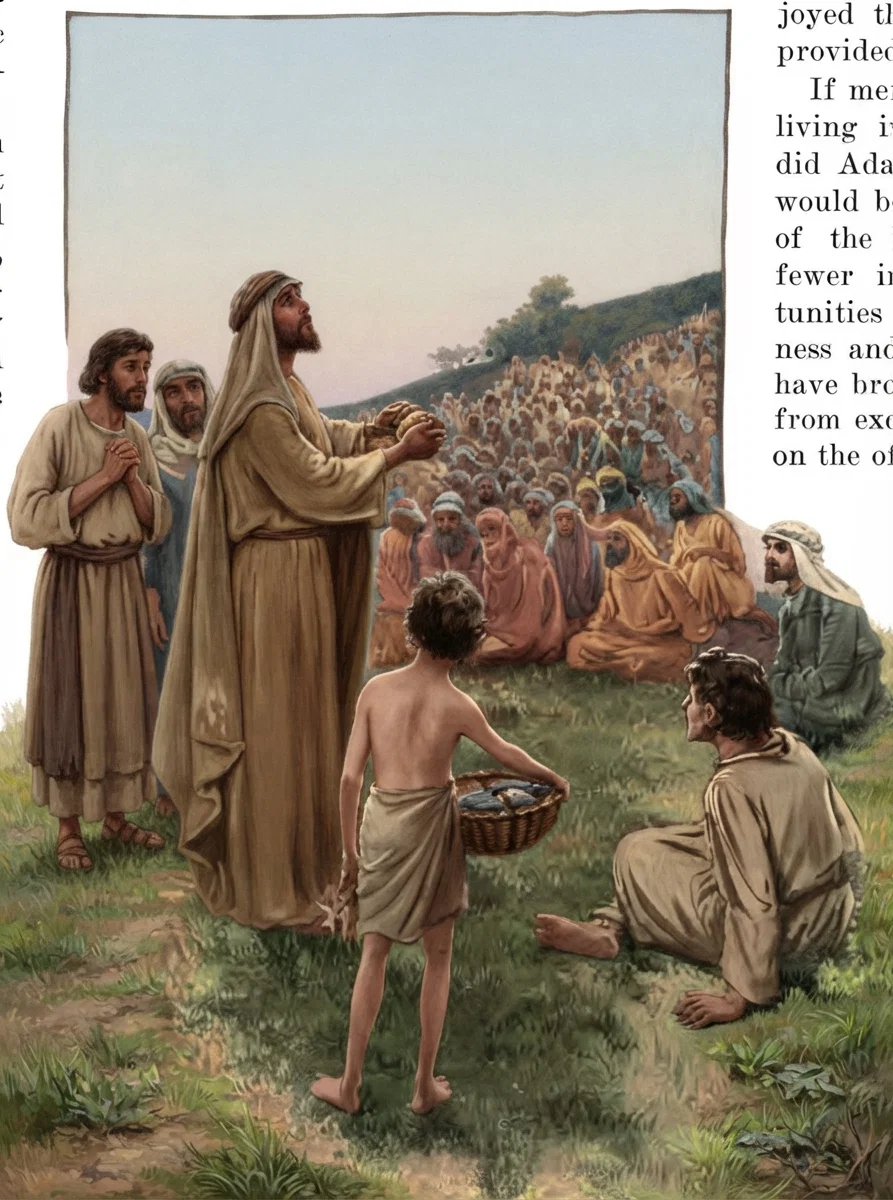
"And when the day was now far spent, His disciples came unto Him, and said, This is a desert place, and now the time is far passed: send them away, that they may go into the country round about, and into the villages, and buy themselves bread: for they have nothing to eat. He answered and said unto them, Give ye them to eat." Surprised and astonished, they say unto Him, "Shall we go and buy two hundred penny-worth of bread, and give them to eat? He saith unto them, How many loaves have ye? go and see. And when they knew, they say, Five, and two fishes. And He commanded them to make all sit down by companies upon the green grass. And they sat down in ranks, by hundreds, and by fifties. And when He had taken the five loaves and the two fishes, He looked up to heaven, and blessed, and brake the loaves, and gave them to His disciples to set before them; and the two fishes divided He among them all. And they did all eat, and were filled. And they took up twelve baskets full of the fragments, and of the fishes."
He who taught the people the way to secure peace and happiness was just as thoughtful of their temporal necessities as of their spiritual need. The miracle of the loaves shows us that God's dealings with His people are full of goodness and truth. The people were weary and faint. Many had been standing for hours.
"There is a lad here, which hath five barley loaves, and two small fishes," John 6:9.
They had been so intensely interested in Christ's words that they had never once thought of sitting down, and the crowd was so great that there was danger of their trampling upon each other. Jesus would give them a chance to rest, and He bade them sit down. They could sit down and rest in comfort; for there was much grass in the place. Christ arranged to give them all the rest they needed. O, how few understand the sympathy and love of Jesus!
Object of Miracles
Christ never worked a miracle except to supply a genuine necessity, and every miracle was of a character to lead the people to the Tree of Life, whose fruit is for the healing of the nations. The simple food passed around by the hands of the disciples contained a whole treasure of lessons. Christ could have spread before the people a rich repast if He had thought that this diet would convey the instruction essential for their souls. But food prepared for the gratification of perverted appetite would have conveyed no lesson for their good. Christ taught them, in this lesson, that the natural provisions of God for man had been perverted. And never did a people enjoy the luxurious feasts prepared for the gratification of perverted taste as this people enjoyed the rest and the simple food Christ provided so far from human habitations.
If men to-day were simple in their habits, living in harmony with nature's laws, as did Adam and Eve in the beginning, there would be an abundant supply for the needs of the human family. There would be fewer imaginary wants, and more opportunities to work in God's ways. But selfishness and the indulgence of unnatural taste have brought sin and misery into the world, from excess on the one hand, and from want on the other. A condition of things has been created which reveals that Satan has been leading others to partake of the fruit of the tree of knowledge, which the Lord prohibited Adam and Eve from eating.
The Continual Miracle
The book of nature should be studied by all. The soil is cultivated, and the seed is put into the ground. Then God, through His miracle-working power, sends the rain and sunshine, causing the seed to send forth, first the blade, then the ear, and then the corn in the ear. Thus the materials are provided from which man, using his God-given faculties, prepares the loaf which is placed upon the table. In this way God feeds thousands, and ten times ten thousand, a multitude which can not be numbered.
But men are accustomed to this process, and they drop God out of their thoughts, thinking that they themselves are doing the work. They do not give God the glory due to His name. But it takes just as much power to prepare the harvest which men garner as to make a few barley loaves serve for so many thousands. God gives us all that is needed to sustain life, and in so doing, He is daily working miracles. Were it not for these miracles, which are so graciously repeated in our behalf, we would be weary, hungry, starving, and dying. But God, full of mercy and compassion, constantly cares for us; and because there is no cessation of His goodness, because we are surrounded by His miracles, we cease to appreciate His continually increasing mercies. Fixing our eyes upon hu4man instrumentalities, we give the glory to men, and ascribe the miracles of God to natural causes. Men allow the enemy of God to lead them to glorify men in the place of praising their Creator. Many convert the rich provisions of nature into unnatural stimulants, and thus pervert the good things of God. They becloud the intellect, and wear out the delicate organs of the system, by the indulgence of the appetite. They banish God from their thoughts, and act as did the inhabitants of the Noachic world, polluting the earth by their sins. Thus man dishonors his God.
Gather Up the Fragments
After the miracle of feeding, there was an abundance of food left. But He who had all the sources of infinite power at His command said, "Gather up the fragments that remain, that nothing be lost." This lesson was twofold. Nothing is to be wasted. We are to let slip no temporal advantage. We should neglect nothing that will tend to benefit a human being. Let everything be gathered up that will relieve the necessity of earth's hungry ones.
Those who were at that feast so richly provided were to go forth and give to the needy the bread that Christ had provided to appease physical hunger, and they were to give them also the bread that cometh down from heaven, to satisfy the hunger of the soul. They were to repeat what they had learned of the wonderful things of God. Nothing was to be lost. Not one word that concerned their eternal salvation was to fall useless to the ground.
"Gather up the fragments that remain, that nothing be lost," meant more than putting the bread into the baskets. These words contain a precious spiritual lesson. We are to sink the shaft deep into the mines of truth, gathering out the precious ore, which is of more value than gold or silver or the costly dwellings of earth, with their expensive furniture.
A Lesson in Compassion
This miracle was evidence that Jesus is the world's Redeemer, that He possesses omnipotent power; and it is also a most precious lesson of His beneficence. Christ designed that it should teach His disciples the compassion and interest they should feel for their fellow men who were seeking to know the way of salvation. Interested efforts should be made, that those who are anxious to hear the word of life may have the opportunity. When weary and hungry, they should not be neglected. All that is possible should be done by their brethren, that none may be sent away faint, weary, and discouraged. It is a Christian duty to study the best ways of helping the people. No one is to make the way to Christ wearisome and objectionable. Remove everything that would obstruct the path.
"Is not this the fast that I have chosen?" the Lord asks,—"to loose the bands of wickedness, to undo the heavy burdens, and to let the oppressed go free, and that ye break every yoke? Is it not to deal thy bread to the hungry, and that thou bring the poor that are cast out to thy house? when thou seest the naked, that thou cover him; and that thou hide not thyself from thine own flesh? Then shall thy light break forth as the morning, and thine health shall spring forth speedily; and thy righteousness shall go before thee; the glory of the Lord shall be thy rereward. . . . If thou draw out thy soul to the hungry, and satisfy the afflicted soul; then shall thy light rise in obscurity, and thy darkness be as the noonday; and the Lord shall guide thee continually, and satisfy thy soul in drought, and make fat thy bones: and thou shalt be like a watered garden, and like a spring of water, whose waters fail not."
Man in the Kingdom
By Charles L. Taylor
By Charles L. Taylor
The saints of the Most High shall take the kingdom, and possess the kingdom forever, even forever and ever. Dan. 7:18.
MAN'S career began in a kingdom,—a kingdom of God upon earth. Man was the ruler; for God said to him, "Have dominion." The purpose of his creation was that he should rule,—"Thou madest him to have dominion over the works of Thy hands." Ps. 8:6.
"In the image of God," "upright," man was fitted, as a saint, as God's "holy one," to rule wisely and well. And given, through faith, the blessing of everlasting life, his kingdom was to be an everlasting kingdom, a dominion that should know no end.
Now, the fact that sin entered, has in no wise set aside that divine plan. Only temporarily have its provisions been set aside. As man was created to rule, so he shall rule. "Whatsoever God doeth, it shall be forever." Eccl. 3:14. Holy men were designed to control the earth, therefore holy ones "shall take the kingdom, and possess the kingdom forever, even forever and ever."
The Everlasting Kingdom
The everlasting kingdom has been kept before the mind of man all through the ages. It was shown to Abraham (Gen. 13: 14, 15; compared with Rom. 4:13), to Isaac (Gen. 26:2, 3), to Jacob (Gen. 28:13, 14), and to all the faithful ones who have identified themselves with God's earthly work. Heb. 11:12-16. To His people, through the prophet Micah, the Lord said, "Unto thee shall it come, even the first dominion; the kingdom shall come to the daughter of Jerusalem." Micah 4:8.
This same kingdom was revealed to King Nebuchadnezzar. Said Daniel to the great Babylonian monarch, "In the days of these kings shall the God of heaven set up a kingdom, which shall never be destroyed: and the kingdom shall not be left to other people, but it shall break in pieces and consume all these kingdoms, and it shall stand forever." Dan. 2:44. And let the student note how the Word of God each time emphasizes the thought that it is to continue forever.
Jesus spoke frequently of the time when His earth kingdom would be established. At that time He would come in glory and sit upon His throne (Matthew 25); then, also, His disciples would sit upon thrones, judging the twelve tribes of Israel (Matt. 19:28); then would be the time of final reward for all (Matt. 16:27); then, at that time, "shall the King say unto them on His right hand, Come, ye blessed of My Father, inherit the kingdom prepared for you from the foundation of the world." Matt. 25:34.
Character of That Kingdom's Subjects
The character of that kingdom is most fully portrayed by holy writ. It will be a kingdom of peace. Ps. 72:7, 8. Its Ruler will be "the Prince of Peace." Isa. 9:6, 7. God's glory and righteousness will flood and fill the whole earth. Hab. 2:14; 2 Peter 3:13. The Tree of Life and the River of Life will be there (Rev. 22:1, 2), Edenic beauty will be everywhere (Isa. 35:1, 2), and every trace of the curse will be forever removed (Rev. 22:3).
Is it not the restoration of the kingdom once given to Adam?
But that which is of deepest interest to us is the fact that the inhabitants of that new world are men and women and children who served the Lord Jesus upon earth. They have overcome, and "have washed their robes, and made them white in the blood of the Lamb." Rev. 7:14. "Therefore," continues the Word, "are they before the throne of God, and serve Him day and night in His temple." Verse 15. Their place in the kingdom has been determined by the character formed during the probation period. They were first saints in time, afterward saints in eternity.
A saint is a holy one. Saints, or holy ones, take the kingdom. Holiness is from God. A holy man is a godlike man, having God's nature. God is eternal. To be godlike is to be a "partaker of the divine nature" and therefore like God, eternal. Holy people are those who have everlasting life. Everlasting life belongs to an everlasting kingdom. Saints, holy ones, those who are everlasting, are rightly the ones to take the kingdom.
No Death in That Kingdom
Of that glory land it is said, "There shall be no more death." Rev. 21:4. "The inhabitant5shall not say, I am sick." Isa. 33:24. Why? Ah, because "the people that dwell therein shall be forgiven their iniquity." The absolute forgiveness and removal of sin takes away all that leads to sickness and death. Perfect holiness means perfect life. Holiness really signifies wholeness, and true wholeness stands for true health. Holiness is health. In that blessed country of holiness, the bloom of health, of life in its perfection, of life in the absolute, of life everlasting, will be upon every cheek.
When testing has brought an individual (who has everlasting life only relatively and in trust) to the point where he will not longer yield to temptation, where he can not find it in his heart to do wrong (see 1 John 3:9), then he has reached the ultimate of Christian integrity, and can safely be trusted with the life in the absolute. Such are those who will have a place in the world to come. Having learned to live righteously under stress of temptation, it is perfectly safe to trust them to live under the responsibility of immortality.
The new earth kingdom of Christ will have as subjects those who can not die any more (Luke 20:36), because they can not sin any more.
Immortality Bestowed
Immortality is to be bestowed upon the entire host of God's redeemed and loyal servants. As they come forth from the tomb at the great trumpet-call, they leave behind all mortality, all death, all decay. "In a moment, in the twinkling of an eye, at the last trump," "the dead shall be raised incorruptible." 1 Cor. 15:52. At the same moment are the righteous living transformed. The bodies of their humiliation are fashioned anew; and with glory within and without, in company with their immortal Redeemer, they are permitted to stand forever in the presence of God.
God "only hath immortality," says the Scripture. 1 Tim. 6:16. Undoubtedly this will always be true, so far as immortality has a fountainhead; but an eternal, unbroken connection with that fount will give to the children of God eternal enjoyment of the gift.
Hasten on, glad day! Come, Lord Jesus, come quickly! O that our God may speedily fulfil all His promises, and give His people soon to know the blessedness of life's final triumph, the crowning gift of immortality!
The Picture
By Halcyon Goodrich Morgareidge
By Halcyon Goodrich Morgareidge
The artist stood in the fading light,
Low o'er the easel bent;
And his keen eyes scanned the unfinished task,
Where light and shade were blent.
Long were the years since in manhood's prime
The picture was first begun.
Old were the hands that caressed it now,
In the light of the sinking sun.
He had dreamed, in youth, of a beautiful Face,
So human, yet so divine;
And he made this vow: he would strive to catch
On his canvas that Face sublime.
And he spent his days at the wonderful task,
Which momently sweeter grew,
And year by year the vision became
More clear to the master's view.
Now he was old, and the snows of age
Had settled upon his brow;
And the master was sad for his work undone
And his unkept youthful vow,
Nor knew that out from his own true eyes
The soul of the dream Face shone,
Nor dreamed that the beauty he longed to portray
Had daily become his own!
When the lowering sun's last rays had laid
Caresses upon his head,
The master sank by the easel's side,
And there they found him — dead,
His work unfinished; but no one thought
Of its incompleteness, because
Each whispered to each, with aching heart,
"How Christlike our master was!"
Healing Not a Sign
LET it be understood once for all that the mere healing of the sick is no sign or evidence that the one or ones who heal are doing God's work or presenting God's truth.
If healing the sick is evidence of a divine mission, then the healing mediums of "Spiritualism," hypnotic healers, magnetic healers, "Christian Science" physicians, the late Mr. Dowie of Chicago, and others, have good claims to present, and evidences to prove their claim. Even now men are saying of more or less of these as was said of one of old, "This man is the great power of God." Acts 8:10.
We would not for a moment intimate that there is not divine healing. There is; there has been since sickness came through the curse of sin. In regular ways, in wonderful, marvelous ways, has God healed the sick; and He has given to His church His gift of healing power, if by faith and holy living they will use it to His glory. But the manifestation of healing power or wonder-working is not the evidence that God is with the worker.
The apostle Paul declares that in the last days, just before Christ's coming, Satan will work "with all power and signs and lying wonders, and with all deceivableness of unrighteousness in them that perish." 2 Thess. 2:9, 10. Now all power and signs and lying wonders must include that of healing, after which the whole great sick world is seeking, the most of whom do not question as to the character of the means. Again we read that last-day wonders are wrought by the spirits of demons "working miracles." Rev. 16:13, 14. And Jesus tells us that many will come to Him in that day,
saying, "Lord, Lord, did we not prophesy by Thy name, and by Thy name cast out demons, and by Thy name do many mighty works? And then will I profess unto them, I never knew you: depart from Me, ye that work iniquity." Matt. 7:22, 23.
These passages show clearly two things: (1) that there will be many last-day signs and miracles wrought, among them healing, which are not of God; and (2) that the true and only test is obedience to God's holy law. Those who are guilty of "iniquity," lawlessness, law-breaking, will not be known of Him. Healing of the body is important; healing of the soul, bringing the character into harmony with God, is infinitely more important. One may follow a "healer" to eternal death.