Your ShelfYour Projects

Signs of the Times, Vol. 42, No. 21.

A WORLD-WIDE EXPECTANCY

Signs of the Times

May 25, 1915

Pacific Press Publishing Association · Mountain View, California · May 25, 1915

A WORLD-WIDE EXPECTANCY

An Irresistible Conviction Coming over the World—All Classes of Men Everywhere Share It—Even the Heathen Nations Aroused
By Lee S. Wheeler
© Baltimore American
AMONG the most significant phenomena of our age is the general apprehension that mankind is nearing the great finale of earth’s prophetic scenes, Armageddon, the second coming of Christ, the end of the world. This great expectation is the more remarkable because it is not so much the result of what has been said or is being said, as it is of what is seen and felt; a conviction born of fear and alarm at the sudden veering of events toward threatening destruction; a premonition arising from the desolations of earthquakes, the calamities of an almost universal war, and the terrors of famine and pestilence, mixed with a consciousness of the striking similarity between what the world is now witnessing, and what God has foretold in His word.
The impression which the present reverses of our woe-stricken world are producing upon the minds of men is illustrated by the accompanying cartoon, which appeared in a recent issue of the Baltimore American. The newspaper artist paints the very words of our Lord as found in Matt. 24:7, upon the clouds that overhang a scene of devastation; and a giant hand protruding from the rent earth, points to the divine prophecy. Underneath he asks a question that has come instinctively to the hearts of thousands: “Can these be ‘signs of the times’?”

Cardinal Expects End of World

Press dispatches from Baltimore on February 17 said: “The Scriptures prophecy of the conditions that shall prevail near the end of the world, seems to be in process of fulfilment , according to a statement made to-day by Cardinal James Gibbons. He was commenting upon the war news from Europe, which he said was terrible.”
“We cannot grasp its magnitude or what it means,” he said. “Does it not seem that the Scriptures are being fulfilled—‘Nation shall rise against nation, and there shall be sorrow throughout the world, and then shall the end come’?”
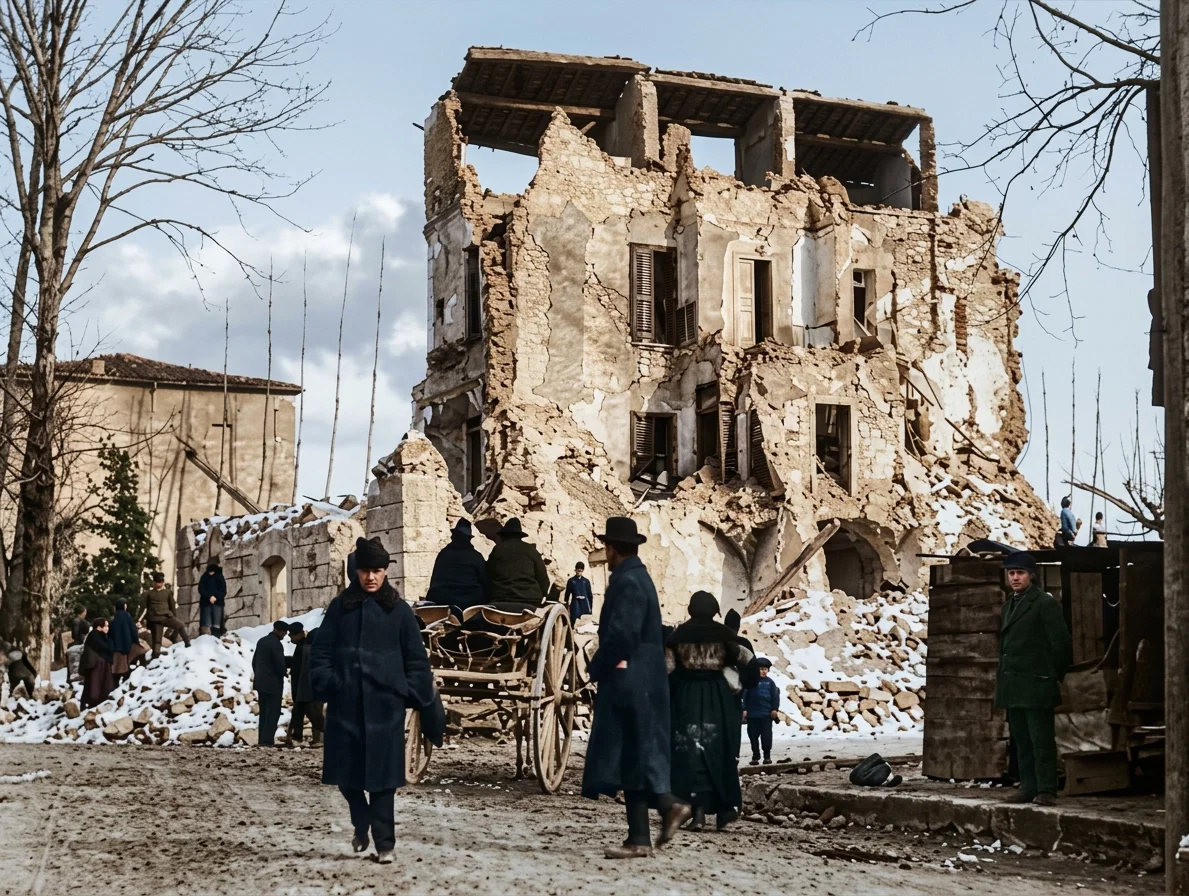
It may seem significant also that those countries most affected by these deplorable afflictions, as Belgium and Poland, are those which have adhered most faithfully to the Catholic religion. While these have been shattered by war, the very throne of the pope has been shaken by the ravages of earthquake in Italy, where a hundred thousand persons have been destroyed by such disasters since the opening of the twentieth century. Ominous already of prophetic wrath,
“Pale superstition flees the bloodstained sod, And wondering nations see the day of God.”

Turks Believe the End Near

Dr. G. Ermain, who has lived as a missionary among the Turks, writing to the Review and Herald, Washington, D. C., of the expectation which prevails among them with reference to the closing events of the age, says: “From my personal experience, I can say that the Turks generally believe that the end of the world is very near. They seem to believe this more firmly than most of the nominal Christians.”
In his book entitled “Kismet,” Mr. Macfarlane, referring to such belief among these people, says: “The Turks seem generally to be convinced that their final hour is approaching. ‘It is kismet. We cannot resist destiny.’ I heard words to this effect from many Turks, in Asia as well as in Europe.” — Page 409.

To March to Jerusalem

A few years ago, it was reported from Constantinople that a company of Turks from the Transcaucasus had arrived in Nicomedia, bringing all their possessions with them. When asked if they were intending to settle in that part, they replied that they would settle nowhere permanently, as they had come to follow their leader (the sultan) when he should leave Constantinople to go to Jerusalem. This incident shows the singular impression which has long possessed the Turkish mind, that they would have to flee to Jerusalem before the end of the world. Dan. 12:1-3.

Many Had Dreams

SICILIAN EARTHQUAKE RUINS, 1908
Work of Earthquake in Sora, Italy, 1915
Dr. Donald Carr, in speaking of mission experiences in Persia, relates that “a Mohammedan dreamed that Christ was coming soon again. He told his brother, who had the same dream.They went to a friend. He had had the same dream. The three set out to find some one to teach them.” On the way, they met a converted robber who had received the knowledge of the gospel from an Arabic Bible found one day among the loot. This man directed them to the mission hospital, where they are now receiving instruction.
“Another man dreamed he saw a vision of a shining person who directed him a certain way. He felt that this was Jesus Christ, and told a friend, who agreed to go with him in search of light. They went two days’ journey to where a white man was, and asked him, expecting that he was a Christian; but he told them he could not help them. They traveled six days to another place with the same result. Finally they came to the mission, where the workers received them gladly and taught them.”
Are not these things in fulfilment of Joel’s prophecy of the outpouring of the Spirit “before the great and the terrible day of the Lord”? Joel 2:28-32.

The Heathen Awakening

In China last year three and a half million copies of the Bible and of portions of it were put into circulation. The story is told of a native teacher who came five hundred miles for a load of Bibles, which he took back on a wheelbarrow and distributed among his people.
Pastor R. C. Porter, in charge of mission work in that great country, in a published account, says: “New fields are most piteously calling for the message. One whole tribe of four thousand is appealing for teachers. Four hundred of them have forsaken their idols. In Pastor Hsi’s territory, hundreds are seeking for more light, in view of the signs which indicate the rapidly approaching end of all things.”

The Great Expectation

When Christ appeared in the world the first time, it is said in the New Testament that “the people were in expectation.” Luke 3:15. The Scriptures had been translated into the Greek language and scattered widely. Many among the nations of that day had pondered the prophecies of the coming Messiah, and were anxiously watching for His appearance.
“When Jesus was born in Bethlehem of Judea in the days of Herod the king, behold, there came wise men from the east to Jerusalem, saying, Where is He that is born King of the Jews? for we have seen His star in the east, and are come to worship Him.” Matt. 2:1-3. It was this general feeling, and the strange experience of the wise men, which so aroused the apprehensions of the crafty Herod. “He was troubled, and all Jerusalem with him.”
The historians “Tacitus, Suetonius, and Josephus speak expressly of this expectation as being very general throughout the east. . . . Virgil alludes to this expectation, and uses almost the very language of some of the prophets respecting the Messiah.” See Wharey’s “Church History,” pages 14-17.

Signs Produce Another Expectation

That the second coming of Christ will be preceded by a similar general expectation throughout the world is plainly taught by the Scriptures. Not only the proclamation of His advent as a prominent feature of the gospel of the kingdom, is to be given in all the world for a witness, before the end comes, but also the nature of the events which were set forth by Jesus as signs of His coming, is such as to stir the world with awe. Said He:
“There shall be signs in sun and moon and stars; and upon the earth distress of nations, in perplexity for the roaring of the sea and the billows; men fainting for fear, and for expectation of the things which are coming on the world. . . . But when these things begin to come to pass, look up, and lift up your heads; because your redemption draweth nigh.” Luke 21:25-28, A. R. V.
Such concussion of nature, such signal occurrences, are clearly intended to arouse the church from its lukewarm Laodicean state, and intensify its missionary love, “to serve the living and true God; and to wait for His Son from heaven.” 1 Thess. 1:9, 10.

A Striking Resemblance

By G. D. Ballou
IN the April number of the Geographical Magazine, the leading article, on “Castles in the Air, or Experiences and Journeys in Unknown Bhutan,” by John Claude White, an official of the British government, notes some most striking resemblances between the mixed Buddhistic and heathen ritual and the Roman Catholic forms of worship.
On page 382 occurs a picture of one of their shrines, with a venerable lama in front counting his beads. I quote from the next page:
“The form of worship has a curious resemblance, in many particulars, to that of the Catholic Church. On any of their high holy days, the intoning of the chief lama conducting the service, the responses chanted by the choir, sometimes voices alone, sometimes to the accompaniment of instruments, where the deep note of the large trumpet strangely resembles the roll of an organ, the ringing of the bells, burning of incense, the prostrations before the altar, the telling of beads, and burning of candles, the processions of priests in gorgeous vestments, and even the magnificent altars surmounted by images and decorated with gold and silver vessels, with lamps burning before them, even the side chapels with the smaller shrines where lights burn day and night, add to the feeling that one is present at some high festival in a Catholic place of worship.”
“I have been present at the services on feast days in the temples in Sikkim, Bhutan, and in Lassa, and no great stretch of imagination was required to imagine myself in a Catholic cathedral in France or Spain, especially the latter. There is also some resemblance in the dress and vestments of the priests and lamas, and even in some of their customs. Many of them go entirely into seclusion, and they also have certain periods of time devoted to prayer, corresponding to a retreat, during which they see no one.”
Bhutan is in the northernmost section of India, up under and on the slopes of the Himalaya Mountains, far out of the reach of all modern influences, thus making it clearly evident that both of these ancient systems were fashioned after the same original pattern.

Earnestness and Bluster

“THERE are some people who can never see the difference between earnestness and bluster. The latter raises more dust and makes more noise. We are not sure that it does not get more praise. The former is more quiet, but it holds on. Its vision takes a longer and wider sweep. It is thoughtful in the adaptation of means to ends. Be earnest, but don't bluster. It is to earnestness that the world's progress is mainly due.”

A Rule for Sojourning Well

“It is a good and safe rule to sojourn in every place as if you meant to spend your life there, never omitting an opportunity to do a kindness or speak a true word, or make a friend. Seeds thus sown by the wayside often bring forth abundant harvest.”

THE FOOLISH RICH MAN

The Master Impressed the Essentials—Temporary Inheritance Too Small to Absorb Us—Well Filled Barns and Granaries Suddenly Lose Their Value
By Mrs. E. G. White
CHRIST was teaching; and as usual, others besides His disciples had gathered about Him. He had been speaking to the disciples of the scenes in which they were soon to act a part. They were to publish abroad the truths He had committed to them, and they would be brought in conflict with the rulers of this world. For His sake they would be called into courts, and before magistrates and kings. He had assured them of wisdom which none could gainsay. His own words, that moved the hearts of the multitude, and brought to confusion His wily adversaries, witnessed to the power of that indwelling Spirit which He had promised to His followers.

WOULD BORROW HIS POWER FOR WORLDLY GAIN

But there were many who desired the grace of heaven only to serve their selfish purposes. They recognized the marvelous power of Christ in setting forth the truth in a clear light. They heard the promise to His followers of wisdom to speak before rulers and magistrates. Would He not lend His power for their worldly benefit?
“And one of the company said unto Him, Master, speak to my brother, that he divide the inheritance with me.” Luke 12:13. Through Moses, God had given directions concerning the transmission of property. The oldest son received a double portion of the father's estate (Deut. 21:17), while the younger brothers were to share alike. This man thinks that his brother has defrauded him of his inheritance. His own efforts have failed to secure what he regards as his due; but if Christ will interpose, the end will surely be gained. He has heard Christ's stirring appeals, and His solemn denunciations of the scribes and Pharisees. If words of such command could be spoken to this brother, he would not dare to refuse the aggrieved man his portion.

INHERITANCE ABSORBED HIM

In the midst of the solemn instruction that Christ had given, this man had revealed his selfish disposition. He could appreciate that ability of the Lord which might work for the advancement of his own temporal affairs; but spiritual truths had taken no hold on his mind and heart. The gaining of the inheritance was his absorbing theme.
Jesus, the King of glory, who was rich, yet for our sake became poor, was opening to him the treasures of divine love. The Holy Spirit was pleading with him to become an heir of the inheritance that is “incorruptible, and undefiled, and that fadeth not away.” 1 Peter 1:4. He had seen evidence of the power of Christ. Now the opportunity was his to speak to the great Teacher, to express his desire uppermost in his heart. So, like the man with the muck-rake in Bunyan's allegory, his eyes were fixed on the earth. He saw not the crown above his head. Like Simon Magus, he valued the gift of God as a means of worldly gain.

REFUSED TO BE JUDGE OR DIVIDER

The Saviour's mission on earth was fast drawing to a close. Only a few months remained for Him to complete what He had come to do, in establishing the kingdom of His grace. Yet human greed would have turned Him from His work, to take up the dispute over a piece of land. But Jesus was not to be diverted from His mission. His answer was, “Man, who made Me a judge or a divider over you?” Luke 12:14.
Jesus could have told this man just what was right. He knew the right in the case; but the brothers were in a quarrel because both were covetous. Christ virtually said, It is not My work to settle controversies of this kind. He came for another purpose, to preach the gospel, and thus to arouse men to a sense of eternal realities.

PROPERTY POSSESSIONS OF SECONDARY IMPORTANCE

Our Lord struck at the root of the affair that troubled this questioner, and of all similar disputes, saying, “Take heed, and beware of covetousness: for a man's life consisteth not in the abundance of the things which he possesseth.”
“And He spake a parable unto them, saying, The ground of a certain rich man brought forth plentifully: and he thought within himself, saying, What shall I do, because I have no room where to bestow my fruits? And he said, This will I do: I will pull down my barns, and build greater; and there will I bestow all my fruits and my goods. And I will say to my soul, Soul, thou hast much goods laid up for many years: take thine ease, eat, drink, and be merry. But God said unto him, Thou fool, this night thy soul shall be required of thee: then whose shall those things be, which thou hast provided? So is he that layeth up treasure for himself, and is not rich toward God.” Luke 12:15-21.

THE RICH MAN PERPLEXED

By the parable of the foolish rich man, Christ showed the folly of those who make the world their all. This man had received everything from God. The sun had been permitted to shine upon his land; for its rays fall on the just and on the unjust. The showers of heaven descend on the evil and on the good. The Lord had caused vegetation to flourish, and the fields to bring forth abundantly. The rich man was in perplexity as to what he should do with his produce. His barns were full to overflowing, and he had no place to put the surplus of his harvest. He did not think of God, from whom all hismercies had come. He did not realize that God had made him a steward of His goods, that he might help the needy. He had a blessed opportunity of being God's almoner, but he thought only of ministering to his own comfort.
The situation of the poor, the orphan, the widow, the suffering, the afflicted, was brought to this rich man's attention; there were many places in which to bestow his goods. He could easily have relieved himself of a portion of his abundance, and many homes would have been freed from want, many who were hungry would have been fed, many naked clothed, many hearts made glad, many prayers for bread and clothing answered, and a melody of praise would have ascended to heaven. The Lord had heard the prayers of the needy, and of His goodness He had prepared for the poor. Ps. 68:10. Abundant provision for the wants of many had been made in the blessings bestowed upon the rich man. But he closed his heart to the cry of the needy, and said to his servants: “This will I do; I will pull down my barns, and build greater; and there will I bestow all my fruits and my goods. And I will say to my soul, Soul, thou hast much goods laid up for many years; take thine ease, eat, drink, and be merry.”

NO HIGHER THAN THE BEASTS

This man's aims were no higher than those of the beasts that perish. He lived as if there were no God, no heaven, no future life; as if everything he possessed were his own, and he owed nothing to God or man. The psalmist described this rich man when he wrote, “The fool hath said in his heart, There is no God.” Ps. 14:1.
This man has lived and planned for self. He sees that the future is abundantly provided for; there is nothing for him now but to treasure and enjoy the fruits of his labors. He regards himself as favored above other men, and takes credit to himself for his wise management. He is honored by his fellow townsmen as a man of good judgment and a prosperous citizen. For “men will praise thee, when thou doest well to thyself.” Ps. 49:18.
But “the wisdom of this world is foolishness with God.” 1 Cor. 3:19. While the rich man is looking forward to years of enjoyment, the Lord is making far different plans. The message comes to this unfaithful steward, “Thou fool, this night thy soul shall be required of thee.” Here is a demand that money cannot supply. The wealth he has treasured can purchase no reprieve. In one moment that which he has toiled through his whole life to secure becomes worthless to him. “Then whose shall those things be, which thou hast provided?” His broad fields and well-filled granaries pass from under his control. “He heapeth up riches, and knoweth not who shall gather them.” Ps. 39:6.

LACKED THE ONE THING OF VALUE

The only thing that would be of value to him now, he has not secured. In living for self, he has rejected that divine love which would have flowed out in mercy to his fellow men. Thus he has rejected life. For God is love, and love is life. This man has chosen the earthly rather than the spiritual, and with the earthly he must pass away. “Man that is in honor, and understandeth not, is like the beasts that perish.” Ps. 49:20.
To live for self is to perish. Covetousness, the desire of benefit for self's sake, cuts the soul off from life. It is the spirit of Satan to get, to draw to self. It is the spirit of Christ to give, to sacrifice self for the good of others. “And this is the record, that God hath given to us eternal life, and this life is in His Son. He that hath the Son hath life; and he that hath not the Son of God hath not life.” 1 John 5:11, 12.
Wherefore He says, “Take heed, and beware of covetousness: for a man's life consisteth not in the abundance of the things which he possesseth.”

Recalled from Dust

By MABEL CORINE CRAKER
Some men select with pride the paths that yield The greatest influx of earth's shining gold. Their hopes attained, great power can they wield; Yet Death within his robes their forms will fold. Some others crave that Fame with mystic touch Their names will place upon some height renowned. Still yearning for a higher cliff to clutch, To dust their souls return, though honor crowned. And others trip o'er paths with flowers strewn. Infused with pleasure, and to fashion wed, Their days are spent. Departing at life's noon, They, too, are numbered with the passing dead.
The toilers at the mill, the herdsmen lone, The plowmen severing the hardened clods, The woodmen by whose skill huge timbers groan, The weary ones who bear the weighty hods, And those who guide the liners o'er the deep That forms a highway for each race and tribe, The mother whose low song induces sleep, And play-worn thoughts away to dreamland glide, The prisoner who long in anguish lies, The dancing maid whose agile motions lure, The villain who malicious poison gives, The man of morals, and the Christian pure,— Each, all, ere long, to ashen dust return; And we who gaze upon their sunken mounds, Propound the question ages-frayed and stern, “Are bare six feet of earth men's final bounds?”
Did Christ, the great Creator, make of dust A being who could laud His praises o'er, A creature who upon his God should trust, And yet that God, unmindful, lock the door, And keep him in Death's chamber dark and cold? Ah, no! 'Tis Christ that owns the master key. No somber tomb its righteous dust can hold When He in glory comes to set men free. The modulations of His mighty voice With power charged, by fervent love installed, New life impart. The risen saints rejoice. Theirs that immortal thrill — from dust recalled!

Papal Prophetic Period

What Events Marked Its Beginning? What Marked Its Close?
By Calvin P. Bollman
The papacy is at once a spiritual, an ecclesiastical, and a political power. In all its phases it is a growth, a development.
In the spiritual and ecclesiastical realms, the “mystery of iniquity” was working even as early as Paul’s day.
The political phase had its beginning in the time of Constantine, but was not fully developed until the pope became a temporal sovereign, about the middle of the eighth century.
It is less easy to trace the development of the spiritual phase; but as an ecclesiastical power, the papacy may be said, not indeed to have been established, but to have attained its majority, with the letter or decree of Justinian styling the bishop of Rome “head of all the churches,” A.D. 533. As the logical result of this decree, the pope was a few years later declared also “corrector of heretics,” by the same emperor.

“HEAD OF ALL THE CHURCHES”

But at the time the title, “head of all the churches,” was conferred upon the pope, the ambitions of that bishop were still strenuously opposed, as they had long been, by the Arian kingdoms, of which two still survived, the Vandals in Africa, and the Ostrogoths in Italy.
The very year Justinian’s decree was issued, Carthage, the Vandal capital, was overthrown; but not until three years later was the subjugation of the Vandals complete. At this time, the Ostrogoths ruled Italy from their capital at Ravenna, refusing to acknowledge the pretensions of the bishop of Rome.
In 537 Vitiges and his Goths laid siege to Rome itself in an effort to recover it from Belisarius. The next year,—namely, 538,—the siege was raised by Belisarius, the Goths sustaining a crushing defeat, from which they never fully recovered. Still they maintained their national existence fifteen years longer, during which time they carried on a more or less intermittent warfare with the forces of Justinian.

BEGINNING OF HER SUPREMACY

But so far as any effective national opposition to the claims of the papacy, was concerned, it ended in 538. From that year, therefore, we may reckon the 1,260 years of papal supremacy.
That these were eventful days is abundantly testified. Of the era of Justinian, Finlay remarks, “The unerring instinct of mankind has fixed on this period as one of the greatest in man’s annals.” And again he says, “With the conquest of Rome by Belisarius [A.D. 536], the history of the ancient city may be considered as terminating; and with his defense against Vitiges [A.D. 538] commences the history of the Middle Ages, of the time of destruction and of change.”

THE FRENCH REVOLUTION BRINGS THE CLIMAX

As the supremacy of the papacy was due to two specific acts,—first a decree, and five years later a military campaign making effective the decree,—so the close of the 1,260 years of that supremacy is marked by two events separated by a period of five years.
It will not be denied by any one, that the French Revolution was quite as much a revolt against the abuses of the Roman Catholic Church as against abuses under the civil government of Louis XVI. In 1793 the States-General of France, desiring to go to the root of the whole trouble, decreed the abolition not only of the state church, but of the whole papal system, and even of Christianity itself. Five years later,—namely, 1798,—a French army under General Berthier captured the city of Rome, declared the papacy abolished, established a republic in the states of the church in its stead, and carried the pope a prisoner to France.

NOT THE ONLY POPE DEPOSED

It is true, as is sometimes said, that Pius VI was not the only pope forcibly deposed from the papal office and deprived of his liberty; but he is the only one ever so deposed and imprisoned with the avowed object of abolishing the whole papal system. It is for this reason that the act of Berthier in 1798 stands forth preeminent as marking the end of the 1,260 years of papal supremacy, the giving of the deadly wound of Rev. 13: 10, the leading into captivity of the head of that system which had for centuries condemned millions to imprisonment and to death.

The Merciful Obtain Mercy

Must Forgive if We Would Be Forgiven
By Rufus A. Underwood
This is the fifth of several short articles by Elder Underwood on the fundamentals of the gospel as set forth in the Sermon on the Mount. The article next week will dwell upon the blessing of the Master on heart purity.
“BLESSED are the merciful; for they shall obtain mercy.” Matt. 5:7. To be merciful is to treat the offender better than he deserves. The sinful heart is not so inclined. It demands an eye for an eye, or to return a little heavier blow than is received. The world’s policy is to win by might, rather than by the rule of Christ’s gospel.
Christ places before all men a settled rule of action, by which He seeks to win His enemies to accept the principles that will govern the eternal kingdom of peace; and those only who choose to act upon the principles, can be admitted into that everlasting kingdom. Those who choose to show no mercy to others, decide their own destiny, and can receive no mercy at the hands of the Judge in the final assize of all men.

UNLESS WE FORGIVE

This principle is made clear in the Scriptures. Christ says: “When ye stand praying,forgive, if ye have aught against any: that your Father also which is in heaven may forgive you your trespasses. But if ye do not forgive, neither will your Father which is in heaven forgive your trespasses.” Mark 11:25, 26.
Again in James 2:13: “For he shall have judgment without mercy, that hath showed no mercy; and mercy rejoiceth against judgment.” No man can expect that God can forgive him or answer his prayers while he holds the spirit of hatred in his heart against any man. We must forgive if Heaven forgives us.

A DANGEROUS PRAYER

How often, in repeating the Lord’s Prayer, “Forgive us our debts, as we forgive our debtors,” men pray for their own condemnation in the Judgment!
But says one, “That is a dangerous prayer, and I never pray it.” It matters not whether we repeat the words or not, so long as in our hearts we refuse to forgive those who may have trespassed against us.
However, it is vain to think that the unregenerated heart will carry out this divine principle of mercy, unless the individual has taken the steps that antedate the experiences brought to view in the forgiveness of our enemies. And why?—“Because the carnal mind is enmity against God: for it is not subject to the law of God, neither indeed can be. So then they that are in the flesh cannot please God.” Rom. 8:7, 8.
However, if the four steps preceding this requirement have been taken, as set forth in Christ’s Sermon on the Mount, the way is easy, and divine love implanted in the soul makes it possible for an individual to forgive another, no matter what the personal wrong has been which he has committed. None but a regenerated heart can understand this divine principle.
If bitterness and hatred, in the form of grudges and enmity toward our fellow beings, still linger in our hearts, we have need to seek God earnestly, that the work of regeneration may be made complete and thorough in our souls; for these are the conditions upon which the Saviour of the world has made it possible for us to share in the kingdom of eternal glory.

God's Aeroplanes

Messengers of Mercy, Light, and Power
By George Burt Starr
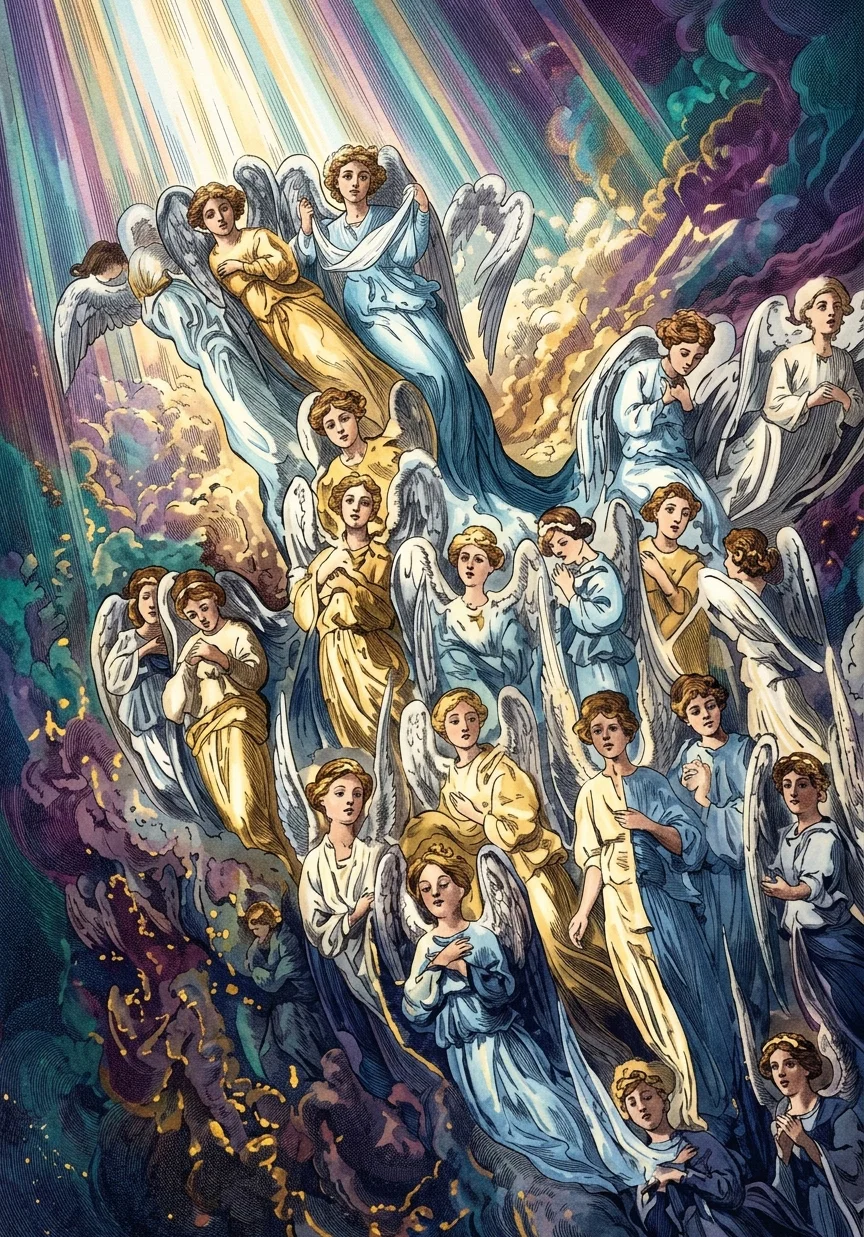
“The chariots of God are twenty thousand, even many thousands of angels” (Ps. 68: 17, margin), or “thousands upon thousands.” A. R. V.
These chariots of God, composed of living angels, are all chariots of salvation sent from heaven upon errands of mercy to the lost, to assist mightily in their salvation, to rescue them from evil angels, to deliver them from a thousand unseen dangers, and to save those who are heirs of salvation from falling into sin,—into the traps laid by the enemy of their souls.

To Save and Not to Destroy

These are the first real aeroplanes that ever swept earth's skies; and they were, and are still, angels whose love for souls has been kindled by the love of Christ, and who rejoice to coöperate with Him in the redemption of lost mankind. They are soul savers, not destroyers.
“The chariots of God are twenty thousand, even many thousands of angels.”
In Habakkuk 3 the curtain is lifted, and God may be seen overturning mountains and nations, and turning the course of rivers, and causing the sun and the moon to stand still, to make way for His chariots of salvation to reach souls and accomplish their work.
God is intensely interested in the work of soul saving, and so ought we all to be, and so we will be if imbued with His Spirit. When we have most of the Spirit of God in our hearts, then do we have most of the joy of the Lord, and then singers are converted to Him. Ps. 51: 10-13.
Thus the heavenly agencies and human agencies combine in the work of salvation. Thus does Jesus Christ enlist with Him in His work of reaching and saving others all who love Him, and who know His redeeming power in their own experiences. He loves to exercise His mighty power to deliver the helpless and lost. He loves to break the cruel power of sin that has held in chains of bondage those created in His own likeness. He loves to transform the fallen into His own sweet image again.
“We shall be like Him.” We who have borne the likeness of Satan in feature, in temper, in degraded life, shall, if we yield to Him, by the power of the Holy Spirit be transformed into His likeness, and be used of Him in coöperation with the loyal angels in finishing His work of soul winning and soul saving in our world.
Continue reading: A Challenge to Protestants