Leaving God's Word out of the Plan — The Result Is Oblivion
By EMMA M. HARRIS
THE natural world is filled with mysteries that the mind of man is ever seeking to penetrate. The question, asked in Job, “Canst thou by searching find out God?”
“And Jesus saith unto him, The foxes have holes, and the birds of the air have nests; but the Son of man hath not where to lay His head.” Matt. 8:20.
Can there be any connection between the apostasies of the time and the luxuries in which leading ecclesiastics indulge—luxuries that are so out of harmony with the ample life and the teaching of the divine Master?
canst thou find out the Almighty unto perfection?” has never been answered in the affirmative.
By searching the works of nature unaided by the Spirit of God, men obtain a kind of wisdom that excludes God from their knowledge. As it is written, “the world by wisdom knew not God.” 1 Cor. 1:21. After having known God, it is sad to forget Him. It is unwise to shut Him out of mind and heart, and say, consciously or unconsciously, “I will study and work on the hypothesis that I know nothing of what God has revealed in His word, and see if by searching I can find the origin of life.” To take such a course, and then hope to find a true answer to questionings and theories as to the origin of this world and the cause of things as they are, is to head, slowly it may be, but none the less surely, for darkness and heathenism. If we persist in such folly, it means eventually to be blotted from the face of the earth.
NOTHING BUT THEIR SEPULCHERS
There have been many peoples of whom we know nothing except that as nature worshipers they had a form of burial through which is handed down to us the sole evidence that they ever existed. Primarily all peoples must have known of God; but not choosing to obey Him, they lost sight of Him or any revelation from Him, and drifted further and further away as time went on.
The record of many aboriginal peoples of North and South and Central America is that they were sun worshipers, or nature worshipers. Little else is known of them except that they perished ages ago.
Even to His chosen people, the Israelites, God gave the assurance that, if they forgot Him and went after other gods, He would destroy them from the face of the earth. Deut. 6:15.
RATHER AUDACIOUS
In discarding the Biblical account of creation, and accepting the conclusions of geologists based upon appearances, there is danger of turning the back upon God and walking into darkness. Several millions of years, more or less, in computing the age of the world, is a mere trifle in the minds of many evolutionists. These are rather long periods to be handled so flippantly by men whose allotted term of years is seventy.
Having started with a false premise, it is necessary for them to catch at every straw afloat to keep from sinking—to hunt assiduously for missing links, and make conjectures without number, and finally to return to dust without having come to any satisfactory conclusion. This is sad indeed. For finite man, with his limited capacities and short space of life, even to think to fathom the mysteries of infinity, is utter absurdity on the face of it.
THE CREATOR ALONE CAN TELL
Is there, then, no light to illumine the past, present, or future of the most intelligent creature that inhabits this earth? The answer is, There is none unless he will accept the testimony of One who knows all things because He is infinite in years and is the Author of infinite mysteries.
It is evidently decreed that faith alone shall ever come into possession of true knowledge. Faith, virtue, knowledge, temperance, patience, godliness, brotherly kindness, charity—a goodly array of attributes, truly. “But he that lacketh these things is blind, and cannot see afar off.” 2 Peter 1:5–9.
Faith is necessarily the first step toward the light. That step taken, for those who follow, with a heart perfect toward God, there is no limit to the knowledge and the possessions to which man is heir as joint heir with Christ, who is heir of all things. Heb. 1:2. God has promised that those who have faith in His word, shall be heirs with Christ of the world to come. “For the promise, that he should be the heir of the world, was not to Abraham, or to his seed, through the law, but, through the righteousness of faith.” Rom. 4:13.
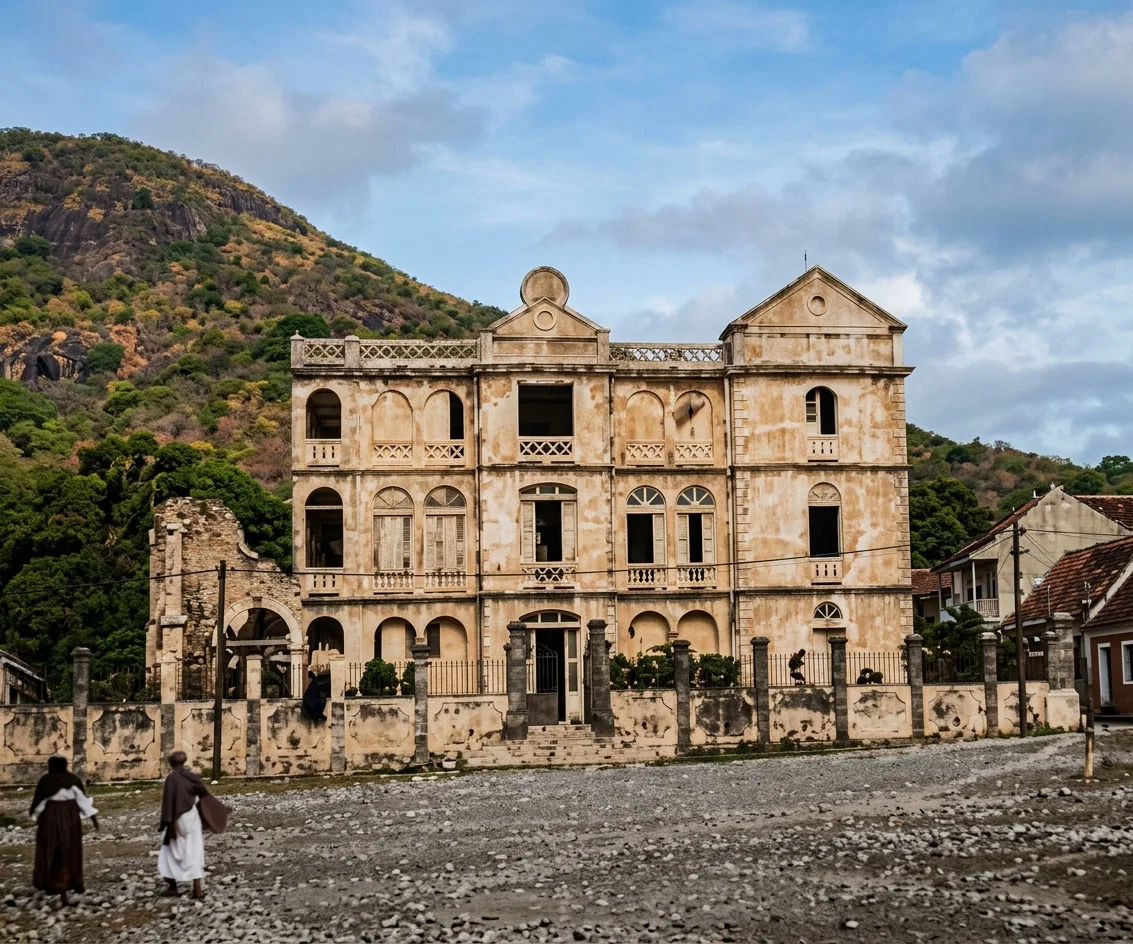
The Bishop's Palace
W. C. I
By W. C. I.
From an editorial paragraph in the Orient we note that the average term of actual service of ten of the veteran missionaries of the Presbyterian Board in Turkey is forty-one years. Well may the query be raised, “We wonder whether any other mission field can show such a record list of veterans.”
W. C. I
A SEVENFOLD SIGN OF THE END
By M. C. Wilcox
A Nation Rising Rapidly to Great Power Under Peaceful Conditions
THIS is the fourth of the series of articles by Elder M. C. Wilcox on the general theme of “A Sevenfold Sign of the End.” In these articles, he is presenting seven of the most striking characteristics of the prophecy that relates to the United States government. Editor.
BABYLON rose to her height of power under the skill and daring of her greatest warrior-king, Nebuchadnezzar, who subjected to himself all surrounding countries, and extended his power to the subjugation of Egypt, as God declared he would by Jeremiah the prophet.
Medo-Persia succeeded Babylon, with still greater dominion to the east and the north, and under the powerful arms of Darius Hystaspis, conquered Egypt. Her whole dominion of one hundred and twenty-seven provinces was acquired and maintained by force of arms; not merely in wars of defense, but in wars of conquest.
As with Babylon and Medo-Persia, so it was even more emphatically with Grecia. The great empire of the Hellenes started in the insignificant little kingdom, so far as territory was concerned, of Macedonia; but in the space of a few years, Alexander had conquered the then known civilized world. He built a kingdom by conquest, and by constant contest it was maintained, even in its divided state, till it became subject to Rome in B. C. 168.
The great Roman Empire was built and gathered in the same way and by the same means. The little tribes on the Tiber in Italy, by rigorous warfare, spread the domain of Rome over all the known civilized powers of earth. She was the mistress of the world by war and conquest.
A PEACEFUL POWER
The power with which our prophecy deals, arises to world prestige in a different manner. Said the prophet, foreseeing the future, at the time of the breaking of papal supremacy (1793-1798), “I beheld another beast coming up out of the earth.” Rev. 13: 11.
The former dynastic powers, represented by the seven-headed beast, arose from the great storm-tossed, turbulent sea (Dan. 7: 3; Rev. 13: 1), symbolizing “peoples, and multitudes, and nations, and tongues” (Rev. 17: 15), as we have more fully shown in number three of this series. This power was to come up out of the earth. The word rendered “coming up,” is anabaino, from the preposition ana, up, and baino, to walk. It means to arise, ascend, climb, grow. It is used of the rapid growing up of the mustard plant (Mark 4: 32), which we have seen grow from the seed to a small tree fifteen feet tall in three months; of the quick climbing of Zacchaeus into the sycamore tree (Luke 19: 4); of the thief who climbs into the house in some other way (John 10: 1); of the ascending of the Son of man (John 20: 17); of the thoughts which suddenly arise in the heart (Luke 24: 38); of the tumultuous smoke that poured out of the bottomless pit (Rev. 9: 2). So John saw a beast rising up out of the earth, even while he looked upon him, as a smoke would ascend from a pit, as a plant would quickly spring from the earth.
We need not say that but one great nation on the face of the earth so came to power and influence—namely, the United States. Her war of the Revolution was not for conquest, but for freedom. Her people risked all to win it, and they won. Her subsequent extensions were not by the sword, from conquered peoples, but were purchased from France and Spain and Russia. From a narrow strip of land skirting the western shore of the Atlantic in 1800, when the United States was fairly launched as a nation, with a meager population of 5,308,483, and an area of 827,844 miles, it increased in one century to a population of 76,303,987, and an area of 3,026,789. In the decade 1900 to 1910, there was added more than three times the population of the whole nation in 1800. One city on the Atlantic coast has over a million more inhabitants than had the entire country when the nation first started.
In 1850 the Nation, of Dublin, Ireland, said:
“In the east there is arising a colossal centaur called the Russian Empire. With a civilized head and front, it has the sinews of a huge barbaric body. There one man’s brain moves 70,000,000 [now 160,100,000]. There all the traditions of the people are of aggression and conquest in the west. There but two ranks are distinguishable, serfs and soldiers. There the map of the future includes Constantinople and Vienna as outposts of St. Petersburg.
“In the west an opposing and still more wonderful American empire is emerging. We islanders have no conception of the extraordinary events which amid the silence of the earth are daily adding to the power and pride of this gigantic nation. Within three years, territories more extensive than these three kingdoms, Great Britain, France, and Italy put together, have been quietly and in almost ‘matter of course’ fashion annexed to the union.
“Within seventy years, seventeen new sovereignties, the smallest91of them larger than Great Britain, have peaceably united themselves to the federation. No standing army was raised, no national debt was sunk, no great exertion was made, but there they are. And the last mail brings news of three more great states about to be joined to the thirty,—Minnesota in the northwest, Deseret in the southwest, and California on the shores of the Pacific. These three states will cover an area equal to one half of the European continent.”
Emile Girardin wrote in La Liberte in 1868:
“The population of America, not limited by any conscription, multiplies with prodigious rapidity, and the day may before long be seen when they will number sixty or eighty millions of souls. This parvenu is aware of his importance and destiny. Hear him proudly exclaim, ‘America for Americans.’ See him promising his alliance to Russia; and we see that power, which well knows what force is, grasp the hand of this giant of yesterday.
“In view of his unparalleled progress and combination, what are the little toys with which we vex ourselves in Europe? What is this needle gun we are anxious to get from Prussia, that we may beat her next year with it? Had we not better take from America the principle of liberty she embodies, out of which have come her citizen pride, her gigantic industry, and her formidable loyalty to the destinies of her republican land?”
The nation has now forty-nine sovereign states, and a population of 100,000,000.
We may still use the words of Mitchell’s school geography, “It presents the most striking instance of national growth to be found in the history of mankind.”—Fourth revised edition.
In the quiet yet rapid manner of its rise, in the rapid increase of strength and capital, in its great wealth and resources developed and undeveloped, in its material prosperity, in its marvelous inventions, in its colossal undertakings, in every material thing which goes to make a nation great, in free education and religion, there is no nation to compare with it. The nations that have the territory and people, like Russia and China, are fettered and weighted by superstition, degradation, bureaucracies, tyranny, and the dead traditions of unprogressive centuries. America has spelled “Opportunity.”
Vice President Schuyler Colfax thus spoke of this country in 1870:
“Wonderful, indeed, has been that history. Springing into life from under the heel of tyranny, its progress has been onward, with the firm step of a conqueror. From the rugged clime of New England, from the banks of the Chesapeake, from the savannah of Carolina and Georgia, the descendants of the Puritans, the cavalier, and the Huguenot swept over the towering Alleghenies, but a century ago the barrier between civilization on the one side and almost unbroken barbarism on the other; and the banners of the republic waved from flagstaff and highland, through the broad valleys of the Ohio, the Mississippi, and the Missouri. Nor stopped its progress there. Thence onward poured the tide of American civilization and progress, over the vast regions of the Western States fronting the calm Pacific, an empire of themselves in remoteness and wealth, but loyal in our darkest hours to the nation whose authority they acknowledge, and in whose glory they proudly share.”
Said Edward Everett, speaking of the English exiles who founded the government:
“Did they look for a retired spot, inoffensive from its obscurity, safe in its remoteness from the haunts of despots, where the little church of Leyden might enjoy freedom of conscience? Behold the mighty regions over which in peaceful conquest—Victoria sine clade—they have borne the banners of the cross.”
This third specification of the prophecy has been met. As the world never witnessed before, under “peaceful conditions” a nation has risen to power before the very vision of our generation.
The next article will be a study upon the “Two Horns Like a Lamb.”
The Final Religious Controversy
THE prophecies of Daniel and the Revelation present the governing powers of earth under the symbols of beasts. Many of these beasts, as is well known by those who have studied the prophecies, represent oppressive religious powers. Nothing could be clearer than the prediction made in the book of Revelation that a church power exercising the cruelest oppressions will be one of the things to appear at the close of time.
This oppressive power will exercise world dominion, for the text says: “All the world wondered after the beast. . . . And they worshiped the beast, saying, Who is like unto the beast? who is able to make war with Him? . . . And it was given unto him to make war with the saints, and to overcome them: and power was given him over all kindreds, and tongues, and nations. And all that dwell upon the earth shall worship him, whose names are not written in the book of life of the Lamb slain from the foundation of the world.” Rev. 13: 3, 4, 7, 8.
The ecclesiastical character of this beast power is shown in the statement that he made war with the saints. His dominance over the peoples of earth is shown in such expressions as, “All that dwell upon the earth shall worship him, whose names are not written in the book of life of the Lamb slain from the foundation of the world.”
Numerous similar prophecies make it clear, beyond a peradventure, that God has foretold a religious controversy that will be characterized by cruel persecution, as the closing act in the great drama of sin. Among the important things for men to study in this time, no one thing should engage our attention more fully than the developments in the world which show the centering of power in the hands of the church; and this centralization of power, while it will be headed by the papacy, will be supported by apostatized Protestantism throughout the world. The new church power will be a combination of all these religious elements in their manifestation of intolerance and oppression.
Let us carefully study and watch these things, and let us be sure that we stand among those who have their names “written in the book of life of the Lamb slain from the foundation of the world.” For the prophecy is that all others will go down in the destruction that is impending as the result of this final and awful apostasy.
Question Corner
By Milton C. Wilcox
Conducted by MILTON C. WILCOX
Mountain View, California
NOTE.—This department is for the purpose of helping Bible students. Answers must of necessity be brief, often only suggestive, never exhaustive, never infallible, only as they agree with the infallible Word. Such questions only will be answered as seem to the editors to minister to the mission of the paper. Questions of the same import can not be answered repeatedly in the same volume. Name and address must be given, not for publication, but as evidence of good faith and to insure reply by letter if thought best. It is well always to inclose stamp, not stamped envelope, unless answer is desired by letter alone.
85 — PROBATION’S CLOSE AND THE LORD’S COMING
“Will you please give the time between the close of probation and when our Lord comes? I have understood that it was a year, but what is the Bible proof concerning it?” M. T. W.
The time is generally held to be one year, from these facts:
First, probation closes before the Lord comes. In other words, the great day of salvation ends and the day of God’s wrath begins,—sometimes called “the great day of the Lord.” See the earnest appeal in Zeph. 2: 1-3, in which he exhorts God’s children to “seek ye the Lord, all ye meek of the earth, which have wrought His judgment,” “before the decree bring forth, before the day pass as the chaff, before the fierce anger of the Lord come upon you, before the day of the Lord’s anger come upon you;” from which we learn that the passing of the day of salvation, which is now—“behold, now is the day of salvation”—and the beginning of the great day of God’s wrath, will be marked by decree.
This decree is set forth in Rev. 22: 11: “He that is unjust, let him be unjust still: and he which is filthy, let him be filthy still: and he that is righteous, let him be righteous still: and he that is holy, let him be holy still.”
Second, this decree is not an arbitrary decree that cuts souls off from seeking God or returning to Him. It simply declares that that time has passed when souls will seek God, when God has done everything in His power to win them, and they have turned from Him.
Third, the wrath of God is manifest in the pouring out of the plagues. In other words, the great day of the Lord begins in the pouring out of the plagues, for “in them is filled up the wrath of God.” Rev. 15: 1.
Fourth, the pouring out of these plagues, or the setting in operation of the agencies of God’s wrath, is accomplished in one prophetic day. Rev. 18: 8 declares, “Therefore shall her plagues come in one day, death, and mourning, and famine; and she shall be utterly burned with fire.” The day, being a prophetic day, would represent one year. This seems to be the thought of Isa. 34: 8, where the same period is mentioned: “For it is the day of the Lord’s vengeance, and the year of recompenses for the controversy of Zion.”
At the close of that year of wrath upon the nations of the world, the Lord comes. Those who are not destroyed under the plagues will be destroyed by the glorious presence of Christ. Rev. 9: 21; 2 Thess. 2: 8.
86 — BAPTIZED FOR THE DEAD
Will you please explain 1 Cor. 15: 29? What does it mean? J. W. C.
The middle part of the twenty-ninth verse holds the key to its solution—“If the dead rise not.” Baptism is a setting forth of the great facts of the gospel, and these great facts are that Jesus died for our sins, that He was buried, that He arose again the third day. 1 Cor. 15: 1-4. These same facts are set forth in baptism. “Know ye not, that so many of us as were baptized into Jesus Christ were baptized into His death? Therefore we are buried with Him by baptism into death: that like as Christ was raised up from the dead by the glory of the Father, even so we also should walk in newness of life. For if we have been planted together in the likeness of His death, we shall be also in the likeness of His resurrection: knowing this, that our old man is crucified with Him, that the body of sin might be destroyed, that henceforth we should not serve sin.” Rom. 6: 3-6.
Those who are baptized, are baptized into the death of Jesus Christ; and if we be dead with Christ, we believe that we shall also live with Him; but if there be no resurrection, of what account is it that we should be baptized into His death or for the dead? The “dead” of the text, it seems to us, is Christ Jesus, and we dying with Him. In reference to His death we are baptized. Through Him too we are raised from death—our only hope.
The prophecy of Zephaniah is a double prophecy. There are judgments pronounced against God’s children of old and the land that they occupied. And these judgments were typical of the great day of Judgment—that day of the Lord against Palestine was a type of the great day of the Lord.
Chapter 3 of Zephaniah opens with a prophecy against Jerusalem. She is called “filthy” and “polluted,” “the oppressing city.” And the Lord’s destruction of that city was typical of the destruction that would be visited upon all the nations, as indicated in the eighth verse, when He should “gather the nations,” and would pour out upon them His indignation, even all His fierce anger, “for all the earth shall be devoured with the fire of My jealousy.”
But not all the people would be destroyed, for God would save His own; and of that people He says, “Then will I turn to the peoples a pure language, that they may all call upon the name of Jehovah, to serve Him with one consent.” The “pure language” is sometimes said to have reference to one particular tongue or language of earth, but what is evidently meant is that it will not be a deceptive tongue with which God’s children will serve Him. The language will express the heart, and the pure language will mean that behind it is the pure heart, just as it is later said in the same chapter, “The remnant of Israel shall not do iniquity, nor speak lies; neither shall a deceitful tongue be found in their mouth.”
A Fight for National Existence
By Daniel H. Kress
The Worst Menace to Our Boys—An Evil to Be Classed with Opium and Alcohol—Fathers and Mothers Should Be Aroused
By DANIEL H. KRESS, M. D.
This is the first of two articles by Dr. Kress on the degenerating effects of the cigarette. Concerning the doctor's investigations of the cigarette menace, the editor of “The Boy” magazine says: “There are probably few men who can speak more authoritatively upon the cigarette evil than can Dr. Kress. For many years, in his extensive travels and experience as a physician, he has made a careful study of the influence of the cigarette upon growing life.”
Every mother and father should carefully read these articles, and get their children to read them. They should form the basis for animated teaching and conversation in the home life. The conditions are so alarming as to cause parents to be earnestly and intelligently aroused.
Either of the two articles may be profitably read alone, for they are independent of each other. But each will be filled with interesting matter that furnishes material for profitable reflection.
EDITOR.
THE fight against the cigarette in America will, in the near future, resolve itself into a fight for national existence, just as, in China, the fight against opium has during the past few years.
When the opium plant was first cultivated in China, it was termed “the divine herb,” because of its soothing effect as a drug; and so long as the opium habit was confined to the few, it gave no concern, and little was said about it as an evil. But when its use became universal, and the evils resulting therefrom became apparent, China, in order to save herself from total demoralization and annihilation as a nation, was willing to sacrifice the annual revenue of over thirty million dollars that she received from the traffic. With her the fight against opium had resolved itself into a fight for national existence.
When Introduced in Japan
Three hundred years ago, tobacco was introduced into Japan. It was then considered a valuable drug, one of the most precious herbs the earth tendered to man; and so long as it was dispensed merely for medicinal purposes, nothing was said against its use. The time came when the people of Japan became enslaved to the tobacco habit to such an extent that her national existence was threatened. Boys not yet in their teens were addicts to its use in the worst form—that of the cigarette—and Japan found it necessary, in her own interest, to suppress the evil among her youths. In the year 1900 a bill was introduced into her national parliament forbidding the use of tobacco in any form by boys and young men under twenty years of age. This bill became a law on the first of April in the same year, and has been rigorously enforced.
Feared the Effect
The aim of Japan in this wise legislation may be seen from the following: The Hon. Mr. Nemote, in introducing the bill, said: “I would briefly give you reasons why we have introduced this bill. Recently even children in our public schools have come to use cheap imported cigarettes, the consequence of which we fear will bring our country down to the miserable condition of countries like China and India, because tobacco, like opium, contains narcotic poisons, which benumb the nervous system, weaken the mental power of children addicted to smoking; and thus to give point to our national policy, we must strictly prohibit the smoking of tobacco by children and young people. If we expect to make this nation superior to the nations of Europe and America, we must not allow our youths in common schools, who are to become fathers and mothers of our country, to smoke.”
It will be observed that their purpose in framing such a law was to make their country “superior to the nations of Europe and America.” They may never succeed in this effort; but they certainly recognize a principle which if strictly enforced, will go a long way toward its accomplishment. They class the tobacco habit with other forms of drug addiction, where it rightfully belongs, for it is purely a drug addiction, and cultivated because of its drug effect.
Denounced as a Traitor
When it was urged by a letter to members of the Japanese legislature that in passing such a bill, the treasury would be deprived of two hundred thousand yen annually, the Hon. Mr. Kabota replied: “He is a traitor. He is willing to sacrifice the character of our youths, simply for two hundred thousand yen. What wickedness! Such a person would most assuredly try to urge the use of opium by and by.” The fight against tobacco by her youths had in Japan resolved itself into a fight for national existence.
Inhaling the Smoke
Tobacco smoke inhalation was first recommended in England by physicians as a most valuable remedy in disease. Men, women, and children became addicted to the practice, and England too found the suppression of the evil necessary. Educational and legislative efforts were carried forward until, in writing of that period, Dr. Johnson could say, “Smoking has gone out.” For nearly one hundred years this continued. At the beginning of the reign of Queen Victoria (1837), any one found smoking on the streets of London was still considered “irretrievably bad,” and the practice, it is said, was confined to public inns.
It was not until after the Crimean war, when the English soldiers had been brought in contact with the Spanish and the French, that the drug was again introduced into England, and this time in the form of the cigarette. So general has the practice again become, that England is feeling alarm at the outcome. Her young men are stunted in their development, morally and physically.
Three Out of Four Rejected
Several years ago, when a call was made for young men to enter the army in her fight with the Boers, she found that three out of every four volunteers had to be rejected as unfit. Many of these suffered of what was termed “tobacco heart.” “They come to us,” said the examiners, “with their fingers stained with nicotine.” While alarm was felt at the time, so far nothing has been done to arrest the evil that is destroying her youth and threatening her future as a world power.
In a recent speech on finance, Sir Brampton Gordon, in referring to this, said: “The evil effects of the growing habit among boys of smoking cigarettes could scarcely be exaggerated. Without doubt it is a habit which leaves the rising generation deteriorated in physique. If in ten or fifteen years hence we should have the misfortune to be engaged in a great war, this habit among our youth to-day would tell against us.” In England the fight against the cigarette is again resolving itself into a fight for civilization and national existence.
How Spain Has Gone Down
Spain, the country which first cultivated tobacco, and for a time supplied the entire civilized world, has possibly suffered more than any other nation from this practice. She was once the wealthiest and most prosperous nation upon the earth, possessing the richest colonies. Her trade in tobacco, it is said, proved to be more profitable to her than her gold mines of India. But while money was pouring into her treasury from this source, she was ruined by this habit which had fastened itself upon her youth and women. Spain failed to recognize that her real asset as a nation was not her wealth, but her boys and girls. She has been reduced to poverty; her colonies have one by one been taken from her, the last American colony she was deprived of being Cuba, the island upon which, four hundred years ago, she discovered among the naked savage this practice of tobacco using.
France is a dying nation. Already her death rate exceeds her birth rate. How much the prevalent use of cigarettes by her boys and women has to do with this degeneracy, may never be scientifically demonstrated; but that it is one of the chief causative factors, is evident.
Smoking Was Forbidden
The Puritans and the early American settlers were all haters of tobacco. Laws existed against its use. There are men still living who are able to recall the time when smoking on public thoroughfares was forbidden in our Eastern towns. At that time, America gave birth to men whose moral and intellectual worth we to-day reverence. America has become a great nation, but she is not securely great.
Gradually the pipe was introduced into America, then the cigar, and within the past fifty years the cigarette, and with it smoke inhalation, the worst form in which tobacco can be used.
Forty years ago smoke inhalation was practically unknown in America. To-day it is common. Ninety-three per cent of those who apply for aid at our clinic, conducted in the large cities of America, I have discovered are smoke inhalers.
The cigarette is rapidly crowding out the pipe and the cigar.
The pipe has about disappeared; and during the past ten years, while the consumption of cigars has increased eight and one third per cent, the consumption of cigarettes has increased over four hundred per cent.
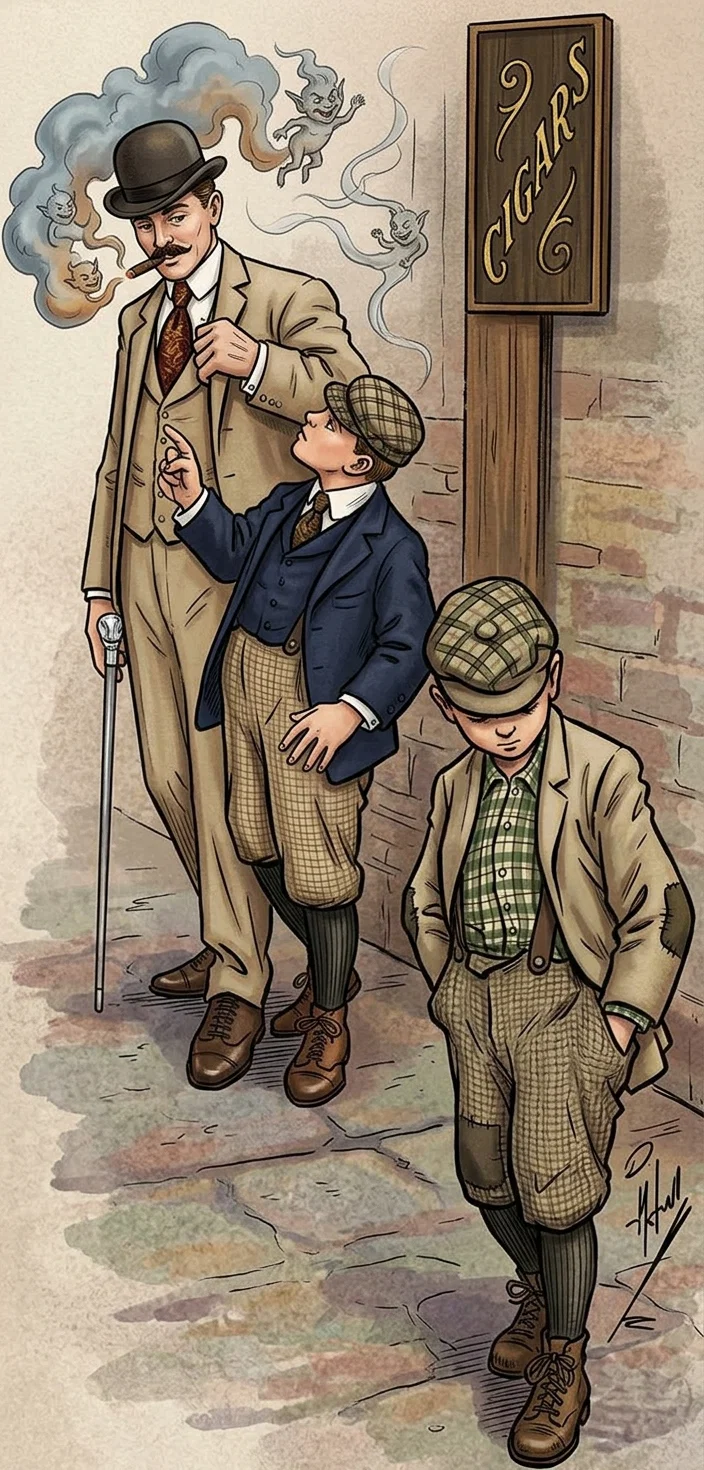
We consumed in 1913, in America, about fifteen billion American manufactured cigarettes, bringing in revenue to our government93the sum of seventeen million dollars, and a net profit to the manufacturers of over thirty-five million dollars. There were consumed, during the same period, probably twice as many imported and hand-rolled cigarettes. It is safe to say we consume at present forty billion cigarettes annually, making an average of over twelve hundred for every male inhabitant over ten years of age. Should these be laid end to end, they would encircle the earth over fifty times. The deplorable thing is that boys so readily become victims of this practice. During 1913, there were born in America about one million two hundred thousand male children. Eighty per cent of this number will take up with tobacco, and begin with the cigarette. Each day of last year, probably twelve hundred boys took their first smoke, and were introduced to this drug addiction.
Labeled and Put Away
By Adelaide D. Wellman
MUCH time is spent, by unmethodical persons, in overhauling and examining repeatedly articles that clutter desk, drawers, et cetera.
Of course, any one of orderly habits avoids that annoying waste of time and energy by keeping his possessions segregated, assigning each to its particular pigeon hole or drawer, or labeling it and storing it away in chest or on shelf.
The shelving process is to be commended not only as a means of disposing of materials seldom needed, but also, in a figurative sense, for disposing of questions that otherwise might annoy and embarrass and hinder by arising repeatedly for consideration.
An American whose name is honored in many countries, was compelled to settle once for all—that is, to “lay on the shelf”—the question of accepting treats, because so long as he used liquors at all, refusal to drink with an acquaintance was likely to give offense, while to accept all such invitations would often result in intoxication. Happily, he decided upon an invariable reply which no one could interpret as a slight—“I never take stimulants.”
Another troublesome question to which an unvarying negative can well be given, pertains to attendance at theaters, of any and all classes. A person who fluctuates between inclination to go and scruples against going, is in a state as undesirable as that of the receptacle that has been rummaged again and again for misplaced articles. Be thoroughgoing enough to put that question emphatically aside, plainly labeled NO.
The same shelf will serve for many other forms of amusement. Intellectual beings can find sufficient pleasure and recreation that is in no degree dangerous to morals, health, mentality, or even finances.
Still another question that should be put out of the way with finality, is that of reading fiction.
In fact, most of these questions might fittingly be stamped with skull and crossbones, and the familiar warning, “Danger! Poison!”
Some questions that are always kept on an opposite shelf by dependable people, relate to fidelity in fulfilling promises, and promptness in paying bills. This necessitates forethought, both in guarding against incurring obligations that one may not be able to meet, and in providing for meeting such as have been assumed.
Another question that should not often require94consideration, pertains to attendance at church services, including Sabbath school and prayer meetings. But if the enemy of all righteousness finds that a slight indisposition, or any other trivial excuse, will suffice to make one reconsider the advisability of attending, he straightway commissions some of his agents to provide the excuse.
Paul wisely put one subject beyond controversy when he said, “This one thing I do.” And with equal decision he averred, in reference to another matter, that he would not do that again “while the world standeth.”
It has been declared that Christ was never tempted a second time on any point, because every temptation that came to Him, He met fully and finally.