Your ShelfYour Projects

Signs of the Times, Vol. 23, No. 41.

Editorial

Signs of the Times

Oct 21, 1897

Pacific Press Publishing Company · Oakland, California · Oct 21, 1897

Editorial

Concerning Prayer.—"Call upon Me in the day of trouble; I will deliver thee, and thou shalt glorify Me." Ps. 50:15. Thus saith the Lord; and what he says in this place is repeated many times in the Scriptures. "Ask, and it shall be given you; seek, and ye shall find; knock, and it shall be opened unto you." Matt. 7:7.

A Forcible Illustration

—Immediately following the above statement, we find a striking illustration of God's willingness, nay, his anxiety, to answer prayer: "What man is there of you, whom if his son ask bread, will he give him a stone? or if he ask a fish, will he give him a serpent?" There can be but one answer; no real father would deal so heartlessly with his child. "If ye then, being evil, know how to give good gifts unto your children, how much more shall your Father which is in heaven give good things to them that ask him?"

Are We Better Than God?—The foregoing illustration is something that parents especially can appreciate. Whenever any one who is a parent feels despondent, and thinks that God does not care for him, let him ask himself, Why should I think myself better than God? I would not think of refusing my children any good thing that lay in my power to bestow; but I am selfish even at the best, and even my best wishes for my children are limited by my lack of resources; God, on the con-
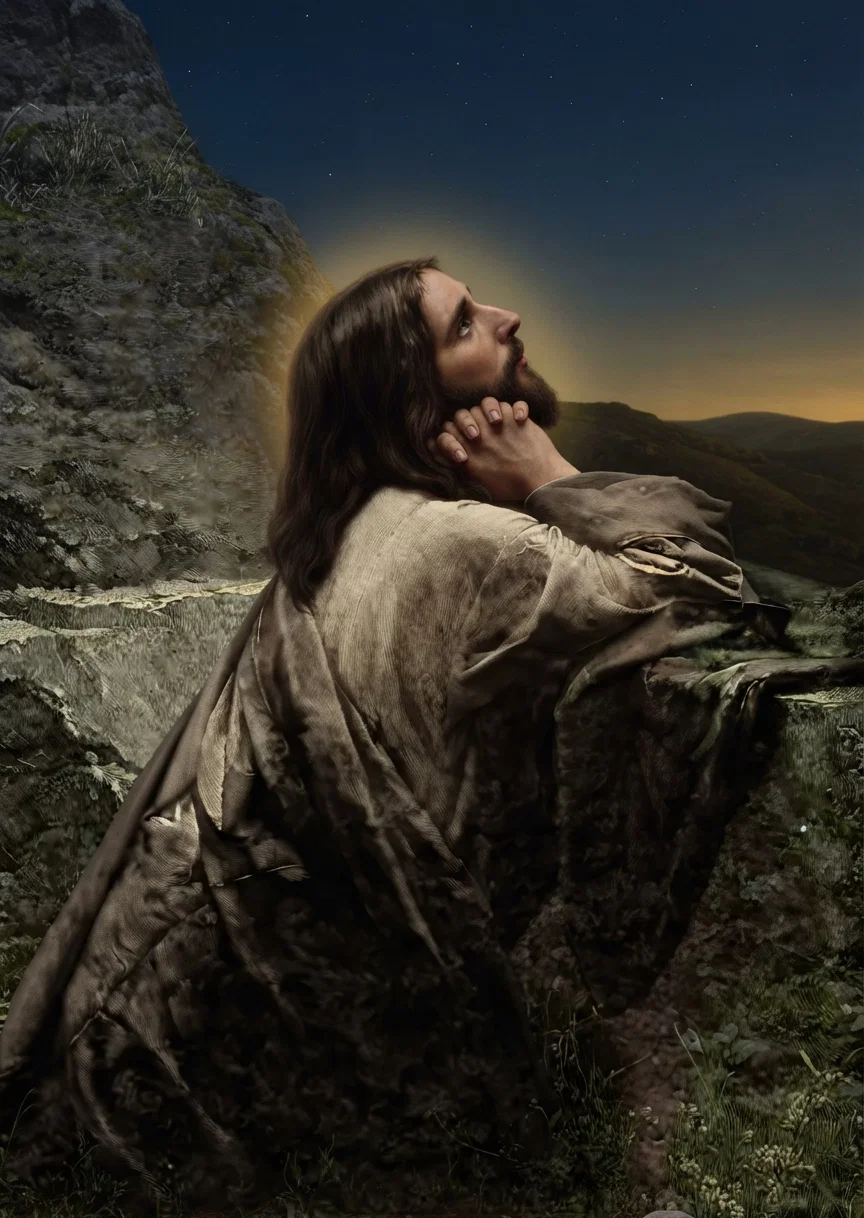
THE MIGHTY PETITIONER.
trary, is infinite love and compassion, and has power to perform whatever his love prompts; therefore as surely as I live I know that God does hear my prayers.

The Great Provider.—Think further of the illustration here given. The parent is not only willing to supply the child's needs, but provides for them beforehand. The child never thinks of food until it is hungry. Suppose now that the parents likewise had not thought about providing food, until the child's request brought it to their attention; then the child would be obliged to wait, and would suffer hunger. But such is never the case. Long before the child thought of eating, the parents were at work providing something against the time of need. This is the work of parents, to look ahead, and provide for their children's wants. Even so it is with God. He knows what we need, so that, as the child to the parent, we come to him, not to let him know that we are in need, but to take what he has before prepared for us. Our asking is not to make him willing to give, but to show our willingness to receive.

What It Is His Will to Do.—God wishes that we should be saved from sin, that we should receive eternal life; and, as the greater includes the less, he also wishes that we should have all things necessary for this life. "Godliness is profitable unto all things, having promise of the life that now is, and of that which is to come." 1 Tim. 4:8. In his Word God has made known his will. The commandments show that it is God's will that we should live righteously, that we should love him supremely, and our neighbor as ourselves.

But how can we attain to all this? The question is easily answered: "This is the confidence that we have in Him, that, if we ask anything according to His will He heareth us. And if we know that He hear us, whatsoever we ask, we know that we have the petitions that we desired of Him." 1 John 5:14, 15. We can not begin or continue our own lives, either in this world or the world to come; but God can, and it is hispleasure to do so; if therefore we are willing to accept God's good gifts, then we may know, without any shadow of doubt, that we have them whenever we ask for them; and if we "pray without ceasing," then we are always in possession of every good gift.

Do We Weary Him?—"Well, isn't it tiresome continually to be asking for what we need?"—That depends on whom we ask. The parable of the unjust judge (Luke 18:1-8), was given to teach us that "men ought always to pray, and not to faint." The judge feared not God, neither regarded man, and so when a widow asked redress for her wrongs, he paid no attention to her for a while. But afterwards he thought that his ease might be disturbed much more by her repeated requests than by complying with them, and so he granted them. If we read no further, we should not be encouraged to pray always and not to faint; for even if we did not become discouraged after a few unheeded petitions, and give up without receiving the thing desired, we would at least say, "I will not ask any oftener than I am absolutely obliged to." But God is "faithful and just" (1 John 1:9); not unjust; he cares for us (1 Peter 3:7), and desires our welfare far more than we do. What then?—"And shall not God avenge his elect, which cry to him day and night, and he is long-suffering over them? I say unto you, that he will avenge them speedily." R. V.

The parable is a contrast. If the unjust judge, who had no regard whatever for men, would grant a request simply that he might not be further disturbed, how much more will God grant the request of his chosen ones, with whose failings he is so long-suffering! He will not keep them waiting; nay, "he will avenge them speedily." "Nevertheless when the Son of man cometh, shall he find faith on the earth?" In spite of the fact that everything, not only in the Bible but in God's open book of nature, speaks of God's readiness and parental anxiety to give good gifts, it is a rare thing to find people with faith enough to continue asking and receiving.

Why Importunate?—"But why continue to ask, if God is so ready to give?" unbelief asks. "What means that statement that God's elect cry day and night to him, if he is so willing to give?" How ready and seemingly anxious people are to make God out unfeeling, and the way of life hard! God's people cry day and night to him, for the very reason that he answers them so speedily, not even waiting till they have done speaking. "I love the Lord, because he hath heard my voice and my supplications. Because he hath inclined his ear unto me, therefore will I call upon him as long as I live." Ps. 116:1, 2. Because he inclines his ear to us, bending over toward us, so as not to miss the faintest whisper, and even anticipates our words, because he reads the heart's desire, and knows what we would ask for far better than we know how to express it, we are encouraged to keep calling on him continually. This is why we can always pray and not faint; God does not weary us by keeping us waiting.

Wrong Ideas of Prayer.—But when we go no further in the consideration of prayer than to agree that God answers prayer, altho that is a good thing to know, it is far from a true realization of what prayer really is. We speak now, of course, of sincere prayer. We speak about God's hearing us, when the question really turns on whether or not we hear God. In our ordinary thought and talk about prayer, we seem to have the idea that we speak first, and that our part is to call God's attention to us. That is a step in the direction of the heathen idea, that they must awaken their god, so that he may be conscious of their presence. It is this idea, more or less fully developed, which holds many people back from God. They fear to approach him; they fear that they will be intruding on his time and patience, and they have not courage to ask an audience with him, regarding him much as they would an earthly autocrat, only infinitely greater and therefore proportionally unapproachable. If it were indeed the case that we must approach the throne alone, and ask to gain an audience with God on our own account,—if we had to take the initiative,—then it would indeed be presumptuous for us to think of it, and we might well shrink from the trial. But the fact is, God has spoken first; he has called us to him, and therefore instead of its being presumption for us to approach and speak to him, it is rudeness in the highest degree if we turn away and say nothing. Common civility demands that we reply to a fellow-man when he speaks to us; how much more should we give heed and reply when God speaks to us.

Hearing God Speak.—God speaks to us, and offers us forgiveness, righteousness, everlasting riches. When we come to him in prayer, it is only because he has called us to him; it is only to take what he has already said he freely gives us. The question is not, therefore, whether God will hear us, but whether we will hear God; and true prayer consists more in listening than in talking. Therefore it is that Christ tells us not to use vain repetitions, or an overflow of words, as the heathen, who "think that they shall be heard for their much speaking;" "for your Father knoweth what things ye have need of, before ye ask him." Matt. 6:7, 8. God has called us to him, to receive rich gifts, and he says: "Incline your ear, and come unto me; hear, and your soul shall live." Isa. 55:3. But since it is a fact that God has spoken first, that he has made known his will to us, and that true prayer is our response to his offer, with thanksgiving for what he has given, it necessarily follows that a study of God's will as revealed in his Word is necessary to prayer. He who is best acquainted with God's will, can pray best.

Ask for Great Things.—But what if we should ask too much? Is there not danger of presuming on God's generosity, overtaxing it?—No fear whatever. He is able, and therefore willing, "to do exceeding abundantly above all that we ask or think." Eph. 3:20. And when we hear his voice, that offers us so many good things, and come to him, and receive them at his hands, what shall we give in return? That is just what the psalmist asked, after God's readiness to hear had made him determined to call upon the Lord as long as he lived. "What shall I render unto the Lord for all his benefits toward me?" Ps. 116:12. That is a most natural question, and the inspired answer immediately follows: "I will take the cup of salvation, and call upon the name of the Lord." Verse 13. How shall I pay the Lord for what he has given me?—By taking more. That is the only way. "But then I will owe him more than before!" Certainly, and so are you under obligation to take more than before; and as you are in duty bound to pay your debt by taking twice as much as before, so you make your debt four times as large, and in order to pay it you must now take eight times as much as before, and so on in endless progression. "O, the depth of the riches both of the wisdom and knowledge of God!" "Let us therefore come boldly unto the throne of grace, that we may obtain mercy, and find grace to help in time of need."

The Sabbath Question in Methodism

"WHICH? SABBATH OR SUNDAY? SEVENTH DAY OR FIRST DAY?"
THE above is the title of the leading article in the "Contributions" department of the chief Methodist Episcopal paper in America, the Christian Advocate, of September 23. The writer is Abbie C. Morrow. From the position of the article, with no disclaimer on his part, the editor evidently indorses it. It is certainly worthy, because of the journal which gives it publicity, of a passing notice. The first paragraph presents these astounding statements:—
Some fourteen years ago a little tract was put into my hands, entitled "One Hundred Reasons Why Christians Should Keep the Seventh Day." It contained one hundred Scripture passages on the Sabbath, and not a word besides. It confused me, hurt me, stunned me. Holding it in my hand I prayed that if the Adventists were right, God would open the way for me to worship on Saturday. Then I laid it aside, and forgot all about it. Afterward, when the truth had been made clear to me, I found the tract and put it in the fire.
This is indeed a remarkable confession. Here were "one hundred Scripture passages upon the Sabbath and not a word besides." Why should passages from the Word of God confuse, stun, or hurt a Christian? If the Spirit of that Word were in the heart, why should the Word itself confuse, stun, or hurt? In the light of many scriptures did not those passages of Scripture reveal that the heart was not right, even as, "Thou shalt not covet," showed Paul that he was a sinner? See Rom. 7:7.But when the Christian is confused about the way, where should he go? That he should pray there is no doubt; pray that God would give him a heart to do all that the Lord had commanded. But where would he find God's directions? In the "inner consciousness" of a natural heart which is ever glad to forget all about unpleasant duties?—No; but to the Word of God. It is the Word that is the lamp to our feet and the light to our path (Ps. 119: 105); it is by the Word that we are kept from the paths of the destroyer (Ps. 17:4); it is by the Holy Scriptures we are to be indoctrinated, reproved, corrected, and instructed in righteousness, and built up (2 Tim. 3:15, 16; Acts 20:32). Any inward voice contrary to the Word of God is but the voice of ignorance, lust, sin, or Satan. Why did not the writer take the law taught in the Methodist catechisms, and the example of Jesus Christ? And how did it help the matter to cast into the fire "one hundred Scripture passages on the Sabbath, and not a word besides"? Why not rather hide the Word in the heart?
Further on in the article the writer attempts to show that the seventh day is not obligatory. She tells us that this article is called out by a recent letter, the writer of which said she went to her pastor, who could give "no satisfactory proof—in fact seemed very uneasy." Of course there is no satisfactory proof of Sunday sacredness, and yet the writer of the article states that "there is overwhelming proof" from the Word of God that Christians should keep the first day, a part of which is the following:—
The Sabbath was given to man in the garden, in his innocence (Gen. 2:3); continued to him as a merciful provision after he sinned (Gen. 8:10-12; Job 1:6; 2:1; Ex. 16:23-26); and confirmed on Mount Sinai (Ex. 20:8). Then the Sabbath or seventh day became a Jewish institution. The Jew was commanded to keep it. Lev. 19:30. [2] The law spent all its force on Christ, our Substitute, as he hung upon the cross for us. When Christ died we died; when he rose again we rose with him. Col. 3:1-3, R. V. "We have been discharged from the law, having died to that wherein we were holden; so that we serve in newness of the spirit, and not in oldness of the letter." Rom. 7:6, R. V. We are "dead to the law" that we "might live unto God." Gal. 2:19. [3] If we were under the law, the Seventh-day Adventists would be right, and we must keep "the Sabbath," the seventh day, or be disobeying God. [4] "For whosoever shall keep the whole law, and yet stumble in one point, he is become guilty of all." James 2:10, R. V. If a man were suspended over a precipice by a chain of ten links, and one of them were to break, his death would be as certain and terrible as if every link had been broken. The least infringement of the least commandment puts the law-breaker under the curse as surely as if he had broken them all. "The law hath been our tutor to bring us unto Christ, that we might be justified by faith. But now that faith is come, we are no longer under a tutor." Gal. 3:24, 25, R. V. We "are not under the law, but under grace. What then? shall we sin, because we are not under the law, but under grace? God forbid." Rom. 6:14, 15. Because we are not obligated to keep the seventh day, which pertained to the old creation, to Sinai and to law, shall we be careless about the first day, which pertains to the new creation, to the church, and to grace? —No, beloved! One sight of the cross and what it cost our Lord to give us this day will make us long to sanctify it. Impelled by love, we shall be more faithful than if compelled by law. And "love is the fulfilling of the law." Rom. 13:10.
We number the above quotations for convenience' sake. Our comments will be numbered to correspond.
1. If, because the Jew was commanded to keep the Sabbath, that made it "a Jewish institution," and not binding upon Gentiles or Christians, is not this just as true of any of the other precepts of the Decalog? The Jew was commanded, "Thou shalt have no other gods before Me," "Thou shalt not kill," "Thou shalt not commit adultery," "Honor thy father and thy mother." If the fourth or Sabbath commandment is not binding, why should the first, or sixth, or seventh, or fifth, which we have quoted above, be binding? If because the Sabbath was commanded the Jew, it became a Jewish institution, logically every command in the Decalog became Jewish also. Christians may therefore worship other gods, kill, disobey parents, commit adultery, steal, and covet. But this is not so. God does not call the Sabbath "Jewish," but "the Sabbath of the Lord thy God." The Scriptures were all given to Jews and through Jews; and Jesus Christ was a Jew, and tells us that "salvation is of the Jews." John 4:22. But the Jew then, as God's people are now, was only God's channel of light to the world; the law, the Sabbath, the Word, the Saviour, were all of God to the whole world.
2. True, Jesus Christ suffered the penalty of sin, transgression of the law, but he did it "to redeem us from all iniquity, and purify unto himself a peculiar people, zealous of good works." Titus 2:14. "Iniquity" is lawlessness, law-breaking. If Christ died to redeem us from law-breaking, as he certainly did, he died to redeem us to law-keeping, to obedience. While we are sinners the law holds us as condemned, prisoners of guilt. It holds over us the curse of the wrong-doer; death. We are under the law, under its condemnation, under its curse. But in Christ Jesus we are discharged from custody; "for the law of the Spirit of life in Christ Jesus hath made" us "free from the law of sin and death." Rom. 8:2. To the sinner his transgression brings death. But when the perfect obedience to that law in Jesus Christ is placed upon us and within us, we are free. Rom. 3:21, 22; 5:19. We are justified in him. Why? That we should "serve in newness of the spirit, and not in oldness of the letter." Rom. 7:4. We are dead to the law's condemnation, that we may in Christ Jesus live its righteousness. Rom. 8:4. Christ died in vain were it otherwise.
3. As long as "Christians" are "under the law," they can not keep the Sabbath or any other part of God's holy law. Seventh-day Adventists believe what God's Word teaches, that he who is under the law is condemned by the law. He who is a Christian is justified from his transgression, and the law is written in his heart by the Spirit of God, that he may do the law. Eze. 36:26, 27. He is no longer under the law; he is with the law, in the law, and the law is in him, because he is with Christ and in Christ, and Christ, the perfect embodiment of the law, is in him.
4. James teaches just what is stated above; but he also says: "But he that looketh into the perfect law [Rom. 7:12; Ps. 19:7], the law of liberty, and so continually, being not a hearer that forgeteth, but a doer that worketh, this man shall be blessed in his doing." James 1:25, R. V. "So speak ye, and so do, as they that shall be judged by the law of liberty." James 2:12. The transgressed law pressed home upon the conscience leads us to Christ, who, through faith, justifies, or makes us in harmony with the law.
But shall the justified one, who is under grace, sin? Madame Morrow quotes Rom. 6:15, which declares, "God forbid." But what is sin?—"Sin is the transgression of the law." 1 John 4:3. That law is the law of the Decalog, which says, "Thou shalt not covet," Rom. 7:7; James 2:10, 11. He, therefore, who knowingly breaks one point of that law, denies the "God forbid" of Rom. 6:15. For "know ye not, that to whom ye yield yourselves servants to obey, his servants ye are to whom ye obey, whether of sin unto death, or of obedience unto righteousness?" Rom. 6:16. God has commanded the seventh-day Sabbath. Jesus Christ kept it. God commanded, "Honor thy father and thy mother." Jesus Christ kept that command as well as every other one of the Decalog. He forgives us, that we may follow him, that he may again obey them in us. The first-day sabbath has been commanded in its origin only by paganism, followed by an apostate church. Who is obeyed in keeping it? It cost the Lord no more to give the first day than it did the fourth or sixth. All this, and volumes like it, are mere appeals to sentiment, unworthy of regard by one who would do God's will. What says the Word?
"LOVE"!! What is love?—Bible love is not a sentiment which leads us to do our own way. "If ye love me, keep my commandments." John 14:15. "For in Jesus Christ neither circumcision availeth anything, nor uncircumcision; but faith which worketh by love." Gal. 5:6. "This is the love of God, that we keep his commandments, and his commandments are not grievous." 1 John 5:3. "This is love, that we walk after his commandments." 2 John 6. He who truly dies with Christ to sin, forsakes sin; and he who truly lives with Christ, lives Christ's life of obedience. "He that saith he abideth in Him, ought himself also so to walk even as He walked." 1 John 2:6. What more need be said? What can a Christian ask more than God's law and Christ's life and example?
For the first day Madame Morrow endeavors to find proof in the "first days" of Jewish feasts, days which fell on no particular day of the week; in the meetings of our Lord on the first day of the week with his disciples, the records of which in Matthew 28; Mark 16; Luke 24, and John 20 and 21 certainly disprove any first-day sabbath; in Acts 2:1, the day of Pentecost, in which the day of the week is not even mentioned; in Acts 20:7, a mere incidental farewell meeting, the day of which was used for labor; in 1 Cor. 16:2, a text which refers not to public collections, but private setting apart at home. She gives us no command for a Sunday sabbath, no divine example. There is none to give.
Then Madame Morrow turns to the "fathers" of the Catholic Church. She quotes from the spurious and unholy epistle of Barnabas, from the equally spurious epistle of Ignatius to the Magnesians. Here we wonder that the learned and able editor of the Christian Advocate would admit such testimony. The first writer who unequivocally refers to Sunday as the Lord's day is Tertullian, who wrote in A.D. 200, but who also taught prayers for the dead and the sign of the cross. He expressly tells us that for those things they had no Scripture injunction.
But shall Christians look to apostasy for precept and example? Rather should they not look to the Word of the living God and the example of our Lord Jesus Christ? And in the light of these, "Which? Sabbath or Sunday? Seventh Day or First Day?" What say you, reader?
THE crown of patience can not be received where there has been no suffering. If thou refusest to suffer thou refusest to be crowned; but if thou wishest to be crowned thou must fight manfully and suffer patiently. Without labor none can obtain rest, and without contending there can be no conquest.—Thomas a Kempis.

GLIMPSES OF "THE FIELD." NO. 2.

IN nothing do we need to be more sure that we have the spirit of perseverance than in the sort of preaching which is required in a city mission or settlement; and this is determined by the motive which has taken us into it, our appreciation of its importance, and the self-forgetfulness with which we are able to meet obstacles.
Since slumming became a sort of fad, and Christian conventions so enthusiastic, we need to be all the more sure that we are led of God, instead of fashion and emulation, in all our Christian endeavors. If we must follow the fashion at all hazards, and can not drop from our efforts the determination to "get in ahead," it is vastly better for the world in which we live that we follow a fashion of doing good, and that all our pushing is toward righteousness, even if it should be all external.
A great many people have started in to do mission work out of the same sort of sentiment which would have led them to get up a church fair, or amateur theatricals. It was "for fun." They wanted a new kind of entertainment with which to relieve the monotony of life. They have become wearied with the emptiness of society, with its selfishness and greed of admiration, and long for a change that shall bring rest to soul and body. They go to the masseur for the body, and to the mission for the soul. They enjoy just about in the same kind and measure the play of skilled hands along muscles, nerves, and tendons, and the strange and intense emotions that are awakened in them by the sights and sounds of mission life. The desperate, almost hopeless struggle of degraded men and women after purity, the testimonies of drunkards, debauchees, gamblers, and criminals of all grades who have been converted, are of more thrilling interest than the last novel could be.
Then the gratitude that is to be expected from this class, when one has undertaken to do so much for them. There can be nothing like it anywhere. So these seekers after new sensations rush in, scatter their smiles and alms, and expect to fill their cups to the brim with the gratitude that will bubble like a spring that is too full to keep within its banks. It will be so delightful to be appreciated. Verily they shall have their reward.
But the mission workers who go for the gratitude and appreciation that is in it, will sooner or later become discouraged, and abandon the field; for there is nothing more discouraging than the sort of gratitude which is given in return for even the most self-sacrificing efforts, until Christ really has been made welcome, and has opened the hitherto sealed up springs; and then we shall be surprised to find that we are not very much needed; for those who have in them the element out of which gratitude can spring, are almost sure to become helpers very soon. Christ reigns in the truly grateful heart.
It will not do to take much selfishness as inspiration into this field. It will be burdensome, if not dangerous. At the best, it will cripple us; for it will take the place of a true, helpful motive, and we can never find anything in it that will be strong enough to hold us to the work. The only thing that can do that is the mind that was in Christ, that same loving earnestness which can not be appeased except we do something to relieve the sorrows and bitterness of sin, until we have made these burdens, which sin has laid on the ignorant and weak, our own. We must have that motive which will give us patience with all the failings of these wandering souls, patience with their misdoings, which will make us patient as a mother is patient with her sick child. They are sick, tho they may be apparently able-bodied. They are sin-sick, which is far worse than any bodily infirmity.
We shall find a great deal of meddlesome curiosity concerning us and what we are after. The people will judge us according to their own motives. They would not do anything for any one unless they expected to get something out of it. That would not be business; and they can not understand how any one can have any other object in life than business of some sort. They will think we are trying to work them for what there is in them, and will retaliate by trying to work us; and if they find that they can not get anything out of us that they want, they will have no more interest in us. So we must see to it that they are not disappointed. They have a right to all that they can get out of us that can help them out of their distresses, sicknesses, and sins, and bring them into the haven of rest which is in Christ.
We shall find critics of the severest type. They will have their own standards by which we shall be judged, as to dress, deportment, and Christian character, to say nothing of benevolence, which will always be the especial point of interest. They will put us to the severest tests at every point of character, not because they would really like to break us down, but because they will want to know if we are true and are teaching the truth—if we and it will hold; and they have a right to test us to the utmost.
The people with whom we will have to do will have a very keen comprehension of some things that comprise consistency in Christian living, and if we fall below this standard, if we disappoint them, wo is us, as far as our work is concerned. We shall have to run a gauntlet of such judgment, as in no other portion of the field of the world. This is because they are hopeless; and we come professing to represent hope, and holding it out as a possibility; and to fail in this would be the crime of crimes. They are reckless because they are despairing. They are degraded because they know no ground of faith in God or man. They have no thought that we mean well by them, because they have never had any experience that could confirm such an idea and make it look practical.
In all this we are supposing that we are looking over a new field. We are the first to go into it with an offer of the Gospel to these lost and hopeless ones. We are bringing them the first glimpse of a practical salvation for body and soul. So we must get a foothold, and win our way. The hindrances which are in their hearts must be overcome, or we can accomplish nothing. No other hindrances are worth a thought; win a heart, and we have the key to the situation. But to do this we must overcome death and despair with the life that is in us from Christ; for this is their only chance. Christ must be practically in us, for we are sent to occupy the place in his stead. How this brings us close to him, and makes us one with him in the remnant of his work! We must have a genuine Christian experience to take with us, for we shall not be able to lay hold of power without the strength which it gives; and without the power we fail.
The work must be practical. We must begin with the child and the mother. If we become acquainted with the little child, and cultivate its friendship, and win it to become interested in us, we can say whatever we please to the father and mother. I had a beautiful illustration of that a good many years ago. I was looking up delinquent Sunday-school children, among them a certain little girl, who had been absent for several weeks. On reaching the street and number which had been given me, I found a saloon. I went in, however, and, mentioning the name, inquired for the child, incongruous as it seemed then to think of a child in such a place. The face of the man behind the bar brightened at once, and, coming out, he led me back beyond the screen to the rear, where was the family sitting-room, separated by only a square of carpet from the place which was occupied by groups of men at gaming-tables, as well as those who were drinking. On this carpet, in the rear of this great room, was a woman with a sewing-machine, a baby's cradle, and a little child playing on the floor. With the tables and men behind me, the sleeping baby, the pretty child with its toys, the sweet-faced mother before me, the sunny end of the hall, with its home-like appointments, really had the appearance of a cozy home room. It was a revelation of possibilities, for I had never seen anything quite like it before.
I was introduced by the saloon-keeper as a lady who was wanting to know why Gertie didn't go to Sunday-school any more, and was cordially greeted by the mother. "Gertie was out playing somewhere," she said, and bade her husband go find her. He went at once, and soon she came bounding in, her father following, with every feature of his face full of pride in her and cordial interest in her visitor. She and I began a merry talk. Sheasked me to sing certain Sunday-school songs.
We sang together, and in a few moments had all the people in the saloon listening. They had left their games, their drinking, drawn by their interest in my little hostess, and stood around us as we sang the Gospel, now and then a voice joining with us. I did not notice those men, however. I gave all my attention to the child. I told her the lesson stories which she had missed, read the last lesson from my Bible, bringing out the points of truth as if all for her, but far more for that listening audience than for her. The result was that those people became fast friends of our mission. And ever after in the saloon work which I was doing in that part of the city, I, as the mission visitor, was treated with marked consideration; for the story of this visit was not kept a secret, but bruited abroad among the saloon element. Whenever I passed or entered that place I was greeted as a friend, and courteously treated all along the street. I was glad of that friendship, because it was an acknowledgment of Christ, and was for his sake.
When to other qualifications there can be added the skill to give practical relief to the sick, it will not be difficult to break down prejudice, silence criticism, build up confidence, and open doors for the truth.
MRS. S. M. I. HENRY.

THE WORD SPEAKETH.

"Lo, now speakest Thou plainly, and speakest no proverb." John 16:29.
I AM coming, my loved ones, to take you with Me, To the home of My Father in heaven; For mercy's last message is being proclaimed, The last that on earth will be given. My Father is waiting to greet you with joy, Upon the bright sea that's before Him, Where with music celestial the angelic hosts Will join you to praise and adore Him.
I am coming, My loved ones, your freedom to give, In the home of the blest, prepared for you; The seventh trump's sounding, make ready at once, Let nothing on earth now deter you; O! come, heavy-laden, come into My rest, Leave your cares and your sorrows behind you; In heaven, My home, I would sup with you all, And other dear friends would there find you.
I am coming, My loved ones; look up and rejoice, For the buds on the fig tree are bursting; And others are coming your glory to share; For the fountain of life they are thirsting. By faith you've been with Me in Gethsemane, In sickness and sorrow and trouble; But trials upon earth will make heaven more sweet, And the cup of your joy will be double.
I am coming, My loved ones, so speaketh the Word; Be ready to meet Him with gladness; And list to the call of the Spirit and Bride, That the end of your life be not sadness; Go, speak to some dear ones outside of the fold; They may hear, and God's seal to them given; So their names may be found in the Lamb's book of life, 'Tis the only true passport to heaven.
JOSEPH REA. Salem, Or.
Continue reading: THE PHARISEE AND THE PUBLICAN