Which Is It, the First or the Last Day of the Week? — Four Steps in the Making of the Sabbath
By CARLYLE B. HAYNES
IN considering the origin of the Sabbath, it is important for us to understand the manner in which the Sabbath was made. The steps taken in the creation of the Sabbath are of the greatest interest. What those steps were, the Scriptures clearly inform us.
"Thus the heavens and the earth were finished, and all the host of them. And on the seventh day God ended His work which He had made; and He rested on the seventh day from all His work which He had made. And God blessed the seventh day, and sanctified it: because that in it He had rested from all His work which God created and made." Gen. 2: 1-3.
Four Steps in Making the Sabbath
FROM these verses, it will be seen that there are four steps in the making of the Sabbath; namely, labor, rest, blessing, and sanctification. The labor was not common labor. It was not of an ordinary character. It was creative labor. It was labor of a kind that no being but God could perform. In this case, it consisted of bringing a world into existence in six days. To make a Sabbath, then, creative labor is necessary.
From the labor of creation on the six days, the Creator rested on the seventh day, thus finishing His work. It must not be supposed that the Creator rested because of weariness; for "the everlasting God, the Lord, the Creator of the ends of the earth, fainteth not, neither is weary." Isa. 40: 28.
Christ needed no rest; yet the record is that "on the seventh day He rested, and was refreshed." Ex. 31: 17.
Christ rested because He was laying the foundation of a divine institution, and He was refreshed because He took profound pleasure in conferring upon men such a beneficial institution as the Sabbath proves to be to all who observe it. He took delight in bringing into existence an institution which He designed should ever be a memorial of His great work of creation, and ever serve to remind His creatures of the true God.
Then, too, He rested as an example of the manner in which He designed that His creatures should observe the Sabbath. The purpose of the rest was not to regain lost strength and vigor, but to lay the foundation of a perpetual institution. Thus we are told that "God blessed the seventh day, and sanctified it: because that in it He had rested"; and that He "rested the seventh day: wherefore the Lord blessed the Sabbath day, and hallowed it." Gen. 2: 3; Ex. 20: 11.
Sabbath the Last Day
IT is worthy of special notice, in this connection, that rest must come after labor, and therefore that the Sabbath, to be a rest day, must, in the very nature of things, fall on the last day of the week. Rest presupposes labor. Sabbath means rest. The labor must take place before the rest. Therefore no matter how many days there may be in a week, two, three, five, seven, or ten, the Sabbath, being a day of rest from preceding labor, cannot be any day but the last day of the week. If the week had ten days in it, and one was a rest day, or Sabbath, then the tenth day would be the Sabbath. If the week had but six days in it, the sixth day would be the Sabbath; if five days, the fifth; if four, the fourth; if three, the third; if two, the second. There being seven days in the week, the Sabbath must be the last day, the seventh, as rest must come after labor.
Having made the world in six days, and rested from that work on the seventh day, the Creator then put His blessing on the day upon which He had rested. It thus became His blessed rest day. And obviously if, in the future, another day was to become the Sabbath, the blessing which was placed on the seventh day must be removed from it, and placed on the day which was to take its place. But can this be done? When God's blessing is bestowed, can it then be removed? How long does God's blessing remain on that upon which He places it? Let the Bible answer: "Now therefore let it please Thee to bless the house of Thy servant, that it may be before Thee forever: for Thou blessest, O Lord, and it shall be blessed forever." 1 Chron. 17: 27.
Therefore the blessing which God in the beginning placed on the seventh day will remain on that day forever. The seventh day was blessed in the beginning, has been blessed ever since, is blessed now, and will remain forever blessed. The blessing was not a temporary but an eternal thing.
The Blessing Cannot Be Removed
NOR can the blessing which was placed on the seventh day ever be reversed, or transferred to another day; for "God is not a man, that He should lie; neither the son of man, that He should repent: hath He said, and shall He not do it? or hath He spoken, and shall He not make it good? Behold, I have received commandment to bless: and He hath blessed; and I cannot reverse it." Num. 23: 19, 20.
Therefore it is plain that if another than the seventh day is ever made a Sabbath, this will in no way detract from the sacredness of the seventh day. Another day might be blessed and made holy by the Lord, but that day would not take the place of the seventh day. Rather would there be two blessed, holy days; for the blessing on the seventh day can never be removed or reversed. It will remain a blessed and holy day as long as time lasts, and throughout eternity.
The fourth step in the making of the Sabbath was to sanctify it, or make it holy. To sanctify anything is, according to the "Standard Dictionary," "to set apart as holy or for holy purposes; consecrate; hallow; as, the Sabbath was sanctified by God."
God's Presence Makes Holy
WHAT it means to make holy may be seen by reading Ex. 3: 2-5: "And the angel of the Lord appeared unto him in a flame of fire out of the midst of a bush: and he looked, and, behold, the bush burned with fire, and the bush was not consumed. And Moses said, I will now turn aside, and see this great sight, why the bush is not burnt. And when the Lord saw that he turned aside to see, God called unto him out of the midst of the bush, and said, Moses, Moses. And he said, Here am I. And He said, Draw not nigh hither: put off thy shoes from off thy feet, for the place whereon thou standest is holy ground."
It is plain that the ground where Moses stood was holy because God's presence was there. God's presence is what makes anything holy. It is what makes a place holy,—the temple, the sanctuary, Mount Sinai. It is what makes a person holy — God's presence in the heart. God's presence is in the seventh day. Therefore the seventh day is holy. God is in that day as He is in no other day. Therefore in a peculiar sense it is His day, "My holy day," "the Lord's day," "the Sabbath of the Lord thy God."
HINDERING OTHERS
By C. G. Bellah
"WOE unto you," Christ said; "for . . . ye entered not in yourselves, and them that were entering in ye hindered." Luke 11: 52.
A minister of the gospel is surely untrue to his trust as God's watchman when he does not take an active part in any true reform measure agitated in his community. And when he not only refuses to coöperate, but deliberately blocks the wheels by his own inconsistent actions, he is doubly guilty.
A year ago, the board of education of Oklahoma City, Oklahoma, employed Dr. Dora Martin to work against the cigarette evil in the public schools. Miss Martin is field secretary of the Anti-Cigarette League of Oklahoma. She stated that the press and the public schools did their part nobly against this great evil. But the churches held back, because two thirds of the ministers themselves use tobacco, and did not want to give up the habit.
Recently, in a town where the writer held a series of meetings, pastors of two leading churches attended theater almost every evening. One, attired in rags, with a bottle in his hand, played the drunkard for the photographer, that his picture, thrown on the screen of the "movie," might lend added local attraction. Another urged his congregation to attend theater, presumably because his own son furnished the music. Many of his congregation refused to go, and remonstrated with their pastor about his course. It does seem strange that the sheep were evidently forced to the unusual task of endeavoring to lead a blind shepherd.
The minister does not cry very loudly against the sins of his own life. Sin compels silence. Isaiah speaks of such when he says, "His watchmen are blind, . . . ignorant, . . . dumb dogs, they cannot bark." Isa. 56: 10. If the watchdog is friendly to the thief, he'll keep silent, and let his master's valuables be taken by the marauder. So the minister who becomes friendly with the world, and remains silent toward its sins, by his treacherous silence lets the enemy enter the flock of God with destructive power. May God help His faithful watchmen to "cry aloud" and "spare not." C. G. BELLAH.
Making Their Last Stand
By A. Earl Hall
Preparing for the Final Conflict — God's Eternal Plan to Be Carried Out
In our issue of May 16, Professor Hall began a series of articles bearing upon the great Protestant Reformation period and its underlying causes. A general view of the entire Christian era was presented, that we might grasp with greater clearness the events of the sixteenth century. In this, the concluding article, a résumé will be given of the age-long controversy between the hosts of evil and the legions of righteousness, which controversy will soon end in the eternal triumph of truth.
WE read, in the first chapter of the Bible, that as each day of creation was over, God beheld, and said that its work "was very good." When He decided to create man — the crowning work of creation — the record says, "Let Us make man in Our image." Concerning the creation of the world, the prophet Isaiah says, "He created it not in vain, He formed it to be inhabited." Isa. 45: 18. With reference to this plan, the prophet further declares, "It [My word] shall not return unto Me void, but it shall accomplish that which I please." Isa. 55: 11.
These texts show that there was a plan thought out long ago, even before the creation of man, and that that plan will be carried out in God's good time and way. But sin entered; and for a time, the plan was delayed. We read that in Noah's day, men became so wicked that a flood of waters was sent to destroy them. Then the earth was repeopled by the descendants of Noah. But they soon gathered and built the Tower of Babel — "the gateway to God." This scheme of salvation by works was set at naught by the Lord, and the dispersion of the people to different parts of the earth resulted. Nations were founded, and centers developed.
A Continued Series of Apostasies
ONE lone man in Ur of the Chaldees was found by the Lord. He was called to leave his home and go to an unknown land. "And he went out, not knowing whither he went." A land was promised to his seed, but at that time he had not one child. This promise was fulfilled; and in a few centuries, Israel had become a great people. But they were in bondage in the land of Egypt until the Exodus.
The land of Palestine, the center of the civilized world, was chosen by the Lord as a home for His people. Here the light could shine to all the nations around them. But the record is a series of apostasies. When in bondage or trouble, the people returned to the Lord, asking forgiveness. Leaders were raised up, and the Lord delivered them from bondage and from their enemies. Finally, in 721 B. C., Sargon II, king of Assyria, captured Samaria, and scattered the ten tribes throughout his kingdom. Between 606 and 586 B. C., Nebuchadnezzar, king of Babylon, did likewise with the inhabitants of Judah and Jerusalem. By the decrees of the Persian monarch, all who so wished, could return, and repair the walls of the city and the temple. This was done, and the descendants of these faithful ones formed the Jewish nation at the time of Christ.
The Jews were determined to learn the lesson which God had been trying to teach them in captivities and other reverses. They resolved to keep all the commandments, especially the fourth. No more would they be taken into bondage for the nonobservance of the Sabbath. But as is often the case, the other extreme was soon reached. The rabbis attached to the religious services and teachings hundreds of rules and traditions, which Christ Himself said were burdens "grievous to be borne." The Jews were dead in formalism — a condition most gratifying to the enemy of all righteousness.
A "Man of Sin" Revealed
THE work of Christ and the apostles soon resulted in the establishment of the Christian church. One of these apostles was especially prominent on the day of Pentecost. Soon after the stoning of Stephen, occurred the conversion of Saul, the persecutor, who afterwards became Paul, the apostle to the gentiles.
We wish here to call attention to some statements by this New Testament writer. In speaking to the elders of the church of Ephesus, he says: "I know this, that after my departing shall grievous wolves enter in among you, not sparing the flock. Also of your own selves shall men arise, speaking perverse things, to draw away disciples after them." Acts 20: 29, 30.
Also in his letter to the Thessalonians, he told them that Christ would not come until after a "falling away." A "man of sin" was to be revealed. In short, an apostate power or institution would arise, and a conflict with the true church was to result. See 2 Thess. 2: 3, 4. Two very definite prophecies of this event are thus given. This apostate power was to arise from within the true church; and in time it would persecute those who remained faithful to the plain teachings of the Scriptures.
By the letter of Justinian, the Roman emperor in 533, the bishop of Rome received authority in all ecclesiastical matters in the East and the West. By the uprooting of the Ostrogoths five years later, this letter could become effective. In 756, by the donation of Pepin, the Frankish king, the foundation was laid for supremacy in secular matters. A definite papal policy was drawn up and promulgated in the eleventh century. The history of the Waldenses, the Albigenses, the Lollards, and the Hussites, the inhuman treatment of the Protestants in the Netherlands and of the Huguenots in France, and the Inquisition in other places, is an ineffaceable blot on this persecuting power, that system spoken of by Daniel, Paul, and the Revelator.
Discontinued the Search for Truth
A FORMER article has told of Wycliffe and other early Reformers. They prepared the way for the one event of history after the establishment of the papacy — the Reformation of the sixteenth century. Luther, Melanchthon, Zwingli, Calvin, Knox, Farel, Lefevre, and a host of others, dispelled the gloom in at least the larger part of Europe. But as we have already seen, the Romance nations would not accept the "new faith."
Truths and principles long forgotten were brought to light. The Bible was issued in the language of the people. The printing press made it possible for even the poorest to possess a copy of this Book, heretofore something for the few. In a word, the Protestant denominations of our day have their origin in this century.
The sad thing, however, about these churches is that the search for truth was not continued. The Lutheran is satisfied to remain where Luther stopped. The same is true with reference to the Methodists following Wesley, and the Presbyterians with their founder, John Calvin. To a large ex6tent, they are all "creed-bound." The words of Peter concerning "present truth" are not understood and consequently not preached much by them.
The eighteenth century was a time of indifference and infidelity. Two great political events of that century stand out in bold relief — the establishment of the United States of America in 1789, and the French Revolution in the same year. The latter is the result of ages of tyranny and of rejection of truth; the former is based on safe, sane principles of government as enunciated in the Declaration of Independence and the national constitution.
Rocking the "Cradle of Missions"
Two events of another kind also must be noted. It seemed that the eighteenth century would "rock the cradle of infidelity," instead of the "cradle of missions." This word "missions" brings to our minds more than a century of glorious deeds and most gratifying results. A cobbler preached his famous sermon based on Isa. 54: 2, 3,—"Lengthen thy cords, and strengthen thy stakes,"—from which has come the motto, "Attempt great things for God; expect great things from God."
Following this, May 31, 1792, the Baptist Missionary Society was organized; and William Carey, the father and founder of modern missions, was on his way to India, to which country he gave forty-one years of untiring labor, never returning once to the native land for a rest.
The other event was the close of the twelve hundred sixty years of papal supremacy. The signs of Matthew 24 (the darkening of the sun on May 19, 1780, and the great meteoric shower on November 13, 1833) also appeared in this same time. The pope was taken prisoner in 1798; and the papal system has not yet enjoyed the privileges and prerogatives which were hers before that time. But the wound is being healed. Some events during this present war clearly show this. The signs mentioned were to come at the close of the days of tribulation, the studying of which had a part in directing attention to the messages of Revelation 14.
Advent Movement Begins
THE parable of the ten virgins, in Matthew 25, is closely connected with the chapter preceding. The stars fell in 1833; and it was at this time that the second advent movement began. Godly men were persuaded, from Bible study, that these signs proved that the coming of Christ was near, "even at the doors." The book of Daniel told of a period of twenty-three hundred days until the cleansing of the sanctuary. In the book of Revelation was found a message which spoke of a Judgment that had come, and that was391to have a world-wide proclamation. Thus by comparing Daniel 8 and 9 with Revelation 10 and 14, the conclusion was inevitable that they meant that Christ was to come at the close of the twenty-three hundred days, or in 1844. The fulfilled prophecy concerning the fall of the Ottoman empire in 1840 greatly added to the interest in the preaching of this message.
The body of believers thought that Christ would come in the spring of 1844. But the event did not occur. A careful investigation revealed the fact that the full time would not expire until the fall. So October 22 was set as the time. After the month of July, there came what is called "the midnight cry," corresponding to the parable of the virgins. But the second disappointment was much more serious and disheartening than the first. Again the faithful studied and prayed over the matter. Soon light came. The sanctuary was not the earth; and Christ entered the most holy place in the heavenly sanctuary to begin the Investigative Judgment.
Organized a New Body
IN the meantime, the second message of Revelation 14 was begun,—a call to come out of Babylon, a call to the earnest to leave the popular churches and receive new light, present truth for that time and generation. Soon the next and last one was understood and preached, which resulted in the organization of a new body.
This people are to be found keeping the commandments of God, and having the faith or testimony of Jesus. In the same book, we learn that the testimony of Jesus is the spirit of prophecy. This people are not only to give the first two messages; but the third, a solemn warning against the worship of the beast and his image, is to be heralded "to every nation, and kindred, and tongue, and people." This is also indicated in the tenth chapter, where the angel stands with one foot on the sea, and one on the land.
It is certain that these messages are being given. A people have united in the acceptance of the "advent message." Much new light has been given to the world since 1844, which is the result of Bible study and of this gift of gifts—the spirit of prophecy. A warning is being given about the "beast" and his "image."
The churches raised up in Reformation times have not kept pace with God's opening providences. Their teachings are not stirring themes and sound doctrine which will prepare a people for Christ's coming. The prophecies of Daniel and the Revelation hardly receive any attention from the ministers of to-day. Of one of these books, Christ says that we are to understand it; and on those who even read the other, a blessing is pronounced. These books are to be studied and understood.
Some Solemn Questions
THE original plan of God will be eventually carried out. This earth will be peopled with "the ransomed of the Lord." "The first dominion" will be restored to the redeemed race. "Affliction shall not rise up the second time." This awful reign of sin is almost over. Satan has had a fair trial. The whole universe has looked on for millenniums, and is satisfied that he is wrong, and that God is right. The forces of good and evil are nearly ready for the last great conflict. The end is right upon us.
Can you not see this age-long strife as it is enacted in your own life? Do you know the truth as found in the Book of books? Is your own conscience clear in this most solemn and important matter, the salvation of your soul? What does it mean to you that the prophecies are nearly all fulfilled? Are you studying, as did the noble Bereans of old, to see if "those things were so"? Are you following the word of God or tradition? These are questions which each one must answer for himself. Decide that you will always be found on the Lord's side.
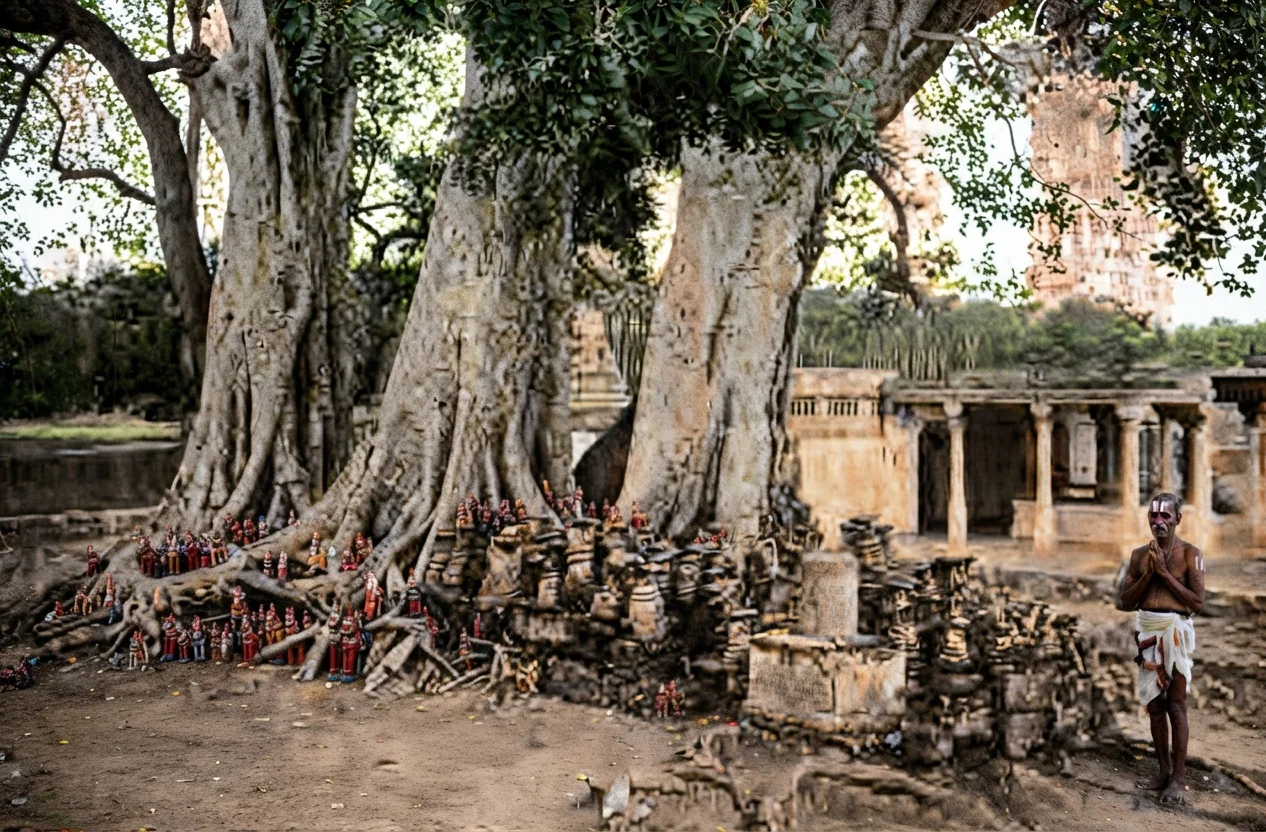
A Sacred Tree Under Which Are Placed Votive Offerings of Pottery Horses
MORAL FAILURE OF STATE RELIGIONS
By W. Mayhew Healey
By W. Mayhew Healey
“When the church turns to the state for aid, and asks civil government for strength and support, it rejects God’s word and power.”
THE Bible tells us, in the first chapter of John, that Jesus Christ is the Light of the world, and that He “lighteth every man that cometh into the world.” It does not follow that He will save “every man that cometh into the world,” or that they will even so much as hear of His existence; but He imparts to every man, though born in heathen lands, and educated by heathen teachers, a sense of the distinct difference between right and wrong, although his sense may be low, and his standard imperfect.
Doubting God’s Ability
WHEN Jesus Christ went back to heaven, He commissioned His followers to go forth and be “the light of the world.” Matt. 5:14. Then He prayed to the Father that He would keep all those who believed on Him, from the evil in the world. John 17:15.
To doubt God’s ability to keep a man from sin is to question His power and government. To doubt His willingness to keep His people from evil is to doubt His word and love.
When the church turns to the state for aid, and asks civil government for strength and support, it rejects God’s word and power. When Israel asked for a king to be at their head, the Lord said to Samuel, “They have rejected Me.”
God’s government is founded on the principle of love, with a constitution of two “great commandments” of love to God and love to one’s fellow beings.
Turning to the State
GOD does not save men as nations, or as churches, but as individuals. The church as a body rejected God in the days of Constantine, by turning from the Lord to the civil government for help and strength. Then followed the most cruel torture and death of millions of the best men and women on the earth. The strength of civil power is compulsion by physical force.
After centuries of bloodshed, there were those who saw glimmerings of light, and they declared for the right of choice without persecution; but the root of the evil was not fully destroyed. Russia established her national church, with the czar at its head. England under Henry VIII united the church to the state, with the king at its head instead of the pope. Germany gives indorsement to the system by permitting each state to decide what support it will give the church. France has, until very recently, given government aid and support to the church. Turkey holds to the Mohammedan belief that the sword is the proper power with which to enforce religion. Austria, while professing liberty in matters of religion, constitutionally demands that her reigning monarch must be a member of the Roman Catholic Church.
Nations Have Gone Astray
THUS the great nations of earth now engaged in deadly conflict have had their religious education under this great error of depending upon the human power of civil government, and not upon the power of God’s divine love. While nations and churches have gone astray from God, He has had, and still has, in all nations and all churches, faithful individuals who walk in the best light they have seen.
The spirit of war is the natural outcome of the state’s enforcing the doctrines of the church, as her power is compulsion by physical force. The present strife of nations shows the moral failure of a religion united to the state. The pure religion of Jesus Christ has not been on trial by nations, but it has been fully tested by millions of individuals, who have stood for truth in love under every conceivable trial, with God alone to sustain them.
Dangers Threaten
THE government of the United States of America was founded upon the true principle of an entire separation of church and state. But grave danger threatens both, in the persistent efforts that are made to obtain legislative enactments, state and national, to enforce the doctrines and religious institutions of the church. Every state in the Union, except California, has already placed on its statutes some kind of law to protect and enforce the church institution of Sunday rest.
A bill is now pending in Congress, known as H. R. 491, to authorize the postmaster-general to exclude from the mail any publication containing any article “which tends to expose any race, creed, or religion to either hatred, contempt, ridicule, or obloquy.” Such a law would cripple the power of the press to expose the greatest errors or the vilest practices when held under the name of religion, because the exposure of such would “tend” to bring them into “contempt.” If we desire liberty and peace, let us keep the church and the state forever separate, according to the true Christian religion. Only then will each prosper.