Putting New Labels on Old Cans—A Trick of the Impure Spiritual Food Manufacturers
Page 4
Signs of the Times
May 27, 1908
Pacific Press Publishing Company · Mountain View, California · May 27, 1908
Putting New Labels on Old Cans—A Trick of the Impure Spiritual Food Manufacturers
(See Page 8)
With Our Inquirers
By Editor
"If ye will inquire, inquire ye."
This Inquirers' Department is conducted for the purpose of helping those who are studying the Bible. The answers are oftentimes only suggestive. They are never to be considered infallible, only as they agree with the infallible word. The writer who may answer them does not consider that his opinion is infallible. He will simply give the best that he has, and plead with the inquirer to search the word. Such questions only will be answered which, to the editors, seem to minister to the good of the readers and to the mission of the paper. We can not answer repeatedly in the same volume questions upon the same scripture. The name and address must accompany question, not for publication, but as an evidence of good faith, and that answer may be made by letter if deemed advisable. No letters are answered which do not contain the name of the writer. It is well always to enclose stamp for reply.
Please give me some light on the first chapter of Isaiah, verses 12 to 14.
The whole of the first part of the first chapter of Isaiah is God's setting forth of the spiritual condition of Israel. They had turned from the Lord until from the sole of the foot unto the head there was no soundness in the body of the people. Their desolated country, their burned cities, were all evidence of their departure from God. Their spiritual condition was like Sodom and Gomorrah. And yet they came before the Lord with their burnt offerings and their worship and their ceremonies, the keeping of the Sabbath, and all of that; and the Lord tells them in verses 12 to 14 that all those empty forms and ceremonies were not the things that He asked of them. Their oblations were meaningless; their new moons and Sabbath-keeping and calling of assemblies He did not want. His soul hated them because they were full of hypocrisy. That is all the passage means.
It is just as true in this age as it was in that age. The Lord does not mean by what He says that He would not have His children keep His ordinances. He does not mean by it that He would not have them observe His Sabbath, or offer to Him thankful oblations as tokens of their gratitude to Him. But all these things which He has given to His children, if they are filled with hypocrisy and selfishness, become hateful indeed. It would be better to throw off the very cloak of righteousness than to fill it with that which is evil. If one is going to be a wolf, he had better cast off the sheep's clothing. God does not mean by this that He had rejected His people; altho if they remained in that condition, He would not hear them; yet He pleads with them to put away their evil, learn to do well, and come to Him and have their sins washed away. We have thought by the letter that our inquirer probably referred to the eighth chapter of Isaiah instead of the first, but the letter very clearly says the first chapter.
2515.—The Deception of the Wicked.
You say at Christ's coming the righteous will be raised, all the righteous made immortal, and then taken to heaven, the wicked will be slain, the earth is left desolate, the wicked, dead. At the close of the thousand years the wicked dead are raised and Satan is permitted to deceive them again. Of what use to deceive the man who has already gone beyond redemption. It would almost seem from the reading that the New Jerusalem and the righteous are on earth while it is being burned and melting "with fervent heat."
E. P. H.
There are two reasons which appeal to us, among others, as to why the wicked should be raised at the end of the thousand years. Many have gone down in death in their iniquity, yet deceived as to the future; while cherishing the iniquity in their own hearts they have also cherished the idea that they would be saved because they had trusted in their own devices or the devices of men, while their hearts were not really converted to God. In the great and final day of punishment all will be undeceived as regards this. Many of these souls who have thus died have seemed to the righteous who have lived upon the earth to be righteous persons. The Lord wishes to demonstrate to His own people that all His ways are just.
Secondly, one of the great falsehoods of Satan, told in the beginning, and persisted in with an ever-growing following, is that man himself is divine, that he has within himself the potency of everlasting life, and the right formation of character. On the other hand, the Bible teaches that no man can come to Christ except the Father draw him; that there is no salvation outside of the Lamb of God; that only by the Spirit of God are men drawn to Him. This will be demonstrated not simply for the future inhabitants of this world, but for all the universe, that men left to themselves still have hearts of enmity against God. Notwithstanding God's power to bring them again from the dead, notwithstanding the presence of the Holy City before them, notwithstanding the multitudinous evidences of God's power, there is in their hearts no repentance or submission to Him, while their selfishness throws them open to the deceptions of the enemy who makes them believe they can take the city of God and become possessors of the eternal throne.
Thirdly, Satan has made them believe that no element of destruction coming against the real man can destroy him; while, on the other hand, God has taught that only in righteousness is persistence of being. Therefore the New Jerusalem and the people of God within it will be unharmed amid all the surrounding fires, while sin and all identified with sin will be consumed.
2516.—At the Resurrection of Christ.
Please explain Matt. 27:50-53. The scripture reads, "Jesus, when He had cried again with a loud voice, yielded up the ghost. And, behold, the veil of the temple was rent in twain from the top to the bottom; and the earth did quake, and the rocks rent; and the graves were opened, and many bodies of the saints which slept arose, and came out of the graves after His resurrection, and went into the holy city, and appeared unto many." (a) When did these saints arise? (b) When did they go into the city? (c) What became of them? A. L. M.
1. By a careful reading of the scripture you will see that the graves were opened at the time of the earthquake at Christ's death; but the resurrection of the saints did not take place until after Christ's resurrection. You will notice that there is but a comma separating verses fifty-two and fifty-three, "and many bodies of the saints which slept arose, and came out of the graves after His resurrection."
2. It was immediately after the resurrection that they went into the city and appeared unto many, or during the forty days that Christ was here upon earth before His ascension.
3. When Christ ascended up on high, He "led captivity captive," or as the margin of Eph. 4:8 reads, "a multitude of captives." They were the trophies of His triumph over sin and death. His ascension with them and His reception at the capital of the universe are described in the last part of the twenty-fourth Psalm.
2517.—The Annual Feasts of the Jews.
Are the three feasts of the twenty-third chapter of Leviticus to be fulfilled in their season? H. S. W.
We do not know to what particular three feasts of the twenty-third of Leviticus our inquirer refers—whether to the feast of the passover, the feast of pentecost, the feast of trumpets, or the feast of tabernacles. These, of course, when the Jews were living as they should before God, were celebrated from year to year. They were all typical of the great fulfilment in Christ. The passover lamb was fulfilled when Christ died; not necessarily, however, the whole passover feast. The feast of pentecost also met a fulfilment in the outpouring of the Spirit. But all of these feasts, in fact, all the ceremonies of the Levitical law, were met in our Lord Jesus Christ, and in His work as priest. There will come a time when the day of atonement will be over, and also when the feast of tabernacles will be met in the great antitype of the home-coming in the New Jerusalem. We do not see, however, that these feasts should be celebrated year by year until the time of their complete antitypical fulfilment. These are all met in the ministrations which are given of our Lord Jesus Christ and in a consistent celebration of Him in walking in newness of life.
2518.—Oath-taking.
Is the taking of an oath by witnesses in courts, as before a notary public, as a legal test, a violation of the Lord's command to swear not at all? B.
Very evidently it is not. It refers to those extra-judicial oaths in which so many people indulged very commonly in the days of the Saviour, even more commonly in the heathen world than among the Jews. Men swore by their heads, swore by the altar, swore by various things which they considered sacred. All these added nothing. "Let your communication be, Yea, yea; Nay, nay." But when the law demanded the judicial oath, that was another thing. We know nothing whatsoever in the Scriptures which forbids that. In fact, we have the very best examples of the solemn affirmation by the oath in the fact that God Himself swore to Abraham, by Himself, because there was no higher, as stated in Heb. 6:17; and also the example of our Lord Himself at the time of His trial. To the various questions which were put to Him He answered nothing at first. Finally the priest said to Him, "I adjure Thee by the living God, that Thou tell us whether Thou be the Christ, the Son of God." That was the form of taking the oath. Jesus said to him, "Thou hast said."
2519.—The Marriage of Cousins.
What is the meaning of the 37th and 38th verses of Gen. 24? Is it, therefore, right for cousins to marry? M. F. M.
Gen. 24:37, 38 simply give the words of instruction to Abraham's servant, that he was not to take a wife for Isaac from the daughters of the Canaanites, but that he should go unto Abraham's father's house and to his kindred, and take a wife for his son. He, therefore, went and found Rebekah, a cousin of Isaac's, and brought her to him. There is nothing in the Scriptures, so far as we know, to forbid cousins marrying, and yet constant intermarriage always tends to the degeneracy of the race. The prohibition, however, of Abraham's was not as regards relatives, but religion. The Canaanites were idolaters, and very gross idolaters; therefore not one of their daughters was to be taken as a wife for Isaac. While Abraham's relatives were tinctured, to some extent, with idolatry, they were not to be considered with the Canaanites; and from this class, those who believed in the true God, a wife was to be taken for Isaac.
2520.—Crossing of Diverse Animals is answered in Lev. 19:19. As to what bearing and force that text should have at the present time in either principle or prohibition is for the individual himself to decide. The Lord was very careful with His people anciently in endeavoring to keep all things connected with their administration and national life pure. Idolatry entered into almost every phase of the life of the heathen. The object-lessons which God has given us concerning His own people are that in all their daily avocations and their business relationships, everything should tend to the one great lesson of keeping God continually before them and His worship pure.
2521.—Concubines.—M. F. M.—Regarding Gen. 25:6 and other passages, certainly it was wrong to have concubines, or plurality of wives, for such they were. They were not to be considered as the first wife, whose children heired the property, but they were after all legitimate second-class wives. God suffered these things. Abraham himself did not see the wrong of it clearly, but we do see over and over that it never worked out for good. Abraham's taking Hagar brought trouble into his family; Jacob having two wives brought trouble into his family; David's many wives brought trouble into his family; and Solomon's many wives led him astray. Plural marriages have always been a curse.
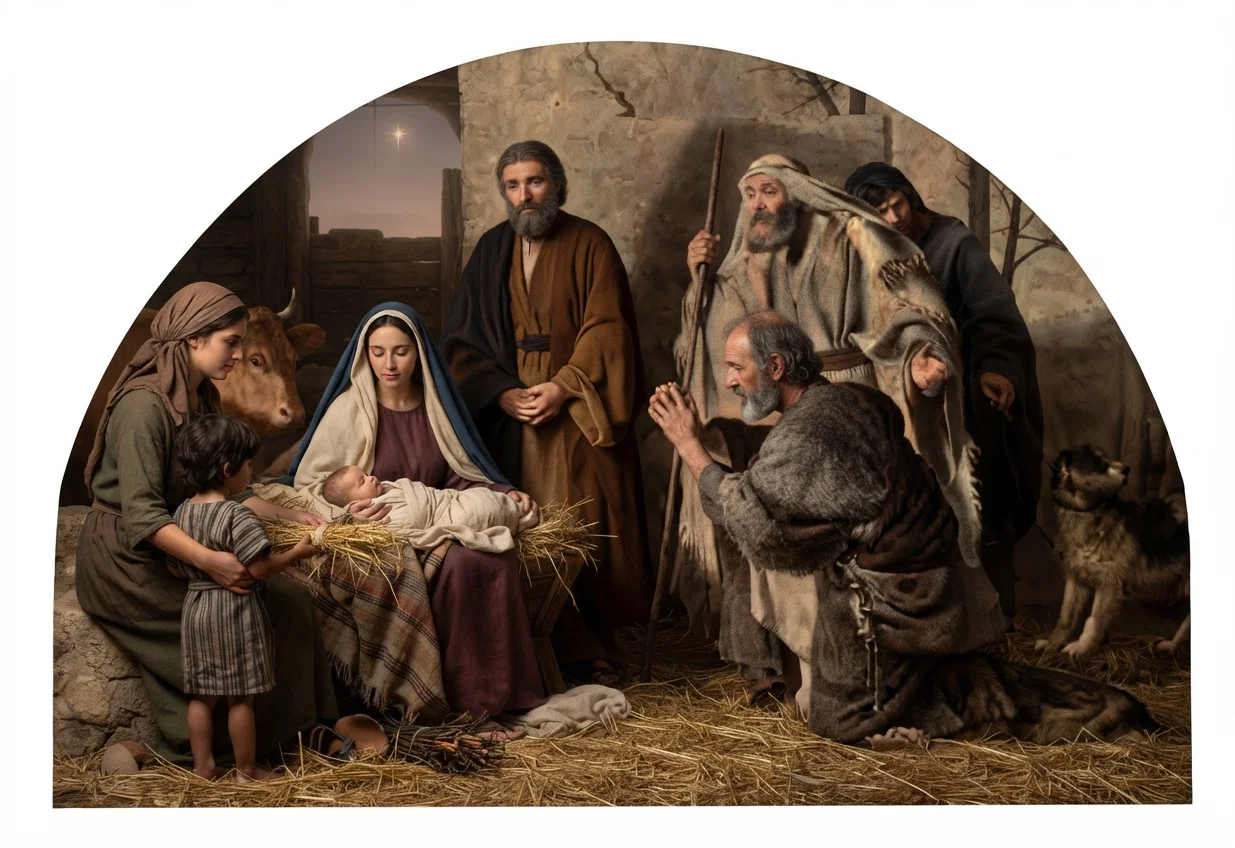
Unto You Is Born a Saviour
By Mrs. E. G. White
By Mrs. E. G. White
THE King of glory stooped low to take humanity. Rude and forbidding were His earthly surroundings. His glory was veiled that the majesty of His outward form might not become an object of outward attraction. He shunned all outward display. Riches, worldly honor, and human greatness can never save a soul from death; Jesus purposed that no attraction of an earthly nature should call men to His side. Only the beauty of heavenly truth must draw those who would follow Him. The character of the Messiah had long been foretold in prophecy, and He desired men to accept Him upon the testimony of the word of God.
"And they came with haste, and found both Mary and Joseph, and the Babe lying in the manger." Luke 2:16.
The angels had wondered at the glorious plan of redemption. They watched to see how the people of God would receive His Son, clothed in the garb of humanity. Angels came to the land of the chosen people. They came unseen to Jerusalem, to the appointed expositors of the Sacred Oracles, and the ministers of God's house. Already to Zacharias the priest, as he ministered before the altar, the nearness of Christ's coming had been announced. Already the forerunner was born, his mission attested by miracle and prophecy. The tidings of his birth and the wonderful significance of his mission had been spread abroad. Yet Jerusalem was not preparing to welcome her Redeemer. Hearts selfish and world-engrossed were untouched by the joy that thrilled all heaven. Only a few were longing to behold the Unseen. To these, heaven's embassy was sent.
Angels attend Joseph and Mary as they journey from their home in Nazareth to the city of David. The decree of imperial Rome for the enrolment of the peoples of her vast dominion, has extended to the dwellers among the hills of Galilee. As in old time, Cyrus was called to the throne of the world's empire that he might set free the captives of the Lord, so Cæsar Augustus is made the agent for the fulfilment of God's purpose in bringing the mother of Jesus to Bethlehem. She is of the lineage of David, and the son of David must be born in David's city. Out of Bethlehem, said the prophet, "shall He come forth . . . that is to be ruler in Israel; whose goings forth have been from of old, from the days of eternity." But in the city of their royal line, Joseph and Mary are, unrecognized and unhonored. Weary and homeless, they traverse the entire length of the narrow street, from the gate of the city to the eastern extremity of the town, vainly seeking a resting-place for the night. There is no room for them at the crowded inn. In a rude building where the beasts are sheltered, they at last find refuge, and here the Redeemer of the world is born.
Men know it not, but the tidings fill heaven with rejoicing. With a deeper and more tender interest the holy beings from the world of light are drawn to the earth. The whole world is brighter for His presence. Above the hills of Bethlehem are gathered an innumerable throng of angels. They wait the signal to declare the glad news to the world. Had the leaders in Israel been true to their trust, they might have shared the joy of heralding the birth of Jesus. But now they are passed by.
God declares, "I will pour water upon him that is thirsty, and floods upon the dry ground." "Unto the upright there ariseth light in the darkness." To those who are seeking for light, and who accept it with gladness, the bright rays from the throne of God will shine.
In the fields where the boy David had fed his flocks, shepherds were still keeping watch by night. Thru the silent hours they talked together of the promised Saviour, and prayed for the coming of the King to David's throne. "And lo, the angel of the Lord came upon them, and the glory of the Lord shone round about them; and they were sore afraid. And the angel said unto them, Fear not; for, behold I bring you good tidings of great joy, which shall be to all people. For unto you is born this day in the city of David a Saviour, which is Christ the Lord. And this shall be a sign unto you: Ye shall find the Babe wrapped in swaddling-clothes, lying in a manger."
The heavenly messenger had quieted their fears. He had told them how to find Jesus. With tender regard for their human weakness, he had given them time to become accustomed to the divine radiance. Then the joy and glory could no longer be hidden. The whole plain was lighted up with the bright shining of the hosts of God. Earth was hushed, and Heaven stooped to listen to the song,— "Glory to God in the highest, And on earth peace, good-will toward men." As the angels disappeared, the light faded away, and the shadows of night once more fell on the hills of Bethlehem. But the brightest picture ever beheld by human eyes remained4in the memory of the shepherds.
“And it came to pass, as the angels were gone away from them into heaven, the shepherds said one to another, Let us now go even unto Bethlehem, and see this thing which is come to pass, which the Lord hath made known unto us. And they came with haste, and found Mary, and Joseph, and the babe lying in a manger.”
Departing with great joy, they made known the things they had seen and heard. “And all they that heard it wondered at those things which were told them by the shepherds. But Mary kept all these things, and pondered them in her heart. And the shepherds returned, glorifying and praising God.”
The story of Bethlehem is an exhaustless theme. In it are hidden “the depths of the riches both of the wisdom and knowledge of God.” We marvel at the Saviour’s sacrifice in exchanging the throne of heaven for the manger, and the companionship of adoring angels for the beasts of the stall. Human pride and self-sufficiency stand rebuked in His presence. Yet this was but the beginning of His wonderful condescension. It would have been an almost infinite humiliation for the Son of God to take man’s nature, even as it was when Adam stood in his innocence in Eden. But Jesus accepted humanity as weakened and defiled by four thousand years of sin. Like every child of Adam, He accepted the results of the working of the great law of heredity. What those results were is shown in the history of His earthly ancestors. He came with such a heredity to share our sorrows and temptations, and to give us the example of a sinless life.
Satan in heaven had hated Christ for His position in the courts of God. He hated Him the more when he himself was dethroned. He hated Him who pledged Himself to redeem a race of sinners. Yet into the world where Satan claimed dominion God permitted His Son to come, a helpless babe, subject to the weakness of humanity. He permitted Him to meet life’s peril in common with every soul, to fight the battle as every child of humanity must fight it, at the risk of failure and eternal loss.
The heart of the human father yearns over his son. He looks into the face of his little child, and trembles at the thought of life’s peril. He longs to shield his dear one from Satan’s power, to hold him back from temptation and conflict. To meet a bitterer conflict and more fearful risk, God gave His only-begotten Son, that the path of life might be made sure for our little ones. “Herein is love.” Wonder, O heavens! and be astonished, O earth!
Christ, the Lamb Slain from the Foundation of the World
By C. L. Taylor
By C. L. Taylor
God is eternal. Deut. 33:27. He “inhabiteth eternity.” Isa. 57:15. The psalmist says of Him, “From everlasting to everlasting, Thou art God.” Ps. 90:2.
God is infinite. Eternal in all His attributes, He is infinite in all His ways. “Touching the Almighty, we can not find Him out.” Job 37:23. Infinitude has been stamped upon all His work.
But while men by searching can not find Him out, yet He has been pleased to reveal to them thru His word somewhat of His greatness as comprehended in His purposes and plans. He desires that man shall by faith enter into the secrets of divinity (Ps. 25:14), and thru both time and eternity join with Him in fulfilling the divine will (Eph. 2:7).
The Scriptures speak of God’s “eternal purpose, which He purposed in Christ Jesus our Lord.” Eph. 3:11. This glorious purpose, in which man has a place and part, was laid “before the foundation of the world” (Eph. 1:4),—before worlds sprang forth and before angels came to be. Not only this world but all worlds thruout illimitable space were provided for in its wonderful fulness of righteousness and life.
This glorious purpose, all-embracing and never-ending, was “purposed [that is, laid] in Christ Jesus our Lord.” He was to be its foundation and assurance. Of necessity this had to be; for an infinite and eternal plan called for infinite and eternal resources and support. In Jesus Christ alone could be found a sufficient pledge that such a purpose should not fail.
From the days of eternity, therefore, the Son of God accepted the responsibility of maintaining the uprightness of all things in all God’s universe, of providing a safe-conduct, as it were, for every world which should move thru space, and for every life which should be brought into existence.
Creator and Preserver.
In pursuance of the great and eternal plan of God, the Son became the Creator of all things (John 1:1-3), the Upholder of all things (Heb. 1:3; Isa. 40:26); by Him they consist (Col. 1:17), from Him they receive their name (Eph. 3:15), and, finally, in Him all will be gathered together (Eph. 1:10).
Like the great whole of which they were but a minute part, the specific plans for this world were laid for eternity. “What God doeth, it shall be forever.” Eccl 3:14. And as for the whole, so Jesus Christ was pledged to maintain earth’s purity and freedom, to preserve its original uprightness forever.
What were earth’s plans?—Under the fashioning hand of the divine Architect, earth was to be made a glorious and eternal Eden, inhabited by holy characters formed after the divine similitude. And “from the foundation of the world” these character-names were “written in the book of life.” Rev. 17:8.
In harmony with the beautiful design, the Creation took place. Formed in the image of God, our first parents were placed upon test, every advantage being given them to demonstrate their loyalty to Him who had given them life. Had they continued faithful, every character-name would have found its human dwelling, multiplication would have ceased, and mankind would have been immortalized.
But the sad record of man’s failure is familiar to all. “By one man sin entered into the world, and death by sin.” Rom. 5:12. It appeared that Heaven’s plans had ended in failure. Yet it was not so. The mighty stream of omnipotence and infinity was destined to flow on, even tho an enemy maliciously sought to check its course.
The Development of the Purpose.
As we have seen, the eternal purpose of God had set forth Jesus Christ as surety, and thus had provided against every emergency. And so it was, that in that day of sin, that hour of world calamity, the divine resources, brought forward from the days of eternity, were called into requisition. True to the responsibility which “from the beginning” He had assumed, the Son of God threw Himself, with all the divine “fulness of the Godhead,” into the void which sin had made.
Tho “foreordained before the foundation of the world” (1 Peter 1:20), it was not until earth’s crisis actually came that the Son of God, in that mysterious “counsel of peace” between Himself and the Father, surrendered Himself as man’s Substitute and announced to the universe the glorious plan of redemption. But in that day of doom, He took man’s place. Where death was, there He placed life; where sin was, there He established righteousness. In God’s plan He was that day offered up; He was henceforth “the Lamb slain.” Rev. 13:8.
From the very foundation of the world, therefore, “the precious blood of Christ, as of a lamb without blemish and without spot,” was thus made available to man. The virtues of the Christ-character were imparted to believing sinners. In the promise of the coming “Seed” which should “bruise” the head of all evil (Gen. 3:15), our sorrowing first parents were made to know of the Redeemer. To them the “Child” was even then born; to them the “Son” was “given.” In their hearts was placed the enmity; in their lives the Lord Jesus Christ found an abiding-place. Over them the second Adam began to reign.
The beautiful story of John 3:16 was first told in Eden. And when Adam and Eve were driven forth from the garden, they were not without the comforts of faith, hope, and love. They saw the cross, and met it in their own lives. Their faith in the Coming One was expressed in their offering up of the lambs of the flock, and day after day and year after year they saw5more and more clearly the love of God, and knew more fully that power which saves from sin and sinning.
Thru the gift of His Son, God maintained His purpose. That purpose, as originally designed before worlds were created, will be carried out. Sin may apparently triumph, but its time is short. The day is soon to dawn when with open face we shall see that the eternal purpose of Jehovah has been fully realized in “the Lamb slain from the foundation of the world.”
True Christian Science.
By Editor
How One Person Views It.
THE following paragraphs are excerpts from a letter written to a friend by a young lady who has been a patient at one of our sanitariums. She is a member of one of the large evangelical churches. As to whether she is a Christian or not, her own words will convey better the idea. She says:
“These Adventists are certainly a peculiar people. When they go in to teach people religion they teach them how to live. They do not believe that belonging to a church will save a person. They do not believe a person can be a Christian if he is filthy in clothing or in personal habits; they do not believe that a man can hope for a better condition, and keep on chewing or smoking tobacco, or putting poison into his system and making a hog of himself. If all these things are corrected, and he will take a bath, eat to live, take care of his physical strength, living right in every way, then he is fit to be a church-member.”
Of course in this the young lady is somewhat mistaken, because the one essential thing above all others in order to be a Christian is faith in the Lord Jesus Christ. All these other things ought to follow as the fruit of faith.
She remarks to her friend to whom she writes:6“I think of old B. — at F. —, and all those other ‘bums’ the Methodist church took in regularly at revivals, and who joined about twice every year.
“I have some respect for religion as the Adventists practise it. It is something plain and simple, and a practical solution. I used to be taught, or given to believe, that sickness and distress and trouble were punishments sent by God on people who disobeyed Him; but I believe now that these things are not from God, or in His plan, but we were made subject to laws and given the power of choice. A man can not be given the power of reason without having the power of choice; so all sin and sickness come from laws broken. If we kept all the laws of health, and if our ancestors had done so, we would not be sick.
“I think the churches do a great deal of harm in giving the people the idea that they can come from a disorderly, dirty home, and from saloons, and from idleness and neglect of duty, and simply by joining the church be given a spiritual life and right to a reward to come. If they were told—especially the young people—how to live, and what true Christianity is; if they were taught physiology, and that a person can not have a brain capable of healthy action unless he lives right and normal; and that mental and moral power depend to a great extent upon physical power, better characters would be developed.
“The idea that I had in the past was that the church could save men. But I do like the idea of health reform and right living; and the church for the purpose of holding enlightened people together, and for the purpose of teaching others, is a good thing. This is the first place I have seen applied Christianity. They make a practise of it in everything. Perfectly truthful and honest, never any disturbance or unpleasantness, and things go so nicely. It is infinitely more than I could see ahead a short time ago, that I could have health. I have not worried about anything here, and everything about the place gives me confidence that there is no need of worry. Life is not so hard among such people as these. I have seen lots of new things, and have come at such a time as to see and appreciate. I have some books on hygiene I want you to read.”
Our readers may be interested to know how the teaching of God's laws of health and hygiene looks to one who has never known them in the past. They may also see how they are truly connected with Bible Christianity, true Christian science.
The Bible Scientific
By G. D. Ballou
By G. D. Ballou
(Concluded.)
MODERN science has developed a system of object-lesson teaching for kindergarten work which has proved most effective in keeping the attention of the little folks, and impressing on their plastic minds the preparatory development so necessary to mold them for advance work.
A few simple objects, as toothpicks, kernels of corn, beans, or grains of wheat, are given names of persons or animals, and even character is ascribed to these representative objects. A story is told, and they are made the actors. The law of association is successfully involved by the skilled teacher, and many a lesson is deeply and lastingly impressed on the receptive child-mind.
This is considered to be the very acme of science. Now God the Creator, in His word, endeavoring to open up the future to the minds of His little children, uses precisely the same method. Note particularly those two books which have been so unsparingly criticized by the modern pulpit, — Daniel and the Revelation. Both have been pronounced incomprehensible mysteries which the heavenly Father never designed His patient, trusting children should ever bother with. Yet in these is a complete illustration of the kindergarten science. In Daniel 2 is an image made of four metals, which is smitten by a stone. The God of heaven reveals to the prophet the meaning of each metal part and of the stone, and he tells the simple story to the king. That object-lesson, revealing the coming of three other universal monarchies and the utter passing of all, and the establishment of the kingdom of God in their stead, produced a most profound impression on the mind of Nebuchadnezzar. How simple it all was! Just a kindergarten story, and no more; but it was God’s kindergarten method of making impressions on a giant mind which could not have been so thoroly aroused by any other statement of the same truths. This, with a later personal experience, where another lesson of the same kind is taught, in which the king was likened to a tree, even to a stump, resulted in Nebuchadnezzar’s conversion.
In chapter seven occurs another object-lesson. The kingdoms of this world are represented by beasts. Just as the teacher tells the children that the kernels of corn are sheep, and that a toothpick is the shepherd, so God said that these beasts, the lion, the bear, the leopard, and that awful beast with nails of brass and teeth of iron, were the same four kingdoms about which He had told Nebuchadnezzar.
Again, in chapter eight are two beasts and a horn that grew wonderfully great: The angel said that the ram represented the Medo-Persian kingdom, and the goat, the kingdom of Greece.
So we might go on in the book of Daniel and all thru the Revelation. Object-lesson after object-lesson is introduced to make lasting impressions on the human mind and to make it easy for the understanding to grasp the great lessons of future things. Shall we call our work and our ways scientific, and not acknowledge the ways of the Lord to be also scientific? There must be something worse than color-blindness in him who can see light and wisdom in modern human methods and pronounce the same methods dark and mysterious when God sees fit to use them. Each line of prophecy is as distinct and clear in itself as ever was any lesson of science, and the only thing God has left for us to do is to compare these different lessons He has given, and thus search out the whole chain of truth.
Each great truth is set forth clearly and simply, and God would have us use our intellects in finding the relationship of these various truths.
I can not better illustrate the manner in which the men and women of this generation have been induced to discredit the Bible, especially the prophecies, than by supposing that a certain young man had been told by his grandfather and master and his own parents and his school-teacher, that he would never be able to understand geometry. It was all a mystery, never designed to be understood, there was no use for him ever to meddle with it, and that the old neighborhood surveyor knew of it all that was necessary for the good of the community. Do you think that young man would have much ambition to study geometry? So it has been with the Bible. The ministry of the churches has not hesitated to pronounce the prophetic portion of it mysterious, dark, profound, and beyond human comprehension. I do not wonder that my fellow men feel that way about the Bible. So much has been said to discourage and hinder that I marvel that any one has the courage to attempt its study.
But having shown that the Old Book is as scientific, and more so, as the methods of men, we are content to leave it with the reader to decide whether or not it will be wise for him to give it the same careful attention he would and does give to the common sciences relating chiefly to this life. If half the time were given to the Bible prophecies that is given to the study of mathematics alone, there would be an end of infidelity and skepticism, and men would be more numerous of whom the apostle Peter speaks: "Therefore, beloved, seeing ye know these things before, beware lest ye also, being led away with the error of the wicked, fall from your own steadfastness. But grow in grace, and in the knowledge of our Lord and Saviour Jesus Christ."
That Cutting Word.
By Eliza H. Morton
It came like a flash from a summer sky,
It sank in a heart like a leaden die;
The impress was made like a brand of fire,
A livid mark from a living wire.
And no one will know the bitter tears,
Of the homesick cry adown the years;
Be careful, soul, of the words you speak,
For the time is short, and the flesh is weak.
Eliza H. Morton.