Your ShelfYour Projects

Signs of the Times, Vol. 40, No. 22.

The Return of the Ransomed

Signs of the Times

Jun 3, 1913

Pacific Press Publishing Association · Mountain View, California · Jun 3, 1913

The Return of the Ransomed

BY LLEWELLYN A. MORRISON
"The ransomed of Jehovah shall return, and come with singing unto Zion; everlasting joy shall be upon their heads: they shall obtain gladness and joy, and sorrow and sighing shall flee away." Isaiah 35:10.

HE children of God, in glad freedom returning, Their pilgrimage journey with joy have begun; The desert, the darkness, the bondage, the mourning, The travail and thraldom, are over and done. Onward to Zion, the city immortal! Riseth their song of delight by the road, Swelling afar till they reach the crown'd portal— The home of the ransomed, the city of God.
No more shall they languish in fetters and prison, By passionate evil and hatred imbued; Their Shiloh—Redeemer—for them has arisen; Their hearts have been changed, and their natures renewed. Onward to Zion, the city immortal! Riseth their song of delight by the road, Swelling afar till they reach the crown'd portal— The home of the ransomed, the city of God.
By the "highway" they come and are coming, and ever New feet join the marching, new lips the refrain; The weak knees are strengthened by ceaseless endeavor; The dumb tongues are loosened, and blend in the strain. Onward to Zion, the city immortal! Riseth their song of delight by the road, Swelling afar till they reach the crown'd portal— The home of the ransomed, the city of God.
From the hedgerows and byways, from sorrow and sighing, The wilderness breaking in bloom as they sing— With joy everlasting, all dangers defying, And shouting, they come to abide with the King. Onward to Zion, rebuilt and eternal; Free as the light, with their banners they move, Chanting their psalms, to the city supernal, Matchless in beauty and perfect in love.

"IF YE WILL INQUIRE, INQUIRE YE."

This Inquirers' Department is conducted for the purpose of helping those who are studying the Bible. The answers are oftentimes only suggestive. They are never to be considered infallible, only as they agree with the infallible Word. The writer who may answer them does not consider that his opinion is infallible. He will simply give the best that he has, and plead with the inquirer to search the Word. Such questions only will be answered as, to the editors, seem to minister to the good of the readers and to the mission of the paper. We can not answer repeatedly in the same volume questions upon the same scripture. The name and address must accompany question, not for publication, but as an evidence of good faith, and that answer may be made by letter if deemed advisable. No letters are answered which do not contain the name of the writer. It is well always to enclose stamp for reply.

4086 — Melchizedek, Heb. 7:1

E. H. and E. J. C.
It is impossible for us to explain in this department some of the great questions of the Bible. The Melchizedek to whom this passage refers is the Melchizedek who met Abraham. We have the account in the 14th chapter of Genesis. The word itself means "king of righteousness,"—"malki," king, and "zedek," righteousness. He was king of Salem, and "Salem" means peace. Righteousness is always peace with God. This Melchizedek was "a priest of God most high." It is strongly held by some—and there seems to be some very good evidence to support the view—that he was a visitor from another world, the head of another world, as Adam would have been the head of this if he had never sinned. He was sent for a while to cooperate with Abraham, and served as an illustration of what God designed this world should be. Therefore it could be said of such a being as that that he was without father and without mother—"without genealogy," having neither beginning of days nor end of life, but made like unto the Son of God, abideth a priest continually." Adam would have been the priest in this world to all eternity, if he had never sinned. Our Lord Jesus Christ won his place by taking upon Himself man's nature and sinful condition, and winning by His righteous life the place which man lost. Therefore He will be our High Priest forever,—our Melchizedek Priest, both King and Priest. That Melchizedek was a type of Christ, our glorious Melchizedek.

4087 — Not on the Sabbath Day, Matt. 24:19, 20

Kindly explain the passage, "Wo unto them that are with child, and to them that give suck in those days! But pray ye that your flight be not in the winter, neither on the Sabbath day." E. J. C.
By the context, our querist will see that the time referred to is the destruction of Jerusalem, one of the greatest calamities that came upon the Jews. Of course our Lord would have disciples among the Jews at this time. From Josephus and other sources we learn that the Jews suffered greatly. In fact, the nation was practically wiped out, many thousands killed, and many other thousands sold into slavery. We could understand under what fearfully trying conditions those would be who sought to escape from Jerusalem as it was surrounded by the Roman armies. It is a recorded historical fact that when the armies surrounded Rome, there came a period in which the armies were withdrawn, which seemed indeed to be a marvelous thing; but this clearly was God's providence to permit His children to escape, and they were told to pray that this opportunity might come at a time when the feeblest could get away, and when they would not be restrained by any law regarding the Sabbath day; not only that they would not be confined in the city by the closing of the gates on that day, but that they might also regard the Sabbath itself as sacred.
We could see that women who were bearing little children at that time would find it a greater hardship than humanity could endure, and therefore the wo that is pronounced. The wo is not God's curse. It is really a lamentation for those who are in an unfit condition to flee. Rotherham's rendering is, "But alas for the women."

4088 — Differences in Days

Please explain Rom. 14:5, 6: "One man esteemeth one day above another: another esteemeth every day alike. Let every man be fully persuaded in his own mind. He that regardeth the day, regardeth it unto the Lord; and he that regardeth not the day, to the Lord he doth not regard it. He that eateth, eateth to the Lord, for he giveth God thanks; and he that eateth not, to the Lord he eateth not, and giveth God thanks." E. J. C.
Read as in the American Revised Version, in verse 6, "He that regardeth the day, regardeth it unto the Lord." The next clause is wanting. Note the general subject of the chapter. The whole passage is given for one purpose, and that is that we should not judge one another. Now this is addressed to Christians, to those that have accepted the Lord Jesus Christ, to those in whose heart God's law is established (Rom. 3:31), in whom the righteousness of the law is fulfilled (Rom. 8:4), whose carnal mind has been slain, and the mind of God lives in them, which is not at enmity with His law (Rom. 8:7). The "day," then, does not have reference to the day that is enjoined in God's law, neither to any immoral thing whatsoever. Some in that Roman church were Jews, some were Gentiles. To some of those Jews the Passover would be a holy day. The day of atonement would also be. They would prefer to keep them after they had become Christians, because of their long associations. Others could see that all those types had passed away and had met their fulfilment in Jesus. And the natural tendency would be for one class to judge the other. Some could be much more liberal in their eating than others. Others would wish to eat only vegetable food. The real point of the apostle is not as to whether they should observe this day or that, or those ancient feasts, nor whether they should eat this or that, but that they should not judge one another. That is the real point of the chapter, and that is the great lesson that God wishes us to learn. "Who art thou that judgest the servant of another? to his own lord he standeth or falleth. Yea, he shall be made to stand [in spite of any judgment that we can render]; for the Lord hath power to make him stand." Verse 4. "So then each one of us shall give account of himself to God. Let us not therefore judge one another any more; but judge ye this rather, that no man put a stumbling-block in his brother's way, or an occasion of falling." Verses 12, 13. We know that it is said that the "every day" must include the Sabbath day; but see Ex. 16:4 and the context, where it is shown very clearly that the "every day" there meant simply every one of "the six working-days," and did not include the Sabbath day.

4089 — An Indication of Victory

Is it not a certain sign of forgiveness of sin if one gains the victory over sin? M. E. G.
Surely, it is a true sign that the Lord is helping. And yet there is a better evidence than this for forgiveness of sin. It is the assurance of His word. Here is one text: "If we confess our sins, He is faithful and just to forgive us our sins, and to cleanse us from all unrighteousness." There is the promise. God can not go back on His word. His Spirit brings His law to our heart and shows us the sin; and if we go to Him and confess the sin, in harmony with His word, there is His promise, and the sin is forgiven. We may not feel that it is forgiven; the devil may still hold its black cloud before our face; but there is God's word, and His word can not fail. Of course it is a blessed added assurance if He is helping us to overcome our sins; He is thus telling our poor, timid, almost distrustful, doubting hearts that He is willing to help us. Let us thank Him for this also.

4090 — Remarriage

After a couple have married for true love, and one is taken by death, could Christ join the surviving one with another companion in one flesh? Would a marriage of this kind be divine? Could a person have true love the second time and the third time, after the person has married one for true love? Did Christ Himself ever favor second marriage in His statements? R. T.
We know no reason why one may not marry the second and the third time. Certainly this has been countenanced among God's children all the way through, and in the books of Moses the Lord gave special instruction regarding it. We do not know why one who had been married by true love might not, after the sorrow for the first was over, truly love another person. We find evidences of that among our acquaintances often. Frequently we hear it said by a wife who has lost a husband, and a husband who has lost a wife, that they could never marry again, or never love another; but after time has healed the wound, it has been found expedient, at least, to marry, and they find some one that they love, eventually, equally with the first. We do not have any account of our Lord's discussing that question, but it is well for us to remember that He is the one through whom the whole word of God came. It is clearly evident that Mary herself was the second wife of Joseph, Joseph himself having by his first wife other children, called the brothers of Jesus.

4091 — Ishmael's Character, Gen. 16:12

Please explain Gen. 16:12: "And he shall be as a wild ass among men; his hand shall be against every man, and every man's hand against him; and he shall dwell over against all his brethren." C. M.
The text is a clear delineation of what Ishmael's character would be, and a prophecy of his continuance. A wild ass is known for his unruly, vicious character; so the very nation which would spring from Ishmael would be of that character. It is admitted that the wild tribes of the desert, the Arabs, sprang from Ishmael. They live by robbery, rapine, and plunder, their hand against every man and every man's hand against them; but it is a remarkable prophecy that he shall dwell over against all his brethren, or in the presence of his brethren. His brethren were the Jews. The Ishmaelites lived in the country adjoining them to the south and the east. Nation after nation has gone to destruction, but two nations abide,—the Jew and the Arab, the descendants of Isaac and the descendants of Ishmael; and so they will continue even to the very end.
4092 — N. S. P.—Referring to Lev. 4:17, we would say that all these ceremonies concerning the sacrifices that were offered are typical of what our Lord Himself has done for His children once for all. The sprinkling of the blood of the sacrifice was the type of the offering of His own blood for us. See Hebrews 9.

Our Bible Band

Schedule for Week Ending June 7, 1913 Sunday June 1 2 Kings 13, 14 Monday " 2 " 15, 16 Tuesday " 3 " 17, 18 Wednesday " 4 " 19, 20 Thursday " 5 " 21, 22 Friday " 6 " 23, 24 Sabbath " 7 Psalms 39, 40, 41
Our lesson begins with the 13th chapter of 2 Kings, recording the reign of Jehoash, or Joash, over Israel, and Elisha's last sickness, and his effort to teach Joash persistency and faithfulness, but he failed. In Judah we have the reign of Amaziah, which began well but ended wickedly. He was followed by Azariah, the good Jotham, the weak Ahaz, the good Hezekiah and his remarkable experiences, the wicked Manasseh, his wicked son Amon, followed by the good Josiah, who fulfilled the prophecy of the disobedient prophet, which we read in the 13th chapter of 1 Kings. Of those kings two were decided reformers,—Hezekiah and Josiah; and one sympathizes deeply with Jeremiah as he mourned the loss of the noble king Josiah. Israel has a still worse story than Judah. Following the reign of Jehoash, who was slain by conspirators, comes that of Jeroboam II, followed by Zachariah, Shallum, Menahem, Pekahiah, Pekah, and Hoshea, the last king of Israel. The Assyrians' coming removed all the permanent men of Israel, and placed in Palestine captives from various tribes and races. Those tribes and races worshiped their own gods, and in a way the true God. That is, in the language of the Scripture, "They feared Jehovah, and served their own gods, after the manner of the nations from among whom they had been carried away." From this mixed worship and these mixed people came the Samaritans, named, not after their races, but after the city of Samaria, the capital of the territory. The story of Israel is one sad commentary of departure from God. The ten-tribe kingdom might have been a strong and stable government, had they but followed the commandments of the Lord, but their idolatry led them astray. And with that sad lesson before them, Judah followed on in the same course until captivity came to her. Our week closes with Psalms 39, 40, 41.
Our Bible Band
Our Bible Band

An Apotheosis of Patriotism
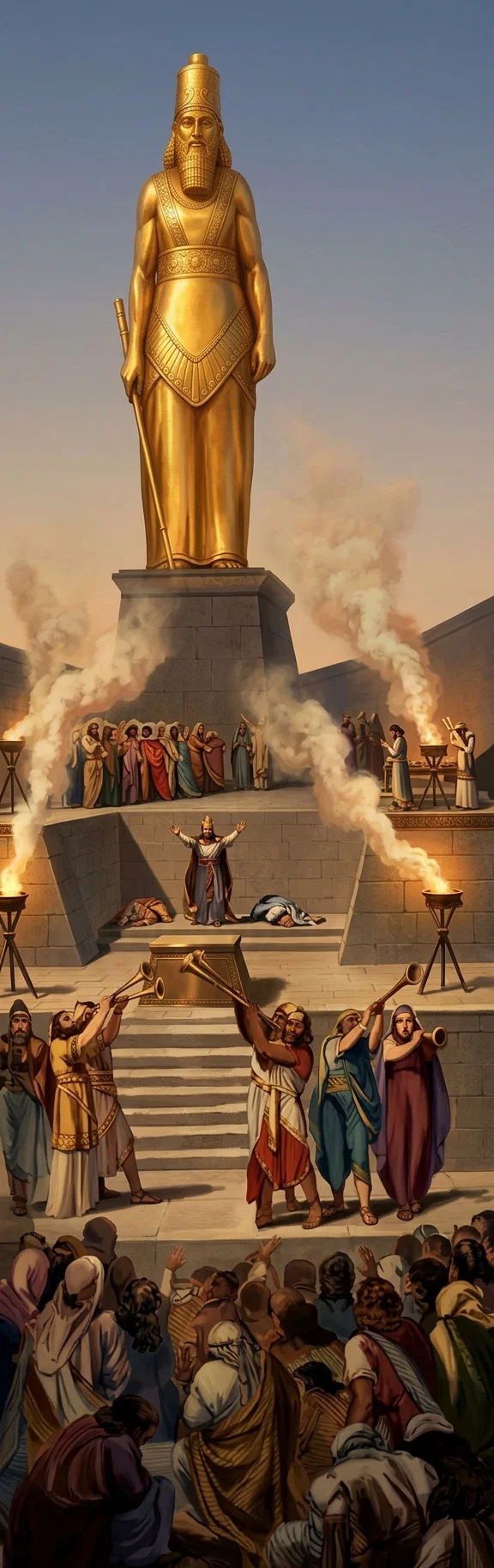
By K. C. Russell
IN the third chapter of Daniel there is contained an account of Nebuchadnezzar's futile attempt to prove that God's revelation through the prophet Daniel was untrue. That is, he did not wish to admit that his kingdom would finally be overcome and another kingdom would supersede it.
Nebuchadnezzar was evidently pleased with the dream that God gave Daniel in reproduction of the dream that had been previously given to the king. But it appears, from the subsequent course he pursued, as recorded in the third chapter of Daniel, that he was not pleased with the interpretation of the dream as it related to his kingdom's being succeeded by another. And therefore the significant words of Daniel the prophet that undoubtedly impressed Nebuchadnezzar more than any other in the interpretation of the dream were as follows: "After thee [Nebuchadnezzar] shall arise another kingdom."
It is not difficult to understand why the proud, arrogant, and idolatrous king of Babylon proceeded to erect a golden image for his subjects to worship, believing, as he did, that his kingdom was never to be superseded by another. This image was to be the one grand patriotic demonstration by which he hoped to assure himself that his kingdom would be perpetuated, and thus show that the words of the Lord through Daniel, that his kingdom would be succeeded by another, were false. The thought of continued existence of his kingdom is evidently hinted at in the words of the Chaldeans as recorded in Dan. 3:9, when they said to Nebuchadnezzar, "O king, live forever."

The King's Tyrannical Decree

The king's command to his subjects to worship the golden image was a most positive and sweeping one. And the penalty to be inflicted upon those who dared to disregard his decree was also most terrible; for those who would not fall down and worship the image when they heard the music, should the same hour be cast into the burning fiery furnace.
There were three subjects in the realm who dared to refuse to obey the command of the king, and instead of falling prostrate at the king's decree, they stood erect when they were commanded to bow before the image. For their disobedience to the king's command, the furnace was heated seven times hotter, and these God-fearing men were cast into that seething fire; but the fire produced no effect upon them, and there was not even the smell of smoke upon their garments.
Why this wonderful deliverance from that awful fiery furnace?—It was due to the fact that Jesus was with them during that trying hour. How true the words of the poet who says, "Anywhere with Jesus I can safely go"!

Their Deliverance Because of Loyalty

It is truly said that the miraculous deliverance of those faithful Hebrew men, and the protecting care of Jesus Christ, the Arch- angel, was because of their refusal to bow down to the golden image. To bow to that image would have been a disobedience to the first and second commandments of the Decalogue, which forbid idolatrous worship. However, it should be remembered that another important element entered into their refusal to bow down to the golden image.
These noble and God-fearing men were associated with Daniel when they sought the God of heaven to reveal to him Nebuchadnezzar's dream and its interpretation. They had implicit faith in God, and believed that when they sought wisdom from above, He would impart it to them. When the Lord did reveal the things that they desired to know, it evidently brought to their hearts and minds an increased confidence in God, whom they were serving. And besides, it gave them great joy. These men, who had experienced such a remarkable answer to prayer, could never consent to bow down to the golden image. In doing so, they would tacitly have said that the remarkable experiences recorded in the first and second chapters of Daniel were a farce. Daniel and his three associates had fasted and earnestly prayed before they sought the Lord in a special manner to reveal the dream and its interpretation. These men had indeed been in the audience-chamber with their God; and for them to bow down to the golden image would have been doing wrong to the Spirit of God.

The Spirit to Perpetuate Kingdoms

The same spirit that controlled Nebuchadnezzar has continued to dominate the rulers to the present time. Recently a Christian missionary was arrested in Turkey for selling a tract explaining the second chapter of Daniel, which shows the final overthrow of all earthly kingdoms and the establishment of Christ's everlasting kingdom at His coming. To the authorities in Turkey, the suggestion that their government was ultimately to be overthrown by any other power was a serious proposition. Turkey is not the only government that is keenly jealous as to the idea that their kingdom shall ever be succeeded by any subsequent one. The thought that this world in its present state is to continue on indefinitely has strangely taken possession of the hearts of men, and any intimation concerning the termination of earthly empires and the world itself is spurned by the masses of people in these times. The great arch-deceiver of mankind realizes what a stronghold the hope of the permanency of an earthly kingdom has upon the hearts of men.
One of the great temptations that Satan brought to bear upon Jesus Christ was the promise of the earthly kingdom if He would pay him homage. Luke 4:5, 6 says: "And the devil, taking Him up into an high mountain, showed unto Him all the kingdoms ofthe world in a moment of time. And the devil said unto Him, All this power will I give Thee, and the glory of them: for that is delivered unto me; and to whomsoever I will I give it." Jesus well knew what was "written," concerning earthly kingdoms. He understood that they were only transitory and soon to pass away, and therefore the enemy was unable to overcome Him by this almost overwhelming temptation.
The message, therefore, that should speedily be borne to both rulers and subjects at this time, is that all earthly kingdoms and their glory will soon pass away and become "as the chaff of the summer threshing-floor."

Earthly Kingdoms Temporary and Transitory

Men of God in every age, who have been under the influence of the Holy Spirit, have realized the temporary and transitory character of earthly kingdoms. We read of Moses, who was on the verge of becoming the king of Egypt, one of the greatest and wealthiest of earthly empires, that "by faith Moses, when he was come to years, refused to be called the son of Pharaoh's daughter; choosing rather to suffer affliction with the people of God, than to enjoy the pleasures of sin for a season; esteeming the reproach of Christ greater riches than the treasures in Egypt: for he had respect unto the recompense of the reward." Heb. 11:24-26. From this inspired statement it appears that Moses regarded all of his earthly prospects as only "pleasures . . . for a season," temporary, but had respect to the "recompense of the reward," which will be his inheritance in God's everlasting kingdom.
Likewise Abraham "looked for a city which hath foundations, whose builder and maker is God." Heb. 11:10. He realized that earthly cities were not enduring, but temporary and indeed without foundations. We have but to scan the history of the past to realize the significance of the words of the patriarch Abraham, when he said he looked for a city which would have foundations. Think of the proud and wicked cities of the plains—Sodom and Gomorrah—with only the Dead Sea to mark the place where they once stood. Think of Babylon, one of the greatest cities that ever existed, now a barren waste; and of Jerusalem and Pompeii. What is true of these cities, already indicated, will be true of the great and populous cities of modern times,—London, New York, Chicago, and other great cities of the world: for says the prophet Jeremiah, "I beheld, and, lo, the fruitful place was a wilderness, and all the cities thereof were broken down at the presence of the Lord, and by His fierce anger." Jer. 4:26. Men may try to sink the foundations of the great skyscrapers and other buildings deep in the earth, thinking that by so doing they will insure the permanency of these great structures, which they believe will be immune from the perils of earthquakes and tornadoes; but, alas, they will find that they are only temporary, and will be laid low by the judgments of God that will soon visit the inhabitants of this world.
The inspired apostle, in his exhortation to constant faith and godliness, shows that everything that can be shaken will be shaken, and that the only enduring thing will be God's everlasting kingdom. In Heb. 12:26-28 we read, "Whose [Christ's] voice then [at Sinai] shook the earth: but now He hath promised, saying, Yet once more I shake not the earth only, but also heaven." From this it will again be seen that the only kingdom that will never be removed is Christ's everlasting kingdom. The inspired apostle Peter has already outlined, in his second epistle, first chapter, verses 4-11, that if we will become partakers of Christ's divine nature, and add to our faith the heavenly graces which constitute a genuine Christian character, we will by that means have an entrance into His everlasting kingdom.

The Christian's Commission

By Mrs. E. G. White
"Ye shall receive power, after that the Holy Ghost is come upon you: and ye shall be witnesses unto Me both in Jerusalem, and in all Judea, and in Samaria, and unto the uttermost part of the earth."
I CALL your attention especially to the commission which Christ gave to His disciples. He said, "Ye shall be witnesses unto Me . . . unto the uttermost part of the earth." But they were not fitted to present the gospel of Jesus to the world until they received the gift of the Holy Spirit. The commission Christ gave His disciples then, is our commission to-day. We are to be witnesses of Him to the world; but we can not impart heaven's light unless we have received it. We can not reveal a Saviour of whom we have no knowledge.
There are many who have a legal, casual faith. They have nominally accepted Christ as the Saviour of the world, but they have no evidence in their hearts that He is their personal Saviour, that He has forgiven their sins, that they have a living connection with God, the source of all light. You can not teach others of Jesus and His righteousness, you can not portray His matchless love and the fulness of His grace, you can not picture Him as the Christian's all in all, as the comforter and guide of man, unless your own heart is filled with His love. You will not be able to present God as a God of compassion and love unless you can say, "I have tasted and know that the Lord is good."

It Must Be a Personal Work

The fact that others receive blessings will not benefit your soul; unless you exercise faith in Christ on your own behalf, you will be unblessed. That others partake of food will not serve to nourish your physical strength, neither will it nourish your spiritual strength to see others rejoicing in God and His love. You yourselves must partake of the feast which your Saviour has provided. Every one of you must wash and be clean. But you say, How can I do this? Have you not told us we have no power of ourselves to cleanse our souls from one spot or stain of sin?—Yes, I have told you this, and yet I say to you, "Wash you, make you clean." God has provided a way of salvation at an infinite cost to heaven. A fountain for sin and uncleanness has been opened for Judah and Jerusalem.
The Father "gave His only-begotten Son, that whosoever believeth in Him should not perish, but have everlasting life." There are many who act as tho Christ were the friend of men, but the Father were their enemy. If this were so, would God have delivered His Son to death that man might have life? Jesus says, "I and My Father are one." Philip said to Christ, "Show us the Father, and it sufficeth us." Jesus turned to him and said, "Have I been so long time with you, and yet hast thou not known Me, Philip? he that hath seen Me hath seen the Father."
Christ came into the world to do a special work. He did not come to originate truth. It was already originated. He did not come to set aside what patriarchs and prophets had spoken; for He Himself had spoken through these representative men. He Himself was the originator of truth. Every jewel of truth came from Christ. But these priceless gems had been placed in false settings. Their precious light had been made to minister to error. Men had taken them to adorn tradition and superstition. Christ came to take them out of the false settings of error and to put them into the framework of truth. He came from heaven to give the world a correct representation of the Father. Through Satan's suggestions and temptations, the Father had been represented as a being of a stern and unforgiving nature. The Christian life had been represented altogether too much as a life of hardship and sorrow. God was pictured as a being who was watching with jealous eyes, spying the mistakes and errors of men, that He might delight Himself in punishing them by the severest discipline, and that there could be no peace or joy in His service. Satan clothed the Father in his own forbidding attributes of character. All this was a false representation, and Christ came to reveal the character of God, and the nature of His service.

A Misrepresentation

Christians misrepresent their heavenly Father when they go mourning and groaning, as tho they were burdened with an enormous load, when their countenances are expressive of gloom and despondency, and the shadow encompasses their souls. But let them not think they are serving God in so doing; they are doing Satan's work in misrepresenting God and His service. They should go before the Father, and plead with Him for a view of His goodness. They have lost sight of Jesus and His love. Let them go to Christ and study His character, for He came to represent the Father.
Shall we receive Satan's misrepresentations of our God, and go on in discouragement, lacking peace and joy in the Holy Ghost? Shall we go on mistrusting our heavenly Father's love and doubting His goodness? What greater injury could we do to our children and our friends than to give them such false impressions of Christian life? It was at an infinite cost to the Father that man's salvation was purchased. The Father suffered with the Son to bring salvation within our reach. It is not His will that one soul should perish, but that all should come to repentance and receive eternal life. He has done all that it is possible to do to save fallen man. There wasno other way by which man could be brought into harmony with His unchangeable law, save by the death of Christ. Christ became our surety, our sacrifice, Saviour, and example, and when all heaven has been poured out to us in this gift of God, how shall He not with Him freely give us all things?
How much we lose by doubting the love of God! Why do we not come boldly to a throne of grace, and by living faith lay hold of the merits of the blood of a crucified and risen Saviour? This must be an individual work. I can not be saved by another's faith, nor can another be saved by my faith. Every soul must be saved by his own righteousness. Can we manufacture this righteousness?— No. But Jesus has furnished it for us. When the sinner comes to Him He takes his load of sin, and gives him His righteousness. The vilest sinner may claim all that was provided in the plan of salvation through the merits of Christ. He may have the attributes of the Saviour. He may go forth to tell of a living Saviour, and to win men to the truth; for he knows what it is to lay hold of Christ by living faith. He has taken the requisite steps in repentance, confession, and restitution, and he can teach others the way of salvation. He can present Christ as one who left His royal throne, who clothed His divinity with humanity, that He might save fallen man. He can present Him as one who was rich and yet for our sakes became poor, that we through His poverty might be made rich. He can go without the camp, bearing his reproach. He is willing to deny self that others may be saved.
Continue reading: THE WITNESSING OF GOD