Your ShelfYour Projects

Signs of the Times, Vol. 40, No. 48.

Christ’s Temptation in the Wilderness

Signs of the Times

Dec 16, 1913

Pacific Press Publishing Association · Mountain View, California · Dec 16, 1913

Christ’s Temptation in the Wilderness
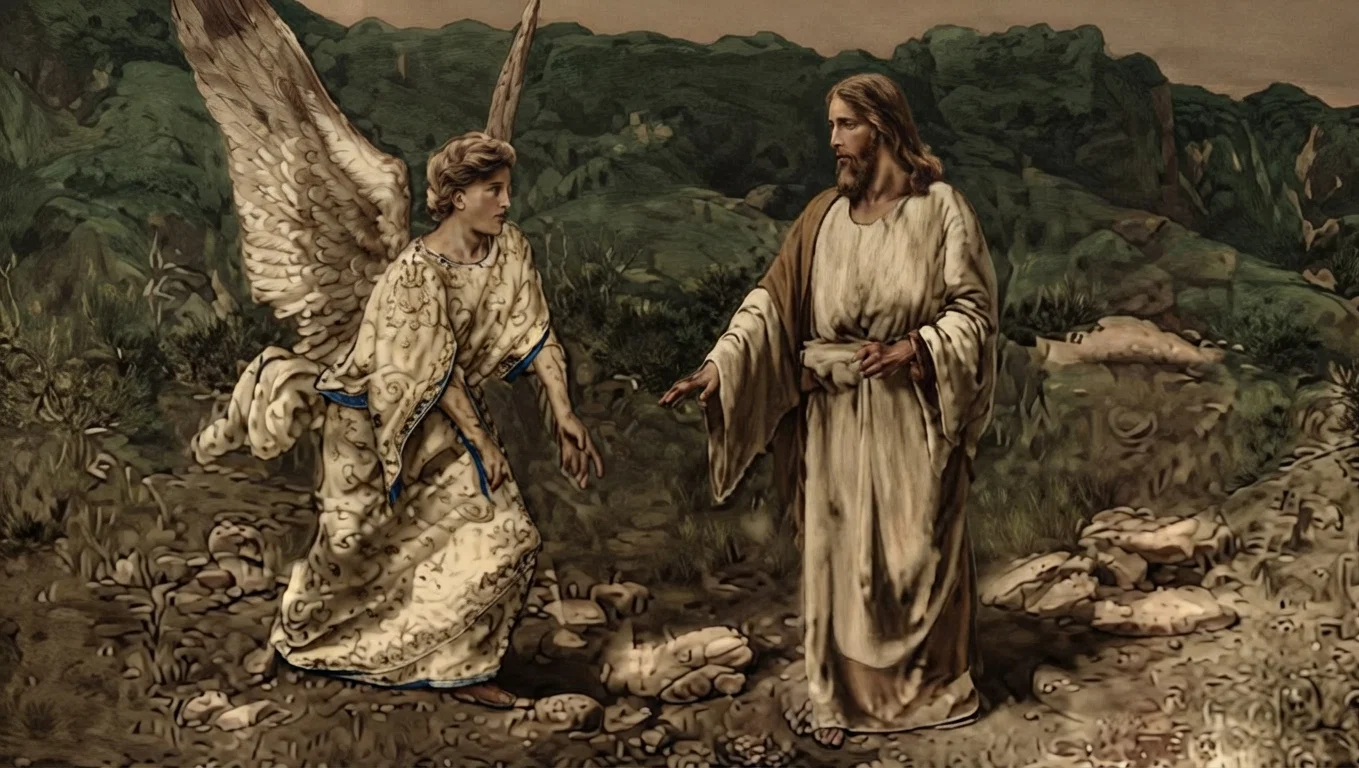
“THERE came to the Saviour, as if in answer to His prayers, one in the guise of an angel from heaven. He claimed to have a commission from God to declare that Christ's fast was at an end. As God had sent an angel to stay the hand of Abraham from offering Isaac, so, satisfied with Christ's willingness to enter the blood-stained path, the Father had sent an angel to deliver Him; this was the message brought to Jesus. The Saviour was faint from hunger, He was craving for food, when Satan came suddenly upon Him. Pointing to the stones which strewed the desert, and which had the appearance of loaves, the tempter said, ‘If Thou be the Son of God, command that these stones be made bread.’”
The Temptation
The Temptation

His Moral Victory Saves the World

The Prince of Life and the Prince of Darkness in Decisive Combat—A Self-Control Stronger than Hunger or Death—The Power in the Word the Deciding Factor

BY MRS. E. G. WHITE
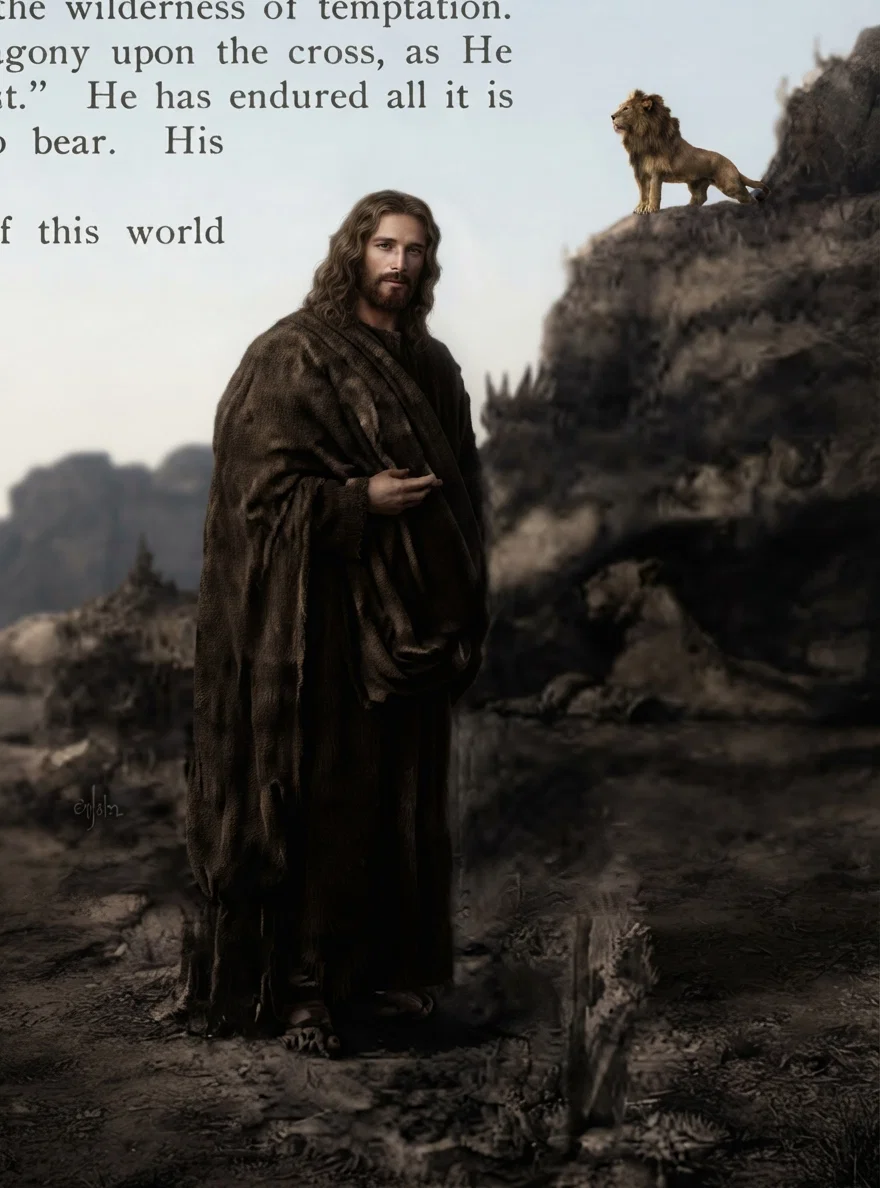
AND Jesus being full of the Holy Ghost returned from Jordan, and was led by the Spirit into the wilderness.” Luke 4:1. The words of Mark are still more significant. He says: “Immediately the Spirit driveth Him into the wilderness. And He was there in the wilderness forty days, tempted of Satan; and was with the wild beasts.” “And in those days He did eat nothing.”
When Jesus was led into the wilderness to be tempted, He was led by the Spirit of God. He did not invite temptation. He went to the wilderness to be alone, to contemplate His mission and work. By fasting and prayer, He was to brace Himself for the blood-stained path He must travel.
Mighty issues for the world were at stake in the conflict between the Prince of Light and the leader of the kingdom of darkness. After tempting man to sin, Satan claimed the earth as his, and styled himself the prince of this world. Having conformed to his own nature the father and mother of our race, he thought to establish here his empire. He declared that men had chosen him as their sovereign. Through his control of men, he held dominion over the world. Christ had come to disprove Satan’s claim. As the Son of man, Christ would stand loyal to God. Thus it would be shown that Satan had not gained complete control of the human race, and that his claim to the world was false. All who desired deliverance from his power would be set free. The dominion that Adam had lost through sin would be recovered.
Since the announcement to the serpent in Eden, “I will put enmity between thee and the woman, and between thy seed and her seed,” Satan had known that he did not hold absolute sway over the world. At the birth of Jesus, Satan knew that One had come with a divine commission to dispute his dominion. He trembled at the angel’s message attesting the authority of the new-born King. That the Son of God should come to this earth as a man, filled him with amazement and apprehension. He could not fathom the mystery of this great sacrifice. His selfish soul could not understand such love for the deceived race.

SATAN AN INTERESTED OBSERVER

At the Saviour’s baptism, Satan was among the witnesses. He saw the Father’s glory overshadowing His Son. He heard the voice of Jehovah testifying to the divinity of Jesus. Ever since Adam’s sin, the human race had been cut off from direct communion with God. The intercourse between heaven and earth had been through Christ. But now that Jesus had come “in the likeness of sinful flesh,” the Father Himself spoke. He had before communicated with humanity through Christ; now He communicated with humanity in Christ. Satan had hoped that God’s abhorrence of evil would bring an eternal separation between heaven and earth. But now it was manifest that the connection between God and man had been restored.
Satan saw that he must either conquer or be conquered. The issues of the conflict involved too much to be entrusted to his confederate angels. He must personally conduct the warfare. All the energies of apostasy were rallied against the Son of God. Christ was made the mark of every weapon of hell.
With Christ, as with the holy pair in Eden, appetite was the ground of the first great temptation. Just where the ruin began, the work of our redemption must begin. As by the indulgence of appetite Adam fell, so by the denial of appetite Christ must overcome. “And when He had fasted forty days and forty nights, He was afterward an hungered. And when the tempter came to Him, he said, If Thou be the Son of God, command that these stones be made bread. But He answered and said, It is written, Man shall not live by bread alone, but by every word that proceedeth out of the mouth of God.”

A SELF-CONTROL STRONGER THAN HUNGER OR DEATH

From the time of Adam to that of Christ, self-indulgence had increased the power of the appetites and passions, until they had almost unlimited control. Thus men had become debased and diseased, and of themselves it was impossible for them to overcome. In man’s behalf, Christ conquered by enduring the severest test. For our sake He exercised a self-control stronger than hunger or death. And in this first victory were involved other issues that enter into all our conflicts with the powers of darkness.
When Jesus entered the wilderness, He was shut in by the Father’s glory. Absorbed in communion with God, He was lifted above human weakness. But the glory departed, and He was left to battle with temptation. It was pressing upon Him every moment. His human nature shrank from the conflict that awaited Him. For forty days He fasted and prayed. Weak and emaciated from hunger, worn and haggard with mental agony, “His visage was so marred more than any man, and His form more than the sons of man.” Now was Satan’s opportunity. Now he supposed that he could overcome Christ.

IN THE GUISE OF AN ANGEL

There came to the Saviour, as if in answer to His prayers, one in the guise of an angel from heaven. He claimed to have a commission from God to declare that Christ’s fast was at an end. As God had sent an angel to stay the hand of Abraham from offering Isaac, so, satisfied with Christ’s willingness to enter the blood-stained path, the Father had sent an angel to deliver Him; this was the message brought to Jesus. The Saviour was faint from hunger. He was craving for food, when Satan came suddenly upon Him. Pointing to the stones which strewed the desert, and which had the appearance of loaves, the tempter said, “If Thou be the Son of God, command that these stones be made bread.”
Though he appears as an angel of light, these first words betray his character. “If Thou be the Son of God.” Here is the insinuation of distrust. Should Jesus do what Satan suggests, it would be an acceptance of the doubt. The tempter plans to overthrow Christ by the same means that were so successful with the human race in the beginning. How artfully had Satan approached Eve in Eden: “Yea, hath God said, Ye shall not eat of every tree of the garden?” Thus far the tempter’s words were truth; but in his manner of speaking them, there was a disguised contempt for the words of God. There was a covert negative, a doubt of the divine truthfulness. Satan sought to instil into the mind of Eve the thought that God would not do as He had said; that the withholding of such beautiful fruit was a contradiction of His love and compassion for man. So now the tempter seeks to inspire Christ with his own sentiments. “If Thou be the Son of God.” The words rankle with bitterness in his mind. In the tones of his voice is an expression of utter incredulity. Would God treat His own Son thus? Would He leave Him in the desert with wild beasts, without food, without companions, without comfort? He insinuates that God never meant His Son to be in such a state as this. “If Thou be the Son of God,” show Thy power by relieving Thyself of this pressing hunger. Command that this stone be made bread.

A MAN AMONG MEN, HE DEPENDS UPON THE WORD

The words from heaven, “This is My beloved Son, in whom I am well pleased,” were still sounding in the ears of Satan. But he was determined to make Christ disbelieve this testimony. The word of God was Christ’s assurance of His divine mission. He had come to live as a man among men, and it was the Word that declared His connection with Heaven. It was Satan’s purpose to cause Him to doubt that Word. If Christ’s confidence in God could be shaken, Satan knew that the victory in the whole controversy would be his. He could overcome Jesus. He hoped that under the force of despondency and extreme hunger, Christ would lose faith in His Father, and work a miracle in His own behalf. Had He done this, the whole plan of salvation would have been broken.
Not without a struggle could Jesus listen in silence to the arch-deceiver. But the Son of God was not to prove His divinity to Satan, or to explain the reason of His humiliation. By conceding to the demands of the rebel, nothing for the good of man or the glory of God would be gained. Had Christ complied with the suggestion of the enemy, Satan would still have said, “Show me a sign, that I may believe You to be the Son of God.” Evidence would have been worthless to break the power of rebellion in his heart. And Christ was not to exercise divine power for His own benefit. He had come to bear trial as we must do, leaving us an example of faith and submission. Neither here nor at any subsequent time in His earthly life did He work a miracle in His own behalf. His wonderful works were all for the good of others. Though Jesus recognized Satan from the beginning, He was not provoked to enter into controversy with him. Strengthened with the memory of the voice from heaven, He rested in His Father’s love. He would not parley with temptation.
Jesus met Satan with the words of Scripture. “It is written,” He said. In every temptation, the weapon of His warfare was the word of God. Satan demanded of Christ a miracle as a sign of His divinity. But that which is greater than all miracles, a firm reliance upon a “Thus saith the Lord,” was a sign that could not be controverted.

MET THE ENEMY IN TIME OF SUPREME WEAKNESS

It was in the time of greatest weakness that Christ was assailed by the fiercest temptations. Thus Satan thought to prevail. By this policy, he had gained the victory over men. And he will still work in the same way. Whenever one is encompassed with clouds, perplexed by circumstances, or afflicted by poverty or distress, Satan is at hand to tempt and annoy. He attacks our weak points of character. He seeks to shake our confidence in God, who suffers such a condition of things to exist. We are tempted to distrust God, to question His love. Often the tempter comes to us as he came to Christ, arraying before us our weakness and infirmities. He hopes to discourage the soul, and to break our hold on God. Then he is sure of his prey. If we would meet him as Jesus did, we should escape many a defeat. By parleying with the enemy, we give him an advantage.
Of all the lessons to be learned from our Lord’s first great temptation, none is more important than that bearing upon the control of the appetites and passions. In all ages, temptations appealing to the physical nature have been most effectual in corrupting and degrading mankind. Through intemperance, Satan works to destroy the mental and moral powers that God gave to man as a priceless endowment. Thus it becomes impossible for men to appreciate things of eternal worth. Through sensual indulgence, Satan seeks to blot from the soul every trace of likeness to God.
In our own strength it is impossible for us to deny the clamors of our fallen nature. Through this channel Satan will bring temptation upon us. Christ knew that the enemy would come to every human being, to take advantage of hereditary weakness, and by his false insinuations to ensnare all whose trust is not in God. And by passing over the ground which man must travel, our Lord has prepared the way for us to overcome. It is not His will that we should be placed at a disadvantage in the conflict with Satan. He would not have us intimidated and discouraged by the assaults of the serpent. “Be of good cheer,” He says: “I have overcome the world.”

HIS VICTORY IS OURS

Let him who is struggling against the power of appetite, look to the Saviour in the wilderness of temptation. See Him in His agony upon the cross, as He exclaimed, “I thirst.” He has endured all it is possible for us to bear. His victory is ours.
"And He was with the wild beasts."
“The prince of this world cometh,” said Jesus, “and hath nothing in Me.” There was in Him nothing that responded to Satan’s sophistry. He did not consent to sin. Not even by a thought did He yield to temptation. So it may be with us. Christ’s humanity was united with divinity; He was fitted for the conflict by the indwelling

His Moral Victory Saves the World

(Continued from page 2) of the Holy Spirit. And He came to make us partakers of the divine nature. So long as we are united to Him by faith, sin has no more dominion over us. God reaches for the hand of faith in us to direct it to lay fast hold upon the divinity of Christ, that we may attain to perfection of character.
And how this is accomplished, Christ has shown us. By what means did He overcome in the conflict with Satan?—By the word of God. Only by the Word could He resist temptation. “It is written,” He said. And unto us are given “exceeding great and precious promises: that by these ye might be partakers of the divine nature, having escaped the corruption that is in the world through lust.” Every promise in God’s word is ours. “By every word that proceedeth out of the mouth of God” are we to live. When assailed by temptations, look not to circumstances or to the weakness of self, but to the power of the Word. All its strength is yours. “Thy word,” says the psalmist, “have I hid in mine heart, that I might not sin against Thee.” “By the word of Thy lips I have kept me from the paths of the destroyer.”

Jesus, I'll Go Through with Thee

By CLAUDE WILTSIE
I AM passing o'er the pathway That the saints before me trod, Leading up from sin's dark valley To the glorious heights of God. Though my way's beset with demons, And my crosses heavy be, Through the grace of God abundant, Jesus, I'll go through with Thee.
Take my trembling hand, and lead me O'er life's waters dark and wild. Though earth's sin and strife surround me, I would be Thy trusting child. Lead me as Thou leddest Moses And Thy hosts across the sea;
And though all the world forsake me, Jesus, I'll go through with Thee.
When I reach the time of trouble, And man's heart with terror faints, When all faces gather blackness, Thou wilt not forsake Thy saints. In Thy blessed, sure pavilion All Thy waiting ones shall be. In the time of indignation, Jesus, I'll go through with Thee.
When the earth is rent beneath us, And Thou send'st the storm of hail, Lord, Thy angels then shall keep us; Not a word of Thine shall fail. When the sun shall scorch all nature, Thou wilt food and shelter be. My Redeemer and Creator, Jesus, I'll go through with Thee.
When I'm taken up to heaven, And the shining gates behold; When I view the walls of jasper, And the streets of glitt'ring gold; When I see life's crystal river, Flowing there so calm and free; When the ransomed ones shall enter, Jesus, I'll go through with Thee.

The Inevitable Industrial War

What the Prophets Saw Concerning the Conflict Between Capital and Labor in These Times — The Great Amassing of Fortunes — The Howling Cries of the Rich Man — Eternal Peace Just Beyond
By PROF. G. W. RINE
IN the preceding article of this series, there was given a mass of irrefutable evidence that a tremendous struggle between capitalist employers on the one hand and the working class on the other is not only inevitable but imminent. That such a struggle is near and unescapable is the uniform conviction on the part of all enlightened publicists and sociologists of the civilized world.
But the one aspect of the conflict which is of paramount interest and moment is the unique fact that the whole movement and its outcome were anticipated and enunciated by both Old Testament and New Testament prophets. Under the inspiration of the divine Spirit, many of the ancient prophets foresaw that the economic strife of our day would constitute one of many latter-day signs of the times. It would be a mark, a distinctive characteristic, of "the last days."

"WEEP AND HOWL," "YE RICH MEN"

Everybody knows that we are living in an age of fabulous wealth — of wealth unprecedented in the history of mankind. Under the quickening power of the Spirit, James was enabled to foresee that a class of men would arise in the last days who would be distinctly "rich men." Observe the opening words of the fifth chapter of his letter: "Go to now, ye rich men, weep and howl for your miseries that shall come upon you." In verse 3 he says explicitly that their treasures were laid up in the last days. He states also, in verse 4, that one of the reasons why they would be able to amass such vast riches is the fact that they would keep back by fraud a part of the hire justly due to "the laborers," whose toil largely created the amassed "treasures."
But the words of James that have special relevancy in this connection are those which show that these latter-day rich men would ultimately "weep and howl" because of the miseries that would come to them. Are not these words an obvious anticipation of the sanguinary contest now impending? They surely mean this or they mean nothing. Now observe that it is in the last days, in the days when "the coming of the Lord draweth nigh," that this struggle between the "rich men" — capitalists — and the "laborers" would take place. See verses 3 and 8. It is at the very time when the "brethren," the true believers, are admonished by the Holy Spirit to be "patient," to "stablish" their hearts, for the express reason that "the coming of the Lord draweth nigh." It is evident, then, that this prophetic revelation of the status of the economic world of to-day was given through the prophet for the express purpose of constituting it a sign to the remnant church of God that her Lord is about to "come again," "in power and great glory," to take to Himself His redeemed people, in order that they may "inherit the kingdom" prepared for them "from the foundation of the world."

"WHO ENLARGETH HIS DESIRE AS HELL"

This momentous fact — a fact fraught with eternal consequences — is set forth even more strikingly, if possible, in the vision given to Habakkuk, and recorded in the second chapter of his prophecy. Habakkuk was divinely commanded to "write the vision, and make it plain upon tables, that he may run that readeth it." How plainly this command shows the prophecy to be an exceptionally significant one — one to be read and pondered and understood! In verse 3 we are told that the vision is "for an appointed time," and "at the end it shall speak [be fulfilled], and not lie." These words show unmistakably that the prophecy will be realized, fulfilled, at "the end"; that is, in the end of time, or as James puts it, "in the last days." See also verse 14.
Of the typical man of our day, when the vision "shall speak," it is said that he "enlargeth his desire as hell," and as death, he "can not be satisfied." How trenchantly these words declare that in these latter days men would be inordinately avaricious, insatiably greedy for gain! The original of "hell" is sheol, the place of the dead, or the grave. Though sheol or the grave receives more than one hundred thousand human victims every day in the year, yet it is never satisfied — it is forever yawning for more. Even so "death" is the black camel that kneels at a hundred thousand doors each day, yet he is never sated, never appeased. What a startling illustration are these similes of the relentless greed which would be characteristic of men in our day! Read verses 1 and 2 of the third chapter of 2 Timothy, and note how Paul foretold the same fact, when he declared that "in the last days" men should be "covetous," or as the American Revised Version expresses it, "lovers of money." So general and malignant is avarice in our day that the Rev. Dr. Washington Gladden calls it "the new idolatry" as the title of a lecture upon the subject.

SYSTEMATICALLY DESPOILED

Now, the prophet Habakkuk goes on to declare that the typical rich man of the last days has brought together workers of all "nations" and "peoples," and has "despoiled" them; that is, has systematically defrauded them by withholding from them wages that in equity and justice belonged to them. The prophet then asks the startling question, "Shall not all these [exploited working men] take up a parable against him, and a taunting proverb against him, and say, Wo to him that increaseth that which is not his?" Againthe prophet, by way of emphasis, asks, "Shall they not rise up suddenly that shall bite thee, and awake that shall vex thee, and thou shalt be for booties unto them?"
No student of sacred literature would deny that the words "bite" and "vex" are specific terms used to express the idea of violent attack in any form. The despoiled workers are represented as violently despoiling their despoilers. By the figure of apostrophe, the prophet continues to address the devotee of Mammon, the capitalist employer of to-day, in these portentous words: "Because thou hast spoiled [despoiled] many nations, all the remnant of the people shall [de] spoil thee." The "remnant" of anything is the last part of it. Hence the remnant of the people can mean only the last people, that is, the people of the last generation.

INSATIABLY GREEDY

The import of this prophecy is as clearly obvious as the noonday sun. It tells us, in words that breathe and burn, that "in the end" men would become insatiably greedy — would become "lovers of money," and, accordingly, would "despoil," defraud their helpless employees, until, driven to frenzied wrath, the workers would turn upon their heartless employers, and by violence despoil them. Recall the words of the apostle James: "Go to now, ye rich men, weep and howl for your miseries that shall come upon you." Note again the stern pronouncement addressed by Habakkuk to the typical money lord of to-day: "Thou shalt be for booties unto them" [the defrauded workers].

WILL CAST THEIR SILVER IN THE STREETS

In the nineteenth verse of the seventh chapter of Ezekiel is found a tellingly significant declaration of the same tenor. The prophet foresees that in the days when the "wrath of the Lord" is about to be revealed from heaven upon a hopelessly godless world, the rich "shall cast their silver in the streets, and their gold shall be removed: their silver and their gold shall not be able to deliver them in the day of the wrath of the Lord: . . . because it is the stumbling-block of their iniquity." This terrible prognostic declaration needs no extended comment. Its meaning is evident. The modern lords of the money tables would continue worshiping at the shrine of Mammon until they make the awful discovery that their treasures have been the stumbling-block, the cause, of their irretrievable sins; they have been the occasion of all their woes; and, finally, their gold and silver have robbed them of eternal life. For, as Jesus taught, we can not serve God and Mammon. Hence, in agony of despair, they hurl their treasures into the streets. In the words of James, they weep and howl because of the miseries that have come upon them. Let us not forget that it is "in the last days" that men, according to the testimony of Paul, shall be lovers of money, "lovers of pleasures more than lovers of God; having a form of godliness, but denying the power thereof."

IT CAN NOT FAIL

The people who know their Bible, and have studied history with a serious purpose, know full well that it would be easier for heaven and earth to pass away than for one jot or tittle of inspired prophecy to fail of fulfilment. We have seen that the divine oracles repeatedly declare that a militant class conflict will be one of the tragic ordeals through which latter-day society is destined to pass. Not that God has decreed that it should be so. He simply, in love to man, foretold that it would be so. And, as we noted in the preceding article, men of foresight and intelligence are everywhere predicting that a world-wide industrial or social war is apparently inevitable.
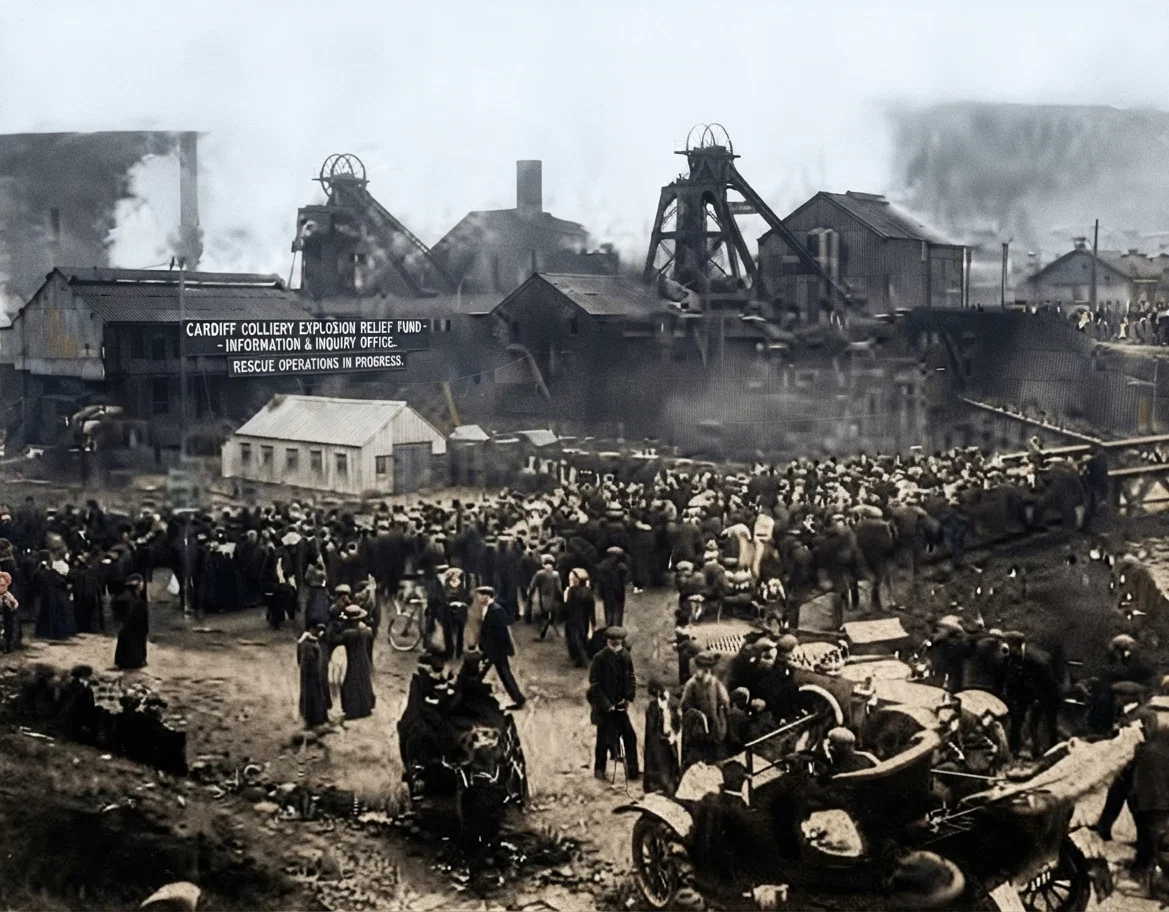
Photo by Paul Thompson CROWD AROUND THE HEAD OF THE MINE AT CARDIFF, WALES, AFTER THE GREAT EXPLOSION, OCTOBER 14

SEEKING TO PARALYZE INDUSTRY

Dr. Strong reminds us that, under the auspices of the Syndicalists, the general strike has been attempted in various countries, with sufficient success "to cause not a little fear on the part of the general public." The whole structure of Russian society was shaken, in 1905, by the "universal strike." All the railways of Russia were tied up for many months, and by reason of sympathetic strikes everywhere, industrial and commercial life came to a standstill. A like attempt was made to paralyze society in France, which was overcome by the military forces, but only after an enormous expenditure of blood and treasure. Early in 1912 the coal strike practically prostrated British industry for the time being. Press despatches said:
"The magnitude of the strike is almost inconceivable. It has affected in a direct way, counting only the miners and other men thrown out of work, with their families, more than four million persons. In other respects it has paralyzed practically the whole life of the nation. Prices of food have gone sky-high, fuel is virtually unattainable, railways have curtailed their services, shipping has been held up, and every branch of industry stopped to a greater or less extent."

INSPIRED BY THE SYNDICALISTS

It should be remembered that these disastrous strikes were all inspired and directed by the Syndicalists. "These attempts," says Dr. Strong, "suggest what tremendous possibilities lie in this sort of 'masterly inactivity.'"
We are reminded that the feasibility of a universal strike is constantly increasing. Industry as now organized is a great school in which working men are daily drilled in concerted action; and as the solidarity of labor progresses, and class antipathy deepens, "the day approaches, when the general strike can disorganize society and inaugurate anarchy." Dr. Strong thinks failure will attend premature effort in this country as in Europe, and the strikers will be the greatest sufferers, which must further embitter the working class against the capitalist class, and increase the score which the strikers will remember against the final day of reckoning.

THEY WOULD OVERTURN SOCIETY

Mr. Bruce Barton reports in the Congregationalist the following statements made by a national I. W. W. organizer:
"We are fighting a war; this is merely a battle. . . . Between battles we make the boss pay the bills. . . . Between capital and labor there is a war; and capital has no rights which labor is bound to respect. We produce everything; we mean to have everything. . . . Of course the owners hate us; of course they'd like to see us hanged. I don't blame them. I'd feel that way if I were a capitalist. It's because they see that we are growing, and realize that our program means their extinction, that they dread us so. . . . Ours is a constant war, and the end of it is the overturn of society and the abolition of the private ownership of wealth."
In these statements are exhibited the spirit, aim, and methods of the Syndicalists. Referring to the same movement, Mr. John Graham Brooks says, "Its tendency is steadily toward anarchy, and it is extremely likely within a few years seriously to plague the Socialist party, as now organized, and it will surely plague the public."

THE DARKEST HOUR JUST BEFORE DAY

Does the picture we have tried to sketch look dark? It is ominous and forbidding. But we must by no means forget the trite saying that the darkest hour comes just before the dawn. Manifold signs of the times conspire to show that the kingdoms of this world have almost run their course. The first petition in our Lord's prayer, "Thy kingdom come. Thy will be done in earth, as it is in heaven," is about to be answeredin fact. When that kingdom comes, it will supplant all the kingdoms of this world. It will be the kingdom of God, and God is love, and where LOVE reigns there can be no class ethics, no class consciousness, no class antipathy, no class war. The law of that kingdom is the law of Christ; and we are expressly taught, by the divine Spirit, that the law of Christ is fulfilled by bearing one another’s burdens.
According to the inviolable testimony of inspired prophecy, as we have seen above, the very fact that we have to-day an industrial warfare is a sign that the return of our Lord in His kingdom is imminent. In that kingdom we shall have socialism, we shall have collectivism, we shall have solidarity—but it will be socialism founded upon divine love, it will be solidarity issuing from the love of God shed abroad in every individual heart. In this way, and in no other, will the great economic problems now vexing society be solved.
But Christ is the “way,” the only way, into that kingdom. Is He your hope, your trust, your life? If He is, then you are one of the elect, and you shall share forever the justice, the peace, the glory and joys of a social state founded eternally in the wisdom and goodness of God.
Continue reading: The People of the Valleys