Well-Attended Meetings Notwithstanding Conditions of Unrest—Native Recruits to the Working Force
LEAVING Shanghai in company with Elder R. F. Cottrell, enjoying a pleasant trip up the Yang-tse River, we reached Hankow in time for the Hupeh general meeting.
There were sixty-five present at the meeting, eighteen of whom were Chinese native workers. Three of these are evangelists, three Bible women, and ten are colporteurs. The meetings were of a deep spiritual nature, and all hearts united in renewed consecration to service in the cause of Christ.
The last Sabbath, the attendance increased to one hundred. At the close of a consecration service, Brother Frederick Lee was ordained to the gospel ministry, and twenty-seven were buried with their Lord in baptism.
The two mission homes for our workers are nearing completion. They are well arranged and neat in appearance. The laborers present at this meeting were Dr. A. G. Larson, S. G. White, F. Lee, R. F. Cottrell, the native evangelists, and the writer.
"Melican Heathen" Not Up to His Standard
THOSE who come to our shores from heathen lands are quick to see the inconsistencies of professing Christians. A story is told of a Chinaman who applied for a position as house servant with a family which belonged to a fashionable church. Among the inquiries proposed by the mistress of the house were the following:
"Do you drink whisky?"
"No, I Clistian man."
"Do you play cards?"
"No, I Clistian man."
The position was given him, and he proved to be a very capable servant. After a time the lady gave a bridge party, with wine accompaniments. The Chinaman did his part during the evening acceptably, but the next morning he said to his mistress, "I want quit."
"Why? What is the matter?"
"I Clistian man. I told you so before. I no work for Melican heathen!"
It is useless to pray for the heathen at our doors, so long as we do the things that are inconsistent with the Christian profession. — Onward.
Our Yencheng School
By J. J. Westrup
OUR foreign houses and schools will soon be ready. I have lived in one room through the heat of July and August, and it was really comfortable. We had a good breeze most of the time. For about a week, I felt the oppressiveness of the heat. The rest of the time, I really enjoyed the heat more than I enjoy the cold that we have now. From about the fifteenth to the twentieth of August the thermometer stood at 99 in my room, but after that a cold wind from the north brought it down to 64, and it has been there ever since. It has been cloudy for a long time, but the Lord has kept back the rain, and we have the roof on one schoolhouse, and the other will be on to-day or to-morrow. I shall be glad when the building work is done, for it is extremely trying.
Just received a letter from the consul, forbidding us to travel in Honan, as the country has no protection and is full of robbers — all the poor turn robbers — and the farmers and the rich people have suffered terribly, both this year and last. The robbers have come very near Yencheng sometimes, but the Lord has kept them away.
J. J. WESTRUP.
The Lord's Day the Test of the Ages
This little monograph, costing only ten cents, gives more information as to the great Sabbath question than any dollar book ever published. The Sabbath, its origin, its history, before and after Christ to the present day. A multum in parvo.
This volume presents in a most wonderful and interesting way the great struggle in which we are all engaged. It brings out the principles involved, and makes clear to the reader the path which leads to Him who is able to conquer in every conflict.
"Great Controversy" in limp is 8 1-16 inches long by 5 3-4 inches wide and less than 1 inch thick. Price in limp leather binding, post-paid, $2.00; cloth, same size, $1.50.
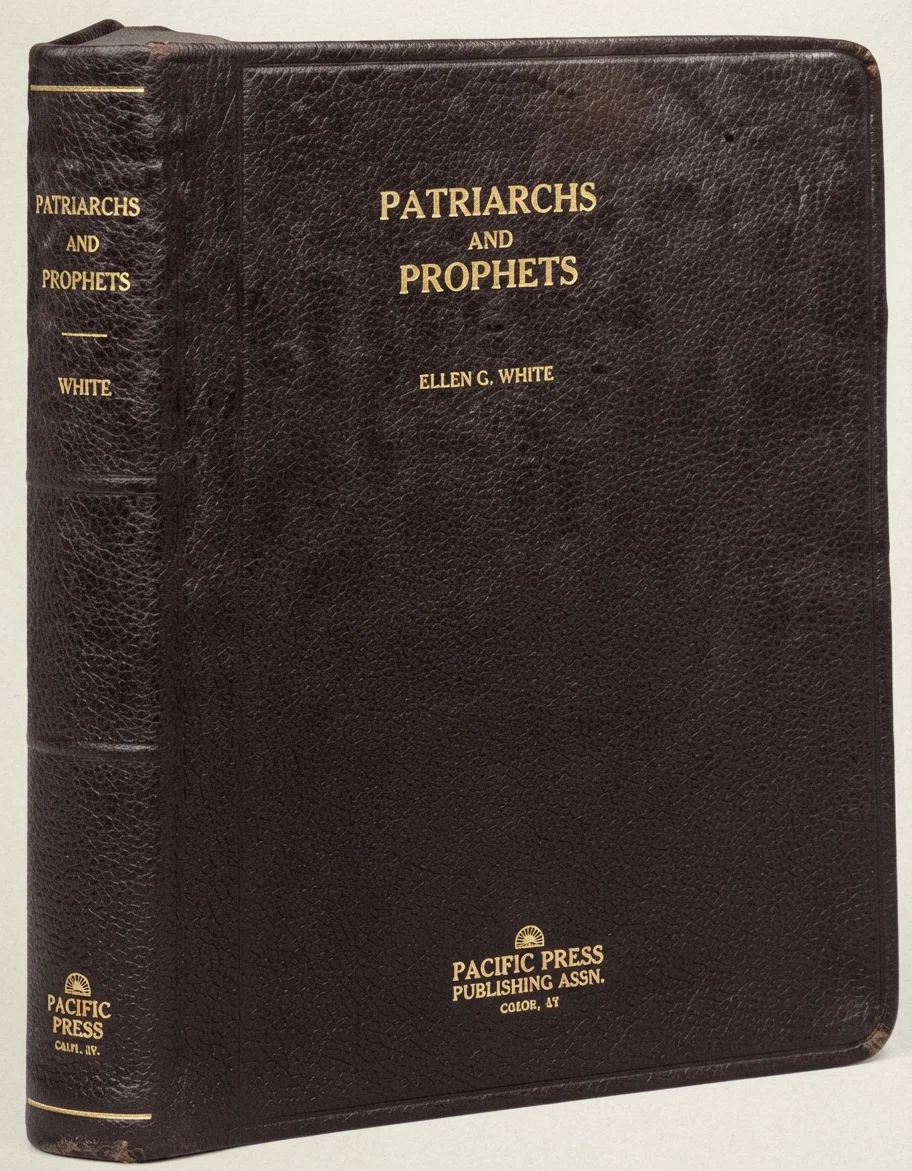
Patriarchs and Prophets
In this style "Patriarchs" weighs just 24 ounces. It is 8 1-16 inches long by 5 3-4 inches wide and 1 inch thick. Every family should have this work for constant use in the study of the Old Testament. You will find this light edition easy to carry with you. Price in the limp leather binding, post-paid, $2.00; same size in durable cloth, $1.50.
Address your tract society or
PACIFIC PRESS PUBLISHING ASSN.
Mountain View, California
Breaking Through the Hedge
By I. H. Evans
ONE evening just at twilight, as I was passing a beautiful home in a rural town in the state of Wisconsin, I overheard a pleading voice entreating a well-dressed lad of about seventeen not to go on the street. I saw the face of the mother. It was carved in sorrow, and the tears were rushing down her cheeks. Her voice was importuning, her hand was outstretched, and I caught only the last words,—“Please stay home to-night.”
The mother did not see me; but the son, standing on the lower door-step, with his face toward the street and his back to his mother, saw the stranger, and answered her in an impatient undertone: “I’ll do as I please. You have always kept me in. I hate restraint.”
With these words, he entered the street before me. I followed the young man, curious to see where he would find the liberty he craved, the freedom from restraint that to him seemed so desirable. It was not far. In front of a hotel, where a crowd of men were sitting, smoking, reading, and talking, the youth paused. Beer was served, and cigars and cigarettes were passed from table to table by the waiter.
The young man sat down at a table, and a waiter asked what he wanted. He hesitated, stammered, then asked for cigarettes and a glass of beer. As he lighted a cigarette and began smoking, I passed on, and saw him no more.
I said to myself, “That young man has broken the hedge.” I never passed his way again, but in my mind I have seen him bitten by the serpent. No man can tell what the end of the lad may be.
The long evenings of autumn had come. The skating-rinks were opened. A young, bright girl of sixteen asked her mother if she might go to the rink and skate that night with a young man friend. The mother-heart knew the danger, and replied: “Daughter, it is not best. Some night soon father will go with you. It is not proper for you to go with a young man. You are too young.”
Mary grew angry, and said hot, bitter words, and went. She came home late, intoxicated with the excitement, and determined to endure restraint no longer. Two years later, there sat in a maternity home a pale, haggard girl, with shame and despair written in every lineament of her countenance. What was the trouble?—She had broken a hedge, and been bitten by a serpent.
A young man was cashier in a bank. He was trusted and respected by all. Once he bet on a horse-race—and lost. It was a small sum, but more than he had. To keep “honor,” as he called it, he took the cash from the bank, putting in its place a cash slip, and later was able to redeem it. No one knew; but every time the president entered the bank, the young man trembled, grew pale, and was confused, until the cash was replaced. Then he bet again, and again. It became common for him to tamper with the cash. One day the local daily was sold on the streets with great red head-lines,—“Cashier of the First National Bank Arrested for Stealing $2,000.” What had happened?—The young man had broken a hedge, and been bitten by a serpent.
Our conscience, our knowledge of right and wrong, is a hedge about us. Only when we break this hedge are we in danger of sin. No one can break through this hedge, which God Himself has put about us, without being bitten by the serpent. Eve was bitten in the Garden of Eden. Cain, and Balaam, and Saul, and Judas, and Ananias, and Sapphira, and a host of other Bible characters, broke through this hedge, and were bitten by the serpent of sin. Many young men and women are breaking this hedge to-day. Just so surely will the same result follow them as came to those whose failure is recorded in God’s word. A serpent will bite them.
God has put a hedge about His people. No one can break it without being bitten by sin. “Whoso breaketh an hedge, a serpent shall bite him.” Eccl. 10:8.
Jennie's Religion
IT was decided that Jennie and I should have six weeks in the country, my son Tom, Jennie's husband, spending the week-ends with us.
Jennie had not had a holiday in years. What with caring for Tom and the children, to say nothing of me, she never had time to think of a holiday. But now the children were old enough to leave, and my health good enough to allow me to travel. I did think Jennie ought to go without me, but she would not hear tell of it. She said she just knew I was starved and thirsty and aching for the country; and so I was, but I don't know how she found it out. But then I never do know how Jennie finds things out. She always knows what we all want before we hint a word, especially if we're sick.
Yes, I do think a lot of Jennie. No, her being a daughter-in-law does not make it any harder. I like all my sons' wives. I make it a point to do so. You see, they were not choosing daughters-in-law for me, but wives for themselves, and it was none of my business. If I could like them, so much the better for me, my sons, and every one concerned. Of course we do not think alike in all things. When I was their age, I did not think as I do now about many things.
But to go back to my story. Jennie would not go without me. That was settled. She would not yield that point, but she gave in to a lot of other things.
I would hear her say, "Now I can take that crochet yoke of Edith's and finish it, so the child can have her under waist to wear before the summer is over." "No, you can't, mother," would be the answer. "No crochet work for you. You are going up there to rest."
Then it would be, "I can just as well hem those table napkins up there in the country as not." But when she looked for the napkins to put in her trunk, they could not be found. She did get the stocking bag in, saying she could darn up the stockings and send them back with Tom, Monday morning; but somebody needed a darning-needle, so the secret was out, and the stocking bag disappeared.
The evening before we left, she appealed to Tom at the table, asking him what she was going to do, and if he did not think she ought to take some work with her.
Tom smiled, and picked up a paper he had just been reading. "Mother's church paper tells you here, in the little moral on the front, to take your religion with you on your holidays," he answered. "Take that, Jennie, and I'll warrant you'll find lots to do."
"Just as if you could separate mother from her religion!" blurted Bob, who was beginning to look like a lost sheep, and his mother not even yet gone.
Well, we set out, and I had not been on a train for so long I felt like a child. Jennie was very thoughtful and quiet, and I asked her if she was homesick already. "No, I'm not, mother; but ever since Tom spoke of my taking my religion with me, I have felt bothered. I don't believe I have any of the real, old-fashioned religion."
Well, if I didn't laugh at her, and told her I hoped her kind would become popular! But she would not be comforted. She went on to say that she had never been able to meditate and pray long prayers like so many people she knew.
"I have never spoken of this before, mother," says she, "but I have been bothered. You all think I am almost perfect, and that has quieted my conscience. Why, mother, many and many nights, when the children were small, and we had so much sickness, I would just thank God that He had helped me through the day, and commit you all to His care, and I'd be asleep before I could say a thing more. Then, in the morning, I would be so tired that I would sleep until the last minute, and then only have time to ask Him to help me do my little part well."
"Well, Jennie," says I, "I think all those prayers were answered, for I can not remember when you did not do your little part well, and it was not such a little part either," says I. "Why, when Jack's leg was broken, and Tom failed in business, and the house was burned, and even when the dear baby died, we all know how your religion revealed itself."
"Well, I hope I am all right, mother; but I do wish I could pray longer prayers and spend more time in meditation. Now that I have more time, I find I have not the habit, and can not form it. Perhaps, when I am up in the country, where all is quiet, I can do more thinking."767
I smiled to myself. I could not imagine Jennie sitting down to think over religion for very long, for she wouldn't sit ten minutes until she'd think of something she could do for some one, and she'd be doing instead of thinking. But Jennie's religion suited me all right, and I noticed she had it with her, and that it suited the people at the farm.
When we were going home at the end of our holiday, I asked her if she had succeeded in forming her habits of meditation and long prayers; and she said no, she had not, and looked so disappointed I just laughed at her good and hard, and says I: "What would you call it, reading to Mrs. Davey when she was pitting cherries and other things, and making the dessert for dinner three times a week—I think I even saw you hanging out the clothes for her one Monday—and helping that poor, awkward oldest girl to make a decent shirt-waist for herself, and teaching the little ones to sing that pretty little hymn, and even persuading Mr. Davey to take Mrs. Davey off to church for the first time in a year, and you looked after dinner? And, mind you, he told me he was going to get a separator, and sell his cream, so as to make it easier for the women folks; and I know who influenced him in that, even if he doesn't know himself," says I.
"O, mother! I didn't do one thing I didn't want to do; and do you really think that is religion and the proper kind? I do hope so, for I am lacking when it comes to long prayers, and some of the church sisters have looked at me rather disapprovingly sometimes when my simple petitions were given at the meetings."
"Well, Jennie, your kind of religion suits all the people you live with, and it suits your husband's mother, and they say mothers-in-law are hard to suit," says I.
"Not mothers-in-law whose own religion makes them look for the best," says she.
But it doesn't take any religion to see Jennie's religion, though it does take a lot to keep up with her.—Gertrude M. Neil, in "Christian Guardian."
IN THREE DAYS
By Editor
SAN FRANCISCO
Overland Limited
TAKES YOU
To Chicago
ACROSS GREAT SALT LAKE
AND
HIGH SIERRA BY DAYLIGHT
Luxurious High-class Equipment
Electric Lighted Throughout
Pullman Drawing-room
Stateroom
Vestibuled Sleeping-cars
Careful and Attentive Dining Service
Parlor Observation-car with Library and Cafe
Ladies' Reading-room
Gentlemen's Smoking-room
Daily News Bulletins
Latest Papers and Magazines
Southern Pacific
Questions and Answers
The Premium of This Journal
Practical and comprehensive exposition of difficult, perplexing, or hard texts in the Bible.
Recognized and accepted by leading Bible students.
You can not purchase a copy. It is given only as a premium of the SIGNS OF THE TIMES weekly at these terms:
The journal one year . . . . . . $1.75
Value of the book . . . . . . . . 1.25
Total . . . . . . . . . . . . . . . $3.00
Over 250 pages.
Almost 300 Questions and Answers.
Topical and Textual Indexes. Full Cloth Binding.
SPECIAL,—the journal one year and the book, $2.00, or the book free with two yearly subscriptions at $1.75 each.
Paper and book to separate addresses if desired. You will find both a great help to you in your study. Address our depositories, or
Signs of the Times Mountain View, California
STANDARD HOUSEHOLD LUBRICANT
Keep your tools in good condition by applying occasionally a little
STANDARD HOUSEHOLD LUBRICANT
The oil in the Handy Can—Ready and Easy to use.
Prevents rust. A high grade oil for all the needs of home, office and shop.
Dealers everywhere.
Standard Oil Company
(California)
San Francisco
To Young Ministers
By Editor
At the recent Council of the General Conference, the following recommendation was adopted:
"That young men who are now licensed ministers but have not completed the academic course be urged to pursue studies in our training-schools, or in the Fireside Correspondence School, with a view to reaching this educational standard before ordination."
Desiring to cooperate in rendering effective this wise recommendation, the Fireside Correspondence School will be glad to correspond with young ministers who can not at present attend our training-schools, in order to assist them in selecting those subjects that are best adapted to meet their individual needs, and that will at the same time advance them toward the completion of the academic course. Copies of the Academic Course and of the Correspondence School Announcement will be mailed them on request.
PUBLIC SPEAKING COURSE
By C. C. Lewis
In this connection, I am pleased to announce that my experience in writing the first ten lessons of the Public Speaking Course has convinced me that the subject can be satisfactorily presented in twenty lessons, instead of forty, as announced in our last calendar, thus reducing the tuition from $14.00 to $7.00. The books upon which these lessons are based, Phillips's "Effective Speaking" and "Drills in Expression," are the best I have ever used or seen. There is more to effective preaching than "swinging the arms and hollering." That can be acquired without assistance. But to understand and apply the fundamental principles that underlie effective speaking is a more important matter, requiring earnest study. In this study, I am sure I can help you, by means of the textbooks, the lessons of instruction and direction, and the personal correspondence that will grow out of these. A number of persons are now pursuing these lessons, and many more ought to begin them at once. Address C. C. Lewis, Principal Fireside Correspondence School, Takoma Park, Washington, D. C.
Your Name and Address
And a nickel will bring you a ten-cent package of E-Z Washing Tablets and an offer whereby you can get the tablets at agents' rates, mailed direct to you by parcel-post, prepaid. One tablet in your boiler will remove all the dirt without rubbing,—cutting out most of the hard work of washing. Send at once to Alfred Mallett, 1515 Eye Street, Sacramento, California.
Do You Know Your Bible?
SEND for the "Scriptural Exercise," a new Bible game. Fifteen subjects; a brief outline of Present Truth. Entertaining, instructive, profitable, for both young and old. Approved by Mrs. McKibbin, author of "Bible Lessons," and by other teachers. Price 50 cents. Discount to agents. Address Mrs. M. E. Steward, Sanitarium, Cal.
Cleaning Up a Great City
By Editor
IT passes without saying that one of the recognized problems of this time is the condition of things in our great cities. Practically all the cities have some kind of process or plan in operation most of the time for the cleansing and the betterment of their conditions. Every little while some particular city is held up before us through the papers as a great example of what can be done, and also of what is being done in the way of reforms.
We might take as a concrete example a certain Western city. We will not mention the name, because we do not desire the reader to get to thinking about that individual city, but desire instead that he shall recognize that the story of this city is simply the story that is repeated over and over again in practically all the cities, not merely of this country, but of the whole world. This city, that we will not mention by name, had a thorough house cleaning some six or seven years ago. Even the president of the United States took occasion to speak of the work that was going on, and said that it was an omen of better days in city life; that the exposures of frauds and crimes would create a public disgust that would cause a complete renovation. That work wore itself out, and the city was still found to be in a desperate condition. In later days one reform after another has been attempted. The latest was during the past year, when some of the leading newspapers, the clergy, and other reformers united for a general cleaning up of the city. Its vice-laden districts were to be thoroughly cleansed and fumigated. It was to be made, through the united efforts of these reformers, an ideal and a model city, with respect particularly to its lack of open sewers of vice. That work was carried on for quite a while with a great blare of trumpets, and one writer ridiculed the idea that the world was getting worse instead of better. He said, “There are some people who, in order for their theories to succeed, must show that the world is getting worse all the time, but we will show them instead that it is getting better.” They created a temporary atmosphere that was calculated to lead one to doubt the Scripture statement that “evil men and seducers shall wax worse and worse, deceiving, and being deceived.” They would tempt one to doubt the Master’s positive prediction that the days of His second coming would be as full of violence, crime, and evil as were the days of Noah and of Lot, when every imagination of the thoughts of men was only evil continually.
So we could only watch and wait developments, to see whether or not these words of God would stand. If these words are true, it would not necessarily be the case that there would be no attempts at reforms, but it would be true that these reforms would simply scratch over the surface, and would not touch the hearts and consciences of men, where all true reforms must be wrought out.
But to return to this city. This great storm of reformation has blown over, and during recent weeks an editor of one of the papers that took the lead in the reformatory work, tells us that a merchant on one of the principal business streets of his city —
“says his store has been repeatedly looted by thieves, that he has found many stolen articles in pawn-shops, and that he has always been forced to pay the pawnbroker his price before he could get his goods back.”
Then the editor goes on to remark upon these conditions:
“We assume that every one knows that the owner has the right to recover stolen goods, no matter where he finds them or who has them. And we assume that every one knows that a pawnbroker who receives stolen goods and who refuses to give them up when he knows they are stolen goods, is subject to forfeiture of his license and to arrest.
“It is an astounding condition of things when reputable merchants, doing business in the very heart of the retail district, must buy back stolen goods from the receivers.
“Are we to guess that the amicable relations between the police and the bunco-men were rudely interrupted, only to be followed by the establishment of equally amicable relations between the police and the pawnbrokers?”
Great reforms have been attempted in city after city all over the world, but corruption has developed itself into a system, and it has entrenched itself in such high places and to such a wide extent that we see it deepening and broadening everywhere. God knew this thousands of years ago, and foretold it.
Now it is not for men to sneer at these things. Eternal issues are involved in the right decision upon these questions. The sensible man will throw away sentiment. He will stand squarely upon the word of God, and look the conditions fairly in the face. God’s word gives the truth in the matter, because God has known these conditions accurately, and has taken the pains to foretell them centuries upon centuries before the time arrived for them to occur.
The Condition of Man in Death and the Judgment-Day
By Editor
A THEORY that is taught by a large part of the Christian church and that is believed by the most of the world, is that when a man dies he has an immortal soul that leaves the body, to go away to some other realm, and be, if anything, more conscious in death than it was during life. This soul is thought to be the real man.
The same Christian church which teaches this theory in regard to man's condition in death also teaches, and rigidly so, for that matter, that there is a Judgment-day. Indeed, the apostle has said, in the word of God, that "He hath appointed a day, in the which He will judge the world."
There is no doctrine of the Bible that is any more clearly taught than the future Judgment, and the church as a whole, regardless of creed or sect, quite generally recognizes that teaching. Now if the soul of the righteous man at death goes immediately to heaven, and the soul of the wicked man at death goes immediately to hell, as the orthodox church has so generally taught, what is the occasion of this future Judgment-day? Will God, at the end of time, call a general Judgment to decide whether or not He has made a mistake in sending some poor man to hell maybe five or six thousand years ago, with the possibility of divine justice and divine accuracy being called in question, and having to apologize to this poor person for burning him so many thousand years, when he ought to have been in heaven? And then, is the same Judgment-day to consider whether or not the awful fact will have to be disclosed to some one who has been singing and rejoicing in heaven for two or three thousand years, that after all, he is in the wrong place? We would like to have those who really believe in their theories concerning the conscious state of the dead and the future Judgment-day, explain this thing to us. It is a conundrum that we can not harmonize with the justice, mercy, and infallibility of the divine Father.
Able writers in recent issues of this paper have presented scriptures which show that in death the man is absolutely unconscious, that he is dependent upon the future resurrection for his existence again. During this unconscious state in death he is absolutely oblivious to everything that is passing, and so the time that he spends in the grave will be to him only a moment, the twinkling of an eye. If he is a righteous man, it will be as if he had closed his eyes on his death-bed, only immediately to open them to the glorious spectacle of the second coming of Christ and to the experience of being made immortal.
Some of these same writers have shown, in our recent issues, that the Judgment upon the righteous will be in the past when Christ comes the second time. The books in heaven will have been opened, and their cases will have been decided for eternal life. Then during the thousand years between the first and the second resurrection, the righteous sit in judgment with God. They go over the entire history of the world. Every case that is sentenced to eternal death is examined, and the righteous are permitted to know why God has decided in the way that He has. And then they all heartily join in saying that God is righteous because He has judged thus.
We are not reviewing, in these paragraphs, the evidences that our writers have presented, but are simply calling attention to the conclusions reached from the Scripture evidence. What a clear, consistent plan this is, and how good it is to know that it rests upon a plain "Thus saith the Lord," and not upon mere human speculations!
A Naval Holiday for a Year
THE proposition made by the first lord of the British admiralty that the leading powers of the world should take a naval holiday of one year, is being seriously considered by a number of the leading nations. Mr. Underwood, leader of the house, expresses his belief that a resolution will be passed by the United States Congress favorable to the proposition.
If the nations of the world can suspend naval building and operations for a year, they can suspend them for a longer time. And why could these not be done away with altogether, and thus the world have universal peace? This is a dream that a great many wise and good men have, and discussions of the character now under consideration look very favorable from time to time in the direction of world-wide peace.
The Bible prophecies, however, tell of Armageddon and a world-wide war at the close of time. They also tell of the great efforts for peace. It will be very interesting to watch these developments in the light of divine predictions.