Their Release from Prison—Their Exile to Foreign Lands—Their Return to Their Valleys and Heroic Defense—Religious Liberty Finally Decreed to Them
By H. H. HALL
THIS is the concluding article on the Waldenses by Mr. Hall. In a very interesting way he has told, in preceding articles, of the descent of this people from the apostolic church. He has told of their doctrines, their great missionary activity, their highly perfected educational system, and the persecutions launched against them with exterminating intent. In the last article, it would seem that their enemies had hopelessly destroyed this devout and courageous little people. The happy outcome is therefore an unexpected and pleasing climax in this article. EDITOR.
AS the silence of death settled down upon the valleys, and the smoke of burning villages died away, there arose a new power to be reckoned with.
"From the recesses of the ravines, from the clefts of the rocks, from the summits of steep peaks, came forth emaciated men, half-naked patriots, outlaws battered by the storm, inured to danger, familiar with fatigue and hunger, who, to escape persecution, had maintained their lives for whole months on the herbs of the mountains and the flesh of the chamois, or even on the savage brood of wolves that wandered about to devour the corpses left unburied. By degrees these rude mountaineers drew together, united, organized themselves, and, having taken an account of their numbers in the Valley of Lucerna, . . . they found themselves in all forty-two men, with a few women and a few children. An almost equal number made their appearance from the Valley of St. Martin."—"Israel of the Alps," volume 1, page 454.
THE CAUSE OF THEIR RELEASE
Made desperate by the knowledge that thousands of their brothers and sisters were languishing in the prisons at the foot of their mountains, and animated, it would seem, by the cry of Milton, "Avenge, O Lord," they threw themselves like thunderbolts upon their persecutors at Villar, La Torre, Lucerna, and St. Segont. They intercepted supply trains, and thus secured food and ammunition. In the darkness of midnight they even fell upon some of the cities of the plains, setting them on fire, and compelling the payment of heavy ransoms. Knowing every foot of the mountain passes, they always returned to their strongholds before dawn and without loss. A terrible fear gripped the hearts of their enemies, and the sound of a gun at night would ofttimes set them in a panic. Perhaps they thought, with Herod of old, "It is John, whom I beheaded: he is risen from the dead." The refugees were offered safe-conducts to such foreign countries as they might elect to go to, but they demanded that their imprisoned associates accompany them. This was finally agreed to, and the doors of the fourteen prisons and fortresses opened one after another, and about three thousand people emerged, and left their native land, in different detachments, for Geneva, Switzerland. We will not dwell upon the terrible march over the mountains in the dead of winter. Suffice it to say that one hundred fifty persons in one company died of cold and fatigue the first day out.
THE BALSILLE
THE VALLEYS LEFT DESOLATE
Well has the historian described the condition of the valleys at that time:
"We now behold these famous valleys, for the first time in their history, empty. The ancient lamp burns no longer. The school of the prophets in the Pra del Torre is razed. No smoke is seen rising from cottage, and no psalm is heard ascending from dwelling or sanctuary. No herdsman leads forth his kine on the mountains, and no troop of worshippers, obedient to the summons of the Sabbath bell, climbs the mountain paths. The vine flings wide her arms, but no skilful hand is nigh to train her boughs and prune her luxuriance. The chestnut-tree rains its fruits, but there is no troop of merry children to gather them, and they lie rotting on the ground. The terraces of the hills, that were wont to overflow with flowers and fruitage, and which presented to the eye a series of hanging gardens, now torn and bleached, shoot in a mass of ruinous rubbish down the slope. Nothing is seen but dismantled forts, and the blackened ruins of churches and hamlets. A dreary silence overspreads the land, and the beasts of the field strangely multiply. A few herdsmen, hidden here and there in forests and holes of the rocks, are now the only inhabitants. Monte Viso, from out the silent vault, looks down with astonishment at the absence of that ancient race over whom, from immemorial time, he had been wont to dart his kindling glories at dawn, and let fall at eve in purple shadows the ample folds of his friendly mantle."—Wylie's "History of the Waldenses," pages 173, 174.
THEIR RETURN AND FINAL STAND
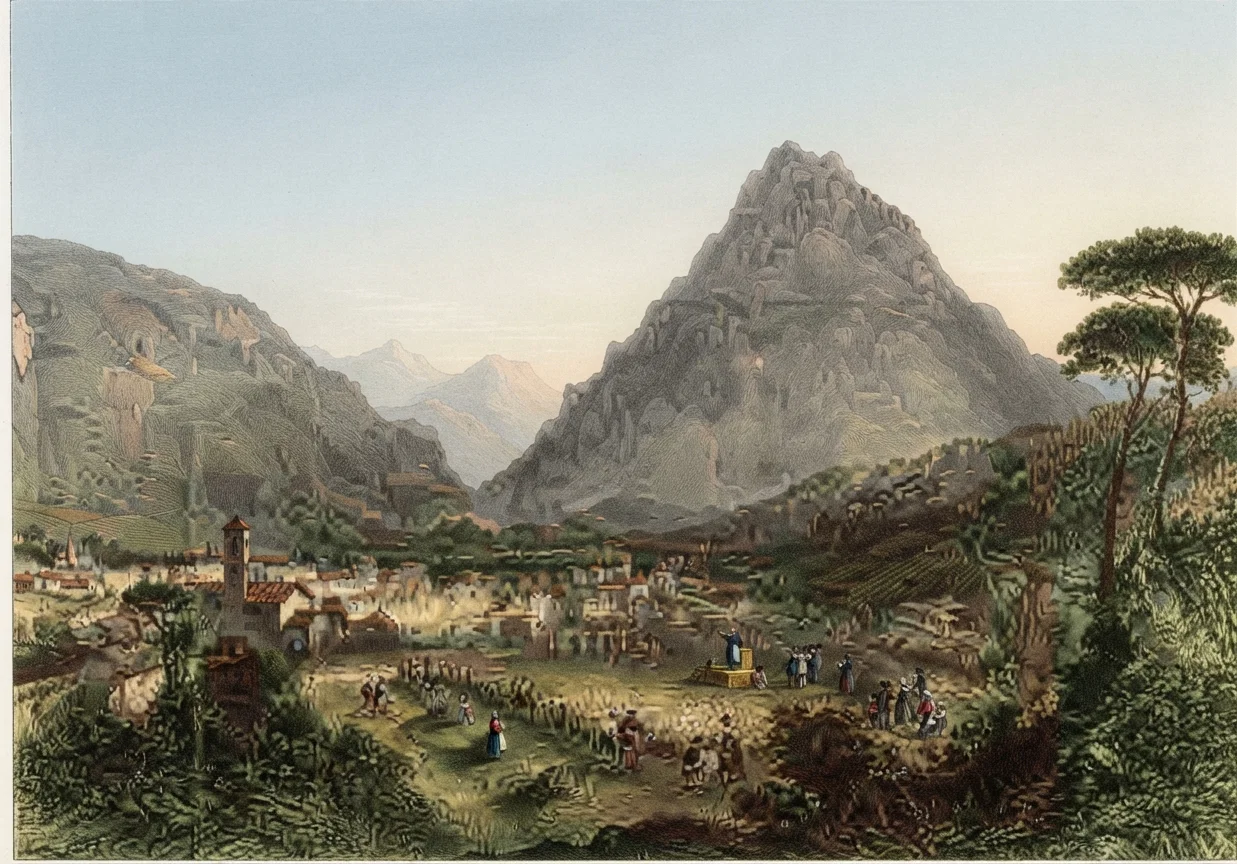
Although most kindly treated by the Swiss, and by several German princes who opened their states to these exiles, they longed for home. Three years later, eight hundred men secretly collected, scaled the mountains that separated them from their own valleys, and began the task of recovering them. Troops were rushed in, winter began, food was covered up with snow, they had to depend upon their enemies for ammunition. Yet they fought on. Finally the remnant, about four hundred, retreated to the Balsille, a terraced mountain which "shoots its gigantic pyramids heavenward, as if proudly conscious of having once been the resting-place of the Vaudois ark." Here the four hundred planned for their final758stand. They added to the natural strength of the citadel by earthen fortifications, into which they fastened trees with their tops downward. Some eighty storerooms were dug. They found that early snows had covered the ungathered corn of the valley, and they harvested and stored it. Thus they spent the winter.
When spring opened, their enemies, twenty-two thousand strong, returned with it, bringing four hundred ropes to hang the last of the hated race. They covered the entire valley and approaches, and began to lay siege. Time after time they were driven back with heavy losses. Finally they mounted cannon on a distant height, and for the first time these mountains, valleys, and peaks echoed with their thunder, while thousands of muskets added to the terror of these refugees. By night their fortifications were in ruins, and the lower portion had been taken. The valley and the mountainsides were lighted up by great camp-fires. Well they knew that no quarter would be given. Destruction seemed certain. The night alone postponed it. And then when all human help had vanished, the hand of God's deliverance was extended.
THE MIST BEGINS TO GATHER
"The mist began to gather on the summits of the mountains around them. They knew the old mantle that was wont to be cast around their fathers in the hour of peril. It crept lower and yet lower on the great mountains. Now it touched the supreme peak of the Balsiglia.
"Will it mock their hopes? Will it only touch, but not cover, their mountain camp? Again it is in motion. Downward roll its white, fleecy billows, and now it hangs in sheltering folds around the war-battered fortress and its handful of heroic defenders. They dared not as yet attempt escape, for still the watch-fires burned brightly in the valley. But it was only for a few minutes longer. The mist kept its downward course, and now all was dark. A Tartarean gloom filled the gorge of San Martino."—Wylie's "History of the Waldenses," page 199.
And then there stood forth a man—for it is by the sword of the Lord and of Gideon, the union of the human and the divine, that the Lord carries on His work—Poulat by name, and he bade them be of good courage, for he knew the paths, and would conduct them to safety.
"Having accurately examined, by the light of the fires, the position of each guard, Captain Poulat . . . offered to conduct them down a ravine full of frightful precipices. Sliding on their backs, and holding on by the bushes, they followed their conductor, who first felt with his hands and feet for spots which could be rested on with safety. They all followed his example, without shoes, alike for sake of silence and security of footing."—"The Glorious Recovery," page 180.
The next morning, the eyes of the invading host scanned the Balsille, but in vain did they look for their quarry. But looking higher, they spied them scaling the distant mountain peaks by cutting foot holes in the snow and ice. Pursuit was in vain. If the
Waldenses did not sing, they certainly appreciated the feelings of that other hunted man who did sing:
"Our soul is escaped as a bird out of the snare of the fowlers:
The snare is broken, and we are escaped."
Their crestfallen enemies returned to Pignerol with wagons filled with wounded, and four hundred unused ropes. Peace was soon declared, the lands of the Waldenses restored, their churches reopened, and their exiled brethren permitted to return.
This really closed their great persecutions, but they were subject to many petty ones until the year 1848. February 17, the following order was signed:
"1. The Vaudois are admitted to the enjoyment of all the civil and political rights of our other subjects, and freely to attend our schools, both within and without the university, and to obtain academic degrees
THE TOWN OF BOBI, NEAR WHICH THE RETURNING EXILES HELD THEIR FIRST DIVINE SERVICE
"2. No change, however, is made as to the exercise of their worship and their own schools.
"3. We repeal, by these presents, every law to the contrary, and command the senate and the chamber of accounts to register this decree, enjoining all and sundry to observe it and cause it to be observed, and willing that it be inserted in the collection of acts of the government."—"Israel of the Alps," volume 2, page 390.
This order was received with the utmost enthusiasm, not only by the Vaudois, but by their neighbors as well. Great bonfires were lighted, houses and public buildings were illuminated, processions were formed; and amidst general rejoicing, the men of the valley came into their own. At the time of the annual festival at Turin, the Vaudois delegation was placed at the very head of the procession by the managers, who said, "They have been so long last that it is right that to-day they should be first."
"IT IS ENOUGH"
And well did they deserve that recognition. For more than a thousand years, they had held the torch of truth aloft in their native valleys, and sent out their missionaries throughout Europe. The Reformers had found their light unextinguished in the sixteenth century, the sacred manuscripts still in their possession, their missionary zeal still alive. And even after this they battled on for almost two hundred years, enduring in the meantime some of the most terrible persecutions in their history. Finally God said, "It is enough," and made even their enemies to be at peace with them.
Dear reader, is not the example of this people—their adherence to the Sacred Scripture, and their rejection of tradition, their missionary activities, their system of education, and their patience in the hour of persecution—is not all this worthy of our study and emulation? And shall we not in this our day, when the Bible is spiritualized away by one class, evolutionized away by another, and criticized away by still another, remember that after all it is the only safe guide to the heavenly city? And let this recital of the struggle of the Waldenses impress our minds and hearts anew with the fact that while obedience to that Word may require cross bearing for a time, "the way of the cross leads home." And the promise is that after the cloudy and dark day, "at evening time it shall be light."
Peace and Quietness
By William Covert
THERE is a state of mind called peace, to be obtained from God alone. This peace is the fruitage of the Holy Spirit. Gal. 5:22. It is the peace of God passing all understanding (Phil. 4:7), keeping the heart and mind through Christ Jesus. This is the tranquil rest which the upholding power of God gives to the heaven-born soul.
God gives this peace to His children that they may be enabled to stand against the terrific assaults of the adversary. In explanation of its work, the prophet said to his Lord, "Thou wilt keep him in perfect peace, whose mind is stayed on Thee: because he trusteth in Thee." Isa. 26:3.
It is the chief aim of Satan to enshroud the children of God in gloom, and thereby encompass their destruction. This peace reaches the soul of man through the channel of faith, which appropriates the promises of God; and these promises, through the Spirit, do the work. When the channel is kept free from doubt, the inflow of the Holy Spirit fills the soul with a victory which carries the day for God.
The obtaining of this peace comes through the medium of resignation to the will of God, and then God works within to do as He wills. The working and the effect of this divine tranquillity is well told in the following language: "And the work of righteousness shall be peace; and the effect of righteousness quietness and assurance forever." Isa. 32:17.
This peace must be made and ratified in the heart of the man by an entire surrender of everything to the divine will. God must have possession of the entire citadel, and be permitted to plant all the banners of victory where the nails will hold fast.
We remember well how the soldiers rejoiced at the close of the war between the759North and South, when the articles of peace were signed and made sure. Wonderful was that peace to them. It was indeed unspeakable and full of glory with a significance that none but those who had an experience in it can know. O, what a load was lifted from their anxious hearts when they knew it was actually done! They shouted and they sang. They embraced one another, and said many complimentary things, to heighten the joy of that day.
But when one really enters into that peace, that wonderful peace, which God has provided from the sorrow of sin, should he not rest from worry, and be tranquil in the holiness of his joy? To have divine peace in the soul is what God desires for each and every one.
WILLIAM COVERT.
The Sure Mercies of David
By Francis Monroe Burg
Drawn by the Power of His Love—The Delights of the Converted Soul—The Rich Reward
By Francis Monroe Burg
“What shall I render unto the Lord for all His benefits unto me?”
THE converted soul, out of constraint, renders to God the very best service of which his being is capable. The constraint that becomes the mainspring of his devotion is born of love. “We love Him, because He first loved us.” Says the great New Testament apostle, “The love of Christ constraineth us.” This witness for God had an experience that inspired the following testimony concerning the love of God:
“I am persuaded, that neither death, nor life, nor angels, nor principalities, nor powers, nor things present, nor things to come, nor height, nor depth, nor any other creature, shall be able to separate us from the love of God, which is in Christ Jesus our Lord.” Rom. 8: 38, 39.
He so appreciated the “excellency of the knowledge of Christ Jesus” that everything of any mere temporal worth to him lost its value; and to him to live was Christ, and to die for Christ was gain.
This “chosen vessel” of the Lord was, because of this experience, preeminently prepared to make known to men Him who “was in Christ, reconciling the world unto Himself, not imputing their trespasses unto them.” 2 Cor. 5: 19. He became an ambassador in Christ’s stead, to beseech men to be reconciled to God. Verse 20.
THE MAINSPRING OF EXPERIENCE
Many others besides Paul have had an experience in the love of God, and have felt a strong constraint, as he did, to give their all to His service. Here is the mainspring of Christian experience. There is an obvious reason why so many professed Christians are walking far away from God, and in their lives so little of consecration and self-sacrificing devotion is seen. They have not had that deep experience in the forgiveness of sins, and in the “power of His resurrection, and the fellowship of His sufferings,” that will put them under everlasting constraint to devote everything to the service of their Redeemer.
Isaiah shows how men will forsake and leave their former ways when once God has been revealed to them. In chapter 30, verses 18, 19, the Lord said He was “waiting” to be gracious to His people; and that when He should hear their cry, He would be “very gracious” to them. They would then be in a position to hear and know His voice telling them the way to go. The Christian who is under constraint by the love of God, is continually inquiring to know His will. The “still, small voice” prompts him against every danger of deviating to the right hand or to the left. He walks in “ways of pleasantness,” and “all his paths are peace.” The things he once loved, and which were displeasing to God, are now detestable to him. As the prophet states it in verse 22, “Ye shall defile also the covering of thy graven images of silver, and the ornament of thy molten images of gold: thou shalt cast them away; . . . thou shalt say unto it, Get thee hence.” So it will be in a normal Christian experience—things that are offensive to God are hated and despised.
THE BLESSINGS THAT FOLLOW
When all idols are cast out of the heart and separated from the life, a fulness in the things of God will follow. This thought is expressed by the prophet in a most beautiful manner:
“Then shall He give the rain of thy seed, that thou shalt sow the ground withal; and bread of the increase of the earth, and it shall be fat and plenteous: in that day shall thy cattle feed in large pastures. The oxen likewise and the young asses that ear the ground shall eat clean provender, which hath been winnowed with the shovel and with the fan.” Verses 23, 24.
What beautiful figures are used here to suggest the fatness and the fulness of a life where the love of God has won the undivided affections, and where the avenues for receiving are unobstructed!
Isaiah further shows the privilege of the Christian to enjoy a completeness and fulness in his life:
“And there shall be upon every high mountain, and upon every high hill, rivers and streams of waters. . . . Moreover the light of the moon shall be as the light of the sun, and the light of the sun shall be sevenfold, as the light of seven days, in the day that the Lord bindeth up the breach of His people, and healeth the stroke of their wound.” Verses 25, 26.
While verse 26 applies literally to the new earth state, it has at the same time a beautiful meaning and application here. It is the privilege of the Christian to live in the full sunlight, instead of groping in the shadows of the lowlands. The light of his experience can be like that of the sun when it shall finally shine in its sevenfold fulness.
GET UP INTO THE HEIGHTS
“O Zion, that bringest good tidings, get thee up into the high mountain; . . . say unto the cities of Judah, Behold your God.” Isa. 40: 9. Shall we not get up higher, where the full light shines? From there we can see far “beyond time’s little day, to the fair morning of a better life.”
We may see just ahead the grandest pageant ever heard of, when He “who loved us, and gave Himself for us,” will be crowned King of kings in the presence of the assembled universe. Exalted high on His throne of burnished gold will be the blessed Son of God and Son of man. Beside Him will be seated those who have been the deepest in sin,—who have hated, reviled, and persecuted Him, or who have done the darkest deeds, all forgiven, and washed as white as snow in His precious blood. Won by His great love, they have confessed, in deep repentance, their terrible guilt, and in faith received His pardon. Now they are the foremost witness for Him who was called Jesus because He saved His people from their sins, because He was willing to forgive.
I have wondered if David, whom God chose to lead His people in telling the story of His love, and whose testimony has led many to “see, and fear, and to trust in the Lord,” will not lead in the coronation anthem around the great throne.
ASSEMBLED FOR THE CORONATION
As the people of all worlds assemble to witness this wonderful coronation scene, and when they hear the swell of the song which none can sing save them who have had an experience that enabled them to learn it, they will fall down and “confess that Jesus Christ is Lord, to the glory of God the Father.”
Who can ask for more as an incentive to give to Christ his very best, yea, his all, forever?
Will you, dear reader, not do this, and cherish the hope of living in the eternal years to praise Him as you can not until your vision is extended as it will be then?
Will you seek God as David did? Then you will find Him as he found Him; and you will join this great leader of God’s redeemed in praises that will fill the vast universe, and Jehovah’s praise will be made glorious.
A Thousand Lives for Christ
By Robert Moffat
O THAT I had a thousand lives, and a thousand bodies! All of them should be devoted to no other employment but to preach Christ to these degraded, despised, yet beloved mortals.—R. Moffat.
"Pray Through"
By G. B. Starr
IF clouds of darkness hang heavy and dense across your pathway, and the form and face of your Leader are obscured, pray through, pray through. It can be done. Though Satan, the prince of darkness, throw his dark shadow across your pathway, over your Christian experience, and cause the future to loom with failure and defeat, pray through.
Though your own weaknesses and past failures seem to spell defeat large, pray through. Pray until the darkness breaks and scatters. Pray until out of weakness you are made strong. Pray until the light of God shines into your heart, and hope and gladness take the place of despair and gloom. Pray through, until the heart is cleansed and the power of sin broken, until you know that its hold upon you is loosened. Pray until you feel it give way. Pray until you are on top, and the mists and sins and rubbish are beneath you. Pray until you can spell triumph and success large through Christ.
"Men ought always to pray," and pray through, "and not to faint." Keep praying until victory comes. "Ye let go of the arm of the Lord too soon." Pray through.
It is when fighting our hardest battles with self and Satan, with darkness and weakness, on our knees alone with God, in the closet or in the woods, that faith is in most lively exercise. Pray and believe. Grasp the largest promises, and hold them until they are yours in experience. "Sin shall not have dominion over you." You are to triumph. "All things are possible to him that believeth." Press your case. Pray through. Listen to no suggestions of defeat and failure. Resist the darkness. Hold fast your confidence, and it will increase. There is victory for every soul who is determined to have it. Stay alone with Christ and angels and the Spirit of God until the joy of heaven and the strength of God are imparted to you, through the righteousness of Christ. Pray through.
You are defeated when you decide not to pray through, when you listen to the suggestion that "it is no use." It is use. It is victory and success. It is peace and power, and triumph and blessed rest in active warfare. It means deliverance from all your enemies, within and without. God lives, and hears and answers prayer. Prove it. Pray through, until your hand is in His; until your weakness is united to His might, your foolishness to His wisdom; until all heaven is on your side, and they that are for you are more than they that are against you. Pray until every particle of doubt of God's goodness and love, every suggestion of infidelity, is banished from your soul, and confidence, assurance, and love take their place, and you are sweetly comforted of God, and assured of His full and free pardon of all past sins and failures, and that He puts them away from before Himself and you, to remember them no more forever. And believe that it gives Him the joy of the most loving of fathers to press you to His heart of love, and whisper in your ear the sweetest of assurances that you are His child, a child of faith, a prince of His household, and that you and He together are more than a match for the combined powers of earth and hell, and that you are to triumph gloriously, to the honor and glory of God, your Deliverer.
Pray through, clear through. Never surrender. The battle is yours, and eternity the reward.
G. B. STARR.
Beauty of Holiness
By H. A. St. John
"Give unto the Lord the glory due unto His name; worship the Lord in the beauty of holiness." Ps. 29: 2.
TO worship means to reverence, love, and obey. Mankind are naturally constituted worshipers. All worship something. Many worship their appetites, or passions, or conceits, while many more worship the work of their own hands, or the work of others like themselves. Again, there are many that worship earthly treasures, or pleasures, or fame, or education, or business. And not a few bow down and worship some creature rather than the Creator. All worship that does not center in the living God, the Creator and Preserver of all, is idolatry.
Reader, whom or what do you worship? Examine yourself and see. You may know without question. Do you reverence, love, and obey the living God? If so, then you worship Him. Angels must not be worshiped. Only fallen angels will accept worship. Satan wanted Christ to fall down and worship him. Matt. 4:9. John fell down at the feet of a good angel to worship him, but the angel said, "See thou do it not; . . . worship God." Rev. 22:9.
How shall we render acceptable worship to God? The Lord does not say, Worship Me in outward surroundings of splendor and gorgeousness. If He had, many could not render acceptable worship. He does not say, Worship Me in scholarly attainments, or personal beauty, or costly attire, or worldly honor; for then very many could not worship God at all. But He does say, Worship Me "in the beauty of holiness."
What kind of beauty is this? and is it attainable by all without respect of persons? Jesus explains it by saying that they that worship God "must worship Him in spirit and in truth." John 4: 24. This, then, is holiness. To worship God in spirit is to have the soul full of His love, the mainspring of all acceptable service to God. Without this spiritual mind, there is no true worship. But this is not all. We are required to worship God in truth. His holy word is the truth, and His Spirit guides into a knowledge of truth, that our worship may be intelligent and according to His will. Paul said his brethren "obeyed from the heart that form of doctrine." Rom. 6: 17. This expresses it exactly,—the heart work and the form of doctrine, the spirit and the truth. John says, "This is the love of God, that we keep His commandments: and His commandments are not grievous." 1 John 5: 3. True love and true obedience go hand in hand. These constitute true worship, not in the meeting-house, or at the family altar, or in the secret prayer chamber alone, but everywhere, every day, all the time.
It is holiness. It is the beauty of holiness, and attainable by the weakest and the poorest. There is nothing so beautiful in all the world, nothing so valuable, nothing so beautiful in the sight of God, Christ, or angels, as holiness. Reader, you may possess it internally, and externally, and eternally. It will be the heritage of the redeemed saints in glory. O, worship the Lord in spirit and in truth, or in the beauty of holiness!
H. A. St. John.
The Chain of Life
By Adelaide Anne Proctor
HOURS are golden links, God's token
Reaching heaven; but one by one
Take them, lest the chain be broken
Ere the pilgrimage be done.
—A. A. Proctor.
Studies in the Word "Let"
By John Norton Loughborough
WHILE the Lord declares, in His word, what we should let, He has as plainly commanded what we should not let. In the words of Solomon we read, "Let not mercy and truth forsake thee: bind them about thy neck; write them upon the table of thine heart: so shalt thou find favor and good understanding in the sight of God and man." Prov. 3:3. To do this would be a great aid in following other injunctions, as: "Let not sin therefore reign in your mortal body, that ye should obey it in the lusts thereof. Neither yield ye your members as instruments of unrighteousness unto sin: but yield yourselves unto God, as those that are alive from the dead, and your members as instruments of righteousness unto God." Rom. 6:12, 13. "Let no corrupt communication proceed out of your mouth, but that which is good to the use of edifying, that it may minister grace unto the hearers." Eph. 4:29. "Let no man deceive you with vain words." Eph. 5:6. "Let nothing be done through strife or vainglory; but in lowliness of mind let each esteem other better than themselves." Phil. 2:3. "Let no man beguile you of your reward in a voluntary humility." Col. 2:18. "Let no man deceive you by any means." 2 Thess. 2:3. "Let no man say when he is tempted, I am tempted of God: for God can not be tempted with evil, neither tempteth He any man." James 1:13.